warning Seat Ibiza ST 2009 Owner's manual
[x] Cancel search | Manufacturer: SEAT, Model Year: 2009, Model line: Ibiza ST, Model: Seat Ibiza ST 2009Pages: 250, PDF Size: 6.4 MB
Page 198 of 250
Checking and refilling levels197
Safety First
Operating instructions
Practical tips
Technical Data
WARNING
There is a serious danger of accidents if a tyre bursts during driving!•The tyres must be replaced at the latest when the tread is worn down to
the tread wear indicators. Failure to do so could result in an accident. Worn
tyres do not grip well at high speeds on wet roads. There is also a greater
risk of “aquaplaning” •At continuously high speeds, a tyre with insufficient pressure flexes
more. This causes it to overheat. This can cause tread separation and tyre
blow-out. Risk of accident. Always observe the recommended tyre pres-
sures.•If tyres show excessive wear, you should have the running gear checked
by an Authorised Service Centre.•Keep chemicals such as oil, fuel and brake fluid away from tyres.•Damaged wheels and tyres must be replaced immediately!For the sake of the environment
Under-inflated tyres will increase fuel consumption.New tyres and wheels
New tyres and wheels have to be run-in.The tyres and wheel rims are an essential part of the vehicle's design. The
tyres and rims approved by SEAT are specially matched to the characteristics
of the vehicle and make a major contribution to good road holding and safe
handling ⇒.
Tyres should be replaced at least in pairs and not individually (i.e. both front
tyres or both rear tyres together). A knowledge of tyre designations makes it easier to choose the correct tyres. Radial tyres have the tyre designations
marked on the sidewall, for example:
195/65 R15 91T
This contains the following information:
195 Tyre width in mm
65 Height/width ratio in %
RTyre construction: Radial
15 Rim diameter in inches
91 Load rating code
TSpeed rating
The tyres could also have the following information:
•A direction of rotation symbol•“Reinforced” denotes heavy-duty tyres.
The manufacturing date is also indicated on the tyre sidewall (possibly only
on the inner side of the wheel).
“DOT ... 1103 ...” means, for example, that the tyre was produced in the 11th
week of 2003.
We recommend that work on tyres and wheels is carried out by an Authorised
Service Centre. They are familiar with the procedure and have the necessary
special tools and spare parts as well as the proper facilities for disposing of
the old tyres.
Any Authorised Service Centre has full information on the technical require-
ments when installing or changing tyres, wheels or wheel trims.WARNING
•We recommend that you use only wheels and tyres which have been
approved by SEAT for your model. Failure to do so could impair vehicle
handling. Risk of accident.
Ibiza ST_EN.book Seite 197 Dienstag, 12. Januar 2010 4:03 16
Page 199 of 250
Checking and refilling levels
198•Avoid running the vehicle on tyres that are more than six years old. If
you have no alternative, you should drive slowly and with extra care at all
times.•Never use old tyres or those with an unknown “history of use”.•If wheel trims are retrofitted, you must ensure that the flow of air to the
brakes is not restricted. This could cause them to overheat.•All four wheels must be fitted with radial tyres of the same type, size
(rolling circumference) and the same tread pattern.For the sake of the environment
Old tyres must be disposed of according to the laws in the country concerned.
Note
•For technical reasons, it is not generally possible to use the wheels from
other vehicles. This can also apply to wheels of the same model. The use of
wheels or tyres which have not been approved by SEAT for use with your
model may invalidate the vehicle's type approval for use on public roads.•If the spare tyre is not the same as the tyres that are mounted on the
vehicle - for example with winter tyres - you should only use the spare tyre for
a short period of time and drive with extra care. Refit the normal road wheel
as soon as possible.Wheel bolts
Wheel bolts must be tightened to the correct torque.The design of wheel bolts is matched to the rims. If different wheel rims are
fitted, the correct wheel bolts with the right length and correctly shaped bolt heads must be used. This ensures that wheels are fitted securely and that the
brake system functions correctly.
In certain circumstances, you may not use wheel bolts from a different car -
even if it is the same model
⇒page 172.
WARNING
If the wheel bolts are not tightened correctly, the wheel could become
loose while driving. Risk of accident.•The wheel bolts must be clean and turn easily. Never apply grease or oil
to them.•Use only wheel bolts which belong to the wheel.•If the prescribed torque of the wheel bolts is too low, they could loosen
whilst the vehicle is in motion. Risk of accident! If the tightening torque is
too high, the wheel bolts and threads can be damaged.Caution
The prescribed tightening torque for wheel bolts for steel and alloy wheels is
120 Nm.Winter tyres
Winter tyres will improve the vehicles handling on snow and
ice.In winter conditions winter tyres will considerably improve the vehicles
handling. The design of summer tyres (width, rubber compound, tread
pattern) gives less grip on ice and snow.
Winter tyres must be inflated to a pressure 0.2 bar higher than the pressures
specified for summer tyres (see sticker on tank flap).
WARNING (continued)
Ibiza ST_EN.book Seite 198 Dienstag, 12. Januar 2010 4:03 16
Page 200 of 250
Checking and refilling levels199
Safety First
Operating instructions
Practical tips
Technical Data
Winter tyres must be fitted on all four wheels.
Information on permitted
winter tyre sizes can be found in the vehicle's regis-
tration documents. Use only radial winter tyres. All tyre sizes listed in the
vehicle documentation also apply to winter tyres.
Winter tyres lose their effectiveness when the tread is worn down to a depth
of 4 mm.
The speed rating code ⇒page 197, “New tyres and wheels” determines the
following speed limits for winter tyres: ⇒
In some countries, vehicles which can exceed the speed rating of the fitted
tyre must have an appropriate sticker in the driver's field of view. These
stickers are available from your Authorised Service Centre. The legal require-
ments of each country must be followed.
Do not have winter tyres fitted for unnecessarily long periods. Vehicles with
summer tyres handle better when the roads are free of snow and ice.
If you have a flat tyre, please refer to the notes on the spare wheel
⇒ page 197, “New tyres and wheels”.
WARNING
The maximum speed for the winter tyres must not be exceeded. Otherwise,
this could lead to tyre damage and thus, an accident risk.
For the sake of the environment
Fit your summer tyres in good time. They are quieter, do not wear so quickly
and reduce fuel consumption.Snow chainsSnow chains may be fitted only to the front wheels, and only for the following
tyres:
Remove wheel hub covers and trim rings before fitting snow chains. For safety
reasons cover caps, available in any Authorised Service Centre, must then be
fitted over the wheel bolts.
WARNING
Snow chains should be correctly tightened in accordance with the manu-
facturer's instructions. This will prevent the chains coming into contact
with the wheel housing.
Caution
You must remove the snow chains to drive on roads which are free of snow.
Otherwise they will impair handling, damage the tyres and wear out very
quickly.
Q
max. 160 km/h
S
max. 180 km/h
T
max. 190 km/h
H
max. 210 km/h
175/70R14
185/60R15
Chains with links not exceeding 15 mm (including the
chain closure)
215/45R16
Chains with links not exceeding 9 mm (including the
chain closure)
215/40R17
Chains with links not exceeding 7mm (including the
chain closure)
Ibiza ST_EN.book Seite 199 Dienstag, 12. Januar 2010 4:03 16
Page 202 of 250
If and when201
Safety First
Operating instructions
Practical tips
Technical Data
If and whenVehicle tools, spare wheelVehicle Tools
The vehicle onboard tools are lo cated under the floor panel in
the luggage compartment.– Lift floor panel
– Take the onboard tools out of the vehicle.The tool kit includes:•Jack*•Hook to remove integral* trim and screw caps.•Box spanner for wheel bolts*•Reversible screwdriver with handle (including hexagonal interior) for the
wheel bolts. The screwdriver is a combination tool.•Towing ring*•Adapter for the anti-theft wheel bolts*
Some of the items listed are only provided in certain models / model years,
or are optional extras.WARNING
•Do not use the hexagonal socket in the screwdriver handle to tighten
the wheel bolts as with this it is not possible to tighten the bolts to the
required torque. Risk of accident.
•The jack supplied by the factory is only designed for changing wheels
on this model. On no account attempt to use it for lifting heavier vehicles
or other loads. Risk of injury.•Use the jack only on a firm, level ground.•Never start the engine when the vehicle is on the jack. Risk of accident.•I f w o r k is t o b e ca r r ie d o u t un d e r n ea t h t h e v e h ic l e , t h is m u s t be s e cu re d
by suitable means. Otherwise, there is a risk of injury.
Spare wheel (emergency wheel)*
The spare wheel (emergency wheel) must only be used for the
minimum necessary time.The temporary spare wheel is stored under the floor panel in the luggage
compartment and is attached by a thumbnut.
How to use the temporary spare wheel
If you ever have a punctured tyre or loss of pressure, the emergency wheel is
only intended for temporary use until you reach a workshop. Change it for a
duty wheel as soon as possible.
Please note the following restrictions when using the temporary spare wheel.
This spare wheel has been specially designed for your vehicle, thus, it cannot
be changed with the spare wheel from another vehicle.
No other type of tyre (normal summer or winter tyre) may be fitted on the
compact temporary spare wheel rim.
WARNING (continued)
Ibiza ST_EN.book Seite 201 Dienstag, 12. Januar 2010 4:03 16
Page 203 of 250
If and when
202Snow chains
For technical reasons, snow chains must not be used on the compact tempo-
rary spare wheel.
If you have a puncture on one of the front wheels when using snow chains, fit
the compact temporary spare in place of one of the rear wheels. You can then
attach the snow chains to the wheel taken from the rear and use this wheel to
replace the punctured front wheel.
WARNING
•The tyre pressures must be checked and corrected as soon as possible.•Do not drive faster than 80 km/h. Higher speeds can cause an accident.•Avoid heavy acceleration, hard braking and fast cornering. Risk of acci-
dent.•Never use two or more compact spare tyres at the same time, risk of
accident.•No other type of tyre (normal summer or winter tyre) may be fitted on
the compact temporary spare wheel rim.
Tyre repair kit*
The tyre repair kit (for vehicles not including a spare wheel) is
stored under the floor panel in the luggage compartment.Your vehicle is equipped with the Tyre Mobility System “Tyre repair kit”.
The tyre repair kit consists of a container with sealing compound to repair the
puncture and a compressor to generate the required tyre pressure. The kit will
reliably seal punctures up to a size of about 4 mm caused by the penetration
of a foreign body into the tyre.
Note
•Seek professional assistance if the repair of a tyre puncture is not
possible with the sealing compound.Wheel changePreparation work
What you must do before changing a wheel.– If you have a flat tyre or puncture, park the vehicle as far away from the flow of traffic as possible. Choose a location that is as
level as possible.
– All passengers should leave the vehicle. They should wait in a safe area (for instance behind the roadside crash barrier).
– Switch the engine off. Switch the hazard warning lights on and place the warning triangles in position.
–Apply the handbrake firmly.
– Engage the first gear, or put the gear lever to position P for those
vehicles with an automatic gearbox.
– If you are towing a trailer, unhitch it from your vehicle.
–Take the vehicle tools and the spare wheel out of the luggage
compartment.
Ibiza ST_EN.book Seite 202 Dienstag, 12. Januar 2010 4:03 16
Page 204 of 250
If and when203
Safety First
Operating instructions
Practical tips
Technical Data
WARNING
Switch on the hazard warning lights and place the warning triangles in
position. This is for your own safety and also warns other road users.
Caution
If you have to change the wheel on a slope, it is essential to lock the parallel
w h e e l o n t h e s a m e a x l e a s t h a t t o b e ch a n g e d , w i t h a w e d g e o r s i m i l a r i n o r d e r
to immobilise the vehicle.
Note
Please observe legal requirements when doing so.Changing a wheelChange the wheel as described below
– Remove the hub caps or the integral trim .
– Slacken the wheel bolts .
– Raise the car with the jack in the corresponding zone.
– Remove the wheel and then fit the spare wheel.
– Lower the vehicle.
– Tighten the wheel bolts firmly with the box spanner.
– Replace the hub cap.
After changing a wheel
After changing the wheel there are still tasks to complete.– Put the tools and jack back in the luggage compartment.
– Place the wheel with the defective tyre in the luggage compart-
ment and secure it.
– Check the tyre pressure of the newly fitted tyre as soon as possible.
– Have the tightening torque of th e wheel bolts checked as soon as
possible with a torque wrench. Th e prescribed torque must be
120 Nm.
Note•If you notice that the wheel bolts are corroded and difficult to turn when
changing a wheel, they must be replaced before having the wheel bolt torque
checked.•For your safety, drive at moderate speeds until the wheel bolt tightening
torque has been checked.
Ibiza ST_EN.book Seite 203 Dienstag, 12. Januar 2010 4:03 16
Page 206 of 250
If and when205
Safety First
Operating instructions
Practical tips
Technical Data
WARNING
Loosen the wheel bolts only about one turn before raising the vehicle with
the jack, loosening the wheel bolts more than one turn can result in an acci-
dent.
Note
•Do not use the hexagonal socket in the screwdriver handle to loosen or
tighten the wheel bolts.•If the wheel bolt is very tight, you may be able to loosen it by pushing
down the end of the spanner carefully with your foot. Hold on to the vehicle
for support and take care not to slip.Raising the vehicle
In order to remove the wheel, the vehicle must be raised with
a jack.
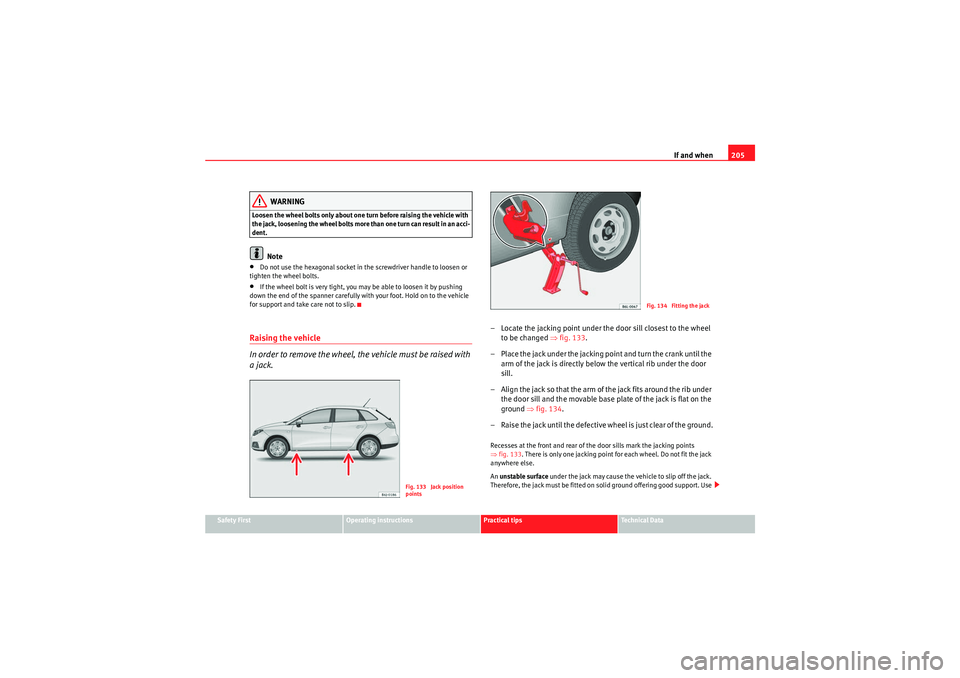
– Locate the jacking point under the door sill closest to the wheel to be changed ⇒fig. 133 .
– Place the jack under the jacking point and turn the crank until the arm of the jack is directly below the vertical rib under the door
sill.
– Align the jack so that the arm of the jack fits around the rib under the door sill and the movable base plate of the jack is flat on the
ground ⇒fig. 134 .
– Raise the jack until the defective wheel is just clear of the ground.Recesses at the front and rear of the door sills mark the jacking points
⇒ fig. 133 . There is only one jacking point for each wheel. Do not fit the jack
anywhere else.
An unstable surface under the jack may cause the vehicle to slip off the jack.
Therefore, the jack must be fitted on solid ground offering good support. Use
Fig. 133 Jack position
points
Fig. 134 Fitting the jack
Ibiza ST_EN.book Seite 205 Dienstag, 12. Januar 2010 4:03 16
Page 207 of 250
If and when
206a large and stable base, if necessary. On a hard, slippery surface (such as
tiles) use a rubber mat or similar to prevent the jack from slipping.
WARNING
•Take all precautions so that the base of the jack does not slip. Failure to
do so could result in an accident.•The vehicle can be damaged if the jack is not applied at the correct
jacking points. There is also a risk of injury since the jack can slip off
suddenly if it is not properly engaged.
Removing and fitting the wheel
For removal and fitting the wheel, the following tasks must be
completed.After loosening the wheel bolts and raising the vehicle with the jack,
change the wheel as described below: Removing a wheel
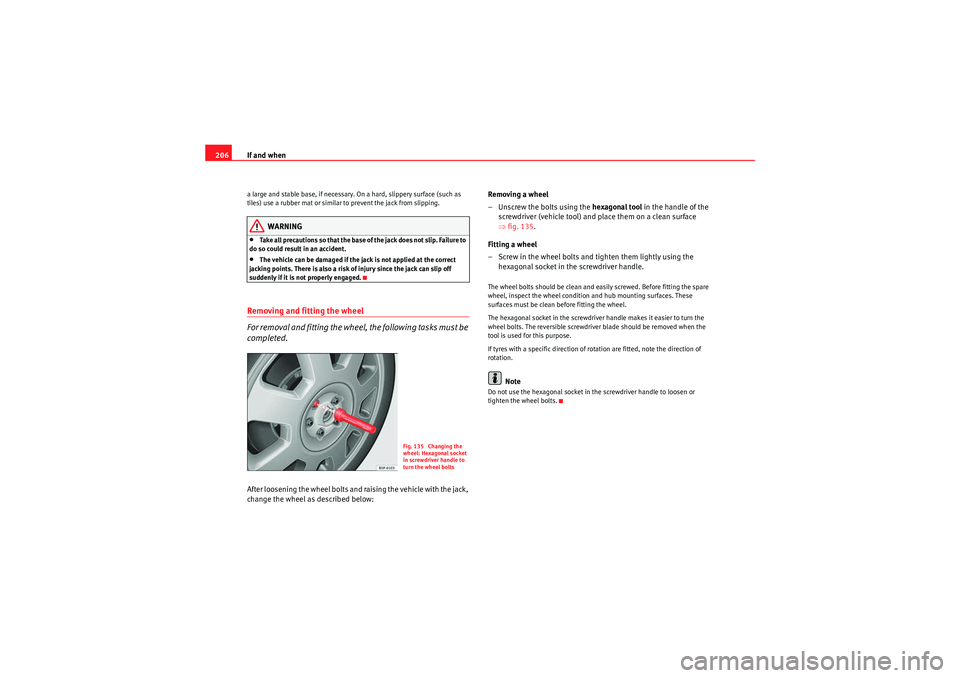
– Unscrew the bolts using the
hexagonal tool in the handle of the
screwdriver (vehicle tool) and place them on a clean surface
⇒ fig. 135 .
Fitting a wheel
– Screw in the wheel bolts and tighten them lightly using the hexagonal socket in the screwdriver handle.
The wheel bolts should be clean and easily screwed. Before fitting the spare
wheel, inspect the wheel condition and hub mounting surfaces. These
surfaces must be clean before fitting the wheel.
The hexagonal socket in the screwdriver handle makes it easier to turn the
wheel bolts. The reversible screwdriver blade should be removed when the
tool is used for this purpose.
If tyres with a specific direction of rotation are fitted, note the direction of
rotation.
Note
Do not use the hexagonal socket in the screwdriver handle to loosen or
tighten the wheel bolts.
Fig. 135 Changing the
wheel: Hexagonal socket
in screwdriver handle to
turn the wheel bolts
Ibiza ST_EN.book Seite 206 Dienstag, 12. Januar 2010 4:03 16
Page 209 of 250
If and when
208It also contains the instructions for using the compressor.
WARNING
•Do not attempt to repair a puncture with the sealing compound if the
tyre has been damaged by driving the car after the tyre has lost its air.•Always observe warnings and follow safety instructions concerning
compressor and sealing compound carefully.•Do not drive faster than 80 km/h, avoid heavy acceleration, hard
braking and fast cornering.•Tyres which have been repaired with sealing compound are only suit-
able for temporary use over a short period. Therefore, please drive carefully
to the next available qualified workshop.For the sake of the environment
•Used sealing compound containers should be disposed of at a proper
facility.•The bottle containing sealing compound must be recycled in its correct
container.Note
•If sealant should leak out, leave it to dry. When it has dried, you can pull
it off like a piece of foil.•Observe the expiry date stated on the sealing compound can. Have the
sealing compound exchanged by a qualified workshop.•Seek professional assistance if the repair of a tyre puncture is not
possible with the sealing compound.
What to do first
Certain steps must be taken before repairing a tyre.– If you have a flat tyre or puncture, park the vehicle as far away from the flow of traffic as possible.
–Apply the handbrake firmly.
–Engage first gear, or put the selector lever to position P.
– All passengers should leave the vehicle. They should wait in a
safe area (for instance behind the roadside crash barrier).
– Check whether a repair is possible using the Tyre Mobility System “General information and safety notes.”
– Unscrew inflation cap from the affected wheel.
–Take the tyre repair kit out of the luggage compartment.
WARNING
Switch on the hazard warning lights and place the warning triangles in
position. This is for your own safety and also warns other road users.
Caution
Take special care if you have to repair a tyre on a slope.
Note
•Please observe legal requirements when doing so.•Remember to replace the sealing compound as soon as possible.
Ibiza ST_EN.book Seite 208 Dienstag, 12. Januar 2010 4:03 16
Page 211 of 250
If and when
210The individual electrical circuits are protected by fuses. The fuses are located
behind a cover at the left-hand end of the dash panel. When the steering
wheel is on the right, the fuses are on the right-hand side of the dash panel,
behind a cover.
The electric windows are protected by circuit breakers . These reset automat-
ically after a few seconds when the overload (caused for example by frozen
windows) has been corrected.
Fuses colour code
WARNING
Never “repair” damaged fuses and never replace them with fuses with a
higher rating. Failure to comply could result in fire. This could also cause
damage to other parts of the electrical system.
Note
•If a newly replaced fuse blows again after a short time, the electrical
system must be checked by a qualified workshop as soon as possible.•If you replace a fuse with higher-rating fuse, you could cause damage to
another location in the electrical system.
•Always keep some spare fuses in the vehicle. These are available from
SEAT dealers.Fuses on left side of dash panelFuses
Colour
Amps
Beige
5
Brown
7,5
Red
10
Blue
15
Ye ll ow
20
Natural (white)
25
Green
30
Number
Consumer
Amps
1
Power steering/Engine operation
7,5
2
Diagnostics/Heater/Autoclimate/Cli-
matronic/Electric anti-dazzle mirror/Naviga-
tor/Air conditioning pressure switch/ Climate
fan/ Kisi/ AFS Control unit/Coming home
relay/Soundaktor
10
3
Petrol engine control unit/Flow meter/Diesel
engine control unit/Relay coils/Engine opera-
tion/Bi-turbo fuel control unit
5
4
ABS/ESP switch (turning sensor)/Light lever
10
5
Reverse light/Heating nozzles
10
6
Instrument panel
5
7
Rear fog light
5
8
Vaca n t
9
Headlight lever
10
10
Headlight lever/Clutch (Petrol)/Brakes (all)
5
11
Airbag control unit
5
12
Automatic gearbox/ Headlight lever
10
13
Exterior mirror control
5
Ibiza ST_EN.book Seite 210 Dienstag, 12. Januar 2010 4:03 16