fuel Seat Ibiza ST 2009 User Guide
[x] Cancel search | Manufacturer: SEAT, Model Year: 2009, Model line: Ibiza ST, Model: Seat Ibiza ST 2009Pages: 250, PDF Size: 6.4 MB
Page 116 of 250
Seats and storage compartments115
Safety First
Operating instructions
Practical tips
Technical Data
•Ensure that the fire extinguisher is fully functional. The fire extinguisher
should, therefore, be checked regularly. The sticker on the fire extinguisher
will inform you of the next date for checking.•Before acquiring accessories and emergency equipment see the instruc-
tions in “Accessories and spares” ⇒page 172.Luggage compartmentLoading the luggage compartment
Loads in the luggage compartment should be safely secured.To maintain safe handling on the road, please observe the following
points:
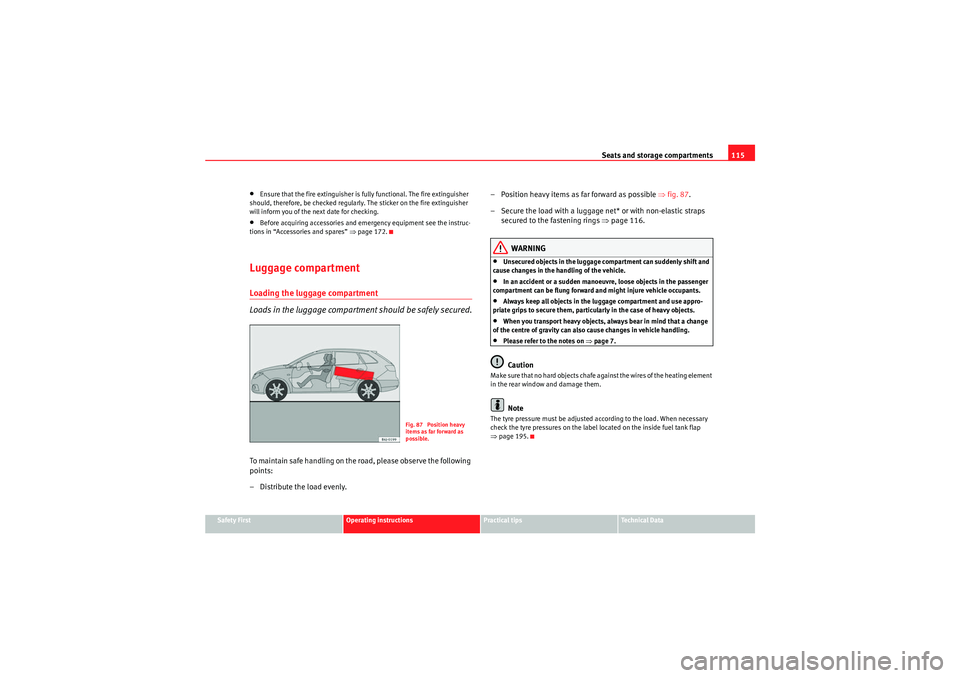
– Distribute the load evenly. – Position heavy items as far forward as possible
⇒fig. 87 .
– Secure the load with a luggage net* or with non-elastic straps secured to the fastening rings ⇒page 116.
WARNING
•Unsecured objects in the luggage compartment can suddenly shift and
cause changes in the handling of the vehicle.•In an accident or a sudden manoeuvre, loose objects in the passenger
compartment can be flung forward and might injure vehicle occupants.•Always keep all objects in the luggage compartment and use appro-
priate grips to secure them, particularly in the case of heavy objects.•When you transport heavy objects, always bear in mind that a change
of the centre of gravity can also cause changes in vehicle handling.•Please refer to the notes on ⇒page 7.Caution
Make sure that no hard objects chafe against the wires of the heating element
in the rear window and damage them.
Note
The tyre pressure must be adjusted according to the load. When necessary
check the tyre pressures on the label located on the inside fuel tank flap
⇒page 195.
Fig. 87 Position heavy
items as far forward as
possible.
Ibiza ST_EN.book Seite 115 Dienstag, 12. Januar 2010 4:03 16
Page 127 of 250
Air conditioning
126•If the function is not deactivated by pressing the button, this will deacti-
vate after approx. 20 min.Economic use of the air conditioningWhen the air conditioning is switched on, the compressor consumes engine
power and has influence on fuel consumption. Consider the following points
in order to have the system operating in the minimum possible time.•If the vehicle interior has overheated due to an excessive solar radiation,
it is best to open the windows or doors to allow the hot air to escape.•While in motion, the air conditioning should not be switched on if the
windows or the sunroof are open.*
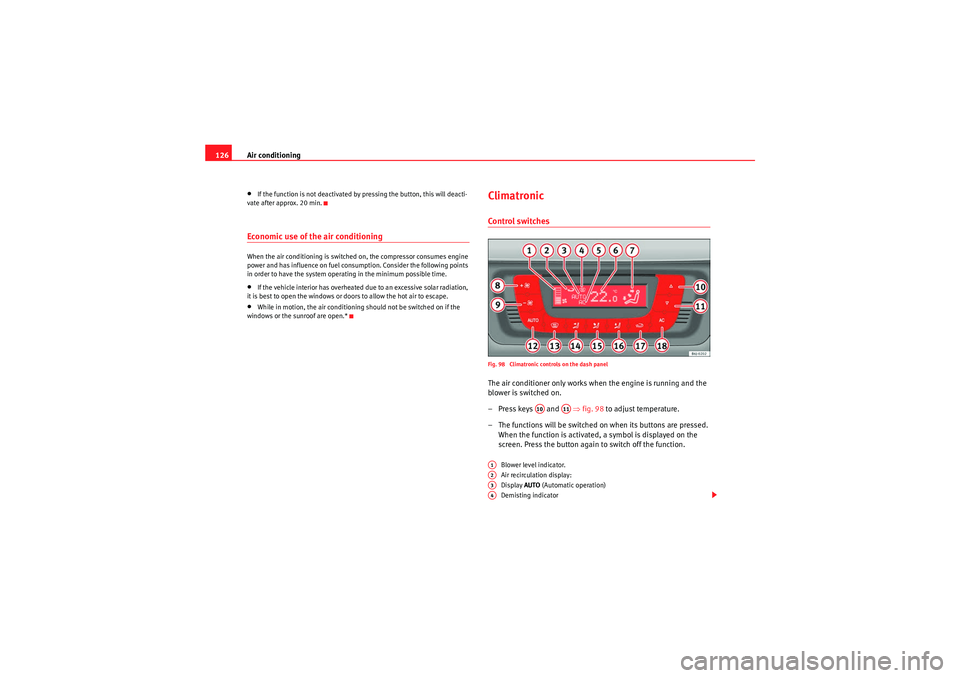
ClimatronicControl switchesFig. 98 Climatronic controls on the dash panelThe air conditioner only works when the engine is running and the
blower is switched on.
–Press keys and ⇒ fig. 98 to adjust temperature.
– The functions will be switched on when its buttons are pressed. When the function is activated, a symbol is displayed on the
screen. Press the button again to switch off the function.
Blower level indicator.
Air recirculation display:
Display AUTO (Automatic operation)
Demisting indicator
A10
A11
A1A2A3A4
Ibiza ST_EN.book Seite 126 Dienstag, 12. Januar 2010 4:03 16
Page 129 of 250
Air conditioning
128Manual mode
In manual mode the air temperature, flow, and the desired air
distribution can be adjusted.Switching on manual mode
– Press one of the buttons ⇒ page 126, fig. 98 to or press
t he blo wer co n t rol a nd do wn . The in dicator is switche d o f f .Te m p e r a t u r e
The inside temperature can be set between +18°C (64°F) and +29°C (86°F).
These are approximate temperatures which may slightly vary depending on
the outside conditions.
If a temperature below 18°C (64°C), is selected, the display switches to LO In
this setting the system runs at maximum cooling output and the temperature
is not regulated.
If a temperature above 29°C (86°F) is selected, the display switches to HI In
this setting the system runs at maximum heating output and the temperature
is not controlled.
Blower
The blower can be adjusted with buttons and ⇒page 126, fig. 98 . If
the blower is off (level is not shown on the screen) and button is kept
pressed down, the Climatronic switches off. Then OFF is displayed on the
screen.
Air distribution
The air distribution is adjusted using the buttons , and . It is also
possible to open and close some of the air outlets separately. Switching the air conditioning system on and off
Pressing the button the air cooling system can be switched off in order to
save fuel. The temperature continues to self-regulate. The set temperature
can then only be reached if it is higher than the outside temperature.
Air recirculation mode
Air recirculation mode prevents fumes or unpleasant smells
from coming from the outside.– Press the button to switch air recirculation mode on or off.
This is ON if the symbol
⇒ page 126, fig. 98 is displayed on
the screen.
Air recirculation mode prevents strong odours in the ambient air from
entering the vehicle interior, for example when passing through a tunnel or in
a traffic jam.
When the outside temperature is low, air recirculation mode improves
heating performance by heating air from the interior instead of cold air from
the outside.
When the outside temperature is high, air recirculation mode improves
cooling performance by cooling air from the interior instead of warm air from
outside.
For safety reasons, the air recirculation should not be switched on when the
air distribution control is set to the windscreen setting
.
A14
A16
A8
A9
A3
A8
A9
A1
A9
AC
Ibiza ST_EN.book Seite 128 Dienstag, 12. Januar 2010 4:03 16
Page 134 of 250
Driving133
Safety First
Operating instructions
Practical tips
Technical Data
The immobiliser will be activated again automatically as soon as you pull the
key out of the ignition lock.
The engine can only be started using a genuine SEAT key with its correct code.
Note
A perfect operation of the vehicle is ensured if genuine SEAT keys are used.Starting and stopping the engineStarting petrol engines
The engine can only be started using a genuine SEAT key with
its correct code.– Move the gear lever to the neutral position and depress the
clutch pedal thoroughly and hold it in this position for the starter
to turn the engine on.
– Turn the ignition key to the starting ⇒page 132 position.
– Le t go o f the ig nit io n key as so on as the e ngin e star t s; t he sta r ter motor must not run on with the engine.After starting a very hot engine, you may need to slightly press down the
accelerator.
When starting a very cold engine, it may be a little noisy for the first few
seconds until oil pressure has built up in the hydraulic valve compensators.
This is quite normal, and no cause for concern. If the engine does not start immediately, switch the starter off after
10 seconds and try again after half a minute. If the engine still does not start,
the fuel pump fuse should be checked
⇒page 209, “Fuses”.
WARNING
•Never start or run the engine in unventilated or closed rooms. The
exhaust fumes contain carbon monoxide, an odourless and colourless
poisonous gas. Risk of fatal accidents. Carbon monoxide can cause loss of
consciousness. It can also cause death.•Never leave the vehicle unattended if the engine is running.•Never use “cold start sprays”, they could explode or cause the engine
to run at high revs. Risk of injury.Caution
•When the engine is cold, you should avoid high engine speeds, driving at
full throttle and over-loading the engine. Risk of engine damage.•The vehicle should not be pushed or towed more than 50 metres to start
the engine. Unburnt fuel could enter the catalytic converter and damage it.•Before attempting to push-start or tow a vehicle in order to start it, you
should first try to start it using the battery of another vehicle. Note and follow
the instructions in ⇒page 222, “Jump-starting”.For the sake of the environment
Do not warm-up the engine by running the engine with the vehicle stationary.
You should drive off as soon as you start the engine. This helps the engine
reach operating temperature faster and reduces emissions.
Ibiza ST_EN.book Seite 133 Dienstag, 12. Januar 2010 4:03 16
Page 135 of 250
Driving
134Starting diesel engines
The engine can only be started using a genuine SEAT key with
its correct code.– Move the gear lever to the neutral position and depress the
clutch pedal thoroughly and hold it in this position for the starter
to turn the engine on.
– Turn the ignition key to the starting position.
– Turn the ignition key to position ⇒page 132, fig. 101 . The
indicator lamp
will light for engine pre-heating.
– When the warning lamp turns off, turn the key to position to start the engine. Do not press the accelerator.
– Let go of the ignition key as soon as the engine starts, the starter motor must not be allowed to run on with the engine.
When starting a very cold engine, it may be a little noisy for the first few
seconds until oil pressure has built up in the hydraulic valve compensators.
This is quite normal, and no cause for concern.
If there are problems starting the engine, see the ⇒page 222.
Glow plug system for the diesel engine
To avoid unnecessary discharging of the battery, do not use any other major
electrical equipment while the glow plugs are pre-heating.
Start the engine as soon as the glow plug warning lamp goes out.
Starting the engine after the fuel tank has been completely run dry
If the fuel tank has been completely run dry, it may take longer than normal
(up to one minute) to start the engine after refuelling with diesel fuel. This is
because the system must eliminate air first.
WARNING
•Never start or run the engine in un ventilated or closed rooms. The
exhaust fumes contain carbon monoxide, an odourless and colourless
poisonous gas. Risk of fatal accidents. Carbon monoxide can cause loss of
consciousness. It can also cause death.•Never leave the vehicle unattended if the engine is running.•Never use “cold start sprays”, they could explode or cause the engine
to run at high revs. Risk of injury.Caution
•When the engine is cold, you should avoid high engine speeds, driving at
full throttle and over-loading the engine. Risk of engine damage.•The vehicle should not be pushed or towed more than 50 metres to start
the engine. Unburnt fuel could enter the catalytic converter and damage it.•Before attempting to push-start or tow a vehicle in order to start it, you
should first try to start it using the battery of another vehicle. Note and follow
the instructions in ⇒ page 222, “Jump-starting”.For the sake of the environment
Do not warm-up the engine by running the engine with the vehicle stationary.
You should drive off as soon as you start the engine. This helps the engine
reach operating temperature faster and reduces emissions.Switching the engine off– Stop the vehicle.
– Turn the ignition key to position ⇒page 132, fig. 101 .
A2A3
A1
Ibiza ST_EN.book Seite 134 Dienstag, 12. Januar 2010 4:03 16
Page 137 of 250
Driving
136The reverse lights light up when the reverse gear is selected and the ignition
is on.
WARNING
•When the engine is running, the vehicle will start to move as soon as a
gear is engaged and the clutch released.•Never select the reverse gear when the vehicle is in motion. Risk of acci-
dent.Note
•Do not rest your hand on the gear lever while driving. The pressure of your
hand could cause premature wear on the selector forks in the gearbox.•When changing gear, you should always depress the clutch fully to avoid
unnecessary wear and damage.•Do not hold the car “on the clutch” uphills. This causes premature wear
and damage to the clutch.
Automatic gearbox*Gearbox programmes
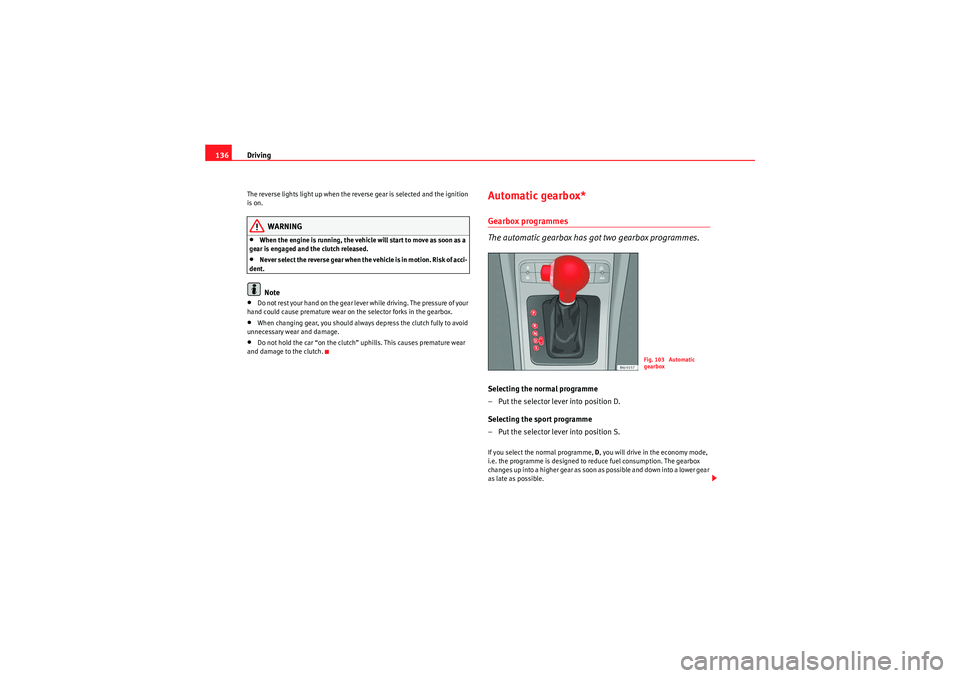
The automatic gearbox has got two gearbox programmes.Selecting the normal programme
– Put the selector lever into position D.
Selecting the sport programme
– Put the selector lever into position S.If you select the normal programme, D , you will drive in the economy mode,
i.e. the programme is designed to reduce fuel consumption. The gearbox
changes up into a higher gear as soon as possible and down into a lower gear
as late as possible.
Fig. 103 Automatic
gearbox
Ibiza ST_EN.book Seite 136 Dienstag, 12. Januar 2010 4:03 16
Page 146 of 250
Driving145
Safety First
Operating instructions
Practical tips
Technical Data
•Never park where the hot exhaust system could ignite inflammable
materials, such as dry grass, low bushes, spilt fuel etc.•Never allow vehicle occupants to remain in the vehicle when it is
locked. They would be unable to open the vehicle from the inside, and
could become trapped in the vehicle in an emergency. In the event of an
emergency, locked doors will delay assistance to occupants.•Never leave children alone in the vehicle. They could set the vehicle in
motion, for example, by releasing the handbrake or the gear lever.•Depending on weather conditions, it may become extremely hot or cold
inside the vehicle. This can be fatal.
Hill-start assist*
This function is only included in vehicles with ESP.This device helps when starting uphill.
These are the basic operation conditions: doors closed, brake pedal pressed
down and vehicle in neutral. The system gets activated on engaging gear.
After removing your foot from the brake pedal, the braking force is maintained
for a few seconds to prevent the vehicle from moving backward when putting
into gear. This short space of time is enough to start the vehicle with ease.
This system also works when reversing uphill.
WARNING
•If you do not start the vehicle immediately after taking your foot off the
brake pedal, the vehicle may start to roll back under certain conditions.
Depress the brake pedal or use the hand brake immediately.
•If the engine stalls, depress the brake pedal or use the hand brake
immediately.•When following a line of traffic uphill, if you want to prevent the vehicle
from rolling back accidentally when starting off, hold the brake pedal down
for a few seconds before starting off.Note
The Official Service or a specialist workshop can tell you if your vehicle is
equipped with this system.Acoustic parking aid system*Rear parking aid
The parking aid system will use an acoustic signal to warn of
the approach of any object towards the rear of the vehicle.Description
The acoustic parking aid system will measure the distance between the rear
of the vehicle and any possible obstacle using four ultrasonic sensors located
on the rear bumper. The measuring range of the sensors starts approximately
and depending on the nature of the obstacle at a distance of:•side of the rear bumper: 0.6 m•middle of the rear bumper: 1.6 m
Activation
The system is activated by engagement of the reverse gear. A brief acoustic
signal confirms the activation and correct function of the system.
WARNING (continued)
WARNING (continued)
Ibiza ST_EN.book Seite 145 Dienstag, 12. Januar 2010 4:03 16
Page 158 of 250
Driving and the environment157
Safety First
Operating instructions
Practical tips
Technical Data
If you drive with
wet brakes, for example, after crossing areas of water, in
heavy rainfall or even after washing the car, the effect of the brakes is less-
ened as the brake discs are wet or even frozen (in winter): The brakes should
be “dried” by pressing the pedal to restore full braking effect.
WARNING
Longer braking distances and faults in the brake system increase the risk
of accidents.•New brake pads must be run in and do not have the correct friction
during the first 200 km. However, the reduced braking capacity may be
compensated by pressing on the brake pedal a little harder. This also
applies when new brake pads are fitted.•If brakes are wet or frozen, or if you are driving on roads which have
been gritted with salt, braking power may set in later than normal.•On steep slopes, if brakes are excessively used, they will overheat.
Before driving down a long steep slope, it is advisable to reduce speed and
change down into a lower gear (or move the selector lever to a lower gear if
your vehicle has automatic transmission). This makes use of engine
braking and relieves the brakes.•Never let the brakes “slip” by applying light pressure. Continuous
braking will cause the brakes to overheat and the braking distance will
increase. Apply and then release the brakes alternately.•Never let the vehicle run with the engine switched off. The braking
distance is increased considerably when the brake servo is not active.•Very heavy use of the brakes may cause a vapour lock if the brake fluid
is left in the system for too long. This impairs the braking effect.•Non-standard or damaged front spoilers could restrict the airflow to the
brakes and cause them to overheat. Before purchasing accessories please
observe the relevant ⇒ page 172, “Technical modifications” instructions.•If a brake circuit fails, the braking distance will be increased consider-
ably. Contact a qualified workshop immediately and avoid unnecessary
journeys.
Exhaust gas purification systemCatalytic converter*To conserve the useful life of the catalytic converter
– Always use unleaded petrol.
– Do not let the fuel get too low in the tank.
– For engine oil changes, do not replenish with too much engine oil ⇒page 184, “Topping up engine oil ”.
– Never tow the vehicle to start it, use jump leads if necessary ⇒page 222.If you notice misfiring, uneven running or loss of power when the vehicle is
moving, reduce speed immediately and have the vehicle inspected at the
nearest qualified workshop. In general, the exhaust gas warning lamp will
light up when any of the described symptoms occur ⇒page 56. If this
happens, unburnt fuel can enter the exhaust system and escape into the envi-
ronment. The catalytic converter can also be damaged by overheating.
WARNING
The catalytic converter reaches very high temperatures! Fire hazard!•Never park where the catalytic converter could come into contact with
dry grass or inflammable materials under the vehicle.•Do not apply additional underseal or anti-corrosion coatings to the
exhaust pipes, catalytic converter or the heat shields on the exhaust
system. These materials could catch fire when the vehicle is being driven.
Ibiza ST_EN.book Seite 157 Dienstag, 12. Januar 2010 4:03 16
Page 159 of 250
Driving and the environment
158
CautionNever fully drain the fuel tank because the irregularity of the fuel supply may
cause ignition problems. This allows unburnt fuel to enter the exhaust
system, which could cause overheating and damage the catalytic converter.
For the sake of the environment
Even when the emission control system is working perfectly, there may be a
smell of sulphur from the exhaust gas under some conditions. This depends
on the sulphur content of the fuel used. Quite often the problem can be
solved by changing to another brand of fuel.Diesel engine particulate filter*
The diesel engine particulate filter eliminates soot produced
by burning diesel.The diesel engine dust filter eliminates most of the soot from the exhaust gas
system. Under normal driving conditions, the filter cleans itself. If the driving
conditions do not allow the filter to clean itself (for example, multiple short
trips) the filter will be obstructed by dust and pollen and the indicator
for
the diesel engine particulate filter indicator will light up. See section on
Warning Lamps.
WARNING
•The diesel engine particulate filter may reach extremely high tempera-
tures; it should not enter into contact with flammable materials under-
neath the vehicle. Failure to comply could result in fire.
Caution
•The vehicle is not designed for refuelling with blends of FAME fuel
(biodiesel) over 7% in accordance with DIN 51628. The diesel particulate
filter is damaged when this blend percentage is exceeded.Economical and environmentally-friendly
drivingGeneral notes
Fuel consumption depends to a large extent on your personal
driving style.Fuel consumption, environmental impact and engine, brake and tyre wear
depend largely on three factors:•Personal driving style•Conditions of use (weather, road surface)•Te chni cal r eq ui re men ts
By adopting an economical driving style and anticipating the traffic situation
ahead, you can easily reduce fuel consumption by 10-15%. This section
suggests methods of lessening the impact on the environment and reducing
your operating costs at the same time.Foresight when drivingA vehicle uses most fuel when accelerating. If you think ahead when driving,
you will need to brake less and thus accelerate less. Wherev er possible, take
Ibiza ST_EN.book Seite 158 Dienstag, 12. Januar 2010 4:03 16
Page 160 of 250
Driving and the environment159
Safety First
Operating instructions
Practical tips
Technical Data
advantage of your vehicle inertia, for instance when you see that the next
traffic light is red.
Regular servicesBy taking your car to an Authorised Service Centre for regular servicing you
can establish a basis for good fuel economy
before you start driving. A well-
serviced engine gives you the benefit of improved fuel efficiency as well as
maximum reliability and an enhanced resale value.
A badly serviced engine can consume up to 10% more fuel than necessary.
Check the oil level every time you refuel ⇒page 183. Oil consumption
depends to a great extent on the engine load and engine speed. Depending
on your personal driving style, oil consumption can be up to 1 litre per 1,000
km.
Avoid short journeysThe engine and catalytic converter need to reach their proper working
temperature in order to minimise fuel consumption and emissions.
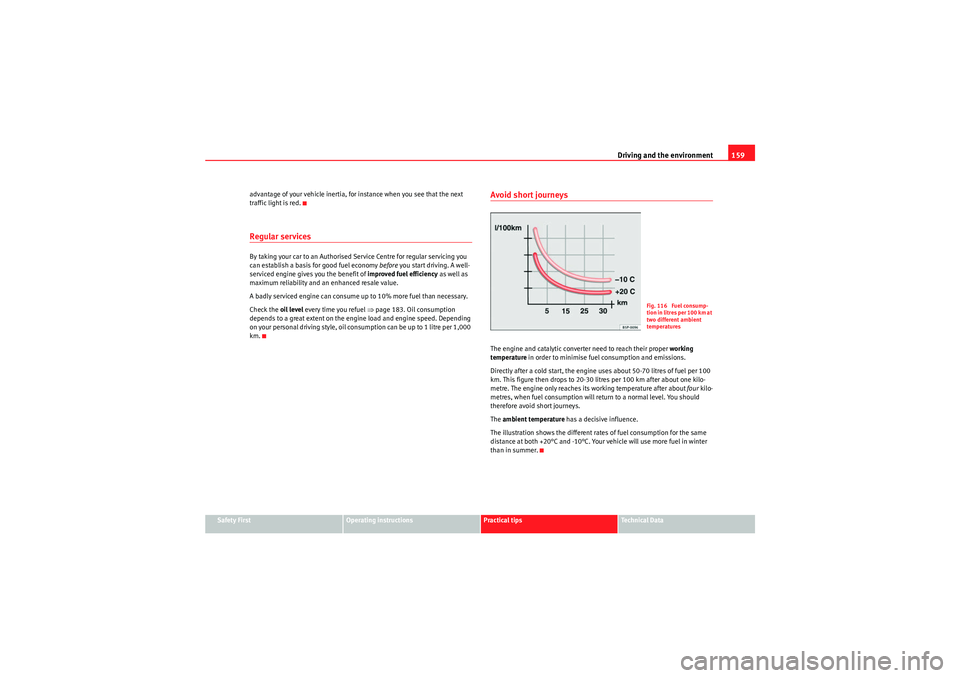
Directly after a cold start, the engine uses about 50-70 litres of fuel per 100
km. This figure then drops to 20-30 litres per 100 km after about one kilo-
metre. The engine only reaches it s working temperature after about four kilo-
metres, when fuel consumption will return to a normal level. You should
therefore avoid short journeys.
The ambient temperature has a decisive influence.
The illustration shows the different rates of fuel consumption for the same
distance at both +20°C and -10°C. Your vehicle will use more fuel in winter
than in summer.
Fig. 116 Fuel consump-
tion in litres per 100 km at
two different ambient
temperatures
Ibiza ST_EN.book Seite 159 Dienstag, 12. Januar 2010 4:03 16