lights Seat Ibiza ST 2009 User Guide
[x] Cancel search | Manufacturer: SEAT, Model Year: 2009, Model line: Ibiza ST, Model: Seat Ibiza ST 2009Pages: 250, PDF Size: 6.4 MB
Page 62 of 250
Cockpit61
Safety First
Operating instructions
Practical tips
Technical Data
Brake system* / handbrake
The warning lamp lights up if the handbrake is applied, if the
brake fluid level falls too low or if there is a fault in the brake
system.
This warning lamp
lights up if
•the handbrake is on.•the brake fluid level is too low ⇒page 191.•there is a fault in the brake system.
This warning lamp can light up together with the ABS system warning lamp.WARNING
•If the brake warning lamp does not go out, or if it lights up when
driving, the brake fluid level ⇒page 191, “Brake fluid” in the reservoir is
too low. Risk of accident. Stop the vehicle and do not drive on. Obtain tech-
nical assistance.•If the brake warning lamp
lights up together with the ABS warning
lamp
, the control function of the ABS could be out of action. This could
cause the rear wheels to lock quickly when you brake. This could cause the
rear to break away. Risk of skidding. Stop the vehicle and seek technical
assistance.
Cruise control system*
The warning lamp comes on when the cruise control system
is switched on.The warning lamp
lights up when the cruise control system is switched on.
For further information on the cruise control system, see ⇒page 147.
Tyre pressure*
The tyre monitor
5) co m p a r e s w h e e l r e v o l u t i o ns a n d wi t h t h is i n f o r m a t i o n , t h e
diameter of each wheel using the ESP sensors. If the diameter of a wheel
changes, the tyre monitor indicator lights . The wheel diameter changes
when:
•Tyre pressure is insufficient.•The tyre structure is damaged.•The vehicle is unbalanced because of a load.•The wheels of one axle are under more pressure (for example, driving with
a trailer or on extreme slopes).•The vehicle is fitted with snow chains.•The temporary spare wheel is fitted.•The wheel on one axle is changed.5)Depending on the model version
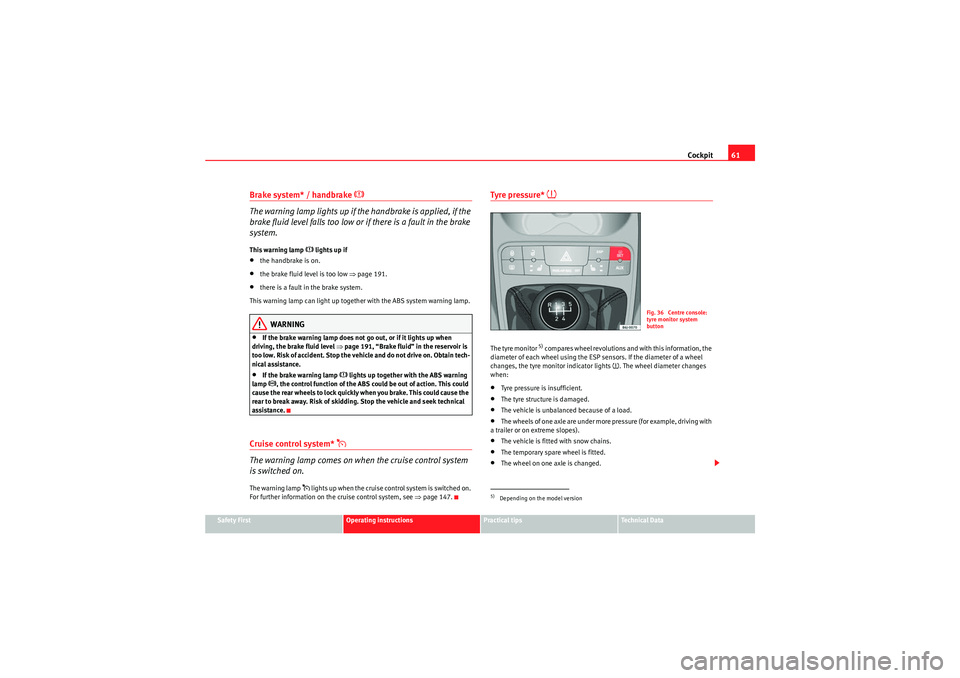
Fig. 36 Centre console:
tyre monitor system
button
Ibiza ST_EN.book Seite 61 Dienstag, 12. Januar 2010 4:03 16
Page 63 of 250
Cockpit
62Tyre pressure adjustment
Following the modification to tyre pressure or changing one or more wheels,
the button ⇒page 61, fig. 36 must be kept pressed while the ignition is on
until an acoustic signal is heard.
If the wheels are under excessive load (for example, driving with a trailer or
heavy load), the tyre pressure must be increased to the recommended value
for a full load (see the sticker on the inside of the fuel flap). If the tyre m onitor
system button is pressed down, the new tyre pressures are confirmed.
The tyre pressure monitor indicator
lights up
If the tyre pressure of one wheel is much lower than the value set by the
driver, then the tyre pressure monitor indicator ⇒ will light up.
WARNING
•When the tyre pressure indicator lights, reduce speed immediately and
avoid any sudden manoeuvre or braking. Stop when possible, and check
the tyre pressure and status.•The driver is responsible for maintaining correct tyre pressures. For this
reason, tyre pressure must be regularly checked.•Under certain circumstances (for example, when driving in a sportslike
manner, in winter conditions or on a dirt track) the tyre monitor indicator
may light or function incorrectly.Note
If the battery is disconnected, the yellow indicator
lights up after turning
the ignition on. This should turn off after a brief journey.
Speed selector lever lock*
The brake pedal must be depressed when this warning lamp lights up. This is
necessary when the automatic gearbox* gear lever is moved out of the posi-
tions P or N.Fuel level/reserve
This symbol lights up to indicate that the fuel tank under the
reserve level.It li ghts u p w he n o nly 7 lit res of fu el re mai n i n th e ta nk . Mo re ove r, a n warning
buzzer* is heard. It reminds you to fuel up the fuel tank as soon as possible
⇒ page 176.Indicates that the doors are open*
This indicator lights if one of the doors or the rear lid is open.The warning light
should go off when all the doors are closed correctly.
Rear lid open*
The warning lamp
should switch off when the rear lid is fully closed.
Ibiza ST_EN.book Seite 62 Dienstag, 12. Januar 2010 4:03 16
Page 64 of 250
Cockpit63
Safety First
Operating instructions
Practical tips
Technical Data
Main beam headlights
This warning lamp lights up when the main beams are on.The warning lamp
is switched on once main beams are on or once the
headlight flasher is operating.
For further information see ⇒page 92.
Electro-hydraulic steering*
The level of steering assistance depends on the vehicle speed and on the
steering wheel turning speed.
The warning lamp should light up for a few seconds when the ignition is
switched on. It should go out once the engine is started.
There is a fault in the electro-hydraulic steering system if the lamp does not
go out or lights up whilst the vehicle is in motion. Take the vehicle to the
Authorised Service Centre as soon as possible.
Note
When towing the vehicle with the engine stopped or due to a fault in the
power steering, this will not operate. The vehicle can still be steered, but it
will require greater force to turn the steering wheel.
Emission control system*
This warning lamp monitors the exhaust system.
Warning lamp
flashes:
When there is misfiring that can damage the catalytic converter. Reduce
speed and drive carefully to the nearest qualified workshop to have the
engine checked.
Warning lamp is lit:
If a fault has developed during driving which has reduced the quality of the
exhaust gas (e.g. lambda probe fault). Reduce speed and drive carefully to
the nearest qualified workshop to have the engine checked.
Coolant level* / temperature
The warning lamp lights up if the coolant temperature is too
high or if the coolant level is too low.There is a fault if:•The warning symbol does not go out again after a few seconds.•The warning lamp lights up or flashes while the vehicle is moving, while
three acoustic warning signals ⇒ are emitted.
This means that either the coolant level is too low or the coolant temperature
is too high.
Coolant temperature too high
If the warning light comes on, stop the vehicle, switch off the engine and wait
for it to cool down. Check the coolant level.
If the coolant level is correct, the overheating may be caused by a malfunction
of the radiator fan. Check the radiator fan fuse and have it replaced if neces-
sary ⇒page 209.
Ibiza ST_EN.book Seite 63 Dienstag, 12. Januar 2010 4:03 16
Page 65 of 250
Cockpit
64If the warning lamp lights up again after driving on for a short distance, stop
the vehicle and switch the engine off . Contact an Authorised Service Centre
or a qualified workshop.
Coolant level too low
If the warning light comes on, stop the vehicle, switch off the engine and wait
for it to cool down First check the coolant level. If the level of the coolant is
below the “MIN” mark, top up with coolant liquid ⇒.
WARNING
•If your vehicle is immobilised for any technical reasons, move it to a
safe distance from traffic. Tur n the e ngin e off, turn t he hazard l ights on and
place the warning triangle.•Never open the bonnet if you can see or hear steam or coolant escaping
from the engine compartment. Risk of scalding. Wait until you can no
longer see or hear escaping steam or coolant.•The engine compartment is a danger ous area! Before carrying out any
work in the engine compartment, switch off the engine and allow it to cool
down. Always note the corresponding warnings ⇒page 179.
Alternator
This warning lamp signals a fault in the alternator.
The warning lamp
lights up when the ignition is switched on. It should go
out when the engine has started running.
If the warning lamp lights up while driving, the alternator is no longer
charging the battery. You should immediately drive to the nearest qualified
workshop. You should avoid using electrical equipment that is not absolutely necessary
because this will drain the battery.
If the indicator flashes the voltage is insufficient for normal vehicle
operation.
Turn signals
The warning lamp flashes when the turn signals are in oper-
ation.Depending on which turn signal is operated, either the left
or right
turn
signal indicator lamp flashes. Both warning lamps will flash at the same time
when the hazard warning lights are switched on.
If any of both turn signals fails, the warning lamp will start flashing twice
faster than normal.
For further information on the turn signals, please see ⇒page 92.
Electronic immobiliser “Safe”*
This warning lamp flashes if an unauthorised key is used.Inside the key there is a chip that deactivates the electronic immobiliser auto-
matically when the key is inserted into the ignition. The immobiliser will be
activated again automatically as soon as you pull the key out of the ignition
lock.
Ibiza ST_EN.book Seite 64 Dienstag, 12. Januar 2010 4:03 16
Page 82 of 250
Unlocking and locking81
Safety First
Operating instructions
Practical tips
Technical Data
WARNING
•Always close the rear lid properly. Risk of accident or injury.•The rear lid must not be opened when the reverse or rear fog lights are
lit. This may damage the tail lights•Do not close the rear lid by pushing it down with your hand on the rear
window. The glass could smash. Risk of injury!•Ensure the rear lid is locked after closing it. If not, it may open unex-
pectedly while driving.•Never allow children to play in or around the vehicle. A locked vehicle
can be subjected to extremely high and low temperatures, depending on
the time of year, thus causing serious injuries/illness. It could even have
fatal consequences. Close and lock both the rear lid and all the other doors
when you are not using the vehicle.•Closing the rear lid without observing and ensuring it is clear could
cause serious injur y to you and to third parties. Make sure that no one is in
the path of the rear lid.•Never drive with the rear lid open or half-closed, exhaust gases may
penetrate into the interior of the vehicle. Danger of poisoning!•If you only open the rear lid, do not leave the key inside. The vehicle will
not be opened if the key is left inside.
Emergency opening
This allows the vehicle to be opened if the central locking
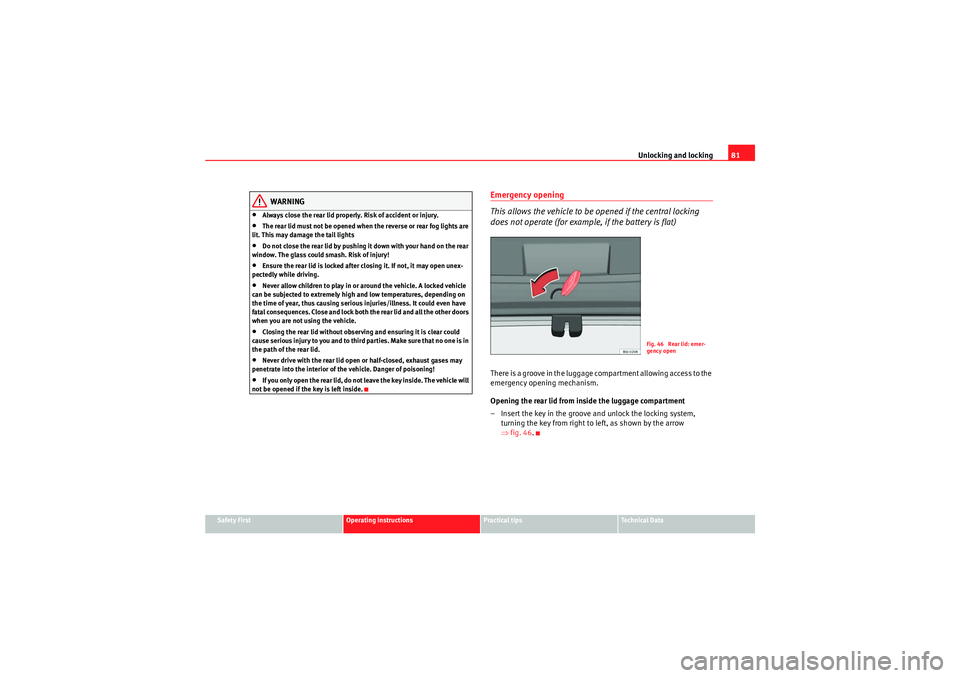
does not operate (for exampl e, if the battery is flat)There is a groove in the luggage compartment allowing access to the
emergency opening mechanism.
Opening the rear lid from inside the luggage compartment
– Insert the key in the groove and unlock the locking system,
turning the key from right to left, as shown by the arrow
⇒fig. 46 .
Fig. 46 Rear lid: emer-
gency open
Ibiza ST_EN.book Seite 81 Dienstag, 12. Januar 2010 4:03 16
Page 88 of 250
Lights and visibility87
Safety First
Operating instructions
Practical tips
Technical Data
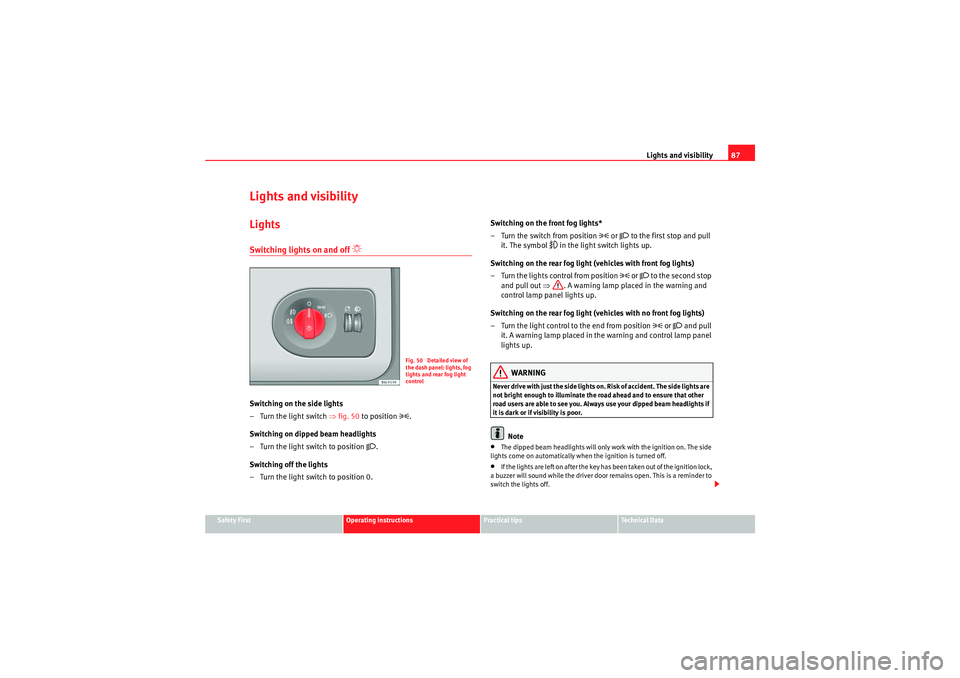
Lights and visibilityLightsSwitching lights on and off
Switching on the side lights
– Turn the light switch ⇒fig. 50 to position
.
Switching on dipped beam headlights
– Turn the light switch to position
.
Switching off the lights
– Turn the light switch to position 0. Switching on the front fog lights*
– Turn the switch from position
or to the first stop and pull
it. The symbol
in the light switch lights up.
Switching on the rear fog light (vehicles with front fog lights)
– Turn the lights control from position
or to the second stop
and pull out ⇒. A warning lamp placed in the warning and
control lamp panel lights up.
Switching on the rear fog light (vehicles with no front fog lights)
– Turn the light control to the end from position or and pull
it. A warning lamp placed in the warning and control lamp panel
lights up.
WARNING
Never drive with just the side lights on. Risk of accident. The side lights are
not bright enough to illuminate the road ahead and to ensure that other
road users are able to see you. Always use your dipped beam headlights if
it is dark or if visibility is poor.
Note
•The dipped beam headlights will only work with the ignition on. The side
lights come on automatically when the ignition is turned off.•If the lights are left on after the key has been taken out of the ignition lock,
a buzzer will sound while the driver door remains open. This is a reminder to
switch the lights off.
Fig. 50 Detailed view of
the dash panel: lights, fog
lights and rear fog light
control
Ibiza ST_EN.book Seite 87 Dienstag, 12. Januar 2010 4:03 16
Page 89 of 250
Lights and visibility
88•The rear fog light is so bright that it can dazzle drivers behind you. You
should use the rear fog light only when visibility is very poor.•The use of the lighting described here is subject to the relevant statutory
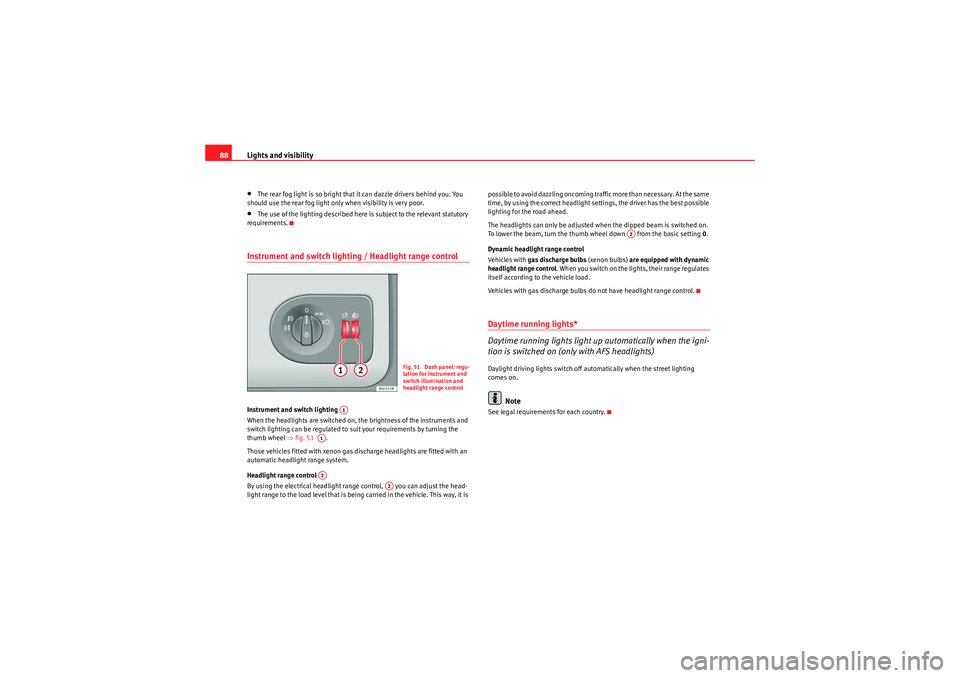
requirements.Instrument and switch lighting / Headlight range controlInstrument and switch lighting
When the headlights are switched on, the brightness of the instruments and
switch lighting can be regulated to suit your requirements by turning the
thumb wheel ⇒fig. 51 .
Those vehicles fitted with xenon gas discharge headlights are fitted with an
automatic headlight range system.
Headlight range control
By using the electrical headlight range control, you can adjust the head-
light range to the load level that is being carried in the vehicle. This way, it is possible to avoid dazzling oncoming traffic more than necessary. At the same
time, by using the correct headlight settings, the driver has the best possible
lighting for the road ahead.
The headlights can only be adjusted when the dipped beam is switched on.
To lower the beam, turn the thumb wheel down from the basic setting
0.
Dynamic headlight range control
Ve hi cle s wi th gas discharge bulbs (xenon bulbs) are equipped with dynamic
headlight range control . When you switch on the lights, their range regulates
itself according to the vehicle load.
Vehicles with gas discharge bulbs do not have headlight range control.
Daytime running lights*
Daytime running lights light up automatically when the igni-
tion is switched on (only with AFS headlights)Daylight driving lights switch off automatically when the street lighting
comes on.
Note
See legal requirements for each country.
Fig. 51 Dash panel: regu-
lation for instrument and
switch illumination and
headlight range control
A1
A1A2
A2
A2
Ibiza ST_EN.book Seite 88 Dienstag, 12. Januar 2010 4:03 16
Page 90 of 250
Lights and visibility89
Safety First
Operating instructions
Practical tips
Technical Data
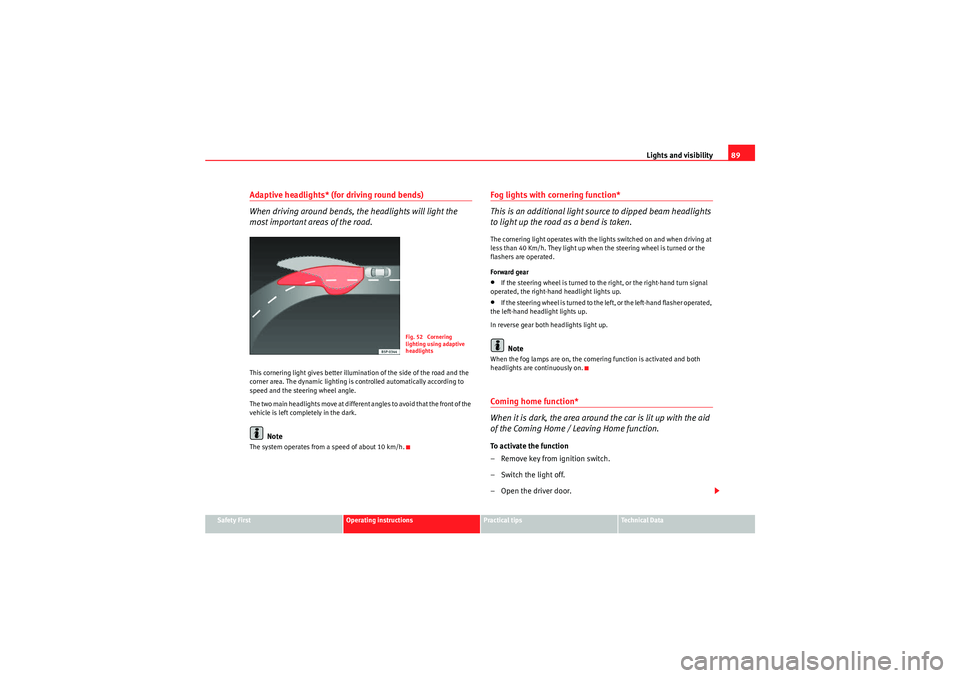
Adaptive headlights* (for driving round bends)
When driving around bends, the headlights will light the
most important areas of the road.This cornering light gives better illumination of the side of the road and the
corner area. The dynamic lighting is controlled automatically according to
speed and the steering wheel angle.
The two main headlights move at different angles to avoid that the front of the
vehicle is left completely in the dark.
Note
The system operates from a speed of about 10 km/h.
Fog lights with cornering function*
This is an additional light source to dipped beam headlights
to light up the road as a bend is taken.The cornering light operates with the lights switched on and when driving at
less than 40 Km/h. They light up when the steering wheel is turned or the
flashers are operated.
Forward gear•If the steering wheel is turned to the right, or the right-hand turn signal
operated, the right-hand headlight lights up.•If the steering wheel is turned to the left, or the left-hand flasher operated,
the left-hand headlight lights up.
In reverse gear both headlights light up.Note
When the fog lamps are on, the cornering function is activated and both
headlights are continuously on.Coming home function*
When it is dark, the area around the car is lit up with the aid
of the Coming Home / Leaving Home function.To activate the function
– Remove key from ignition switch.
– Switch the light off.
– Open the driver door.
Fig. 52 Cornering
lighting using adaptive
headlights
Ibiza ST_EN.book Seite 89 Dienstag, 12. Januar 2010 4:03 16
Page 91 of 250
Lights and visibility
90
– Push the headlight lever to the main beam position
.
– Dipped headlights come on when the door is opened.
You have 2 mins. from when the key is taken out of the ignition switch to when
the lights flash; after this, the Coming home function will not activate. To acti-
vate it again, repeat the operation.
W h e n t h e s y s t e m i s a c t i v a t e d , d i p p e d b e a m h e a d l i g h t s r e m a i n o n f o r 3 0 s e c s .
after closing the door. If the door is open for more than 3 mins., the system
will not remain active after the 3 mins., which means that the dipped lights
will not light up.
Note
•If the vehicle is often used during the night for short trips and the Coming
home function is used, the battery will considerably discharge. To avoid this,
make longer journeys whenever possible.•Observe all relevant legal requirements when using the signalling and
lighting systems described here.
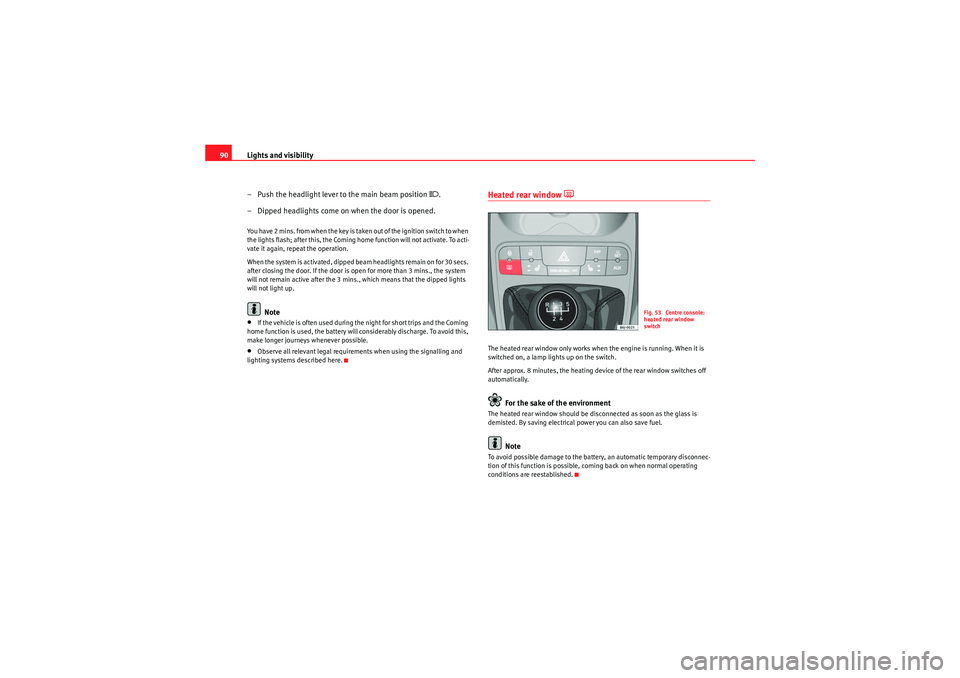
Heated rear window
The heated rear window only works when the engine is running. When it is
switched on, a lamp lights up on the switch.
After approx. 8 minutes, the heating device of the rear window switches off
automatically.
For the sake of the environment
The heated rear window should be disconnected as soon as the glass is
demisted. By saving electrical power you can also save fuel.
Note
To avoid possible damage to the battery, an automatic temporary disconnec-
tion of this function is possible, coming back on when normal operating
conditions are reestablished.
Fig. 53 Centre console:
heated rear window
switch
Ibiza ST_EN.book Seite 90 Dienstag, 12. Januar 2010 4:03 16
Page 92 of 250
Lights and visibility91
Safety First
Operating instructions
Practical tips
Technical Data
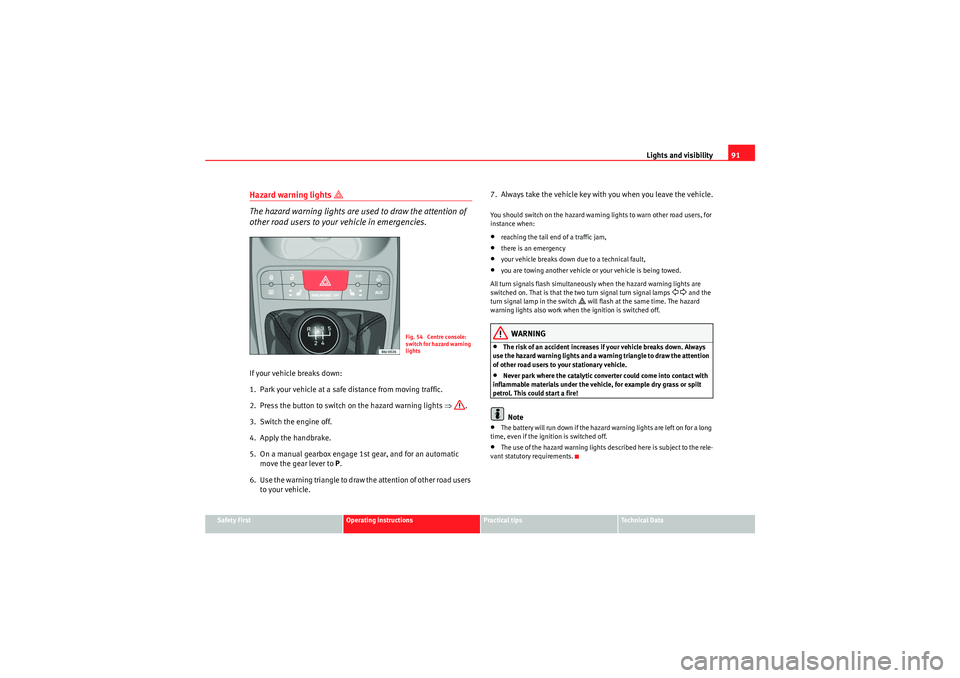
Hazard warning lights
The hazard warning lights are used to draw the attention of
other road users to your vehicle in emergencies.
If your vehicle breaks down:
1. Park your vehicle at a safe distance from moving traffic.
2. Press the button to switch on the hazard warning lights ⇒.
3. Switch the engine off.
4. Apply the handbrake.
5. On a manual gearbox engage 1st gear, and for an automatic move the gear lever to P.
6. Use the warning triangle to draw the attention of other road users to your vehicle. 7. Always take the vehicle key with you when you leave the vehicle.
You should switch on the hazard warning lights to warn other road users, for
instance when:•reaching the tail end of a traffic jam,•there is an emergency•your vehicle breaks down due to a technical fault,•you are towing another vehicle or your vehicle is being towed.
All turn signals flash simultaneously when the hazard warning lights are
switched on. That is that the two turn signal turn signal lamps
and the
turn signal lamp in the switch
will flash at the same time. The hazard
warning lights also work when the ignition is switched off.
WARNING
•The risk of an accident increases if your vehicle breaks down. Always
use the hazard warning lights and a warning triangle to draw the attention
of other road users to your stationary vehicle.•Never park where the catalytic converter could come into contact with
inflammable materials under the vehicle, for example dry grass or spilt
petrol. This could start a fire!Note
•The battery will run down if the hazard warning lights are left on for a long
time, even if the ignition is switched off.•The use of the hazard warning lights described here is subject to the rele-
vant statutory requirements.
Fig. 54 Centre console:
switch for hazard warning
lights
Ibiza ST_EN.book Seite 91 Dienstag, 12. Januar 2010 4:03 16