roof Seat Ibiza ST 2009 User Guide
[x] Cancel search | Manufacturer: SEAT, Model Year: 2009, Model line: Ibiza ST, Model: Seat Ibiza ST 2009Pages: 250, PDF Size: 6.4 MB
Page 127 of 250
Air conditioning
126•If the function is not deactivated by pressing the button, this will deacti-
vate after approx. 20 min.Economic use of the air conditioningWhen the air conditioning is switched on, the compressor consumes engine
power and has influence on fuel consumption. Consider the following points
in order to have the system operating in the minimum possible time.•If the vehicle interior has overheated due to an excessive solar radiation,
it is best to open the windows or doors to allow the hot air to escape.•While in motion, the air conditioning should not be switched on if the
windows or the sunroof are open.*
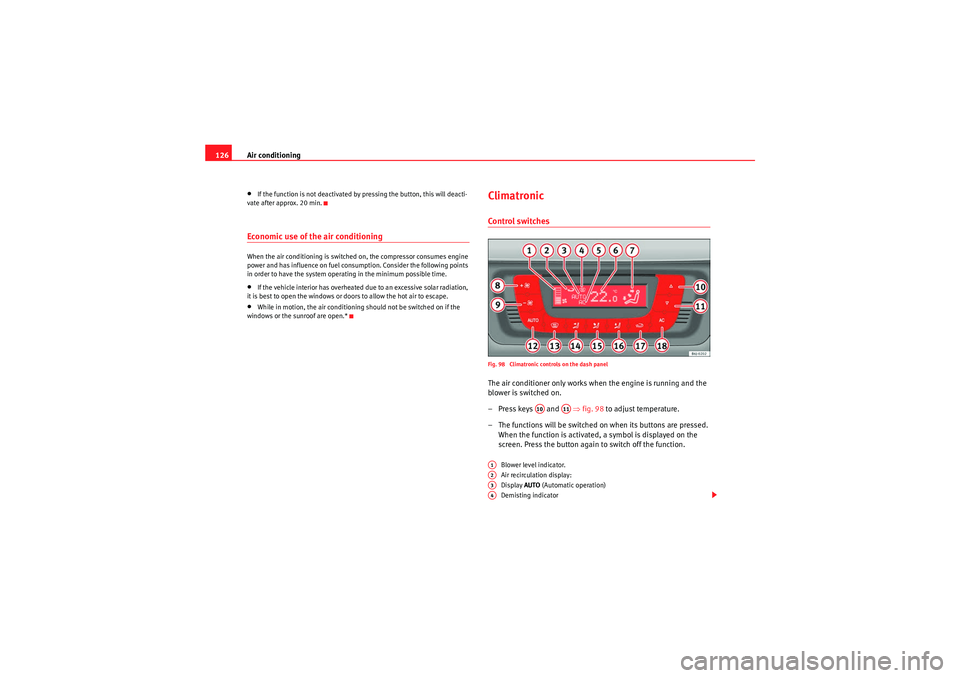
ClimatronicControl switchesFig. 98 Climatronic controls on the dash panelThe air conditioner only works when the engine is running and the
blower is switched on.
–Press keys and ⇒ fig. 98 to adjust temperature.
– The functions will be switched on when its buttons are pressed. When the function is activated, a symbol is displayed on the
screen. Press the button again to switch off the function.
Blower level indicator.
Air recirculation display:
Display AUTO (Automatic operation)
Demisting indicator
A10
A11
A1A2A3A4
Ibiza ST_EN.book Seite 126 Dienstag, 12. Januar 2010 4:03 16
Page 130 of 250
Air conditioning129
Safety First
Operating instructions
Practical tips
Technical Data
WARNING
In air recirculation mode, no cold air from the outside enters the vehicle
interior. If the air conditioner is switched off, the windows can quickly mist
over. Therefore, never leave the air recirculation mode switched on for a
long time (risk of accident).
Note
When engaging reverse gear, the air recirculation is connected automatically
to prevent the entrance of exhaust fumes in the vehicle on travelling back-
wards. In this case the symbol for air recirculation is not displayed.General notesPollution filter
The pollution filter (a combined particulate filter and active carbon filter)
serves as a barrier against impurities in the outside air, including dust and
pollen.
For the air conditioner to work with maximum efficiency, the pollution filter
must be replaced at the specified intervals in the Maintenance Programme.
If the filter loses efficiency prematurely due to use in areas reaching very high
pollution levels, the pollen filter must be changed more frequently than
stated in the Service Schedule.
Caution
•If you suspect that the air conditioner is damaged, switch it off with button
to prevent further damage and have it checked by a qualified workshop.
•Repairs to the air conditioner require specialist knowledge and special
tools. Therefore, we recommend you to take the vehicle to a qualified work-
shop.Note
•If the humidity and temperature outside the vehicle are high, condensa-
tion can drip off the evaporator in the cooling system and so forming a puddle
underneath the vehicle. This is completely normal and there is no need to
suspect a leak.•Keep the air intake slots in front of the windscreen free of snow, ice and
leaves to ensure heating and cooling are not impaired, and to prevent the
windows from misting over.•The air from the vents flows through th e vehicle interior and is extracted
by slots designed for this purpose. Therefore, do not cover these slots with
items of clothing or other objects.•The air conditioner operates most effectively with the windows and the
sliding/tilting roof* closed. However, if the vehicle has been overheated by
sun, the air inside can be cooled faster by opening the windows for a short
time.•Do not smoke while air recirculation mode is on, as smoke drawn into the
air conditioning system leaves a residue on the evaporator, producing a
permanent unpleasant odour.•At low outside temperatures the compressor switches off automatically.
The button cannot be switched on either.•It is advisable to connect the air conditioning at least once a month, to
lubricate the system gaskets and prevent leaks. If a decrease in the cooling
capacity is detected, an Authorised Service Centre should be consulted to
check the system.•To ensure correct operation, the grilles on both sides of the screen must
not be obstructed•When the engine is under extreme strain, switch off the compressor for a
moment.
AC
AUTO
Ibiza ST_EN.book Seite 129 Dienstag, 12. Januar 2010 4:03 16
Page 165 of 250
Vehicle maintenance and cleaning
164Care of the vehicle exteriorAutomatic car washing tunnelThe vehicle paintwork is so durable that the car can normally be washed
without problems in an automatic car washing tunnel. However, the paint-
work wear depends to a large extent, on the kind of the car washing tunnel,
the brushes used, its water filtering and the type of cleaning and preservative
products.
Before going through a car wash, be sure to take the usual precautions such
as closing the windows and sunroof. There is nothing to note apart from that.
If the vehicle has special accessories such as spoilers or a roof carrier or two-
way radio aerial, etc., it is advisable to consult the car washing tunnel oper-
ator.
After washing, the brakes could hesitate to respond as the brake discs and
pads could be wet, or even frozen in winter. “Dry” the brakes by braking
several times.
WARNING
Water, ice and salt on the brakes can reduce braking efficiency. Risk of acci-
dent.
Caution
Before putting the vehicle through the car washing tunnel, do not tighten the
aerial if it is folded because it can be damaged.
Washing by handVehicle washing
– First soften the dirt with plenty of water and rinse it off.
– Clean your vehicle from top to bottom with a soft sponge, a glove or a brush. Use very light pressure.
– Rinse the sponge or glove often with clean water.
– Special car shampoo should only be used for very stubborn dirt.
– Clean the wheels, sill panels etc. until last with a different sponge or glove.
– Rinse the vehicle thoroughly with water.
– Dry your vehicle surface gently with a chamois leather.
–When temperature is cold , dry the rubber seals and its surfaces
to prevent them from freezing. Apply silicone spray to the rubber
seals.
After washing
– Directly after washing, avoid sudden and sharp braking. “Dry” the brakes by braking several times.
WARNING
•Wash your car with the ignition switched off.•Protect your hands and arms from cuts on sharp metal edges when
cleaning the underbody, the inside of the wheel housings etc. Risk of
injury.
Ibiza ST_EN.book Seite 164 Dienstag, 12. Januar 2010 4:03 16
Page 166 of 250
Vehicle maintenance and cleaning165
Safety First
Operating instructions
Practical tips
Technical Data
•Water, ice and salt on the brakes can reduce braking efficiency. Risk of
accident.Caution
•Never remove dirt, mud or dust if the vehicle surface is dry. Never use a
dry cloth or sponge for cleaning purposes. This could scratch the paintwork
or glass on your vehicle.•Washing the vehicle in low temperatures: when washing the vehicle with
a hose, do not direct water into the lock cylinders or the gaps around the
doors, rear lid, or sunroof. Risk of freezing.For the sake of the environment
To protect environment, the car should be washed only in specially provided
wash bays. This prevents toxic, oil-laden waste water entering the sewerage
system. In some districts, washing vehicles outside wash bays is prohibited.
Note
Do not wash the vehicle in direct sunlight.Washing the car with a high pressure cleaner
Be particularly careful when using a high pressure cleaner!– Always observe the instructions for the high-pressure cleaner, particularly those concerning the pressure and the spraying
distance. – Increase the spraying distance
for soft materials and painted
bumpers.
– Do not use a high pressure cleaner to remove ice or snow from windows ⇒page 166.
– Never use concentrated jet nozzles (“rotating jets”) ⇒.
– Directly after washing, avoid sudden and sharp braking. “Dry” ⇒page 156 the brakes by braking several times.
WARNING
•Never wash tyres with a concentrated jet (“rotating nozzle”). Even at
large spraying distances and short cleaning times, visible and invisible
damage can occur to the tyres. This may cause an accident.•Water, ice and salt on the brakes can reduce braking efficiency. Risk of
accident.Caution
•Do not use water hotter than 60°C. This could damage the vehicle.•To avoid damage to the vehicle, keep a sufficient distance from sensitive
materials such as flexible hoses, plastic, soundproofing material, etc. This is
also important for bumpers painted as the paintwork. The closer the nozzle is
to the surface, the greater the wear on the material.Vehicle paint maintenance requirements
Regular waxing protects the paintwork.You need to apply wax to your car if water does not form small drops and run
off the paintwork when it is clean.
WARNING (continued)
Ibiza ST_EN.book Seite 165 Dienstag, 12. Januar 2010 4:03 16
Page 174 of 250
Accessories, parts replacement and modifications173
Safety First
Operating instructions
Practical tips
Technical Data
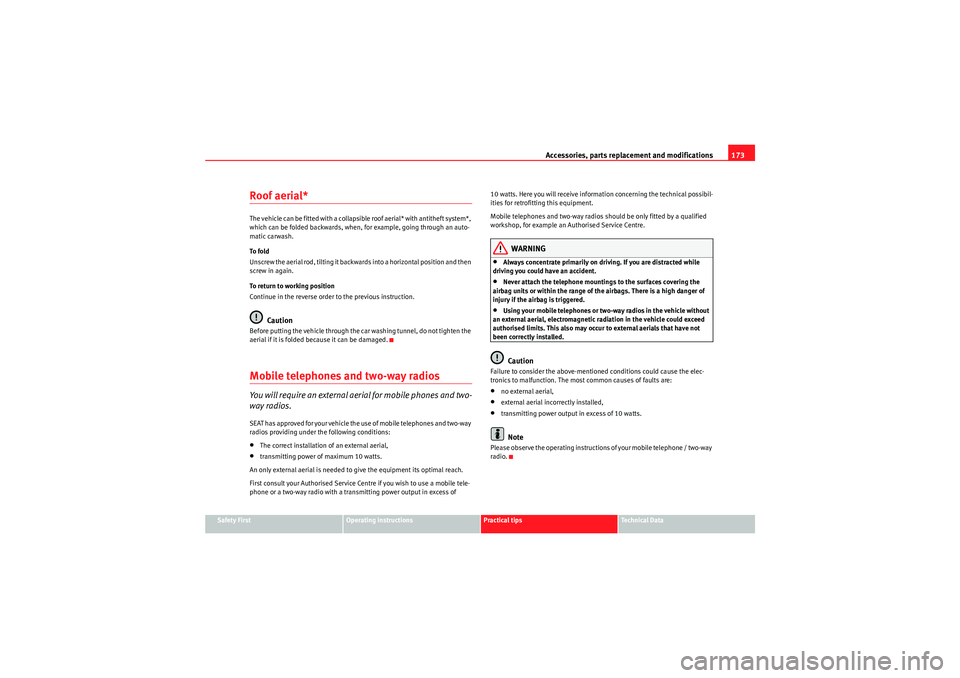
Roof aerial*The vehicle can be fitted with a collapsible roof aerial* with antitheft system*,
which can be folded backwards, when, for example, going through an auto-
matic carwash.
To f o l d
Unscrew the aerial rod, tilting it backwards into a horizontal position and then
screw in again.
To return to working position
Continue in the reverse order to the previous instruction.
Caution
Before putting the vehicle through the car washing tunnel, do not tighten the
aerial if it is folded because it can be damaged.Mobile telephones and two-way radiosYou will require an external aerial for mobile phones and two-
way radios.SEAT has approved for your vehicle the use of mobile telephones and two-way
radios providing under the following conditions:•The correct installation of an external aerial,•transmitting power of maximum 10 watts.
An only external aerial is needed to give the equipment its optimal reach.
First consult your Authorised Service Centre if you wish to use a mobile tele-
phone or a two-way radio with a transmitting power output in excess of 10 watts. Here you will receive information concerning the technical possibil-
ities for retrofitting this equipment.
Mobile telephones and two-way radios should be only fitted by a qualified
workshop, for example an Authorised Service Centre.
WARNING
•Always concentrate primarily on driving. If you are distracted while
driving you could have an accident.•Never attach the telephone mountings to the surfaces covering the
airbag units or within the range of the airbags. There is a high danger of
injury if the airbag is triggered.•Using your mobile telephones or two-way radios in the vehicle without
an external aerial, electromagnetic radiation in the vehicle could exceed
authorised limits. This also may occur to external aerials that have not
been correctly installed.Caution
Failure to consider the above-mentioned conditions could cause the elec-
tronics to malfunction. The most common causes of faults are:•no external aerial,•external aerial incorrectly installed,•transmitting power output in excess of 10 watts.Note
Please observe the operating instructions of your mobile telephone / two-way
radio.
Ibiza ST_EN.book Seite 173 Dienstag, 12. Januar 2010 4:03 16
Page 195 of 250
Checking and refilling levels
194Charging and changing the vehicle battery
The battery is maintenance-free and is checked during the
inspection service. All work on the vehicle battery requires
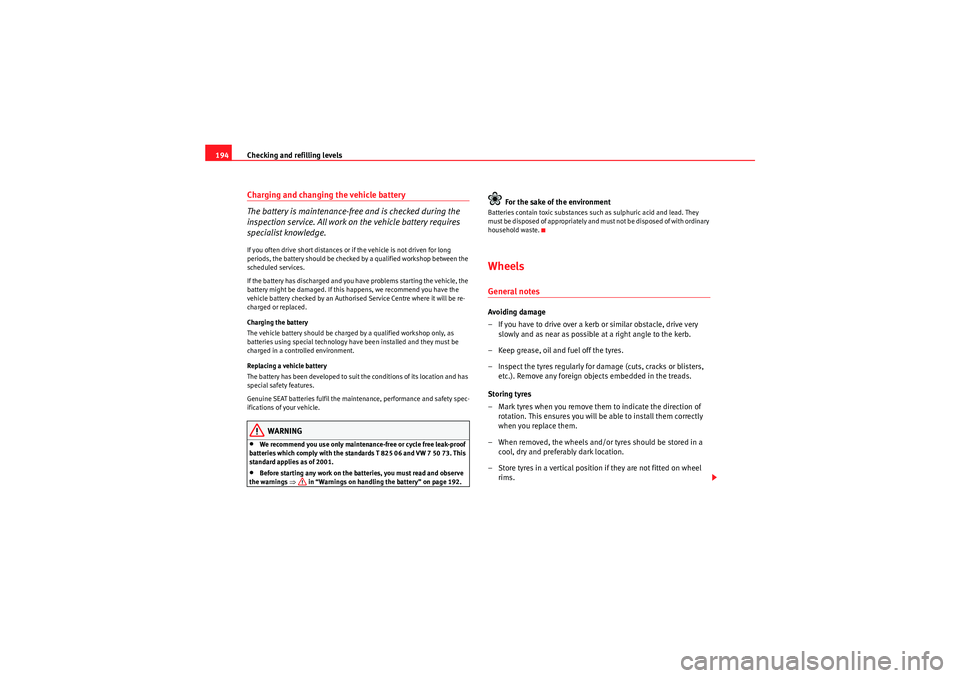
specialist knowledge.If you often drive short distances or if the vehicle is not driven for long
periods, the battery should be checked by a qualified workshop between the
scheduled services.
If the battery has discharged and you have problems starting the vehicle, the
battery might be damaged. If this happens, we recommend you have the
vehicle battery checked by an Authorised Service Centre where it will be re-
charged or replaced.
Charging the battery
The vehicle battery should be charged by a qualified workshop only, as
batteries using special technology have been installed and they must be
charged in a controlled environment.
Replacing a vehicle battery
The battery has been developed to suit the conditions of its location and has
special safety features.
Genuine SEAT batteries fulfil the maintenance, performance and safety spec-
ifications of your vehicle.
WARNING
•We recommend you use only maintenance-free or cycle free leak-proof
batteries which comply with the standards T 825 06 and VW 7 50 73. This
standard applies as of 2001.•Before starting any work on the batteries, you must read and observe
the warnings ⇒ in “Warnings on handling the battery” on page 192.
For the sake of the environment
Batteries contain toxic substances such as sulphuric acid and lead. They
m ust b e d isp ose d of app ro pr iate ly a nd m ust no t b e disp ose d of wit h or di na r y
household waste.WheelsGeneral notesAvoiding damage
– If you have to drive over a kerb or similar obstacle, drive very
slowly and as near as possible at a right angle to the kerb.
– Keep grease, oil and fuel off the tyres.
– Inspect the tyres regularly for damage (cuts, cracks or blisters, etc.). Remove any foreign objects embedded in the treads.
Storing tyres
– Mark tyres when you remove them to indicate the direction of rotation. This ensures you will be able to install them correctly
when you replace them.
– When removed, the wheels and/or tyres should be stored in a cool, dry and preferably dark location.
– Store tyres in a vertical position if they are not fitted on wheel rims.
Ibiza ST_EN.book Seite 194 Dienstag, 12. Januar 2010 4:03 16
Page 212 of 250
If and when211
Safety First
Operating instructions
Practical tips
Technical Data
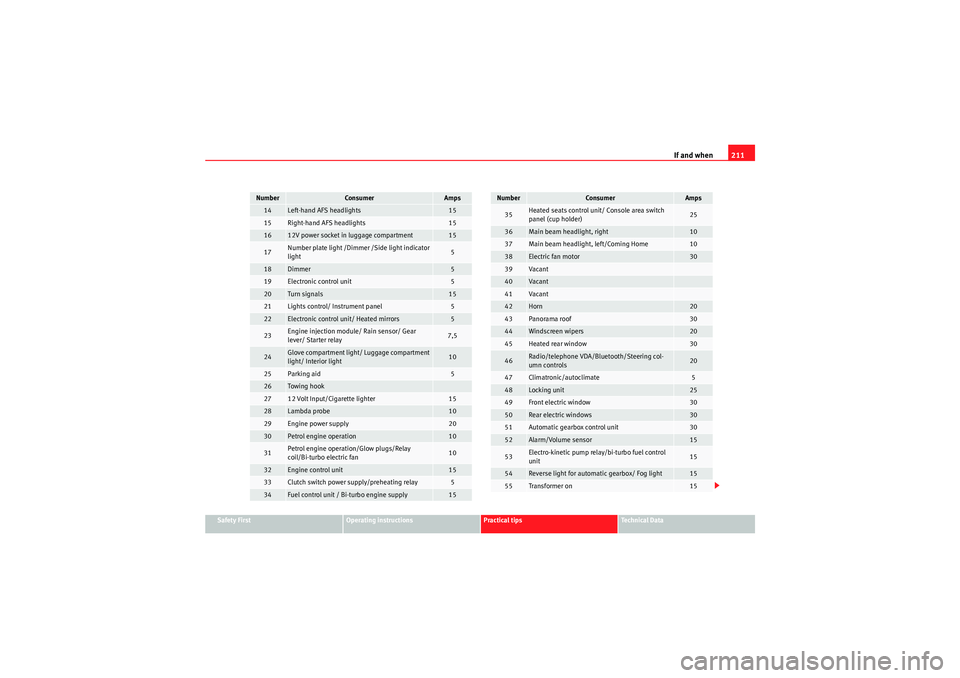
14
Left-hand AFS headlights
15
15
Right-hand AFS headlights
15
16
12V power socket in luggage compartment
15
17
Number plate light /Dimmer /Side light indicator
light
5
18
Dimmer
5
19
Electronic control unit
5
20
Turn signals
15
21
Lights control/ Instrument panel
5
22
Electronic control unit/ Heated mirrors
5
23
Engine injection module/ Rain sensor/ Gear
lever/ Starter relay
7,5
24
Glove compartment light/ Luggage compartment
light/ Interior light
10
25
Parking aid
5
26
Towing hook
27
12 Volt Input/Cigarette lighter
15
28
Lambda probe
10
29
Engine power supply
20
30
Petrol engine operation
10
31
Petrol engine operation/Glow plugs/Relay
coil/Bi-turbo electric fan
10
32
Engine control unit
15
33
Clutch switch power supply/preheating relay
5
34
Fuel control unit / Bi-turbo engine supply
15
Number
Consumer
Amps
35
Heated seats control unit/ Console area switch
panel (cup holder)
25
36
Main beam headlight, right
10
37
Main beam headlight, left/Coming Home
10
38
Electric fan motor
30
39
Va can t
40
Va can t
41
Va can t
42
Horn
20
43
Panorama roof
30
44
Windscreen wipers
20
45
Heated rear window
30
46
Radio/telephone VDA/Bluetooth/Steering col-
umn controls
20
47
Climatronic/autoclimate
5
48
Locking unit
25
49
Front electric window
30
50
Rear electric windows
30
51
Automatic gearbox control unit
30
52
Alarm/Volume sensor
15
53
Electro-kinetic pump relay/bi-turbo fuel control
unit
15
54
Reverse light for automatic gearbox/ Fog light
15
55
Transformer on
15
Number
Consumer
Amps
Ibiza ST_EN.book Seite 211 Dienstag, 12. Januar 2010 4:03 16
Page 236 of 250
Technical Data235
Safety First
Operating instructions
Practical tips
Technical Data
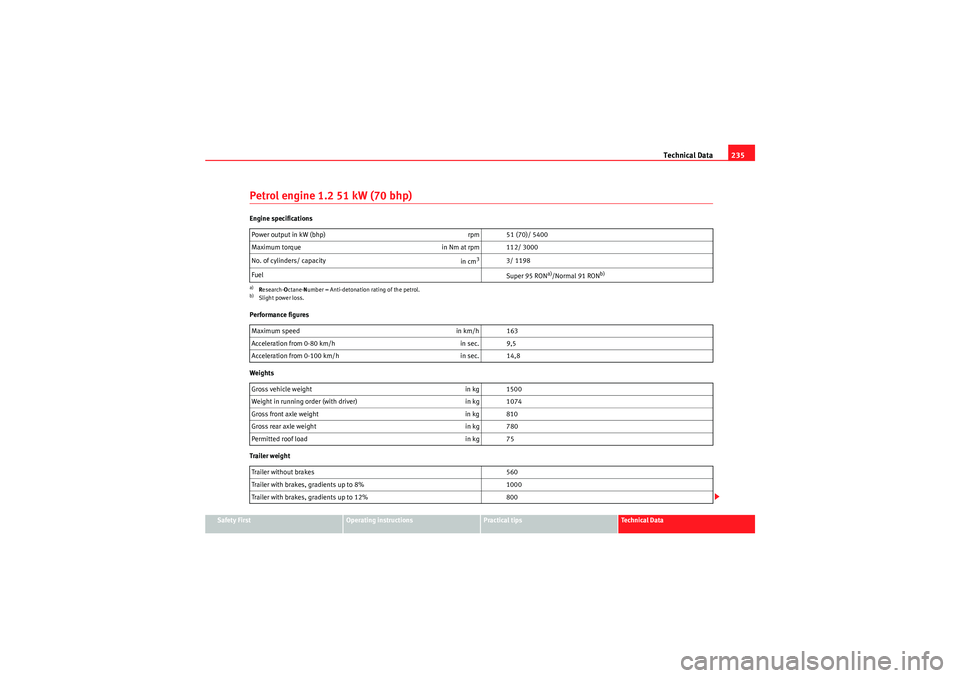
Petrol engine 1.2 51 kW (70 bhp)Engine specifications
Performance figures
Weights
Trailer weightPower output in kW (bhp)
rpm 51 (70)/ 5400
Maximum torque in Nm at rpm 112/ 3000
No. of cylinders/ capacity in cm
3
3/ 1198
Fuel Super 95 RON
a)/Normal 91 RON
b)
a)Research- Octane- Number = Anti-detonation rating of the petrol.b)Slight power loss.Maximum speed in km/h 163
Acceleration from 0-80 km/h in sec. 9,5
Acceleration from 0-100 km/h in sec. 14,8
Gross vehicle weight in kg 1500
Weight in running order (with driver) in kg 1074
Gross front axle weight in kg 810
Gross rear axle weight in kg 780
Permitted roof load in kg 75
Trailer without brakes 560
Trailer with brakes, gradients up to 8% 1000
Trailer with brakes, gradients up to 12% 800
Ibiza ST_EN.book Seite 235 Dienstag, 12. Januar 2010 4:03 16
Page 237 of 250
Technical Data
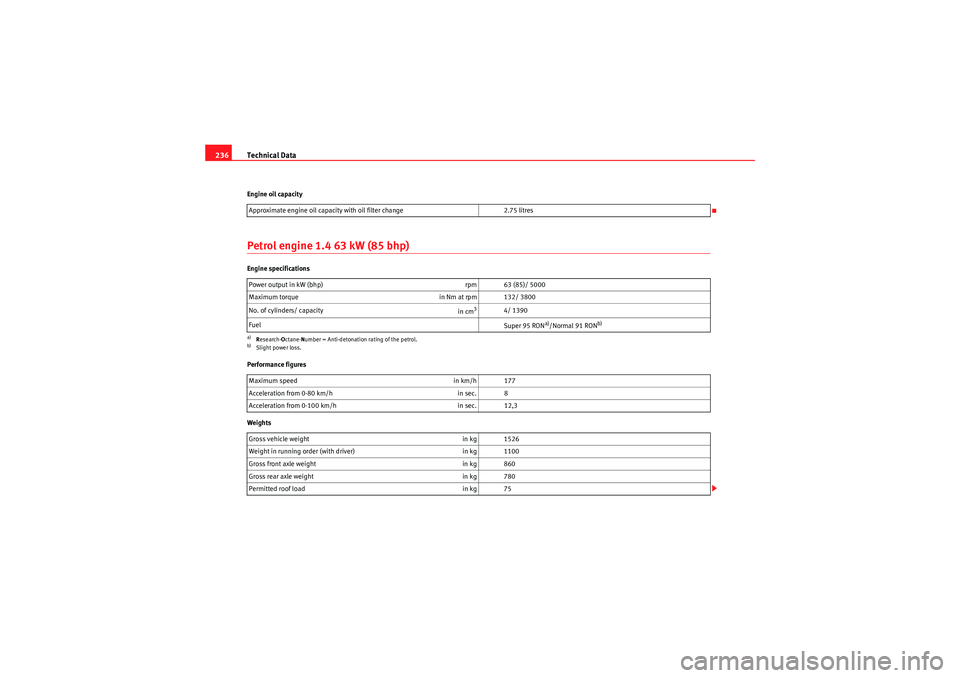
236Engine oil capacityPetrol engine 1.4 63 kW (85 bhp)Engine specifications
Performance figures
Weights Approximate engine oil capacity with oil filter change
2.75 litres
Power output in kW (bhp) rpm 63 (85)/ 5000
Maximum torque in Nm at rpm 132/ 3800
No. of cylinders/ capacity in cm
3
4/ 1390
Fuel Super 95 RON
a)/Normal 91 RON
b)
a)Research- Octane- Number = Anti-detonation rating of the petrol.b)Slight power loss.Maximum speed in km/h 177
Acceleration from 0-80 km/h in sec. 8
Acceleration from 0-100 km/h in sec. 12,3
Gross vehicle weight in kg 1526
Weight in running order (with driver) in kg 1100
Gross front axle weight in kg 860
Gross rear axle weight in kg 780
Permitted roof load in kg 75
Ibiza ST_EN.book Seite 236 Dienstag, 12. Januar 2010 4:03 16
Page 239 of 250
Technical Data
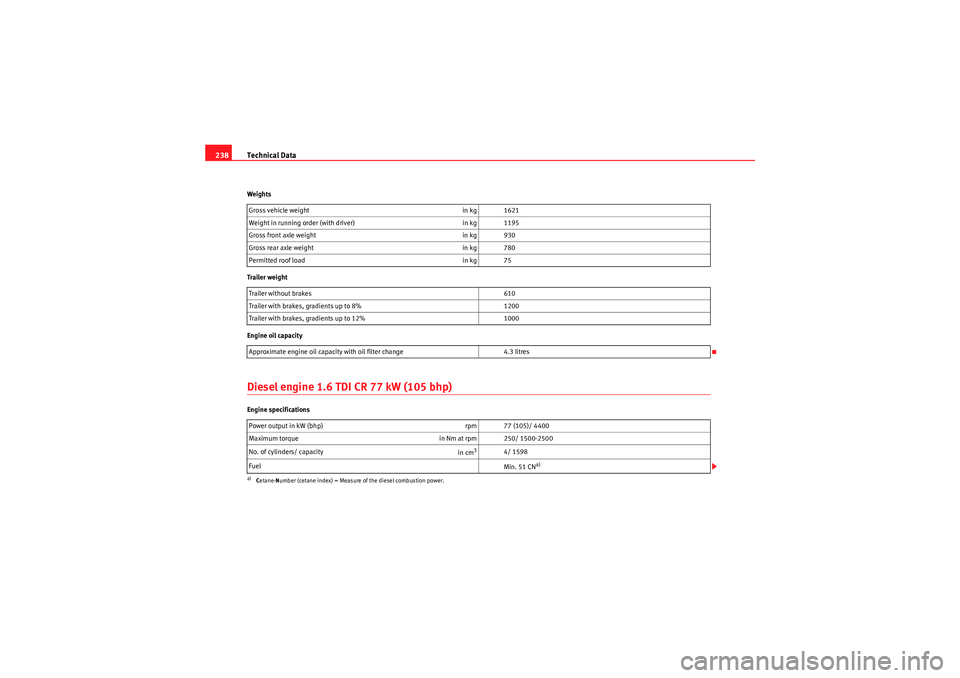
238Weights
Trailer weight
Engine oil capacityDiesel engine 1.6 TDI CR 77 kW (105 bhp)Engine specifications Gross vehicle weight
in kg 1621
Weight in running order (with driver) in kg 1195
Gross front axle weight in kg 930
Gross rear axle weight in kg 780
Permitted roof load in kg 75
Trailer without brakes 610
Trailer with brakes, gradients up to 8% 1200
Trailer with brakes, gradients up to 12% 1000
Approximate engine oil capacity with oil filter change 4.3 litres
Power output in kW (bhp) rpm 77 (105)/ 4400
Maximum torque in Nm at rpm 250/ 1500-2500
No. of cylinders/ capacity in cm
3
4/ 1598
Fuel Min. 51 CN
a)
a)Cetane- Number (cetane index) = Measure of the diesel combustion power.
Ibiza ST_EN.book Seite 238 Dienstag, 12. Januar 2010 4:03 16