warning Seat Ibiza ST 2010 Owner's manual
[x] Cancel search | Manufacturer: SEAT, Model Year: 2010, Model line: Ibiza ST, Model: Seat Ibiza ST 2010Pages: 264, PDF Size: 7.11 MB
Page 150 of 264
Driving
148Changing gears in the normal or sport programme using the steering wheel
paddle levers
If the paddle levers ⇒ page 147, fig. 113 are used in the normal or sport
programme, the system switches temporarily to tiptronic mode. To exit
“tiptronic” mode again, press the right paddle lever towards the steering
wheel for approximately one second. You will also leave tiptronic mode if the
paddle levers are not moved for a certain time.
Note
•The gear paddle levers on the steering wheel can be operated with the
selector lever in any position and with the vehicle in motion.Selector lever positions
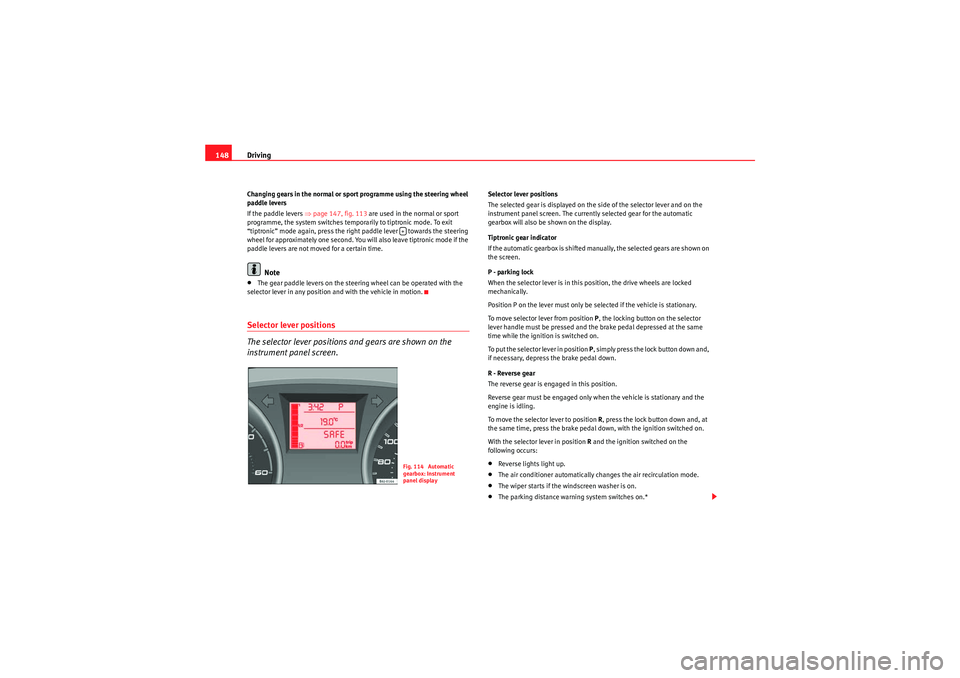
The selector lever positions and gears are shown on the
instrument panel screen.
Selector lever positions
The selected gear is displayed on the side of the selector lever and on the
instrument panel screen. The currently selected gear for the automatic
gearbox will also be shown on the display.
Tiptronic gear indicator
If the automatic gearbox is shifted manually, the selected gears are shown on
the screen.
P - parking lock
When the selector lever is in this position, the drive wheels are locked
mechanically.
Position P on the lever must only be selected if the vehicle is stationary.
To move selector lever from position P, the locking button on the selector
lever handle must be pressed and the brake pedal depressed at the same
time while the ignition is switched on.
To put the selector lever in position P, simply press the lock button down and,
if necessary, depress the brake pedal down.
R - Reverse gear
The reverse gear is engaged in this position.
Reverse gear must be engaged only when the vehicle is stationary and the
engine is idling.
To move the selector lever to position R, press the lock button down and, at
the same time, press the brake pedal down, with the ignition switched on.
With the selector lever in position R and the ignition switched on the
following occurs:•Reverse lights light up.•The air conditioner automatically changes the air recirculation mode.•The wiper starts if the windscreen washer is on.•The parking distance warning system switches on.*
+Fig. 114 Automatic
gearbox: Instrument
panel display
IbizaST_EN.book Seite 148 Dienstag, 14. September 2010 1:31 13
Page 151 of 264
Driving149
Safety First
Operating Instructions
Practical Tips
Technical Specifications
N - Neutral (idling)
If this position is selected, the gearbox is in neutral. Power is not transmitted
to the wheels and the engine does not have a braking function.
Never use the
N position to drive down a hill. The engine does not function as
a brake and the brakes are subjected to excessive stain.
You could damage the automatic gearbox if you drive down hills with the gear
lever in position N and the engine switched off.
D - Drive (forward)
In this position the gearbox automatically changes to a lower or higher gear,
according to the engine’s requirements, the driving style and speed. The
braking effect of the engine when driving downhill is very limited when the
selector is in this position. The instrument panel displays the selected gear
as well as the selector lever in position D.
If position N has been selected and you wish to select D, you must press the
foot brake if the vehicle is stationary, or travelling at under 5 km/h.
S - Standard driving position (Sport programme)
When the selector lever is in position S, it will automatically change up into a
h igh er gea r late r, an d change d own i nto a low g ea r, if com pare d wi th p osi ti on
D . This way, it is possible to take full advantage of the engine reserve power,
depending on the engine demand, driving style and speed. The braking
effect of the engine when driving downhill is very limited. On the instrument
panel display the selected gear is shown as well as the selector lever to posi-
tion S.
To select gear range S, press the lock button on the selector lever.
WARNING
If the vehicle moves with no control, an accident and serious injury may
occur.
•As a driver, you should never leave your vehicle if the engine is running
and a gear is engaged. If you have to leave your vehicle while the engine is
running, you must always apply the handbrake and engage parking lock P.•If the engine is running and if D or R are engaged, you will need to hold
the the vehicle stopped by depressing footbrake down. The car would creep
forward as the power transmission is not fully interrupted even when the
engine is idling.•Never accelerate when moving the selector gear or you may cause an
accident.•Never move the selector lever to “R” or “P” when driving. Risk of acci-
dent.•Before driving down a very steep slope, reduce your speed and shift to
first gear.•Always hold the vehicle on the foot brake if you stop on hills. Other-
wise, the vehicle could roll back.•Never allow the brake to rub and do not use the brake pedal too often
or for long periods. Constant braking will cause the brakes to overheat and
will considerably reduce the brake effect. This increases the braking
distance and could cause the brake system to fail.WARNING
Never switch the engine off until the vehicle is stationary. You could lose
control of your vehicle. This could cause an accident and serious injury.•The airbags and belt tensioners do not work when the ignition is
switched off.•The brake servo does not work with the engine off. You need more force
to stop the vehicle.•Power steering does not work when the engine is not running. That is
why it is much more difficult to turn the steering wheel.WARNING (continued)
IbizaST_EN.book Seite 149 Dienstag, 14. September 2010 1:31 13
Page 152 of 264
Driving
150•Never remove the key from the ignition if the vehicle is in motion. The
steering lock could suddenly engage, and you would not be able to steer
the vehicle.•Never allow the car to roll downhill with the selector lever in “N”,
regardless of the engine is running or not.Caution
If you allow the vehicle to move when the engine is switched off or with the
selector lever in position “N”, take your foot off the accelerator and wait until
the engine starts idling before returning to position “D”.Kickdown feature
This feature allows maximum acceleration.If you press the accelerator down thoroughly, the gearbox automatically
changes down, depending on speed and en gine speed, into a lower gear to
take full advantage of give the vehicle maximum acceleration.
The gearbox does not change gear until the engine reaches the maximum
determined engine speed for the gear.
WARNING
You could lose control of the vehicle if you accelerate on slippery road
surfaces. Risk of serious injury.•Be particularly careful when using the kickdown features on slippery
road surfaces. With a fast acceleration, the vehicle could lose traction and
skid.
•You should use the kickdown feature only when traffic and weather
conditions allow it to be used safely.
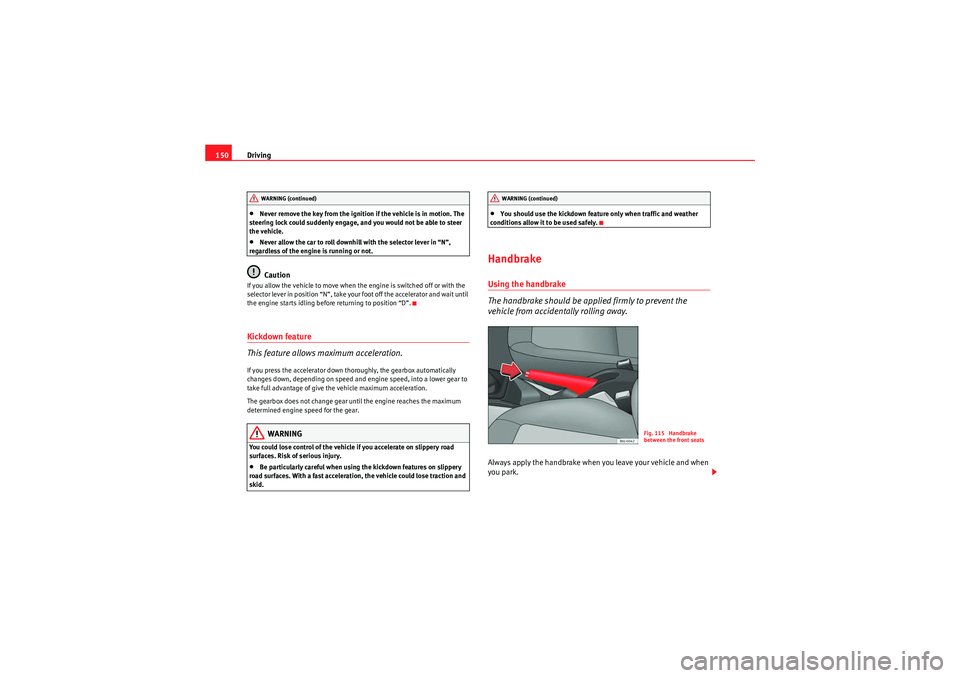
HandbrakeUsing the handbrake
The handbrake should be applied firmly to prevent the
vehicle from accidentally rolling away.Always apply the handbrake when you leave your vehicle and when
you park.
WARNING (continued)
WARNING (continued)
Fig. 115 Handbrake
between the front seats
IbizaST_EN.book Seite 150 Dienstag, 14. September 2010 1:31 13
Page 153 of 264
Driving151
Safety First
Operating Instructions
Practical Tips
Technical Specifications
Applying the handbrake
– Pull the handbrake lever up firmly ⇒ fig. 115.
Releasing the handbrake
– Pull the lever up slightly and press the release knob in the direc- tion of the arrow ⇒fig. 115 and guide the handbrake lever down
fully ⇒ .Always apply the handbrake as far as it will go in order to prevent you from
driving with the handbrake applied by mistake ⇒ .
The handbrake warning lamp
H lights up when the handbrake is applied
and the ignition switched on. The warning turns off when the handbrake is
released.
WARNING
•Never use the handbrake to stop the vehicle when it is in motion. The
braking distance is considerably longer, because braking is only applied to
the rear wheels. Risk of accident!•If it is only partially released, this will cause rear brakes overheating,
which can impair the function of the brake system and could lead to an acci-
dent. This also causes premature wear on the rear brake pads.Caution
Always apply the handbrake before you leave the vehicle. The 1st gear should
also be selected.
Parking
The handbrake should always be firmly applied when the
vehicle is parked.Always note the following points when parking the vehicle:
– Use the brake pedal to stop the vehicle.
– Apply the handbrake.
– The 1st gear should also be selected.
– Switch the engine off and remove the key from the ignition. Turn the steering wheel slightly to engage the steering lock.
– Always take you car keys with you when you leave the vehicle ⇒ .Additional notes on parking the vehicle on gradients:
Turn the steering wheel so that the vehicle rolls against the kerb if it started
to roll.•If the vehicle is parked facing downhill, turn the front wheels so that they
point towards the kerb .•If the vehicle is parked facing uphill, turn the front wheels so that they
point away from the kerb .•Secure the vehicle as normal by applying the handbrake firmly and
engaging 1st gear.WARNING
•Take measures to reduce the risk of injury when you leave your vehicle
unattended.
IbizaST_EN.book Seite 151 Dienstag, 14. September 2010 1:31 13
Page 154 of 264
Driving
152•Never park where the hot exhaust system could ignite inflammable
materials, such as dry grass, low bushes, spilt fuel etc.•Never allow vehicle occupants to remain in the vehicle when it is
locked. They would be unable to open the vehicle from the inside, and
could become trapped in the vehicle in an emergency. In the event of an
emergency, locked doors will delay assistance to occupants.•Never leave children alone in the vehicle. They could set the vehicle in
motion, for example, by releasing the handbrake or the gear lever.•Depending on weather conditions, it may become extremely hot or cold
inside the vehicle. This can be fatal.
Hill-start assist*
This function is only included in vehicles with ESP.This device helps when starting uphill.
These are the basic operation conditions: doors closed, brake pedal pressed
down and vehicle in neutral. The system gets activated on engaging gear.
After removing your foot from the brake pedal, the braking force is maintained
for a few seconds to prevent the vehicle from moving backward when putting
into gear. This short space of time is enough to start the vehicle with ease.
This system also works when reversing uphill.
WARNING
•If you do not start the vehicle immediately after taking your foot off the
brake pedal, the vehicle may start to roll back under certain conditions.
Depress the brake pedal or use the hand brake immediately.
•If the engine stalls, depress the brake pedal or use the hand brake
immediately.•When following a line of traffic uphill, if you want to prevent the vehicle
from rolling back accidentally when starting off, hold the brake pedal down
for a few seconds before starting off.Note
Your Authorised Service or a specialised workshop can tell you if your vehicle
is equipped with this system.Acoustic parking aid system*Rear parking aid
The parking aid system will use an acoustic signal to warn of
the approach of any object towards the rear of the vehicle.Description
The acoustic parking aid system will measure the distance between the rear
of the vehicle and any possible obstacle using four ultrasonic sensors located
on the rear bumper. The measuring range of the sensors starts approximately
and depending on the nature of the obstacle at a distance of:•side of the rear bumper: 0.6 m•middle of the rear bumper: 1.6 m
Activation
The system is activated by engagement of the reverse gear. A brief acoustic
signal confirms the activation and correct function of the system.
WARNING (continued)
WARNING (continued)
IbizaST_EN.book Seite 152 Dienstag, 14. September 2010 1:31 13
Page 155 of 264
Driving153
Safety First
Operating Instructions
Practical Tips
Technical Specifications
Reverse gear
The distance warning will begin as soon as an obstacle is detected by the
system. The frequency of the bleeps emitted by the system will increase
rapidly as the vehicle approaches the obstacle.
Within a short distance of about 30cm, a continuous signal sounds (stop
signal). The driver should not reverse any further.
Models with a factory-fitted towing bracket: When the vehicle is less than
0.35 m away from the obstacle the warning tone will sound continuously. The
driver should then not reverse any further.
The warning tone decreases by 30% after 3 seconds from the start of the
system.
Provided that it is not in continuous mode, the tone on the parking aid system
stops when it detects a wall parallel to the vehicle.
Trailer towing
For vehicles factory-fitted with a towing bar, the parking aid system will not
be activated by the engagement of the reverse gear when pulling a trailer, as
the trailer’s electric connector will be plugged into the vehicle.
Possible faults
If a continuous beep sounds for some seconds when the reverse gear is
engaged, this indicates that there is a fault in the parking aid system.
If the fault continues until the ignition is turned off, the acoustic signal
warning of the fault will not be emitted every time the system is reactivated
(by engaging the reverse gear). Thus, the system ready indication will not
sound either. Have the fault repaired by an Authorised Service Centre as soon
as possible.
If there is no ready signal or no acoustic warning signal, then the parking aid
loudspeaker is faulty and may not warn of obstacles.
To ensure that the system works properly, the sensors must be kept clean and
free of ice and snow.
WARNING
•The sensors have blind spots in which obstacles may not be detected.•Always look out for small children and animals because the system will
not always detect them. Always pay attention when reversing to avoid acci-
dents.•The parking aid is not a replacement for driver awareness. The driver
must take full responsibility for parking and other manoeuvres.Caution
•Please note that low obstacles detected by the system may no longer be
registered by the sensors as the car moves closer, so the system will not give
any further warning. Certain kinds of obstacles (such as wire fences, chains,
thin posts or trailer draw bars, high kerbs or painted railings etc) may not
always be detected by the system, so there is a risk of damaging the vehicle
in such cases.•In some cases, obstacles with uniform edges and bumps may not be
detected immediately by the system due to their geometry. Take special care
of this type of obstacle (corners, rectangular objects, etc.), as they can cause
damage to the vehicle.•Be especially careful when manoeuvring into a corner between two
perpendicular walls. Carefully watch the approach of the wall to the side of
the vehicle (using the mirrors).•The parking aid system does not replace use of the mirrors for manoeu-
vres.•External ultra-sonic sources (pneumatic drills, construction machinery,
other vehicles with PDC) may interfere with the operation of the system.•P e r i o d i c c le a n i n g o f t h e s e ns o r s , ta ke ca r e n o t to d a m a ge o r s cr a tch t h e m .
When cleaning with high pressure washers or steam cleaners, the sensors
should be sprayed for only a very short period and from a distance of more
than 10 cm.
IbizaST_EN.book Seite 153 Dienstag, 14. September 2010 1:31 13
Page 156 of 264
Driving
154Cruise control*Description
The cruise control system is able to maintain the set speed in
the range of 30 km/h to 180 km/h.Once the speed setting has been saved, you may take your foot off the accel-
erator.
WARNING
It could be dangerous to use the cruise control system if it is not possible
to drive at constant speed.•Do not use the cruise control system when driving in dense traffic, on
roads with lots of bends or on roads with poor conditions (with ice, slippery
surfaces, loose grit or gravel), as this could cause an accident.•Always switch the cruise control system off after using it in order to
avoid an involuntary use.•It is dangerous to use a set speed which is too high for the current road,
traffic or weather conditions. Risk of accident.Note
The cruise control cannot maintain a constant speed when descending down-
hill. The vehicle will accelerate due to its own weight. Use the foot brake to
slow the vehicle.
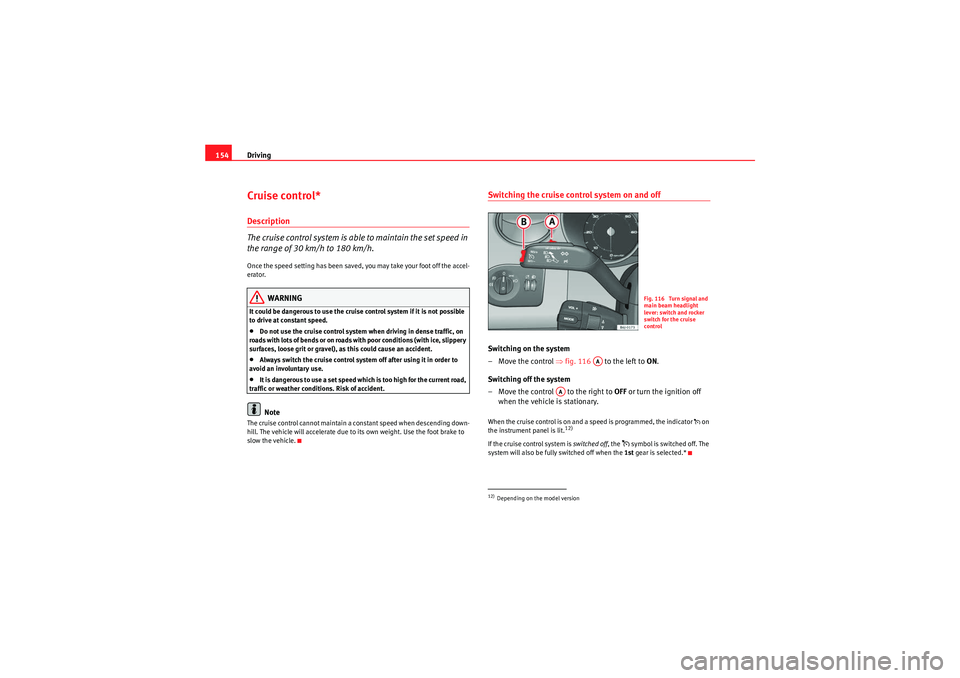
Switching the cruise control system on and offSwitching on the system
–Move the control ⇒fig. 116 to the left to ON .
Switching off the system
– Move the control to the right to OFF or turn the ignition off
when the vehicle is stationary.W h en the cr uis e cont rol is o n an d a sp ee d is pr ogra m m e d, the in di cato r on
the instrument panel is lit.
12)
If the cruise control system is switched off , the
symbol is switched off. The
system will also be fully switched off when the 1st gear is selected.*
12)Depending on the model version
Fig. 116 Turn signal and
main beam headlight
lever: switch and rocker
switch for the cruise
control
AA
AA
IbizaST_EN.book Seite 154 Dienstag, 14. September 2010 1:31 13
Page 158 of 264
Driving
156When you increase speed with the accelerator and then release the pedal, the
system will automatically restore the set speed. This will not be the case,
however, if the vehicle speed is more than 10 km/h higher than the stored
speed for longer than 5 minutes. The speed will have to be stored again.
Cruise control is switched off if you reduce speed by depressing the brake
pedal. Reactivate the control by pressing once on the upper part of the rocker
switch RES+ ⇒ page 155, fig. 118 .
WARNING
It is dangerous to use a set speed which is too high for the current road,
traffic or weather conditions. Risk of accident.Switching off the system temporarily*The cruise control system will be switched off in the following situations:•if the brake pedal is depressed,
•if the clutch pedal is depressed,•if the vehicle is accelerated to over 180 km/h,•when the lever is moved in the direction of OFF without fully being
engaged.
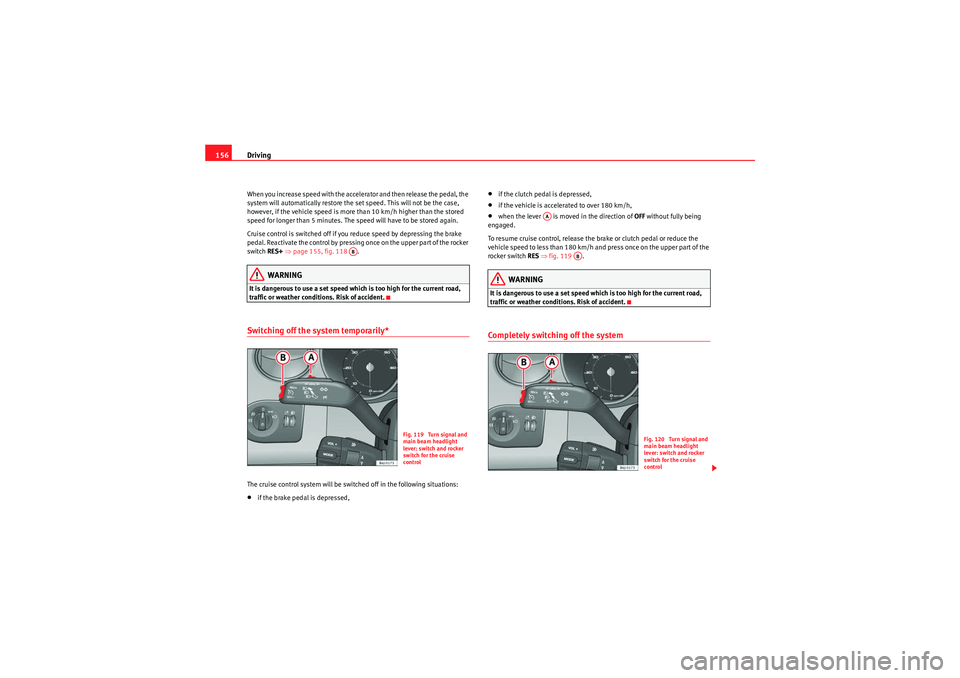
To resume cruise control, release the brake or clutch pedal or reduce the
vehicle speed to less than 180 km/h and press once on the upper part of the
rocker switch RES ⇒fig. 119 .WARNING
It is dangerous to use a set speed which is too high for the current road,
traffic or weather conditions. Risk of accident.Completely switching off the system
AB
Fig. 119 Turn signal and
main beam headlight
lever: switch and rocker
switch for the cruise
control
AA
AB
Fig. 120 Turn signal and
main beam headlight
lever: switch and rocker
switch for the cruise
control
IbizaST_EN.book Seite 156 Dienstag, 14. September 2010 1:31 13
Page 161 of 264
Intelligent technology159
Safety First
Operating Instructions
Practical Tips
Technical Specifications
Practical TipsIntelligent technologyBrakesBrake servoThe brake servo increases the pressure you apply to the brake pedal. It works
only when the engine is running .
If the brake servo is not functioning due to a malfunction, or if the vehicle has
to be towed, you will have to press the brake pedal considerably harder to
make up for the lack of servo assistance.
WARNING
The braking distance can also be affected by external factors.•Never let the vehicle coast with the engine switched off. Failure to do so
could result in an accident. The braking distance is increased considerably
when the brake servo is not active.•If the brake servo is not working, for example when the vehicle is being
towed, you will have to press the brake pedal considerably harder than
normal.
Hydraulic Brake Assist (HBA)*
The Hydraulic Brake Assist function (HBA) is only included in
vehicles with ESP.In an emergency, most drivers brake in time, but not with maximum force.
This results in unnecessarily long braking distances.
This is when the brake assist system comes into action. When pressing the
brake pedal rapidly, the assistant interprets it as an emergency. It then very
quickly builds up the full brake pressure so that the ABS can be activated
more quickly and efficiently, thus reducing the braking distance.
Do not reduce the pressure on the brake pedal. The brake assist system
switches off automatically as soon as you release the brake.
Automatic hazard warning lights activation
The brake lights flash automatically to indicate that the vehicle is braking
suddenly or in an emergency situation. If the emergency braking continues
until the vehicle comes to a standstill, the hazard warning lights will then
come on and the brake lights will remain on permanently from that moment.
The hazard warning lights will automatically switch off when the vehicle
begins to move again or when the warning light button is pressed.
WARNING
•The risk of accident is higher if you drive too fast, if you do not keep
your distance to the vehicle in front, and when the road surface is slippery
or wet. The increased accident risk cannot be reduced by the brake assist
system.
IbizaST_EN.book Seite 159 Dienstag, 14. September 2010 1:31 13
Page 162 of 264
Intelligent technology
160•The brake assist system cannot defy the laws of physics. Slippery and
wet roads are dangerous even with the brake assist system! Therefore, it is
essential that you adjust your speed to suit the road and traffic conditions.
Do not let the extra safety features tempt you into taking any risks when
driving.
Anti-lock brake system and traction control
ABSAnti-lock brake system (ABS)
The anti-lock brake system prevents the wheels locking
during braking.The anti-lock brake system (ABS) is an important part of the vehicle’s active
safety system.
How the ABS works
If one of the wheels is turns too slowly in relation to the road speed, and is
close to locking, the system will reduce the braking pressure for this wheel.
The driver is made aware of this control process by a pulsating of the brake
pedal and audible noise. This is a deliberate warning to the driver that one or
more of the wheels is tending to lock and the ABS control function has inter-
vened. In this situation it is important to keep the brake pedal fully depressed
so the ABS can regulate the brake application. Do not “pump”.
If you brake hard on a slippery road surface, the best possible control is
retained as the wheels do not lock. However, ABS will not necessarily gu
arantee shorter braking distances in all
conditions. The braking distance could even be longer if you brake on gravel
or on fresh snow covering a slippery surface.
WARNING
•The anti-lock brake system cannot defy the laws of physics. Slippery
and wet roads are dangerous even with ABS! If you notice that the ABS is
working (to counteract locked wheels under braking), you should reduce
speed immediately to suit the road and traffic conditions. Do not let the
extra safety features tempt you into taking any risks when driving.•The effectiveness of ABS is also determined by the tyres fitted
⇒ page 203.•If the running gear or brakes are modified, the effectiveness of the ABS
could be severely limited.
Traction control system (TCS)*
The traction control system prevents the drive wheels from
spinning when the vehicle is accelerating. The system always
includes ABSDescription and operation of the traction control system during acceleration
(TCS)
TCS reduces engine power to help prevent the drive wheels of front-wheel
drive vehicles losing traction during acceleration. The system works in the
entire speed range in conjunction with ABS. If a malfunction occurs in the
ABS, the TCS will also be inoperative.
TCS helps the vehicle to start moving, accelerate and climb a gradient in slip-
pery conditions where this may otherwise be difficult or even impossible.
WARNING (continued)
IbizaST_EN.book Seite 160 Dienstag, 14. September 2010 1:31 13