lights control Seat Ibiza ST 2010 User Guide
[x] Cancel search | Manufacturer: SEAT, Model Year: 2010, Model line: Ibiza ST, Model: Seat Ibiza ST 2010Pages: 264, PDF Size: 7.11 MB
Page 96 of 264
Lights and visibility
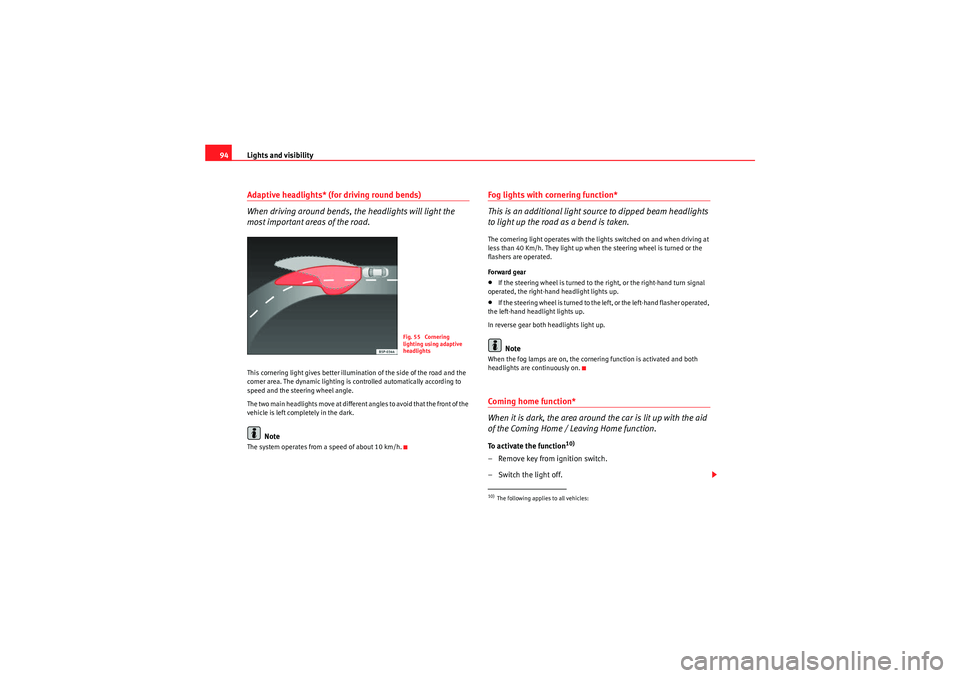
94Adaptive headlights* (for driving round bends)
When driving around bends, the headlights will light the
most important areas of the road.This cornering light gives better illumination of the side of the road and the
corner area. The dynamic lighting is controlled automatically according to
speed and the steering wheel angle.
The two main headlights move at different angles to avoid that the front of the
vehicle is left completely in the dark.
Note
The system operates from a speed of about 10 km/h.
Fog lights with cornering function*
This is an additional light source to dipped beam headlights
to light up the road as a bend is taken.The cornering light operates with the lights switched on and when driving at
less than 40 Km/h. They light up when the steering wheel is turned or the
flashers are operated.
Forward gear•If the steering wheel is turned to the right, or the right-hand turn signal
operated, the right-hand headlight lights up.•If the steering wheel is turned to the left, or the left-hand flasher operated,
the left-hand headlight lights up.
In reverse gear both headlights light up.Note
When the fog lamps are on, the cornering function is activated and both
headlights are continuously on.Coming home function*
When it is dark, the area around the car is lit up with the aid
of the Coming Home / Leaving Home function.To activate the function
10)
– Remove key from ignition switch.
– Switch the light off.
Fig. 55 Cornering
lighting using adaptive
headlights
10)The following applies to all vehicles:
IbizaST_EN.book Seite 94 Dienstag, 14. September 2010 1:31 13
Page 102 of 264
Lights and visibility
100
NoteIncorrect use of the sun visors (e.g. pulling them downwards once they are
open) may result in broken hinges. This damage is not covered by the vehicle
warranty.Windscreen wipersWindscreen wipers
U
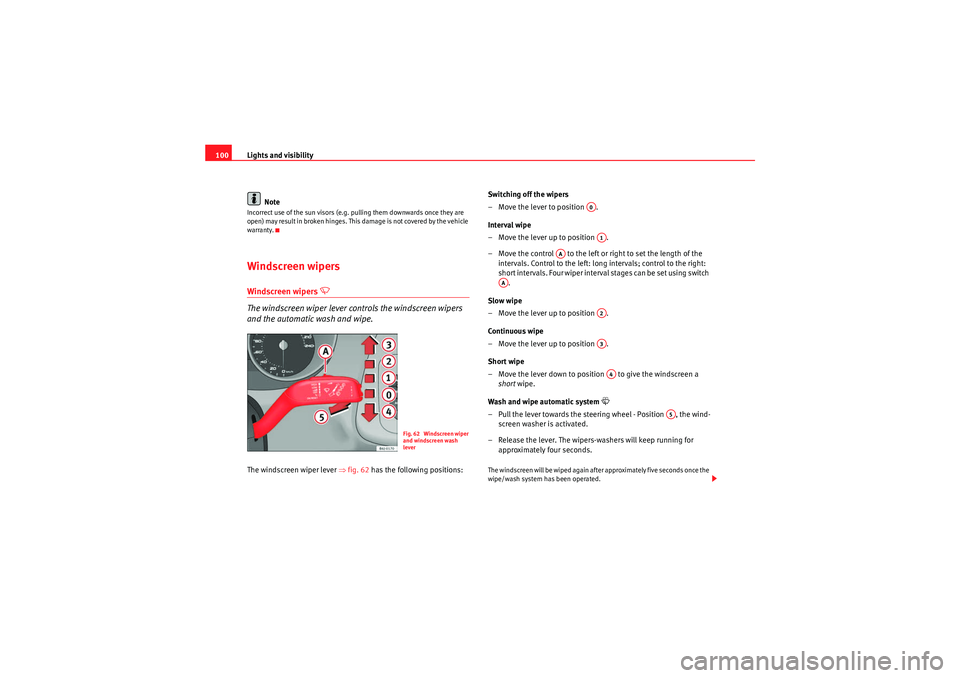
The windscreen wiper lever controls the windscreen wipers
and the automatic wash and wipe.
The windscreen wiper lever ⇒fig. 62 has the following positions: Switching off the wipers
– Move the lever to position .
Interval wipe
– Move the lever up to position .
– Move the control to the left or right to set the length of the
intervals. Control to the left: long intervals; control to the right:
short intervals. Four wiper interval stages can be set using switch .
Slow wipe
– Move the lever up to position .
Continuous wipe
– Move the lever up to position .
Short wipe
– Move the lever down to position to give the windscreen a short wipe.
Wash and wipe automatic system
W
– Pull the lever towards the steering wheel - Position , the wind- screen washer is activated.
– Release the lever. The wipers-washers will keep running for approximately four seconds.The windscreen will be wiped again after approximately five seconds once the
wipe/wash system has been operated.
Fig. 62 Windscreen wiper
and windscreen wash
lever
A0A1
AA
AA
A2A3A4
A5
IbizaST_EN.book Seite 100 Dienstag, 14. September 2010 1:31 13
Page 103 of 264
Lights and visibility101
Safety First
Operating Instructions
Practical Tips
Technical Specifications
WARNING
•Worn and dirty wiper blades reduce visibility and safety levels while
driving.•In cold conditions, you should not use the wash / wipe system unless
you have warmed the windscreen with the heating and ventilation system.
The washer fluid could otherwise freeze on the windscreen and obscure
your view of the road.•Always note the corresponding warnings on ⇒page 198.Caution
In icy conditions, always check that the wiper blades are not frozen to the
glass before using the wipers for the first time. If you switch on the wipers
when the wiper blades are frozen to the windscreen, you could damage both
the wiper blades and the wiper motor.
Note
•The windscreen wipers will only work when the ignition is switched on.•The heat output of the heated jets* is controlled automatically when the
ignition is switched on, depending upon the outside temperature.•In certain versions of vehicles with alarms, the windscreen wiper will only
work in interval/rain sensor mode when the ignition is on and the bonnet
closed.•When the interval wipe function is on, the intervals are directly propor-
tional to the speed. This way, the higher the vehicle speed the shorter the
intervals.•If you stop the vehicle with the windscreen wiper in position 1 or 2, it will
automatically change to a lower position speed. The set speed will be
resumed when the vehicle pulls away.
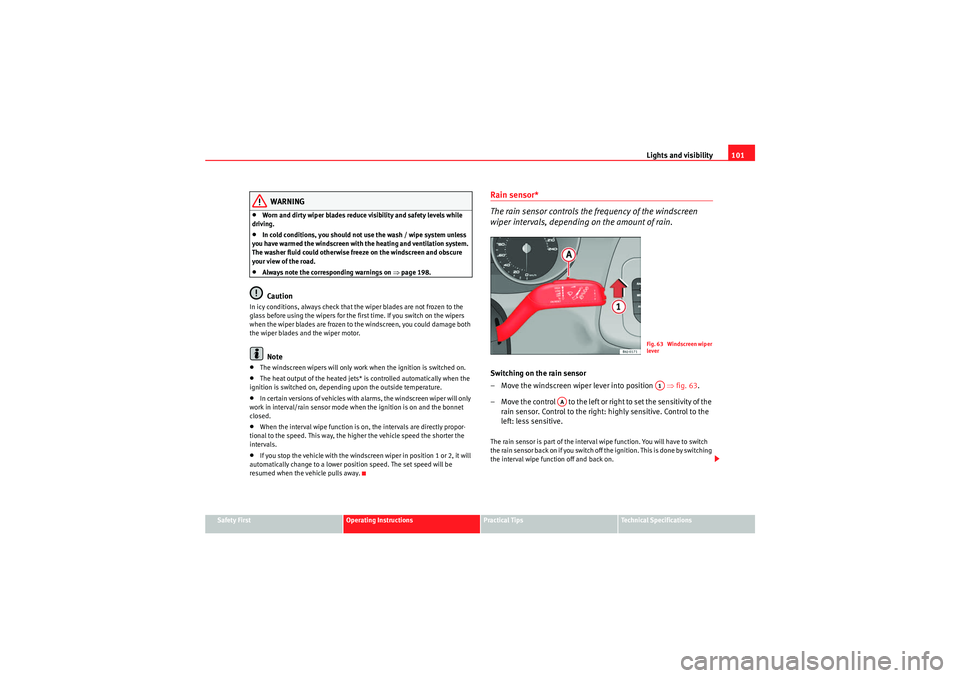
Rain sensor*
The rain sensor controls the frequency of the windscreen
wiper intervals, depending on the amount of rain.Switching on the rain sensor
– Move the windscreen wipe r lever into position ⇒fig. 63 .
– Move the control to the left or right to set the sensitivity of the rain sensor. Control to the right: highly sensitive. Control to the
left: less sensitive.The rain sensor is part of the interval wipe function. You will have to switch
t h e r a i n s e n s o r b a ck o n i f y o u s w i tch o f f t h e i g n i t i o n . T h i s is d o n e b y s wi t ch i n g
the interval wipe function off and back on.
Fig. 63 Windscreen wiper
leverA1
AA
IbizaST_EN.book Seite 101 Dienstag, 14. September 2010 1:31 13
Page 106 of 264
Lights and visibility
104
Switching on the anti-dazzle function
–Press button ⇒page 103, fig. 65 . The indicator lamp turns
on.Anti-dazzle function
The anti-dazzle function is activated every time the ignition is switched on.
The green indicator lamp lights up in the mirror housing.
When the anti-dazzle function is enabled, the interior mirror will darken auto-
matically according to the amount of light it receives. The anti-dazzle func-
tion is cancelled if reverse gear is engaged.
Note
•The automatic anti-dazzle function will only work properly if the sun
blind* for the rear window is retracted and there are no other objects
preventing light from reaching the rear view mirror.•If you have to stick any type of sticker on the windscreen, do not do so in
front of the sensors. Doing so could prevent the anti-dazzle function from
working well or even from working at all.Folding in the exterior mirrorsThe exterior mirrors of the vehicle may be folded in. For this, press the mirror
housing towards the vehicle.
Note
Before washing the vehicle with an automatic car wash, fold in the mirrors to
avoid damage.
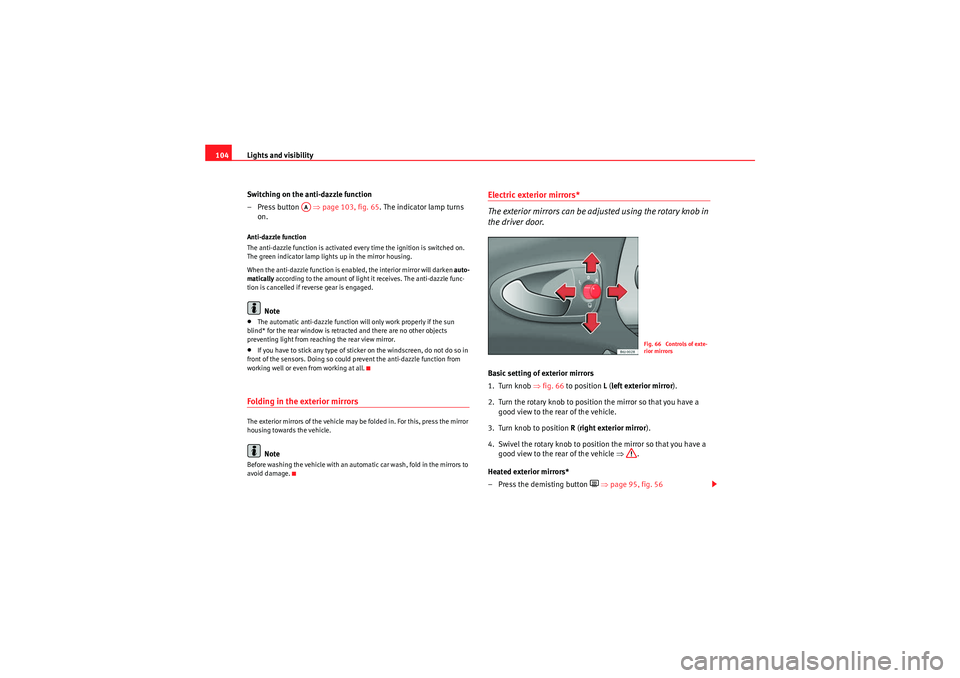
Electric exterior mirrors*
The exterior mirrors can be adjusted using the rotary knob in
the driver door.Basic setting of exterior mirrors
1. Turn knob ⇒fig. 66 to position L ( left exterior mirror ).
2. Turn the rotary knob to positi on the mirror so that you have a
good view to the rear of the vehicle.
3. Turn knob to position R (right exterior mirror ).
4. Swivel the rotary knob to position the mirror so that you have a good view to the rear of the vehicle ⇒.
Heated exterior mirrors*
–Press the demisting button
= ⇒ page 95, fig. 56
AA
Fig. 66 Controls of exte-
rior mirrors
IbizaST_EN.book Seite 104 Dienstag, 14. September 2010 1:31 13
Page 107 of 264
Lights and visibility105
Safety First
Operating Instructions
Practical Tips
Technical Specifications
– The mirrors demist for some minutes to prevent draining the
battery.
– If necessary, press the button again to repeat the function.
– The exterior mirror heating is not activated with temperatures above 20 °C.
Folding in exterior mirrors*
–Turn the control ⇒page 104, fig. 66 to position
to fold in the
exterior mirrors. You should always fold in the exterior mirrors if
you are driving through an automa tic car wash. This will help
prevent damage.
Folding exterior mirrors back out to the extended position*
– Turn the knob to position L or R to fold the exterior mirrors back out ⇒ .
WARNING
•Convex or aspheric mirrors increase the field of vision however the
objects appear smaller and further away in the mirrors. If you use these
mirrors to estimate the distance to vehicles behind you when changing
lane, you could make a mistake. Risk of accident.•If possible, use the rear view mirror to estimate distances to vehicles
behind you.•Make sure that you do not get your finger trapped between the mirror
and the mirror base when folding back the mirrors. Risk of injury!For the sake of the environment
The exterior mirror heating should be switched off when it is no longer
needed. Otherwise, it is an unnecessary fuel waste.
Note
•If the electrical adjustment ever fails to operate, the mirrors can be
adjusted by hand by lightly pressing the edge of the mirror glass.•In vehicles with electric exterior mirrors, the following points should be
observed: if, due to an external force (e.g. a knock while manoeuvring), the
adjustment of the mirror housing is altered, the mirror will have to be
completely folded electrically. D o n o t r e a d j us t t h e m i r r o r h o us i n g b y ha n d , a s
this will interfere with the mirror adjuster function.•The rear view mirrors can be adjusted separately or simultaneously, as
described before.•The fold-in function on the exterior mirrors is not active at speeds over 40
km/h.
IbizaST_EN.book Seite 105 Dienstag, 14. September 2010 1:31 13
Page 127 of 264
Air conditioning125
Safety First
Operating Instructions
Practical Tips
Technical Specifications
Air conditioningHeatingControls– Using the controls and and with the switch ⇒fig. 96
you can adjust the temperature, the air distribution and the
blower speed.
– Press the button to switch ai r recirculation mode on or off.
When the function is activated, a warning light on the button is
turned on.Te m p e r a t u r e
Switch adjusts temperature. The required temperature inside the vehicle
cannot be lower than the ambient temperature. Maximum heat output, which is needed to defrost the windows quickly, is only available when the engine
has reached its operating temperature.
Blower
The air flow can be set at four speeds with switch . The blower should
always be set at the lowest speed when driving slowly.
Air distribution
Control for setting the flow of air in the required direction.
< – Air distribution towards the windscreen in order to demist. For safety
reasons, it is not recommended to switch air recirculation on. – Air distribution to the upper body – Air distribution to footwell – Air distribution to the windscreen and the footwell.
Air recirculation mode
Air recirculation mode on (a lamp lights up in red) prevents strong odours
from the outside air from entering in the vehicle, for example when passing
through a tunnel or in a traffic jam ⇒.
When the outside temperature is low, air recirculation mode improves
heating performance by heating air from the interior instead of cold air from
the outside.
WARNING
•For your safety, the windows should never be fogged up or covered with
snow or ice. This is essential to ensure good visibility. Please familiarise
yourself with the correct operation of the heating and ventilation system,
including the demist/defrost functions for the windows.
Fig. 96 Heating controls
on the dash panel
AA
AC
AB
AD
AA
AB
AC
AD
IbizaST_EN.book Seite 125 Dienstag, 14. September 2010 1:31 13
Page 164 of 264
Intelligent technology
162Electronic Stability Programme (ESP)*
ESP reduces the danger of skidding by braking the wheels individually.
The system uses the steering wheel angle and road speed to calculate the
changes of direction desired by the driver, and constantly compares them
with the actual behaviour of the vehicle. If the desired course is not being
maintained (for instance, if the vehicle is starting to skid), then the ESP
compensates automatically by braking the appropriate wheel.
The forces acting on the braked wheel bring the vehicle back to a stable
condition. If the vehicle tends to oversteer, the system will act on the front
wheel on the outside of the turn.
WARNING
•It must be remembered that ESP cannot defy the laws of physics. This
should be kept in mind, particularly on slippery and wet roads and when
towing a trailer.•Always adapt your driving style to suit the condition of the roads and
the traffic situation. Do not let the extra safety afforded by ESP tempt you
into taking any risks when driving, as this can cause accidents.Caution
•In order to ensure that ESP functions correctly, all four wheels must be
fitted with the same tyres. Any differences in the rolling radius of the tyres can
cause the system to reduce engine power when this is not desired.•Modifications to the vehicle (e.g. to the engine, the brake system, running
gear or any components affecting the wheels and tyres) could affect the effi-
ciency of the ABS, EDL, ESP and TCS.
Anti-lock brake system (ABS)The anti-lock brake system prevents the wheels locking during braking
⇒ page 160.Electronic differential lock (EDL)*
The electronic differential lock helps prevent the loss of trac-
tion caused if one of the driven wheels starts spinning.EDL helps the vehicle to start moving, accelerate and climb a gradient in slip-
pery conditions where this may otherwise be difficult or even impossible.
The system will control the revolutions of the drive wheels using the ABS
sensors (in case of an EDL fault the warning lamp for ABS lights up)
⇒ page 63.
At speeds of up to approximately 80 km/h, it is able to balance out differ-
ences in the speed of the driven wheels of approximately 100 rpm caused by
a slippery road surface on one side of the vehicle. It does this by braking the
wheel which has lost traction and distributing more driving force to the other
driven wheel via the differential.
To prevent the disc brake of the braking wheel from overheating, the EDL cuts
out automatically if subjected to excessive loads. The vehicle will continue to
function normally without EDL. For this reason, the driver is not informed that
the EDL has been switched off.
The EDL will switch on again automatically when the brake has cooled down.
WARNING
•When accelerating on a slippery surface, for example on ice and snow,
press the accelerator carefully. Despite EDL, the driven wheels may start to
spin. This could impair the vehicle’s stability.
IbizaST_EN.book Seite 162 Dienstag, 14. September 2010 1:31 13
Page 222 of 264
If and when
220
14
Left-hand AFS headlights
15
15
Right-hand AFS headlights
15
16
Vaca n t
17
Number plate light /Dimmer /Side light indicator
light
5
18
Dimmer
5
19
Electronic control unit
5
20
Turn signals
15
21
Lights control/ Instrument panel
5
22
Electronic control unit/ Heated mirrors
5
23
Engine injection module/ Rain sensor/ Auto-
matic gear lever/ Starter relay
7.5
24
Glove compartment light/ Luggage compartment
light/ Interior light
10
25
Parking aid
5
26
Towing hook
27
Vaca n t
28
Lambda probe
10
29
Engine power supply
20
30
Petrol engine operation
10
31
Petrol engine operation/Glow plugs/Relay
coil/Bi-turbo electric fan
10
32
Engine control unit
15
33
Clutch switch power supply/ Preheating relay/
Servo sensor
5
Number
Consumer
Amps
34
Fuel control unit / Bi-turbo engine supply
15
35
12V power socket in luggage compartment
15
36
Main beam headlight, right
10
37
Main beam headlight, left/Coming Home
10
38
Electric fan motor
30
39
Vaca n t
15
40
12 Volt Input/Cigarette lighter
15
41
Heated seats control unit / Cup Holder
25
42
Horn
20
43
Panorama sunroof
30
44
Windscreen wipers
20
45
Heated rear window
30
46
Radio / VDA telephone / Bluetooth / Steering
wheel controls / DC/DC converter for Start/Stop
20
47
Climatronic/autoclimate
5
48
Locking unit
25
49
Front electric window
30
50
Rear electric windows
30
51
Automatic gearbox control unit
30
52
Alarm/Volume sensor
15
53
Electro-kinetic pump relay/bi-turbo fuel control
unit
15
54
Reverse light for automatic gearbox/ Fog light
15
55
Transformer on
15
Number
Consumer
Amps
IbizaST_EN.book Seite 220 Dienstag, 14. September 2010 1:31 13
Page 224 of 264
If and when
222BulbsGeneral notesBefore changing any bulb, first turn off the failed component.
Do not touch the bulb glass. Fingerprints vaporise in the heat, causing a
reduction in the bulb life and condensation on the mirror surface, thus
reducing efficiency.
A bulb should only be replaced by one of the same type. The type is inscribed
on the bulb, either on the glass part or on the base.
It is highly recommended to keep a box of spare bulbs in the vehicle. At the
very least, the following spare bulbs, which are essential for road safety,
should be kept in the vehicle.
Double headlights
Dipped beam - H7 Long Life
Main beam - H7
Position - 2 x W5W Long Life
Turn signal - PY21W
Single headlight
Dipped/Main H4 Long Life
Position W5W Long Life
Turn signal PY 21W
Xenon headlights
13)/adaptive*
Dipped and full beam - D1S
14)
Position W5W Blue Long Life DRL (day light) P21W Super Long Life
Turn signals PY21W
Fog lights
Fog light/cornering - H11
Ta i l l i g h t s
Fog light - P21W
Reverse gear - R10W
Stop/position P21 /5W Long Life
Turn signal - PY21W
Side turn signal
Side turn signal - W5W
Number plate light
Number plate light - W5W Long Life
Note
•Depending on weather conditions (cold or wet), the front lights, the fog
lights, the tail lights and the turn signals may be temporarily misted. This has
no influence on the useful life of the lighting system. By switching on the
lights, the area through which the beam of light is projected will quickly be
demisted. However, the edges may continue to be misted.•Please check at regular intervals that all lighting (especially the exterior
lighting) on your vehicle is functioning properly. This is not only in the interest
of your own safety, but also that of all other road users.•Due to the difficulty in accessing some of the bulbs, any replacement work
should be done by a SEAT dealer. However, there is a description below as to
how to change these bulbs, except for the fog lights.
13)On this type of headlight, the bulb changes must be made by the SEAT dealer, given that complex elements must be removed from the vehicle and a reset must be made
on the automatic control system incorporated.
14)The Xenon bulbs discharge 2.5 times the light flux and have an average lifespan of 5
times more than that of halogen bulbs, this means that, except due to unusual circum-
stances, there is no need to change the bulbs for the whole life of the vehicle.
IbizaST_EN.book Seite 222 Dienstag, 14. September 2010 1:31 13
Page 256 of 264
Index
254Selective unlocking system* . . . . . . . . . . . . 75
Unlocking system* . . . . . . . . . . . . . . . . . . . . 76
Central locking button Locking . . . . . . . . . . . . . . . . . . . . . . . . . . . . . 77
Unlocking . . . . . . . . . . . . . . . . . . . . . . . . . . . . 77
Cetane number . . . . . . . . . . . . . . . . . . . . . . . . . 187
Changing a wheel . . . . . . . . . . . . . . . . . . . . . . . 211
Changing bulbs interior light and front reading lights . . . . 230
Changing double headlight bulbs . . . . . . . . . . 223 dipped beam . . . . . . . . . . . . . . . . . . . . . . . . 224
main beam and side lights . . . . . . . . . . . . . 223
turn signal . . . . . . . . . . . . . . . . . . . . . . . . . . 225
Changing gear See Manual gearbox . . . . . . . . . . . . . . . . . . 142
Changing gear in tiptronic mode . . . . . . . . . . . 147
Changing rear lights on the tailgate . . . . . . . . . . . . . . . . . . . . . . . 228
on the wing . . . . . . . . . . . . . . . . . . . . . . . . . 227
Changing single headlight bulbs . . . . . . . . . . . 225 turn signal . . . . . . . . . . . . . . . . . . . . . . . . . . 227
Changing the bulbs Luggage compartment light . . . . . . . . . . . . 231
Number plate light . . . . . . . . . . . . . . . . . . . 230
Side turn signals . . . . . . . . . . . . . . . . . . . . . 229
Changing the single headlight bulbs dipped/main beam . . . . . . . . . . . . . . . . . . . 226
Side lights . . . . . . . . . . . . . . . . . . . . . . . . . . 226
Changing windscreen wiper blades . . . . . . . . . 198
Chassis number . . . . . . . . . . . . . . . . . . . . . . . . 238
Checking . . . . . . . . . . . . . . . . . . . . . . . . . . . . . . 202 Checking battery electrolyte level . . . . . . . . . . 202
Checking engine oil level . . . . . . . . . . . . . . . . . 192
Child safety . . . . . . . . . . . . . . . . . . . . . . . . . . . . . 39
Child seat . . . . . . . . . . . . . . . . . . . . . . . . . . . . . . . 41
Categorisation in groups . . . . . . . . . . . . . . . 41
Group 1 . . . . . . . . . . . . . . . . . . . . . . . . . . . . . 42
Group 2 . . . . . . . . . . . . . . . . . . . . . . . . . . . . . 42
Group 3 . . . . . . . . . . . . . . . . . . . . . . . . . . . . . 42
Groups 0 and 0+ . . . . . . . . . . . . . . . . . . . . . . 41
ISOFIX system . . . . . . . . . . . . . . . . . . . . . . . . 44
Safety notes . . . . . . . . . . . . . . . . . . . . . . . . . . 39
Securing . . . . . . . . . . . . . . . . . . . . . . . . . . . . . 44
Child seats on the front passenger seat . . . . . . . . . . . . . 28
Top Tether system . . . . . . . . . . . . . . . . . . . . . 45
Cigarette lighter . . . . . . . . . . . . . . . . . . . . . . . . 116
Cleaning alloy wheels . . . . . . . . . . . . . . . . . . . . 177
Cleaning chrome . . . . . . . . . . . . . . . . . . . . . . . . 176
Cleaning engine compartment . . . . . . . . . . . . . 178
Cleaning steel wheel rims . . . . . . . . . . . . . . . . 177
Cleaning windows . . . . . . . . . . . . . . . . . . . . . . . 175
Climatronic automatic mode . . . . . . . . . . . . . . . . . . . . . 132
controls . . . . . . . . . . . . . . . . . . . . . . . . . . . . 131
General notes . . . . . . . . . . . . . . . . . . . . . . . 134
manual mode . . . . . . . . . . . . . . . . . . . . . . . 133
Clock . . . . . . . . . . . . . . . . . . . . . . . . . . . . . . . . . . 52
Cloth seat covers cleaning . . . . . . . . . . . . . . . . 179
Cockpit . . . . . . . . . . . . . . . . . . . . . . . . . . . . . . . . . 49
Coming home function . . . . . . . . . . . . . . . . . . . . 94
Compartment for on-board documentation . . 112 Control
Exterior mirrors . . . . . . . . . . . . . . . . . . . . . . 104
Control lamps . . . . . . . . . . . . . . . . . . . . . . . . . . . 58
Control lighting . . . . . . . . . . . . . . . . . . . . . . . . . . 49
Controls Electric windows . . . . . . . . . . . . . . . . . . . . . . 86
Convenience closing Sliding/tilting sunroof . . . . . . . . . . . . . . . . . 90
Windows . . . . . . . . . . . . . . . . . . . . . . . . . . . . 88
Convenience opening Windows . . . . . . . . . . . . . . . . . . . . . . . . . . . . 88
Coolant . . . . . . . . . . . . . . . . . . . . . . . . . . . 195, 196
Coolant level . . . . . . . . . . . . . . . . . . . . . . . . . . . 196 Warning lamp . . . . . . . . . . . . . . . . . . . . . . . . 67
Coolant loss . . . . . . . . . . . . . . . . . . . . . . . . . . . . 196
Coolant temperature Safety instructions . . . . . . . . . . . . . . . . . . . . 68
Warning lamp . . . . . . . . . . . . . . . . . . . . . . . . 67
Correct adjustment of front head restraints . . . 12
Correct sitting position Front passenger . . . . . . . . . . . . . . . . . . . . . . 11
Incorrect sitting position . . . . . . . . . . . . . . . 13
Cruise control . . . . . . . . . . . . . . . . . . . . . . . . . . 154
Cruise control system . . . . . . . . . . . . . . . . . . . . 154 Warning lamp . . . . . . . . . . . . . . . . . . . . . . . . 65
DDanger of fitting a child seat on the front passenger seat . . . . . . . . . . . . . . . . . . . . . . . . . . . . . . . 28
Dash panel . . . . . . . . . . . . . . . . . . . . . . . . . . . . . 49
IbizaST_EN.book Seite 254 Dienstag, 14. September 2010 1:31 13