weight Seat Ibiza ST 2010 User Guide
[x] Cancel search | Manufacturer: SEAT, Model Year: 2010, Model line: Ibiza ST, Model: Seat Ibiza ST 2010Pages: 264, PDF Size: 7.11 MB
Page 116 of 264
Seats and storage compartments
114It is necessary to use a specific adapter for each navigator, so consult your
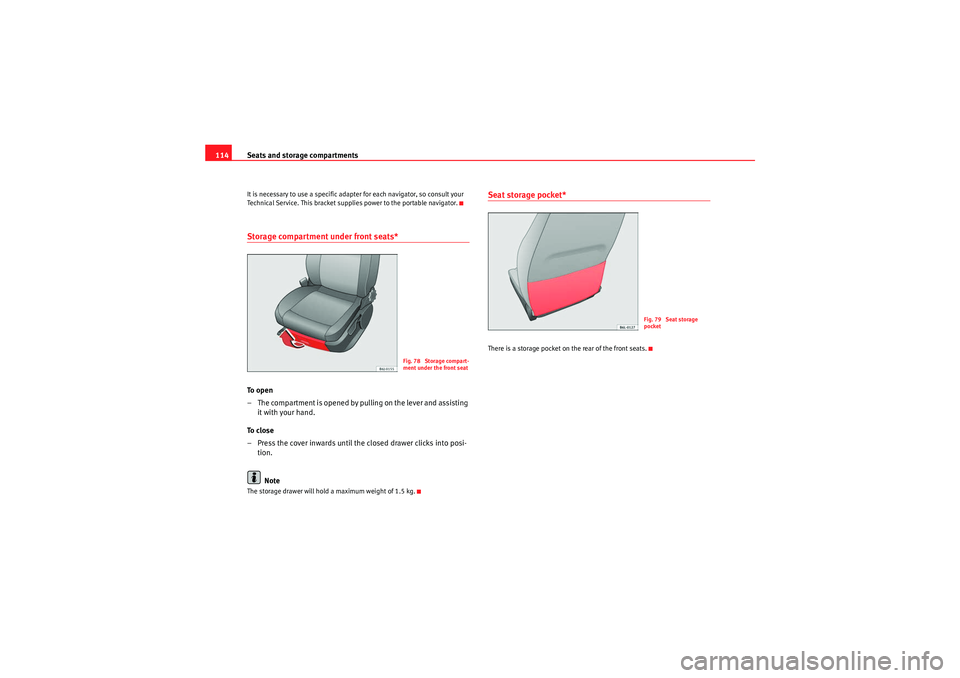
Technical Service. This bracket supplies power to the portable navigator.Storage compartment under front seats*To o p e n
– The compartment is opened by pulling on the lever and assisting
it with your hand.
To c l o s e
– Press the cover inwards until the closed drawer clicks into posi- tion.
NoteThe storage drawer will hold a maximum weight of 1.5 kg.
Seat storage pocket*There is a storage pocket on the rear of the front seats.
Fig. 78 Storage compart-
ment under the front seat
Fig. 79 Seat storage
pocket
IbizaST_EN.book Seite 114 Dienstag, 14. September 2010 1:31 13
Page 126 of 264
Seats and storage compartments
124•For safety reasons, only luggage racks and accessories approved by SEAT
should be used.•It is essential that you follow the assembly instructions included with the
bars exactly, being especially careful to position the front and rear luggage
compartment cover bars on the special housings on the longitudinal bars.
You must also respect their position according to the direction of travel indi-
cated in the assembly manual. Not following these instructions may cause
marks on the longitudinal bars.•Distribute the load evenly. A maximum load of 40 kg only is permitted for
each roof rack system support bar, the load must be distributed evenly along
the entire length. However, the maximum load permitted for the entire roof
(including the support system) of 75 kg must not be exceeded nor should the
total weight of the vehicle be exceeded. See the Technical Data section.•When transporting heavy or large objects on the roof, any change in the
normal vehicle behaviour due to a change in the centre of gravity or an
increased wind resistance must be taken into account. For this reason, a suit-
able speed and driving style must be used.•For those vehicles fitted with a sliding/ tilting sunroof*, ensure that it does
not interfere with the load on the roof rack system when opened.
IbizaST_EN.book Seite 124 Dienstag, 14. September 2010 1:31 13
Page 156 of 264
Driving
154Cruise control*Description
The cruise control system is able to maintain the set speed in
the range of 30 km/h to 180 km/h.Once the speed setting has been saved, you may take your foot off the accel-
erator.
WARNING
It could be dangerous to use the cruise control system if it is not possible
to drive at constant speed.•Do not use the cruise control system when driving in dense traffic, on
roads with lots of bends or on roads with poor conditions (with ice, slippery
surfaces, loose grit or gravel), as this could cause an accident.•Always switch the cruise control system off after using it in order to
avoid an involuntary use.•It is dangerous to use a set speed which is too high for the current road,
traffic or weather conditions. Risk of accident.Note
The cruise control cannot maintain a constant speed when descending down-
hill. The vehicle will accelerate due to its own weight. Use the foot brake to
slow the vehicle.
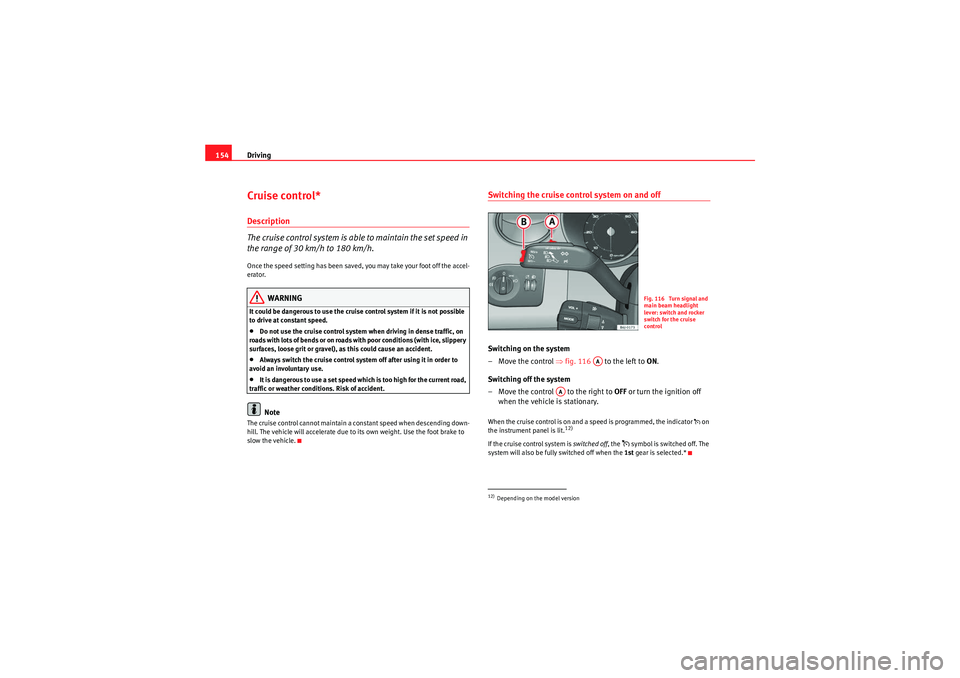
Switching the cruise control system on and offSwitching on the system
–Move the control ⇒fig. 116 to the left to ON .
Switching off the system
– Move the control to the right to OFF or turn the ignition off
when the vehicle is stationary.W h en the cr uis e cont rol is o n an d a sp ee d is pr ogra m m e d, the in di cato r on
the instrument panel is lit.
12)
If the cruise control system is switched off , the
symbol is switched off. The
system will also be fully switched off when the 1st gear is selected.*
12)Depending on the model version
Fig. 116 Turn signal and
main beam headlight
lever: switch and rocker
switch for the cruise
control
AA
AA
IbizaST_EN.book Seite 154 Dienstag, 14. September 2010 1:31 13
Page 170 of 264
Driving and the environment
168Do not use winter tyres all year round as they increase fuel consumption by
up to 10%.
Avoid unnecessary weight
Every kilo of extra weight will put up the fuel consumption, so it is worth
checking the luggage compartment occasionally to make sure that no unnec-
essary loads are being transported.
A roof rack is often left in place for the sake of convenience, even when it is
no longer needed. At a speed of 100-120 km/h your vehicle will use about
12% more fuel as a result of the extra wind resistance caused by the roof rack
even when it is not in use.
Save electricity
The engine activates the alternator, which produces electricity. With the need
for electricity, fuel consumption is also increased. Because of this, always
turn off electrical components when you do not need them. Examples of
components that use a lot of electricity are: the fan at high speeds, the rear
window heating or the seat heaters*.
Note
•If you vehicle has Start-Stop, it is not recommended to disconnect this
function.•It is recommended to close the windows when driving at more than 60
km/h•Do not drive with your foot resting on the clutch pedal, as the pressure can
make the plate spin, more fuel will be used and it can burn the clutch plate
lining, causing a serious fault.•Do not hold the vehicle on a hill with the clutch, use the foot brake or hand
brake, using the latter to start. The fuel consumption will be lower and you will
prevent the clutch plate from being damaged.•On descents, use the engine brake, changing to the gear that is more suit-
able for the slope. The fuel consumption will be lower and the brakes will not
suffer.
Environmental friendlinessEnvironmental protection is a top priority in the design, choice of materials
and production of your new Seat.
Design measures for economical recycling•Joints and connections designed for easy dismantling•Modular construction to facilitate dismantling•Increased use of single-grade materials•Plastic parts and elastomers are rated in accordance with ISO 1043, ISO
11469 and ISO 1629
Choice of materials•Nearly all materials used can be recycled•Similar types of plastics grouped together for easy recycling•Recycled materials used in manufacture•Reduction of volatile compounds in plastics•CFC-free refrigerant in air conditioner
Compliance with prohibited materials regulation : cadmium, lead, mercury,
chrome VI.
Manufacturing methods•Use of recycled material for manufacturing plastic parts•Solvent-free cavity sealing•Solvent-free wax for protecting the vehicles in transit•Solvent-free adhesives•No CFCs used in production•Surplus materials used extensively for energy conversion and building
materials•Overall water consumption reduced•Heat recovery systems
IbizaST_EN.book Seite 168 Dienstag, 14. September 2010 1:31 13
Page 171 of 264
Driving and the environment169
Safety First
Operating Instructions
Practical Tips
Technical Specifications
•The use of water-soluble paintsDriving abroadObservationsTo drive abroad, the following must be taken into consideration:•Fo r v eh icles f it te d wit h a ca ta lyt ic co nv er ter e nsur e that unleade d pe tr ol is
available for the journey. See the chapter “Refuelling”. Automobile organisa-
tions will have information about service station networks selling unleaded
fuel.•In some countries, it is possible that your vehicle model is not sold, and
therefore spare parts are not available or the Authorised Services can only
carry out limited repairs.
SEAT importers and distributors will gladly provide information about the
technical preparations that you vehicle requires and also about necessary
maintenance and repair possibilities.Adhesive strips for headlightsIf you have to drive a right-hand drive vehicle in a left-hand drive country, or
vice versa, the asymmetric dipped beam headlights will dazzle oncoming
traffic.
To prevent dazzling, you must apply stickers to certain parts of the headlight
lenses. Further information is available at your Authorised Service Centre.
In vehicles with adaptive headlights, the rotation system must previously be
disconnected. To do this, please go to a specialised workshop.
Trailer towingWhat do you need to bear in mind when towing a trailer?Your vehicle may be used to tow a trailer when fitted with the correct equip-
ment.
If the car is supplied with a factory-fitted towing bracket it will already have
the necessary technical modifications and meet the statutory requirements
for towing a trailer. If you wish to retrofit a towing bracket, consult
⇒ page 183.
Connectors
Your vehicle is fitted with a 12-pin connector for the electrical connection
between the trailer and the vehicle.
If the trailer has a 7-pin plug you will need to use an adapter cable. This is
available in any SEAT dealer.
Trailer weight / drawbar load
Never exceed the authorised trailer weight. If you do not load the trailer up to
the maximum permitted trailer weight, you can then climb correspondingly
steeper slopes.
The maximum trailer weights listed are only applicable for altitudes up to
1000 m above sea level. With increasing altitude the engine power and there-
fore the vehicle’s climbing ability are impaired because of the reduced air
density. The maximum trailer weight has to be reduced accordingly. The
weight of the vehicle and trailer combination must be reduced by 10% for
every 1000 m of height. The gross combination weight is the actual weight of
the laden vehicle plus the actual weight of the laden trailer. When possible,
operate the trailer with the maximum permitted drawbar load on th e ba ll jo int
of the towing bracket, but do not exceed the specified limit.
The figures for trailer weights and drawbar loads that are given on the data
plate of the towing bracket are for certification purposes only. The correct
IbizaST_EN.book Seite 169 Dienstag, 14. September 2010 1:31 13
Page 172 of 264
Driving and the environment
170figures for your specific model, which may be lower than these figures for the
towing bracket, are given in the vehicle documents or in ⇒Section “Tech-
nical Data”.
Distributing the load
Distribute loads in the trailer so that heavy objects are as near to the axle as
possible. Loads carried in the trailer must be secured to prevent them
moving.
Tyre pressure
Set tyre pressure to the maximum permissible pressure shown on the sticker
on the inside of the fuel tank flap. Set the tyre pressure of the trailer tyres in
accordance with the trailer manufacturer’s recommendations.
Exterior mirrors
Check whether you can see enough of the road behind the trailer with the
standard mirrors. If this is not the case, you should have additional mirrors
fitted. Both exterior mirrors should be mounted on hinged extension
brackets. Adjust the mirrors to give sufficient vision to the rear.
WARNING
Never transport people in a trailer. This could result in fatal accidents.
Note
•Towing a trailer places additional demands on the vehicle. We recom-
mend additional services between the normal inspection intervals if the
vehicle is used frequently for towing a trailer.•Find out whether special regulations apply to towing a trailer in your
country.
Ball coupling of towing bracket*The ball coupling is provided with instructions on fitting and removing the
ball coupling of the towing bracket.
WARNING
The towing bracket ball coupling must be stored securely in the luggage
compartment to prevent them being flung through the vehicle and causing
injury.
Note
•By law, the ball coupling must be re moved if a trailer is not being towed
and it obscures the number plate.Driving tips
Driving with a trailer always requires extra care.Weight distribution
The weight distribution of a loaded trailer with an unladen vehicle is very
unfavourable. However, if this cannot be avoided, drive extra slowly to allow
for the unbalanced weight distribution.
Speed
The stability of the vehicle and trailer is reduced with increasing speed. For
this reason, it is advisable not to drive at the maximum permissible speed in
an unfavourable road, weather or wind conditions. This applies especially
when driving downhill.
You should always reduce speed immediately if the trailer shows the slightest
sign of snaking . Never try to stop the “snaking” by increasing speed.
IbizaST_EN.book Seite 170 Dienstag, 14. September 2010 1:31 13
Page 241 of 264
Description of specifications239
Safety First
Operating Instructions
Practical Tips
Technical Specifications
Information on fuel consumptionFuel consumption
The consumption and emission details shown on the vehicle
data sticker differ from one vehicle to another.The fuel consumption and CO
2 emissions of the vehicle can be found on the
vehicle data sticker.
The fuel consumption and emissions figures given are based on the vehicle
weight category, which is determined according to the engine/gearbox
combination and the equipment fitted.
The consumption and emission figures are calculated in accordance with the
tests indicated in regulations 715/2007/EC and 692/2008/EC.
Note
•Actual consumption may vary from quoted test values, depending on
personal driving style, road and traffic conditions, the weather and the
vehicle condition.WeightsKerb weight refers to the basic model with a fuel tank filled to 90% capacity
and without optional extras. The figure quoted includes 75 kg to allow for the
weight of the driver.
For special versions and optional equipment fittings or for the addition of
accessories, the weight of the vehicle will increase ⇒.
WARNING
•Please note that the centre of gravity may shift when transporting
heavy objects; this may affect the vehicle’s handling and lead to an acci-
dent. Always adjust your speed and driving style to suit road conditions
and requirements.•Never exceed the gross axle weight rating or the gross vehicle weight
rating. If the allowed axle load or the allowed total weight is exceeded, the
driving characteristics of the vehicle may change, leading to accidents,
injuries and damage to the vehicle.
To w i n g a t r a i l e rTrailer weightsTrailer weight
The trailer weights and drawbar loads approved are selected in intensive
trials according to precisely defined criteria. The approved trailer weights are
valid for vehicles in the EU for maximum speeds of 80 km/h (in certain
circumstances up to 100 km/h). The figures may be different in other coun-
tries. All data in the official vehicle documents take precedence over these
data ⇒ .
Drawbar load
The maximum permitted drawbar load on the ball joint of the towing bracket
must not exceed 75 kg.
In the interest of road safety, we recommend that you always tow
approaching the maximum drawbar load. The response of the trailer on the
road will be poor if the drawbar load is too small.
IbizaST_EN.book Seite 239 Dienstag, 14. September 2010 1:31 13
Page 242 of 264
Description of specifications
240If the maximum permissible drawbar load cannot be met (e.g. with small,
empty and light-weight single axle trailers or tandem axle trailers with a
wheelbase of less than 1 metre), at least 4% of the actual trailer weight is a
legal stipulation for a drawbar load.
WARNING
•For safet y reas ons , d o not excee d the 8 0 k m/h limit . Th is is als o valid in
countries where higher speeds are permitted.•Never exceed the maximum trailer weights or the drawbar load. If the
permissible axle load or the permissible total weight is exceeded, the
driving characteristics of the vehicle may change, leading to accidents,
injuries and damage to the vehicle.
WheelsTyre pressure, snow chains, wheel boltsTyre pressures
The sticker with the tyre pressure values can be found on the inside of the
tank flap. The tyre pressure values given there are for cold tyres. The slightly
raised pressures of warm tyres must not be reduced ⇒.
Snow chains
Snow chains may be fitted only to the front wheels, and only for the following
tyres: Wheel bolts
After the wheels have been changed, the tightening torque
of the wheel bolts
s ho uld b e che cke d as s o on as p ossible wit h a to rqu e w re nch ⇒ . The tight-
ening torque for steel and alloy wheels is 120 Nm.
WARNING
•Check the tyre pressure at least once per month. Checking the tyre
pressure is very important. If the tyre pressure is too high or too low, there
is an increased danger of accidents, particularly at high speeds.•If the torque of the wheel bolts is too low, they could loosen while the
vehicle is in motion. Risk of accident! If the tightening torque is too high,
the wheel bolts and threads can be damaged.Note
We recommend that you ask your Authorised Service Centre for information
about appropriate wheel, tyre and snow chain size.175/70R14
185/60R15
Chains with links not exceeding 15 mm (including the
chain closure)
215/45R16
Chains with links not exceeding 9 mm (including the
chain closure)
215/40R17
Chains with links not exceeding 7mm (including the
chain closure)
IbizaST_EN.book Seite 240 Dienstag, 14. September 2010 1:31 13
Page 244 of 264
Technical Specifications
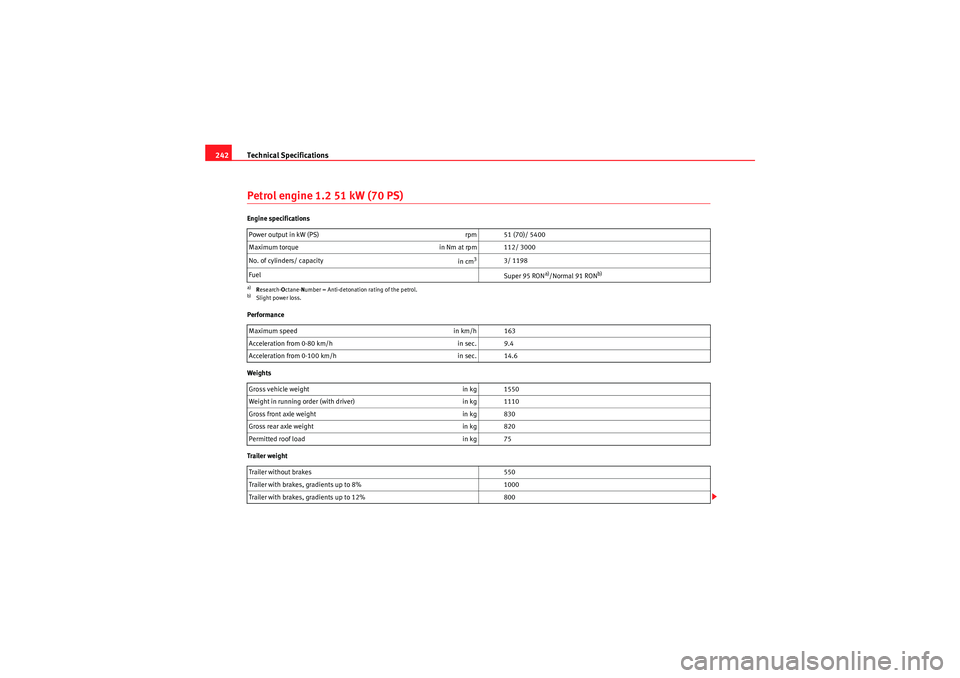
242Petrol engine 1.2 51 kW (70 PS)Engine specifications
Performance
Weights
Trailer weight Power output in kW (PS)
rpm 51 (70)/ 5400
Maximum torque in Nm at rpm 112/ 3000
No. of cylinders/ capacity in cm
3
3/ 1198
Fuel Super 95 RON
a)/Normal 91 RON
b)
a)Research- Octane- Number = Anti-detonation rating of the petrol.b)Slight power loss.Maximum speed in km/h 163
Acceleration from 0-80 km/h in sec. 9.4
Acceleration from 0-100 km/h in sec. 14.6
Gross vehicle weight in kg 1550
Weight in running order (with driver) in kg 1110
Gross front axle weight in kg 830
Gross rear axle weight in kg 820
Permitted roof load in kg 75
Trailer without brakes 550
Trailer with brakes, gradients up to 8% 1000
Trailer with brakes, gradients up to 12% 800
IbizaST_EN.book Seite 242 Dienstag, 14. September 2010 1:31 13
Page 245 of 264
Technical Specifications243
Safety First
Operating Instructions
Practical Tips
Technical Specifications
Engine oil capacity
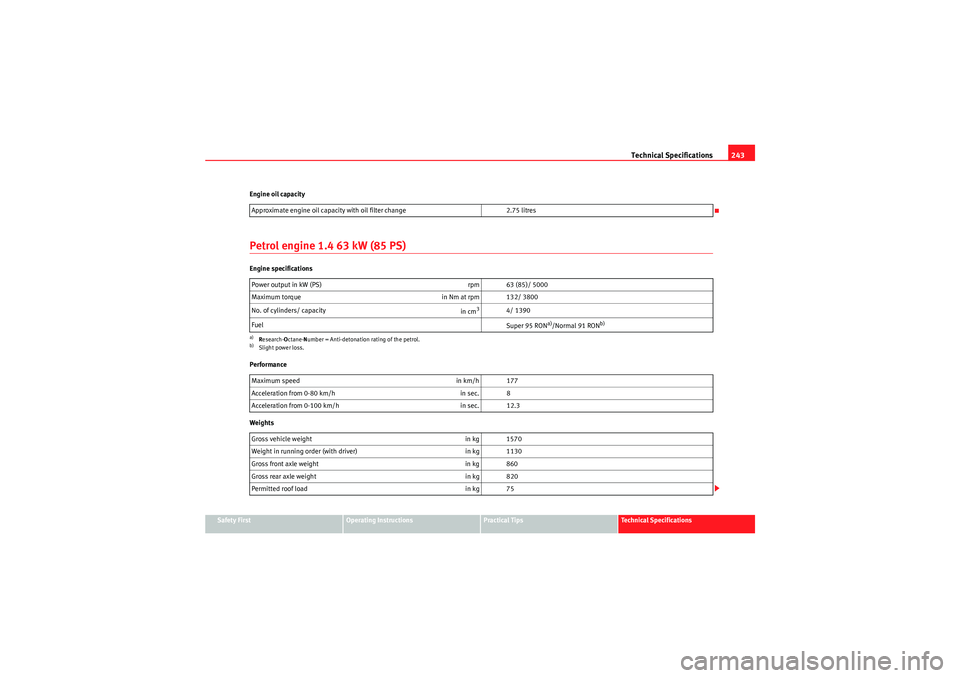
Petrol engine 1.4 63 kW (85 PS)Engine specifications
Performance
Weights
Approximate engine oil capacity with oil filter change
2.75 litres
Power output in kW (PS) rpm 63 (85)/ 5000
Maximum torque in Nm at rpm 132/ 3800
No. of cylinders/ capacity in cm
3
4/ 1390
Fuel Super 95 RON
a)/Normal 91 RON
b)
a)Research- Octane- Number = Anti-detonation rating of the petrol.b)Slight power loss.Maximum speed in km/h 177
Acceleration from 0-80 km/h in sec. 8
Acceleration from 0-100 km/h in sec. 12.3
Gross vehicle weight in kg 1570
Weight in running order (with driver) in kg 1130
Gross front axle weight in kg 860
Gross rear axle weight in kg 820
Permitted roof load in kg 75
IbizaST_EN.book Seite 243 Dienstag, 14. September 2010 1:31 13