battery Seat Ibiza ST 2010 Owner's Guide
[x] Cancel search | Manufacturer: SEAT, Model Year: 2010, Model line: Ibiza ST, Model: Seat Ibiza ST 2010Pages: 264, PDF Size: 7.11 MB
Page 203 of 264
Checking and refilling levels201
Safety First
Operating Instructions
Practical Tips
Technical Specifications
•Before opening the bonnet to check the brake fluid level, read and
observe the warnings ⇒page 188.•Brake fluid should be stored in the closed original container in a safe
place out of reach of children. There is a toxic risk.•Complete the brake fluid change according to the Maintenance
Programme. Heavy use of the brakes may cause a vapour lock if the brake
fluid is left in the system for too long. This would seriously affect the effi-
ciency of the brakes and the safety of the vehicle. This may cause an acci-
dent.Caution
Brake fluid could damage the paintwork. Wipe off any brake fluid from the
paintwork immediately.
For the sake of the environment
The brake pads and fluid must be collected and disposed of according the
applicable regulations. The SEAT Technical Service network has the necessary
equipment and qualified personnel for collecting and disposing of this waste
material.
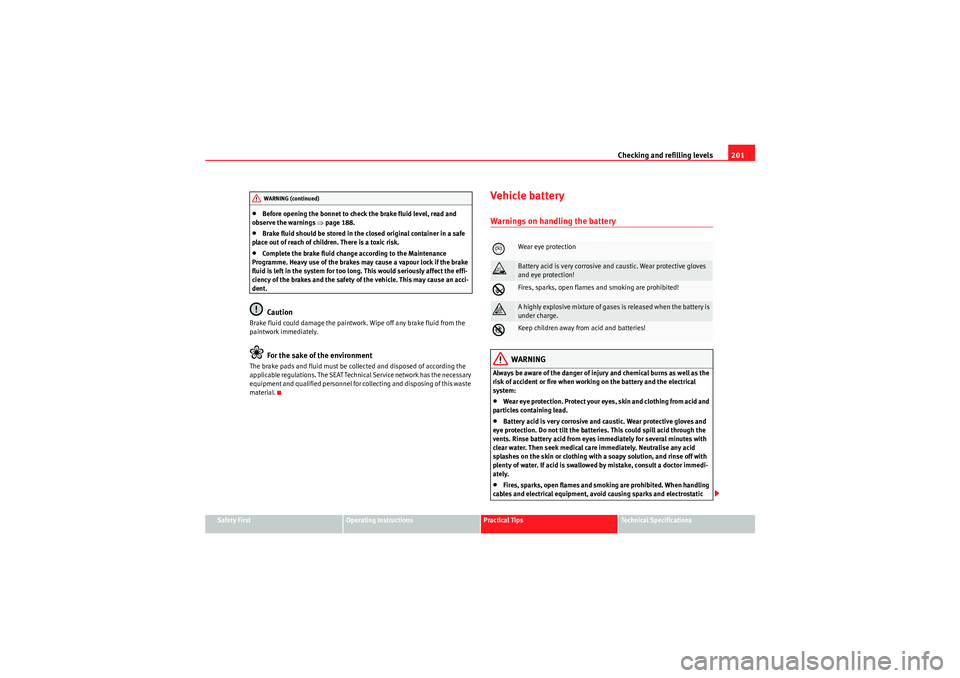
Vehicle batteryWarnings on handling the battery
WARNING
Always be aware of the danger of injury and chemical burns as well as the
risk of accident or fire when working on the battery and the electrical
system:•Wear eye protection. Protect your eyes, skin and clothing from acid and
particles containing lead.•Battery acid is very corrosive and caustic. Wear protective gloves and
eye protection. Do not tilt the batteries. This could spill acid through the
vents. Rinse battery acid from eyes immediately for several minutes with
clear water. Then seek medical care immediately. Neutralise any acid
splashes on the skin or clothing with a soapy solution, and rinse off with
plenty of water. If acid is swallowed by mistake, consult a doctor immedi-
ately.•Fires, sparks, open flames and smoking are prohibited. When handling
cables and electrical equipment, avoid causing sparks and electrostatic
WARNING (continued)
Wear eye protection
Battery acid is very corrosive and caustic. Wear protective gloves
and eye protection!
Ž
Fires, sparks, open flames and smoking are prohibited!
Ÿ
A highly explosive mixture of gases is released when the battery is
under charge.
Keep children away from acid and batteries!
IbizaST_EN.book Seite 201 Dienstag, 14. September 2010 1:31 13
Page 204 of 264
Checking and refilling levels
202charge. Never short the battery terminals. High-energy sparks can cause
injury.•A highly explosive mixture of gases is released when the battery is
under charge. The batteries should be charged in a well-ventilated room
only.•Keep children away from acid and batteries.•Before working on the electrical system, you must switch off the
engine, the ignition and all consumers. The negative cable on the battery
must be disconnected. When a light bulb is changed, you need only switch
off the light.•Deactivate the anti-theft alarm by unlocking the vehicle before you
disconnect the battery! The alarm will otherwise be triggered.•When disconnecting the battery from the vehicle electrical system,
disconnect first the negative cable and then the positive cable.•Switch off all electrical consumers before reconnecting the battery.
Reconnect first the positive cable and then the negative cable. Never
reverse the polarity of the connections. This could cause an electrical fire.•Never charge a frozen battery, or one which has thawed. This could
result in explosions and chemical burns. Always replace a battery which
has frozen. A flat battery can freeze at temperatures around 0 °C.•Ensure that the vent hose is always connected to the battery.•Never use a defective battery. This could cause an explosion. Replace a
damaged battery immediately.•For vehicles with the battery in the luggage compartment: Check that
the battery gas ventilation hose is securely attached.Caution
•Never disconnect the battery if the ignition is switched on or if the engine
is running. This could damage the electrical system or electronic compo-
nents.
•Do not expose the battery to direct sunlight over a long period of time, as
the intense ultraviolet radiation can damage the battery housing.•If the vehicle is left standing in cold conditions for a long period, protect
the battery from freezing. If it freezes it will be damaged.Checking the electrolyte level
The electrolyte level should be checked regularly in high-
mileage vehicles, in hot countries and in older batteries.– Open the engine bonnet and the battery cover ⇒ in “Safety
instructions on working in the engine compartment” on
page 188 ⇒ in “Warnings on handling the battery” on
page 201.
– Check the colour display in the "magic eye" on the top of the battery.
– If there are air bubbles in the window, tap the window gently until they disperse.The position of the battery is shown in the corresponding engine compart-
ment diagram ⇒page 241.
The “magic eye” indicator, located on the top of the battery changes colour,
depending on the charge state and electrolyte level of the battery.
There are two different colours:•Black: correct charge status.•Transparent/clear yellow: the battery must be replaced. Contact a special-
ised workshop.
WARNING (continued)
IbizaST_EN.book Seite 202 Dienstag, 14. September 2010 1:31 13
Page 205 of 264
Checking and refilling levels203
Safety First
Operating Instructions
Practical Tips
Technical Specifications
Charging and changing the vehicle battery
The battery is maintenance-free and is checked during the
inspection service. All work on the vehicle battery requires
specialist knowledge.If you often drive short distances or if the vehicle is not driven for long
periods, the battery should be checked by a specialised workshop between
the scheduled services.
If the battery has discharged and you have problems starting the vehicle, the
battery might be damaged. If this happens, we recommend you have the
vehicle battery checked by an Authorised Service Centre where it will be re-
charged or replaced.
Charging the battery
The vehicle battery should be charged by a specialised workshop only, as
batteries using special technology have been installed and they must be
charged in a controlled environment.
Replacing a vehicle battery
The battery has been developed to suit the conditions of its location and has
special safety features.
Genuine SEAT batteries fulfil the maintenance, performance and safety spec-
ifications of your vehicle.
WARNING
•We recommend you use only maintenance-free or cycle free leak-proof
batteries which comply with standards T 825 06 and VW 7 50 73. This
standard applies as of 2001.•Before starting any work on the batteries, you must read and observe
the warnings ⇒ in “Warnings on handling the battery” on page 201.
For the sake of the environment
Batteries contain toxic substances such as sulphuric acid and lead. They
m ust b e d isp os ed o f a ppro p ria tely and m ust not be d isp ose d of wi th o rd ina r y
household waste.WheelsGeneral notesAvoiding damage
– If you have to drive over a kerb or similar obstacle, drive very
slowly and at a right angle.
– Keep grease, oil and fuel off the tyres.
– Inspect the tyres regularly for da mage (cuts, cracks or blisters,
etc.). Remove any foreign objects embedded in the treads.
Storing tyres
– When you remove the tyres, mark them in order to maintain the same direction of rotation when they are installed again.
– When removed, the wheels and/or tyres should be stored in a cool, dry and preferably dark location.
– Store tyres in a vertical position if they are not fitted on wheel
rims.New tyres
New tyres must be run in ⇒ page 164.
IbizaST_EN.book Seite 203 Dienstag, 14. September 2010 1:31 13
Page 223 of 264
If and when221
Safety First
Operating Instructions
Practical Tips
Technical Specifications
Fuses below steering wheel in relay holderPTC fuses
AUX 1 Fuses
AUX 3 Fuses
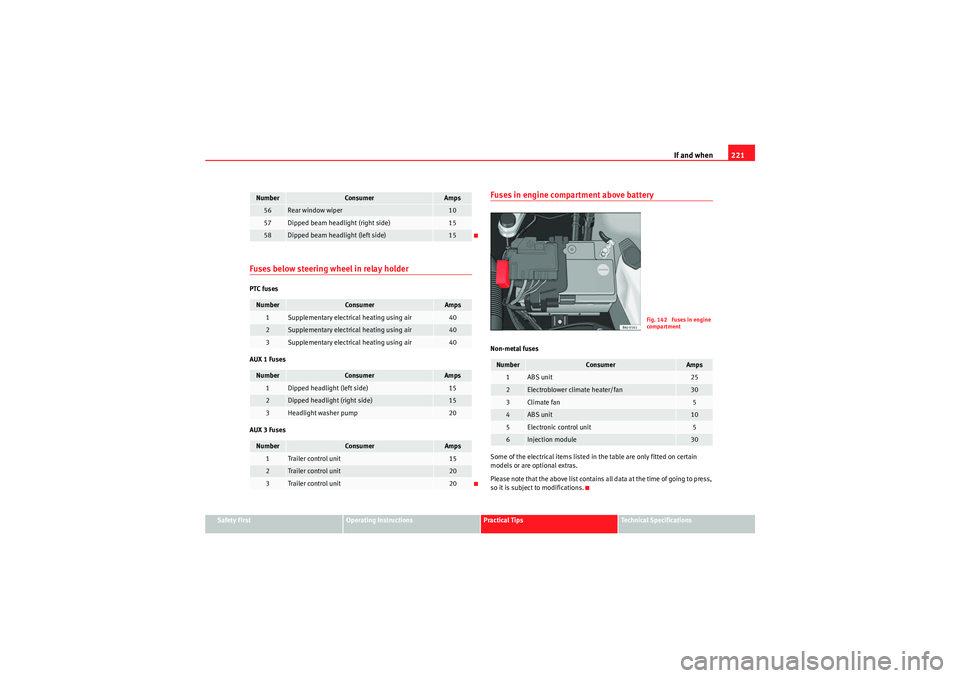
Fuses in engine compartment above batteryNon-metal fuses
Some of the electrical items listed in the table are only fitted on certain
models or are optional extras.
Please note that the above list contains all data at the time of going to press,
so it is subject to modifications.
56
Rear window wiper
10
57
Dipped beam headlight (right side)
15
58
Dipped beam headlight (left side)
15
Number
Consumer
Amps
1
Supplementary electrical heating using air
40
2
Supplementary electrical heating using air
40
3
Supplementary electrical heating using air
40
Number
Consumer
Amps
1
Dipped headlight (left side)
15
2
Dipped headlight (right side)
15
3
Headlight washer pump
20
Number
Consumer
Amps
1
Trailer control unit
15
2
Trailer control unit
20
3
Trailer control unit
20
Number
Consumer
Amps
Number
Consumer
Amps
1
ABS unit
25
2
Electroblower climate heater/fan
30
3
Climate fan
5
4
ABS unit
10
5
Electronic control unit
5
6
Injection module
30
Fig. 142 Fuses in engine
compartment
IbizaST_EN.book Seite 221 Dienstag, 14. September 2010 1:31 13
Page 233 of 264
If and when231
Safety First
Operating Instructions
Practical Tips
Technical Specifications
– First fit the glass with the fastening tabs over the frame of the
switch. Next press the front part until the two long tabs click on
the support.Additional brake lights*Given the difficulty involved in the replacement of this light it should be done
by the Technical Service.Luggage compartment light
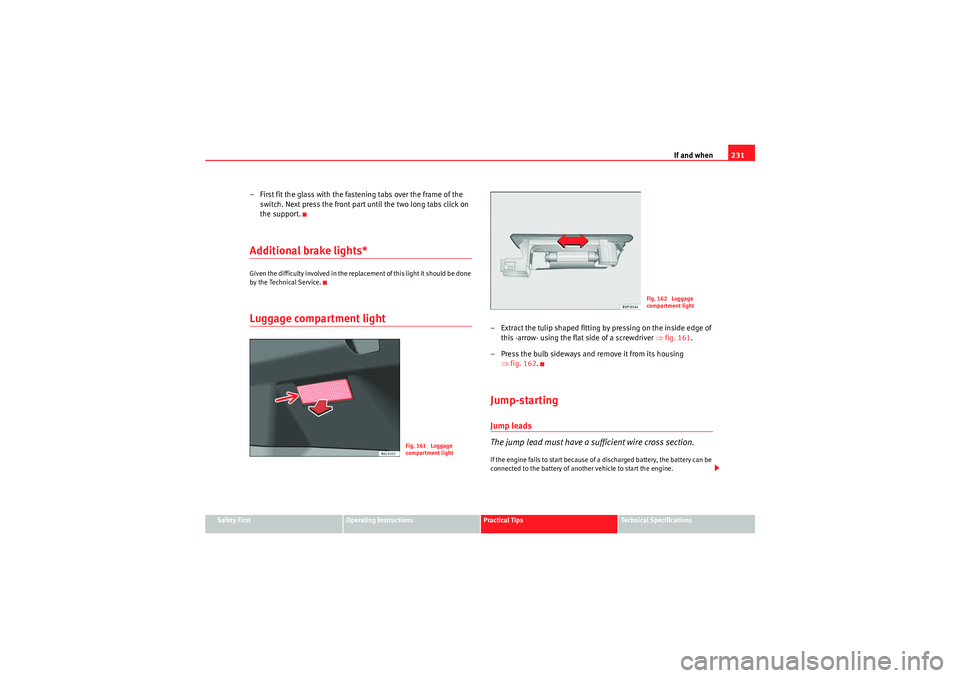
– Extract the tulip shaped fitting by pressing on the inside edge of this -arrow- using the flat side of a screwdriver ⇒fig. 161 .
– Press the bulb sideways and remove it from its housing
⇒ fig. 162 .Jump-startingJump leads
The jump lead must have a su fficient wire cross section.If the engine fails to start because of a discharged battery, the battery can be
connected to the battery of another vehicle to start the engine.
Fig. 161 Luggage
compartment light
Fig. 162 Luggage
compartment light
IbizaST_EN.book Seite 231 Dienstag, 14. September 2010 1:31 13
Page 234 of 264
If and when
232Jump leads
Jump leads must comply with standard DIN 72553 (see manufacturer’s docu-
mentation). The wire cross section must be at least 25 mm
2 for petrol engines
and at least 35 mm
2 for diesel engines.
Note
•The vehicles must not touch each other, otherwise electricity could flow as
soon as the positive terminals are connected.•The discharged battery must be properly connected to the vehicle elec-
trical system.How to jump start: description
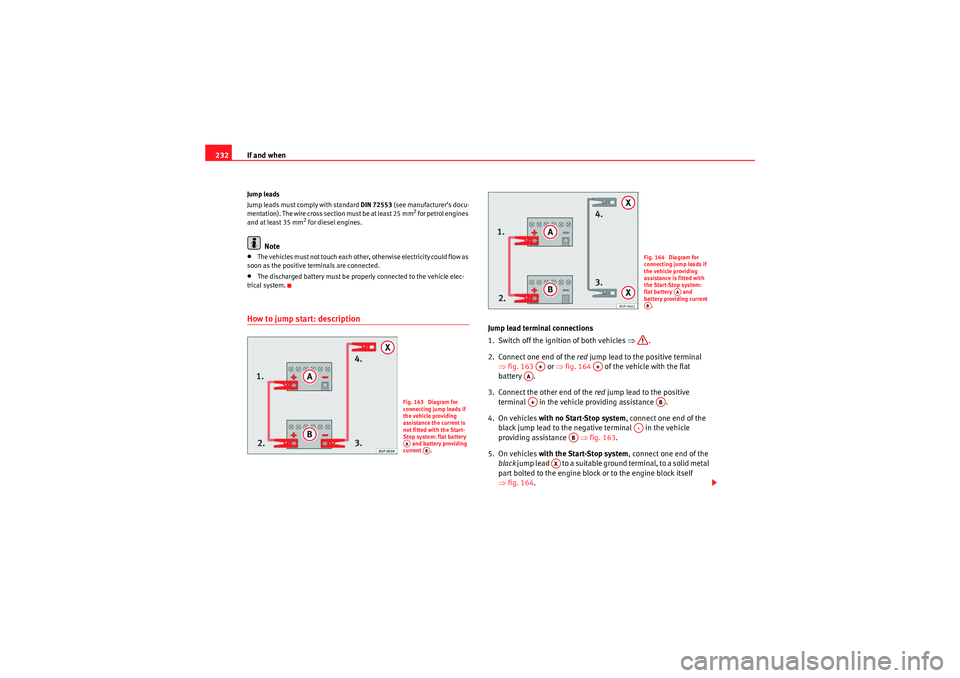
Jump lead terminal connections
1. Switch off the ignition of both vehicles ⇒.
2. Connect one end of the red jump lead to the positive terminal
⇒ fig. 163 or ⇒fig. 164 of the vehicle with the flat
battery .
3. Connect the other end of the red jump lead to the positive
terminal in the vehicle providing assistance .
4. On vehicles with no Start-Stop system , connect one end of the
black jump lead to the negative terminal in the vehicle
providing assistance ⇒fig. 163 .
5. On vehicles with the Start-Stop system , connect one end of the
black jump lead to a suitable ground terminal, to a solid metal
part bolted to the engine block or to the engine block itself
⇒ fig. 164 .
Fig. 163 Diagram for
connecting jump leads if
the vehicle providing
assistance the current is
not fitted with the Start-
Stop system: flat battery
and battery providing
current .AA
AB
Fig. 164 Diagram for
connecting jump leads if
the vehicle providing
assistance is fitted with
the Start-Stop system:
flat battery and
battery providing current .
AA
AB
A+
A+
AAA+
AB
A-
AB
AX
IbizaST_EN.book Seite 232 Dienstag, 14. September 2010 1:31 13
Page 235 of 264
If and when233
Safety First
Operating Instructions
Practical Tips
Technical Specifications
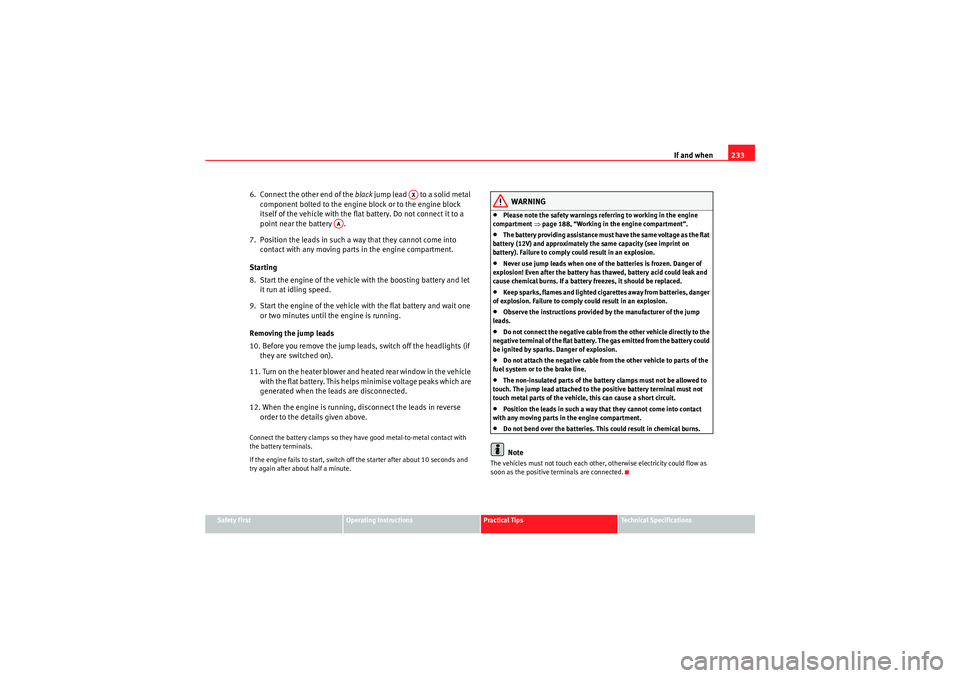
6. Connect the other end of the black jump lead to a solid metal
component bolted to the engine block or to the engine block
itself of the vehicle with the flat battery. Do not connect it to a
point near the battery .
7. Position the leads in such a way that they cannot come into contact with any moving parts in the engine compartment.
Starting
8. Start the engine of the vehicle with the boosting battery and let it run at idling speed.
9. Start the engine of the vehicle with the flat battery and wait one or two minutes until the engine is running.
Removing the jump leads
10. Before you remove the jump leads, switch off the headlights (if they are switched on).
11. Turn on the heater blower and heated rear window in the vehicle with the flat battery. This helps minimise voltage peaks which are
generated when the leads are disconnected.
12. When the engine is running, disconnect the leads in reverse order to the details given above.Connect the battery clamps so they have good metal-to-metal contact with
the battery terminals.
If the engine fails to start, switch off the starter after about 10 seconds and
try again after about half a minute.
WARNING
•Please note the safety warnings referring to working in the engine
compartment ⇒page 188, “Working in the engine compartment”.•The battery providing assistance must have the same voltage as the flat
battery (12V) and approximately the same capacity (see imprint on
battery). Failure to comply could result in an explosion.•Never use jump leads when one of the batteries is frozen. Danger of
explosion! Even after the battery has thawed, battery acid could leak and
cause chemical burns. If a battery freezes, it should be replaced.•Keep sparks, flames and lighted cigarettes away from batteries, danger
of explosion. Failure to comply could result in an explosion.•Observe the instructions provided by the manufacturer of the jump
leads.•Do not connect the negative cable from the other vehicle directly to the
negative terminal of the flat battery. The gas emitted from the battery could
be ignited by sparks. Danger of explosion.•Do not attach the negative cable from the other vehicle to parts of the
fuel system or to the brake line.•The non-insulated parts of the battery clamps must not be allowed to
touch. The jump lead attached to the positive battery terminal must not
touch metal parts of the vehicle, this can cause a short circuit.•Position the leads in such a way that they cannot come into contact
with any moving parts in the engine compartment.•Do not bend over the batteries. This could result in chemical burns.Note
The vehicles must not touch each other, otherwise electricity could flow as
soon as the positive terminals are connected.
AX
AA
IbizaST_EN.book Seite 233 Dienstag, 14. September 2010 1:31 13
Page 243 of 264
Technical Specifications241
Safety First
Operating Instructions
Practical Tips
Technical Specifications
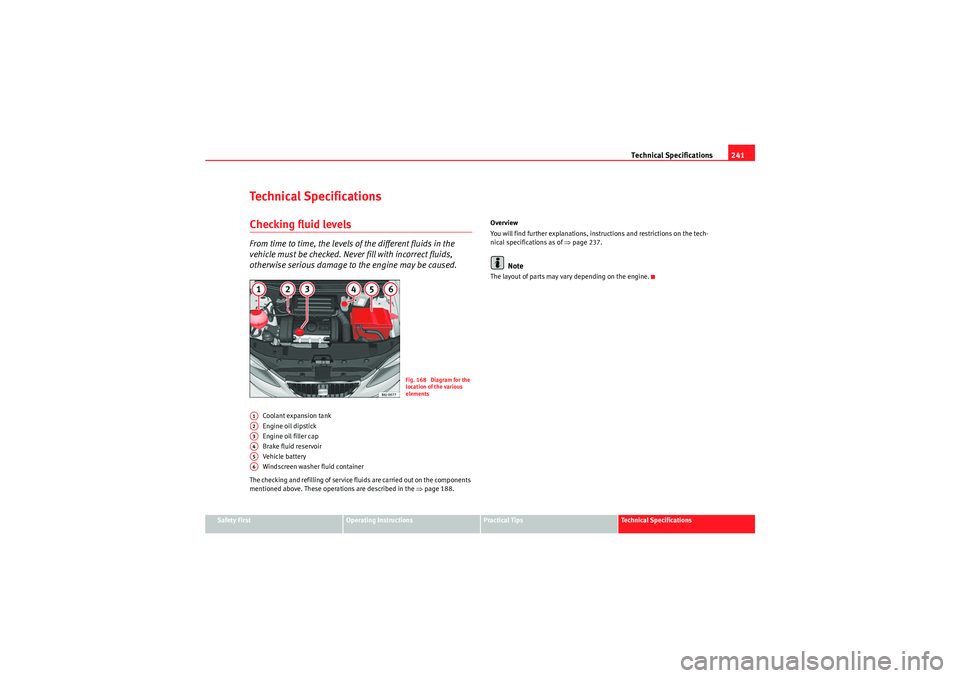
Technical SpecificationsChecking fluid levelsFrom time to time, the levels of the different fluids in the
vehicle must be checked. Never fill with incorrect fluids,
otherwise serious damage to the engine may be caused.
Coolant expansion tank
Engine oil dipstick
Engine oil filler cap
Brake fluid reservoir
Vehicle battery
Windscreen washer fluid container
The checking and refilling of service fluids are carried out on the components
mentioned above. These operations are described in the ⇒page 188. Overview
You will find further explanations, instructions and restrictions on the tech-
nical specifications as of
⇒page 237.
Note
The layout of parts may vary depending on the engine.
Fig. 168 Diagram for the
location of the various
elements
A1A2A3A4A5A6
IbizaST_EN.book Seite 241 Dienstag, 14. September 2010 1:31 13
Page 255 of 264
Index253
Index
AABS . . . . . . . . . . . . . . . . . . . . . . . . . . . . . . . . . . . 160
Warning lamp . . . . . . . . . . . . . . . . . . . . . . . . . 63
Accessories . . . . . . . . . . . . . . . . . . . . . . . . . . . . 181
Acoustic signal . . . . . . . . . . . . . . . . . . . . . . . . . . 18
Acoustic warning . . . . . . . . . . . . . . . . . . . . . . . . 136
Adaptive headlights . . . . . . . . . . . . . . . . . . . . . . 94
Air conditioner Climatronic . . . . . . . . . . . . . . . . . . . . . . . . . . 131
General notes . . . . . . . . . . . . . . . . . . . . . . . . 134
Air conditioning* . . . . . . . . . . . . . . . . . . . . . . . . 128
Air outlets . . . . . . . . . . . . . . . . . . . . . . . . . . . . . . 127
Air recirculation Semi-automatic air conditioning . . . . . . . . 130
Air recirculation mode Climatronic . . . . . . . . . . . . . . . . . . . . . . . . . . 133
Airbag system . . . . . . . . . . . . . . . . . . . . . . . . . . . 27 Front airbags . . . . . . . . . . . . . . . . . . . . . . . . . 30
side airbags . . . . . . . . . . . . . . . . . . . . . . . . . . 33
Warning lamp . . . . . . . . . . . . . . . . . . . . . . . . . 28
Alarm system Switching off . . . . . . . . . . . . . . . . . . . . . . . . . 82
Alternator Warning lamp . . . . . . . . . . . . . . . . . . . . . . . . . 68
Anti-freeze . . . . . . . . . . . . . . . . . . . . . . . . . . . . . 195
Anti-lock brake system . . . . . . . . . . . . . . . . . . . 160 Warning lamp . . . . . . . . . . . . . . . . . . . . . . . . . 63 Anti-theft alarm
Switching off . . . . . . . . . . . . . . . . . . . . . . . . . 82
Anti-theft alarm system . . . . . . . . . . . . . . . . . . . . 82
Anti-theft wheel bolts . . . . . . . . . . . . . . . . . . . . 213
Aquaplaning . . . . . . . . . . . . . . . . . . . . . . . . . . . 206
Ashtray* . . . . . . . . . . . . . . . . . . . . . . . . . . . . . . . 116
Aspects to note before setting off . . . . . . . . . . . . 8
Automatic anti-dazzle interior mirror* Activating the anti-dazzle function . . . . . . 103
Deactivating anti-dazzle function . . . . . . . . 103
Automatic car washing tunnel . . . . . . . . . . . . . 173
Automatic gearbox . . . . . . . . . . . . . . . . . . . . . . 143 Kick-down feature . . . . . . . . . . . . . . . . . . . . 150
Selector lever positions . . . . . . . . . . . . . . . . 148
Automatic lighting . . . . . . . . . . . . . . . . . . . . . . . . 92
Automatic windscreen wiper/washer . . . . . . . . 100
AUX/USB input connection . . . . . . . . . . . . . . . . 118
Auxiliary audio input connection (AUX) . . . . . . 118
BBall coupling . . . . . . . . . . . . . . . . . . . . . . . . . . . 170
Battery Changing . . . . . . . . . . . . . . . . . . . . . . . . . . . 203
Charging . . . . . . . . . . . . . . . . . . . . . . . . . . . . 203
Winter conditions . . . . . . . . . . . . . . . . . . . . 201
Before setting off . . . . . . . . . . . . . . . . . . . . . . . . . . 8
Belt tensioners . . . . . . . . . . . . . . . . . . . . . . . . . . . 26 Biodiesel . . . . . . . . . . . . . . . . . . . . . . . . . . . . . . 187
Biodiesel fuel . . . . . . . . . . . . . . . . . . . . . . . . . . . 187
Bonnet . . . . . . . . . . . . . . . . . . . . . . . . . . . . . . . . 190
Brake fluid . . . . . . . . . . . . . . . . . . . . . . . . . . . . . 200
Changing . . . . . . . . . . . . . . . . . . . . . . . . . . . 200
Brake pads . . . . . . . . . . . . . . . . . . . . . . . . . . . . . 164
Brake servo . . . . . . . . . . . . . . . . . . . . . . . 159, 164
Brake system . . . . . . . . . . . . . . . . . . . . . . . . . . . 200 Warning lamp . . . . . . . . . . . . . . . . . . . . . . . . 65
Brakes . . . . . . . . . . . . . . . . . . . . . . . . . . . . . . . . 164
Braking distance . . . . . . . . . . . . . . . . . . . . . . . . 164
Bulb change general notes . . . . . . . . . . . . . . . . . . . . . . . . 222
Bulb defect Warning lamp . . . . . . . . . . . . . . . . . . . . . . . . 63
Buzzer . . . . . . . . . . . . . . . . . . . . . . . . . . . . . . 97, 136
CCar care Exterior . . . . . . . . . . . . . . . . . . . . . . . . . . . . . 173
Car phone . . . . . . . . . . . . . . . . . . . . . . . . . . . . . . 182
Catalytic converter . . . . . . . . . . . . . . . . . . . . . . . 165
Central locking . . . . . . . . . . . . . . . . . . . . . . . . . . . 74 Automatic speed dependent locking and un-locking system* . . . . . . . . . . . . . . . . . . . . . 76
Emergency unlocking system . . . . . . . . . . . . 76
Locking system for involuntary unlocking . . 76
IbizaST_EN.book Seite 253 Dienstag, 14. September 2010 1:31 13
Page 256 of 264
Index
254Selective unlocking system* . . . . . . . . . . . . 75
Unlocking system* . . . . . . . . . . . . . . . . . . . . 76
Central locking button Locking . . . . . . . . . . . . . . . . . . . . . . . . . . . . . 77
Unlocking . . . . . . . . . . . . . . . . . . . . . . . . . . . . 77
Cetane number . . . . . . . . . . . . . . . . . . . . . . . . . 187
Changing a wheel . . . . . . . . . . . . . . . . . . . . . . . 211
Changing bulbs interior light and front reading lights . . . . 230
Changing double headlight bulbs . . . . . . . . . . 223 dipped beam . . . . . . . . . . . . . . . . . . . . . . . . 224
main beam and side lights . . . . . . . . . . . . . 223
turn signal . . . . . . . . . . . . . . . . . . . . . . . . . . 225
Changing gear See Manual gearbox . . . . . . . . . . . . . . . . . . 142
Changing gear in tiptronic mode . . . . . . . . . . . 147
Changing rear lights on the tailgate . . . . . . . . . . . . . . . . . . . . . . . 228
on the wing . . . . . . . . . . . . . . . . . . . . . . . . . 227
Changing single headlight bulbs . . . . . . . . . . . 225 turn signal . . . . . . . . . . . . . . . . . . . . . . . . . . 227
Changing the bulbs Luggage compartment light . . . . . . . . . . . . 231
Number plate light . . . . . . . . . . . . . . . . . . . 230
Side turn signals . . . . . . . . . . . . . . . . . . . . . 229
Changing the single headlight bulbs dipped/main beam . . . . . . . . . . . . . . . . . . . 226
Side lights . . . . . . . . . . . . . . . . . . . . . . . . . . 226
Changing windscreen wiper blades . . . . . . . . . 198
Chassis number . . . . . . . . . . . . . . . . . . . . . . . . 238
Checking . . . . . . . . . . . . . . . . . . . . . . . . . . . . . . 202 Checking battery electrolyte level . . . . . . . . . . 202
Checking engine oil level . . . . . . . . . . . . . . . . . 192
Child safety . . . . . . . . . . . . . . . . . . . . . . . . . . . . . 39
Child seat . . . . . . . . . . . . . . . . . . . . . . . . . . . . . . . 41
Categorisation in groups . . . . . . . . . . . . . . . 41
Group 1 . . . . . . . . . . . . . . . . . . . . . . . . . . . . . 42
Group 2 . . . . . . . . . . . . . . . . . . . . . . . . . . . . . 42
Group 3 . . . . . . . . . . . . . . . . . . . . . . . . . . . . . 42
Groups 0 and 0+ . . . . . . . . . . . . . . . . . . . . . . 41
ISOFIX system . . . . . . . . . . . . . . . . . . . . . . . . 44
Safety notes . . . . . . . . . . . . . . . . . . . . . . . . . . 39
Securing . . . . . . . . . . . . . . . . . . . . . . . . . . . . . 44
Child seats on the front passenger seat . . . . . . . . . . . . . 28
Top Tether system . . . . . . . . . . . . . . . . . . . . . 45
Cigarette lighter . . . . . . . . . . . . . . . . . . . . . . . . 116
Cleaning alloy wheels . . . . . . . . . . . . . . . . . . . . 177
Cleaning chrome . . . . . . . . . . . . . . . . . . . . . . . . 176
Cleaning engine compartment . . . . . . . . . . . . . 178
Cleaning steel wheel rims . . . . . . . . . . . . . . . . 177
Cleaning windows . . . . . . . . . . . . . . . . . . . . . . . 175
Climatronic automatic mode . . . . . . . . . . . . . . . . . . . . . 132
controls . . . . . . . . . . . . . . . . . . . . . . . . . . . . 131
General notes . . . . . . . . . . . . . . . . . . . . . . . 134
manual mode . . . . . . . . . . . . . . . . . . . . . . . 133
Clock . . . . . . . . . . . . . . . . . . . . . . . . . . . . . . . . . . 52
Cloth seat covers cleaning . . . . . . . . . . . . . . . . 179
Cockpit . . . . . . . . . . . . . . . . . . . . . . . . . . . . . . . . . 49
Coming home function . . . . . . . . . . . . . . . . . . . . 94
Compartment for on-board documentation . . 112 Control
Exterior mirrors . . . . . . . . . . . . . . . . . . . . . . 104
Control lamps . . . . . . . . . . . . . . . . . . . . . . . . . . . 58
Control lighting . . . . . . . . . . . . . . . . . . . . . . . . . . 49
Controls Electric windows . . . . . . . . . . . . . . . . . . . . . . 86
Convenience closing Sliding/tilting sunroof . . . . . . . . . . . . . . . . . 90
Windows . . . . . . . . . . . . . . . . . . . . . . . . . . . . 88
Convenience opening Windows . . . . . . . . . . . . . . . . . . . . . . . . . . . . 88
Coolant . . . . . . . . . . . . . . . . . . . . . . . . . . . 195, 196
Coolant level . . . . . . . . . . . . . . . . . . . . . . . . . . . 196 Warning lamp . . . . . . . . . . . . . . . . . . . . . . . . 67
Coolant loss . . . . . . . . . . . . . . . . . . . . . . . . . . . . 196
Coolant temperature Safety instructions . . . . . . . . . . . . . . . . . . . . 68
Warning lamp . . . . . . . . . . . . . . . . . . . . . . . . 67
Correct adjustment of front head restraints . . . 12
Correct sitting position Front passenger . . . . . . . . . . . . . . . . . . . . . . 11
Incorrect sitting position . . . . . . . . . . . . . . . 13
Cruise control . . . . . . . . . . . . . . . . . . . . . . . . . . 154
Cruise control system . . . . . . . . . . . . . . . . . . . . 154 Warning lamp . . . . . . . . . . . . . . . . . . . . . . . . 65
DDanger of fitting a child seat on the front passenger seat . . . . . . . . . . . . . . . . . . . . . . . . . . . . . . . 28
Dash panel . . . . . . . . . . . . . . . . . . . . . . . . . . . . . 49
IbizaST_EN.book Seite 254 Dienstag, 14. September 2010 1:31 13