steering Seat Ibiza ST 2010 Owner's Guide
[x] Cancel search | Manufacturer: SEAT, Model Year: 2010, Model line: Ibiza ST, Model: Seat Ibiza ST 2010Pages: 264, PDF Size: 7.11 MB
Page 151 of 264
Driving149
Safety First
Operating Instructions
Practical Tips
Technical Specifications
N - Neutral (idling)
If this position is selected, the gearbox is in neutral. Power is not transmitted
to the wheels and the engine does not have a braking function.
Never use the
N position to drive down a hill. The engine does not function as
a brake and the brakes are subjected to excessive stain.
You could damage the automatic gearbox if you drive down hills with the gear
lever in position N and the engine switched off.
D - Drive (forward)
In this position the gearbox automatically changes to a lower or higher gear,
according to the engine’s requirements, the driving style and speed. The
braking effect of the engine when driving downhill is very limited when the
selector is in this position. The instrument panel displays the selected gear
as well as the selector lever in position D.
If position N has been selected and you wish to select D, you must press the
foot brake if the vehicle is stationary, or travelling at under 5 km/h.
S - Standard driving position (Sport programme)
When the selector lever is in position S, it will automatically change up into a
h igh er gea r late r, an d change d own i nto a low g ea r, if com pare d wi th p osi ti on
D . This way, it is possible to take full advantage of the engine reserve power,
depending on the engine demand, driving style and speed. The braking
effect of the engine when driving downhill is very limited. On the instrument
panel display the selected gear is shown as well as the selector lever to posi-
tion S.
To select gear range S, press the lock button on the selector lever.
WARNING
If the vehicle moves with no control, an accident and serious injury may
occur.
•As a driver, you should never leave your vehicle if the engine is running
and a gear is engaged. If you have to leave your vehicle while the engine is
running, you must always apply the handbrake and engage parking lock P.•If the engine is running and if D or R are engaged, you will need to hold
the the vehicle stopped by depressing footbrake down. The car would creep
forward as the power transmission is not fully interrupted even when the
engine is idling.•Never accelerate when moving the selector gear or you may cause an
accident.•Never move the selector lever to “R” or “P” when driving. Risk of acci-
dent.•Before driving down a very steep slope, reduce your speed and shift to
first gear.•Always hold the vehicle on the foot brake if you stop on hills. Other-
wise, the vehicle could roll back.•Never allow the brake to rub and do not use the brake pedal too often
or for long periods. Constant braking will cause the brakes to overheat and
will considerably reduce the brake effect. This increases the braking
distance and could cause the brake system to fail.WARNING
Never switch the engine off until the vehicle is stationary. You could lose
control of your vehicle. This could cause an accident and serious injury.•The airbags and belt tensioners do not work when the ignition is
switched off.•The brake servo does not work with the engine off. You need more force
to stop the vehicle.•Power steering does not work when the engine is not running. That is
why it is much more difficult to turn the steering wheel.WARNING (continued)
IbizaST_EN.book Seite 149 Dienstag, 14. September 2010 1:31 13
Page 152 of 264
Driving
150•Never remove the key from the ignition if the vehicle is in motion. The
steering lock could suddenly engage, and you would not be able to steer
the vehicle.•Never allow the car to roll downhill with the selector lever in “N”,
regardless of the engine is running or not.Caution
If you allow the vehicle to move when the engine is switched off or with the
selector lever in position “N”, take your foot off the accelerator and wait until
the engine starts idling before returning to position “D”.Kickdown feature
This feature allows maximum acceleration.If you press the accelerator down thoroughly, the gearbox automatically
changes down, depending on speed and en gine speed, into a lower gear to
take full advantage of give the vehicle maximum acceleration.
The gearbox does not change gear until the engine reaches the maximum
determined engine speed for the gear.
WARNING
You could lose control of the vehicle if you accelerate on slippery road
surfaces. Risk of serious injury.•Be particularly careful when using the kickdown features on slippery
road surfaces. With a fast acceleration, the vehicle could lose traction and
skid.
•You should use the kickdown feature only when traffic and weather
conditions allow it to be used safely.
HandbrakeUsing the handbrake
The handbrake should be applied firmly to prevent the
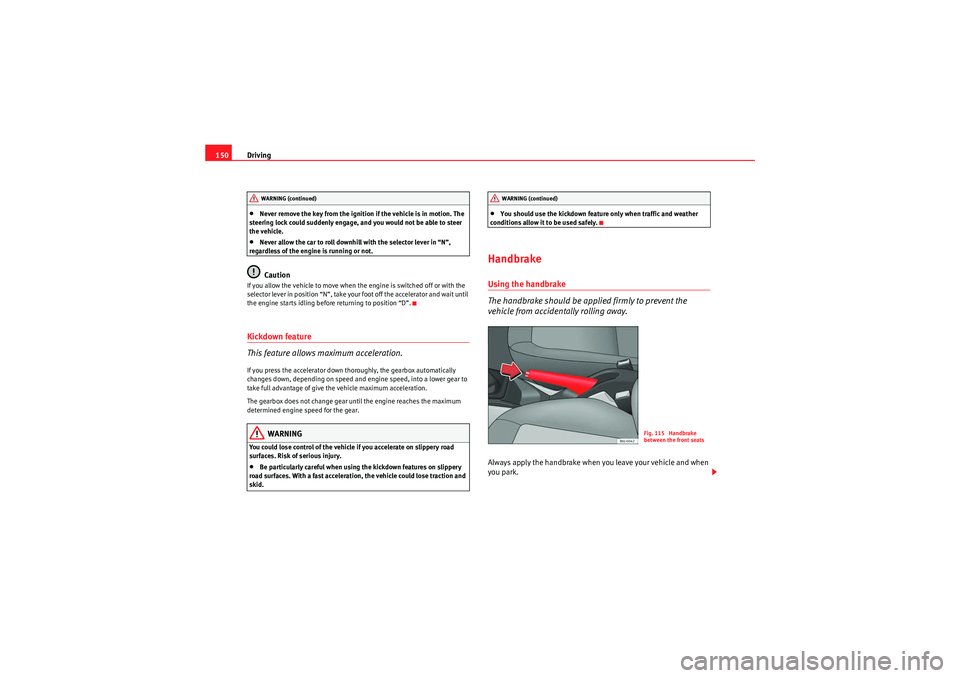
vehicle from accidentally rolling away.Always apply the handbrake when you leave your vehicle and when
you park.
WARNING (continued)
WARNING (continued)
Fig. 115 Handbrake
between the front seats
IbizaST_EN.book Seite 150 Dienstag, 14. September 2010 1:31 13
Page 153 of 264
Driving151
Safety First
Operating Instructions
Practical Tips
Technical Specifications
Applying the handbrake
– Pull the handbrake lever up firmly ⇒ fig. 115.
Releasing the handbrake
– Pull the lever up slightly and press the release knob in the direc- tion of the arrow ⇒fig. 115 and guide the handbrake lever down
fully ⇒ .Always apply the handbrake as far as it will go in order to prevent you from
driving with the handbrake applied by mistake ⇒ .
The handbrake warning lamp
H lights up when the handbrake is applied
and the ignition switched on. The warning turns off when the handbrake is
released.
WARNING
•Never use the handbrake to stop the vehicle when it is in motion. The
braking distance is considerably longer, because braking is only applied to
the rear wheels. Risk of accident!•If it is only partially released, this will cause rear brakes overheating,
which can impair the function of the brake system and could lead to an acci-
dent. This also causes premature wear on the rear brake pads.Caution
Always apply the handbrake before you leave the vehicle. The 1st gear should
also be selected.
Parking
The handbrake should always be firmly applied when the
vehicle is parked.Always note the following points when parking the vehicle:
– Use the brake pedal to stop the vehicle.
– Apply the handbrake.
– The 1st gear should also be selected.
– Switch the engine off and remove the key from the ignition. Turn the steering wheel slightly to engage the steering lock.
– Always take you car keys with you when you leave the vehicle ⇒ .Additional notes on parking the vehicle on gradients:
Turn the steering wheel so that the vehicle rolls against the kerb if it started
to roll.•If the vehicle is parked facing downhill, turn the front wheels so that they
point towards the kerb .•If the vehicle is parked facing uphill, turn the front wheels so that they
point away from the kerb .•Secure the vehicle as normal by applying the handbrake firmly and
engaging 1st gear.WARNING
•Take measures to reduce the risk of injury when you leave your vehicle
unattended.
IbizaST_EN.book Seite 151 Dienstag, 14. September 2010 1:31 13
Page 164 of 264
Intelligent technology
162Electronic Stability Programme (ESP)*
ESP reduces the danger of skidding by braking the wheels individually.
The system uses the steering wheel angle and road speed to calculate the
changes of direction desired by the driver, and constantly compares them
with the actual behaviour of the vehicle. If the desired course is not being
maintained (for instance, if the vehicle is starting to skid), then the ESP
compensates automatically by braking the appropriate wheel.
The forces acting on the braked wheel bring the vehicle back to a stable
condition. If the vehicle tends to oversteer, the system will act on the front
wheel on the outside of the turn.
WARNING
•It must be remembered that ESP cannot defy the laws of physics. This
should be kept in mind, particularly on slippery and wet roads and when
towing a trailer.•Always adapt your driving style to suit the condition of the roads and
the traffic situation. Do not let the extra safety afforded by ESP tempt you
into taking any risks when driving, as this can cause accidents.Caution
•In order to ensure that ESP functions correctly, all four wheels must be
fitted with the same tyres. Any differences in the rolling radius of the tyres can
cause the system to reduce engine power when this is not desired.•Modifications to the vehicle (e.g. to the engine, the brake system, running
gear or any components affecting the wheels and tyres) could affect the effi-
ciency of the ABS, EDL, ESP and TCS.
Anti-lock brake system (ABS)The anti-lock brake system prevents the wheels locking during braking
⇒ page 160.Electronic differential lock (EDL)*
The electronic differential lock helps prevent the loss of trac-
tion caused if one of the driven wheels starts spinning.EDL helps the vehicle to start moving, accelerate and climb a gradient in slip-
pery conditions where this may otherwise be difficult or even impossible.
The system will control the revolutions of the drive wheels using the ABS
sensors (in case of an EDL fault the warning lamp for ABS lights up)
⇒ page 63.
At speeds of up to approximately 80 km/h, it is able to balance out differ-
ences in the speed of the driven wheels of approximately 100 rpm caused by
a slippery road surface on one side of the vehicle. It does this by braking the
wheel which has lost traction and distributing more driving force to the other
driven wheel via the differential.
To prevent the disc brake of the braking wheel from overheating, the EDL cuts
out automatically if subjected to excessive loads. The vehicle will continue to
function normally without EDL. For this reason, the driver is not informed that
the EDL has been switched off.
The EDL will switch on again automatically when the brake has cooled down.
WARNING
•When accelerating on a slippery surface, for example on ice and snow,
press the accelerator carefully. Despite EDL, the driven wheels may start to
spin. This could impair the vehicle’s stability.
IbizaST_EN.book Seite 162 Dienstag, 14. September 2010 1:31 13
Page 207 of 264
Checking and refilling levels205
Safety First
Operating Instructions
Practical Tips
Technical Specifications
Tyre ser vice life
The service life of tyres is dependent on tyre pressure, driving
style and fitting.
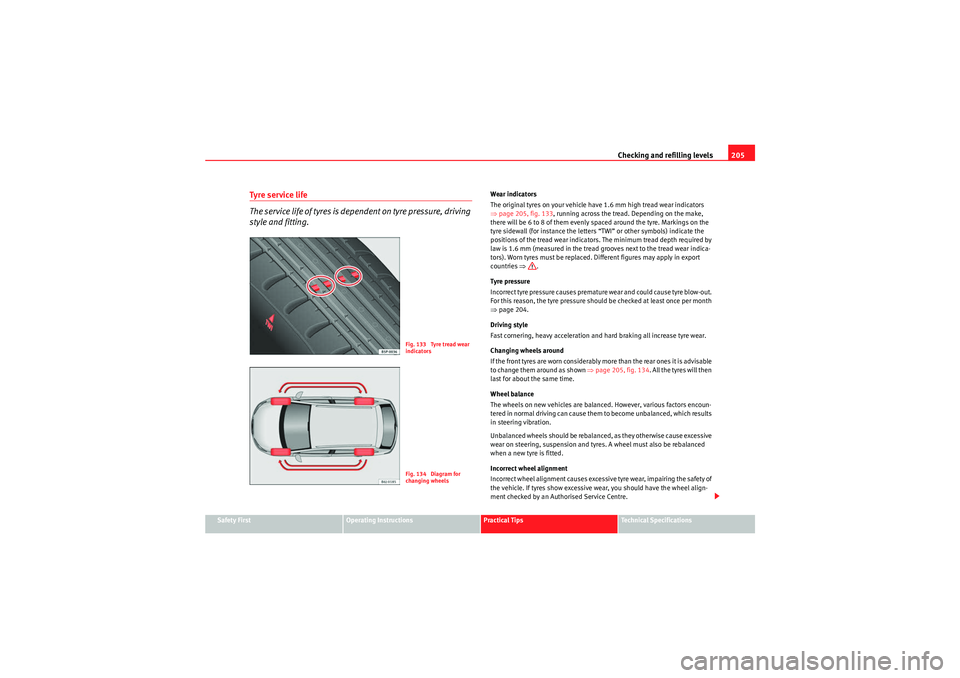
Wear indicators
The original tyres on your vehicle have 1.6 mm high tread wear indicators
⇒page 205, fig. 133 , running across the tread. Depending on the make,
there will be 6 to 8 of them evenly spaced around the tyre. Markings on the
tyre sidewall (for instance the letters “TWI” or other symbols) indicate the
positions of the tread wear indicators. The minimum tread depth required by
law is 1.6 mm (measured in the tread grooves next to the tread wear indica-
tors). Worn tyres must be replaced. Different figures may apply in export
countries ⇒.
Tyre pressure
Incorrect tyre pressure causes premature wear and could cause tyre blow-out.
For this reason, the tyre pressure should be checked at least once per month
⇒ page 204.
Driving style
Fast cornering, heavy acceleration and hard braking all increase tyre wear.
Changing wheels around
If the front tyres are worn considerably more than the rear ones it is advisable
to cha nge t he m ar oun d as sh own ⇒page 205, fig. 134. All the tyres will then
last for about the same time.
Wheel balance
The wheels on new vehicles are balanced. However, various factors encoun-
tered in normal driving can cause them to become unbalanced, which results
in steering vibration.
Unbalanced wheels should be rebalanced, as they otherwise cause excessive
wear on steering, suspension and tyres. A wheel must also be rebalanced
when a new tyre is fitted.
Incorrect wheel alignment
Incorrect wheel alignment causes excessive tyre wear, impairing the safety of
the vehicle. If tyres show excessive wear, you should have the wheel align-
ment checked by an Authorised Service Centre.
Fig. 133 Tyre tread wear
indicatorsFig. 134 Diagram for
changing wheels
IbizaST_EN.book Seite 205 Dienstag, 14. September 2010 1:31 13
Page 221 of 264
If and when219
Safety First
Operating Instructions
Practical Tips
Technical Specifications
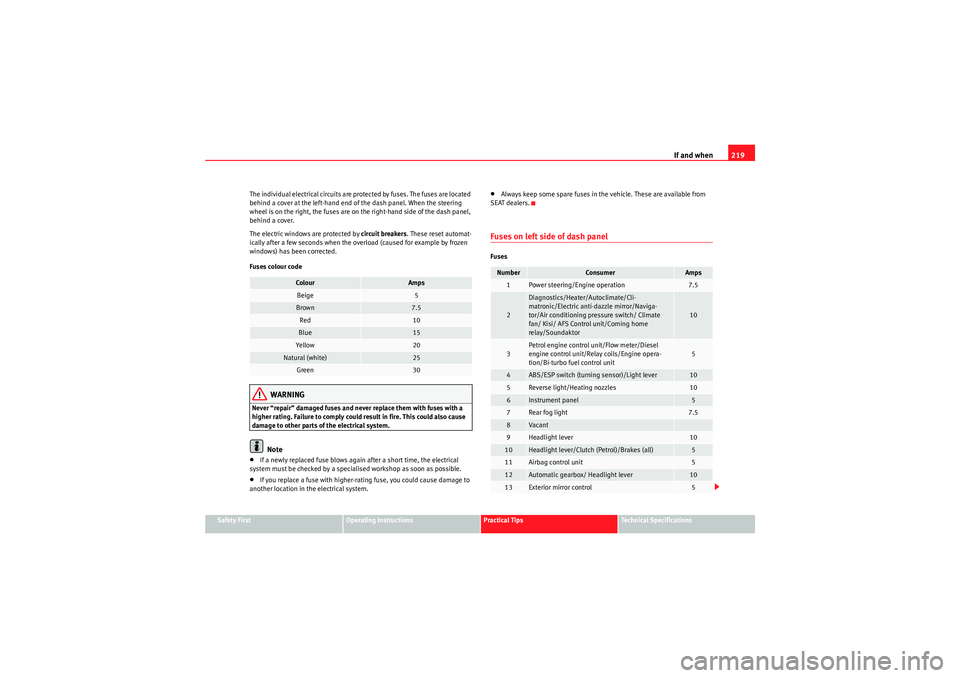
The individual electrical circuits are protected by fuses. The fuses are located
behind a cover at the left-hand end of the dash panel. When the steering
wheel is on the right, the fuses are on the right-hand side of the dash panel,
behind a cover.
The electric windows are protected by
circuit breakers. These reset automat-
ically after a few seconds when the overload (caused for example by frozen
windows) has been corrected.
Fuses colour code
WARNING
Never “repair” damaged fuses and never replace them with fuses with a
higher rating. Failure to comply could result in fire. This could also cause
damage to other parts of the electrical system.
Note
•If a newly replaced fuse blows again after a short time, the electrical
system must be checked by a specialised workshop as soon as possible.•If you replace a fuse with higher-rating fuse, you could cause damage to
another location in the electrical system.
•Always keep some spare fuses in the vehicle. These are available from
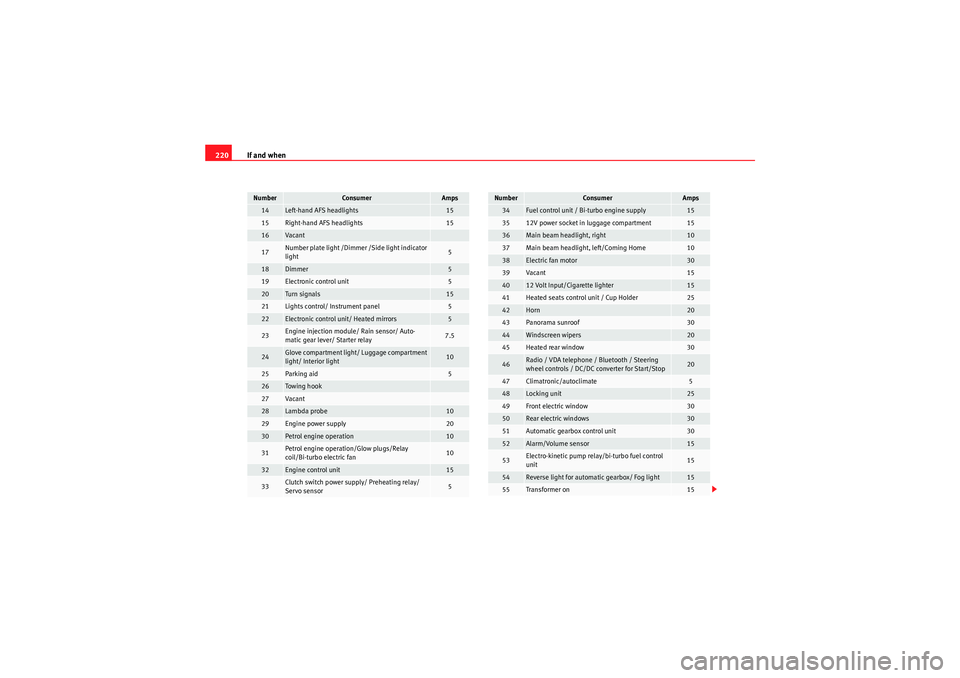
SEAT dealers.Fuses on left side of dash panelFuses
Colour
Amps
Beige
5
Brown
7.5
Red
10
Blue
15
Ye l l o w
20
Natural (white)
25
Green
30
Number
Consumer
Amps
1
Power steering/Engine operation
7.5
2
Diagnostics/Heater/Autoclimate/Cli-
matronic/Electric anti-dazzle mirror/Naviga-
tor/Air conditioning pressure switch/ Climate
fan/ Kisi/ AFS Control unit/Coming home
relay/Soundaktor
10
3
Petrol engine control unit/Flow meter/Diesel
engine control unit/Relay coils/Engine opera-
tion/Bi-turbo fuel control unit
5
4
ABS/ESP switch (turning sensor)/Light lever
10
5
Reverse light/Heating nozzles
10
6
Instrument panel
5
7
Rear fog light
7.5
8
Va can t
9
Headlight lever
10
10
Headlight lever/Clutch (Petrol)/Brakes (all)
5
11
Airbag control unit
5
12
Automatic gearbox/ Headlight lever
10
13
Exterior mirror control
5
IbizaST_EN.book Seite 219 Dienstag, 14. September 2010 1:31 13
Page 222 of 264
If and when
220
14
Left-hand AFS headlights
15
15
Right-hand AFS headlights
15
16
Vaca n t
17
Number plate light /Dimmer /Side light indicator
light
5
18
Dimmer
5
19
Electronic control unit
5
20
Turn signals
15
21
Lights control/ Instrument panel
5
22
Electronic control unit/ Heated mirrors
5
23
Engine injection module/ Rain sensor/ Auto-
matic gear lever/ Starter relay
7.5
24
Glove compartment light/ Luggage compartment
light/ Interior light
10
25
Parking aid
5
26
Towing hook
27
Vaca n t
28
Lambda probe
10
29
Engine power supply
20
30
Petrol engine operation
10
31
Petrol engine operation/Glow plugs/Relay
coil/Bi-turbo electric fan
10
32
Engine control unit
15
33
Clutch switch power supply/ Preheating relay/
Servo sensor
5
Number
Consumer
Amps
34
Fuel control unit / Bi-turbo engine supply
15
35
12V power socket in luggage compartment
15
36
Main beam headlight, right
10
37
Main beam headlight, left/Coming Home
10
38
Electric fan motor
30
39
Vaca n t
15
40
12 Volt Input/Cigarette lighter
15
41
Heated seats control unit / Cup Holder
25
42
Horn
20
43
Panorama sunroof
30
44
Windscreen wipers
20
45
Heated rear window
30
46
Radio / VDA telephone / Bluetooth / Steering
wheel controls / DC/DC converter for Start/Stop
20
47
Climatronic/autoclimate
5
48
Locking unit
25
49
Front electric window
30
50
Rear electric windows
30
51
Automatic gearbox control unit
30
52
Alarm/Volume sensor
15
53
Electro-kinetic pump relay/bi-turbo fuel control
unit
15
54
Reverse light for automatic gearbox/ Fog light
15
55
Transformer on
15
Number
Consumer
Amps
IbizaST_EN.book Seite 220 Dienstag, 14. September 2010 1:31 13
Page 223 of 264
If and when221
Safety First
Operating Instructions
Practical Tips
Technical Specifications
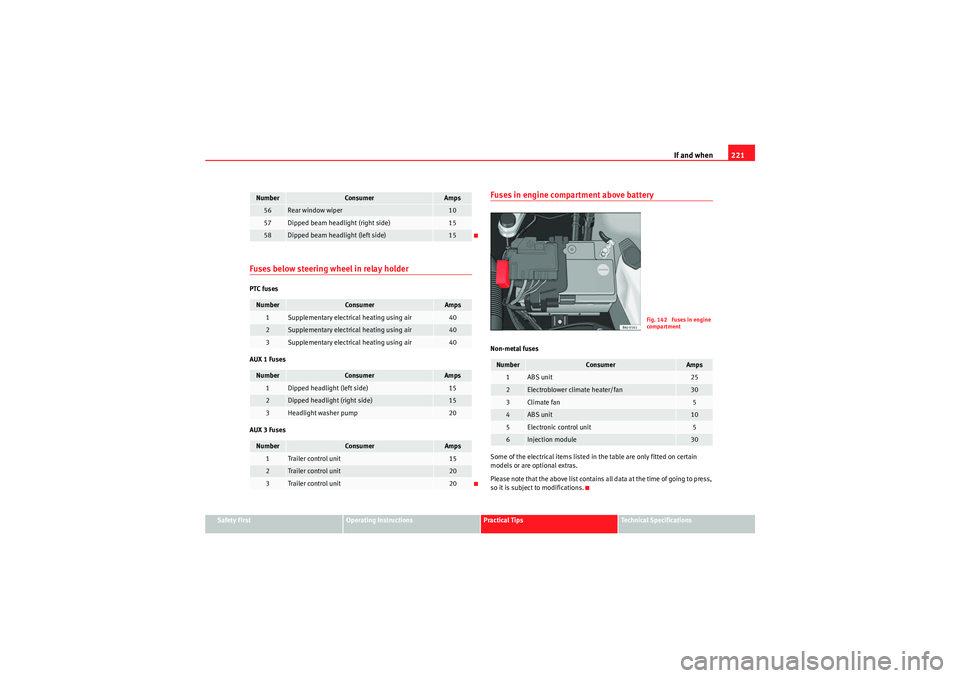
Fuses below steering wheel in relay holderPTC fuses
AUX 1 Fuses
AUX 3 Fuses
Fuses in engine compartment above batteryNon-metal fuses
Some of the electrical items listed in the table are only fitted on certain
models or are optional extras.
Please note that the above list contains all data at the time of going to press,
so it is subject to modifications.
56
Rear window wiper
10
57
Dipped beam headlight (right side)
15
58
Dipped beam headlight (left side)
15
Number
Consumer
Amps
1
Supplementary electrical heating using air
40
2
Supplementary electrical heating using air
40
3
Supplementary electrical heating using air
40
Number
Consumer
Amps
1
Dipped headlight (left side)
15
2
Dipped headlight (right side)
15
3
Headlight washer pump
20
Number
Consumer
Amps
1
Trailer control unit
15
2
Trailer control unit
20
3
Trailer control unit
20
Number
Consumer
Amps
Number
Consumer
Amps
1
ABS unit
25
2
Electroblower climate heater/fan
30
3
Climate fan
5
4
ABS unit
10
5
Electronic control unit
5
6
Injection module
30
Fig. 142 Fuses in engine
compartment
IbizaST_EN.book Seite 221 Dienstag, 14. September 2010 1:31 13
Page 236 of 264
If and when
234Towing and tow-startingTo w - s t a r t i n g *
The use of jump leads is preferable to tow-starting.We recommend that you do not tow-start your vehicle. Jump-starting
is preferable ⇒ page 231.
However, if your vehicle has to be tow-started:
– Engage the 2nd or the 3rd gear.
– Keep the clutch pressed down.
– Switch the ignition on.
– Once both vehicles are moving, release the clutch.
– As soon as the engine starts, press the clutch and move the gear lever into neutral. This helps to prevent driving into the towing
vehicle.
WARNING
The risk of accidents is high when tow-starting. The vehicle being towed
can easily collide with the towing vehicle.
Caution
When tow-starting, fuel could enter the catalytic converter and damage it.
CommentsPlease observe the following points if you use a tow-rope:
Notes for the driver of the towing vehicle
– Drive slowly at first until the tow-rope is taut. Then accelerate gradually.
– Begin and change gears cautiously. If you are driving an auto- matic vehicle, accelerate gently.
– Remember that the brake servo and power steering are not working in the vehicle you are towing. Brake sooner than normal
and pressing the pedal gently.
Notes for the driver of the towed vehicle
– Ensure that the tow-rope remains taut at all times when towing.Tow-rope or tow-bar
It is easier and safer to tow a vehicle with a tow-bar. You should only use a
tow-rope if you do not have a tow-bar.
A tow-rope should be slightly elastic to reduce the loading on both vehicles.
It is advisable to use a tow-rope made of synthetic fibre or similarly elastic
material.
Attach the tow-rope or the tow-bar only to the towing eyes provided or a
towing bracket.
Driving style
Towing requires some experience, especially when using a tow-rope. Both
drivers should be familiar with the technique required for towing. Inexperi-
enced drivers should not attempt to tow.
IbizaST_EN.book Seite 234 Dienstag, 14. September 2010 1:31 13
Page 237 of 264
If and when235
Safety First
Operating Instructions
Practical Tips
Technical Specifications
Do not pull too hard with the towing vehicle and take care to avoid jerking the
tow-rope. When towing on an unpaved road, there is always a risk of over-
loading and damaging the anchorage points.
The ignition of the vehicle being towed must be switched on to prevent the
steering wheel from locking and also to allow the use of the turn signals,
horn, windscreen wipers and washers.
As the brake servo does not work if the engine is not running, you must apply
considerably more pressure to the brake pedal than you normally would.
As the power assisted steering does not work if the engine is not running, you
will need more strength to steer than you normally would.
Towing vehicles with an automatic gearbox
•Put the selector lever into position “N”.•Do not drive faster than 50 km/h.•Do not tow further than 50 km.•If a breakdown vehicle is used, the vehicle must be towed with the front
wheels raised.Note
•Observe legal requirements when towing or tow-starting.•Switch on the hazard warning lights of both vehicles. However, observe
any regulations to the contrary.•For technical reasons, vehicles with an automatic gearbox must not be
tow-started.•If damage to your vehicle means that there is no lubricant in the gearbox,
you must raise the drive wheels while the vehicle is being towed.•If the vehicle has to be towed more than 50 km, the front wheels should
be raised during towing, and towing should be carried out by a qualified
person.
•The steering wheel is locked when the vehicle has no electrical power. The
vehicle must then be towed with the front wheels raised. Towing should be
carried out by a qualified person.•The towing eye should always be kept in the vehicle.To w i n g e y e sFitting the towing eye
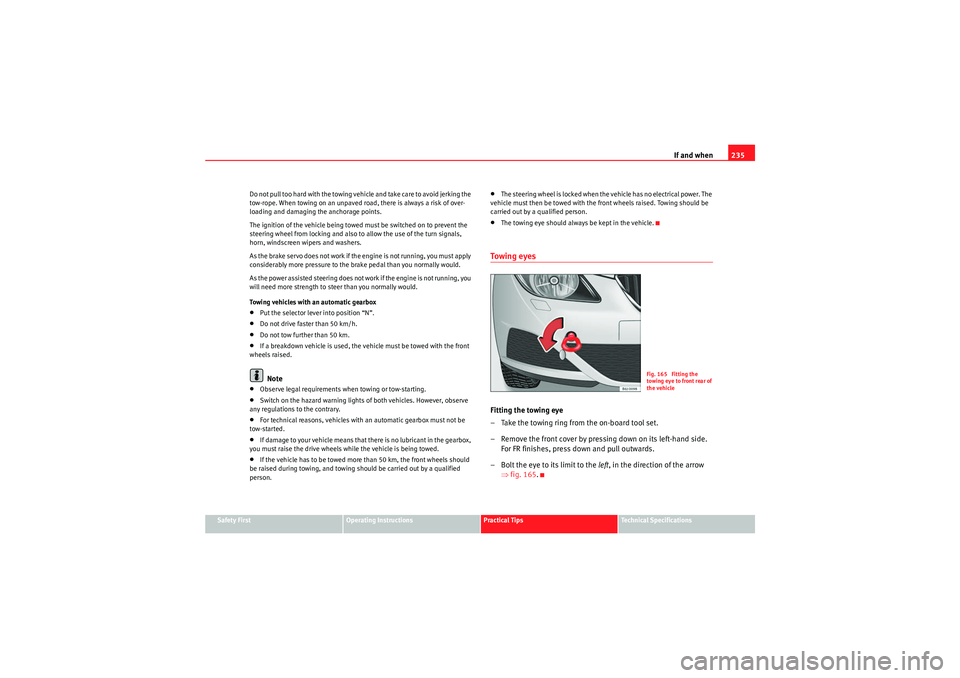
– Take the towing ring from the on-board tool set.
– Remove the front cover by pressing down on its left-hand side. For FR finishes, press down and pull outwards.
– Bolt the eye to its limit to the left, in the direction of the arrow
⇒ fig. 165 .
Fig. 165 Fitting the
towing eye to front rear of
the vehicle
IbizaST_EN.book Seite 235 Dienstag, 14. September 2010 1:31 13