engine Seat Ibiza ST 2010 Repair Manual
[x] Cancel search | Manufacturer: SEAT, Model Year: 2010, Model line: Ibiza ST, Model: Seat Ibiza ST 2010Pages: 264, PDF Size: 7.11 MB
Page 171 of 264
Driving and the environment169
Safety First
Operating Instructions
Practical Tips
Technical Specifications
•The use of water-soluble paintsDriving abroadObservationsTo drive abroad, the following must be taken into consideration:•Fo r v eh icles f it te d wit h a ca ta lyt ic co nv er ter e nsur e that unleade d pe tr ol is
available for the journey. See the chapter “Refuelling”. Automobile organisa-
tions will have information about service station networks selling unleaded
fuel.•In some countries, it is possible that your vehicle model is not sold, and
therefore spare parts are not available or the Authorised Services can only
carry out limited repairs.
SEAT importers and distributors will gladly provide information about the
technical preparations that you vehicle requires and also about necessary
maintenance and repair possibilities.Adhesive strips for headlightsIf you have to drive a right-hand drive vehicle in a left-hand drive country, or
vice versa, the asymmetric dipped beam headlights will dazzle oncoming
traffic.
To prevent dazzling, you must apply stickers to certain parts of the headlight
lenses. Further information is available at your Authorised Service Centre.
In vehicles with adaptive headlights, the rotation system must previously be
disconnected. To do this, please go to a specialised workshop.
Trailer towingWhat do you need to bear in mind when towing a trailer?Your vehicle may be used to tow a trailer when fitted with the correct equip-
ment.
If the car is supplied with a factory-fitted towing bracket it will already have
the necessary technical modifications and meet the statutory requirements
for towing a trailer. If you wish to retrofit a towing bracket, consult
⇒ page 183.
Connectors
Your vehicle is fitted with a 12-pin connector for the electrical connection
between the trailer and the vehicle.
If the trailer has a 7-pin plug you will need to use an adapter cable. This is
available in any SEAT dealer.
Trailer weight / drawbar load
Never exceed the authorised trailer weight. If you do not load the trailer up to
the maximum permitted trailer weight, you can then climb correspondingly
steeper slopes.
The maximum trailer weights listed are only applicable for altitudes up to
1000 m above sea level. With increasing altitude the engine power and there-
fore the vehicle’s climbing ability are impaired because of the reduced air
density. The maximum trailer weight has to be reduced accordingly. The
weight of the vehicle and trailer combination must be reduced by 10% for
every 1000 m of height. The gross combination weight is the actual weight of
the laden vehicle plus the actual weight of the laden trailer. When possible,
operate the trailer with the maximum permitted drawbar load on th e ba ll jo int
of the towing bracket, but do not exceed the specified limit.
The figures for trailer weights and drawbar loads that are given on the data
plate of the towing bracket are for certification purposes only. The correct
IbizaST_EN.book Seite 169 Dienstag, 14. September 2010 1:31 13
Page 173 of 264
Driving and the environment171
Safety First
Operating Instructions
Practical Tips
Technical Specifications
Always brake in due course. If the trailer has an
overrun brake, apply the
brakes gently at first and then, firmly. This will prevent the jerking that can be
caused by the trailer wheels locking. Select a low gear in due course before
going down a steep downhill. This enables you to use the engine braking to
slow down the vehicle.
Reheating
At very high temperatures and during prolonged slopes, driving in a low gear
and high engine speed, always monitor the coolant temperature gauge
⇒ page 49.
Electronic Stability Programme*
The ESP* system helps to stabilise the trailer in case of skidding or rocking.
IbizaST_EN.book Seite 171 Dienstag, 14. September 2010 1:31 13
Page 174 of 264
Vehicle maintenance and cleaning
172Vehicle maintenance and cleaningGeneral notesRegular washing and care help maintain the value of your
vehicle.Vehicle maintenance
Regular care and washing help to maintain the value of the vehicle. This may
also be one of the requirements for acknowledging warranty claims in the
event of bodywork corrosion or paint defects.
The best way to protect your vehicle against the harmful effects of the envi-
ronment is through correct maintenance and frequent washing. The longer
substances such as insect remains, bird droppings, resinous tree sap, road
dirt, industrial deposits, tar, soot or road salt and other aggressive materials
remain on the vehicle, the more damage they do to the paintwork. High
temperatures (for instance in strong sunlight) further intensify the corrosive
effect.
After winter, a period when salt is put on the roads, it is important to have the
underside of the vehicle washed thoroughly.
Products for vehicle maintenance
Car care products are available in your Authorised Service Centre. Keep the
product instructions until you have used them up.
WARNING
•Car care products can be toxic. Because of this, they must always be
kept closed in their original container. Keep them out of the reach of chil-
dren. Failure to comply could result in poisoning.•Always read and observe the instructions and warnings on the package
before using vehicle care products. Improper use could cause health prob- lems or damage the vehicle. The use of certain products may produce
noxious vapours; they should be used in well ventilated areas.
•Never use fuel, turpentine, engine oil, nail varnish remover or other
volatile fluids. These are toxic and highly flammable. Risk of fire and explo-
sion.•Before washing your vehicle, or carrying out any maintenance, switch
the engine off, apply the handbrake firmly and remove the key from the
ignition.Caution
Never attempt to remove dirt, mud or dust if the surface of the vehicle is dry.
Never use a dry cloth or sponge for cleaning purposes. This could damage the
paintwork or the windows of your vehicle. Soak dirt, mud or dust with plenty
of water.
For the sake of the environment
•When purchasing products for your vehicle maintenance, select the ones
which are not harmful to the environment.•The waste from car care products should no t be disposed of with ordinar y
household waste. Observe the disposal information on the package.WARNING (continued)
IbizaST_EN.book Seite 172 Dienstag, 14. September 2010 1:31 13
Page 180 of 264
Vehicle maintenance and cleaning
178Underbody protection
The vehicle underbody is coated to protect it from chemical
and mechanical damage.The protective coating can be damaged when driving. We recommend you to
check the protective coating under the body and on the running gear, and
reinstated if necessary, before and after the winter season.
We recommend you to go to your Authorised Service Centre to carry out repair
work and additional anti-corrosion work.
WARNING
Do not apply underseal or anti-corrosion coatings to the exhaust pipes,
catalytic converter or the heat shields on the exhaust system. The heat of
the exhaust system or the engine could cause them to ignite. Risk of fire.Cleaning the engine compartment
Take special care when cleaning the engine compartment.Anti-corrosion treatment
The engine compartment and the surface of the power unit are given anti-
corrosion treatment at the factory.
G o o d co r r o s i o n p r o t e c t i o n is p a r t i cu la r l y i m p o r t a n t i n wi n te r w h e n t h e v e h i c le
is frequently driven on salted roads. To prevent the salt corroding the vehicle,
the entire engine compartment should be thoroughly cleaned before and
after winter.
Yo u r A u t h o r i s e d S e r v i ce Ce n t r e has got the necessary equipment to provide
the correct cleaning and preserving products. For this reason, we recommend
having this work performed by them. The anti-corrosion protection is usually removed if the engine compartment
is cleaned with grease removing solutions, or if you have the engine cleaned.
On commissioning this work, ensure that all surfaces, seams, joints and
components in the engine compartment are given anti-corrosion treatment.
WARNING
•When working in the engine compartment, always observe the safety
warnings ⇒page 188.•Before opening the bonnet, switch the engine off, apply the handbrake
firmly and always remove the key from the ignition.•Allow the engine to cool before you clean the engine compartment.•Do not clean the vehicle underbody, wheel arches or wheel trims
without protecting your hands and arms. You may cut yourself on sharp-
edged metal parts. Failure to comply could result in injury.•Moisture, ice and salt on the brakes may affect braking efficiency. Risk
of accident. Directly after washing, avoid sudden and sharp braking.•Never touch the radiator fan. It is temperature-controlled and could
start automatically, even when the key is removed from the ignition!For the sake of the environment
Fuel, grease and oil deposits could be removed when the engine is washed.
The polluted water must be cleaned in an oil separator. For this reason,
engine washing should only be carried out at a specialised workshop or an
adequate petrol station.
IbizaST_EN.book Seite 178 Dienstag, 14. September 2010 1:31 13
Page 188 of 264
Checking and refilling levels
186
− Insert the fuel nozzle into the mouth of the canister as far as
possible.
− If the spare fuel canister is made of metal, the filling nozzle must be
in contact with the canister during filling. This helps prevent an electro-
static charge building up.
− Never spill fuel in the vehicle or in the luggage compartment. Fuel
vapours are explosive. Danger of death.Caution
•Fuel spills should be removed from the paintwork immediately.•Never run the tank completely dry. An irregular fuel supply could cause
misfiring. As a result, unburnt fuel could enter the catalytic converter and
cause damage.•When filling the fuel tank after having run it completely dry on a vehicle
with a diesel engine the ignition must be switched on for at least 30 seconds
without starting the engine. When you then start the engine it may take
longer than normal (up to one minute) for the engine to start firing. This is due
to the fact that the fuel system has to purge itself of air before starting.For the sake of the environment
Do not try to put in more fuel after the automatic filler nozzle has switched off;
this may cause the fuel to overflow if it becomes warm.
PetrolPetrol types
The correct petrol types are listed on a sticker inside the fuel
tank flap.Only unleaded petrol conforming to standard DIN EN 228 may be used for
vehicles with catalytic converters (EN = “European Standard”).
Fuel types are differentiated by the octane rating, e.g: 91, 95, 98 RON (RON
= “Research Octane Number”, unit for determining the knock resistance of
petrol). You may use petrol with a higher octane number than the one recom-
mended for your engine. However, this has no advantage in terms of fuel
consumption and engine power.
Caution
•Even one tankful of leaded fuel would permanently impair the efficiency
of the catalytic converter.•High engine speed and full throttle can damage the engine when using
petrol with an octane rating lower than the correct grade for the engine.For the sake of the environment
Just one full tank of leaded fuel would seriously impair the efficiency of the
catalytic converter.
WARNING (continued)
IbizaST_EN.book Seite 186 Dienstag, 14. September 2010 1:31 13
Page 189 of 264
Checking and refilling levels187
Safety First
Operating Instructions
Practical Tips
Technical Specifications
Petrol additives
Petrol additives improve the quality of the petrol.The quality of the petrol influences the performance, power and life of the
engine. For this reason, you should use good quality petrol containing addi-
tives. These additives will help to prevent corrosion, keep the fuel system
clean and prevent deposits from building up in the engine.
If good quality petrol with additives is not available or engine problems occur,
the required additives must be added during refuelling.DieselDiesel*Diesel fuel must conform to DIN EN 590 (EN = “European Standard”). It must
have a cetane number (CN) of at least 51. The cetane number indicates the
ignition quality of the diesel fuel.
Notes on refuelling ⇒ page 185.Biodiesel*
Caution
•Your vehicle is not designed to use biodiesel fuel. Never, under any
circumstances refuel with biodiesel. The use of biodiesel fuel could damage
the engine and the fuel system. The addition of biodiesel to diesel fuel by the
diesel manufacturer in accordance with standard EN 590 or DIN 51628 is
authorised and will not cause damage to the engine or the fuel system.
•The diesel engine has been designed to be used exclusively with diesel
fuel conforming to standard EN 590. Never refuel or use petrol, kerosene, fuel
oil or any other type of fuel. If you accidentally fill up the vehicle with the
wrong type of fuel, do not start the engine. Seek assistance from specialised
personnel. The composition of these fuels may severely damage the fuel
system and the engine.Winter driving
Diesel can thicken in winter.Winter diesel
When using summer diesel fuel, difficulties may be experienced at tempera-
tures below 0 °C because the fuel thickens due to wax separation. Therefore,
winter diesel fuel is available in some countries during the cold months. It can
be used at temperatures as low as -22 °C.
In countries with different climatic conditions the diesel fuel generally sold
has different temperature characteristics. Check with an Authorised Service
Centre or filling stations in the country concerned regarding the type of diesel
fuels available.
Filter pre-heater
Your vehicle is fitted with a fuel filter glow plug system, making it well
equipped for operation in winter. This ensures that the fuel system remains
operational to approx. -24 °C, provided you use winter diesel which is safe to
-15 °C.
However, if the fuel has waxed to such an extent that the engine will not start
at temperatures of under -24 °C, simply place the vehicle in a warm place for
a while.
Caution
Do not mix fuel additives (thinners or similar products) with diesel fuel.
IbizaST_EN.book Seite 187 Dienstag, 14. September 2010 1:31 13
Page 190 of 264
Checking and refilling levels
188Working in the engine compartmentSafety instructions on working in the engine compartment
Any work carried out in the engine compartment or on the
engine must be carried out cautiously.Before starting any work on the engine or in the engine compart-
ment:
1. Switch off the engine and remove the key from the ignition.
2. Apply the handbrake.
3. Move the gear lever to neutral or the selector lever to position P.
4. Wait for the engine to cool down.
5. Keep children away from the vehicle.
6. Raise the bonnet ⇒page 190.You should not do any work in the engine compartment unless you know
exactly how to carry out the jobs and have the correct tools! Have the work
carried out by a specialised workshop if you are uncertain.
All service fluids and consumables, e.g. coolant, engine oil, spark plugs and
batteries, are being constantly developed. SEAT provides a constant flow of
information to the Authorised Service Centres concerning modifications. For
this reason, we recommend you to have service fluids and consumables
replaced by an Authorised Service Centre. Please observe the relevant
instructions ⇒page 181. The engine compartment of the vehicle is a
hazardous area. ⇒.
WARNING
All work on the engine or in the engine compartment, e.g. checking and
refilling fluids, involves a risk of injury and scalding as well as the risk of
accident or fire.•Never open the bonnet if you see steam, smoke or coolant escaping
from the engine compartment. Otherwise, there is a risk of sustaining
burns. Wait until no more steam or coolant is emitted, then allow the
engine to cool before carefully opening the bonnet.•Switch off the engine and remove the key from the ignition.•Apply the handbrake and move the gear lever to neutral or selector
lever to position P.•Keep children away from the vehicle.•Never touch hot engine parts. There is a risk of burns.•Never spill liquids on a hot engine or on a hot exhaust gas system. This
is a fire hazard.•Avoid causing short-circuits in the electrical system, particularly at the
points where the jump leads are attached ⇒page 232. The battery could
explode.•Never touch the radiator fan. It is temperature controlled and could
start automatically, even when the engine has been switched off and the
key removed from the ignition!•Do not unscrew the cap on the coolant reservoir when the engine is hot.
If the coolant is hot, the cooling system will be pressurised!•Protect face, hands and arms by covering the cap with a large, thick
cloth to protect against escaping coolant and steam.•Al wa ys m ake s u re yo u ha ve n o t l e f t a ny o bj e c t s , s u ch as cl e an i n g cl ot h s
and tools, in the engine compartment.•If you have to work underneath the vehicle, you must use suitable
stands additionally to support the vehicle, there is a risk of accident!. A
hydraulic jack is insufficient for securing the vehicle and there is a risk of
injury.
IbizaST_EN.book Seite 188 Dienstag, 14. September 2010 1:31 13
Page 191 of 264
Checking and refilling levels189
Safety First
Operating Instructions
Practical Tips
Technical Specifications
•If any work has to be performed when the engine is started or with the
engine running, there is an additional, potentially fatal, safety risk from the
rotating parts, such as the drive belts, alternator, radiator fan, etc., and
from the high-voltage ignition system. You should also observe the
following points:
−Never touch the electrical wiring of the ignition system.
− Ensure that jewellery, loose clothing and long hair do not get
trapped in rotating engine parts. Danger of death. Before starting any
work remove jewellery, tie back and cover hair, and wear tight-fitting
clothes.
− Never accelerate with a gear engaged without taking the necessary
precautions. The vehicle could move, even if the handbrake is applied.
Danger of death.•If work has to be carried out on the fuel system or on electrical compo-
nents, you must observe the following safety notes in addition to the above
warnings:
−Always disconnect the battery. The vehicle must be unlocked when
this is done, otherwise the alarm will be triggered.
− Do not smoke.
− Never work near naked flames.
− Always have a fire extinguisher on hand.Caution
When topping up service fluids, make sure not to mistake them. Using the
wrong fluids could cause serious malfunctions and engine damage!
For the sake of the environment
Service fluids leaks are harmful to the environment. For this reason you
should make regular checks on the ground underneath your vehicle. If you find spots of oil or other fluids, have your vehicle inspected at a specialised
workshop.
WARNING (continued)
IbizaST_EN.book Seite 189 Dienstag, 14. September 2010 1:31 13
Page 192 of 264
Checking and refilling levels
190Opening the bonnet
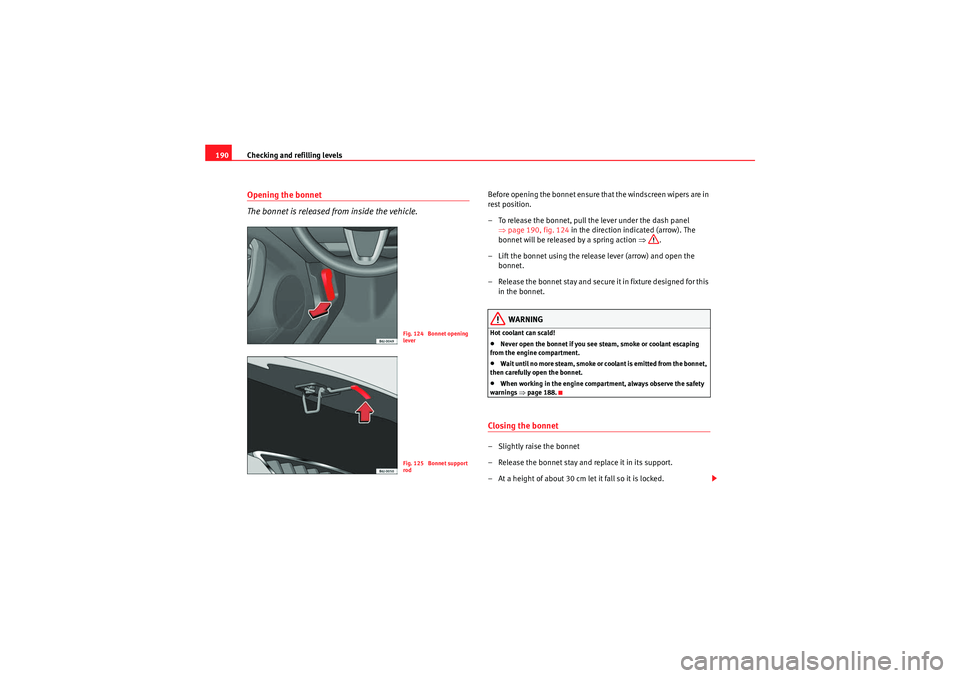
The bonnet is released from inside the vehicle.
Before opening the bonnet ensure that the windscreen wipers are in
rest position.
– To release the bonnet, pull the lever under the dash panel
⇒page 190, fig. 124 in the direction indicated (arrow). The
bonnet will be released by a spring action ⇒.
– Lift the bonnet using the release lever (arrow) and open the bonnet.
– Release the bonnet stay and secure it in fixture designed for this
in the bonnet.
WARNING
Hot coolant can scald!•Never open the bonnet if you see steam, smoke or coolant escaping
from the engine compartment.•Wait until no more steam, smoke or coolant is emitted from the bonnet,
then carefully open the bonnet.•When working in the engine compartment, always observe the safety
warnings ⇒page 188.
Closing the bonnet– Slightly raise the bonnet
– Release the bonnet stay and replace it in its support.
– At a height of about 30 cm let it fall so it is locked.
Fig. 124 Bonnet opening
leverFig. 125 Bonnet support
rod
IbizaST_EN.book Seite 190 Dienstag, 14. September 2010 1:31 13
Page 193 of 264
Checking and refilling levels191
Safety First
Operating Instructions
Practical Tips
Technical Specifications
If the bonnet does not close, do not press downwards. Open it once more and
let it fall as before.
WARNING
If the bonnet is not closed properly, it could open while you are driving and
completely obscure your view of the road. Risk of accident.•After closing the bonnet, always check that it is properly secured. The
bonnet must be flush with the surrounding body panels.•If you notice that the bonnet latch is not secured when the vehicle is
moving, stop the vehicle immediately and close the bonnet properly. Risk
of accident.
Engine oilGeneral notesThe engine comes with a special, high quality, multi grade oil that can be
used in all seasons of the year except for those regions affected by extreme
cold.
As the use of good quality oil is necessary for the correct operation and long
service life of the engine, when it becomes necessary to replenish or change
the oil, always use an oil that complies with VW standards.
The specifications (VW standards) set out in the following page should
appear on the container of the service oil; when the container displays the
specific standards for petrol and diesel engines together, it means that the
oil can be used for both types of engines.
We recommend that the oil change, indicated in the Maintenance
Programme, be performed by an Authorised Service Centre or a specialised
workshop. The correct oil specifications for your engine are listed in
⇒page 192, “Oil
properties”.
Service intervals
Service intervals can be flexible (LongLife service) or fixed (dependent on
time/distance travelled).
If the PR code that appears on the back of the Maintenance Programme
booklet is QG1, this means that your vehicle has the LongLife service
programmed. If it has the codes QG0 or QG2 the interval service is dependent
on time/distance travelled.
Flexible service intervals (LongLife*)
Special oils and processes have been developed which, depending on the
characteristics and individual driving profiles, allow to extend the oil change
service (LongLife service intervals).
Because this oil is essential for extending the service intervals, it must only
be used observing the following indications:
•Avoid mixing it with oil for fixed service intervals.•Only in exceptional circumstances, if the engine oil level is too low
⇒ page 192 and LongLife oil is not available, it is permitted to top up (once)
with oil for fixed service intervals ⇒ page 192 (up to a maximum of 0.5
litres).
Fixed service intervals*
If your vehicle does not have the “LongLife service interval” or it has been
disabled (by request), you may use oils for fixed service intervals, which also
appear in ⇒page 192, “Oil properties”. In this case, your vehicle must be
serviced after a fixed interval of 1 year / 15,000 km (whatever comes first)
⇒ Booklet “Maintenance Programme”.•In exceptional circumstances, if the engine oil level is too low
⇒ page 192 and you cannot obtain the oil specified for your vehicle, you can
put in a small quantity of oil conforming to the specification ACEA A2 or
ACEA A3 (petrol engines) or ACEA B3 or ACEA B4 (diesel engines) (up to 0.5 l).
IbizaST_EN.book Seite 191 Dienstag, 14. September 2010 1:31 13