sunroof Seat Ibiza ST 2010 Owner's manual
[x] Cancel search | Manufacturer: SEAT, Model Year: 2010, Model line: Ibiza ST, Model: Seat Ibiza ST 2010Pages: 264, PDF Size: 7.11 MB
Page 5 of 264
Contents3
ContentsManual structure
. . . . . . . . . . . . . . . . . . . .
Content
. . . . . . . . . . . . . . . . . . . . . . . . . . . . . . . .
Safety First
. . . . . . . . . . . . . . . . . . . . . . . . . . .
Safe driving
. . . . . . . . . . . . . . . . . . . . . . . . . . . . . .
Brief introduction . . . . . . . . . . . . . . . . . . . . . . . .
Proper sitting position for occupants . . . . . . . . .
Pedal area . . . . . . . . . . . . . . . . . . . . . . . . . . . . . .
Storing objects . . . . . . . . . . . . . . . . . . . . . . . . . .
Seat belts
. . . . . . . . . . . . . . . . . . . . . . . . . . . . . . . .
Brief introduction . . . . . . . . . . . . . . . . . . . . . . . .
Why wear seat belts? . . . . . . . . . . . . . . . . . . . . . .
Seat belts . . . . . . . . . . . . . . . . . . . . . . . . . . . . . . .
Belt tensioners* . . . . . . . . . . . . . . . . . . . . . . . . . .
Airbag system
. . . . . . . . . . . . . . . . . . . . . . . . . . . .
Brief introduction . . . . . . . . . . . . . . . . . . . . . . . .
Front airbags . . . . . . . . . . . . . . . . . . . . . . . . . . . .
Side airbags . . . . . . . . . . . . . . . . . . . . . . . . . . . . .
Deactivating airbags* . . . . . . . . . . . . . . . . . . . . .
Child safety
. . . . . . . . . . . . . . . . . . . . . . . . . . . . . .
Brief introduction . . . . . . . . . . . . . . . . . . . . . . . .
Child seats . . . . . . . . . . . . . . . . . . . . . . . . . . . . . .
Securing child seats . . . . . . . . . . . . . . . . . . . . . .
Operating Instructions
. . . . . . . . . . . .
Cockpit
. . . . . . . . . . . . . . . . . . . . . . . . . . . . . . . . . . .
Overview . . . . . . . . . . . . . . . . . . . . . . . . . . . . . . .
Instruments . . . . . . . . . . . . . . . . . . . . . . . . . . . . . Digital instrument panel display . . . . . . . . . . . .
Warning lamps . . . . . . . . . . . . . . . . . . . . . . . . . . .
Steering column controls*
. . . . . . . . . . . . . . . .
General information . . . . . . . . . . . . . . . . . . . . . .
Audio Control . . . . . . . . . . . . . . . . . . . . . . . . . . . .
Audio + Telephone Control . . . . . . . . . . . . . . . . .
Unlocking and locking
. . . . . . . . . . . . . . . . . . . .
Central locking . . . . . . . . . . . . . . . . . . . . . . . . . . .
Keys . . . . . . . . . . . . . . . . . . . . . . . . . . . . . . . . . . .
Radio frequency remote control* . . . . . . . . . . . .
Anti-theft alarm system* . . . . . . . . . . . . . . . . . . .
Tailgate . . . . . . . . . . . . . . . . . . . . . . . . . . . . . . . . .
Windows . . . . . . . . . . . . . . . . . . . . . . . . . . . . . . .
Panorama tilting sunroof* . . . . . . . . . . . . . . . . .
Lights and visibility
. . . . . . . . . . . . . . . . . . . . . . .
Lights . . . . . . . . . . . . . . . . . . . . . . . . . . . . . . . . . .
Interior lights . . . . . . . . . . . . . . . . . . . . . . . . . . . .
Visibility . . . . . . . . . . . . . . . . . . . . . . . . . . . . . . . .
Windscreen wipers . . . . . . . . . . . . . . . . . . . . . . .
Rear view mirrors . . . . . . . . . . . . . . . . . . . . . . . . .
Seats and storage compartments
. . . . . . . . . .
The importance of correct seat adjustment . . . .
Head restraints . . . . . . . . . . . . . . . . . . . . . . . . . .
Front seats . . . . . . . . . . . . . . . . . . . . . . . . . . . . . .
Rear seats . . . . . . . . . . . . . . . . . . . . . . . . . . . . . .
Storage compartment . . . . . . . . . . . . . . . . . . . . .
Ashtrays, cigarette lighter and power socket . .
First-aid kit, warning triangle, fire extinguisher
Luggage compartment . . . . . . . . . . . . . . . . . . . .
Roof rack* . . . . . . . . . . . . . . . . . . . . . . . . . . . . . .
Air conditioning
. . . . . . . . . . . . . . . . . . . . . . . . . .
Heating . . . . . . . . . . . . . . . . . . . . . . . . . . . . . . . . .
Air conditioning* . . . . . . . . . . . . . . . . . . . . . . . . .
Climatronic . . . . . . . . . . . . . . . . . . . . . . . . . . . . . .
General notes . . . . . . . . . . . . . . . . . . . . . . . . . . .
Driving
. . . . . . . . . . . . . . . . . . . . . . . . . . . . . . . . . . .
Steering . . . . . . . . . . . . . . . . . . . . . . . . . . . . . . . .
Safety . . . . . . . . . . . . . . . . . . . . . . . . . . . . . . . . . .
Ignition lock . . . . . . . . . . . . . . . . . . . . . . . . . . . . .
Starting and stopping the engine . . . . . . . . . . .
Start-Stop function* . . . . . . . . . . . . . . . . . . . . . .
Manual gearbox . . . . . . . . . . . . . . . . . . . . . . . . . .
Automatic gearbox* . . . . . . . . . . . . . . . . . . . . . .
Handbrake . . . . . . . . . . . . . . . . . . . . . . . . . . . . . .
Acoustic parking aid system* . . . . . . . . . . . . . . .
Cruise control* . . . . . . . . . . . . . . . . . . . . . . . . . . .
Practical Tips
. . . . . . . . . . . . . . . . . . . . . . . .
Intelligent technology
. . . . . . . . . . . . . . . . . . . . .
Brakes . . . . . . . . . . . . . . . . . . . . . . . . . . . . . . . . .
Anti-lock brake system and traction control ABS
Electronic Stability Programme (ESP)* . . . . . . . .
Driving and the environment
. . . . . . . . . . . . . .
Running-in . . . . . . . . . . . . . . . . . . . . . . . . . . . . . .
Exhaust gas purification system . . . . . . . . . . . . .
Economical and environmentally friendly driving
Driving abroad . . . . . . . . . . . . . . . . . . . . . . . . . . .
Trailer towing . . . . . . . . . . . . . . . . . . . . . . . . . . . .
5
6
7
7
7
9
14
15
17
17
19
22
26
27
27
30
33
37
39
39
41
44
49
49
49
51 52
58
70
70
71
72
74
74
79
80
82
84
86
89
91
91
98
99
100
103
106
106
107
109
111
112
116
119
120
123 125
125
128
131
134
135
135
136
136
138
140
142
143
150
152
154
159
159
159
160
161
164
164
165
167
169
169
IbizaST_EN.book Seite 3 Dienstag, 14. September 2010 1:31 13
Page 85 of 264
Unlocking and locking83
Safety First
Operating Instructions
Practical Tips
Technical Specifications
Interior monitoring and anti-towing alarm*
Monitoring or control function incorporated in the anti-theft
alarm* which detects unauthorized vehicle entry by means of
ultrasound.Activation
– It is connected automatically when the anti-theft alarm is acti-
vated.
Deactivation
– Open the vehicle with the key, either mechanically
9) or by
pressing the button on the remote control.
– Press the button on the remote control twice. The volumetric sensor and tilt sensors will be deactivated. The alarm system
remains activated.
The interior monitoring and the anti-towing alarm are automatically switched
on again next time the vehicle is locked.
The interior monitoring and anti-towing alarm (tilt sensor) are automatically
switched on when the anti-theft alarm is switched on. In order to activate it,
all the doors and the tailgate must be closed.
If you wish to disconnect the interior monitoring and the anti-towing system,
it must be done each time that the vehicle is locked; if not, they will connect
automatically.
The interior monitoring and the anti-towing system should be disconnected
if animals are left inside the locked vehicle (otherwise, their movements will trigger the alarm) or when, for example, the vehicle is transported or has to
be towed with only one axle on the ground.
False alarms
The interior monitoring only operates correctly if the vehicle is completely
closed. Please observe legal requirements when doing so.
The following cases may cause a false alarm:
•opened windows (partially or fully)•panorama/tilting sunroof open (partially or completely).•movement of objects inside the vehicle, such as loose papers, items
hanging from the rear view mirror (air fresheners), etc.Note
•If the vehicle is relocked and the alarm is activated without the volumetric
sensor function, relocking will activate the alarm with all its functions, except
the volumetric sensor. This function is reactivated when the alarm is switched
on again, unless it is deliberately switched off.•If the alarm has been triggered by the volumetric sensor, this will be indi-
cated by a flashing of the indicator on the driver door. The flash is different to
the flash indicating the alarm is activated.•The vibration of a mobile phone left inside the vehicle may cause the inte-
rior monitoring alarm to trigger, as both sensors react to movements and
shakes inside the vehicle.•If on activating the alarm, any door or the tailgate is open, only the alarm
will be activated. The interior monitoring and the anti-towing system will only
be activated once all the doors are closed (including the tailgate).
9)The time period from when the door is opened until the key is inserted in the contact should not exceed 15 sec., otherwise the alarm will be triggered.
IbizaST_EN.book Seite 83 Dienstag, 14. September 2010 1:31 13
Page 91 of 264
Unlocking and locking89
Safety First
Operating Instructions
Practical Tips
Technical Specifications
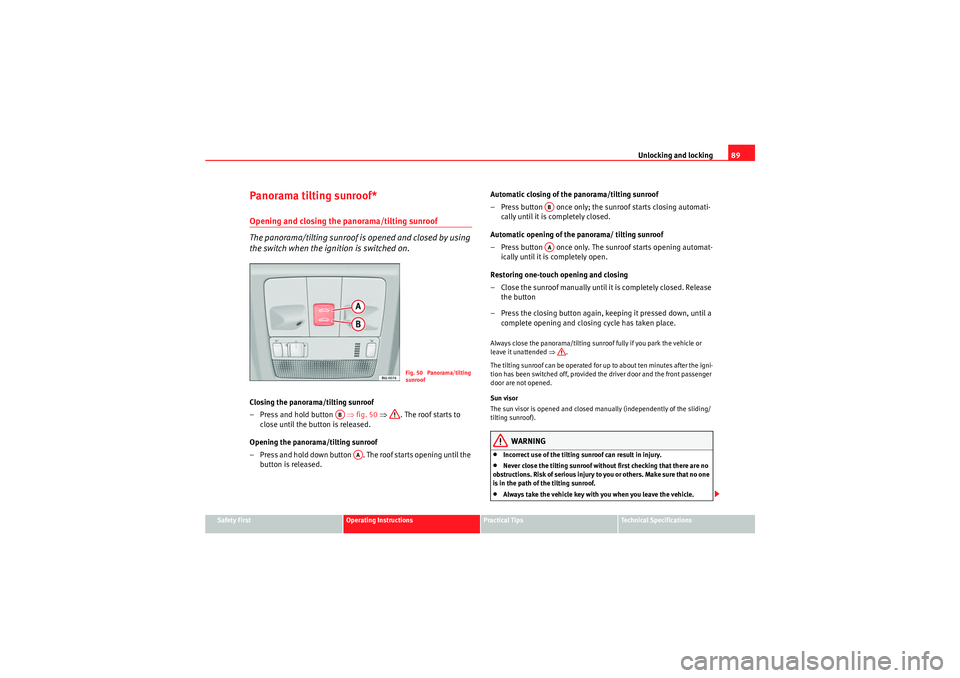
Panorama tilting sunroof*Opening and closing the panorama/tilting sunroof
The panorama/tilting sunroof is opened and closed by using
the switch when the ignition is switched on.Closing the panorama/tilting sunroof
– Press and hold button ⇒fig. 50 ⇒ . The roof starts to
close until the button is released.
Opening the panorama/tilting sunroof
– Press and hold down button . The roof starts opening until the button is released. Automatic closing of the panorama/tilting sunroof
– Press button once only; the sunroof starts closing automati-
cally until it is completely closed.
Automatic opening of the panorama/ tilting sunroof
– Press button once only. The sunroof starts opening automat- ically until it is completely open.
Restoring one-touch opening and closing
– Close the sunroof manually until it is completely closed. Release the button
– Press the closing button again, keeping it pressed down, until a
complete opening and closing cycle has taken place.
Always close the panorama/tilting sunroof fully if you park the vehicle or
leave it unattended ⇒.
The tilting sunroof can be operated for up to about ten minutes after the igni-
tion has been switched off, provided the driver door and the front passenger
door are not opened.
Sun visor
The sun visor is opened and closed manually (independently of the sliding/
tilting sunroof).
WARNING
•Incorrect use of the tilting sunroof can result in injury.•Never close the tilting sunroof without first checking that there are no
obstructions. Risk of serious injury to you or others. Make sure that no one
is in the path of the tilting sunroof.•Always take the vehicle key with you when you leave the vehicle.
Fig. 50 Panorama/tilting
sunroof
AB
AA
ABAA
IbizaST_EN.book Seite 89 Dienstag, 14. September 2010 1:31 13
Page 92 of 264
Unlocking and locking
90•Never leave children or disabled persons in the vehicle, particularly if
they have access to the keys. Unsupervised use of a key could mean that
the engine is started or that electrical equipment is used (e.g. electric
tilting sunroof) with a risk of accident. The doors can be locked using the
remote control key. This could make the aid difficult in an emergency situ-
ation.•The tilting sunroof continues to function until one of the front doors is
opened and the key removed from the ignition.•Ensure that no object and/or end is between the glass and the sunroof
when the one-touch opening/closing function is reset.
Convenience closing* Using the door lock
– Hold the key in the door lock of the driver door in the locking position until the tilting sunroof is closed.
– Release the key to interrupt this function.
Using the remote control
– Push the lock button on the remote control for about 3 seconds. The tilting sunroof closes.
– Press the unlock button to interrupt the function.
Roll-back function of the panorama/ tilting sunroof*The panorama/ tilting sunroof has a roll-back function which prevents larger
objects getting trapped when the roof is closed. The roll-back function does
not prevent fingers getting pinched against the roof opening. The tilting
sunroof stops and opens again immediately if it is obstructed when closing.Operation in case of breakdown
In case of a breakdown, the sunroof may be closed manually.– Remove the plastic cover by inserting a screwdriver into the rear section.
– Insert an Allen key (4 mm) into the opening as far as possible and close the sunroof.
WARNING (continued)
Fig. 51 Emergency opera-
tion of the panorama/
tilting sunroof
IbizaST_EN.book Seite 90 Dienstag, 14. September 2010 1:31 13
Page 126 of 264
Seats and storage compartments
124•For safety reasons, only luggage racks and accessories approved by SEAT
should be used.•It is essential that you follow the assembly instructions included with the
bars exactly, being especially careful to position the front and rear luggage
compartment cover bars on the special housings on the longitudinal bars.
You must also respect their position according to the direction of travel indi-
cated in the assembly manual. Not following these instructions may cause
marks on the longitudinal bars.•Distribute the load evenly. A maximum load of 40 kg only is permitted for
each roof rack system support bar, the load must be distributed evenly along
the entire length. However, the maximum load permitted for the entire roof
(including the support system) of 75 kg must not be exceeded nor should the
total weight of the vehicle be exceeded. See the Technical Data section.•When transporting heavy or large objects on the roof, any change in the
normal vehicle behaviour due to a change in the centre of gravity or an
increased wind resistance must be taken into account. For this reason, a suit-
able speed and driving style must be used.•For those vehicles fitted with a sliding/ tilting sunroof*, ensure that it does
not interfere with the load on the roof rack system when opened.
IbizaST_EN.book Seite 124 Dienstag, 14. September 2010 1:31 13
Page 133 of 264
Air conditioning131
Safety First
Operating Instructions
Practical Tips
Technical Specifications
•If the function is not deactivated by pressing the button, this will deacti-
vate after approx. 20 min.Economic use of the air conditioningWhen the air conditioning is switched on, the compressor consumes engine
power and has influence on fuel consumption. Consider the following points
in order to have the system operating in the minimum possible time.•If the vehicle interior has overheated due to an excessive solar radiation,
it is best to open the windows or doors to allow the hot air to escape.•While in motion, the air conditioning should not be switched on if the
windows or the sunroof are open.*
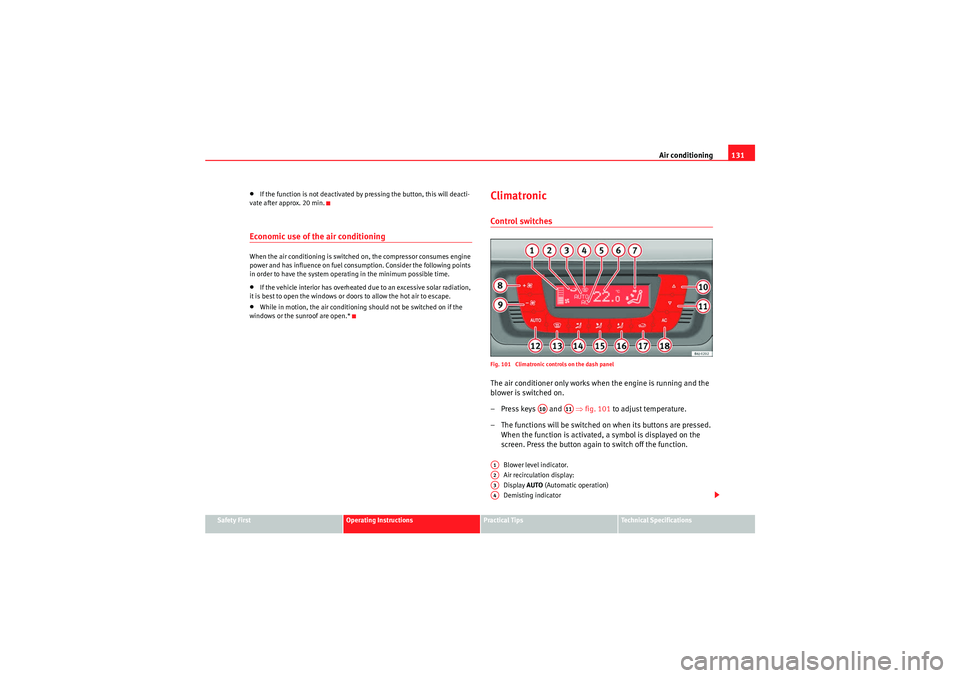
ClimatronicControl switchesFig. 101 Climatronic controls on the dash panelThe air conditioner only works when the engine is running and the
blower is switched on.
–Press keys and ⇒ fig. 101 to adjust temperature.
– The functions will be switched on when its buttons are pressed. When the function is activated, a symbol is displayed on the
screen. Press the button again to switch off the function.
Blower level indicator.
Air recirculation display:
Display AUTO (Automatic operation)
Demisting indicator
A10
A11
A1A2A3A4
IbizaST_EN.book Seite 131 Dienstag, 14. September 2010 1:31 13
Page 136 of 264
Air conditioning
134over. Therefore, never leave the air recirculation mode switched on for a
long time (risk of accident).
Note
When engaging reverse gear, the air reci rculation is connected automatically
to prevent the entrance of exhaust fumes in the vehicle on travelling back-
wards. In this case the symbol for air recirculation is not displayed.General notesPollution filter
The pollution filter (a combined particulate filter and active carbon filter)
serves as a barrier against impurities in the outside air, including dust and
pollen.
For the air conditioner to work with maximum efficiency, the pollution filter
must be replaced at the specified intervals in the Maintenance Programme.
If the filter loses efficiency prematurely due to use in areas reaching very high
pollution levels, the pollen filter must be changed more frequently than
stated in the Service Schedule.
Caution
•If you suspect that the air conditioner is damaged, switch it off with the button to prevent further damage and have it checked by a specialised
workshop.•Repairs to the air conditioner require specialist knowledge and special
tools. Therefore, we recommend you to take the vehicle to a specialised work-
shop.
Note
•If the humidity and temperature outside the vehicle are high, condensa-
tion can drip off the evaporator in the cooling system and so forming a puddle
underneath the vehicle. This is completely normal and there is no need to
suspect a leak.•Keep the air intake slots in front of the windscreen free of snow, ice and
leaves to ensure heating and cooling are not impaired, and to prevent the
windows from misting over.•The air from the vents flows through the vehicle interior and is extracted
by slots designed for this purpose. Therefore, do not cover these slots with
items of clothing or other objects.•The air conditioner operates most effectively with the windows and the
sliding/tilting sunroof* closed. However, if the temperature inside the vehicle
is excessive because of the sun, the air inside can be cooled faster by opening
the windows for a short time.•Do not smoke while air recirculation mode is on, as smoke drawn into the
air conditioning system leaves a residue on the evaporator, producing a
permanent unpleasant odour.•At low outside temperatures the compressor switches off automatically.
The button cannot be switched on either.•It is advisable to connect the air conditioning at least once a month, to
lubricate the system gaskets and prevent leaks. If a decrease in the cooling
capacity is detected, an Authorised Service Centre should be consulted to
check the system.•To ensure correct operation, the grilles on both sides of the screen must
not be obstructed•When the engine is under extreme strain, switch off the compressor for a
moment.
WARNING (continued)
AC
AUTO
IbizaST_EN.book Seite 134 Dienstag, 14. September 2010 1:31 13
Page 175 of 264
Vehicle maintenance and cleaning173
Safety First
Operating Instructions
Practical Tips
Technical Specifications
Care of the vehicle exteriorAutomatic car washing tunnelThe vehicle paintwork is so durable that the vehicle can normally be washed
without problems in an automatic car wash tunnel. However, the paintwork
wear depends to a large extent on the kind of the car wash tunnel, the
brushes used, its water filtering and the type of cleaning and preservative
products.
Before going through a car wash, be sure to take the usual precautions such
as closing the windows and sunroof. There is nothing to note apart from that.
If the vehicle has special accessories such as spoilers or a roof rack or two-
way radio aerial, etc., it is advisable to consult the car wash tunnel operator.
After washing, the brakes could take some time to respond as the brake discs
and pads could be wet, or even frozen in winter. Dry the brakes by braking
several times.
WARNING
Water, ice and salt on the brakes can reduce braking efficiency. Risk of acci-
dent.
Caution
Before putting the vehicle through the car washing tunnel, do not tighten the
aerial if it is folded because it can be damaged.
Washing by handVehicle washing
– First soften the dirt and rinse it off with water.
– Clean your vehicle from top to bottom with a soft sponge, a glove or a brush. Use very light pressure.
– Rinse the sponge or glove often with clean water.
– Special car shampoo should only be used for very stubborn dirt.
– Leave the wheels, sill panels etc. until last, using a different sponge or glove.
– Rinse the vehicle thoroughly with water.
– Dry the vehicle surface gently with a chamois leather.
–In cold temperature , dry the rubber seals and their surfaces to
prevent them from freezing. Apply silicone spray to the rubber
seals.
After washing the vehicle
– After washing, avoid sudden and sharp braking. Dry the brakes by braking several times.
WARNING
•Wash your vehicle with the ignition switched off.•Protect your hands and arms from cuts on sharp metal edges when
cleaning the underbody, the inside of the wheel housings etc. Risk of
injury.
IbizaST_EN.book Seite 173 Dienstag, 14. September 2010 1:31 13
Page 176 of 264
Vehicle maintenance and cleaning
174•Water, ice and salt on the brakes can reduce braking efficiency. Risk of
accident.Caution
•Never remove dirt, mud or dust if the vehicle surface is dry. Never use a
dry cloth or sponge for cleaning purposes. This could scratch the paintwork
or glass on your vehicle.•Washing the vehicle in low temperatures: when washing the vehicle with
a hose, do not direct water into the lock cylinders or the gaps around the
doors, tailgate, or sunroof. Risk of freezing.For the sake of the environment
To protect environment, the vehicle should be washed only in specially
provided wash bays. This prevents toxic, oil-laden waste water entering the
sewerage system. In some places, washing vehicles outside wash bays is
prohibited.
Note
Do not wash the vehicle in direct sunlight.Washing the vehicle with a high pressure cleaner
Be particularly careful when using a high pressure cleaner!– Always observe the instructions for the high-pressure cleaner,
particularly those concerning the pressure and the spraying
distance. – Increase the spraying distance for soft materials and painted
bumpers.
– Do not use a high pressure cleaner to remove ice or snow from windows ⇒page 175.
– Never use concentrated jet nozzles (“rotating jets”) ⇒.
– After washing, avoid sudden and sharp braking. Dry the brakes by braking several times ⇒page 164.
WARNING
•Never wash tyres with a concentrated jet (“rotating nozzle”). Even at
large spraying distances and short cleaning times, visible and invisible
damage can occur to the tyres. This may cause an accident.•Water, ice and salt on the brakes can reduce braking efficiency. Risk of
accident.Caution
•Do not use water hotter than 60 °C. This could damage the vehicle.•To avoid damage to the vehicle, keep a sufficient distance from sensitive
materials such as flexible hoses, plastic, soundproofing material, etc. This is
also important for bumpers painted in the colour of the bodywork. The closer
the nozzle is to the surface, the greater the wear on the material.Vehicle paint maintenance
Regular waxing protects the paintwork.You need to apply wax to your vehicle if water does not form small drops and
run off the paintwork when it is clean .
WARNING (continued)
IbizaST_EN.book Seite 174 Dienstag, 14. September 2010 1:31 13
Page 222 of 264
If and when
220
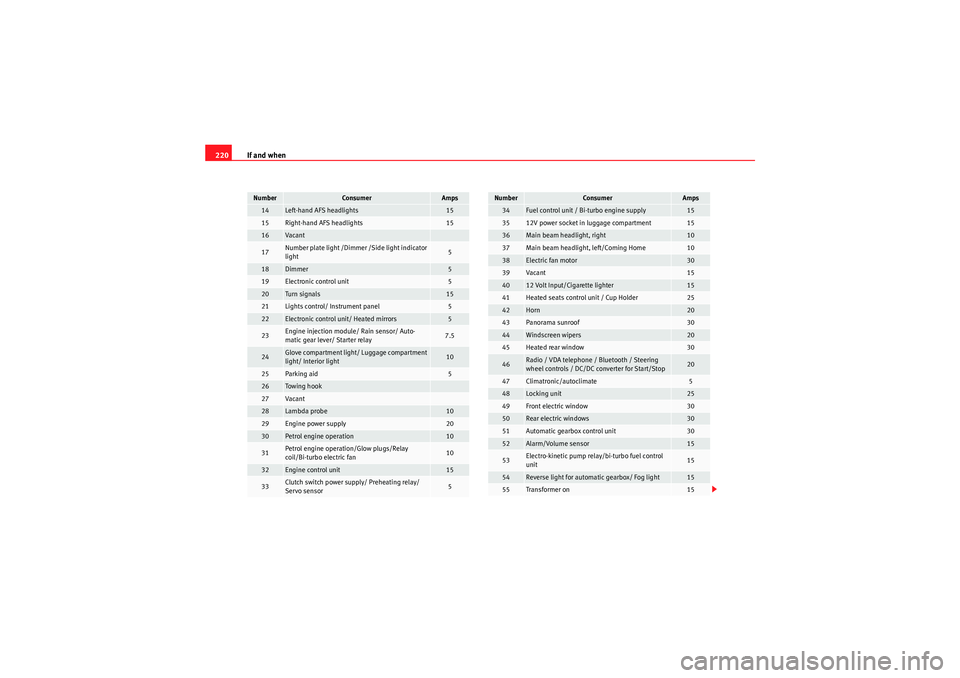
14
Left-hand AFS headlights
15
15
Right-hand AFS headlights
15
16
Vaca n t
17
Number plate light /Dimmer /Side light indicator
light
5
18
Dimmer
5
19
Electronic control unit
5
20
Turn signals
15
21
Lights control/ Instrument panel
5
22
Electronic control unit/ Heated mirrors
5
23
Engine injection module/ Rain sensor/ Auto-
matic gear lever/ Starter relay
7.5
24
Glove compartment light/ Luggage compartment
light/ Interior light
10
25
Parking aid
5
26
Towing hook
27
Vaca n t
28
Lambda probe
10
29
Engine power supply
20
30
Petrol engine operation
10
31
Petrol engine operation/Glow plugs/Relay
coil/Bi-turbo electric fan
10
32
Engine control unit
15
33
Clutch switch power supply/ Preheating relay/
Servo sensor
5
Number
Consumer
Amps
34
Fuel control unit / Bi-turbo engine supply
15
35
12V power socket in luggage compartment
15
36
Main beam headlight, right
10
37
Main beam headlight, left/Coming Home
10
38
Electric fan motor
30
39
Vaca n t
15
40
12 Volt Input/Cigarette lighter
15
41
Heated seats control unit / Cup Holder
25
42
Horn
20
43
Panorama sunroof
30
44
Windscreen wipers
20
45
Heated rear window
30
46
Radio / VDA telephone / Bluetooth / Steering
wheel controls / DC/DC converter for Start/Stop
20
47
Climatronic/autoclimate
5
48
Locking unit
25
49
Front electric window
30
50
Rear electric windows
30
51
Automatic gearbox control unit
30
52
Alarm/Volume sensor
15
53
Electro-kinetic pump relay/bi-turbo fuel control
unit
15
54
Reverse light for automatic gearbox/ Fog light
15
55
Transformer on
15
Number
Consumer
Amps
IbizaST_EN.book Seite 220 Dienstag, 14. September 2010 1:31 13