wiper Seat Ibiza ST 2011 Owner's manual
[x] Cancel search | Manufacturer: SEAT, Model Year: 2011, Model line: Ibiza ST, Model: Seat Ibiza ST 2011Pages: 280, PDF Size: 4.01 MB
Page 5 of 280
Table of Contents
Manual structure . . . . . . . . . . . . . . . . . . . . 5
Content . . . . . . . . . . . . . . . . . . . . . . . . . . . . . . . . 6
Safety First . . . . . . . . . . . . . . . . . . . . . . . . . . . . 7
Safe driving . . . . . . . . . . . . . . . . . . . . . . . . . . . . . . . 7
Brief introduction . . . . . . . . . . . . . . . . . . . . . . . . . 7
Proper sitting position for occupants . . . . . . . . . 10
Pedal area . . . . . . . . . . . . . . . . . . . . . . . . . . . . . . . 16
Storing objects . . . . . . . . . . . . . . . . . . . . . . . . . . . 16
Seat belts . . . . . . . . . . . . . . . . . . . . . . . . . . . . . . . . . 19
Brief introduction . . . . . . . . . . . . . . . . . . . . . . . . . 19
Why wear seat belts? . . . . . . . . . . . . . . . . . . . . . . 21
Seat belts . . . . . . . . . . . . . . . . . . . . . . . . . . . . . . . 25
Belt tensioners* . . . . . . . . . . . . . . . . . . . . . . . . . . 28
Airbag system . . . . . . . . . . . . . . . . . . . . . . . . . . . . . 30
Brief introduction . . . . . . . . . . . . . . . . . . . . . . . . . 30
Front airbags . . . . . . . . . . . . . . . . . . . . . . . . . . . . . 34
Side airbags . . . . . . . . . . . . . . . . . . . . . . . . . . . . . 38
Deactivating airbags* . . . . . . . . . . . . . . . . . . . . . . 41
Child safety . . . . . . . . . . . . . . . . . . . . . . . . . . . . . . . 43
Brief introduction . . . . . . . . . . . . . . . . . . . . . . . . . 43
Child seats . . . . . . . . . . . . . . . . . . . . . . . . . . . . . . . 45
Securing child seats . . . . . . . . . . . . . . . . . . . . . . . 48
Operating Instructions . . . . . . . . . . . . . 53
Cockpit . . . . . . . . . . . . . . . . . . . . . . . . . . . . . . . . . . . 53
Overview . . . . . . . . . . . . . . . . . . . . . . . . . . . . . . . . 53
Instruments . . . . . . . . . . . . . . . . . . . . . . . . . . . . . . 55 LPG system* . . . . . . . . . . . . . . . . . . . . . . . . . . . . . 56
Digital instrument panel display . . . . . . . . . . . . . 57
Warning lamps . . . . . . . . . . . . . . . . . . . . . . . . . . . 63
Steering column controls* . . . . . . . . . . . . . . . . . 76
General information . . . . . . . . . . . . . . . . . . . . . . . 76
Audio Control . . . . . . . . . . . . . . . . . . . . . . . . . . . . . 77
Audio + Telephone Control . . . . . . . . . . . . . . . . . . 78
Unlocking and locking . . . . . . . . . . . . . . . . . . . . . 79
Central locking . . . . . . . . . . . . . . . . . . . . . . . . . . . 79
Keys . . . . . . . . . . . . . . . . . . . . . . . . . . . . . . . . . . . . 84
Radio frequency remote control* . . . . . . . . . . . . . 85
Anti-theft alarm system* . . . . . . . . . . . . . . . . . . . 87
Tailgate . . . . . . . . . . . . . . . . . . . . . . . . . . . . . . . . . 90
Windows . . . . . . . . . . . . . . . . . . . . . . . . . . . . . . . . 92
Panorama tilting sunroof* . . . . . . . . . . . . . . . . . . 95
Lights and visibility . . . . . . . . . . . . . . . . . . . . . . . . 97
Lights . . . . . . . . . . . . . . . . . . . . . . . . . . . . . . . . . . . 97
Interior lights . . . . . . . . . . . . . . . . . . . . . . . . . . . . . 104
Visibility . . . . . . . . . . . . . . . . . . . . . . . . . . . . . . . . . 105
Windscreen wipers . . . . . . . . . . . . . . . . . . . . . . . . 106
Rear view mirrors . . . . . . . . . . . . . . . . . . . . . . . . . . 109
Seats and storage compartments . . . . . . . . . . 113
The importance of correct seat adjustment . . . . . 113
Head restraints . . . . . . . . . . . . . . . . . . . . . . . . . . . 114
Front seats . . . . . . . . . . . . . . . . . . . . . . . . . . . . . . . 116
Rear seats . . . . . . . . . . . . . . . . . . . . . . . . . . . . . . . 118
Storage compartment . . . . . . . . . . . . . . . . . . . . . . 120
Ashtrays, cigarette lighter and power socket . . . 123
First-aid kit, warning triangle, fire extinguisher . 126
Luggage compartment . . . . . . . . . . . . . . . . . . . . . 127
Roof rack* . . . . . . . . . . . . . . . . . . . . . . . . . . . . . . . 131
Air conditioning . . . . . . . . . . . . . . . . . . . . . . . . . . . 132
Heating . . . . . . . . . . . . . . . . . . . . . . . . . . . . . . . . . 132
Air conditioning* . . . . . . . . . . . . . . . . . . . . . . . . . . 135 Climatronic . . . . . . . . . . . . . . . . . . . . . . . . . . . . . . 138
General notes . . . . . . . . . . . . . . . . . . . . . . . . . . . . 140
Driving . . . . . . . . . . . . . . . . . . . . . . . . . . . . . . . . . . . . 142
Steering . . . . . . . . . . . . . . . . . . . . . . . . . . . . . . . . . 142
Safety . . . . . . . . . . . . . . . . . . . . . . . . . . . . . . . . . . . 143
Ignition lock . . . . . . . . . . . . . . . . . . . . . . . . . . . . . . 143
Starting and stopping the engine . . . . . . . . . . . . 145
Start-Stop function* . . . . . . . . . . . . . . . . . . . . . . . 148
Manual gearbox . . . . . . . . . . . . . . . . . . . . . . . . . . 151
Automatic gearbox* . . . . . . . . . . . . . . . . . . . . . . . 152
Handbrake . . . . . . . . . . . . . . . . . . . . . . . . . . . . . . . 159
Acoustic parking aid system* . . . . . . . . . . . . . . . 161
Cruise speed* (Cruise control system) . . . . . . . . 163
Practical Tips . . . . . . . . . . . . . . . . . . . . . . . . . 167
Intelligent technology . . . . . . . . . . . . . . . . . . . . . 167
Brakes . . . . . . . . . . . . . . . . . . . . . . . . . . . . . . . . . . 167
Anti-lock brake system and traction control ABS 168
Electronic Stability Programme (ESP)* . . . . . . . . 169
Driving and the environment . . . . . . . . . . . . . . . 172
Running-in . . . . . . . . . . . . . . . . . . . . . . . . . . . . . . . 172
Exhaust gas purification system . . . . . . . . . . . . . 173
Economical and environmentally friendly driving 175
Driving abroad . . . . . . . . . . . . . . . . . . . . . . . . . . . . 177
Trailer towing . . . . . . . . . . . . . . . . . . . . . . . . . . . . . 178
Vehicle maintenance and cleaning . . . . . . . . . 180
General notes . . . . . . . . . . . . . . . . . . . . . . . . . . . . 180
Care of the vehicle exterior . . . . . . . . . . . . . . . . . . 181
Vehicle interior maintenance . . . . . . . . . . . . . . . . 186
3
Table of Contents
Page 6 of 280
Accessories, parts replacement and
modifications . . . . . . . . . . . . . . . . . . . . . . . . . . . . . 189
Accessories and spare parts . . . . . . . . . . . . . . . . 189
Technical modifications . . . . . . . . . . . . . . . . . . . . 189
Roof aerial* . . . . . . . . . . . . . . . . . . . . . . . . . . . . . . 190
Mobile telephones and two-way radios . . . . . . . . 190
Fitting a towing bracket* . . . . . . . . . . . . . . . . . . . 191
Checking and refilling levels . . . . . . . . . . . . . . . 193
Refuelling . . . . . . . . . . . . . . . . . . . . . . . . . . . . . . . 193
LPG system* . . . . . . . . . . . . . . . . . . . . . . . . . . . . . 195
Petrol . . . . . . . . . . . . . . . . . . . . . . . . . . . . . . . . . . . 198
Diesel . . . . . . . . . . . . . . . . . . . . . . . . . . . . . . . . . . . 198
Working in the engine compartment . . . . . . . . . . 199
Engine oil . . . . . . . . . . . . . . . . . . . . . . . . . . . . . . . . 202
Coolant . . . . . . . . . . . . . . . . . . . . . . . . . . . . . . . . . 206
Washer fluid and windscreen wiper blades . . . . 208
Brake fluid . . . . . . . . . . . . . . . . . . . . . . . . . . . . . . . 211
Vehicle battery . . . . . . . . . . . . . . . . . . . . . . . . . . . 213
Wheels . . . . . . . . . . . . . . . . . . . . . . . . . . . . . . . . . . 215
If and when . . . . . . . . . . . . . . . . . . . . . . . . . . . . . . . 221
Vehicle tools, spare wheel . . . . . . . . . . . . . . . . . . 221
Wheel change . . . . . . . . . . . . . . . . . . . . . . . . . . . . 222
Tyre repair kit (Tyre-Mobility-System)* . . . . . . . . . 227
Fuses . . . . . . . . . . . . . . . . . . . . . . . . . . . . . . . . . . . 229
Bulb change . . . . . . . . . . . . . . . . . . . . . . . . . . . . . 232
Single headlight bulb change . . . . . . . . . . . . . . . 234
Double headlight bulb change . . . . . . . . . . . . . . . 236
Changing the bulbs of AFS headlights . . . . . . . . 240
Changing the fog light bulbs . . . . . . . . . . . . . . . . 241
Changing the rear lights (on the wing) . . . . . . . . 242
Changing the rear lights (on the tailgate) . . . . . . 243
Side turn signal bulbs . . . . . . . . . . . . . . . . . . . . . . 244
Number plate light . . . . . . . . . . . . . . . . . . . . . . . . 244
Interior light and front reading lights . . . . . . . . . 245
Additional brake lights* . . . . . . . . . . . . . . . . . . . . 245
Luggage compartment light . . . . . . . . . . . . . . . . . 246 Jump-starting . . . . . . . . . . . . . . . . . . . . . . . . . . . . . 246
Towing and tow-starting . . . . . . . . . . . . . . . . . . . . 249
Technical Specifications . . . . . . . . . . . 252
Description of specifications . . . . . . . . . . . . . . . 252
Important information . . . . . . . . . . . . . . . . . . . . . 252
Information on fuel consumption . . . . . . . . . . . . 254
Towing a trailer . . . . . . . . . . . . . . . . . . . . . . . . . . . 254
Wheels . . . . . . . . . . . . . . . . . . . . . . . . . . . . . . . . . . 255
Technical specifications . . . . . . . . . . . . . . . . . . . . 256
Checking fluid levels . . . . . . . . . . . . . . . . . . . . . . . 256
Petrol engine 1.2 51 kW (70 PS) . . . . . . . . . . . . . 257
Petrol engine 1.4 63 kW (85 PS) . . . . . . . . . . . . . 258
Petrol engine 1.2 TSI 77 kW (105 PS) . . . . . . . . . 259
Petrol engine 1.2 TSI 77 kW (105 PS) Start-Stop 260
Petrol engine 1.4 TSI 110 kW (150 PS) . . . . . . . . 261
Diesel engine 1.2 TDI CR 55 kW (75 PS) DPF
Start-Stop Ecomotive . . . . . . . . . . . . . . . . . . . . . . 262
Diesel engine 1.2 TDI CR 55 kW (75 PS) DPF . . . . 263
Diesel engine 1.6 TDI CR 66 kW (90 PS) DPF . . . . 264
Diesel engine 1.6 TDI CR 77 kW (105 PS) with/
without DPF . . . . . . . . . . . . . . . . . . . . . . . . . . . . . . 265
Dimensions and capacities . . . . . . . . . . . . . . . . . 267
Index . . . . . . . . . . . . . . . . . . . . . . . . . . . . . . . . . . . 269
4Table of Contents
Page 55 of 280
53
Cockpit
Operating Instructions Cockpit
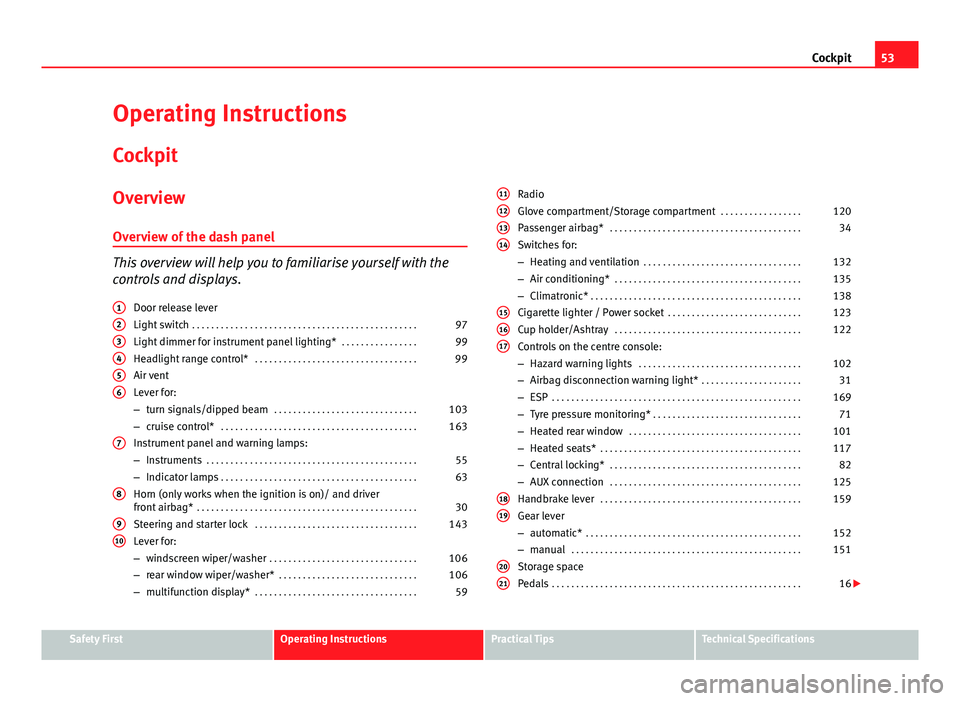
Overview Overview of the dash panel
This overview will help you to familiarise yourself with the
controls and displays. Door release lever
Light switch . . . . . . . . . . . . . . . . . . . . . . . . . . . . . . . . . . . . . . . . . . . . . . . 97
Light dimmer for instrument panel lighting* . . . . . . . . . . . . . . . .99
Headlight range control* . . . . . . . . . . . . . . . . . . . . . . . . . . . . . . . . . . 99
Air vent
Lever for:
– turn signals/dipped beam . . . . . . . . . . . . . . . . . . . . . . . . . . . . . . 103
– cruise control* . . . . . . . . . . . . . . . . . . . . . . . . . . . . . . . . . . . . . . . . . 163
Instrument panel and warning lamps:
– Instruments . . . . . . . . . . . . . . . . . . . . . . . . . . . . . . . . . . . . . . . . . . . . 55
– Indicator lamps . . . . . . . . . . . . . . . . . . . . . . . . . . . . . . . . . . . . . . . . . 63
Horn (only works when the ignition is on)/ and driver
front airbag* . . . . . . . . . . . . . . . . . . . . . . . . . . . . . . . . . . . . . . . . . . . . . . 30
Steering and starter lock . . . . . . . . . . . . . . . . . . . . . . . . . . . . . . . . . . 143
Lever for:
– windscreen wiper/washer . . . . . . . . . . . . . . . . . . . . . . . . . . . . . . . 106
– rear window wiper/washer* . . . . . . . . . . . . . . . . . . . . . . . . . . . . . 106
– multifunction display* . . . . . . . . . . . . . . . . . . . . . . . . . . . . . . . . . . 59
1
23456
7
8
910
Radio
Glove compartment/Storage compartment
. . . . . . . . . . . . . . . . .120
Passenger airbag* . . . . . . . . . . . . . . . . . . . . . . . . . . . . . . . . . . . . . . . . 34
Switches for:
– Heating and ventilation . . . . . . . . . . . . . . . . . . . . . . . . . . . . . . . . . 132
– Air conditioning* . . . . . . . . . . . . . . . . . . . . . . . . . . . . . . . . . . . . . . . 135
– Climatronic* . . . . . . . . . . . . . . . . . . . . . . . . . . . . . . . . . . . . . . . . . . . . 138
Cigarette lighter / Power socket . . . . . . . . . . . . . . . . . . . . . . . . . . . . 123
Cup holder/Ashtray . . . . . . . . . . . . . . . . . . . . . . . . . . . . . . . . . . . . . . . 122
Controls on the centre console:
– Hazard warning lights . . . . . . . . . . . . . . . . . . . . . . . . . . . . . . . . . . 102
– Airbag disconnection warning light* . . . . . . . . . . . . . . . . . . . . .31
– ESP . . . . . . . . . . . . . . . . . . . . . . . . . . . . . . . . . . . . . . . . . . . . . . . . . . . . 169
– Tyre pressure monitoring* . . . . . . . . . . . . . . . . . . . . . . . . . . . . . . . 71
– Heated rear window . . . . . . . . . . . . . . . . . . . . . . . . . . . . . . . . . . . . 101
– Heated seats* . . . . . . . . . . . . . . . . . . . . . . . . . . . . . . . . . . . . . . . . . . 117
– Central locking* . . . . . . . . . . . . . . . . . . . . . . . . . . . . . . . . . . . . . . . . 82
– AUX connection . . . . . . . . . . . . . . . . . . . . . . . . . . . . . . . . . . . . . . . . 125
Handbrake lever . . . . . . . . . . . . . . . . . . . . . . . . . . . . . . . . . . . . . . . . . . 159
Gear lever
– automatic* . . . . . . . . . . . . . . . . . . . . . . . . . . . . . . . . . . . . . . . . . . . . . 152
– manual . . . . . . . . . . . . . . . . . . . . . . . . . . . . . . . . . . . . . . . . . . . . . . . . 151
Storage space
Pedals . . . . . . . . . . . . . . . . . . . . . . . . . . . . . . . . . . . . . . . . . . . . . . . . . . . . 16
11121314
151617
1819
2021
Safety FirstOperating InstructionsPractical TipsTechnical Specifications
Page 61 of 280
59
Cockpit
Multifunction display (MFI)*
The multifunction display (MFI) shows you information on
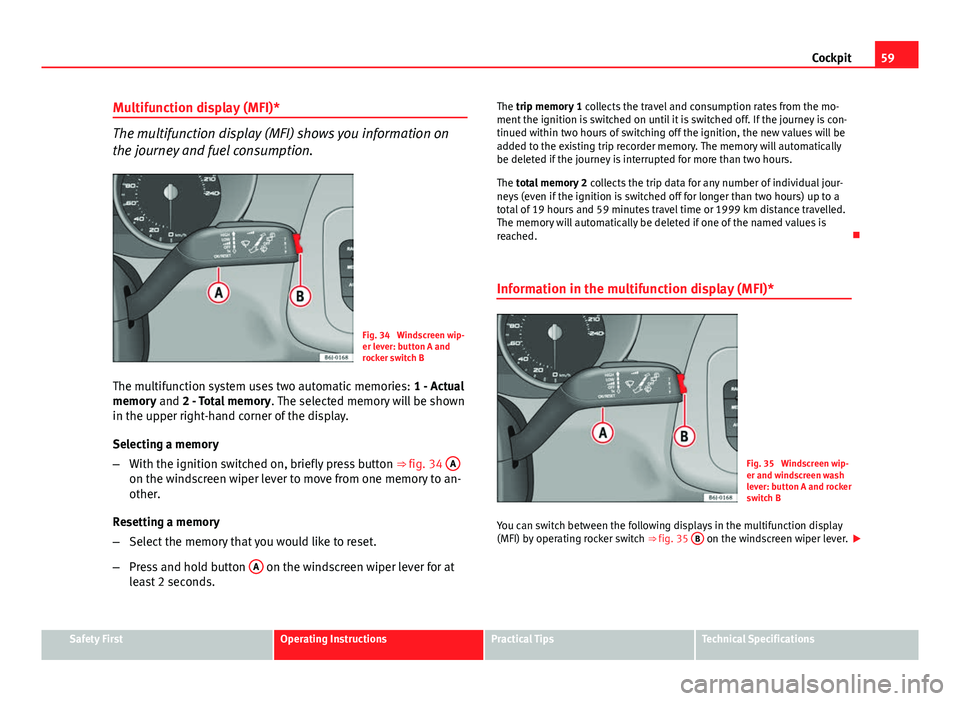
the journey and fuel consumption.
Fig. 34 Windscreen wip-
er lever: button A and
rocker switch B
The multifunction system uses two automatic memories: 1 - Actual
memory and 2 - Total memory . The selected memory will be shown
in the upper right-hand corner of the display.
Selecting a memory
– With the ignition switched on, briefly press button ⇒ fig. 34 A
on the windscreen wiper lever to move from one memory to an-
other.
Resetting a memory
– Select the memory that you would like to reset.
– Press and hold button A
on the windscreen wiper lever for at
least 2 seconds. The trip memory 1
collects the travel and consumption rates from the mo-
ment the ignition is switched on until it is switched off. If the journey is con-
tinued within two hours of switching off the ignition, the new values will be
added to the existing trip recorder memory. The memory will automatically
be deleted if the journey is interrupted for more than two hours.
The total memory 2 collects the trip data for any number of individual jour-
neys (even if the ignition is switched off for longer than two hours) up to a
total of 19 hours and 59 minutes travel time or 1999 km distance travelled.
The memory will automatically be deleted if one of the named values is
reached.
Information in the multifunction display (MFI)*
Fig. 35 Windscreen wip-
er and windscreen wash
lever: button A and rocker
switch B
You can switch between the following displays in the multifunction display
(MFI) by operating rocker switch ⇒ fig. 35 B
on the windscreen wiper lever.
Safety FirstOperating InstructionsPractical TipsTechnical Specifications
Page 100 of 280
98Lights and visibility
● The rear fog light is so bright that it can dazzle drivers behind you. You
should use the rear fog light only when visibility is very poor.
● The use of the lighting described here is subject to the relevant statutory
requirements.
Automatic lighting*
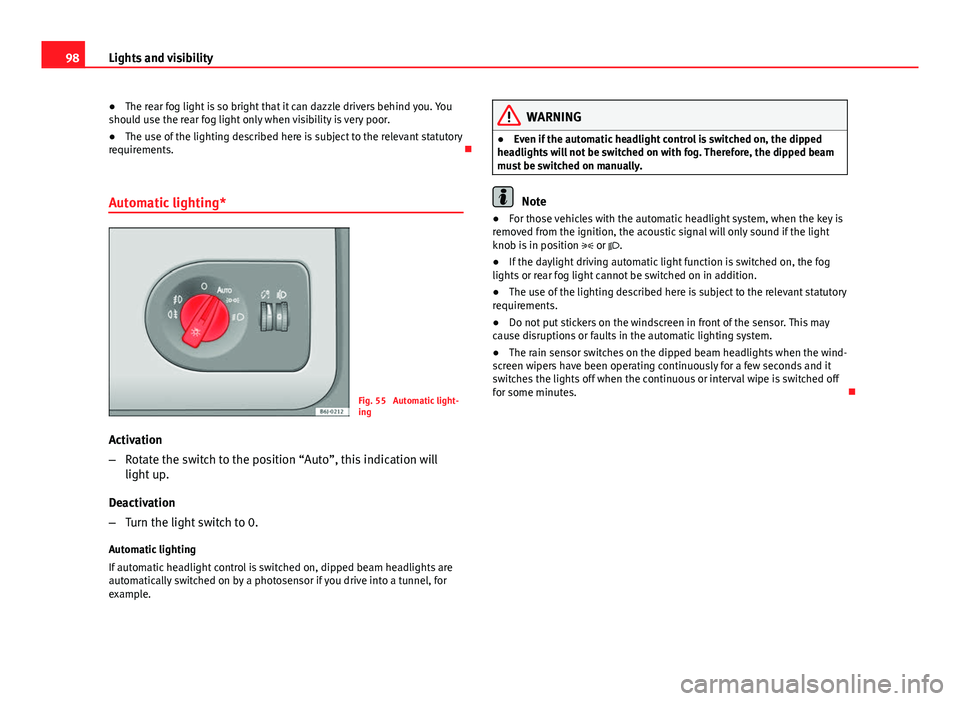
Fig. 55 Automatic light-
ing
Activation
– Rotate the switch to the position “Auto”, this indication will
light up.
Deactivation
– Turn the light switch to 0.
Automatic lighting
If automatic headlight control is switched on, dipped beam headlights are
automatically switched on by a photosensor if you drive into a tunnel, for
example.
WARNING
● Even if the automatic headlight control is switched on, the dipped
headlights will not be switched on with fog. Therefore, the dipped beam
must be switched on manually.
Note
● For those vehicles with the automatic headlight system, when the key is
removed from the ignition, the acoustic signal will only sound if the light
knob is in position or .
● If the daylight driving automatic light function is switched on, the fog
lights or rear fog light cannot be switched on in addition.
● The use of the lighting described here is subject to the relevant statutory
requirements.
● Do not put stickers on the windscreen in front of the sensor. This may
cause disruptions or faults in the automatic lighting system.
● The rain sensor switches on the dipped beam headlights when the wind-
screen wipers have been operating continuously for a few seconds and it
switches the lights off when the continuous or interval wipe is switched off
for some minutes.
Page 108 of 280
106Lights and visibility
The sun visors for the driver and the front passenger can be pulled out of
their central supports and turned towards the doors in the direction of the
arrow ⇒ fig. 63. Never pull them downwards.
The driver sun visor has compartments for cards, and the passenger sun vi-
sor has a vanity mirror with a cover*.
Note
Incorrect use of the sun visors (e.g. pulling them downwards once they are
open) may result in broken hinges. This damage is not covered by the vehi-
cle warranty. Windscreen wipers
Front windscreen wipers
The windscreen wiper lever controls the windscreen wipers
and the automatic wash and wipe.
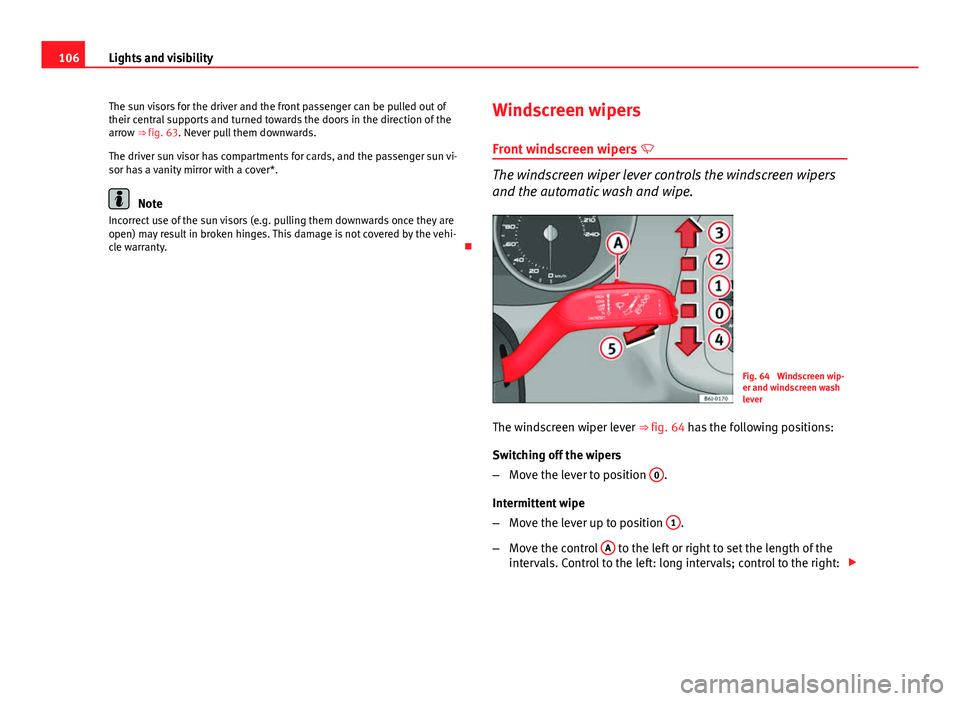
Fig. 64 Windscreen wip-
er and windscreen wash
lever
The windscreen wiper lever ⇒ fig. 64 has the following positions:
Switching off the wipers
– Move the lever to position 0
.
Intermittent wipe
– Move the lever up to position 1
.
– Move the control A
to the left or right to set the length of the
intervals. Control to the left: long intervals; control to the right:
Page 109 of 280
107
Lights and visibility
short intervals. Four wiper interval stages can be set using
switch A
.
Slow wipe
– Move the lever up to position 2
.
Continuous wipe
– Move the lever up to position 3
.
Short wipe
– Move the lever down to position 4
to give the windscreen a
short wipe.
Wash and wipe automatic system
– Pull the lever towards the steering wheel - Position 5
, the
windscreen washer is activated.
– Release the lever. The wipers-washers will keep running for ap-
proximately four seconds.
WARNING
● Worn and dirty wiper blades reduce visibility and safety levels while
driving.
● In cold conditions, you should not use the wash / wipe system unless
you have warmed the windscreen with the heating and ventilation sys-
tem. The washer fluid could otherwise freeze on the windscreen and ob-
scure your view of the road.
● Always note the corresponding warnings on ⇒ page 209.
CAUTION
In icy conditions, always check that the wiper blades are not frozen to the
glass before using the wipers for the first time. If you switch on the wipers
when the wiper blades are frozen to the windscreen, you could damage
both the wiper blades and the wiper motor.
Note
● The windscreen wipers will only work when the ignition is switched on.
● The heat output of the heated jets* is controlled automatically when the
ignition is switched on, depending upon the outside temperature.
● In certain versions of vehicles with alarms, the windscreen wiper will on-
ly work in interval/rain sensor mode when the ignition is on and the bonnet
closed.
● When the interval wipe function is on, the intervals are directly propor-
tional to the speed. This way, the higher the vehicle speed the shorter the
intervals.
● If you stop the vehicle with the windscreen wiper in position 1 or 2, it
will automatically change to a lower speed. The set speed will be resumed
when the vehicle pulls away.
Safety FirstOperating InstructionsPractical TipsTechnical Specifications
Page 110 of 280
108Lights and visibility
Rain sensor*
The rain sensor controls the frequency of the windscreen
wiper intervals, depending on the amount of rain.
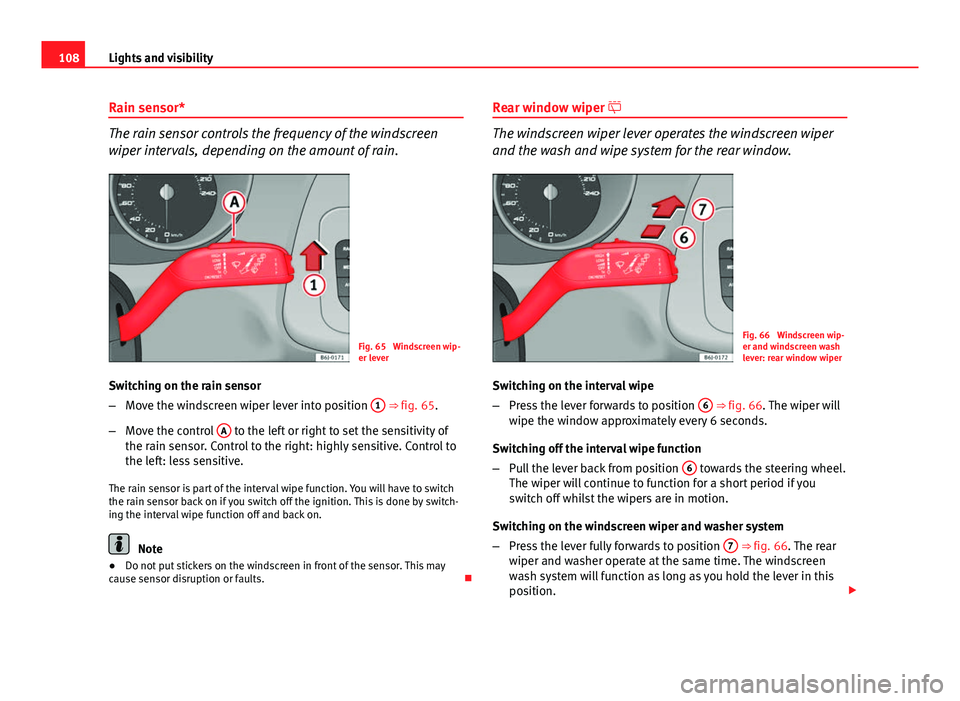
Fig. 65 Windscreen wip-
er lever
Switching on the rain sensor
– Move the windscreen wiper lever into position 1
⇒ fig. 65.
– Move the control A
to the left or right to set the sensitivity of
the rain sensor. Control to the right: highly sensitive. Control to
the left: less sensitive.
The rain sensor is part of the interval wipe function. You will have to switch
the rain sensor back on if you switch off the ignition. This is done by switch-
ing the interval wipe function off and back on.
Note
● Do not put stickers on the windscreen in front of the sensor. This may
cause sensor disruption or faults. Rear window wiper
The windscreen wiper lever operates the windscreen wiper
and the wash and wipe system for the rear window.
Fig. 66 Windscreen wip-
er and windscreen wash
lever: rear window wiper
Switching on the interval wipe
– Press the lever forwards to position 6
⇒ fig. 66. The wiper will
wipe the window approximately every 6 seconds.
Switching off the interval wipe function
– Pull the lever back from position 6
towards the steering wheel.
The wiper will continue to function for a short period if you
switch off whilst the wipers are in motion.
Switching on the windscreen wiper and washer system
– Press the lever fully forwards to position 7
⇒ fig. 66. The rear
wiper and washer operate at the same time. The windscreen
wash system will function as long as you hold the lever in this
position.
Page 111 of 280
109
Lights and visibility
– Release the lever. The washer system stops and the wipers con-
tinue until the end of the cycle.
– Move the lever towards the steering wheel to switch off.
WARNING
● A worn or dirty wiper blade will obstruct visibility and reduce safety.
● Always note the corresponding warnings on ⇒ page 209.
CAUTION
In icy conditions, always check that the wiper blade is not frozen to the
glass before using the wiper for the first time. If you switch on the wiper
when the wiper blade is frozen to the glass, this could damage both the
wiper blade and the wiper motor.
Note
● The rear window wiper will only work when the ignition is switched on.
● Depending on the version of the model, when you engage reverse gear
and with the headlight wiper activated, the lamps are wiped.
Headlight washer*
The headlight washers clean the headlight lenses. The headlight washers are activated automatically when the windscreen
washer is used and the windscreen wiper lever is pulled towards the steer-
ing wheel for at least 1.5 seconds – provided the dipped beam headlights
or main beams are switched on. Clean off stubborn dirt (insects, etc.) from
the headlights at regular intervals, for instance when filling the fuel tank.
Note
● To ensure that the headlight washers work properly in winter, keep the
nozzle holders in the bumper free of snow and remove any ice with a de-icer
spray.
● To remove water, the windscreen wipers will be activated from time to
time, the headlight wipers will be activated every three cycles.
Rear view mirrors
Adjusting the rear view mirrors
Before beginning any journey, adjust the rear view mirrors for correct visibil-
ity.
Interior mirror
It is dangerous to drive if you cannot see clearly through the
rear window. Manual anti-dazzle function for interior mirror
In the basic mirror position, the lever at the bottom edge of the mirror
should be at the front. Pull the lever to the back to select the anti-dazzle
function.
Safety FirstOperating InstructionsPractical TipsTechnical Specifications
Page 160 of 280
158Driving
● The wiper starts if the windscreen washer is on.
● The parking distance warning system switches on.*
N - Neutral (idling)
If this position is selected, the gearbox is in neutral. Power is not transmit-
ted to the wheels and the engine does not have a braking function.
Never use the N position to drive down a hill. The engine does not function
as a brake and the brakes are subjected to excessive stain.
You could damage the automatic gearbox if you drive down hills with the
gear lever in position N and the engine switched off.
D - Drive (forward)
In this position the gearbox automatically changes to a lower or higher gear,
according to the engine's requirements, the driving style and speed. The
braking effect of the engine when driving downhill is very limited when the
selector is in this position. The instrument panel displays the selected gear
as well as the selector lever in position D.
If position N has been selected and you wish to select D, you must press the
foot brake if the vehicle is stationary, or travelling at under 5 km/h.
S - Standard driving position (Sport programme)
When the selector lever is in position S, it will automatically change up into
a higher gear later, and change down into a low gear, if compared with posi-
tion D. This way, it is possible to take full advantage of the engine reserve
power, depending on the engine demand, driving style and speed. The
braking effect of the engine when driving downhill is very limited. On the
instrument panel display the selected gear is shown as well as the selector
lever to position S.
To select gear range S, press the lock button on the selector lever.
WARNING
If the vehicle moves with no control, an accident and serious injury may
occur.
● As a driver, you should never leave your vehicle if the engine is run-
ning and a gear is engaged. If you have to leave your vehicle while the
engine is running, you must always apply the handbrake and engage
parking lock P.
● If the engine is running and if D or R are engaged, you will need to
hold the vehicle stopped by depressing footbrake down. The car would
creep forward as the power transmission is not fully interrupted even
when the engine is idling.
● Never accelerate when moving the selector gear or you may cause an
accident.
● Never move the selector lever to “R” or “P” when driving. Risk of acci-
dent.
● Before driving down a very steep slope, reduce your speed and shift
to first gear.
● Always hold the vehicle on the foot brake if you stop on hills. Other-
wise, the vehicle could roll back.
● Never allow the brake to rub and do not use the brake pedal too often
or for long periods. Constant braking will cause the brakes to overheat
and will considerably reduce the brake effect. This increases the braking
distance and could cause the brake system to fail.
WARNING
Never switch the engine off until the vehicle is stationary. You could lose
control of your vehicle. This could cause an accident and serious injury.
● The airbags and belt tensioners do not work when the ignition is
switched off.