child lock Seat Ibiza ST 2012 User Guide
[x] Cancel search | Manufacturer: SEAT, Model Year: 2012, Model line: Ibiza ST, Model: Seat Ibiza ST 2012Pages: 282, PDF Size: 3.77 MB
Page 91 of 282
89
Opening and closing
WARNING
● An improper use of the key can cause serious injuries.
● Never leave children or disabled persons in the vehicle. In case of
emergency, they may not be able to leave the vehicle or manage on their
own.
● Never forget the keys inside the vehicle. Otherwise, this could result
in serious injuries, accidents or even the theft of your vehicle. Always
take the key with you when you leave the vehicle.
● An uncontrolled use of the key could start the engine or activate any
electric equipment (e.g. electric windows), causing risk of accident. The
vehicle can be locked when using the remote control key. This could com-
plicate the aid in case of emergency.
Note
● The radio frequency remote control key functions only when you are
within range ⇒ Fig. 47.
● If the vehicle cannot be unlocked or locked by using the radio frequency
remote control, the remote control key will have to be re-synchronised. For
this, go to your Technical Service.
Changing the battery
If the battery indicator does not flash when the buttons are pushed, the bat-
tery must be replaced.
CAUTION
The use of inappropriate batteries may damage the radio frequency remote
control. For this reason, always replace the dead battery with another of the
same size and power.
For the sake of the environment
Used batteries must be disposed of at an appropriate waste facility or
through an authorised service, given that their components can affect the
environment.
Synchronising the remote control key
If it is not possible to unlock or lock the door with the remote
control, it should be re-synchronised.
While the vehicle is open:
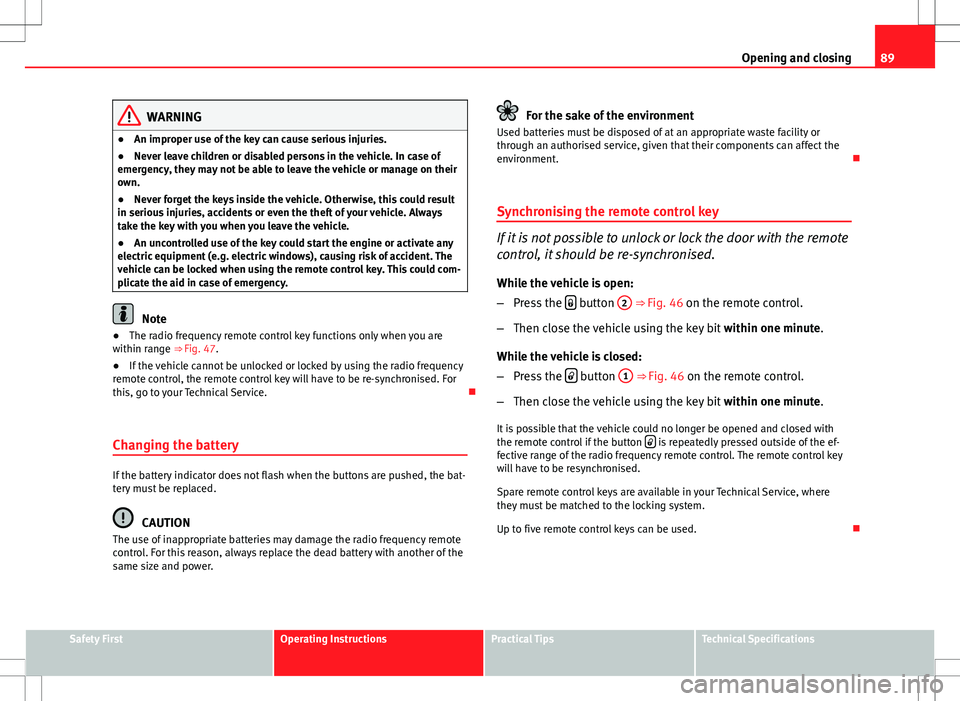
– Press the
button
2 ⇒
Fig. 46 on the remote control.
– Then close the vehicle using the key bit within one minute.
While the vehicle is closed:
– Press the
button
1 ⇒ Fig. 46 on the remote control.
– Then close the vehicle using the key bit within one minute.
It is possible that the vehicle could no longer be opened and closed with
the remote control if the button
is repeatedly pressed outside of the ef-
fective range of the radio frequency remote control. The remote control key
will have to be resynchronised.
Spare remote control keys are available in your Technical Service, where
they must be matched to the locking system.
Up to five remote control keys can be used.
Safety FirstOperating InstructionsPractical TipsTechnical Specifications
Page 96 of 282

94Opening and closing
WARNING
● Always close the rear lid properly. Risk of accident or injury.
● The rear lid must not be opened when the reverse or rear fog lights
are lit. This may damage the tail lights
● Do not close the rear lid by pushing it down with your hand on the
rear window. The glass could smash. Risk of injury!
● Ensure the rear lid is locked after closing it. If not, it may open unex-
pectedly while driving.
● Never allow children to play in or around the vehicle. A locked vehicle
can be subjected to extremely high and low temperatures, depending on
the time of year, thus causing serious injuries/illness. It could even have
fatal consequences. Close and lock both the rear lid and all the other
doors when you are not using the vehicle.
● Closing the rear lid without observing and ensuring it is clear could
cause serious injury to you and to third parties. Make sure that no one is
in the path of the rear lid.
● Never drive with the rear lid open or half-closed, exhaust gases may
penetrate into the interior of the vehicle. Danger of poisoning!
● If you only open the rear lid, do not leave the key inside. The vehicle
will not be opened if the key is left inside.
Emergency opening
This allows the vehicle to be opened if the central locking
does not operate (for example, if the battery is flat)
Fig. 50 Rear lid: emer-
gency open
There is a groove in the luggage compartment allowing access to
the emergency opening mechanism.
Opening the rear lid from inside the luggage compartment
– Insert the key in the groove and unlock the locking system, turn-
ing the key from right to left, as shown by the arrow ⇒ Fig. 50.
Page 97 of 282

95
Opening and closing
Windows Opening or closing the windows electrically*
The front and rear electric windows can be operated by us-
ing the controls on the driver door. The other doors each
have a switch for their own window.
Fig. 51 Detail of the
driver door: controls for
the front and rear win-
dows
Opening and closing the windows
– Press the button
to open the window.
– Pull button
to close the window ⇒ .
Always close the windows fully if you park the vehicle or leave it unattended
⇒
.
You can use the electric windows for approx. 10 minutes after switching off
the ignition if neither the driver door nor the front passenger door has been
opened and the key has not been removed from the ignition. Buttons on the driver door
Button for window in front left door
Button for window in front right door
Safety switch for deactivating the electric window buttons in the rear
doors
Button for window in rear left door
Button for window in rear right door
Safety switch *
Safety switch 3
on the driver door can be used to disable the electric win-
dow buttons in the rear doors.
Safety switch not pressed: buttons on rear doors are activated.
Safety switch pressed: buttons on rear doors are deactivated.
WARNING
● Incorrect use of the electric windows can result in injury.
● Never close the rear lid without observing and ensuring it is clear, to
do otherwise could cause serious injury to you and third parties. Make
sure that no one is in the path of a window.
● Always take the vehicle key with you when you leave the vehicle.
● Never leave children or disabled persons in the vehicle, particularly if
they have access to the keys. The misuse of the keys, for example, by
children, may result in serious injury and accident.
● The engine may accidentally be started and be out of control.
● If the ignition is switched on, the electric equipment could be activa-
ted with risk of injury, for example, in the electric windows.
● The doors can be locked using the remote control key. This could be-
come an obstacle for assistance in an emergency situation.
● Always take the key with you when you leave the vehicle.
123
45
Safety FirstOperating InstructionsPractical TipsTechnical Specifications
Page 99 of 282

97
Opening and closing
● If the window is still obstructed, the window will stop at this point.
● If there is no obvious reason why the window cannot be closed, try to
close it again by pulling the tab within ten seconds. The window closes with
maximum force. The roll-back function is now deactivated.
If more than 10 seconds pass, the window will open fully when you operate
one of the buttons. One-touch closing is reactivated.
The one-touch function and roll-back function will not work if there is a mal-
function in the electric windows. Contact a specialised workshop.
WARNING
● Incorrect use of the electric windows can result in injury.
● Always take the ignition key with you when leaving the vehicle, even
if you only intend to be gone for a short time. Please ensure that children
are never left alone inside the vehicle.
● The electric windows will work until the ignition has been switched
off and one of the front doors has been opened.
● Closing the windows without observing and ensuring it is clear could
cause serious injury to you and third parties. Make sure that no one is in
the path of a window.
● Never allow people to remain in the vehicle when you close the vehi-
cle from the outside. The windows cannot be opened even in an emergen-
cy.
● The roll-back function does not prevent fingers or other parts of the
body from getting pinched against the window frame, causing injury.
Convenience opening and closing*
Using the door lock*
–
Hold the key in the door lock of the driver door in either the
locking or the unlocking position until all windows are either
opened or closed.
– Release the key to interrupt this function.
Using the remote control
– Keep the locking/unlocking button pressed for the electric win-
dow risers to open/close; if you stop pressing the button, the
window raising/lowering function is stopped.
– If the automatic raising is stopped and immediately after, the
opening button is kept pressed, the window risers will lower.
– Once the windows are completely closed, the turn signals will
flash.
Safety FirstOperating InstructionsPractical TipsTechnical Specifications
Page 148 of 282
146Driving
Ignition switched off, steering lock 1
In this position
⇒ Fig. 107 the ignition and the engine are OFF and the steer-
ing may get locked.
For the Steering lock to operate without the ignition key, turn the steering
wheel until it locks with an audible sound. You should always lock the steer-
ing wheel when you leave your vehicle. This will help prevent vehicle theft
⇒
.
Switching the ignition or the glow plug system on 2
Turn the ignition key to this position and release it. If the key cannot be
turned or it is difficult to turn from position 1 to position 2, move the
steering wheel from one side to the other until it is released.
Starting 3
The engine is started when the key is in this position. Electrical components
with a high power consumption are switched off temporarily.
Every time the vehicle is started again, the ignition key must be turned to
position 1
. The
repetitive start prevention lock of the ignition prevents
possible damage to the starter motor if the engine is already running.
WARNING
● The ignition key must NOT be removed from the lock until the vehicle
comes to a standstill. Otherwise, the steering could be immediately
blocked- Risk of accident!
● Always remove the key from the ignition when leaving the vehicle,
even for a short period. This is especially important if children or disa-
bled people are left alone in the vehicle. They could accidentally start the
engine or work electrical equipment such as the electric windows, conse-
quently resulting in an accident.
● Unsupervised use of the keys could start the engine or any electrical
system, such as the electric window. This could result in serious injury.
CAUTION
The starter motor will only work when the engine is stopped (ignition key
position 3
).
Electronic immobiliser
The electronic immobiliser prevents unauthorised persons
from driving the vehicle.
Inside the key there is a chip that deactivates the electronic immobiliser au-
tomatically when the key is inserted into the ignition.
The electronic immobiliser will be activated again automatically as soon as
you pull the key out of the ignition lock.
The engine can only be started using a genuine SEAT key with its correct
code.
Note
A perfect operation of the vehicle is ensured if genuine SEAT keys are used.
Page 164 of 282
162Driving
Parking
The handbrake should always be firmly applied when the
vehicle is parked.
Always note the following points when parking the vehicle:
–Use the brake pedal to stop the vehicle.
– Apply the handbrake.
– Select first gear.
– Switch the engine off and remove the key from the ignition. Turn
the steering wheel slightly to engage the steering lock.
– Always take you keys with you when you leave the vehicle ⇒
.
Additional notes on parking the vehicle on gradients:
Turn the steering wheel so that the vehicle rolls against the kerb if it started
to roll.
● If the vehicle is parked facing downhill, turn the front wheels so that
they point towards the kerb .
● If the vehicle is parked facing uphill, turn the front wheels so that they
point away from the kerb .
● Secure the vehicle as normal by applying the handbrake firmly and se-
lecting first gear.
WARNING
● Take measures to reduce the risk of injury when you leave your vehi-
cle unattended.
● Never park where the hot exhaust system could ignite inflammable
materials, such as dry grass, low bushes, spilt fuel etc.
● Never allow vehicle occupants to remain in the vehicle when it is
locked. They would be unable to open the vehicle from the inside, and
could become trapped in the vehicle in an emergency. In the event of an
emergency, locked doors will delay assistance to vehicle occupants.
● Never leave children alone in the vehicle. They could set the vehicle
in motion, for example, by releasing the handbrake or the gearbox lever.
● Depending on weather conditions, it may become extremely hot or
cold inside the vehicle. This can be fatal.
Hill-start assist*
This function is only included in vehicles with ESC. This device helps when starting uphill.
These are the basic operation conditions: doors closed, brake pedal press-
ed down and vehicle in neutral. The system gets activated on engaging
gear.
After removing your foot from the brake pedal, the braking force is main-
tained for a few seconds to prevent the vehicle from moving backward when
putting into gear. This short space of time is enough to start the vehicle
with ease.
This system also works when reversing uphill.
Page 203 of 282
201
Checking and refilling levels
WARNING
All work on the engine or in the engine compartment, e.g. checking and
refilling fluids, involves the danger of injury and scalding as well as the
risk of accident or fire.
● Never open the bonnet if you see steam, smoke or coolant escaping
from the engine compartment. Otherwise, there is a risk of sustaining
burns. Wait until no more steam or coolant is emitted, then allow the en-
gine to cool before carefully opening the bonnet.
● Switch off the engine and remove the key from the ignition.
● Apply the handbrake and move the gear lever to neutral or selector
lever to position P.
● Keep children away from the vehicle.
● Never touch hot engine parts. There is a risk of burns.
● Never spill liquids on a hot engine or on a hot exhaust gas system.
This is a fire hazard.
● Avoid causing short-circuits in the electrical system, particularly at
the points where the jump leads are attached ⇒ page 249. The battery
could explode.
● Never touch the radiator fan. It is temperature controlled and could
start automatically, even when the engine has been switched off and the
key removed from the ignition!
● Do not unscrew the cap on the coolant expansion tank when the en-
gine is hot. If the coolant is hot, the cooling system will be pressurised!
● Protect face, hands and arms by covering the cap with a large, thick
cloth to protect against escaping coolant and steam.
● Always make sure you have not left any objects, such as cleaning
cloths and tools, in the engine compartment.
● If you have to work underneath the vehicle, you must use suitable
stands additionally to support the vehicle, there is a risk of accident!. A
hydraulic jack is insufficient for securing the vehicle and there is a risk of
injury.WARNING (Continued)
● If any work has to be performed when the engine is started or with
the engine running, there is an additional, potentially fatal, safety risk
from the rotating parts, such as the drive belts, alternator, radiator fan,
etc., and from the high-voltage ignition system. You should also observe
the following points:
–Never touch the electrical wiring of the ignition system.
– Ensure that jewellery, loose clothing and long hair do not get trap-
ped in rotating engine parts. Danger of death. Before starting any
work remove jewellery, tie back and cover hair, and wear tight-fitting
clothes.
– Never accelerate with a gear engaged without taking the necessary
precautions. The vehicle could move, even if the handbrake is ap-
plied. Danger of death.
● If work has to be carried out on the fuel system or on electrical com-
ponents, you must observe the following safety notes in addition to the
above warnings:
–Always disconnect the battery from the on-board network. The ve-
hicle must be unlocked when this is done, otherwise the alarm will be
triggered.
– Do not smoke.
– Never work near naked flames.
– Always have a fire extinguisher on hand.
CAUTION
When topping up service fluids, make sure not to mistake them. Using the
wrong fluids could cause serious malfunctions and engine damage!
Safety FirstOperating InstructionsPractical TipsTechnical Specifications
Page 216 of 282
214Checking and refilling levels
WARNING
Brake fluid is poisonous. Old brake fluid impairs the braking effect.
● Before opening the bonnet to check the brake fluid level, read and ob-
serve the warnings ⇒ page 200.
● Brake fluid should be stored in the closed original container in a safe
place out of reach of children. There is a toxic risk.
● Complete the brake fluid change according to the Maintenance Pro-
gramme. Heavy use of the brakes may cause a vapour lock if the brake
fluid is left in the brake system for too long. This would seriously affect
the effectiveness of the brakes and the safety of the vehicle. This may
cause an accident.
CAUTION
Brake fluid damages the vehicle paintwork. Wipe off any brake fluid from
the paintwork immediately.
For the sake of the environment
The brake pads and brake fluid must be collected and disposed of accord-
ing the applicable regulations. The SEAT Technical Service network has the
necessary equipment and qualified personnel for collecting and disposing
of this waste material. Vehicle battery
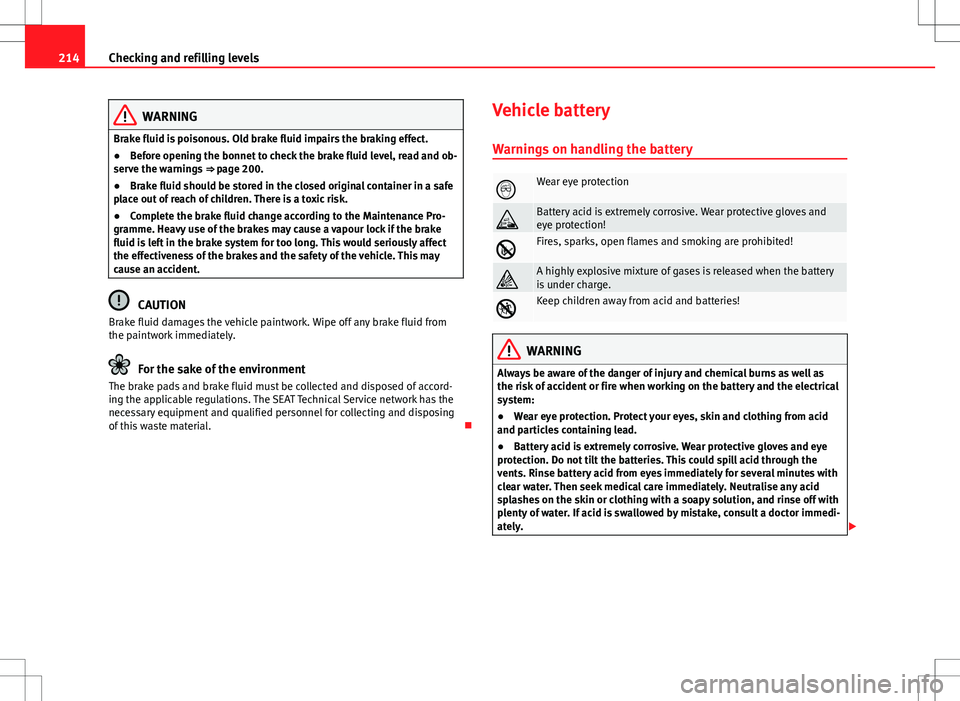
Warnings on handling the battery
Wear eye protection
Battery acid is extremely corrosive. Wear protective gloves and
eye protection!
Fires, sparks, open flames and smoking are prohibited!
A highly explosive mixture of gases is released when the battery
is under charge.
Keep children away from acid and batteries!
WARNING
Always be aware of the danger of injury and chemical burns as well as
the risk of accident or fire when working on the battery and the electrical
system:
● Wear eye protection. Protect your eyes, skin and clothing from acid
and particles containing lead.
● Battery acid is extremely corrosive. Wear protective gloves and eye
protection. Do not tilt the batteries. This could spill acid through the
vents. Rinse battery acid from eyes immediately for several minutes with
clear water. Then seek medical care immediately. Neutralise any acid
splashes on the skin or clothing with a soapy solution, and rinse off with
plenty of water. If acid is swallowed by mistake, consult a doctor immedi-
ately.
Page 217 of 282
215
Checking and refilling levels
WARNING (Continued)
● Fires, sparks, open flames and smoking are prohibited. When han-
dling cables and electrical equipment, avoid causing sparks and electro-
static charge. Never short the battery terminals. High-energy sparks can
cause injury.
● A highly explosive mixture of gases is released when the battery is
under charge. The batteries should be charged in a well-ventilated room
only.
● Keep children away from acid and batteries.
● Before working on the electrical system, you must switch off the en-
gine, the ignition and all consumers. The negative cable on the battery
must be disconnected. When a light bulb is changed, you need only
switch off the light.
● Deactivate the anti-theft alarm by unlocking the vehicle before you
disconnect the battery! The alarm will otherwise be triggered.
● When disconnecting the battery from the vehicle on-board network,
disconnect first the negative cable and then the positive cable.
● Switch off all electrical consumers before reconnecting the battery.
Reconnect first the positive cable and then the negative cable. Never re-
verse the polarity of the connections. This could cause an electrical fire.
● Never charge a frozen battery, or one which has thawed. This could
result in explosions and chemical burns. Always replace a battery which
has frozen. A flat battery can freeze at temperatures around 0°C.
● Ensure that the vent hose is always connected to the battery.
● Never use a defective battery. This could cause an explosion. Replace
a damaged battery immediately.
● For vehicles with the battery in the luggage compartment: Check that
the battery gas ventilation hose is securely attached.CAUTION
● Never disconnect the battery if the ignition is switched on or if the en-
gine is running. This could damage the electrical system or electronic com-
ponents.
● Do not expose the battery to direct sunlight over a long period of time,
as the intense ultraviolet radiation can damage the battery housing.
● If the vehicle is left standing in cold conditions for a long period, protect
the battery from freezing. If it freezes it will be damaged.
Checking the electrolyte level
The electrolyte level should be checked regularly in high-
mileage vehicles, in hot countries and in older batteries. – Open the engine bonnet and the battery cover ⇒
in Safety in-
structions on working in the engine compartment on page 201
⇒
in Warnings on handling the battery on page 214.
– Check the colour display in the "magic eye" on the top of the
battery.
– If there are air bubbles in the window, tap the window gently
until they disperse.
The position of the battery is shown in the corresponding engine compart-
ment diagram ⇒ page 259.
The “magic eye” indicator, located on the top of the battery changes colour,
depending on the charge state and electrolyte level of the battery.
There are two different colours:
Safety FirstOperating InstructionsPractical TipsTechnical Specifications
Page 274 of 282
C
Car care Exterior . . . . . . . . . . . . . . . . . . . . . . . . . . . . 182
Car phone . . . . . . . . . . . . . . . . . . . . . . . . . . . . . 191
Catalytic converter . . . . . . . . . . . . . . . . . . . . . . 174
CCS . . . . . . . . . . . . . . . . . . . . . . . . . . . . . . . . . . 164
Central lock button Locking . . . . . . . . . . . . . . . . . . . . . . . . . . . . . 85
Unlocking . . . . . . . . . . . . . . . . . . . . . . . . . . . 85
Central locking . . . . . . . . . . . . . . . . . . . . . . . . . . 82 Automatic speed dependent locking andunlocking system* . . . . . . . . . . . . . . . . . . 84
Emergency unlocking system . . . . . . . . . . . 85
Locking system for involuntary unlocking . 84
Selective unlocking system* . . . . . . . . . . . . 83
Unlocking system* . . . . . . . . . . . . . . . . . . . . 84
Cetane number . . . . . . . . . . . . . . . . . . . . . . . . . 199
Changing bulbs interior light and front reading lights . . . . 247
Changing gear see Manual gearbox . . . . . . . . . . . . . . . . . . 153
Changing gear in tiptronic mode . . . . . . . . . . 157
Changing rear lights on the rear lid . . . . . . . . . . . . . . . . . . . . . . . 245
on the wing . . . . . . . . . . . . . . . . . . . . . . . . . 244
Changing single headlight bulbs Turn signal bulb . . . . . . . . . . . . . . . . . . . . . 236
Changing the AFS headlight bulbs Xenon lights . . . . . . . . . . . . . . . . . . . . . . . . 242
Changing the bulbs AFS headlight bulbs . . . . . . . . . . . . . . . . . . 242
fog light bulbs . . . . . . . . . . . . . . . . . . . . . . 243 Luggage compartment light . . . . . . . . . . . 248
number plate light . . . . . . . . . . . . . . . . . . . 247
Side turn signal lights . . . . . . . . . . . . . . . . 246
Changing the main headlight bulb turn signal lights . . . . . . . . . . . . . . . . . . . . 240
Changing the main headlight bulbs turn signal lights . . . . . . . . . . . . . . . . . . . . 242
Changing the single headlight bulbs Dipped/main beam . . . . . . . . . . . . . . . . . . 237
Side light . . . . . . . . . . . . . . . . . . . . . . . . . . 237
Changing windscreen wiper blades . . . . . . . . 210
Chassis number . . . . . . . . . . . . . . . . . . . . . . . . 256
Checking . . . . . . . . . . . . . . . . . . . . . . . . . . . . . . 215
Checking battery electrolyte level . . . . . . . . . . 215
Checking engine oil level . . . . . . . . . . . . . . . . . 205
Child safety . . . . . . . . . . . . . . . . . . . . . . . . . . . . . 43
Child seat Categorisation in groups . . . . . . . . . . . . . . . 45
Group 1 . . . . . . . . . . . . . . . . . . . . . . . . . . . . . 46
Group 2 . . . . . . . . . . . . . . . . . . . . . . . . . . . . . 46
Group 3 . . . . . . . . . . . . . . . . . . . . . . . . . . . . . 46
Groups 0 and 0+ . . . . . . . . . . . . . . . . . . . . . . 45
Safety notes . . . . . . . . . . . . . . . . . . . . . . . . . 43
Securing . . . . . . . . . . . . . . . . . . . . . . . . . . . . 48
Child seats . . . . . . . . . . . . . . . . . . . . . . . . . . . . . 45 ISOFIX system . . . . . . . . . . . . . . . . . . . . . . . . 49
on the front passenger seat . . . . . . . . . . . . . 31
Top Tether system . . . . . . . . . . . . . . . . . . . . 50
Cigarette lighter . . . . . . . . . . . . . . . . . . . . . . . . 126
Cleaning alloy wheel rims . . . . . . . . . . . . . . . . 186
Cleaning chrome . . . . . . . . . . . . . . . . . . . . . . . 185
Cleaning engine compartment . . . . . . . . . . . . 187 Cleaning steel wheel rims . . . . . . . . . . . . . . . . 186
Cleaning windows . . . . . . . . . . . . . . . . . . . . . . 184
Climatronic
automatic mode . . . . . . . . . . . . . . . . . . . . . 141
controls . . . . . . . . . . . . . . . . . . . . . . . . . . . . 140
General notes . . . . . . . . . . . . . . . . . . . . . . . 142
manual mode . . . . . . . . . . . . . . . . . . . . . . . 141
Clock . . . . . . . . . . . . . . . . . . . . . . . . . . . . . . . . . . 60
Cloth seat covers cleaning . . . . . . . . . . . . . . . . 188
Cockpit . . . . . . . . . . . . . . . . . . . . . . . . . . . . . . . . 55
Coming Home function . . . . . . . . . . . . . . . . . . 104
Compartment for on-board documentation . . 122
Control Exterior mirrors . . . . . . . . . . . . . . . . . . . . . . 113
control lamp . . . . . . . . . . . . . . . . . . . . . . . . . . . . 31
Control lamps . . . . . . . . . . . . . . . . . . . . . . . . . . . 65
Control lighting . . . . . . . . . . . . . . . . . . . . . . . . . . 55
Controls Electric windows . . . . . . . . . . . . . . . . . . . . . . 95
Convenience closing Sliding/tilting sunroof . . . . . . . . . . . . . . . . . 99
Windows . . . . . . . . . . . . . . . . . . . . . . . . . . . . 97
Convenience opening Windows . . . . . . . . . . . . . . . . . . . . . . . . . . . . 97
Coolant . . . . . . . . . . . . . . . . . . . . . . . . . . . 207, 208
Coolant level . . . . . . . . . . . . . . . . . . . . . . . . . . . 208 control lamp . . . . . . . . . . . . . . . . . . . . . . . . . 75
Coolant loss . . . . . . . . . . . . . . . . . . . . . . . . . . . 208
Coolant temperature control lamp . . . . . . . . . . . . . . . . . . . . . . . . . 75
Safety instructions . . . . . . . . . . . . . . . . . . . . 76
Correct adjustment of front head restraints . . . 13
272 Index