air conditioning Seat Ibiza ST 2013 Owner's manual
[x] Cancel search | Manufacturer: SEAT, Model Year: 2013, Model line: Ibiza ST, Model: Seat Ibiza ST 2013Pages: 294, PDF Size: 4.05 MB
Page 5 of 294
Table of Contents
About this manual . . . . . . . . . . . . . . . . . . . 5
Content . . . . . . . . . . . . . . . . . . . . . . . . . . . . . . . . 6
Safety First . . . . . . . . . . . . . . . . . . . . . . . . . . . . 7
Safe driving . . . . . . . . . . . . . . . . . . . . . . . . . . . . . . . 7
Brief introduction . . . . . . . . . . . . . . . . . . . . . . . . . 7
Proper sitting position for occupants . . . . . . . . . 10
Pedal area . . . . . . . . . . . . . . . . . . . . . . . . . . . . . . . 16
Storing objects . . . . . . . . . . . . . . . . . . . . . . . . . . . 16
Seat belts . . . . . . . . . . . . . . . . . . . . . . . . . . . . . . . . . 19
Brief introduction . . . . . . . . . . . . . . . . . . . . . . . . . 19
Why wear seat belts? . . . . . . . . . . . . . . . . . . . . . . 21
Seat belts . . . . . . . . . . . . . . . . . . . . . . . . . . . . . . . 25
Seat belt tensioners* . . . . . . . . . . . . . . . . . . . . . . 28
Airbag system . . . . . . . . . . . . . . . . . . . . . . . . . . . . . 30
Brief introduction . . . . . . . . . . . . . . . . . . . . . . . . . 30
Front airbags . . . . . . . . . . . . . . . . . . . . . . . . . . . . . 34
Side airbags . . . . . . . . . . . . . . . . . . . . . . . . . . . . . 38
Deactivating airbags* . . . . . . . . . . . . . . . . . . . . . . 41
Child safety . . . . . . . . . . . . . . . . . . . . . . . . . . . . . . . 43
Brief introduction . . . . . . . . . . . . . . . . . . . . . . . . . 43
Child seats . . . . . . . . . . . . . . . . . . . . . . . . . . . . . . . 45
Securing child seats . . . . . . . . . . . . . . . . . . . . . . . 48
Operating instructions . . . . . . . . . . . . . 55
Cockpit . . . . . . . . . . . . . . . . . . . . . . . . . . . . . . . . . . . 55
Overview . . . . . . . . . . . . . . . . . . . . . . . . . . . . . . . . 55
Instruments . . . . . . . . . . . . . . . . . . . . . . . . . . . . . . 57 LPG system* . . . . . . . . . . . . . . . . . . . . . . . . . . . . . 58
Digital instrument panel display . . . . . . . . . . . . . 59
Warning lamps . . . . . . . . . . . . . . . . . . . . . . . . . . . 65
Steering column controls* . . . . . . . . . . . . . . . . . . 78
Opening and closing . . . . . . . . . . . . . . . . . . . . . . 82
Central locking . . . . . . . . . . . . . . . . . . . . . . . . . . . 82
Keys . . . . . . . . . . . . . . . . . . . . . . . . . . . . . . . . . . . . 87
Radio frequency remote control* . . . . . . . . . . . . . 88
Anti-theft alarm system* . . . . . . . . . . . . . . . . . . . 90
Rear lid . . . . . . . . . . . . . . . . . . . . . . . . . . . . . . . . . . 93
Windows . . . . . . . . . . . . . . . . . . . . . . . . . . . . . . . . 96
Panoramic tilting sunroof* . . . . . . . . . . . . . . . . . . 99
Lights and visibility . . . . . . . . . . . . . . . . . . . . . . . . 101
Lights . . . . . . . . . . . . . . . . . . . . . . . . . . . . . . . . . . . 101
Interior lights . . . . . . . . . . . . . . . . . . . . . . . . . . . . . 109
Visibility . . . . . . . . . . . . . . . . . . . . . . . . . . . . . . . . . 110
Windscreen wipers . . . . . . . . . . . . . . . . . . . . . . . . 111
Rear view mirrors . . . . . . . . . . . . . . . . . . . . . . . . . . 114
Seats and storage . . . . . . . . . . . . . . . . . . . . . . . . . 117
The importance of correct seat adjustment . . . . . 117
Head restraints . . . . . . . . . . . . . . . . . . . . . . . . . . . 118
Front seats . . . . . . . . . . . . . . . . . . . . . . . . . . . . . . . 120
Rear seats . . . . . . . . . . . . . . . . . . . . . . . . . . . . . . . 123
Storage compartment . . . . . . . . . . . . . . . . . . . . . . 125
Ashtrays, cigarette lighter and power socket . . . 128
First-aid kit, warning triangle, fire extinguisher* 131
Luggage compartment . . . . . . . . . . . . . . . . . . . . . 132
Air conditioning . . . . . . . . . . . . . . . . . . . . . . . . . . . 137
Heating . . . . . . . . . . . . . . . . . . . . . . . . . . . . . . . . . 137
Air conditioning* . . . . . . . . . . . . . . . . . . . . . . . . . . 140 Climatronic . . . . . . . . . . . . . . . . . . . . . . . . . . . . . . 143
General notes . . . . . . . . . . . . . . . . . . . . . . . . . . . . 145
Driving . . . . . . . . . . . . . . . . . . . . . . . . . . . . . . . . . . . . 147
Steering . . . . . . . . . . . . . . . . . . . . . . . . . . . . . . . . . 147
Safety . . . . . . . . . . . . . . . . . . . . . . . . . . . . . . . . . . . 148
Ignition lock . . . . . . . . . . . . . . . . . . . . . . . . . . . . . . 148
Starting and stopping the engine . . . . . . . . . . . . 150
Start-Stop function* . . . . . . . . . . . . . . . . . . . . . . . 153
Manual gearbox . . . . . . . . . . . . . . . . . . . . . . . . . . 156
Automatic gearbox* . . . . . . . . . . . . . . . . . . . . . . . 157
Handbrake . . . . . . . . . . . . . . . . . . . . . . . . . . . . . . . 164
Parking aid* . . . . . . . . . . . . . . . . . . . . . . . . . . . . . . 166
Cruise speed* (Cruise control system) . . . . . . . . 171
Practical Tips . . . . . . . . . . . . . . . . . . . . . . . . . 174
Intelligent technology . . . . . . . . . . . . . . . . . . . . . 174
Brakes . . . . . . . . . . . . . . . . . . . . . . . . . . . . . . . . . . 174
Anti-lock brake system and traction control ABS 175
Electronic Stability Control (ESC)* . . . . . . . . . . . . 176
Driving and the environment . . . . . . . . . . . . . . . 179
Running-in . . . . . . . . . . . . . . . . . . . . . . . . . . . . . . . 179
Exhaust gas purification system . . . . . . . . . . . . . 180
Economical and environmentally friendly driving 182
Driving abroad . . . . . . . . . . . . . . . . . . . . . . . . . . . . 184
Trailer towing . . . . . . . . . . . . . . . . . . . . . . . . . . . . . 184
Vehicle maintenance and cleaning . . . . . . . . . 187
General notes . . . . . . . . . . . . . . . . . . . . . . . . . . . . 187
Care of the vehicle exterior . . . . . . . . . . . . . . . . . . 188
Vehicle interior maintenance . . . . . . . . . . . . . . . . 193
3
Table of Contents
Page 8 of 294
6Content
Content
This manual is structured to provide the information you need in an organ-
ised way. The content of this Manual is divided into sections which belong
to chapters (e.g. “Air conditioning”). The entire manual is divided into five
large parts which are:
1. Safety First Information about the vehicle equipment relating to passive safety such as
seat belts, airbags, seats, etc.
2. Operating instructions
Information about the distribution of controls in the driver position of your
vehicle, about the seat adjustment possibilities, about how to create a suit-
able climate in the vehicle interior, etc.
3. Practical Tips Advice relating to the driving, caring and maintenance of your vehicle and
certain problems you can solve yourself.
4. Technical specifications
Figures, values and the dimensions of your vehicle.
5. Alphabetic index
At the end of this manual there is a detailed alphabetical index, this will
help you to quickly find the information you require.
Page 57 of 294
55
Cockpit
Operating instructions Cockpit
Overview Overview of the dash panel
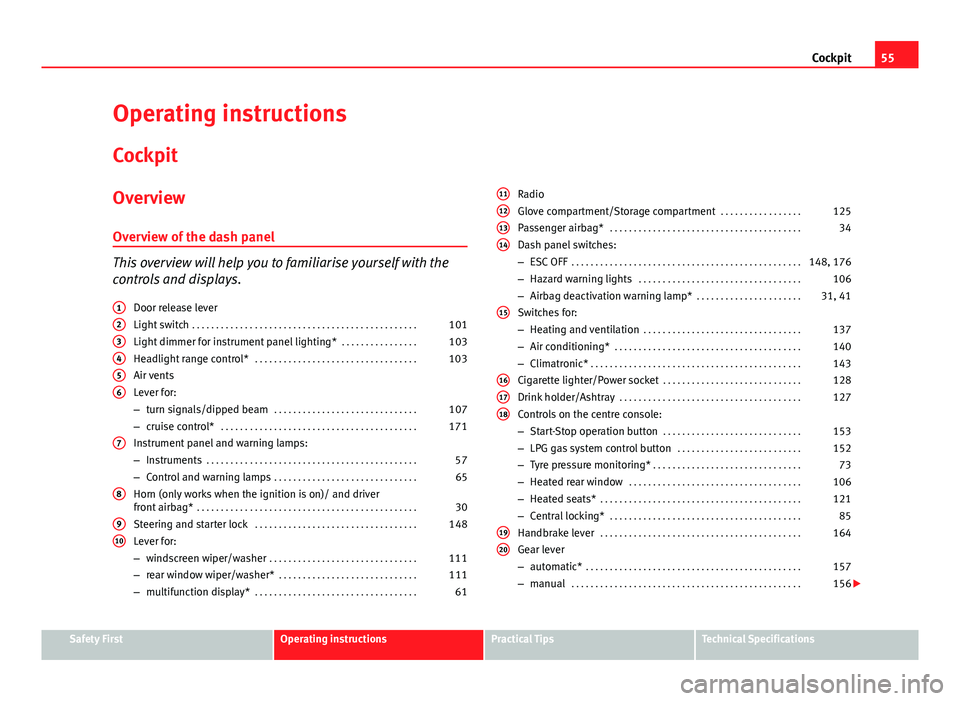
This overview will help you to familiarise yourself with the
controls and displays. Door release lever
Light switch . . . . . . . . . . . . . . . . . . . . . . . . . . . . . . . . . . . . . . . . . . . . . . . 101
Light dimmer for instrument panel lighting* . . . . . . . . . . . . . . . .103
Headlight range control* . . . . . . . . . . . . . . . . . . . . . . . . . . . . . . . . . . 103
Air vents
Lever for:
– turn signals/dipped beam . . . . . . . . . . . . . . . . . . . . . . . . . . . . . . 107
– cruise control* . . . . . . . . . . . . . . . . . . . . . . . . . . . . . . . . . . . . . . . . . 171
Instrument panel and warning lamps:
– Instruments . . . . . . . . . . . . . . . . . . . . . . . . . . . . . . . . . . . . . . . . . . . . 57
– Control and warning lamps . . . . . . . . . . . . . . . . . . . . . . . . . . . . . . 65
Horn (only works when the ignition is on)/ and driver
front airbag* . . . . . . . . . . . . . . . . . . . . . . . . . . . . . . . . . . . . . . . . . . . . . . 30
Steering and starter lock . . . . . . . . . . . . . . . . . . . . . . . . . . . . . . . . . . 148
Lever for:
– windscreen wiper/washer . . . . . . . . . . . . . . . . . . . . . . . . . . . . . . . 111
– rear window wiper/washer* . . . . . . . . . . . . . . . . . . . . . . . . . . . . . 111
– multifunction display* . . . . . . . . . . . . . . . . . . . . . . . . . . . . . . . . . . 61
1
23456
7
8
910
Radio
Glove compartment/Storage compartment
. . . . . . . . . . . . . . . . .125
Passenger airbag* . . . . . . . . . . . . . . . . . . . . . . . . . . . . . . . . . . . . . . . . 34
Dash panel switches:
– ESC OFF . . . . . . . . . . . . . . . . . . . . . . . . . . . . . . . . . . . . . . . . . . . . . . . . 148, 176
– Hazard warning lights . . . . . . . . . . . . . . . . . . . . . . . . . . . . . . . . . . 106
– Airbag deactivation warning lamp* . . . . . . . . . . . . . . . . . . . . . .31, 41
Switches for:
– Heating and ventilation . . . . . . . . . . . . . . . . . . . . . . . . . . . . . . . . . 137
– Air conditioning* . . . . . . . . . . . . . . . . . . . . . . . . . . . . . . . . . . . . . . . 140
– Climatronic* . . . . . . . . . . . . . . . . . . . . . . . . . . . . . . . . . . . . . . . . . . . . 143
Cigarette lighter/Power socket . . . . . . . . . . . . . . . . . . . . . . . . . . . . . 128
Drink holder/Ashtray . . . . . . . . . . . . . . . . . . . . . . . . . . . . . . . . . . . . . . 127
Controls on the centre console:
– Start-Stop operation button . . . . . . . . . . . . . . . . . . . . . . . . . . . . . 153
– LPG gas system control button . . . . . . . . . . . . . . . . . . . . . . . . . . 152
– Tyre pressure monitoring* . . . . . . . . . . . . . . . . . . . . . . . . . . . . . . . 73
– Heated rear window . . . . . . . . . . . . . . . . . . . . . . . . . . . . . . . . . . . . 106
– Heated seats* . . . . . . . . . . . . . . . . . . . . . . . . . . . . . . . . . . . . . . . . . . 121
– Central locking* . . . . . . . . . . . . . . . . . . . . . . . . . . . . . . . . . . . . . . . . 85
Handbrake lever . . . . . . . . . . . . . . . . . . . . . . . . . . . . . . . . . . . . . . . . . . 164
Gear lever
– automatic* . . . . . . . . . . . . . . . . . . . . . . . . . . . . . . . . . . . . . . . . . . . . . 157
– manual . . . . . . . . . . . . . . . . . . . . . . . . . . . . . . . . . . . . . . . . . . . . . . . . 156
11121314
15
161718
1920
Safety FirstOperating instructionsPractical TipsTechnical Specifications
Page 139 of 294
137
Air conditioning
Air conditioning Heating
Controls
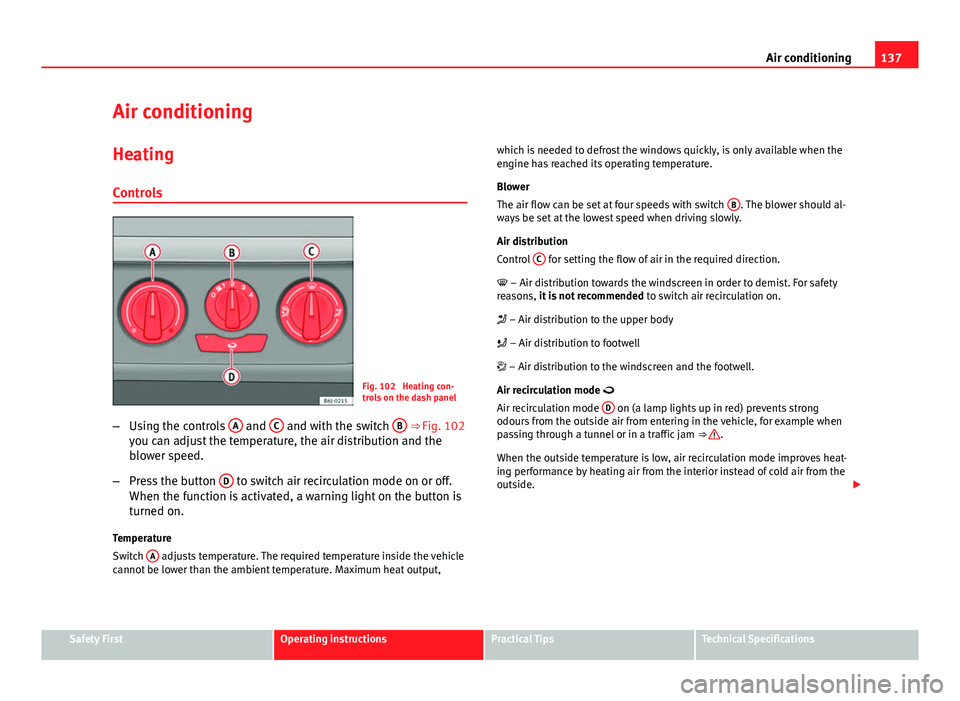
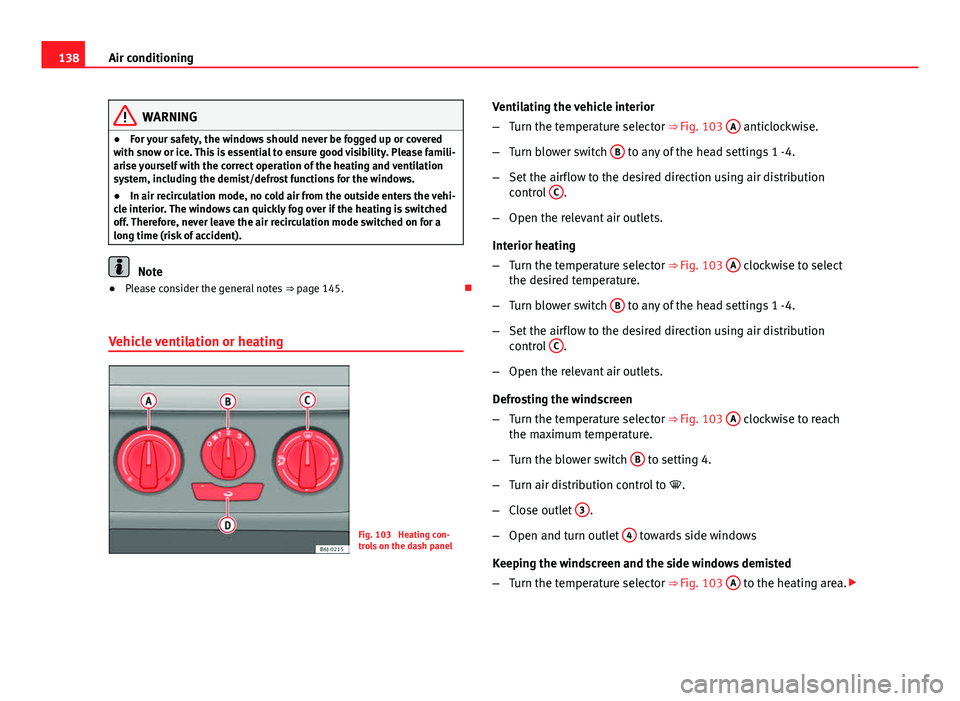
Fig. 102 Heating con-
trols on the dash panel
– Using the controls A
and C and with the switch B ⇒ Fig. 102
you can adjust the temperature, the air distribution and the
blower speed.
– Press the button D
to switch air recirculation mode on or off.
When the function is activated, a warning light on the button is
turned on.
Temperature
Switch A
adjusts temperature. The required temperature inside the vehicle
cannot be lower than the ambient temperature. Maximum heat output, which is needed to defrost the windows quickly, is only available when the
engine has reached its operating temperature.
Blower
The air flow can be set at four speeds with switch
B
. The blower should al-
ways be set at the lowest speed when driving slowly.
Air distribution
Control C
for setting the flow of air in the required direction.
– Air distribution towards the windscreen in order to demist. For safety
reasons, it is not recommended to switch air recirculation on.
– Air distribution to the upper body
– Air distribution to footwell
– Air distribution to the windscreen and the footwell.
Air recirculation mode
Air recirculation mode D
on (a lamp lights up in red) prevents strong
odours from the outside air from entering in the vehicle, for example when
passing through a tunnel or in a traffic jam ⇒
.
When the outside temperature is low, air recirculation mode improves heat-
ing performance by heating air from the interior instead of cold air from the
outside.
Safety FirstOperating instructionsPractical TipsTechnical Specifications
Page 140 of 294
138Air conditioning
WARNING
● For your safety, the windows should never be fogged up or covered
with snow or ice. This is essential to ensure good visibility. Please famili-
arise yourself with the correct operation of the heating and ventilation
system, including the demist/defrost functions for the windows.
● In air recirculation mode, no cold air from the outside enters the vehi-
cle interior. The windows can quickly fog over if the heating is switched
off. Therefore, never leave the air recirculation mode switched on for a
long time (risk of accident).
Note
● Please consider the general notes ⇒ page 145.
Vehicle ventilation or heating
Fig. 103 Heating con-
trols on the dash panel Ventilating the vehicle interior
–
Turn the temperature selector ⇒ Fig. 103 A
anticlockwise.
– Turn blower switch B
to any of the head settings 1 -4.
– Set the airflow to the desired direction using air distribution
control C
.
– Open the relevant air outlets.
Interior heating
– Turn the temperature selector ⇒ Fig. 103 A
clockwise to select
the desired temperature.
– Turn blower switch B
to any of the head settings 1 -4.
– Set the airflow to the desired direction using air distribution
control C
.
– Open the relevant air outlets.
Defrosting the windscreen
– Turn the temperature selector ⇒ Fig. 103 A
clockwise to reach
the maximum temperature.
– Turn the blower switch B
to setting 4.
– Turn air distribution control to .
– Close outlet 3
.
– Open and turn outlet 4
towards side windows
Keeping the windscreen and the side windows demisted
– Turn the temperature selector ⇒ Fig. 103 A
to the heating area.
Page 141 of 294
139
Air conditioning
– Turn blower switch B
to any of the head settings 2 -3.
– Turn air distribution control to .
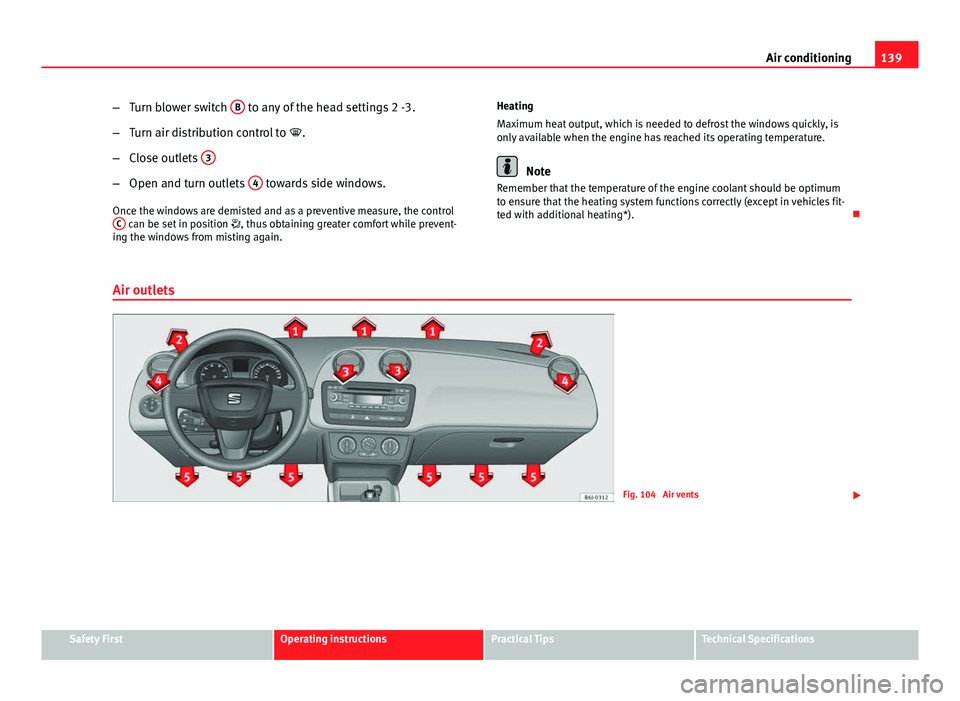
– Close outlets 3
–
Open and turn outlets 4 towards side windows.
Once the windows are demisted and as a preventive measure, the control C
can be set in position , thus obtaining greater comfort while prevent-
ing the windows from misting again. Heating
Maximum heat output, which is needed to defrost the windows quickly, is
only available when the engine has reached its operating temperature.
Note
Remember that the temperature of the engine coolant should be optimum
to ensure that the heating system functions correctly (except in vehicles fit-
ted with additional heating*).
Air outlets
Fig. 104 Air vents
Safety FirstOperating instructionsPractical TipsTechnical Specifications
Page 142 of 294
140Air conditioning
Air distribution C
Switch on symbolMain air output through outlets:
1,2
5
1, 2, 5
3, 4
Outlets 3 and 4 can be closed or opened separately and the air flow di-
rected as required.
Air conditioning* Controls
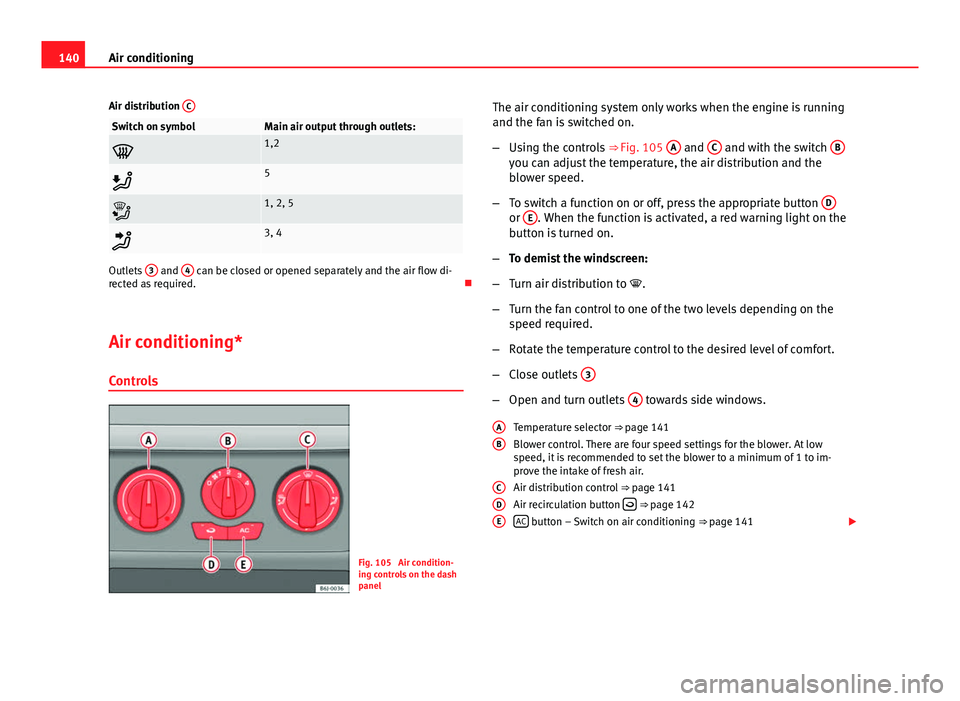
Fig. 105 Air condition-
ing controls on the dash
panel The air conditioning system only works when the engine is running
and the fan is switched on.
–
Using the controls ⇒ Fig. 105 A
and C and with the switch Byou can adjust the temperature, the air distribution and the
blower speed.
– To switch a function on or off, press the appropriate button D
or E. When the function is activated, a red warning light on the
button is turned on.
– To demist the windscreen:
– Turn air distribution to .
– Turn the fan control to one of the two levels depending on the
speed required.
– Rotate the temperature control to the desired level of comfort.
– Close outlets 3
–
Open and turn outlets 4 towards side windows.
Temperature selector ⇒ page 141
Blower control. There are four speed settings for the blower. At low
speed, it is recommended to set the blower to a minimum of 1 to im-
prove the intake of fresh air.
Air distribution control ⇒ page 141
Air recirculation button
⇒ page 142
AC button – Switch on air conditioning ⇒ page 141
A
B
CDE
Page 143 of 294
141
Air conditioning
WARNING
For your safety, the windows should never be fogged up or covered with
snow or ice. This is essential to ensure good visibility. Please familiarise
yourself with the correct operation of the heating and ventilation system,
including the demist/defrost functions for the windows.
Note
Please consider the general notes.
Vehicle interior heating or cooling system
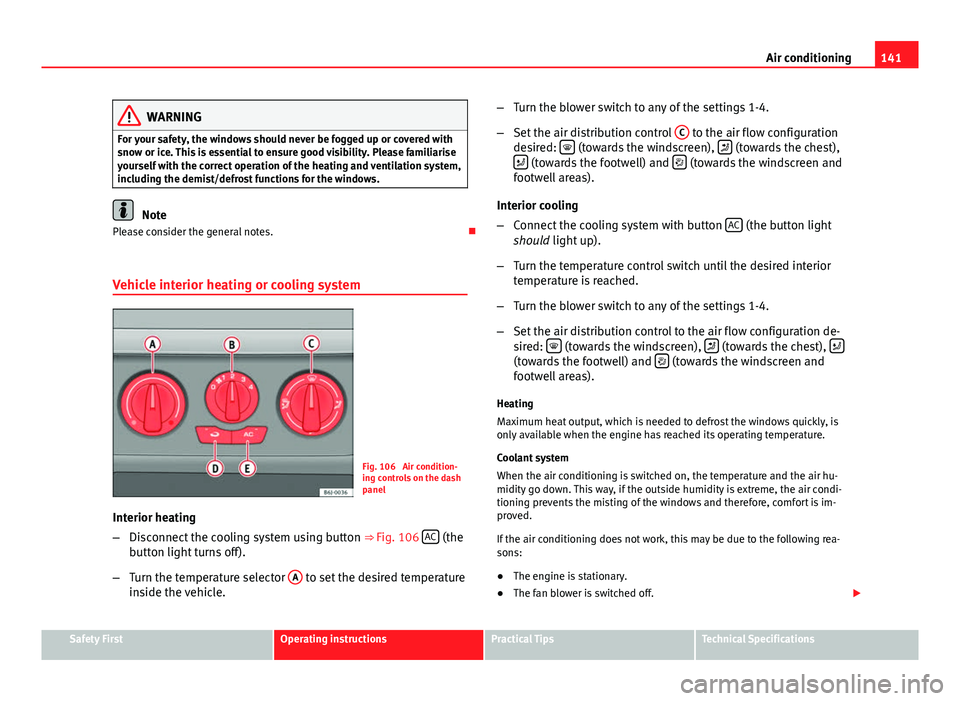
Fig. 106 Air condition-
ing controls on the dash
panel
Interior heating
– Disconnect the cooling system using button ⇒ Fig. 106 AC
(the
button light turns off).
– Turn the temperature selector A
to set the desired temperature
inside the vehicle. –
Turn the blower switch to any of the settings 1-4.
– Set the air distribution control C
to the air flow configuration
desired: (towards the windscreen), (towards the chest),
(towards the footwell) and (towards the windscreen and
footwell areas).
Interior cooling
– Connect the cooling system with button AC
(the button light
should light up).
– Turn the temperature control switch until the desired interior
temperature is reached.
– Turn the blower switch to any of the settings 1-4.
– Set the air distribution control to the air flow configuration de-
sired:
(towards the windscreen), (towards the chest), (towards the footwell) and (towards the windscreen and
footwell areas).
Heating
Maximum heat output, which is needed to defrost the windows quickly, is
only available when the engine has reached its operating temperature.
Coolant system
When the air conditioning is switched on, the temperature and the air hu-
midity go down. This way, if the outside humidity is extreme, the air condi-
tioning prevents the misting of the windows and therefore, comfort is im-
proved.
If the air conditioning does not work, this may be due to the following rea-
sons:
● The engine is stationary.
● The fan blower is switched off.
Safety FirstOperating instructionsPractical TipsTechnical Specifications
Page 144 of 294
142Air conditioning
● The outside temperature is lower than approximately +3 °C (+37 °F).
● The air conditioning system compressor has been temporarily switched
off because of an increased engine coolant temperature.
● The air conditioner fuse is faulty.
● Another fault in the vehicle. Have the air conditioning checked by a spe-
cialised workshop.
Air recirculation
Air recirculation mode prevents fumes or unpleasant smells
from coming from the outside.
When air recirculation mode is switched on (button ⇒ Fig. 106
with
warning lamp) strong odours in the outside air do not enter the vehicle inte-
rior, for example when passing through a tunnel or in a traffic jam.
When the outside temperature is low, air recirculation mode improves heat-
ing performance by heating air from the interior instead of cold air from the
outside.
When the outside temperature is high, air recirculation mode improves cool-
ing performance by cooling air from the interior instead of warm air from
outside.
For safety reasons, the air recirculation should not be switched on when the
air distribution control is set to the windscreen setting .
WARNING
In air recirculation mode, no cold air from the outside enters the vehicle
interior. If the air conditioner is switched off, the windows can quickly
mist over. Therefore, never leave the air recirculation mode switched on
for a long time (risk of accident).
Note
● When engaging reverse gear, the air recirculation is connected automat-
ically to prevent the entrance of exhaust gases in the vehicle on travelling
backwards. The control lamp on the button
does not light up.
● If the temperature control is turned to the coldest setting (blue point)
and the switch AC
is activated, the “Air recirculation” function is automati-
cally activated in order to cool the vehicle rapidly using less energy; its
function control lamp will light.
● If the function is not deactivated by pressing the button, this will deacti-
vate after approx. 20 min.
Economic use of the air conditioning
When the air conditioning is switched on, the compressor consumes engine
power and has influence on fuel consumption. Consider the following
points in order to have the system operating in the minimum possible time.
● If the vehicle interior has overheated due to an excessive solar radiation,
it is best to open the windows or doors to allow the hot air to escape.
● While in motion, the air conditioning should not be switched on if the
windows or the sunroof* are open.
Page 145 of 294
143
Air conditioning
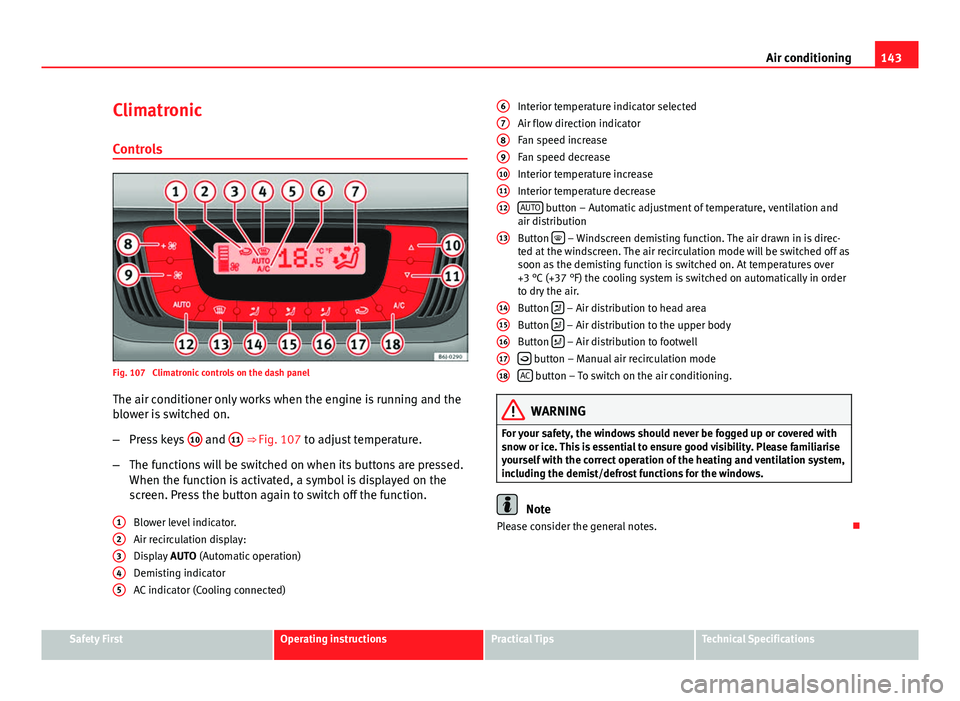
Climatronic Controls
Fig. 107 Climatronic controls on the dash panelThe air conditioner only works when the engine is running and the
blower is switched on.
– Press keys 10
and 11 ⇒ Fig. 107 to adjust temperature.
– The functions will be switched on when its buttons are pressed.
When the function is activated, a symbol is displayed on the
screen. Press the button again to switch off the function.
Blower level indicator.
Air recirculation display:
Display AUTO (Automatic operation)
Demisting indicator
AC indicator (Cooling connected)
1
2345
Interior temperature indicator selected
Air flow direction indicator
Fan speed increase
Fan speed decrease
Interior temperature increase
Interior temperature decrease
AUTO
button – Automatic adjustment of temperature, ventilation and
air distribution
Button
– Windscreen demisting function. The air drawn in is direc-
ted at the windscreen. The air recirculation mode will be switched off as
soon as the demisting function is switched on. At temperatures over
+3 °C (+37 °F) the cooling system is switched on automatically in order
to dry the air.
Button
– Air distribution to head area
Button – Air distribution to the upper body
Button – Air distribution to footwell
button – Manual air recirculation mode
AC button – To switch on the air conditioning.
WARNING
For your safety, the windows should never be fogged up or covered with
snow or ice. This is essential to ensure good visibility. Please familiarise
yourself with the correct operation of the heating and ventilation system,
including the demist/defrost functions for the windows.
Note
Please consider the general notes.
6
789101112
13
1415161718
Safety FirstOperating instructionsPractical TipsTechnical Specifications