coolant Seat Ibiza ST 2014 User Guide
[x] Cancel search | Manufacturer: SEAT, Model Year: 2014, Model line: Ibiza ST, Model: Seat Ibiza ST 2014Pages: 240, PDF Size: 4.89 MB
Page 168 of 240
Advice
Filter pre-heater
Your vehicle is fitted with a fuel filter glow
plug system, making it well equipped for op-
eration in winter. This ensures that the fuel
system remains operational to approx. -24 °C
(-11 ºF), provided you use winter-grade die-
sel which is safe to -15 °C (+5 °F).
However, if the fuel has waxed to such an ex-
tent that the engine will not start at tempera-
tures of under -24 °C (-11 °F), simply place
the vehicle in a warm place for a while. CAUTION
Do not mix fuel additives, the so-called “thin-
ners”, or similar additives with diesel fuel. Working in the engine
compartment
Safety instructions on working in the
engine compartment Before starting any work on the engine or in
the engine compartment:
1. Switch off the engine and remove the key
from the ignition.
2. Apply the handbrake.
3. Move the gear lever to neutral or the selec- tor lever to position P. 4. Wait for the engine to cool down.
5. Keep children away from the vehicle.
6. Raise the bonnet
››› page 167.
You should not do any work in the engine
compartment unless you know exactly how to
carry out the jobs and have the correct tools!
Have the work carried out by a specialised
workshop if you are uncertain.
All service fluids and consumables, e.g. cool-
ant, engine oil, spark plugs and batteries,
are under constant development. SEAT pro-
vides a constant flow of information to Tech-
nical Services concerning modifications. For
this reason, we recommend you have service
fluids and consumables replaced by a Techni-
cal Service. Please observe the relevant in-
structions ››› page 155 . The engine compart-
ment of
the vehicle is a hazardous area ››› .
WARNING
All work on the engine or in the engine com-
partment, e.g. checking and refilling fluids,
involves the danger of injury and burns, acci-
dents and even fire.
● Never open the bonnet if you see steam,
smoke or coolant escaping from the engine
compartment. Otherwise, there is a risk of
sustaining burns. Wait until no more steam or
coolant is emitted, then allow the engine to
cool before carefully opening the bonnet. ●
Switch off the engine and remove the key
from the ignition.
● Apply the handbrake and move the gear
lever to neutral or selector lever to position P.
● Keep children away from the vehicle.
● Never touch hot engine parts. There is a
risk of burns.
● Never spill liquids on a hot engine or on a
hot exhaust gas system. This is a fire hazard.
● Avoid causing short-circuits in the electri-
cal system, particularly at the points where
the jump leads are attached ››› page 188. The
battery could explode.
● Never touch the radiator fan. It is tempera-
ture controlled and could start automatically,
even when the engine has been switched off
and the key removed from the ignition!
● Never cover the engine with additional in-
sulating materials such as a blanket. Risk of
fire!
● Do not unscrew the cap on the coolant ex-
pansion tank when the engine is hot. If the
coolant is hot, the cooling system will be
pressurised!
● Protect face, hands and arms by covering
the cap with a large, thick cloth to protect
against escaping coolant and steam.
● Always make sure you have not left any ob-
jects, such as cleaning cloths or tools, in the
engine compartment.
● If you have to work underneath the vehicle,
you must use suitable stands additionally to 166
Page 169 of 240
Checking and refilling levels
support the vehicle, there is a risk of acci-
dent!. A hydraulic jack is insufficient for se-
curing the vehicle and there is a risk of injury.
●
If any work has to be performed when the
engine is started or with the engine running,
there is an additional, potentially fatal, safety
risk from the rotating parts, such as the drive
belts, alternator, radiator fan, etc., and from
the high-voltage ignition system. You should
also observe the following:
– Never touch the electrical wiring of the
ignition system.
– Ensure that jewellery, loose clothing and
long hair do not get trapped in rotating
engine parts. Danger of death. Before
starting any work remove jewellery, tie
back and cover hair, and wear tight-fit-
ting clothes.
– Never accelerate with a gear engaged
without taking the necessary precau-
tions. The vehicle could move, even if the
handbrake is applied. Danger of death.
● If work has to be carried out on the fuel
system or on electrical components, you
must observe the following safety notes in
addition to the above warnings:
– Always disconnect the battery from the
on-board network. The vehicle must be
unlocked when this is done, otherwise
the alarm will be triggered.
– Do not smoke.
– Never work near naked flames.
– Always have a fire extinguisher on hand. CAUTION
When topping up service fluids, make sure
not to mistake them. Using the wrong fluids
could cause serious malfunctions and engine
damage! For the sake of the environment
Service fluids leaks are harmful to the envi-
ronment. For this reason you should make
regular checks on the ground underneath
your vehicle. If you find spots of oil or other
fluids, have your vehicle inspected in a speci-
alised workshop. Opening the bonnet
Read the additional information carefully
››› page 10
The bonnet is released from inside the vehi-
cle.
Before opening the bonnet ensure that the
windscreen wipers are in rest position. WARNING
Hot coolant can scald!
● Never open the bonnet if you see steam,
smoke or coolant escaping from the engine
compartment. ●
Wait until no more steam, smoke or coolant
is emitted from the bonnet, then carefully
open the bonnet.
● When working in the engine compartment,
always observe the safety warnings
››› page 166. Closing the bonnet
–
Slightly lift the bonnet.
– Release the bonnet stay and replace it in its
support.
– At a height of approximately 30 cm let it fall
so it locks.
If the bonnet does not close, do not press
downwards. Open it again and let it fall as
mentioned above. WARNING
If the bonnet is not closed properly, it could
open while you are driving and completely
obscure your view of the road. Risk of acci-
dent.
● After closing the bonnet, always check that
it is properly secured. The bonnet must be
flush with the surrounding body panels.
● If you notice that the bonnet latch is not se-
cured when the vehicle is moving, stop the
vehicle immediately and close the bonnet
properly. Risk of accident. 167Technical specifications
Advice
Operation
Safety
The essentials
Page 170 of 240
Advice
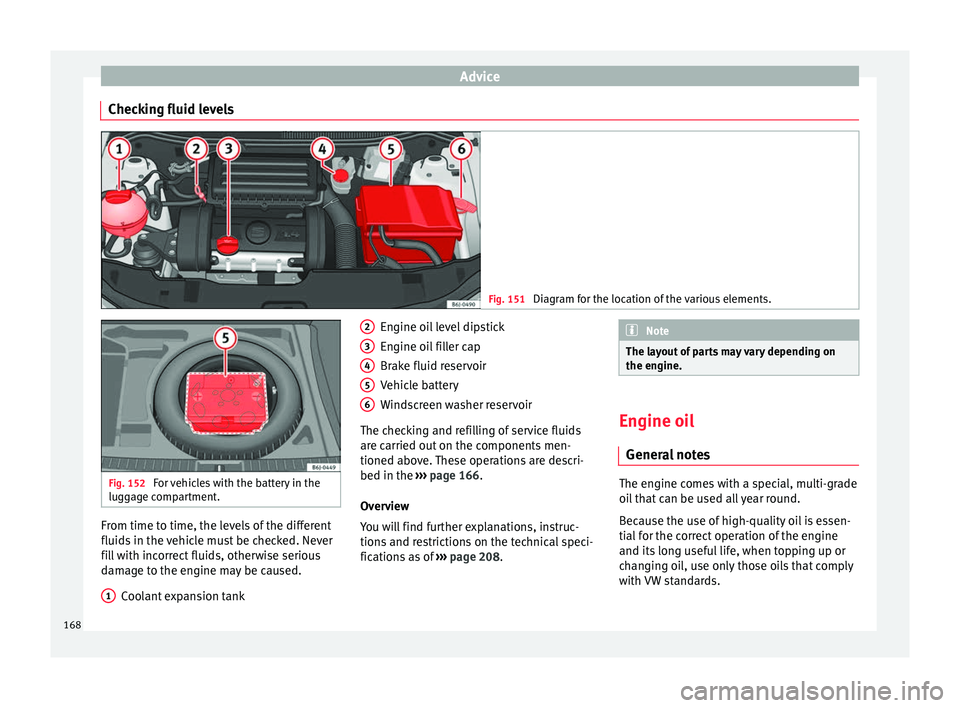
Checking fluid levels Fig. 151
Diagram for the location of the various elements. Fig. 152
For vehicles with the battery in the
luggage compartment. From time to time, the levels of the different
fluids in the vehicle must be checked. Never
fill with incorrect fluids, otherwise serious
damage to the engine may be caused.
Coolant expansion tank
1 Engine oil level dipstick
Engine oil filler cap
Brake fluid reservoir
Vehicle battery
Windscreen washer reservoir
The checking and refilling of service fluids
are carried out on the components men-
tioned above. These operations are descri-
bed in the ››› page 166 .
Ov er
view
You will find further explanations, instruc-
tions and restrictions on the technical speci-
fications as of ››› page 208
.
2 3
4
5
6 Note
The layout of parts may vary depending on
the engine. Engine oil
General notes The engine comes with a special, multi-grade
oil that can be used all year round.
Because the use of high-quality oil is essen-
tial for the correct operation of the engine
and its long useful life, when topping up or
changing oil, use only those oils that comply
with VW standards.
168
Page 173 of 240
Checking and refilling levels
Engine oil specification ››› page 169. WARNING
Oil is highly inflammable! Ensure that no oil
comes into contact with hot engine compo-
nents when topping up. CAUTION
If the oil level is above the area A do not
start the engine. This could result in damage
to the engine and catalytic converter. Contact
a specialised workshop. For the sake of the environment
The oil level must never be above area A .
Otherwise oil can be drawn in through the
crankcase breather and escape into the at-
mosphere via the exhaust system. Changing engine oil
Read the additional information carefully
››› page 24
The engine oil must be changed at the inter-
vals given in the service schedule.
We recommend that you have the engine oil
changed by a Technical Service.
The oil change intervals are shown in the
Maintenance Programme. WARNING
Only change the engine oil yourself if you
have the specialist knowledge required!
● Before opening the bonnet, read and ob-
serve the warnings ››› page 166, Safety in-
structions on working in the engine compart-
ment.
● Wait
for the engine to cool down. Hot oil
may cause burn injuries.
● Wear eye protection to avoid injuries, such
as acid burns, caused by splashes of oil.
● When removing the oil drain plug with your
fingers, keep your arm horizontal to help pre-
vent oil from running down your arm.
● Wash your skin thoroughly if it comes into
contact with engine oil.
● Engine oil is poisonous! Used oil must be
stored in a safe place out of the reach of chil-
dren. CAUTION
No additives should be used with engine oil.
This could result in engine damage. Any dam-
age caused by the use of such additives
would not be covered by the factory warranty. For the sake of the environment
● Because of disposal problems and the spe-
cial tools and specialist knowledge required,
we recommend that you have the engine oil
and filter changed by a Technical Service. ●
Never pour oil down drains or into the
ground.
● Use a suitable container when draining the
used oil. It must be large enough to hold all
the engine oil. Cooling system
Engine coolant specifications The engine cooling system is supplied from
the factory with a specially treated mixture of
water and, at least, 40 % of the additive
G 13
(TL-VW 774 J). The engine coolant additive is
recognisable by its purple colour. This mix-
ture of water and additive gives the necessa-
ry frost protection down to -25°C (-13 F) and
protects the light alloy parts of the cooling
system against corrosion. It also prevents
scaling and considerably raises the boiling
point of the coolant.
To protect the engine cooling system, the
percentage of additive must always be at
l e
ast 40 %, even in warm climates where an-
ti-freeze protection is not required.
If greater frost protection is required in very
cold climates, the proportion of additive can
be increased. However, the percentage of ad-
ditive should not exceed 60%, as this would
reduce the frost protection and, in turn, de-
crease the cooling capacity. »
171
Technical specifications
Advice
Operation
Safety
The essentials
Page 174 of 240
Advice
When the coolant is topped up, use a mixture
of distilled water and, at least, 40 % of the G
13 or G 12 p lu
s-plus (TL-VW 774 G) additive
(both are purple) to obtain an optimum anti-
corrosion protection ››› . The mixture of G
13 with G 12 plus (TL-VW 774 F), G 12 (red) or
G 11 (green-blue) engine coolants will signifi-
cantly reduce the anticorrosion protection
and should, therefore be avoided ››› .
WARNING
If there is not enough anti-freeze in the cool-
ant system, the engine may fail leading to se-
rious damage.
● Please make sure that the percentage of
additive is correct with respect to the lowest
expected ambient temperature in the zone in
which the vehicle is to be used.
● When the outside temperature is very low,
the coolant could freeze and the vehicle
would be immobilised. In this case, the heat-
ing would not work either and inadequately
dressed passengers could die of cold. CAUTION
The original additives should never be mixed
with coolants which are not approved by
SEAT. Otherwise, you run the risk of causing
severe damage to the engine and the engine
cooling system. ● If the fluid in the expansion tank is not pur-
ple but is, for example, brown, this indicates
that the G 13 additive has been mixed with an inadequate coolant. The coolant must be
changed as soon as possible if this is the
case! This could result in serious faults and
engine damage.
For the sake of the environment
Coolants and additives can contaminate the
environment. If any fluids are spilled, they
should be collected and correctly disposed
of, with respect to the environment. Checking the coolant level and
topping up
Read the additional information carefully
››› page 24
Before opening the bonnet, read and observe
the warnings ››› in Safety instructions on
working in the engine compartment on
page 166 .
Openin g the c
oolant expansion tank
– Switch off the engine and allow it to cool.
– To prevent scalding, cover the cap on the
coolant expansion tank with a thick cloth
and carefully unscrew the cap ››› .
Checking coolant level
– Look into the open coolant expansion tank
and read off the coolant level. –
If the level is below the “MIN” mark, top up
with coolant.
Topping up coolant – Only use new coolant liquid.
– Do not fi
ll above the “MAX” mark.
Closing the coolant expansion tank – Screw the cap on again tightly.
The position of the coolant expansion reser-
voir is shown in the corresponding engine
compartment illustration ››› page 168.
Ensure the coolant conforms to the required
specifications. Do not use a different type of
additive if additive G 12++ is not available. In
this case use only water and bring the cool-
ant concentration back up to the correct level
as soon as possible by putting in the speci-
fied additive.
Always top up with new
coolant.
Do not fill above the “MAX” mark. Otherwise
the excess coolant will be forced out of the
cooling system when the engine is hot.
The additive G 12++ can be mixed with the G
12+ in any proportion. WARNING
Any work carried out in the engine compart-
ment or on the engine must be carried out
cautiously. 172
Page 175 of 240
Checking and refilling levels
●
When working in the engine compartment,
always observe the safety warnings
››› page 166.
● When the en gine i
s warm or hot, the cool-
ing system is pressurised! Do not unscrew
the cap on the coolant expansion tank when
the engine is hot. This is a burn injury risk. CAUTION
● If you notice a change in the colour of the
liquid because it has been in use for a long
time, it is recommended to change it, as it
will have lost some of its properties and
could cause damage to the engine.
● If a lot of coolant fluid has been lost, wait
for the engine to cool. This avoids damaging
the engine. Large coolant losses are an indi-
cation of leaks in the cooling system. See a
specialised workshop immediately and have
the cooling system checked. Otherwise, there
is a risk of engine damage. Brake fluid
Checking the brake fluid level Read the additional information carefully
››› page 25
The position of the brake fluid reservoir is
shown in the corresponding engine compart- ment illustration
››› page 168 . The brake fluid
r e
servoir has a black and yellow cap.
The brake fluid level drops slightly when the
vehicle is being used as the brake pads are
automatically adjusted as they wear.
However, if the level goes down noticeably in
a short time, or drops below the “MIN” mark,
there may be a leak in the brake system. A
display on the instrument panel will warn you
if the brake fluid level is too low ››› page 57. WARNING
Before opening the bonnet to check the brake
fluid level, read and observe the warnings
››› page 166. Changing the brake fluid
The Maintenance Programme indicates brake
fluid change intervals.
We recommend that you have the brake fluid
changed by a Technical Service.
Before opening the bonnet, please read and
follow the warnings
››› in Safety instruc-
tions on working in the engine compartment
on page 166 in section “Safety notes for
w ork
ing in the engine compartment”.
In the course of time, brake fluid becomes
hygroscopic and absorbs water from the am-
bient air. If the water content in the brake flu- id is too high, the brake system could cor-
rode. This also considerably reduces the boil-
ing point of the brake fluid. Heavy use of the
brakes may then cause a vapour lock which
could impair the braking effect.
Be sure to always use the correct brake fluid.
Only use brake fluid that expressly meets the
VW 501 14 standard.
You can buy VW 501 14 standard brake fluid
in a SEAT dealership or a SEAT Official Serv-
ice. If none is available, use only high-quality
brake fluid that meets DIN ISO 4925 CLASS 4
standards, or USA Standards FMVSS 116 DOT
4.
Using any other kind of brake fluid or one
that is not of a high quality may affect opera-
tion of the brake system and reduce its effec-
tiveness. Never use a brake fluid if the con-
tainer does not state that it complies with VW
501 14, DIN ISO 4925 CLASS 4 standards, or
USA standards FMVSS 116 DOT 4.
WARNING
Brake fluid is poisonous. Old brake fluid im-
pairs the braking effect.
● Before opening the bonnet to check the
brake fluid level, read and observe the warn-
ings ››› page 166.
● Br ak
e fluid should be stored in the closed
original container in a safe place out of reach
of children. There is a toxic risk. » 173
Technical specifications
Advice
Operation
Safety
The essentials
Page 232 of 240
Index
Cetane number . . . . . . . . . . . . . . . . . . . . . . . . . . . 165
Changing gear see Manual gearbox . . . . . . . . . . . . . . . . . . . . . 128
Ch an
ging gear in tiptronic mode . . . . . . . . . . . . 131
Changing the AFS headlight bulbs xenon light . . . . . . . . . . . . . . . . . . . . . . . . . . . . 201
Changing the bulbs AFS headlight bulbs . . . . . . . . . . . . . . . . . . . . . 201
double headlight bulbs . . . . . . . . . . . . . . . . . . 199
fog light bulbs . . . . . . . . . . . . . . . . . . . . . . . . . 202
general notes . . . . . . . . . . . . . . . . . . . . . . . . . . 196
interior light and reading light . . . . . . . . . . . . 207
luggage compartment light . . . . . . . . . . . . . . . 207
number plate light . . . . . . . . . . . . . . . . . . . . . . 206
single headlight bulbs . . . . . . . . . . . . . . . . . . . 198
Turn signals . . . . . . . . . . . . . . . . . . . . . . . . . . . . 206
Changing the double headlight bulbs dipped beam headlight . . . . . . . . . . . . . . . . . . 200
main beam headlight . . . . . . . . . . . . . . . . . . . . 200
side light . . . . . . . . . . . . . . . . . . . . . . . . . . . . . . 199
Changing the headlight bulbs turn signal lamp . . . . . . . . . . . . . . . . . . . . . . . . 201
Changing the single headlight bulbs dipped/main beam headlights . . . . . . . . . . . . 198
side light . . . . . . . . . . . . . . . . . . . . . . . . . . . . . . 199
turn signal bulb . . . . . . . . . . . . . . . . . . . . . . . . 198
Changing the tail light bulbs . . . . . . . . . . . 203, 204 on the rear lid . . . . . . . . . . . . . . . . . . . . . . . . . . 205
on the side panel . . . . . . . . . . . . . . . . . . . . . . . 204
Changing windscreen wiper blades . . . . . . . . . . 193
Chassis number . . . . . . . . . . . . . . . . . . . . . . . . . . 209
Checking . . . . . . . . . . . . . . . . . . . . . . . . . . . . . . . . 175
Checking battery electrolyte level . . . . . . . . . . . . 175
Checking engine oil level . . . . . . . . . . . . . . . . . . . 170
Child safety . . . . . . . . . . . . . . . . . . . . . . . . . . . . . . . 46
Child seat Categorisation in groups . . . . . . . . . . . . . . . . . . 48 Child seats . . . . . . . . . . . . . . . . . . . . . . . . . . . . . . . 48
ISOFIX system . . . . . . . . . . . . . . . . . . . . . . . . . . . 50
on the front passenger seat . . . . . . . . . . . . . . . . 47
Top Tether system . . . . . . . . . . . . . . . . . . . . . . . . 52
Cigarette lighter . . . . . . . . . . . . . . . . . . . . . . . . . . 107
Cleaning alloy wheel rims . . . . . . . . . . . . . . . . . . 160
Cleaning chrome . . . . . . . . . . . . . . . . . . . . . . . . . 160
Cleaning engine compartment . . . . . . . . . . . . . . 161
Cleaning plastic parts . . . . . . . . . . . . . . . . . . . . . 162
Cleaning steel wheel rims . . . . . . . . . . . . . . . . . . 160
Cleaning the instrument panel . . . . . . . . . . . . . . 162
Cleaning windows . . . . . . . . . . . . . . . . . . . . . . . . 159
Climatronic . . . . . . . . . . . . . . . . . . . . . . . . . . . . . . . 21 automatic mode . . . . . . . . . . . . . . . . . . . . . . . . 121
controls . . . . . . . . . . . . . . . . . . . . . . . . . . . . . . . 121
General notes . . . . . . . . . . . . . . . . . . . . . . . . . . 113
manual mode . . . . . . . . . . . . . . . . . . . . . . . . . . 122
Clock . . . . . . . . . . . . . . . . . . . . . . . . . . . . . . . . . . . . 64
Cloth seat covers cleaning . . . . . . . . . . . . . . . . . . 162
Coming Home Function . . . . . . . . . . . . . . . . . . . . . 94
Compartment for on-board documentation . . . . 104
Compatibility with mobile phones . . . . . . . . . . . . 73
Control Exterior mirrors . . . . . . . . . . . . . . . . . . . . . . . . . . 99
control lamp . . . . . . . . . . . . . . . . . . . . . . . . . . . . . . 42
Control lamps . . . . . . . . . . . . . . . . . . . . . . . . . . . . . 57
Control lighting . . . . . . . . . . . . . . . . . . . . . . . . . . . . 55
Controlling the information system . . . . . . . . . . . . 16
Controls Electric windows . . . . . . . . . . . . . . . . . . . . . . . . . 87
panoramic/tilting sunroof . . . . . . . . . . . . . . . . . 89
Controls on the column Audio control . . . . . . . . . . . . . . . . . . . . . . . . . . . 69
Convenience closing sliding/tilting sunroof . . . . . . . . . . . . . . . . . . . . 89
Windows . . . . . . . . . . . . . . . . . . . . . . . . . . . . . . . 89 Convenience opening
Windows . . . . . . . . . . . . . . . . . . . . . . . . . . . . . . . 89
Coolant . . . . . . . . . . . . . . . . . . . . . . . . . . . . . 24, 172
Coolant fluid . . . . . . . . . . . . . . . . . . . . . . . . . . . . . 171
Coolant level . . . . . . . . . . . . . . . . . . . . . . . . . . . . . 172 control lamp . . . . . . . . . . . . . . . . . . . . . . . . . . . . 63
Coolant loss . . . . . . . . . . . . . . . . . . . . . . . . . . . . . 172
Coolant temperature control lamp . . . . . . . . . . . . . . . . . . . . . . . . . . . . 63
Safety instructions . . . . . . . . . . . . . . . . . . . . . . . 63
Correct adjustment of front head restraints . . . . . 32
Correct sitting position front passenger . . . . . . . . . . . . . . . . . . . . . . . . . 31
Incorrect sitting position . . . . . . . . . . . . . . . . . . 33
passenger . . . . . . . . . . . . . . . . . . . . . . . . . . . . . . 32
Cruise control . . . . . . . . . . . . . . . . . . . . . . . . . . . . . 16 Control lamp . . . . . . . . . . . . . . . . . . . . . . . . . . . . 61
Cruise control system . . . . . . . . . . . . . . . . . . . . . . 150
Cruise speed . . . . . . . . . . . . . . . . . . . . . . . . . . . . . 150 Control lamp . . . . . . . . . . . . . . . . . . . . . . . . . . . . 61
D Dangers in not using the seat belt . . . . . . . . . . . . 36
Dangers of using a child seat on the front pas- senger seat . . . . . . . . . . . . . . . . . . . . . . . . . . . . . 47
Dash panel . . . . . . . . . . . . . . . . . . . . . . . . . . . . . . . 55
Daytime driving lights . . . . . . . . . . . . . . . . . . . . . . 91
Daytime running lights Nordic countries . . . . . . . . . . . . . . . . . . . . . . . . . 92
Deactivated airbags front passenger airbag . . . . . . . . . . . . . . . . . . . . 45
Deactivation of the front passenger front airbag . 11
Diesel . . . . . . . . . . . . . . . . . . . . . . . . . . . . . . . . . . 165
Diesel engine Winter operation . . . . . . . . . . . . . . . . . . . . . . . . 165
Diesel engine particulate filter . . . . . . . . . . . . . . 136
Differential lock . . . . . . . . . . . . . . . . . . . . . . . . . . 139
230
Page 233 of 240
Index
Differential lock fault (EDL) control lamp . . . . . . . . . . . . . . . . . . . . . . . . . . . . 60
Digital clock . . . . . . . . . . . . . . . . . . . . . . . . . . . . . . 64
Dimensions . . . . . . . . . . . . . . . . . . . . . . . . . . . . . . 226
Disposal Seat belt tensioners . . . . . . . . . . . . . . . . . . . . . . 39
Door handle . . . . . . . . . . . . . . . . . . . . . . . . . . . . . 160
Door lock . . . . . . . . . . . . . . . . . . . . . . . . . . . . . . . . 160
Door lock cylinders . . . . . . . . . . . . . . . . . . . . . . . . 160
Door release lever . . . . . . . . . . . . . . . . . . . . . . . . . 55
Doors . . . . . . . . . . . . . . . . . . . . . . . . . . . . . . . . . . . . . 9 Childproof locks . . . . . . . . . . . . . . . . . . . . . . . . . 82
control lamp . . . . . . . . . . . . . . . . . . . . . . . . . . . . 62
Double headlight bulbs . . . . . . . . . . . . . . . . . . . . 199
Driver see Correct sitting position . . . . . . . . . 30, 31, 32
Driv e
shaft differential
XDS . . . . . . . . . . . . . . . . . . . . . . . . . . . . . . . . . . 142
Driving driving abroad . . . . . . . . . . . . . . . . . . . . . . . . . 138
Economically/with Respect for the Environ-ment . . . . . . . . . . . . . . . . . . . . . . . . . . . . . . . 136
With a trailer . . . . . . . . . . . . . . . . . . . . . . . . . . . 153
Driving abroad . . . . . . . . . . . . . . . . . . . . . . . . . . . 138 Headlights . . . . . . . . . . . . . . . . . . . . . . . . . . . . 138
Driving Economically . . . . . . . . . . . . . . . . . . . . . . 136
Driving safety . . . . . . . . . . . . . . . . . . . . . . . . . . . . . 29
Driving with Respect for the Environment . . . . . 136
Duplicate keys . . . . . . . . . . . . . . . . . . . . . . . . . . . . 82
Dust filter . . . . . . . . . . . . . . . . . . . . . . . . . . . . . . . 113
Dynamic headlight range control . . . . . . . . . . . . . 92
E EDL . . . . . . . . . . . . . . . . . . . . . . . . . . . . . . . . . . . . 139 control lamp . . . . . . . . . . . . . . . . . . . . . . . . . . . . 59
Electric windows . . . . . . . . . . . . . . . . . . . . . . . . 10, 87 Electro-hydraulic steering
control lamp . . . . . . . . . . . . . . . . . . . . . . . . . . . . 62
Electronic differential lock . . . . . . . . . . . . . . . . . . 139 control lamp . . . . . . . . . . . . . . . . . . . . . . . . . . . . 59
Electronic immobiliser . . . . . . . . . . . . . . . . . . . . . 124
Electronic Stability Control . . . . . . . . . . . . . 60, 139
Electronic Stability Control (ESC) control lamp . . . . . . . . . . . . . . . . . . . . . . . . . . . . 60
Emission control system control lamp . . . . . . . . . . . . . . . . . . . . . . . . . . . . 63
Engine Running in . . . . . . . . . . . . . . . . . . . . . . . . . . . . . 134
Engine compartment . . . . . . . . . . . . . . . . . . 10, 167 Working in the engine compartment . . . . . . . . 166
Engine coolant G 12 plus-plus . . . . . . . . . . . . . . . . . . . . . . . . . 171
G 13 . . . . . . . . . . . . . . . . . . . . . . . . . . . . . . . . . . 171
Specifications . . . . . . . . . . . . . . . . . . . . . . . . . . 171
Engine coolant fluid . . . . . . . . . . . . . . . . . . . . . . . 171
Engine fault control lamp . . . . . . . . . . . . . . . . . . . . . . . . . . . . 58
Engine management control lamp . . . . . . . . . . . . . . . . . . . . . . . . . . . . 58
Engine oil Changing . . . . . . . . . . . . . . . . . . . . . . . . . . . . . . 171
Checking engine oil level . . . . . . . . . . . . . . . . . 170
Oil properties . . . . . . . . . . . . . . . . . . . . . . . . . . 169
Specifications . . . . . . . . . . . . . . . . . . . . . . . . . . 168
Topping up . . . . . . . . . . . . . . . . . . . . . . . . . . . . 170
Engine oil dipstick . . . . . . . . . . . . . . . . . . . . . . . . 170
Engine oil pressure control lamp . . . . . . . . . . . . . . . . . . . . . . . . . . . . 59
Environment . . . . . . . . . . . . . . . . . . . . . . . . . . . . . 136 Environmental friendliness . . . . . . . . . . . . . . . 135
Environmental tip Avoiding pollution . . . . . . . . . . . . . . . . . . . . . . 164
Equipment . . . . . . . . . . . . . . . . . . . . . . . . . . . . . . 155 ESC . . . . . . . . . . . . . . . . . . . . . . . . . . . . . . . . 60, 139
see also Electronic Stability Control . . . . . . . . 139
Exhau
st gas emission control system . . . . . . . . . 135
Exterior mirror Adjustment . . . . . . . . . . . . . . . . . . . . . . . . . . . . . 12
Exterior mirrors . . . . . . . . . . . . . . . . . . . . . . . . . . . 159
Exterior view . . . . . . . . . . . . . . . . . . . . . . . . . . . . . . . 5
External aerial . . . . . . . . . . . . . . . . . . . . . . . . . . . . 156
F Fabric trim cleaning . . . . . . . . . . . . . . . . . . . . . . . 162
Fastening rings . . . . . . . . . . . . . . . . . . . . . . . . . . . 109
Filling the fuel tank . . . . . . . . . . . . . . . . . . . . . . . 163
Fire extinguisher . . . . . . . . . . . . . . . . . . . . . . . . . . 181
First-aid kit . . . . . . . . . . . . . . . . . . . . . . . . . . . . . . 181
Floor mats . . . . . . . . . . . . . . . . . . . . . . . . . . . . . . . . 34
Fog light bulb . . . . . . . . . . . . . . . . . . . . . . . . . . . . 202
Fog lights . . . . . . . . . . . . . . . . . . . . . . . . . . . . . . . . 90
Fog lights with cornering function . . . . . . . . . . . . 95
Footwell lights . . . . . . . . . . . . . . . . . . . . . . . . . . . . 96
Front head restraints . . . . . . . . . . . . . . . . . . . . . . . . . . 32
headrests . . . . . . . . . . . . . . . . . . . . . . . . . . . . . . 32
Front airbags . . . . . . . . . . . . . . . . . . . . . . . . . . . . . 42 operation . . . . . . . . . . . . . . . . . . . . . . . . . . . . . . . 40
safety instructions . . . . . . . . . . . . . . . . . . . . . . . 43
Front ashtray . . . . . . . . . . . . . . . . . . . . . . . . . . . . . 106
Front drink holder . . . . . . . . . . . . . . . . . . . . . . . . . 106
Front interior light . . . . . . . . . . . . . . . . . . . . . . . . . 96
Front parking aid . . . . . . . . . . . . . . . . . . . . . . . . . . . . . . . . . . . 148
Front passenger airbag deactivation . . . . . . . . . . 45 safety information . . . . . . . . . . . . . . . . . . . . . . . 46
Front passenger front airbag Deactivation . . . . . . . . . . . . . . . . . . . . . . . . . . . . 11
Front reading light . . . . . . . . . . . . . . . . . . . . . . . . . 96
231
Page 236 of 240
Index
Remote control key Buttons . . . . . . . . . . . . . . . . . . . . . . . . . . . . . . . . 83
Synchronising . . . . . . . . . . . . . . . . . . . . . . . . . . . 84
Removing and fitting the wheel . . . . . . . . . . . . . 185
Replacement keys . . . . . . . . . . . . . . . . . . . . . . . . . 82
Replacement of parts . . . . . . . . . . . . . . . . . . . . . . 155
Rev counter . . . . . . . . . . . . . . . . . . . . . . . . . . . . . . . 56
Roll-back function panoramic/tilting sunroof . . . . . . . . . . . . . . . . . 90
Windows . . . . . . . . . . . . . . . . . . . . . . . . . . . . . . . 88
Roof aerial . . . . . . . . . . . . . . . . . . . . . . . . . . . . . . . 155
Roof carrier . . . . . . . . . . . . . . . . . . . . . . . . . . . . . . 111
Roof carrier system . . . . . . . . . . . . . . . . . . . . . . . . 111
Rubber seals . . . . . . . . . . . . . . . . . . . . . . . . . . . . . 160
Running in Brake pads . . . . . . . . . . . . . . . . . . . . . . . . . . . . 134
Engine . . . . . . . . . . . . . . . . . . . . . . . . . . . . . . . . 134
Tyres . . . . . . . . . . . . . . . . . . . . . . . . . . . . . . . . . 134
Running in tyres . . . . . . . . . . . . . . . . . . . . . . . . . . 134
S Safe . . . . . . . . . . . . . . . . . . . . . . . . . . . . . . . . . . . . . 79
Safe driving . . . . . . . . . . . . . . . . . . . . . . . . . . . . . . 29
Safe Security system . . . . . . . . . . . . . . . . . . . . . . . 79
Safety . . . . . . . . . . . . . . . . . . . . . . . . . . . . . . . . . . . 29 child safety . . . . . . . . . . . . . . . . . . . . . . . . . . . . . 46
child seats . . . . . . . . . . . . . . . . . . . . . . . . . . . . . . 46
Safety equipment . . . . . . . . . . . . . . . . . . . . . . . . . . 29
Safety information Front passenger airbag deactivation . . . . . . . . 46
Safety instructions Coolant temperature . . . . . . . . . . . . . . . . . . . . . 63
front airbags . . . . . . . . . . . . . . . . . . . . . . . . . . . . 43
side airbags . . . . . . . . . . . . . . . . . . . . . . . . . . . . 44
Safety notes Seat belt tensioners . . . . . . . . . . . . . . . . . . . . . . 39
Using seat belts . . . . . . . . . . . . . . . . . . . . . . . . . 36 Seals . . . . . . . . . . . . . . . . . . . . . . . . . . . . . . . . . . . 160
Seat belt
Adjusting . . . . . . . . . . . . . . . . . . . . . . . . . . . . . . . 12
Seat belt cleaning . . . . . . . . . . . . . . . . . . . . . . . . 163
Seat belt control lamp . . . . . . . . . . . . . . . . . . . . . . 35
Seat belt position for pregnant women . . . . . . . . . . . . . . . . . . . . . . 38
Seat belts . . . . . . . . . . . . . . . . . . . . . . . . . . . . . . 38
Seat belt protection . . . . . . . . . . . . . . . . . . . . . . . . 35
Seat belt release . . . . . . . . . . . . . . . . . . . . . . . . . . 38
Seat belts . . . . . . . . . . . . . . . . . . . . . . . . . . . . . . . . 34 Adjustment . . . . . . . . . . . . . . . . . . . . . . . . . . . . . 37
control lamp . . . . . . . . . . . . . . . . . . . . . . . . . . . . 35
Safety notes . . . . . . . . . . . . . . . . . . . . . . . . . . . . 36
unfastened . . . . . . . . . . . . . . . . . . . . . . . . . . . . . 36
Seat belt tensioner control lamp . . . . . . . . . . . . . . . . . . . . . . . . . . . . 42
Seat heating . . . . . . . . . . . . . . . . . . . . . . . . . . . . . 102
Selecting a gear . . . . . . . . . . . . . . . . . . . . . . . . . . 128
Selective opening . . . . . . . . . . . . . . . . . . . . . . . . . 80
Semiautomatic air conditioning controls . . . . . . . . . . . . . . . . . . . . . . . . . . . . . . . 118
Service interval display . . . . . . . . . . . . . . . . . . . . . 67
Side airbags . . . . . . . . . . . . . . . . . . . . . . . . . . . . . . 43 safety instructions . . . . . . . . . . . . . . . . . . . . . . . 44
Single headlight bulbs . . . . . . . . . . . . . . . . . . . . 198
Sitting position driver . . . . . . . . . . . . . . . . . . . . . . . . . . . . . . . . . . 30
Sitting position, occupants . . . . . . . . . . . . . . . . . . 30
Snow chains . . . . . . . . . . . . . . . . . . . . . . . . 180, 210
Soot accumulation in the diesel engine particu- late filter
control lamp . . . . . . . . . . . . . . . . . . . . . . . . . . . . 59
Spanner symbol . . . . . . . . . . . . . . . . . . . . . . . . . . . 67
Spare parts . . . . . . . . . . . . . . . . . . . . . . . . . . . . . . 155
Spare wheel . . . . . . . . . . . . . . . . . . . . . . . . . . . . . 182
Speedometer . . . . . . . . . . . . . . . . . . . . . . . . . . . . . 57 Speed selector lever lock
control lamp . . . . . . . . . . . . . . . . . . . . . . . . . . . . 62
Start-Stop Activating and deactivating . . . . . . . . . . . . . . . 143
functioning . . . . . . . . . . . . . . . . . . . . . . . . . . . . 142
Starting petrol engines . . . . . . . . . . . . . . . 124, 125
Starting the engine . . . . . . . . . . . . . . . . . . 124, 125 after the fuel tank has been run dry . . . . . . . . 125
Starting the vehicle . . . . . . . . . . . . . . . . . . . . . . . . 13
Steam jets . . . . . . . . . . . . . . . . . . . . . . . . . . . . . . . 158
Steering . . . . . . . . . . . . . . . . . . . . . . . . . . . . . . . . . 31 steering lock . . . . . . . . . . . . . . . . . . . . . . . . . . . 123
Steering wheel . . . . . . . . . . . . . . . . . . . . . . . . . . . . 13
Steering wheel height adjustment . . . . . . . . . . . . 31
Storage compartment . . . . . . . . . . . . . . . . . . . . . 110 Front passenger side . . . . . . . . . . . . . . . . . . . . 104
right front seat . . . . . . . . . . . . . . . . . . . . . . . . . 105
Sunroof . . . . . . . . . . . . . . . . . . . . . . . . . . . . . . . . . . 10
Sun visor Sliding/tilting sunroof . . . . . . . . . . . . . . . . . . . . 89
Sun visors . . . . . . . . . . . . . . . . . . . . . . . . . . . . . . . . 97
Switch Hazard warning lights . . . . . . . . . . . . . . . . . . . . 95
Heated rear window . . . . . . . . . . . . . . . . . . . . . . 96
Light switch . . . . . . . . . . . . . . . . . . . . . . . . . . . . . 90
Switches Electric windows . . . . . . . . . . . . . . . . . . . . . . . . . 87
Switching off the engine . . . . . . . . . . . . . . . . . . . 125
T
Tail lights . . . . . . . . . . . . . . . . . . . . . . . . . . . . . . . 203
Tank Fuel level . . . . . . . . . . . . . . . . . . . . . . . . . . . . . . . 64
Reserve indicator . . . . . . . . . . . . . . . . . . . . . . . . 64
Tank capacity . . . . . . . . . . . . . . . . . . . . . . . . . . . 64
Technical modifications . . . . . . . . . . . . . . . . . . . . 155
The PND (portable navigation device) . . . . . . . . . 69
234