light Seat Ibiza ST 2016 User Guide
[x] Cancel search | Manufacturer: SEAT, Model Year: 2016, Model line: Ibiza ST, Model: Seat Ibiza ST 2016Pages: 252, PDF Size: 5.56 MB
Page 42 of 252
The essentials
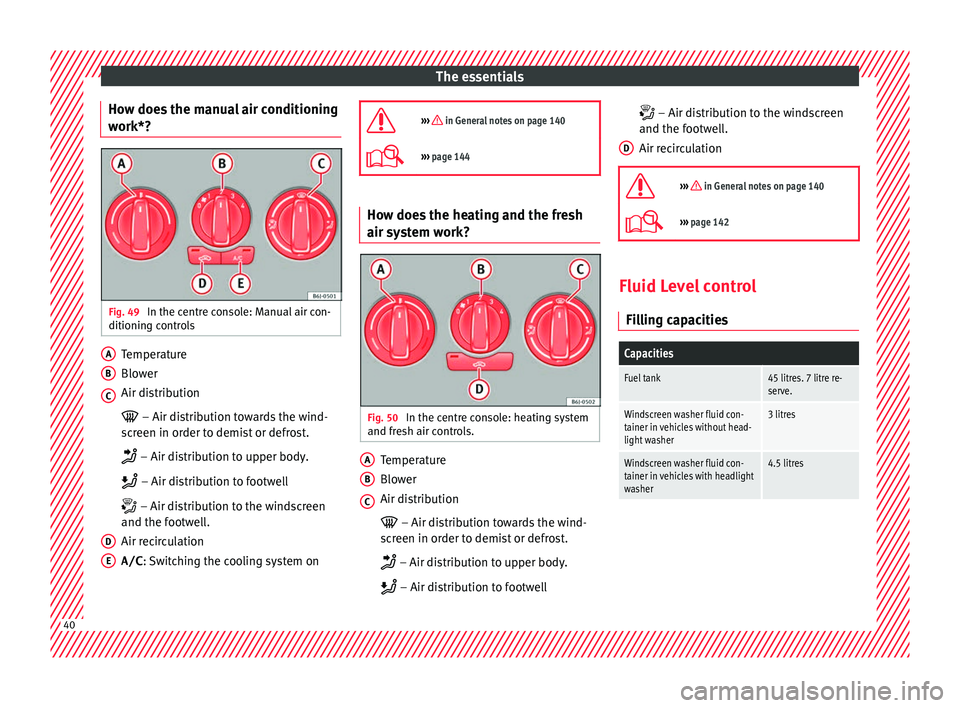
How does the manual air conditioning
w ork*? Fig. 49
In the centre console: Manual air con-
ditionin g c
ontr o
ls Temperature
Blo
w
er
Air di s
tribution
– Air distribution towards the wind-
screen in order to demist or defrost.
– Air distribution to upper body.
– Air distribution to footwell
– Air distribution to the windscreen
and the footwell.
Air recirculation
A/C : Switching the cooling system on
A B
C
D
E
››› in General notes on page 140
›››
page 144 How does the heating and the fresh
air sy
s
tem w
ork? Fig. 50
In the centre console: heating system
and fr e
sh air c ontr
ols. Temperature
Blo
w
er
Air di s
tribution
– Air distribution towards the wind-
screen in order to demist or defrost.
– Air distribution to upper body.
– Air distribution to footwell
A B
C
– Air distrib
ution t
o the windscreen
and the footwell.
Air recirculation
››› in General notes on page 140
››› page 142 Fluid Level control
Fi l
lin g c
apacities
Capacities
Fuel tank45 litres. 7 litre re-
serve.
Windscreen washer fluid con-
tainer in vehicles without head-
light washer3 litres
Windscreen washer fluid con-
tainer in vehicles with headlight
washer4.5 litres D
40
Page 44 of 252
The essentialsEngine typeSpecification
Diesel. Particulate Filter En-
gines (DPF).
With or without flexible
service interval (with and
without LongLife)
a)VW 507 00
a)
Only use recommended oils, otherwise you may damage the
engine.
Engine oil additives
No type of additive should be mixed with the
engine oil. The deterioration caused by these
additives is not covered by the warranty.
››› in Changing engine oil on page 207
››› page 204 Coolant
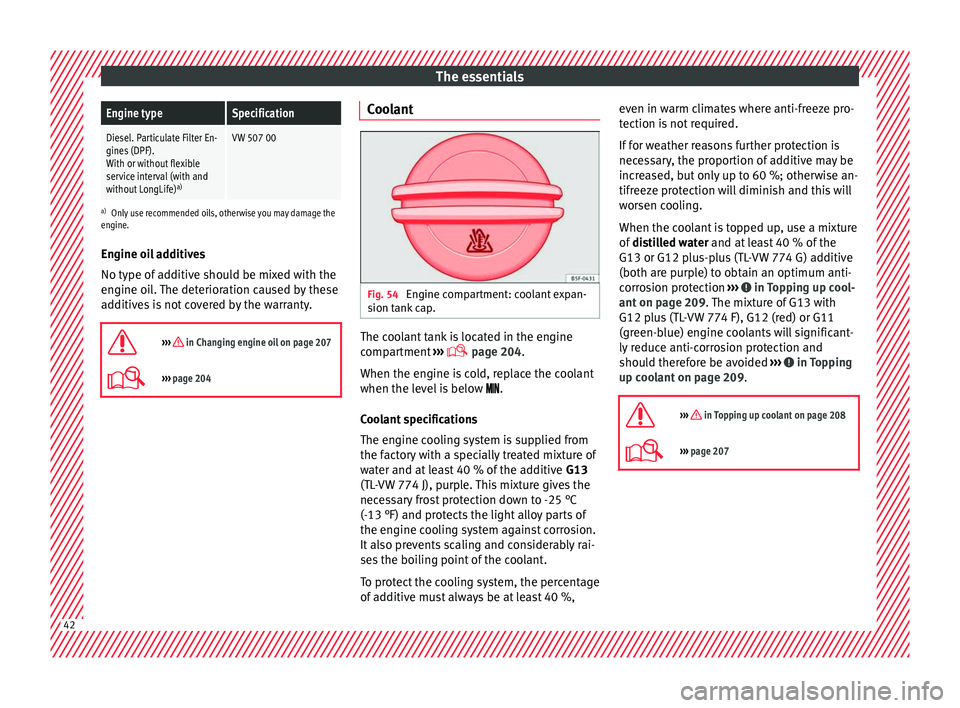
Fig. 54
Engine compartment: coolant expan-
s ion t
ank c
ap. The coolant tank is located in the engine
c
omp
artment
›››
page 204.
When the engine is cold, replace the coolant
when the level is below .
Coolant specifications
The engine cooling system is supplied from
the factory with a specially treated mixture of
water and at least 40 % of the additive G13
(TL-VW 774 J), purple. This mixture gives the
necessary frost protection down to -25 °C
(-13 °F) and protects the light alloy parts of
the engine cooling system against corrosion.
It also prevents scaling and considerably rai-
ses the boiling point of the coolant.
To protect the cooling system, the percentage
of additive must always be at least 40 %, even in warm climates where anti-freeze pro-
tection is not
required.
If for weather reasons further protection is
necessary, the proportion of additive may be
increased, but only up to 60 %; otherwise an-
tifreeze protection will diminish and this will
worsen cooling.
When the coolant is topped up, use a mixture
of distilled water and at least 40 % of the
G13 or G12 plus-plus (TL-VW 774 G) additive
(both are purple) to obtain an optimum anti-
corrosion protection ››› in Topping up cool-
ant on p ag
e 209 .
The mixture of G13 with
G12 plus (TL-VW 774 F), G12 (red) or G11
(green-blue) engine coolants will significant-
ly reduce anti-corrosion protection and
should therefore be avoided ››› in Topping
up c oo
lant on p
age 209.
››› in Topping up coolant on page 208
››› page 207 42
Page 46 of 252
The essentials
Emergencies F u
se s
F
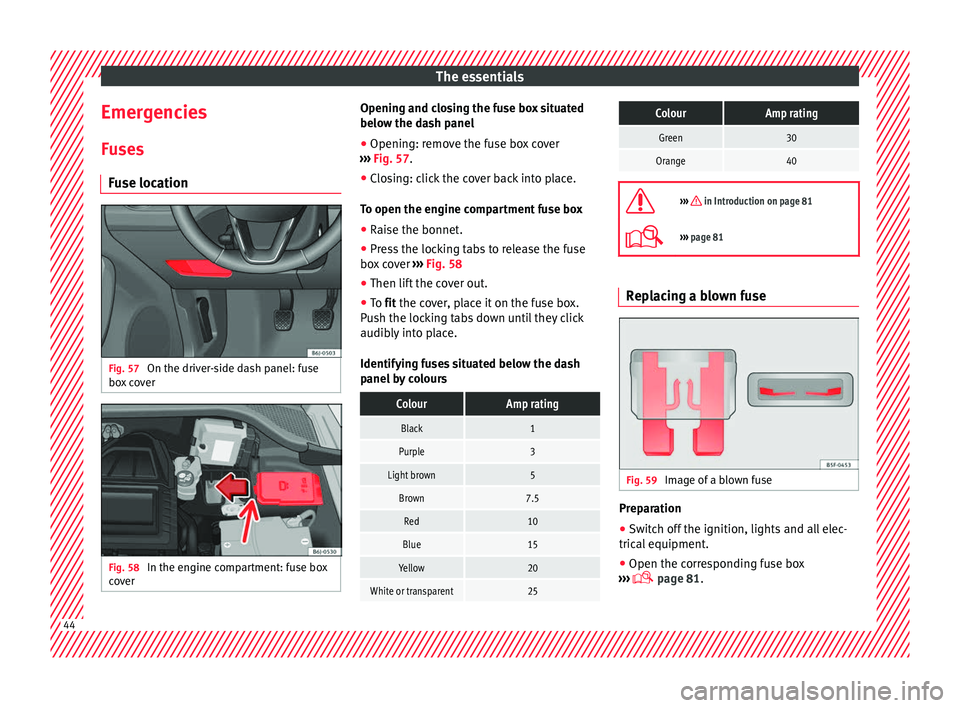
use location Fig. 57
On the driver-side dash panel: fuse
bo x
c o
ver Fig. 58
In the engine compartment: fuse box
c o
ver Opening and closing the fuse box situated
belo
w the d a
sh p
anel
● Opening: remove the fuse box cover
››› Fig. 57
.
● Closing: click the cover back into place.
To open the engine comp
artment fuse box
● Raise the bonnet.
● Press the locking tabs to release the fuse
box co
ver ››› Fig. 58
● Then lift the cover out.
● To fit the cover, place it on the fuse box.
Push the loc
king tabs down until they click
audibly into place.
Identifying fuses situated below the dash
panel by colours
ColourAmp rating
Black1
Purple3
Light brown5
Brown7.5
Red10
Blue15
Yellow20
White or transparent25
ColourAmp rating
Green30
Orange40
››› in Introduction on page 81
›››
page 81 Replacing a blown fuse
Fig. 59
Image of a blown fuse Preparation
● Switch off the ignition, lights and all elec-
tric al
equipment .
● Open the c
orresponding fuse box
››› p
age 81.44
Page 47 of 252
The essentials
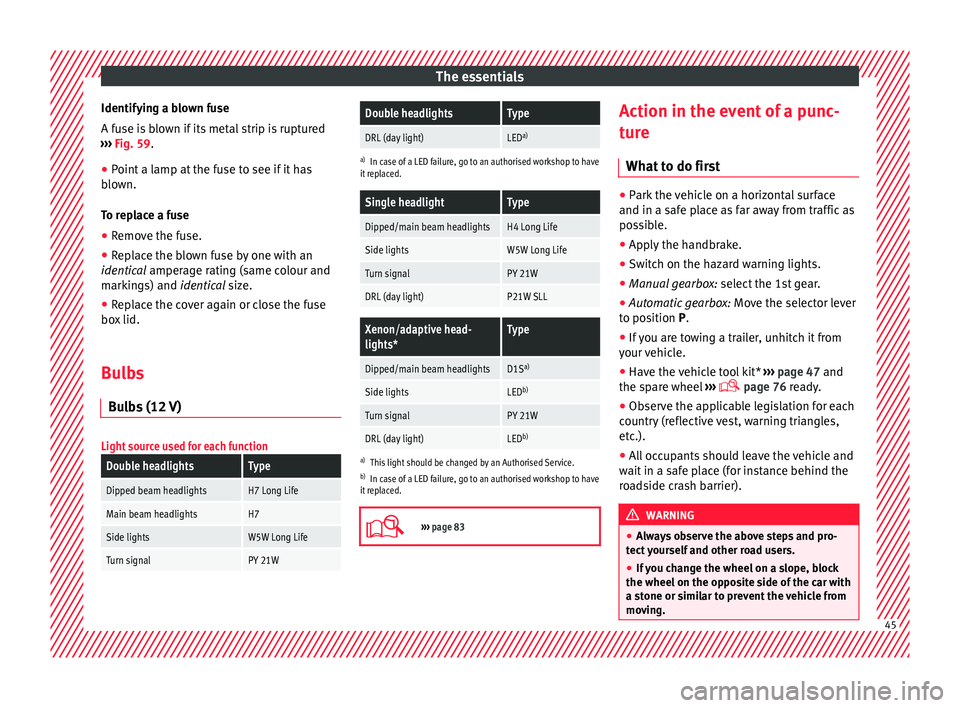
Identifying a blown fuse
A f u
se i s
blown if its metal strip is ruptured
››› Fig. 59.
● Point a lamp at the fuse to see if it has
blown.
To r
eplace a fuse
● Remove the fuse.
● Replace the blown fuse by one with an
identical
amperage rating (same colour and
markings) and identical size.
● Replace the cover again or close the fuse
box lid.
Bu
lbs
Bulb
s (12 V)
Light source used for each function
Double headlightsType
Dipped beam headlightsH7 Long Life
Main beam headlightsH7
Side lightsW5W Long Life
Turn signalPY 21W
Double headlightsType
DRL (day light)LEDa)
a)
In case of a LED failure, go to an authorised workshop to have
it replaced.
Single headlightType
Dipped/main beam headlightsH4 Long Life
Side lightsW5W Long Life
Turn signalPY 21W
DRL (day light)P21W SLL
Xenon/adaptive head-
lights*Type
Dipped/main beam headlightsD1S a)
Side lightsLEDb)
Turn signalPY 21W
DRL (day light)LEDb)
a)
This light should be changed by an Authorised Service.
b) In case of a LED failure, go to an authorised workshop to have
it replaced.
››› page 83 Action in the event of a punc-
t
ur
e
Wh at
to do first ●
Park the vehicle on a horizontal surface
and in a safe p l
ace as far away from traffic as
possible.
● Apply the handbrake.
● Switch on the hazard warning lights.
● Manual gearbox: select the 1st
gear.
● Automatic gearbox: Move the select
or lever
to position P.
● If you are towing a trailer, unhitch it from
your vehic
le.
● Have the vehicle tool kit* ›››
p
age 47 and
the spare wheel ›››
page 76 ready.
● Observe the applicable legislation for each
country
(reflective vest, warning triangles,
etc.).
● All occupants should leave the vehicle and
wait in a saf
e place (for instance behind the
roadside crash barrier). WARNING
● Alwa y
s observe the above steps and pro-
tect yourself and other road users.
● If you change the wheel on a slope, block
the wheel on the oppos
ite side of the car with
a stone or similar to prevent the vehicle from
moving. 45
Page 50 of 252
The essentials
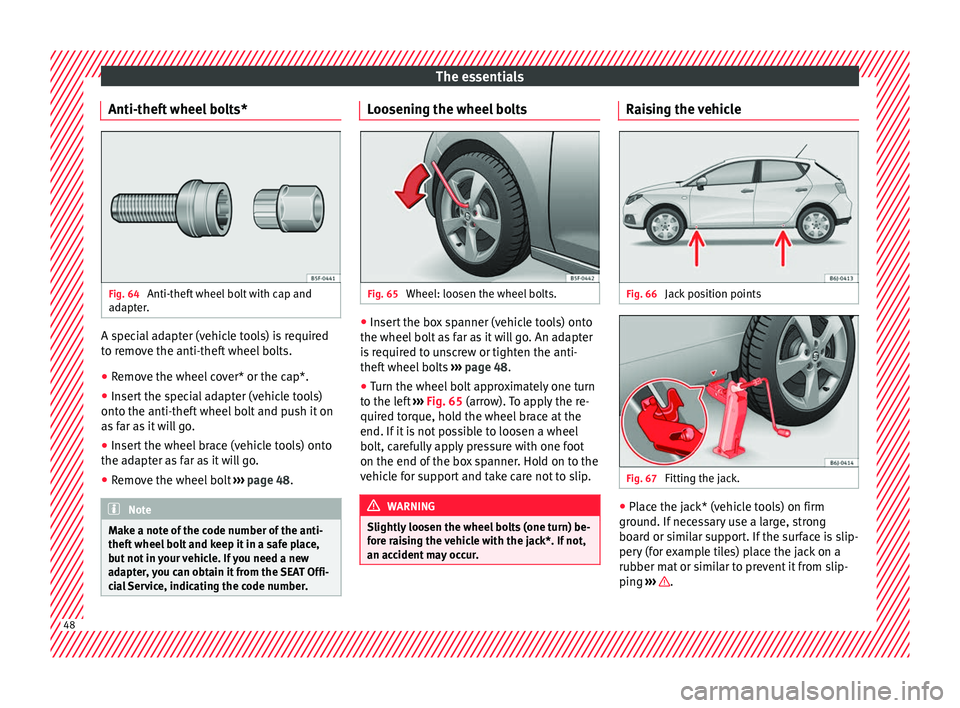
Anti-theft wheel bolts* Fig. 64
Anti-theft wheel bolt with cap and
a d
apt er
. A special adapter (vehicle tools) is required
t
o r
emo v
e the anti-theft wheel bolts.
● Remove the wheel cover* or the cap*.
● Insert the special adapter (vehicle tools)
onto the anti-theft wheel
bolt and push it on
as far as it will go.
● Insert the wheel brace (vehicle tools) onto
the adapter a
s far as it will go.
● Remove the wheel bolt ››› p
age 48. Note
Make a note of the code number of the anti-
theft wheel bo
lt and keep it in a safe place,
but not in your vehicle. If you need a new
adapter, you can obtain it from the SEAT Offi-
cial Service, indicating the code number. Loosening the wheel bolts
Fig. 65
Wheel: loosen the wheel bolts. ●
Insert the box spanner (vehicle tools) onto
the wheel bo
lt a
s far as it will go. An adapter
is required to unscrew or tighten the anti-
theft wheel bolts ››› page 48.
● Turn the wheel bolt approximately one turn
to the left ›
›› Fig. 65 (arrow). To apply the re-
quired torque, hold the wheel brace at the
end. If it is not possible to loosen a wheel
bolt, carefully apply pressure with one foot
on the end of the box spanner. Hold on to the
vehicle for support and take care not to slip. WARNING
Slightly loosen the wheel bolts (one turn) be-
fore r ai
sing the vehicle with the jack*. If not,
an accident may occur. Raising the vehicle
Fig. 66
Jack position points Fig. 67
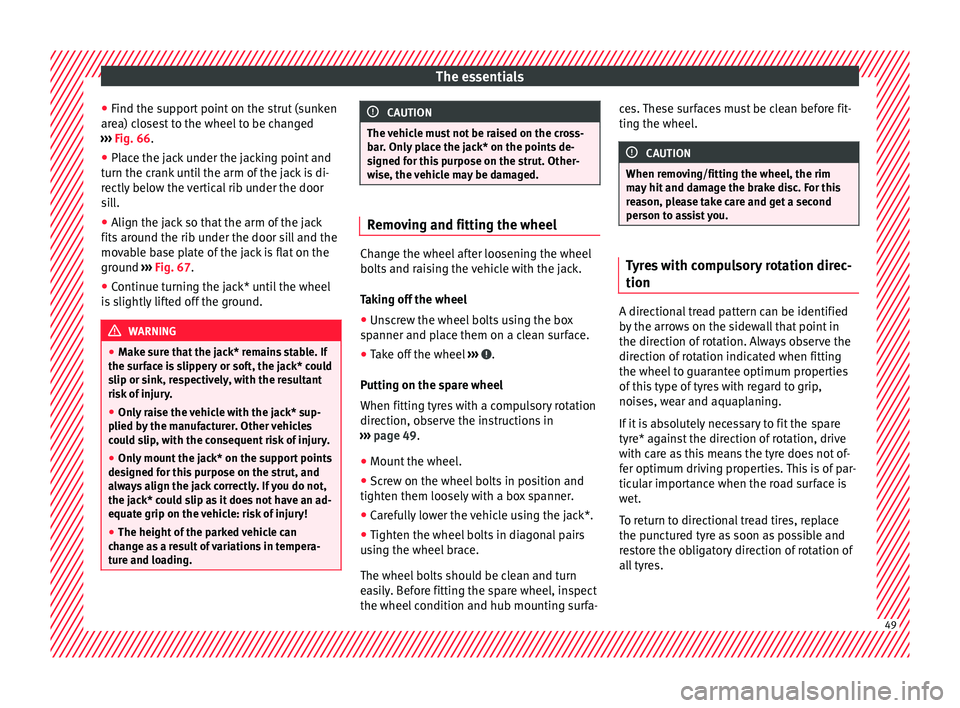
Fitting the jack. ●
Place the jack* (vehicle tools) on firm
gr ou
nd. If nec
essary use a large, strong
board or similar support. If the surface is slip-
pery (for example tiles) place the jack on a
rubber mat or similar to prevent it from slip-
ping ››› .
48
Page 51 of 252
The essentials
● Find the s up
por t
point on the strut (sunken
area) closest to the wheel to be changed
››› Fig. 66.
● Place the jack under the jacking point and
turn the crank
until the arm of the jack is di-
rectly below the vertical rib under the door
sill.
● Align the jack so that the arm of the jack
fits around the rib u
nder the door sill and the
movable base plate of the jack is flat on the
ground ››› Fig. 67.
● Continue turning the jack* until the wheel
is slightly
lifted off the ground. WARNING
● Make s ur
e that the jack* remains stable. If
the surface is slippery or soft, the jack* could
slip or sink, respectively, with the resultant
risk of injury.
● Only raise the vehicle with the jack* sup-
plied by the m
anufacturer. Other vehicles
could slip, with the consequent risk of injury.
● Only mount the jack* on the support points
designed for thi
s purpose on the strut, and
always align the jack correctly. If you do not,
the jack* could slip as it does not have an ad-
equate grip on the vehicle: risk of injury!
● The height of the parked vehicle can
chang
e as a result of variations in tempera-
ture and loading. CAUTION
The vehicle must not be raised on the cross-
bar. On ly
place the jack* on the points de-
signed for this purpose on the strut. Other-
wise, the vehicle may be damaged. Removing and fitting the wheel
Change the wheel after loosening the wheel
bolts and r
ai
sing the vehicle with the jack.
Taking off the wheel
● Unscrew the wheel bolts using the box
spanner and p l
ace them on a clean surface.
● Take off the wheel ››› .
P uttin
g on the s p
are wheel
When fitting tyres with a compulsory rotation
direction, observe the instructions in
››› page 49.
● Mount the wheel.
● Screw on the wheel bolts in position and
tighten them loosely w
ith a box spanner.
● Carefully lower the vehicle using the jack*.
● Tighten the wheel bolts in diagonal pairs
using the wheel
brace.
The wheel bolts should be clean and turn
easily. Before fitting the spare wheel, inspect
the wheel condition and hub mounting surfa- ces. These surfaces must be clean before fit-
ting the wheel. CAUTION
When removing/fitting the wheel, the rim
may hit
and damage the brake disc. For this
reason, please take care and get a second
person to assist you. Tyres with compulsory rotation direc-
tion
A directional tread pattern can be identified
b
y
the arr o
ws on the sidewall that point in
the direction of rotation. Always observe the
direction of rotation indicated when fitting
the wheel to guarantee optimum properties
of this type of tyres with regard to grip,
noises, wear and aquaplaning.
If it is absolutely necessary to fit the spare
tyre* against the direction of rotation, drive
with care as this means the tyre does not of-
fer optimum driving properties. This is of par-
ticular importance when the road surface is
wet.
To return to directional tread tires, replace
the punctured tyre as soon as possible and
restore the obligatory direction of rotation of
all tyres. 49
Page 53 of 252
The essentials
Emergency towing of the vehi-
c l
e
T o
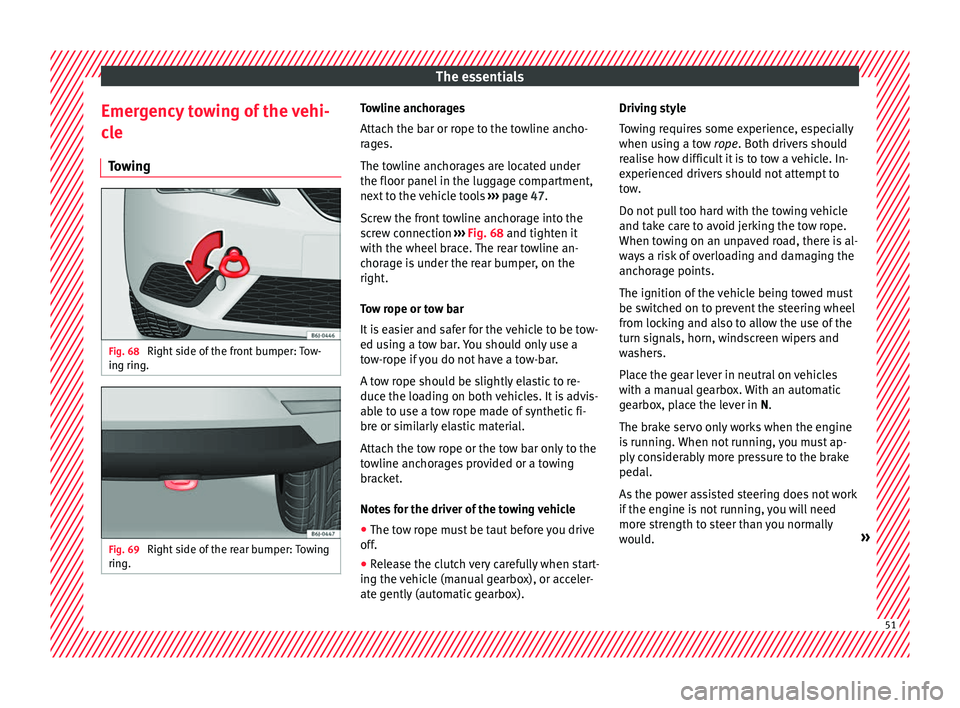
wing Fig. 68
Right side of the front bumper: Tow-
in g rin
g. Fig. 69
Right side of the rear bumper: Towing
rin g. Towline anchorages
Att
ac
h the b ar or r
ope to the towline ancho-
rages.
The towline anchorages are located under
the floor panel in the luggage compartment,
next to the vehicle tools ››› page 47.
Screw the front towline anchorage into the
screw connection ››› Fig. 68 and tighten it
with the wheel brace. The rear towline an-
chorage is under the rear bumper, on the
right.
Tow rope or tow bar
It is easier and safer for the vehicle to be tow-
ed using a tow bar. You should only use a
tow-rope if you do not have a tow-bar.
A tow rope should be slightly elastic to re-
duce the loading on both vehicles. It is advis-
able to use a tow rope made of synthetic fi-
bre or similarly elastic material.
Attach the tow rope or the tow bar only to the
towline anchorages provided or a towing
bracket.
Notes for the driver of the towing vehicle
● The tow rope must be taut before you drive
off.
● Rele
ase the clutch very carefully when start-
ing the vehic
le (manual gearbox), or acceler-
ate gently (automatic gearbox). Driving style
Towin
g requires some experience, especially
when using a tow rope. Both drivers should
realise how difficult it is to tow a vehicle. In-
experienced drivers should not attempt to
tow.
Do not pull too hard with the towing vehicle
and take care to avoid jerking the tow rope.
When towing on an unpaved road, there is al-
ways a risk of overloading and damaging the
anchorage points.
The ignition of the vehicle being towed must
be switched on to prevent the steering wheel
from locking and also to allow the use of the
turn signals, horn, windscreen wipers and
washers.
Place the gear lever in neutral on vehicles
with a manual gearbox. With an automatic
gearbox, place the lever in N.
The brake servo only works when the engine
is running. When not running, you must ap-
ply considerably more pressure to the brake
pedal.
As the power assisted steering does not work
if the engine is not running, you will need
more strength to steer than you normally
would. » 51
Page 55 of 252
The essentials
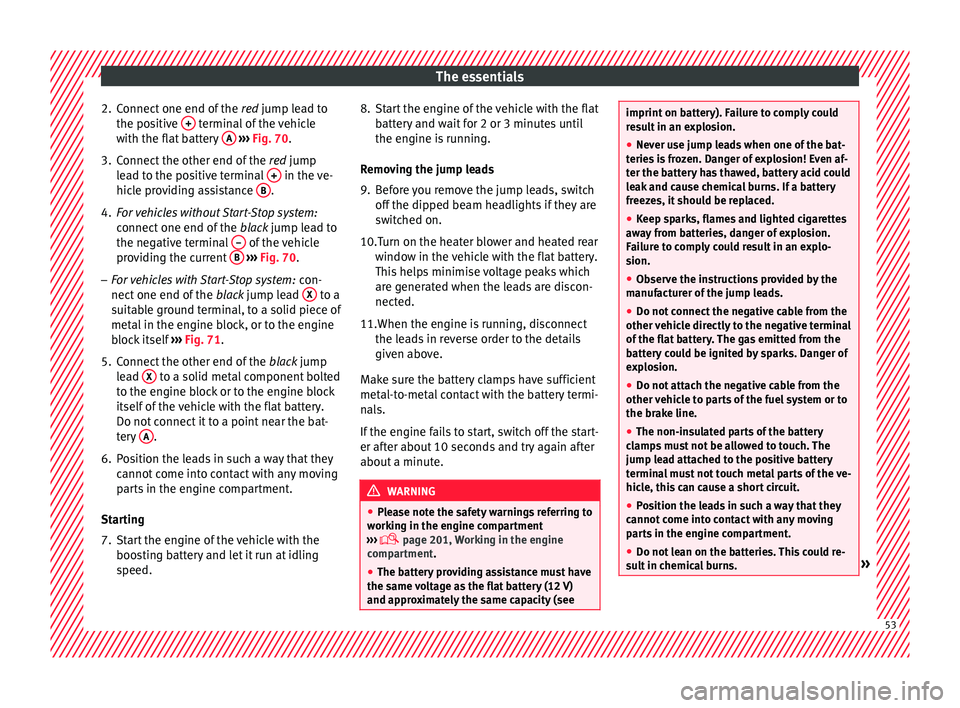
2. Connect one end of the re
d jump l
ead to
the positive + terminal of the vehicle
w ith the fl
at b
attery A
› ››
Fig. 70
.
3. C
onnect the other end of the red jump
l
ead to the positive terminal + in the ve-
hic l
e pr o
viding assistance B .
4. For vehicles without Start-Stop system:
connect
one end of the
b
lack jump lead to
the negative terminal – of the vehicle
pr o
vidin
g the current B
› ››
Fig. 70
.
– For
vehicles with Start-Stop system: con-
nect one end of the b
lack jump lead X to a
s uit
abl
e ground terminal, to a solid piece of
metal in the engine block, or to the engine
block itself ››› Fig. 71.
5. Connect the other end of the black jump
l
ead X to a solid metal component bolted
t o the en
gine bloc
k or to the engine block
itself of the vehicle with the flat battery.
Do not connect it to a point near the bat-
tery A .
6. Position the leads in such a way that they cannot
come int
o contact with any moving
parts in the engine compartment.
Starting
7. Start the engine of the vehicle with the boosting b
attery and let it run at idling
speed. 8. Start the engine of the vehicle with the flat
battery
and wait for 2 or 3 minutes until
the engine is running.
Removing the jump leads
9. Before you remove the jump leads, switch off the dipped beam he
adlights if they are
switched on.
10.Turn on the heater blower and heated rear window in the v
ehicle with the flat battery.
This helps minimise voltage peaks which
are generated when the leads are discon-
nected.
11.When the engine is running, disconnect the lead
s in reverse order to the details
given above.
Make sure the battery clamps have sufficient
metal-to-metal contact with the battery termi-
nals.
If the engine fails to start, switch off the start-
er after about 10 seconds and try again after
about a minute. WARNING
● Plea se not
e the safety warnings referring to
working in the engine compartment
››› page 201, Working in the engine
compartment.
● The battery providing assistance must have
the same vo
ltage as the flat battery (12 V)
and approximately the same capacity (see imprint on battery). Failure to comply could
res
u
lt in an explosion.
● Never use jump leads when one of the bat-
teries i
s frozen. Danger of explosion! Even af-
ter the battery has thawed, battery acid could
leak and cause chemical burns. If a battery
freezes, it should be replaced.
● Keep sparks, flames and lighted cigarettes
away
from batteries, danger of explosion.
Failure to comply could result in an explo-
sion.
● Observe the instructions provided by the
manufactur
er of the jump leads.
● Do not connect the negative cable from the
other vehicl
e directly to the negative terminal
of the flat battery. The gas emitted from the
battery could be ignited by sparks. Danger of
explosion.
● Do not attach the negative cable from the
other vehicl
e to parts of the fuel system or to
the brake line.
● The non-insulated parts of the battery
clamps
must not be allowed to touch. The
jump lead attached to the positive battery
terminal must not touch metal parts of the ve-
hicle, this can cause a short circuit.
● Position the leads in such a way that they
cannot come int
o contact with any moving
parts in the engine compartment.
● Do not lean on the batteries. This could re-
sult in c
hemical burns. » 53
Page 58 of 252
Safety
Safety
Saf e driv
ing
Saf
ety first! This chapter contains important information,
tips, sug
g
estions and warnings that you
should read and consider for both your own
safety and for your passengers' safety. WARNING
● This m anua
l contains important informa-
tion about the operation of the vehicle, both
for the driver and the passengers. The other
sections of the on-board documentation also
contain further information that you should
be aware of for your own safety and for the
safety of your passengers.
● Ensure that the on-board documentation is
kept in the v
ehicle at all times. This is espe-
cially important when lending or selling the
vehicle to another person. Advice about driving
B ef or
e settin
g offFor your own safety and the safety of your
p
a
ssen
gers, always note the following points
before every trip: –
Make sur
e that the vehicle's lights and turn
signals are working properly.
– Check tyre pressure.
– Ensure that all windows provide a clear and
good view of
the surroundings.
– Ensure that all luggage is correctly secured
››› p
age 135.
– Make sure that no objects can interfere
with the pedals.
– Adju
st front seat, head restraint and mir-
rors pr
operly according to your size.
– Ensure that the passenger in the central
rear seat
always has the head restraint in
the correct position for use.
– Instruct passengers to adjust the head re-
straints ac
cording to their height.
– Protect children with appropriate child
seats and properly
applied seat belts
››› page 72.
– Assume the correct sitting position. Instruct
your pas
sengers also to assume a proper
sitting position. ››› page 57.
– Fasten your seat belt securely. Instruct your
passen
gers also to fasten their seat belts
properly. ››› page 61. What affects driving safety? As a driver, you are responsible for yourself
and your p
a
ssengers. When your concentra-
tion or driving safety is affected by any cir-
cumstance, you endanger yourself as well as
others on the road ››› , for this reason:
– Always pay attention to traffic and do not
get di s
tracted by passengers or telephone
calls.
– Never drive when your driving ability is im-
paired (e.g. b
y medication, alcohol, drugs).
– Observe traffic laws and speed limits.
– Always reduce your speed as appropriate
for ro a
d, traffic and weather conditions.
– When travelling long distances, take
breaks
regularly - at least every two hours.
– If possible, avoid driving when you are tired
or stres
sed. WARNING
When driving safety is impaired during a trip,
the risk of injur
y and accidents increases. Safety equipment
Never put your safety or the safety of your
p
a
ssen
gers in danger. In the event of an acci-
dent, the safety equipment may reduce the
56
Page 59 of 252
Safe driving
risk of injury. The following list includes most
of the s
afety
equipment in your SEAT:
● Three-point seat belts
● Belt tension limiter for the front and rear
side seats
● Belt
tensioners for the front seats
● Front airbags
● Side airbags in the front seat backrests,
with ches
t and head protection
● “ISOFIX” anchor points for “ISOFIX” rear
child se
at system
● Height-adjustable front head restraints
● Rear-centre head restraints with in-use po-
sition and non-use pos
ition
● Adjustable steering column
The safety equipment
mentioned above
works together to provide you and your pas-
sengers with the best possible protection in
the event of an accident. However, these
safety systems can only be effective if you
and your passengers are sitting in a correct
position and use this equipment properly.
Safety is everyone's business! Correct position for passengers
Correct s
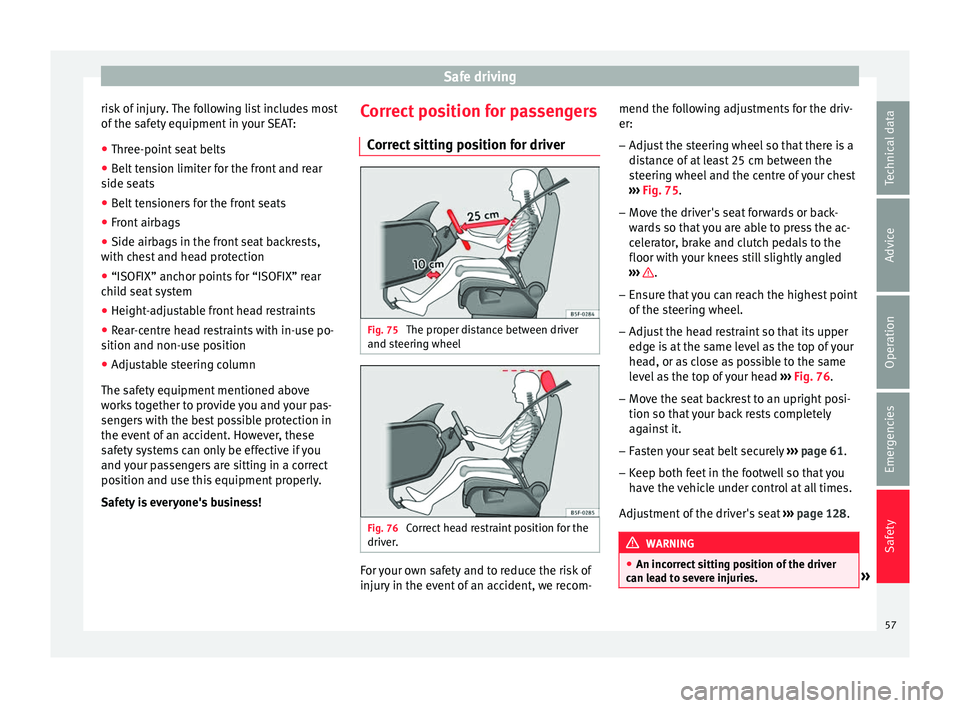
itting position for driver Fig. 75
The proper distance between driver
and s t
eerin g wheel Fig. 76
Correct head restraint position for the
driv er
. For your own safety and to reduce the risk of
injur
y
in the ev ent
of an accident, we recom- mend the following adjustments for the driv-
er:
– Adjust the steering wheel so that there is a
distanc
e of at least 25 cm between the
steering wheel and the centre of your chest
››› Fig. 75.
– Move the driver's seat forwards or back-
wards
so that you are able to press the ac-
celerator, brake and clutch pedals to the
floor with your knees still slightly angled
››› .
– Ensure that you can reach the highest point
of the s
teerin
g wheel.
– Adjust the head restraint so that its upper
edge is at
the same level as the top of your
head, or as close as possible to the same
level as the top of your head ››› Fig. 76.
– Move the seat backrest to an upright posi-
tion so that y
our back rests completely
against it.
– Fasten your seat belt securely ››› p
age 61.
– Keep both feet in the footwell so that you
have the v
ehicle under control at all times.
Adjustment of the driver's seat ››› page 128. WARNING
● An incorrect s
itting position of the driver
can lead to severe injuries. » 57
Technical data
Advice
Operation
Emergencies
Safety