ECU Seat Ibiza ST 2016 Owner's Guide
[x] Cancel search | Manufacturer: SEAT, Model Year: 2016, Model line: Ibiza ST, Model: Seat Ibiza ST 2016Pages: 252, PDF Size: 5.56 MB
Page 131 of 252
Seats and head restraints
Vehicles without the Easy-Entry function
– To f old the backrest, pull the lever 1 up-
w ar
ds
and push the backrest forwards.
– To unfold the backrest, push it back.
Vehicl
es with the Easy-Entry function
– To fold the backrest, pull the lever 1 up-
w ar
ds
and push the backrest forwards. You
can push the seat forwards at the same
time to make entry to the rear seats easier.
– To unfold the backrest, first move the seat
compl
etely back.
The Easy-Entry function facilitates the access
to the vehicle rear seats. Before lifting the
backrest, return the seat to the original posi-
tion. The seat inserts when the backrest is lif-
ted. Adjusting or disassembling the head
restr
aints Fig. 141
Adjusting and removing the head re-
s tr
aints. Read the additional information carefully
› ›
›
p
age 12
Adjusting height (front seats)
– Press the button on the side and pull up-
wards
to the desired position.
– To lower the head restraint, press the but-
ton and push he
ad restraint downwards.
– Make sure that it engages securely into one
of its pos
itions.
Adjusting height (rear seats)
– Press the button on the side and pull up-
wards
to the desired position.
– To lower the head restraint, press the but-
ton and push he
ad restraint downwards. –
Make sur
e that the head restraint engages
securely in one of its positions ››› page 60.
Removing the head restraint – Push the head restraint up as far as it will
go.
– Pre
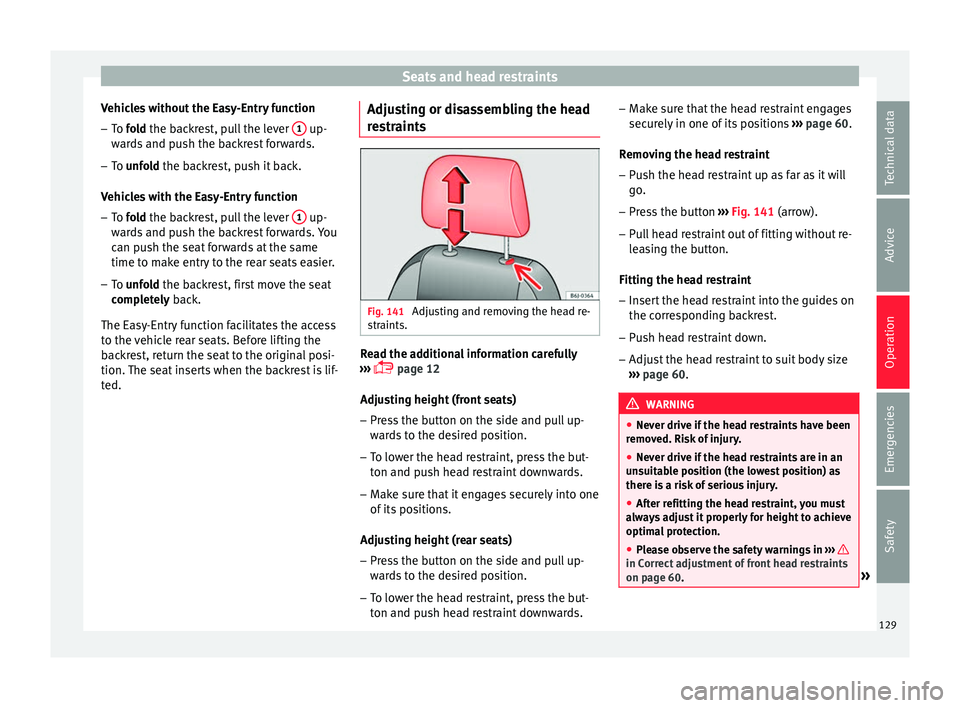
ss the button ››› Fig. 141
(arrow).
– Pull head restraint out of fitting without re-
leas
ing the button.
Fitting the head restraint
– Insert the head restraint into the guides on
the corres
ponding backrest.
– Push head restraint down.
– Adjust the head restraint to suit body size
››› p
age 60. WARNING
● Never drive if the he
ad restraints have been
removed. Risk of injury.
● Never drive if the head restraints are in an
unsuit
able position (the lowest position) as
there is a risk of serious injury.
● After refitting the head restraint, you must
alway
s adjust it properly for height to achieve
optimal protection.
● Please observe the safety warnings in ››› in Correct adjustment of front head restraints
on page 60
. » 129
Technical data
Advice
Operation
Emergencies
Safety
Page 133 of 252
Transport and practical equipment
– Lif t
the c u
shion 2 forwards in the direc-
tion of the arr
ow
.
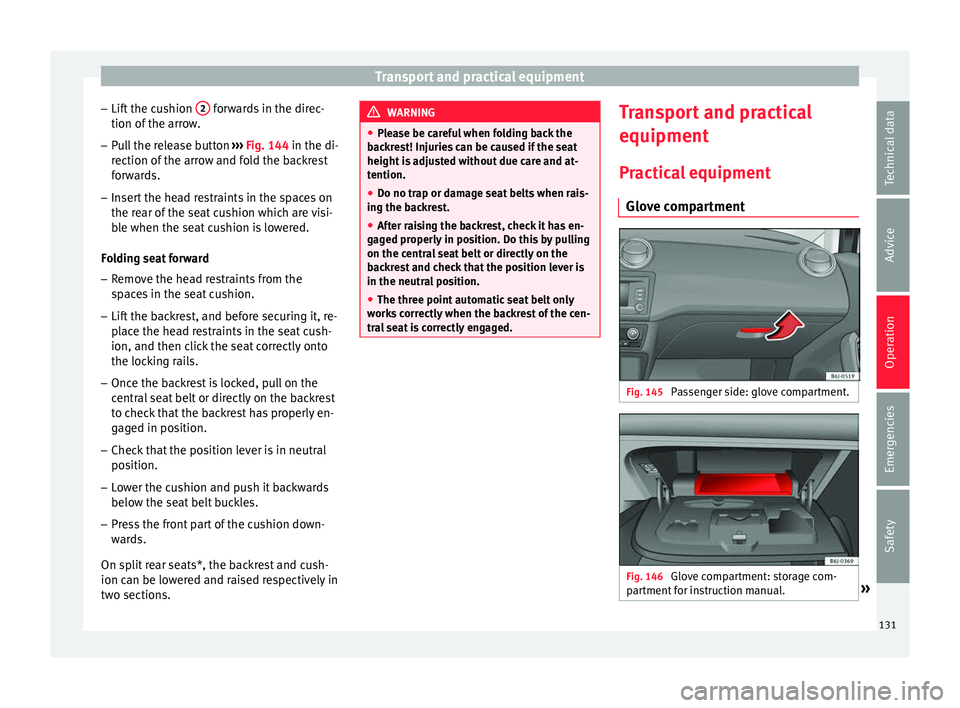
– Pull the release button ››› Fig. 144 in the di-
r
ection of the arrow and fold the backrest
forwards.
– Insert the head restraints in the spaces on
the rear of the se
at cushion which are visi-
ble when the seat cushion is lowered.
Folding seat forward
– Remove the head restraints from the
space
s in the seat cushion.
– Lift the backrest, and before securing it, re-
place the he
ad restraints in the seat cush-
ion, and then click the seat correctly onto
the locking rails.
– Once the backrest is locked, pull on the
central se
at belt or directly on the backrest
to check that the backrest has properly en-
gaged in position.
– Check that the position lever is in neutral
position.
– Lo
wer the cushion and push it backwards
below the seat belt
buckles.
– Press the front part of the cushion down-
wards.
On s
plit rear seats*, the backrest and cush-
ion can be lowered and raised respectively in
two sections. WARNING
● Plea se be c
areful when folding back the
backrest! Injuries can be caused if the seat
height is adjusted without due care and at-
tention.
● Do no trap or damage seat belts when rais-
ing the back
rest.
● After raising the backrest, check it has en-
gaged properly
in position. Do this by pulling
on the central seat belt or directly on the
backrest and check that the position lever is
in the neutral position.
● The three point automatic seat belt only
works c
orrectly when the backrest of the cen-
tral seat is correctly engaged. Transport and practical
equipment
Pr actic
al
equipment
Glove compartment Fig. 145
Passenger side: glove compartment. Fig. 146
Glove compartment: storage com-
p ar tment
f
or instruction manual. » 131
Technical data
Advice
Operation
Emergencies
Safety
Page 137 of 252
Transport and practical equipment
CAUTION
Always use the correct type of plugs to avoid
damagin g the soc
kets.Note
● The power soc k
ets will only work with the
ignition on.
● The use of electrical appliances with the
engine switc
hed off will cause a battery dis-
charge. Luggage compartment
Lo
adin
g the luggage compartment Fig. 156
Position heavy items as far forward
a s
po s
sible. All luggage and other loose objects must be
s
af
ely sec
ured in the luggage compartment.
Unsecured objects which shift back and forth could affect safety or driving characteristics
of the vehic
le by shifting the centre of gravity.
– Distribute the load evenly in the luggage
compartment
.
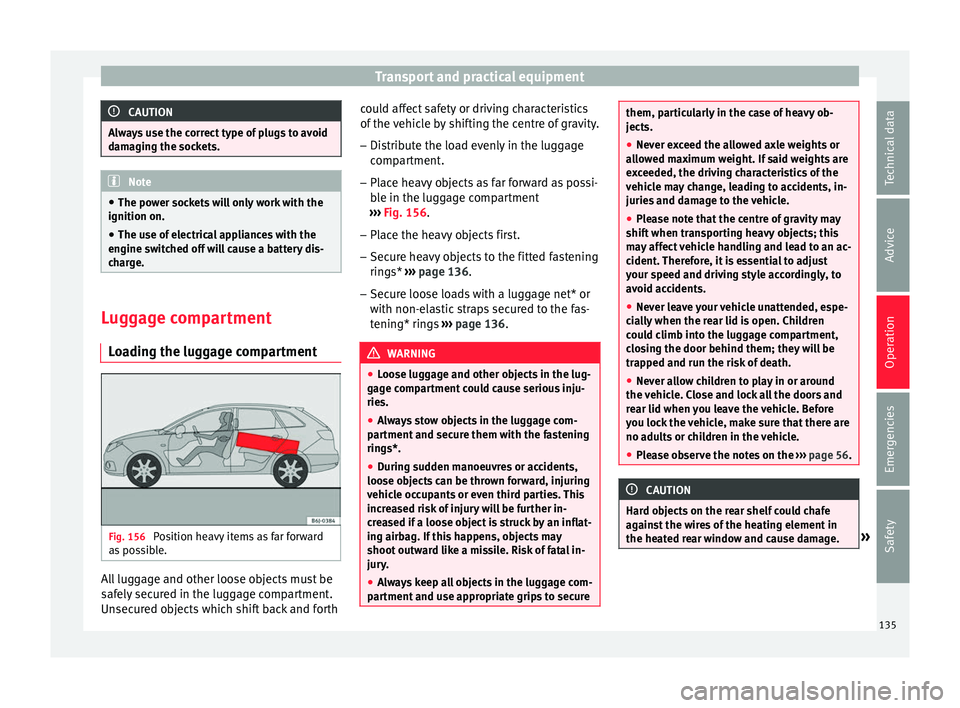
– Place heavy objects as far forward as possi-
ble in the lugg
age compartment
››› Fig. 156.
– Place the heavy objects first.
– Secure heavy objects to the fitted fastening
rings* ››
› page 136.
– Secure loose loads with a luggage net* or
with non-elas
tic straps secured to the fas-
tening* rings ››› page 136. WARNING
● Loose lug g
age and other objects in the lug-
gage compartment could cause serious inju-
ries.
● Always stow objects in the luggage com-
partment and sec
ure them with the fastening
rings*.
● During sudden manoeuvres or accidents,
loose obj
ects can be thrown forward, injuring
vehicle occupants or even third parties. This
increased risk of injury will be further in-
creased if a loose object is struck by an inflat-
ing airbag. If this happens, objects may
shoot outward like a missile. Risk of fatal in-
jury.
● Always keep all objects in the luggage com-
partment and u
se appropriate grips to secure them, particularly in the case of heavy ob-
jects.
●
Nev er e
xceed the allowed axle weights or
allow
ed maximum weight. If said weights are
exceeded, the driving characteristics of the
vehicle may change, leading to accidents, in-
juries and damage to the vehicle.
● Please note that the centre of gravity may
shift when tran
sporting heavy objects; this
may affect vehicle handling and lead to an ac-
cident. Therefore, it is essential to adjust
your speed and driving style accordingly, to
avoid accidents.
● Never leave your vehicle unattended, espe-
cial
ly when the rear lid is open. Children
could climb into the luggage compartment,
closing the door behind them; they will be
trapped and run the risk of death.
● Never allow children to play in or around
the vehicl
e. Close and lock all the doors and
rear lid when you leave the vehicle. Before
you lock the vehicle, make sure that there are
no adults or children in the vehicle.
● Please observe the notes on the ››› p
age 56. CAUTION
Hard objects on the rear shelf could chafe
agains t
the wires of the heating element in
the heated rear window and cause damage. » 135
Technical data
Advice
Operation
Emergencies
Safety
Page 138 of 252
Operation
Note
● The tyre pr e
ssure must be adjusted accord-
ing to the load. When necessary check the
tyre pressures on the label located on the in-
side fuel tank flap ››› page 213.
● Air circulation in the vehicle helps reduce
fogging of
the windows. Used air escapes
through ventilation slits in the side trim of
the luggage compartment. Ensure that the
ventilation slots are never covered.
● Straps for securing the load to the fasten-
ing rings* ar
e commercially available from ac-
cessory shops. Fastening rings*
3 Applies to the model: IBIZA ST
Fig. 157
Location of fastening rings in lug-
g ag
e c omp
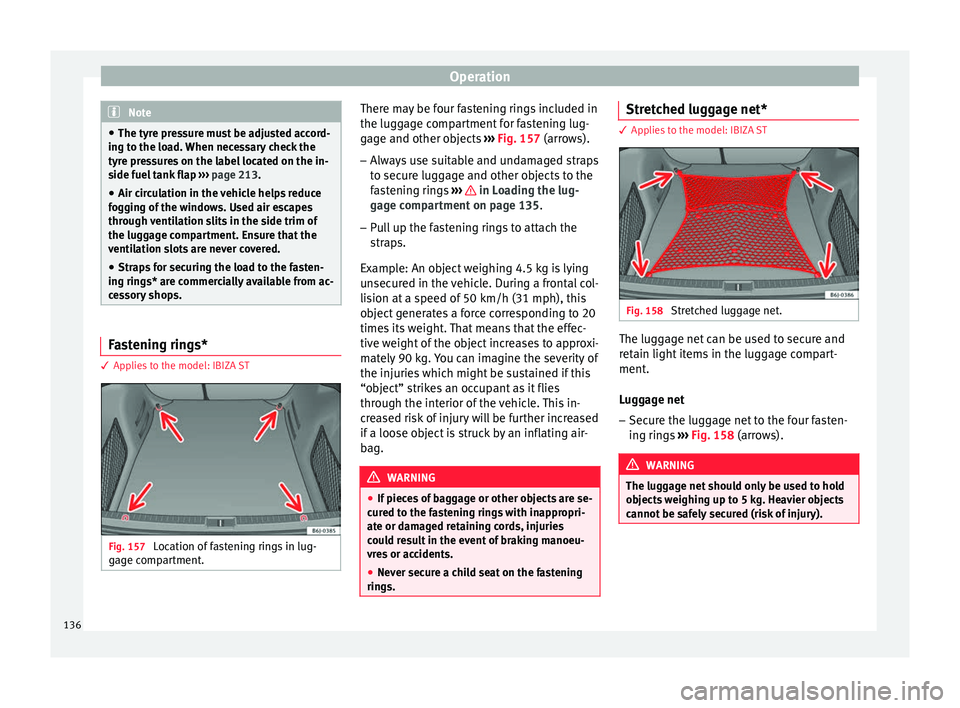
artment. There may be four fastening rings included in
the lug
g
ag e c
ompartment for fastening lug-
gage and other objects ››› Fig. 157 (arrows).
– Always use suitable and undamaged straps
to secure lug
gage and other objects to the
fastening rings ››› in Loading the lug-
g ag
e c omp
artment on page 135.
– Pull up the fastening rings to attach the
straps.
Ex
ample: An object weighing 4.5 kg is lying
unsecured in the vehicle. During a frontal col-
lision at a speed of 50 km/h (31 mph), this
object generates a force corresponding to 20
times its weight. That means that the effec-
tive weight of the object increases to approxi-
mately 90 kg. You can imagine the severity of
the injuries which might be sustained if this
“object” strikes an occupant as it flies
through the interior of the vehicle. This in-
creased risk of injury will be further increased
if a loose object is struck by an inflating air-
bag. WARNING
● If piece s
of baggage or other objects are se-
cured to the fastening rings with inappropri-
ate or damaged retaining cords, injuries
could result in the event of braking manoeu-
vres or accidents.
● Never secure a child seat on the fastening
rings. Stretched luggage net*
3 Applies to the model: IBIZA ST
Fig. 158
Stretched luggage net. The luggage net can be used to secure and
r
et
ain light it
ems in the luggage compart-
ment.
Luggage net
– Secure the luggage net to the four fasten-
ing rings
››› Fig. 158 (arrows). WARNING
The luggage net should only be used to hold
obj ect
s weighing up to 5 kg. Heavier objects
cannot be safely secured (risk of injury). 136
Page 141 of 252
Transport and practical equipment
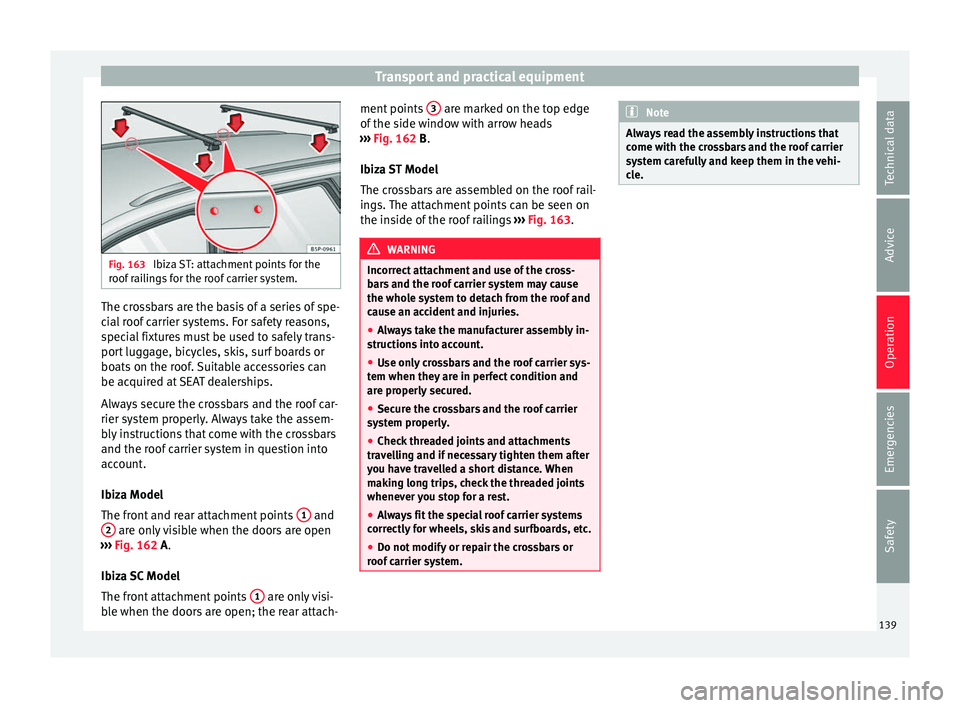
Fig. 163
Ibiza ST: attachment points for the
roof r ai
lings for the roof carrier system. The crossbars are the basis of a series of spe-
c
i
al r
oof carrier systems. For safety reasons,
special fixtures must be used to safely trans-
port luggage, bicycles, skis, surf boards or
boats on the roof. Suitable accessories can
be acquired at SEAT dealerships.
Always secure the crossbars and the roof car-
rier system properly. Always take the assem-
bly instructions that come with the crossbars
and the roof carrier system in question into
account.
Ibiza Model
The front and rear attachment points 1 and
2 are only visible when the doors are open
› ›
›
Fig. 162
A.
Ibiza SC Model
The front attachment points 1 are only visi-
b l
e when the door s
are open; the rear attach- ment points
3 are marked on the top edge
of the s
ide windo
w with arrow heads
››› Fig. 162 B.
Ibiza ST Model
The crossbars are assembled on the roof rail-
ings. The attachment points can be seen on
the inside of the roof railings ››› Fig. 163. WARNING
Incorrect attachment and use of the cross-
bars and the r
oof carrier system may cause
the whole system to detach from the roof and
cause an accident and injuries.
● Always take the manufacturer assembly in-
structions int
o account.
● Use only crossbars and the roof carrier sys-
tem when they are in per
fect condition and
are properly secured.
● Secure the crossbars and the roof carrier
system pr
operly.
● Check threaded joints and attachments
travellin
g and if necessary tighten them after
you have travelled a short distance. When
making long trips, check the threaded joints
whenever you stop for a rest.
● Always fit the special roof carrier systems
correctly f
or wheels, skis and surfboards, etc.
● Do not modify or repair the crossbars or
roof carrier sy
stem. Note
Always read the assembly instructions that
come with the c r
ossbars and the roof carrier
system carefully and keep them in the vehi-
cle. 139
Technical data
Advice
Operation
Emergencies
Safety
Page 156 of 252
Operation
Applying the handbrake
– Pull the handbrake lever up firmly
› ›
›
Fig. 169
.
Releasing the handbrake
– Pull the lever up slightly and press the re-
lease kno
b in the direction of the arrow
››› Fig. 169 and guide the handbrake lever
down fully ››› .
A lw
ay
s pull the handbrake all the way up, so
there is less risk of driving off with it still en-
gaged ››› .
The h andbr
ake w
arning lamp lights up
when the handbrake is applied and the igni-
tion switched on. The warning lamp turns off
when the handbrake is released. WARNING
● Never use the h andbr
ake to stop the vehi-
cle when it is in motion. The braking distance
is considerably longer, because braking is
only applied to the rear wheels. Risk of acci-
dent!
● If the handbrake is only partially released,
this wi
ll cause the rear brakes to overheat,
which can impair the function of the brake
system and could lead to an accident. This al-
so causes premature wear on the rear brake
pads. CAUTION
Always apply the handbrake before you leave
the vehic l
e. Put it in 1st gear as well. In vehi-
cles with an automatic gearbox, place the
gear lever in position P. Parking
The handbrake should always be firmly ap-
plied when the v
ehic
le is parked.
Always note the following points when park-
ing the vehicle: – Use the brake pedal to stop the vehicle.
– Apply the handbrake.
– Put it in 1st gear.
– Switch the engine off and remove the key
from the ignition. T urn the s
teering wheel
slightly to engage the steering lock.
– Always take you keys with you when you
leave the
vehicle ››› .
Ad dition
al
notes on parking the vehicle on
gradients:
Turn the steering wheel so that the vehicle
rolls against the kerb if it started to roll.
● If the vehicle is parked facing downhill
,
turn the front wheels so that they point to-
wards the kerb . ●
If the vehic
le is parked facing uphill, turn
the front wheels so that they point away from
the kerb.
● Secure the vehicle as usual by applying the
handbrake firm
ly and putting it in 1st gear. WARNING
● Take me a
sures to reduce the risk of injury
when you leave your vehicle unattended.
● Never park where the hot exhaust system
could ignit
e inflammable materials, such as
dry grass, low bushes, spilt fuel etc.
● Never allow vehicle occupants to remain in
the vehicl
e when it is locked. They would be
unable to open the vehicle from the inside,
and could become trapped in the vehicle in
an emergency. In the event of an emergency,
locked doors will delay assistance to vehicle
occupants.
● Never leave children alone in the vehicle.
They coul
d set the vehicle in motion, for ex-
ample, by releasing the handbrake or the
gearbox lever.
● Depending on weather conditions, it may
become extremely
hot or cold inside the vehi-
cle. This can be fatal. 154
Page 188 of 252
Operation
CAUTION
Failure to heed the control lamps when they
light up and the corr e
sponding messages
may result in damage to the vehicle. Note
If the “SEAT Drive Profile” system does not
work a s
described in this chapter, have it
checked immediately by a specialised work-
shop. Towing bracket device and
tr
ai
ler
T
railer mode
What do you need to bear in mind
when towing a trailer? Your vehicle may be used to tow a trailer
when fitted with the c
orr
ect equipment.
If the car is supplied with a factory-fitted tow-
ing bracket it will already have the necessary
technical modifications and meet the statuto-
ry requirements for towing a trailer. If you
wish to retrofit a towing bracket, consult
››› page 188.
Connectors
Your vehicle is fitted with a 12-pin connector
for the electrical connection between the
trailer and the vehicle.
If the trailer has a 7-pin plug you will need to
use an adapter cable. It is available at any
Technical Service.
Trailer weight/drawbar load
Never exceed the authorised trailer weight. If
you do not load the trailer up to the maxi-
mum permitted trailer weight, you can then
climb correspondingly steeper slopes. The maximum trailer weights listed are only
applic
ab
le for altitudes up to 1000 m above
sea level. With increasing altitude the engine
power and therefore the vehicle climbing
ability are impaired because of the reduced
air density. The maximum trailer weight has
to be reduced accordingly. The weight of the
vehicle and trailer combination must be re-
duced by 10% for every further 1000 m (or
part thereof). The gross combination weight
is the actual weight of the laden vehicle plus
the actual weight of the laden trailer. When
possible, operate the trailer with the maxi-
mum permitted drawbar load on the ball joint
of the towing bracket, but do not exceed the
specified limit.
The figures for trailer weights and drawbar
loads that are given on the data plate of the
towing bracket are for certification purposes
only. The correct figures for your specific
model, which may be lower than these fig-
ures for the towing bracket, are given in the
vehicle documentation or in ››› chapter Tech-
nical Data .
Distributing the load
Distribute loads in the trailer so that heavy
objects are as near to the axle as possible.
Loads carried in the trailer must be secured
to prevent them moving.
186
Page 190 of 252
Operation
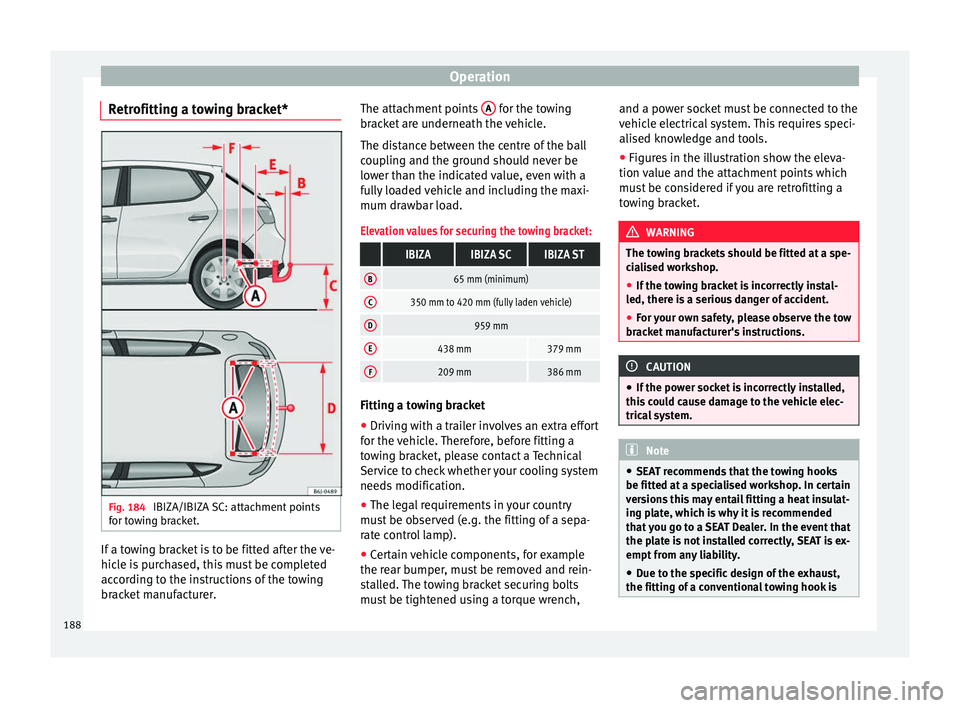
Retrofitting a towing bracket* Fig. 184
IBIZA/IBIZA SC: attachment points
f or t
ow
ing bracket. If a towing bracket is to be fitted after the ve-
hic
l
e i s
purchased, this must be completed
according to the instructions of the towing
bracket manufacturer. The attachment points
A for the towing
br ac
ket
are underneath the vehicle.
The distance between the centre of the ball
coupling and the ground should never be
lower than the indicated value, even with a
fully loaded vehicle and including the maxi-
mum drawbar load.
Elevation values for securing the towing bracket:
IBIZAIBIZA SCIBIZA ST
B65 mm (minimum)
C350 mm to 420 mm (fully laden vehicle)
D959 mm
E438 mm379 mm
F209 mm386 mm Fitting a towing bracket
●
Driving with a trailer involves an extra effort
f or the
vehic
le. Therefore, before fitting a
towing bracket, please contact a Technical
Service to check whether your cooling system
needs modification.
● The legal requirements in your country
must be o
bserved (e.g. the fitting of a sepa-
rate control lamp).
● Certain vehicle components, for example
the rear bumper
, must be removed and rein-
stalled. The towing bracket securing bolts
must be tightened using a torque wrench, and a power socket must be connected to the
vehicle el
ectrical system. This requires speci-
alised knowledge and tools.
● Figures in the illustration show the eleva-
tion value and the attac
hment points which
must be considered if you are retrofitting a
towing bracket. WARNING
The towing brackets should be fitted at a spe-
cia li
sed workshop.
● If the towing bracket is incorrectly instal-
led, there is
a serious danger of accident.
● For your own safety, please observe the tow
bracket
manufacturer's instructions. CAUTION
● If the pow er soc
ket is incorrectly installed,
this could cause damage to the vehicle elec-
trical system. Note
● SEAT r ec
ommends that the towing hooks
be fitted at a specialised workshop. In certain
versions this may entail fitting a heat insulat-
ing plate, which is why it is recommended
that you go to a SEAT Dealer. In the event that
the plate is not installed correctly, SEAT is ex-
empt from any liability.
● Due to the specific design of the exhaust,
the fitting of a con
ventional towing hook is188
Page 201 of 252
Checking and refilling levels
Checking and refilling levels
R ef
uel lin
g
Refuelling Read the additional information carefully
›››
p
age 41
The tank flap is released manually and is lo-
cated at the rear of the vehicle on the right.
The tank holds approximately 45 litres.
Opening the fuel tank cap
– Lift the lid.
– Hold the cap firmly with one hand, then in-
sert the k ey
into the lock and rotate 180° to
the left.
– Unscrew the cap, turning it anticlockwise.
Closin
g the fuel tank cap
– Screw the tank cap to the right until it
“clicks”.
– T
urn the key in the lock, without releasing
the cap, cloc
kwise through 180°.
– Remove the key and close the flap until it
clicks
into place. The tank cap is secured
with an anti-loss attachment
If the automatic filler nozzle is operated cor-
rectly, it will switch itself off as soon as the tank is “full”. Never attempt to fill beyond
this point, as
this will fill the expansion
chamber. Fuel may leak out if ambient condi-
tions are warm.
The correct fuel grade for your vehicle is giv-
en on a sticker on the inside of the fuel tank
flap. WARNING
● Fuel i s
highly flammable and can cause se-
rious burns and other injuries.
–Never smoke or come into contact with
sparks when filling the fuel tank of the
vehicle or a spare fuel canister with fuel.
This is an explosion hazard.
– Follow legal requirements for the use of
spare fuel canisters.
– For safety reasons we do not recommend
carrying a spare fuel canister in the vehi-
cle. The canister could be damaged in an
accident and leak.
● If, in exceptional circumstances, you have
to carry
a spare fuel canister, please observe
the following:
–Never fill the spare fuel canister inside
the vehicle or on it. An electrostatic
charge could build up during filling, caus-
ing the fuel fumes to ignite. This could
cause an explosion. Always place the
canister on the ground to fill it.
– Insert the fuel nozzle into the mouth of
the canister as far as possible. –
If the sp ar
e fuel canister is made of met-
al, the filling nozzle must be in contact
with the canister during filling. This
helps prevent an electrostatic charge
building up.
– Never spill fuel in the vehicle or in the
luggage compartment. Fuel vapours are
explosive. Danger of death. CAUTION
● Fuel s pi
lls should be removed from the
paintwork immediately.
● Never run the tank completely dry. Irregular
fuel sup
ply can cause misfiring. As a result,
unburnt fuel could enter the catalytic convert-
er and cause damage.
● When filling the fuel tank after having run it
complet
ely dry on a vehicle with a diesel en-
gine the ignition must be switched on for at
least 30 seconds before starting the engine.
Subsequently, when you start the engine it
may take longer than normal to start firing
(up to one minute). This is due to the fact that
the fuel system has to purge itself of air be-
fore starting. For the sake of the environment
Do not try to put in more fuel after the auto-
matic fi l
ler nozzle has switched off, this may
cause the fuel to overflow if it becomes warm. 199
Technical data
Advice
Operation
Emergencies
Safety
Page 204 of 252
Advice
are under constant development. SEAT pro-
v ide
s a c
onstant flow of information to Tech-
nical Services concerning modifications. For
this reason, we recommend you have service
fluids and consumables replaced by a Techni-
cal Service. Please observe the relevant in-
structions ››› page 190. The engine compart-
ment of the vehicle is a hazardous area ››› .
WARNING
All work on the engine or in the engine com-
partment, e. g. c
hecking and refilling fluids,
involves the danger of injury and burns, acci-
dents and even fire.
● Never open the bonnet if you see steam,
smoke or cool
ant escaping from the engine
compartment. Otherwise, there is a risk of
sustaining burns. Wait until no more steam or
coolant is emitted, then allow the engine to
cool before carefully opening the bonnet.
● Switch off the engine and remove the key
from the ignition.
● Apply
the handbrake and move the gear
lever to neutr
al or selector lever to position P.
● Keep children away from the vehicle.
● Never touch hot engine parts. There is a
risk of b
urns.
● Never spill liquids on a hot engine or on a
hot exhau
st gas system. This is a fire hazard.
● Avoid causing short-circuits in the electri-
cal sy
stem, particularly at the points where
the jump leads are attached ›››
page 52.
The battery could explode. ●
Never touc h the r
adiator fan. It is tempera-
ture controlled and could start automatically,
even when the engine has been switched off
and the key removed from the ignition!
● Never cover the engine with additional in-
sulatin
g materials such as a blanket. Risk of
fire!
● Do not unscrew the cap on the coolant ex-
pansion t
ank when the engine is hot. If the
coolant is hot, the cooling system will be
pressurised!
● Protect face, hands and arms by covering
the cap with a lar
ge, thick cloth to protect
against escaping coolant and steam.
● Always make sure you have not left any ob-
jects, suc
h as cleaning cloths or tools, in the
engine compartment.
● If you have to work underneath the vehicle,
you must
use suitable stands additionally to
support the vehicle, there is a risk of acci-
dent!. A hydraulic jack is insufficient for se-
curing the vehicle and there is a risk of injury.
● If any work has to be performed when the
engine is s
tarted or with the engine running,
there is an additional, potentially fatal, safety
risk from the rotating parts, such as the drive
belts, alternator, radiator fan, etc., and from
the high-voltage ignition system. You should
also observe the following:
– Never touch the electrical wiring of the
ignition system.
– Ensure that jewellery, loose clothing and
long hair do not get trapped in rotating
engine parts. Danger of death. Before starting any work remove jewellery, tie
back
and c
over hair, and wear tight-fit-
ting clothes.
– Never accelerate with a gear engaged
without taking the necessary precau-
tions. The vehicle could move, even if the
handbrake is applied. Danger of death.
● If work has to be carried out on the fuel
system or on el
ectrical components, you
must observe the following safety notes in
addition to the above warnings:
– Always disconnect the battery from the
on-board network. The vehicle must be
unlocked when this is done, otherwise
the alarm will be triggered.
– Do not smoke.
– Never work near naked flames.
– Always have a fire extinguisher on hand. WARNING
If the bonnet is not correctly closed, it could
sudden ly
open while driving leaving the driv-
er without visibility. This could result in a se-
rious accident.
● After closing the bonnet, always check that
it is pr
operly secured by the locking mecha-
nism in the lock carrier piece. The bonnet
must be flush with the surrounding body pan-
els.
● While driving, if you notice that the bonnet
is not c
orrectly closed then stop immediately
and close it correctly. 202