belt Seat Ibiza ST 2016 Owner's Guide
[x] Cancel search | Manufacturer: SEAT, Model Year: 2016, Model line: Ibiza ST, Model: Seat Ibiza ST 2016Pages: 252, PDF Size: 5.56 MB
Page 70 of 252
Safety
frontal collision the system might not trigger
correctly
or m
ay fail to trigger at all.Airbag activation
The airbags deploy extremely rapidly, within
thousandths
of
a second, to provide addi-
tional protection in the event of an accident.
A fine dust may develop when the airbag de-
ploys. This is normal and it is not an indica-
tion of fire in the vehicle.
The airbag system is only ready to function
when the ignition is on.
In special accidents instances, several air-
bags may activate at the same time.
In the event of minor head-on and side colli-
sions, rear-end collisions, overturning or roll-
over of the vehicle, airbags do not activate.
Activation factors
The conditions that lead to the airbag system
activating in each situation cannot be gener-
alised. Some factors play an important role,
such as the properties of the object the vehi-
cle hits (hard/soft), angle of impact, vehicle
speed, etc.
Deceleration trajectory is key for airbag acti-
vation. The control unit analyses the collision trajec-
tory
and activ
ates the respective restraint
system.
If the deceleration rate is below the prede-
fined reference value in the control unit the
airbags will not be triggered, even though
the accident may cause extensive damage to
the car.
The following airbags are triggered in seri-
ous head-on collisions
● Driver airbag.
● Front passenger front airbag
The follo
wing airbags are triggered in seri-
ous side-on collisions
● Front side airbag on the side of the acci-
dent.
● Rear s
ide airbag on the side of the acci-
dent.
● Curt
ain (head) airbag on the side of the ac-
cident.
In an acc
ident with airbag activation:
● the interior lights switch on (if the interior
light switc
h is in the courtesy light position);
● the hazard warning lights switch on;
● all doors are unlocked;
● the fuel supply to the engine is cut. Airbag control lamp and seat belt ten-
sioner The control lamp monitors all airbags and
seat belt
t
ensioners in the vehicle, including
control units and wiring connections.
Monitoring of airbag and belt tensioner sys-
tem
Both the airbag and belt tensioner systems
operation is constantly monitored electroni-
cally. The control lamp will light up for a
few seconds every time the ignition is switch-
ed on (self-diagnosis).
The system must be checked when the con-
trol lamp :
● does not light up when the ignition is
switc hed on,
● t
urns off after 4 seconds after the ignition
is swit
ched on
● turns off and then lights up again after the
ignition is swit
ched on
● illuminates or flashes while the vehicle is
moving.
In the ev
ent of a malfunction, the warning
lamp remains on continuously. Have the air-
bag system inspected immediately by a spe-
cialised workshop.
68
Page 71 of 252
Airbag system
If any of the airbags are disabled by a Techni-
c al
Ser
vice, the warning lamp flashes for sev-
eral more seconds after verification and will
turn off if there is no fault. WARNING
● If there i s
a malfunction, the airbag and
belt tensioner system cannot properly per-
form its protective function.
● If a malfunction occurs, have the system
checked immedi
ately by a specialised work-
shop. Otherwise, in the event of an accident,
the airbag system and belt tensioners may
not be triggered, or may not be triggered cor-
rectly. Airbag safety instructions
Fr ont
airb ag
sRead the additional information carefully
› ›
›
p
age 14. WARNING
● The seat belt s
and airbags can only provide
maximum protection if the occupants are
seated correctly ››› page 57, Correct position
for passengers.
● The deployment space between the front
passen
gers and the airbags must not in any
case be occupied by other passenger, pets
and objects. ●
The airbags pr
ovide protection for just one
accident; replace them once they have de-
ployed.
● It is also important not to attach any ob-
jects s
uch as cup holders or telephone
mountings to the surfaces covering the air-
bag units.
● Do not attempt to modify components of
the airbag syst
em in any way. Side airbags*
Read the additional information carefully
› ›
›
p
age 15. WARNING
● If y ou do not
wear a seat belt, if you lean
forward, or are not seated correctly while the
vehicle is in motion, you are at a greater risk
of injury if the side airbag system is triggered
in an accident.
● In order for the side airbags to provide their
maximum prot
ection, the prescribed sitting
position must always be maintained with
seat belts fastened while travelling.
● Occupants of the outer seats must never
carry an
y objects or pets in the deployment
space between them and the airbags, or al-
low children or other passengers to travel in
this position. It is also important not to at-
tach any accessories (such as cup holders) to the doors. This would impair the protection
offered b
y
the side airbags.
● The built-in coat hooks should be used only
for lightweight c
lothing. Do not leave any
heavy or sharp-edged objects in the pockets.
● Great forces, such as hard blows or kicks,
must not
be exerted upon the backrest bol-
ster because the system may be damaged. In
this case, the side airbags would not be trig-
gered.
● Under no circumstances should protective
cover
s be fitted over seats with side airbags
unless the covers have been approved for use
in your vehicle. Because the airbag deploys
from the side of the backrest, the use of con-
ventional seat covers would obstruct the side
airbag, seriously reducing the airbag's effec-
tiveness.
● Any damage to the original seat upholstery
or around the seams
of the side airbag units
must be repaired immediately by a special-
ised workshop.
● The airbags provide protection for just one
accident; rep
lace them once they have de-
ployed.
● Any work on the side airbag system or re-
moval
and installation of the airbag compo-
nents for other repairs (such as removal of
the front seat) should only be performed by a
specialised workshop. Otherwise, faults may
occur during the airbag system operation.
● Do not attempt to modify components of
the airbag syst
em in any way. » 69
Technical data
Advice
Operation
Emergencies
Safety
Page 74 of 252
Safety
Transporting children safely Saf ety
for c
hildren
Introduction For safety reasons, as we have learned from
accident
s
tatistics, we recommend that chil-
dren under 12 years of age travel in the rear
seats. Depending on their age, height and
weight, children travelling in rear seats must
use a child seat or a seat belt. For safety rea-
sons, the child seat should be installed in the
rear seat, behind the front passenger seat or
in the centre back seat.
The physical laws involved and the forces
acting in a collision apply also to children
››› page 63. But unlike adults, children do not
have fully developed muscle and bone struc-
tures. This means that children are subject to
a greater risk of injury.
To reduce the risk of injuries, children must
always use special child restraint systems
when travelling in the vehicle.
We recommend the use of child safety prod-
ucts from the SEAT Original Accessories Pro-
gramme, which includes systems for all ages
made by “Peke” (not for all countries).
These systems have been especially de-
signed and approved, complying with the
ECE-R44. regulation. Follow the manufacturer's instructions and
obser
v
e any statutory requirements when in-
stalling and using child seats. Always read
and note ››› page 72.
We recommend you always carry the manu-
facturer's Child Seat Instruction Manual to-
gether with the on-board documentation.
Important information regarding the
front pa
ssenger's airbag Read the additional information carefully
› ›
›
p
age 16.
Read and always observe the safety informa-
tion included in the following chapters:
● Safety distance with respect to the passen-
ger airbag ››
› page 66.
● Objects between the passenger and the
passen
ger side airbag ››› in Front airbags
on p ag
e 69 .
The p
assenger side front airbag, when ena-
bled, is a serious risk for a child that is facing
backward since the airbag can strike the seat
with such force that it can cause serious or
fatal injuries. Children up to 12 years old
should always travel on the rear seat.
Therefore we strongly recommend you to
transport children on the rear seats. This is
the safest location in the vehicle. Alternative-
ly, the front passenger airbag can be disa- bled with a key-operated switch
››› p
age 70.
When transporting children, use a child seat
appropriate to the age and size of each child. WARNING
● If a chi l
d seat is secured to the front pas-
senger seat, the risk to the child of sustain-
ing critical or fatal injuries in the event of an
accident increases.
● An inflating front passenger airbag can
strike the re
ar-facing child seat and project it
with great force against the door, the roof or
the backrest.
● Never install a child seat facing backwards
on the front pa
ssenger seat unless the front
passenger front airbag has been disabled.
Risk of potentially fatal injuries to the child!
However, if it is necessary, in exceptional ca-
ses, to transport a child in the front passen-
ger seat, the front passenger front airbag
must always be disabled ››› page 70, Deacti-
vation of front passenger front airbag*. If the
front passenger seat has a height adjustment
option, move it to the highest position.
● For those vehicles that do not include a key
lock swit
ch to deactivate the airbag, the vehi-
cle must be taken to a technical service.
● All vehicle occupants, especially children,
must a
ssume the proper sitting position and
be properly belted in while travelling.
● Never hold children or babies on your lap,
this can r
esult in potentially fatal injuries to
the child! 72
Page 75 of 252
Transporting children safely
●
Never al lo
w a child to be transported in a
vehicle without being properly secured, or to
stand up or kneel on a seat while travelling.
In an accident, the child could be flung
through the vehicle, causing possibly fatal in-
juries to themselves and to the other vehicle
occupants.
● If children assume an improper sitting posi-
tion when the vehicl
e is moving, they expose
themselves to greater risk of injury in the
event of a sudden braking manoeuvre or in an
accident. This is particularly important if the
child is travelling on the front passenger seat
and the airbag system is triggered in an acci-
dent; as this could cause serious injury or
even death.
● A suitable child seat can protect your child!
● Never leave a child alone in the child seat
or inside the v
ehicle because depending on
the season, very high temperatures may be
reached inside a parked vehicle, which could
be fatal.
● Children who are less than 1.5 metres tall
must not
wear a normal seat belt without a
child seat, as this could cause injuries to the
abdominal and neck areas during a sudden
braking manoeuvre or in an accident.
● Do not allow the seat belt to become twis-
ted and the seat belt
should be properly in
place ››› page 61.
● Only one child may occupy a child seat
››› p
age 73, Child seats. ●
When a chil d se
at is mounted in the rear
seats, the door child-proof lock should be ac-
tivated ››› page 110. Child seats
Safety in s
tructions Read the additional information carefully
›››
p
age 16. WARNING
When travelling, children must be secured in
the vehic l
e with a restraint system suitable
for age, weight and size.
● Read and always observe information and
warnings
concerning the use of child seats
››› page 72. WARNING
The retaining rings are designed only for use
with “ISOFIX” and Top T
ether* system child
seats.
● Never secure other child seats that do not
have the “ISOFIX” or Top
Tether* system, or
retaining belts or objects to the fastening
rings - this can result in potentially fatal inju-
ries to the child.
● Ensure that the child seat is secured cor-
rectly us
ing the “ISOFIX” and Top Tether* se-
curing rings. WARNING
An undue installation of the safety seat will
incre a
se the risk of injury in the event of a
crash.
● Never tie the retainer strap to a hook in the
luggage c
ompartment.
● Never secure or tie luggage or other items
to the lower anc
horages (ISOFIX) or the upper
ones (Top Tether). Categorisation of child seats into
gr
oup
s Only use child seats that are officially ap-
pr
o
ved and s
uitable for the child.
Child seats are subject to the regulation ECE-
R 44. ECE-R stands for: Economic Commis-
sion for Europe Regulation.
The child seats are grouped into 5 catego-
ries:
Group 0: Up to 10 kg (up to around 9
months)
Group 0+: Up to 13 kg (up to around 18
months)
Group 1: from 9 to 18 kg (up to approx. 4
years old)
Group 2: from 15 to 25 kg (up to approx. 7
years old) »
73
Technical data
Advice
Operation
Emergencies
Safety
Page 130 of 252
Operation
●
If pos s
ible, use the rear vision mirror to es-
timate distances to vehicles behind you.
● Make sure that you do not get your finger
trapped between the mirr
or and the mirror
base when folding back the mirrors. Risk of
injury! For the sake of the environment
The exterior mirror heating should be switch-
ed off when it i s
no longer needed. Other-
wise, it is an unnecessary fuel waste. Note
● If the electric a
l adjustment ever fails to op-
erate, the mirrors can be adjusted by hand by
lightly pressing the edge of the mirror glass.
● In vehicles with electric exterior mirrors,
the follo
wing points should be observed: if,
due to an external force (e.g. being knocked
while manoeuvring), the adjustment of the
mirror housing is altered, the mirror will have
to be fully folded electrically. Do not readjust
the rear vision mirror housing by hand, as
this will interfere with the mirror adjuster
function.
● The rear vision mirrors can be adjusted sep-
arately or s
imultaneously, as described
above.
● The fold-in function on the exterior mirrors
will
not activate at speeds over 40 km/h
(25 mph). Seats and head restraints
Adju
s
tin g the se
at and head re-
straints
Adjusting the front seats Read the additional information carefully
›››
p
age 12 WARNING
The safe driving chapter contains important
information, tip s, s
uggestions and warnings
that you should read and observe for your
own safety and the safety of your passengers
››› page 56. WARNING
● Never adju s
t the driver or front passenger
seat while the vehicle is in motion. While ad-
justing your seat, you will assume an incor-
rect sitting position. Risk of accidents. Adjust
the driver or front passenger seat only when
the vehicle is stationary.
● To reduce the risk of injury to the driver and
front pa
ssenger in case of a sudden braking
or an accident, never drive with the backrest
tilted towards the rear. The maximum protec-
tion of the seat belt can be achieved only
when the backrests are in an upright position
and the driver and front passenger have prop-
erly adjusted their seat belts. The further the backrests are tilted to the rear, the greater
the risk of
injur
y due to improper positioning
of the belt web!
● Exercise caution when securing the seat
height into for
wards/backwards position. In-
juries can be caused if the seat height is ad-
justed without due care and attention.
● To move the seat forwards and backwards,
pull
upwards and not sideways on the lever,
as the force exerted on it in that direction
could damage it. Folding and lifting the backrest of the
fr
ont
seat
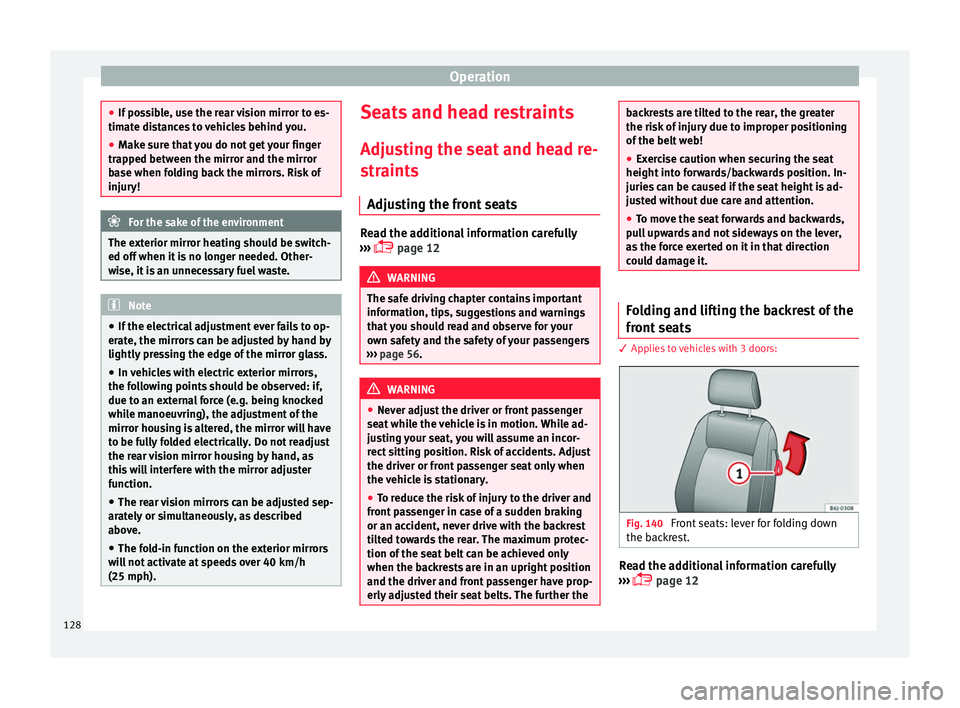
s 3 Applies to vehicles with 3 doors:
Fig. 140
Front seats: lever for folding down
the b ac
kr
est. Read the additional information carefully
› ›
›
p
age 12
128
Page 133 of 252
Transport and practical equipment
– Lif t
the c u
shion 2 forwards in the direc-
tion of the arr
ow
.
– Pull the release button ››› Fig. 144 in the di-
r
ection of the arrow and fold the backrest
forwards.
– Insert the head restraints in the spaces on
the rear of the se
at cushion which are visi-
ble when the seat cushion is lowered.
Folding seat forward
– Remove the head restraints from the
space
s in the seat cushion.
– Lift the backrest, and before securing it, re-
place the he
ad restraints in the seat cush-
ion, and then click the seat correctly onto
the locking rails.
– Once the backrest is locked, pull on the
central se
at belt or directly on the backrest
to check that the backrest has properly en-
gaged in position.
– Check that the position lever is in neutral
position.
– Lo
wer the cushion and push it backwards
below the seat belt
buckles.
– Press the front part of the cushion down-
wards.
On s
plit rear seats*, the backrest and cush-
ion can be lowered and raised respectively in
two sections. WARNING
● Plea se be c
areful when folding back the
backrest! Injuries can be caused if the seat
height is adjusted without due care and at-
tention.
● Do no trap or damage seat belts when rais-
ing the back
rest.
● After raising the backrest, check it has en-
gaged properly
in position. Do this by pulling
on the central seat belt or directly on the
backrest and check that the position lever is
in the neutral position.
● The three point automatic seat belt only
works c
orrectly when the backrest of the cen-
tral seat is correctly engaged. Transport and practical
equipment
Pr actic
al
equipment
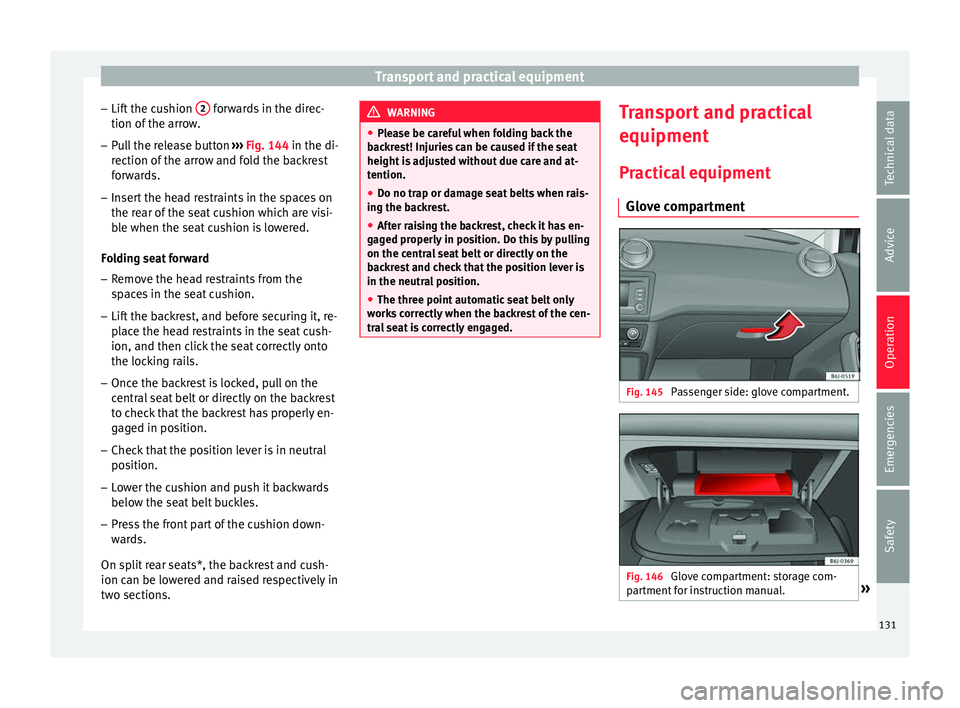
Glove compartment Fig. 145
Passenger side: glove compartment. Fig. 146
Glove compartment: storage com-
p ar tment
f
or instruction manual. » 131
Technical data
Advice
Operation
Emergencies
Safety
Page 165 of 252
Driving
press the brake pedal to change the selector
l ev
er fr om po
sition N to position D.
S - Standard driving position (Sport pro-
gramme)
When the selector lever is in position S, it will
automatically change up into a higher gear
later, and change down into a low gear, if
compared with position D. This way, it is pos-
sible to take full advantage of the engine re-
serve power, depending on the engine de-
mand, driving style and speed. The braking
effect of the engine when driving downhill is
very limited. On the instrument panel display
the selected gear is shown as well as the se-
lector lever to position S.
To select gear range S, press the lock button
on the selector lever. WARNING
● As a driver ,
you should never leave your ve-
hicle if the engine is running and a gear range
is engaged. If you have to leave your vehicle
while the engine is running, you must apply
the parking brake and put the selector lever
in position P.
● If the engine is running and if D or R is en-
gaged, y
ou will need to hold the car on the
foot brake. The car will creep forward as the
power transmission is not fully interrupted
even when the engine is idling.
● Never accelerate when moving the selector
lever or y
ou may cause an accident. ●
Never mov e the sel
ector lever to R or P
when driving. Risk of accident!
● Before driving down a long, steep slope, it
is adv
isable to reduce speed and change into
a lower gear.
● If you stop the vehicle up hill, always hold
the foot brak
e strongly depressed down to
stop it from rolling back.
● Never allow the brake to rub and do not use
the brake peda
l too often or for long periods.
Constant braking will cause the brakes to
overheat and will considerably reduce the
brake effect. This increases the braking dis-
tance and could cause the brake system to
fail.
● Never allow the car to roll down a gradient
with the gear in neutr
al N, or in selector lever
position D, even if the engine is not running.
● If the vehicle moves with no control, an ac-
cident and serious
injury may occur. WARNING
Never switch the engine off until the vehicle
is s t
ationary. You could lose control of your
vehicle. This could cause an accident and se-
rious injury.
● The airbags and belt tensioners do not
work when the ignition is
switched off.
● The brake servo does not work with the en-
gine off. You need mor
e force to stop the vehi-
cle. ●
Pow er s
teering does not work when the en-
gine is not running. That is why it is much
more difficult to turn the steering wheel.
● Never remove the key from the ignition if
the vehicl
e is in motion. The steering lock
could suddenly engage, and you would not be
able to steer the vehicle. CAUTION
If you allow the vehicle to move when the en-
gine i s swit
ched off or with the selector lever
in position “N”, take your foot off the acceler-
ator and wait until the engine starts idling
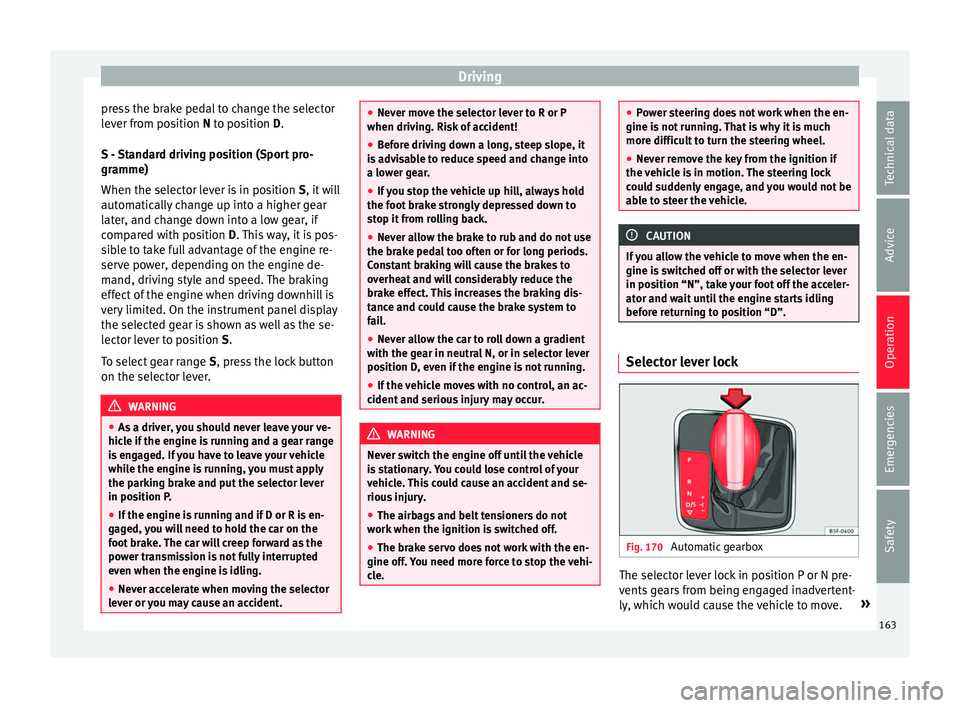
before returning to position “D”. Selector lever lock
Fig. 170
Automatic gearbox The selector lever lock in position P or N pre-
v
ents
ge
ars from being engaged inadvertent-
ly, which would cause the vehicle to move. »
163
Technical data
Advice
Operation
Emergencies
Safety
Page 175 of 252
Driver assistance systems
Start-Stop function conditions
● The driver seat belt must be buckled.
● The bonnet must be closed.
● The engine must be at operating tempera-
t ur
e.
● The s t
eering wheel must be straight.
● The vehicle must be on flat ground.
● The vehicle must not be in reverse.
● A trailer must not be connected.
● The temperature of the interior must be
within the comfor
t limits (A/C button should
be sel ect
ed).
● The w ind
screen de-mist function must be
off.
● If in an incr
ease in airflow is not request
ed.
● The temperature must not be set to HI or
LO .
● The driver door must be closed.
● The diesel particulate filter must not be in
regener
ation mode, for diesel engines.
● The battery charge must not be low for the
next st
art.
● Battery temperature must be between -1 °C
(+30 °F) and +55 °C (+131 °F).
Star
t-Stop function interruption
In the following situations, the Start-Stop
function will be interrupted and the engine
will automatically start: ●
The vehicl
e starts moving.
● The brake pedal is pressed several times in
a row.
● The b
attery has been discharged excessive-
ly.
● The Star
t-Stop System is manually deacti-
vated.
● The wind
screen de-mist function is turned
on.
● The temperature of the interior exceeds the
comfort
limits ( A/C button).
● If the airflow is increased by more than 3
pr e
sse
s.
● Temperature setting HI or LO is select
ed.
● The engine coolant temperature is insuffi-
cient.
● The altern
ator is faulty, for example the V-
belt has
ruptured.
● If any of the conditions described in the
previous
section are not fulfilled.
When the engine is turned off by the Start-
Stop function, this is displayed on the instru-
ment panel.
If the Start-Stop system is not switched on,
the warning lamp will appear on the instru-
ment panel. WARNING
Never allow the vehicle to move with the en-
gine off for an y
reason. You could lose control
of your vehicle. This could cause an accident
and serious injury.
● The brake servo does not work with the en-
gine off. You need mor
e force to stop the vehi-
cle.
● Power steering does not work when the en-
gine is not ru
nning. That is why it is much
more difficult to turn the steering wheel.
● Turn off the Start-Stop system when driving
through water (f
ording streams, etc.). Note
● For v ehic
les with the Start-Stop function
and a manual gearbox, when the engine is
started, the clutch must be pressed.
● When the conditions for the Start-Stop
function are not
fulfilled, the instrument pan-
el displays the Start-Stop indicator dimmed.
● If the steering wheel is turned more than
270°, it wil
l not be possible to start the vehi-
cle again. To start the vehicle, straighten the
steering wheel so that it is turned less than
270°.
● There are different versions of the dash
panel; the disp
lay of indications on the
screen may differ. 173
Technical data
Advice
Operation
Emergencies
Safety
Page 177 of 252
Driver assistance systems
making a calculation of tiredness. This is
c on
st
antly compared with the current driving
behaviour. If the system detects that the driv-
er is tired, an audible warning is given with a
sound and an optic warning is shown with a
symbol and complementary message on the
instrument panel display ››› Fig. 175. The
message on the instrument panel display is
shown for approximately 5 seconds, and de-
pending on the case, is repeated. The system
stores the last message displayed.
The message on the instrument panel display
can be switched off by pressing the button on the windscreen wiper lever or the
b
utt
on on the multi function steering
wheel
›
››
page 25.
The message can be recalled to the instru-
ment panel display using the multifunction
display ›››
page 25.
Conditions of operation
Driving behaviour is only calculated on
speeds above about 65 km/h (40 mph) up to
around 200 km/h (125 mph).
Switching on and off
Fatigue detection can be activated or deacti-
vated in the Easy Connect system with the
button and the function button
›››
page 101. A mark indicates that the ad-
ju s
tment has been activated. System limitations
The Fatigue detection h
a
s certain limitations
inherent to the system. The following condi-
tions can limit the Fatigue detection or pre-
vent it from functioning.
● At speeds below 65 km/h (40 mph)
● At speeds above 200 km/h (125 mph)
● When cornering
● On roads in poor condition
● In unfavourable weather conditions
● When a sporty driving style is employed
● In the event of a serious distraction to the
driver
Fatigue detection w
ill be restored when the
vehicle is stopped for more than 15 minutes,
when the ignition is switched off or when the
driver has unbuckled their seat belt and
opened the door.
In the event of slow driving during a long pe-
riod of time (below 65 km/h, 40 mph) the
system automatically re-establishes the tired-
ness calculation. When driving at a faster
speed the driving behaviour will be recalcula-
ted. Parking aid
General inf
ormation Various systems are available to help you
when parkin
g or m
anoeuvring in tight
spaces, depending on the equipment fitted
on your vehicle.
The rear parking aid is an audible assistant
that warns about obstacles located behind
the vehicle ››› page 176.
During parking, Parking System Plus assists
the driver by visually and audibly warning
them about obstacles detected in front and
behind the vehicle ››› page 177. WARNING
● Alwa y
s pay attention, also when looking
straight ahead, to traffic and the vehicle sur-
roundings. The assistance systems are not a
replacement for driver awareness. When in-
serting or removing the vehicle from a park-
ing space, or when performing similar ma-
noeuvres the driver always assumes the re-
sponsibility.
● Adapt your speed and driving style at all
times to s
uit visibility, weather, road and traf-
fic conditions.
● The ultrasound sensors have blind spots in
which obs
tacles and people are not regis-
tered. Pay special attention to children and
animals. » 175
Technical data
Advice
Operation
Emergencies
Safety
Page 200 of 252
Advice
– Do not l
et the w
ater soak through the leath-
er or soak into the seams.
– Then wipe off with a soft, dry cloth.
Leather maint
enance
– The leather should be treated twice a year
with a speci
al leather-care product, availa-
ble at Technical Services.
– Apply these products very sparingly.
– Then wipe off with a soft cloth.
SEAT does
everything possible to preserve
the genuine qualities of this natural product.
Due to the natural properties of the specially
selected hides employed, the finished leath-
er has a certain sensitivity to grease and dirt,
etc. so a degree of care is required in every-
day use and when looking after the leather.
Dust and grit in the pores and seams can
scratch and damage the surface. If the vehi-
cle is under solar radiation for long periods,
the leather should be protected to prevent it
from fading. However, slight colour variations
in high-quality natural leather are normal. CAUTION
● Do not use so lv
ents, wax polish, shoe
cream, spot removers or similar products on
leather.
● To avoid damage, stubborn stains should
be removed b
y a specialised workshop. Seat belt cleaning
A dirty belt may not work properly. Check all
seat belts
r
egularly and keep them clean.
Seat belts cleaning
– Pull the dirty seat belt right out and unroll
it.
– Cle
an dirty seat belts with a gentle soap
so
lution.
– Allow it to dry.
– Do not roll the seat belt up until it is dry.
If lar g
e stains form on the belts, the automat-
ic belt retractor will not work correctly. WARNING
● Do not use c hemic
al cleaning agents on the
seat belts, as this can impair the strength of
the webbing. Ensure that seat belts do not
come into contact with corrosive fluids.
● Check the condition of the seat belts at reg-
ular inter
vals. If you notice that the belt web-
bing, fittings, retractor mechanism or buckle
of any of the belts is damaged, the belt must
be replaced by a specialised workshop.
● Do not attempt to repair a damaged seat
belt your
self. The seat belts must not be re-
moved or modified in any way. CAUTION
After cleaning, allow seat belts to dry com-
plet ely
before rolling them up. Otherwise, the
belt retractors could become damaged. 198