seats SEAT IBIZA ST 2017 Owner's Manual
[x] Cancel search | Manufacturer: SEAT, Model Year: 2017, Model line: IBIZA ST, Model: SEAT IBIZA ST 2017Pages: 248, PDF Size: 5.24 MB
Page 74 of 248
Safety
Transporting children safely Saf ety
f
or children
Introduction For safety reasons, as we have learned from
acc
ident
statistics, we recommend that chil-
dren under 12 years of age travel in the rear
seats. Depending on their age, height and
weight, children travelling in rear seats must
use a child seat or a seat belt. For safety rea-
sons, the child seat should be installed in the
rear seat, behind the front passenger seat or
in the centre back seat.
The physical laws involved and the forces
acting in a collision apply also to children
››› page 63. But unlike adults, children do not
have fully developed muscle and bone struc-
tures. This means that children are subject to
a greater risk of injury.
To reduce the risk of injuries, children must
always use special child restraint systems
when travelling in the vehicle.
We recommend the use of child safety prod-
ucts from the SEAT Original Accessories Pro-
gramme, which includes systems for all ages
made by “Peke” (not for all countries).
These systems have been especially de-
signed and approved, complying with the
ECE-R44. regulation. Follow the manufacturer's instructions and
ob
ser
ve any statutory requirements when in-
stalling and using child seats. Always read
and note ››› page 72.
We recommend you always carry the manu-
facturer's Child Seat Instruction Manual to-
gether with the on-board documentation.
Important information regarding the
front p
assenger's airbag Read the additional information carefully
› ›
›
page 16.
Read and always observe the safety informa-
tion included in the following chapters:
● Safety distance with respect to the passen-
ger airbag ›
›› page 66.
● Objects between the passenger and the
pas
senger side airbag ››› in Front airbags
on p ag
e 69
.
The passenger side front airbag, when ena-
bled, is a serious risk for a child that is facing
backward since the airbag can strike the seat
with such force that it can cause serious or
fatal injuries. Children up to 12 years old
should always travel on the rear seat.
Therefore we strongly recommend you to
transport children on the rear seats. This is
the safest location in the vehicle. Alternative-
ly, the front passenger airbag can be disa- bled with a key-operated switch
›››
page 70.
When transporting children, use a child seat
appropriate to the age and size of each child. WARNING
● If a c hi
ld seat is secured to the front pas-
senger seat, the risk to the child of sustain-
ing critical or fatal injuries in the event of an
accident increases.
● An inflating front passenger airbag can
strike the r
ear-facing child seat and project it
with great force against the door, the roof or
the backrest.
● Never install a child seat facing backwards
on the front p
assenger seat unless the front
passenger front airbag has been disabled.
Risk of potentially fatal injuries to the child!
However, if it is necessary, in exceptional ca-
ses, to transport a child in the front passen-
ger seat, the front passenger front airbag
must always be disabled ››› page 70, Deacti-
vation of front passenger front airbag*. If the
front passenger seat has a height adjustment
option, move it to the highest position.
● For those vehicles that do not include a key
lock sw
itch to deactivate the airbag, the vehi-
cle must be taken to a technical service.
● All vehicle occupants, especially children,
must
assume the proper sitting position and
be properly belted in while travelling.
● Never hold children or babies on your lap,
this c
an result in potentially fatal injuries to
the child! 72
Page 75 of 248
Transporting children safely
●
Never a l
low a child to be transported in a
vehicle without being properly secured, or to
stand up or kneel on a seat while travelling.
In an accident, the child could be flung
through the vehicle, causing possibly fatal in-
juries to themselves and to the other vehicle
occupants.
● If children assume an improper sitting posi-
tion when the vehic
le is moving, they expose
themselves to greater risk of injury in the
event of a sudden braking manoeuvre or in an
accident. This is particularly important if the
child is travelling on the front passenger seat
and the airbag system is triggered in an acci-
dent; as this could cause serious injury or
even death.
● A suitable child seat can protect your child!
● Never leave a child alone in the child seat
or inside the
vehicle because depending on
the season, very high temperatures may be
reached inside a parked vehicle, which could
be fatal.
● Children who are less than 1.5 metres tall
must
not wear a normal seat belt without a
child seat, as this could cause injuries to the
abdominal and neck areas during a sudden
braking manoeuvre or in an accident.
● Do not allow the seat belt to become twis-
ted and the seat
belt should be properly in
place ››› page 61.
● Only one child may occupy a child seat
›››
page 73, Child seats. ●
When a chi l
d seat is mounted in the rear
seats, the door child-proof lock should be ac-
tivated ››› page 109. Child seats
Safety in
structions Read the additional information carefully
›› ›
page 16. WARNING
When travelling, children must be secured in
the v ehic
le with a restraint system suitable
for age, weight and size.
● Read and always observe information and
warning
s concerning the use of child seats
››› page 72. WARNING
The retaining rings are designed only for use
with “ISOFIX” and T op
Tether* system child
seats.
● Never secure other child seats that do not
have the “ISOFIX” or T
op Tether* system, or
retaining belts or objects to the fastening
rings - this can result in potentially fatal inju-
ries to the child.
● Ensure that the child seat is secured cor-
rectly u
sing the “ISOFIX” and Top Tether* se-
curing rings. WARNING
An undue installation of the safety seat will
incr e
ase the risk of injury in the event of a
crash.
● Never tie the retainer strap to a hook in the
luggag
e compartment.
● Never secure or tie luggage or other items
to the low
er anchorages (ISOFIX) or the upper
ones (Top Tether). Categorisation of child seats into
gr
oup
s Only use child seats that are officially ap-
pr
o
v
ed and suitable for the child.
Child seats are subject to the regulation ECE-
R 44. ECE-R stands for: Economic Commis-
sion for Europe Regulation.
The child seats are grouped into 5 catego-
ries:
Group 0: Up to 10 kg (up to around 9
months)
Group 0+: Up to 13 kg (up to around 18
months)
Group 1: from 9 to 18 kg (up to approx. 4
years old)
Group 2: from 15 to 25 kg (up to approx. 7
years old) »
73
Technical data
Advice
Operation
Emergencies
Safety
Page 76 of 248
Safety
Group 3: Fr om 22 to 36 kg (over around 7
y e
ars old)
Child seats that have been tested and ap-
proved under the ECE R44 standard bear the
test mark on the seat (the letter E in a circle
with the test number below it).
Follow the manufacturer's instructions and
observe any statutory requirements when in-
stalling and using child seats.
We recommend you to always include the
manufacturer's Child Seat Instruction Manual
together with the on-board documentation.
SEAT recommends you use child seats from
the Original Accessories Catalogue . These
child seats have been designed and tested
for use in SEAT vehicles. You can find the
right child seat for your model and age group
at SEAT dealers. WARNING
Read and always observe information and
warnin g
s concerning the use of child seats
››› page 72.74
Page 84 of 248
EmergenciesNo.Consumer/Amps
27Rear window wiper motor15
28Lighter20
29Airbag control unit, airbag deactiva-
tion warning lamp10
30
Reverse, Mirror joysticks, RKA, switch-
ing on heated seats, int. pressure A.C,
heating A.C. controls (supply), electro-
chromic mirror, PDC control, switching
on front and rear fog lights (rotating
lights).
7.5
31Petrol gauge5
32
AFS headlights, headlight regulator
(signal and adjustment), LWR Cent, di-
agnostics, front headlight lever
(switch on), Dimmer (headlight adjust-
ment)
7.5
33Start-Stop relay, clutch sensor5
34Heated jets5
35Soundaktor control feed, GRA feed,
Kühlerlüfter central feed5
36Heated seats10
37Additional diagnostics10
38Right hand lights A/66 feed40
39ABS Pump (rear battery)40
41Heated rear window30
42Passenger side window controls30
No.Consumer/Amps
43Rear right window control30
44Reversing camera10
45Windscreen wiper feed lever, diagnos-
tics10
47ABS Ventil (rear battery)25
49
EKP TDI relay (fuel pump feed)30
EKP MPI relay (fuel pump feed)20
TFSI pump gauge control15
50Multimedia Radio (power supply)20
51Heated mirrors10
53Rain sensor5
5430 ZAS (ignition switch)5
55Heated seats10
Fuse arrangement in engine compart-
ment
Read the additional information carefully
› ›
›
page 44
Only replace fuses with a fuse of the same
amperage (same colour and markings) and
size.
No.Consumer/Amps
1Fan, condenser40
TK8 fan, condenser50
2Glow plugs50
3ABS Pump40
EMBOX2-13 (TA8)20
4PTC glow phase 240
5PTC glow phase 340
6BDM, 30 ReF5
7MSG (KL30)7.5
8Windscreen wipers30
9Automatic gear box control, AQ 160
Control box30
10ABS Ventil25
EMBOX2-11 (TA8)5
11Vacuum pump motor20
12
Injectors
10TDI fuel metering adjuster, TA8 ex-
haust temperature sensor
13Servo sensor5
14Coolant pump high/low temperature,
gauge (relay EKP)10
1550 controls motor diag5 82
Page 129 of 248
Seats and head restraints
Seats and head restraints
Adju s
tin
g the seat and head re-
straints
Adjusting the front seats Read the additional information carefully
›› ›
page 12 WARNING
The safe driving chapter contains important
inform ation, tip
s, suggestions and warnings
that you should read and observe for your
own safety and the safety of your passengers
››› page 56. WARNING
● Never a dju
st the driver or front passenger
seat while the vehicle is in motion. While ad-
justing your seat, you will assume an incor-
rect sitting position. Risk of accidents. Adjust
the driver or front passenger seat only when
the vehicle is stationary.
● To reduce the risk of injury to the driver and
front p
assenger in case of a sudden braking
or an accident, never drive with the backrest
tilted towards the rear. The maximum protec-
tion of the seat belt can be achieved only
when the backrests are in an upright position
and the driver and front passenger have prop-
erly adjusted their seat belts. The further the backrests are tilted to the rear, the greater
the risk
of
injury due to improper positioning
of the belt web!
● Exercise caution when securing the seat
height into f
orwards/backwards position. In-
juries can be caused if the seat height is ad-
justed without due care and attention.
● To move the seat forwards and backwards,
pul
l upwards and not sideways on the lever,
as the force exerted on it in that direction
could damage it. Folding and lifting the backrest of the
fr
ont
se
ats 3 App
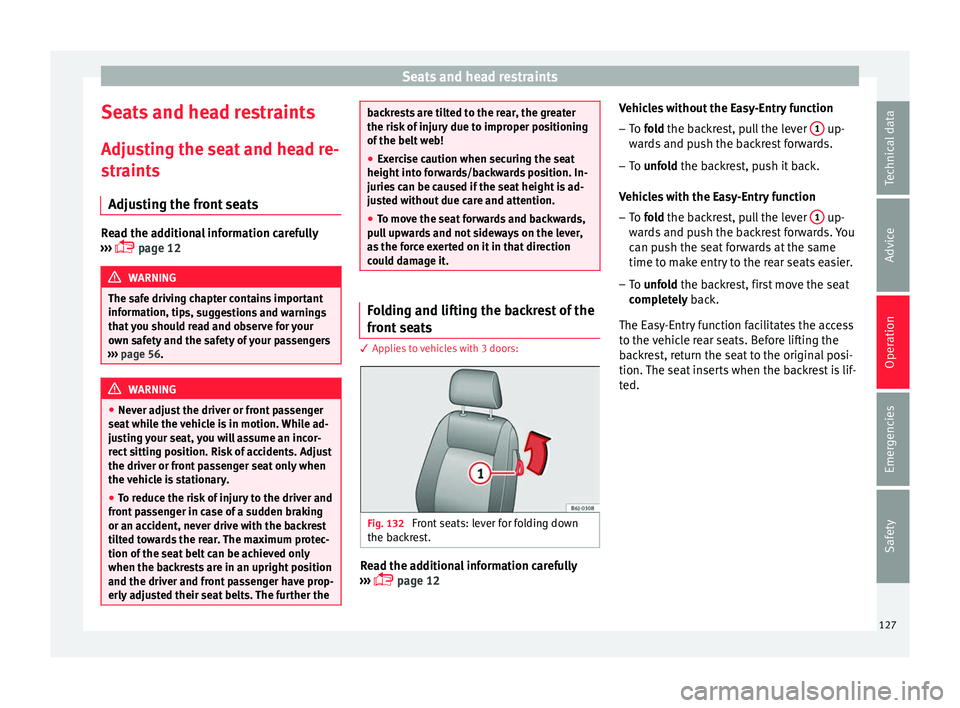
lies to vehicles with 3 doors: Fig. 132
Front seats: lever for folding down
the b ac
k
rest. Read the additional information carefully
› ›
›
page 12 Vehicles without the Easy-Entry function
– To fold the backrest, pull the lever 1 up-
w ar
d
s and push the backrest forwards.
– To unfold the backrest, push it back.
Vehic
les with the Easy-Entry function
– To fold the backrest, pull the lever 1 up-
w ar
d
s and push the backrest forwards. You
can push the seat forwards at the same
time to make entry to the rear seats easier.
– To unfold the backrest, first move the seat
comp
letely back.
The Easy-Entry function facilitates the access
to the vehicle rear seats. Before lifting the
backrest, return the seat to the original posi-
tion. The seat inserts when the backrest is lif-
ted.
127
Technical data
Advice
Operation
Emergencies
Safety
Page 130 of 248
Operation
Adjusting or disassembling the head
r e
s
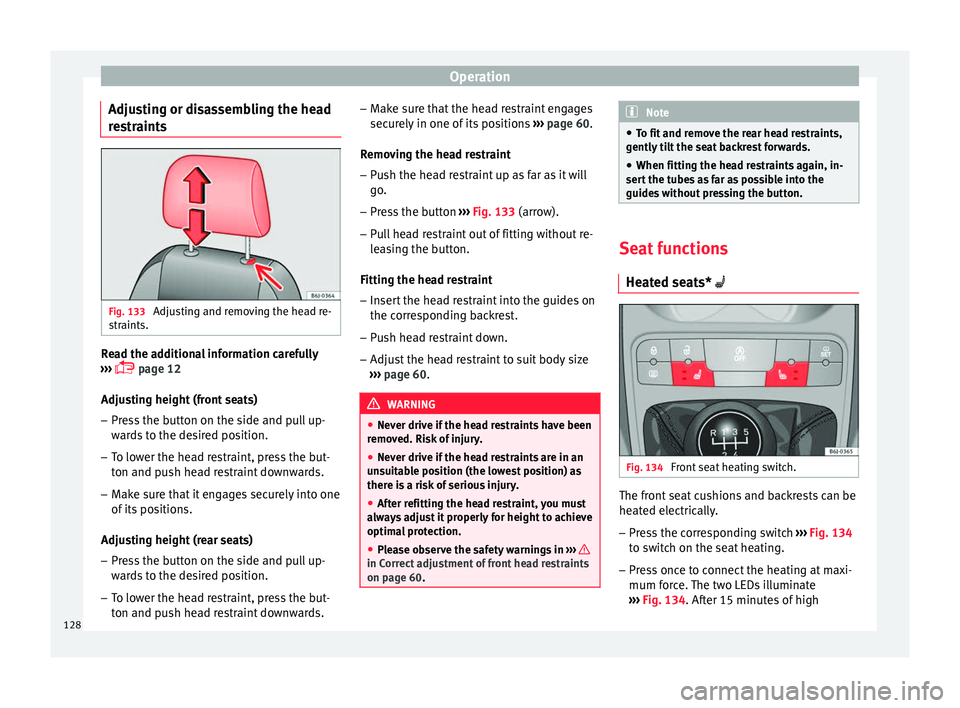
traints Fig. 133
Adjusting and removing the head re-
s tr
aints. Read the additional information carefully
› ›
›
page 12
Adjusting height (front seats)
– Press the button on the side and pull up-
ward
s to the desired position.
– To lower the head restraint, press the but-
ton and pu
sh head restraint downwards.
– Make sure that it engages securely into one
of its po
sitions.
Adjusting height (rear seats)
– Press the button on the side and pull up-
ward
s to the desired position.
– To lower the head restraint, press the but-
ton and pu
sh head restraint downwards. –
Make s
ure that the head restraint engages
securely in one of its positions ››› page 60.
Removing the head restraint – Push the head restraint up as far as it will
go.
– Pr
ess the button ›››
Fig. 133 (arrow).
– Pull head restraint out of fitting without re-
lea
sing the button.
Fitting the head restraint
– Insert the head restraint into the guides on
the corre
sponding backrest.
– Push head restraint down.
– Adjust the head restraint to suit body size
›››
page 60. WARNING
● Never driv e if
the head restraints have been
removed. Risk of injury.
● Never drive if the head restraints are in an
uns
uitable position (the lowest position) as
there is a risk of serious injury.
● After refitting the head restraint, you must
alwa
ys adjust it properly for height to achieve
optimal protection.
● Please observe the safety warnings in ›››
in Correct adjustment of front head restraints
on pag
e 60
. Note
● To fit and r
emove the rear head restraints,
gently tilt the seat backrest forwards.
● When fitting the head restraints again, in-
sert the t
ubes as far as possible into the
guides without pressing the button. Seat functions
Heat ed se
ats* Fig. 134
Front seat heating switch. The front seat cushions and backrests can be
he
at
ed el
ectrically.
– Press the corresponding switch ›››
Fig. 134
to switch on the seat heating.
– Press once to connect the heating at maxi-
mum forc
e. The two LEDs illuminate
››› Fig. 134. After 15 minutes of high
128
Page 131 of 248
Seats and head restraints
intensity, the upper LED goes out, the sys-
t em i
s
deactivated for 2 minutes and is
then reactivated at low intensity (the lower
LED remains on permanently).
– Press the switch again to set the heating to
minimum forc
e. (The lower LED lights up).
– To disconnect the heating, press the switch
again. CAUTION
To avoid damaging the heating elements,
pl e
ase do not kneel on the seat or apply
sharp pressure at a single point to the seat
cushion and backrest. Note
The seats are only heated electrically when
the engine i s
running. Folding down the back seat
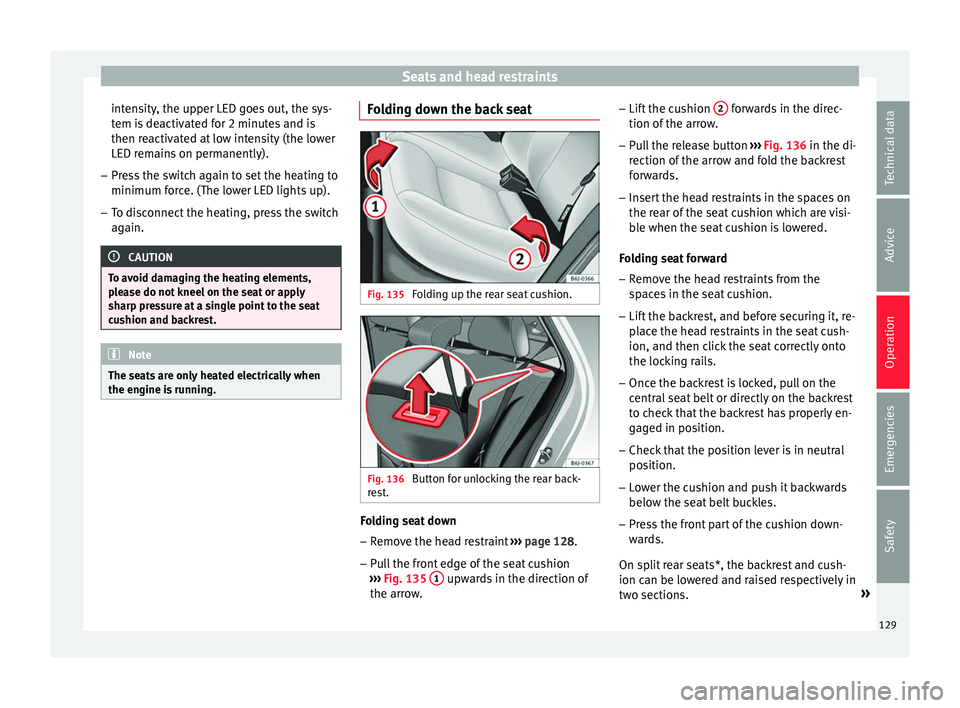
Fig. 135
Folding up the rear seat cushion. Fig. 136
Button for unlocking the rear back-
r e
s
t. Folding seat down
– Remove the head restraint ››
›
page 128.
– Pull the front edge of the seat cushion
›››
Fig. 135 1 upwards in the direction of
the arr o
w
. –
Lift the c
ushion 2 forwards in the direc-
tion of the arr
o
w.
– Pull the release button ›››
Fig. 136 in the di-
rection of the arrow and fold the backrest forwards.
– Insert the head restraints in the spaces on
the rear of
the seat cushion which are visi-
ble when the seat cushion is lowered.
Folding seat forward
– Remove the head restraints from the
spac
es in the seat cushion.
– Lift the backrest, and before securing it, re-
plac
e the head restraints in the seat cush-
ion, and then click the seat correctly onto
the locking rails.
– Once the backrest is locked, pull on the
central
seat belt or directly on the backrest
to check that the backrest has properly en-
gaged in position.
– Check that the position lever is in neutral
position.
– L
ower the cushion and push it backwards
below the seat
belt buckles.
– Press the front part of the cushion down-
ward
s.
On split rear seats*, the backrest and cush-
ion can be lowered and raised respectively in
two sections. »
129
Technical data
Advice
Operation
Emergencies
Safety
Page 133 of 248
Transport and practical equipment
There is a storage compartment on the driver
s ide
St or
age compartment under the front
seats* Fig. 140
Storage compartment under the
right fr
ont
passenger seat. To open
– The compartment is opened by pulling on
the l ev
er and a
ssisting it with your hand.
To close – Press the cover inwards until the closed
draw
er “clicks” into position. Note
The storage drawer will hold a maximum
weight of
1.5 kg. Storage pocket in the seat*
Fig. 141
Storage pocket. There is a storage pocket on the rear of the
fr
ont
se
ats.
Storage compartment in front door
panel* In this storage compartment a 1.5l water bot-
tl
e, et
c
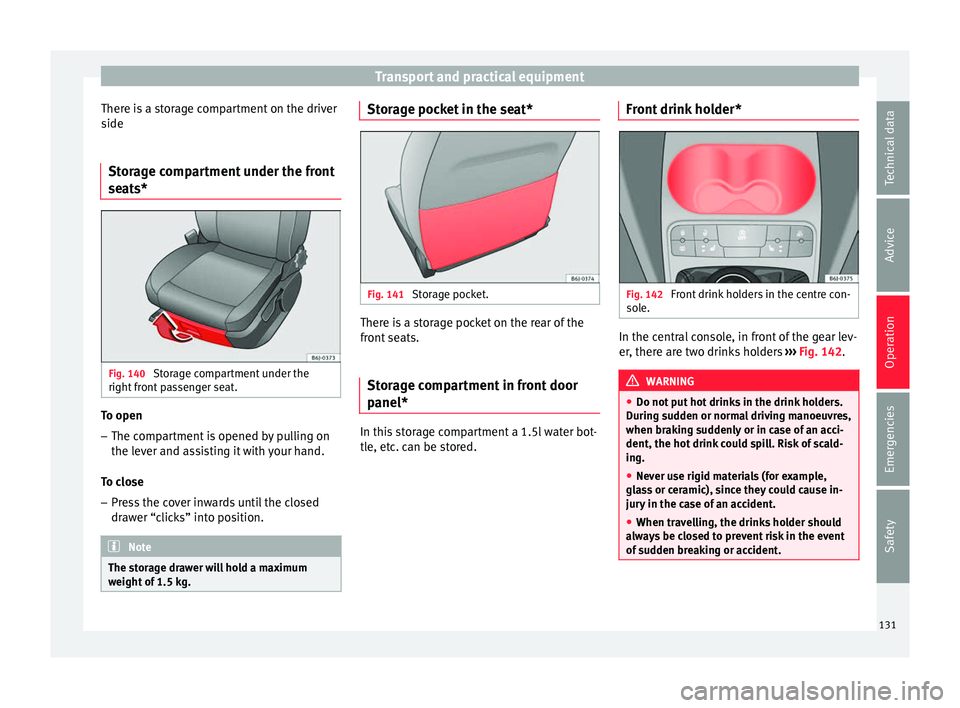
. can be stored. Front drink holder* Fig. 142
Front drink holders in the centre con-
so l
e. In the central console, in front of the gear lev-
er
, ther
e ar
e two drinks holders ››› Fig. 142. WARNING
● Do not p ut
hot drinks in the drink holders.
During sudden or normal driving manoeuvres,
when braking suddenly or in case of an acci-
dent, the hot drink could spill. Risk of scald-
ing.
● Never use rigid materials (for example,
glas
s or ceramic), since they could cause in-
jury in the case of an accident.
● When travelling, the drinks holder should
alwa
ys be closed to prevent risk in the event
of sudden breaking or accident. 131
Technical data
Advice
Operation
Emergencies
Safety
Page 152 of 248
Operation
of your brake pads checked by technical serv-
ic e
s
more frequently than recommended in
the Maintenance Programme.
If you drive with wet brakes, for example, af-
ter crossing areas of water, on days of heavy
rainfall or even after washing the car, the ef-
fect of the brakes is reduced as the brake
discs are wet or even frozen (in winter): in
this case, the brakes should be “dried” by
pressing the brake pedal several times. WARNING
Longer braking distances and faults in the
brak e sy
stem increase the risk of accidents.
● New brake pads must be run in and do not
have the c
orrect friction during the first
200 km. This reduced braking capacity may
be compensated for by pressing on the brake
pedal a little harder, which also applies when
the brake pads have to be changed further
on.
● If brakes are wet or frozen, or if you are
driving on r
oads which have been salted,
braking power may be lower than normal.
● On steep slopes, if brakes are excessively
used, they w
ill overheat. Before driving down
a long steep slope, it is advisable to reduce
speed and change down into a lower gear or
range (depending on the type of transmis-
sion). Thus, make use of engine braking and
relieve the brakes.
● Never let the brakes “drag” by applying
light pre
ssure. Continuous braking will cause the brakes to overheat and the braking dis-
tanc
e w
ill increase. Apply and then release
the brakes alternately.
● Never let the vehicle run with the engine
switc
hed off. The braking distance is in-
creased considerably when the brake servo is
not active.
● If the brake fluid loses its viscosity and is
subj
ected to heavy use, vapour bubbles can
form in the brake system. This reduces the ef-
ficiency of the brakes.
● Non-standard or damaged front spoilers
coul
d restrict the airflow to the brakes and
cause them to overheat. Before purchasing
accessories please observe the relevant in-
structions ››› page 187, Modifications.
● If a brake system circuit fails, the braking
dist
ance will be increased considerably. Con-
tact a specialised workshop immediately and
avoid unnecessary journeys. Control lamp
Situations in which the warning lamp lights
up *
●
the brake fluid level is too low
› ›
›
page 206.
● there is a fault in the brake system.
This w
arning lamp can light up together with
the ABS system warning lamp. WARNING
● If the br ak
e warning lamp does not go out
or if it lights up when driving, the brake fluid
level in the reservoir is too low so there is a
risk of an accident ››› page 206, Brake fluid.
Stop the vehicle and do not drive on. Obtain
technical assistance.
● If the brake warning lamp lights up to-
gether w
ith the ABS lamp this could be
due to an ABS fault. This could cause the rear
wheels to lock quickly when you brake. This
could cause the rear to break away. Risk of
skidding. Stop the vehicle and seek technical
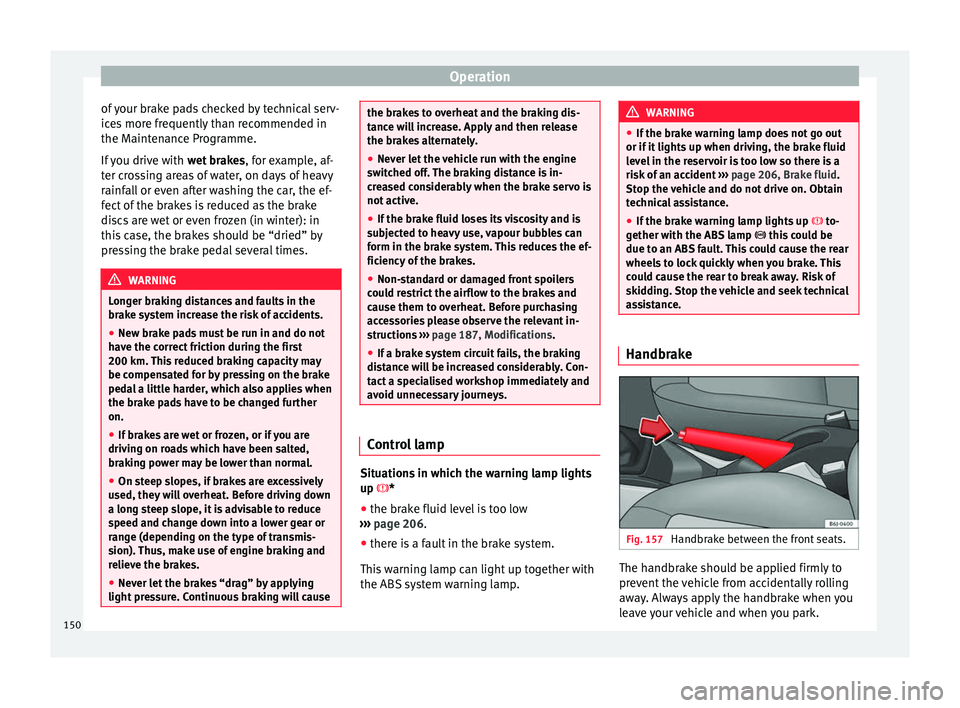
assistance. Handbrake
Fig. 157
Handbrake between the front seats. The handbrake should be applied firmly to
pr
ev
ent
the vehicle from accidentally rolling
away. Always apply the handbrake when you
leave your vehicle and when you park.
150
Page 235 of 248
Index
Index
A
ABS . . . . . . . . . . . . . . . . . . . . . . . . . . . . . . . . . . . .
155
c ontr
ol lamp . . . . . . . . . . . . . . . . . . . . . . . . . . . 156
Accessories . . . . . . . . . . . . . . . . . . . . . . . . . . . . . . 187
Additional electrical appliances (efficiency pro- gramme) . . . . . . . . . . . . . . . . . . . . . . . . . . . . . . . 31
Adjusting front head restraints . . . . . . . . . . . . . . . . . 60, 128
lights . . . . . . . . . . . . . . . . . . . . . . . . . . . . . . . . . 121
rear head restraints . . . . . . . . . . . . . . . . . . . . . . 60
Adjusting the front seats adjusting the lumbar support . . . . . . . . . . . . . 127
Adjusting the head restraints front head restraints . . . . . . . . . . . . . . . . . . . . . 128
rear head restraints . . . . . . . . . . . . . . . . . . . . . . 60
Adjusting the seat . . . . . . . . . . . . . . . . . . . . . . . . 127
Adjustment CAR menu . . . . . . . . . . . . . . . . . . . . . . . . . . . . . . 99
seats . . . . . . . . . . . . . . . . . . . . . . . . . . . . . . . . . . 57
AFS headlight bulbs . . . . . . . . . . . . . . . . . . . . . . . . 87
Airbag covers . . . . . . . . . . . . . . . . . . . . . . . . . . . . . 14
Airbags . . . . . . . . . . . . . . . . . . . . . . . . . . . . . . . . . . 66 description . . . . . . . . . . . . . . . . . . . . . . . . . . . . . 67
Airbag system . . . . . . . . . . . . . . . . . . . . . . . . . . 14, 66 activation . . . . . . . . . . . . . . . . . . . . . . . . . . . . . . 68
control lamp . . . . . . . . . . . . . . . . . . . . . . . . . . . . 68
deactivation of front airbag . . . . . . . . . . . . . . . . 70
description . . . . . . . . . . . . . . . . . . . . . . . . . . . . . 67
front airbags . . . . . . . . . . . . . . . . . . . . . . . . . 14, 69
functioning . . . . . . . . . . . . . . . . . . . . . . . . . . . . . 68
head-protection airbags . . . . . . . . . . . . . . . . . . 15
side airbags . . . . . . . . . . . . . . . . . . . . . . . . . . . . 15 Air conditioning . . . . . . . . . . . . . . . . . . . . . . 39, 141
climatr onic . . . . . . . . . . . . . . . . . . . . . . . . . . . . 143
controls . . . . . . . . . . . . . . . . . . . . . . . . . . . . . . . 141
general notes . . . . . . . . . . . . . . . . . . . . . . . . . . 137
manual air conditioning . . . . . . . . . . . . . . . . . . . 40
Air outlets . . . . . . . . . . . . . . . . . . . . . . . . . . . . . . . 138
Air recirculation air conditioning . . . . . . . . . . . . . . . . . . . . . . . . 142
heating and fresh air . . . . . . . . . . . . . . . . . . . . 139
Alarm system . . . . . . . . . . . . . . . . . . . . . . . . . . . . 111 switching off . . . . . . . . . . . . . . . . . . . . . . . . . . . 112
Alloy wheel rims . . . . . . . . . . . . . . . . . . . . . . . . . . 193
Alternator warning lamp . . . . . . . . . . . . . . . . . . . . . . . . . . 208
Ambient lighting . . . . . . . . . . . . . . . . . . . . . . . . . 122
Anti-freeze . . . . . . . . . . . . . . . . . . . . . . . . . . . . . . . 42
Anti-lock brake system . . . . . . . . . . . . 152, 154, 155 control lamp . . . . . . . . . . . . . . . . . . . . . . . . . . . 156
Anti-puncture . . . . . . . . . . . . . . . . . . . . . . . . . . 46, 76
Anti-puncture kit . . . . . . . . . . . . . . . . . . . . . . . . 46, 76 check after 10 minutes . . . . . . . . . . . . . . . . . . . . 78
Anti-puncture set . . . . . . . . . . . . . . . . . . . . . . . . . . 76
Anti-theft alarm . . . . . . . . . . . . . . . . . . . . . . . . . . 111
Anti-theft alarm system . . . . . . . . . . . . . . . . . . . . 111 switching off . . . . . . . . . . . . . . . . . . . . . . . . . . . 112
Aquaplaning . . . . . . . . . . . . . . . . . . . . . . . . . . . . . 212
Aspects to note before setting off . . . . . . . . . . . . . 56
ASR . . . . . . . . . . . . . . . . . . . . . . . . . . . . . . . . . . . . 153 control lamp . . . . . . . . . . . . . . . . . . . . . . . . . . . 153
Assistance systems parking aid . . . . . . . . . . . . . . . . . . . . . . . 173, 174
Assistance Systems fatigue detection . . . . . . . . . . . . . . . . . . . . . . . 171
Assisted starting . . . . . . . . . . . . . . . . . . . . . . . . . . 52
Audible warning signal seat belt not fastened . . . . . . . . . . . . . . . . . . . . 62
warning and control lamps . . . . . . . . . . . . . . . . 98 Automatic car wash tunnel . . . . . . . . . . . . . . . . . 189
Automatic
gearbox . . . . . . . . . . . . . . . . . . . . . . . . 158
driving programmes . . . . . . . . . . . . . . . . . . . . . 158
driving tips . . . . . . . . . . . . . . . . . . . . . . . . . . . . 162
kick-down device . . . . . . . . . . . . . . . . . . . . . . . 163
manual release of selector lever . . . . . . . . . . . . 38
selecting gears with Tiptronic . . . . . . . . . . . . . 161
selector lever lock . . . . . . . . . . . . . . . . . . . . . . . 161
selector lever positions . . . . . . . . . . . . . . . . . . 159
tiptronic . . . . . . . . . . . . . . . . . . . . . . . . . . . . . . . 158
Automatic lighting . . . . . . . . . . . . . . . . . . . . . . . . 118
AUX-IN . . . . . . . . . . . . . . . . . . . . . . . . . . . . . . . . . . 105
B Back seat folding down and raising the back seat back-rest . . . . . . . . . . . . . . . . . . . . . . . . . . . . . . . . . 129
Ball coupling . . . . . . . . . . . . . . . . . . . . . . . . . . . . . 184
Battery . . . . . . . . . . . . . . . . . . . . . . . . . . . . . . . . . . 111
Before setting off . . . . . . . . . . . . . . . . . . . . . . . . . . 56
Belt pretensioners . . . . . . . . . . . . . . . . . . . . . . . . . 65
Biodiesel . . . . . . . . . . . . . . . . . . . . . . . . . . . . . . . . 197
Bonnet . . . . . . . . . . . . . . . . . . . . . . . . . 10, 198, 201 closing . . . . . . . . . . . . . . . . . . . . . . . . . . . . . . . . 200
opening . . . . . . . . . . . . . . . . . . . . . . . . . . . . . . . 199
Boot hatch . . . . . . . . . . . . . . . . . . . . . . . . . . . . . . 113
Boot lid . . . . . . . . . . . . . . . . . . . . . . . . . . . . . . . . . 113
Brake assist . . . . . . . . . . . . . . . . . . . . . . . . . . . . . 152
Brake fluid . . . . . . . . . . . . . . . . . . . . . . . . . . 43, 206 changing . . . . . . . . . . . . . . . . . . . . . . . . . . . . . . 206
Brake pads . . . . . . . . . . . . . . . . . . . . . . . . . 149, 164
Brakes brake fluid . . . . . . . . . . . . . . . . . . . . . . . . . . . . . 206
new Brake pads . . . . . . . . . . . . . . . . . . . . . . . . 149
Brake servo . . . . . . . . . . . . . . . . . . . . . . . . . 149, 157
Brake system . . . . . . . . . . . . . . . . . . . . . . . . . . . . 206
233