stop start SEAT IBIZA ST 2017 Owner's Guide
[x] Cancel search | Manufacturer: SEAT, Model Year: 2017, Model line: IBIZA ST, Model: SEAT IBIZA ST 2017Pages: 248, PDF Size: 5.24 MB
Page 201 of 248
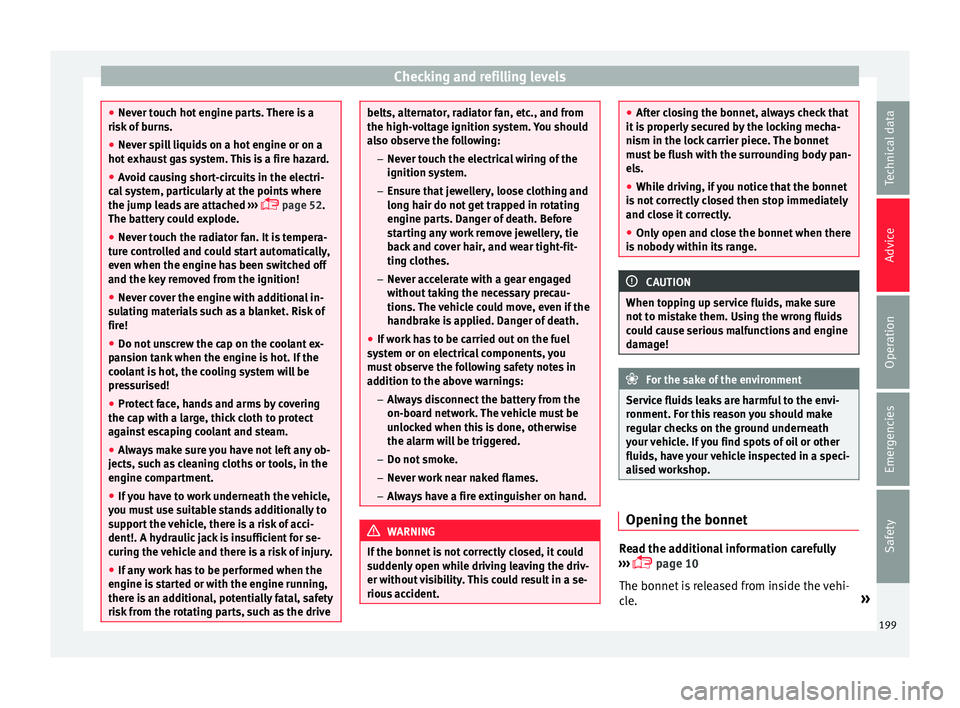
Checking and refilling levels
●
Never t ouc
h hot engine parts. There is a
risk of burns.
● Never spill liquids on a hot engine or on a
hot exh
aust gas system. This is a fire hazard.
● Avoid causing short-circuits in the electri-
cal
system, particularly at the points where
the jump leads are attached ›››
page 52.
The battery could explode.
● Never touch the radiator fan. It is tempera-
ture c
ontrolled and could start automatically,
even when the engine has been switched off
and the key removed from the ignition!
● Never cover the engine with additional in-
sul
ating materials such as a blanket. Risk of
fire!
● Do not unscrew the cap on the coolant ex-
pans
ion tank when the engine is hot. If the
coolant is hot, the cooling system will be
pressurised!
● Protect face, hands and arms by covering
the cap with a l
arge, thick cloth to protect
against escaping coolant and steam.
● Always make sure you have not left any ob-
jects, s
uch as cleaning cloths or tools, in the
engine compartment.
● If you have to work underneath the vehicle,
you mus
t use suitable stands additionally to
support the vehicle, there is a risk of acci-
dent!. A hydraulic jack is insufficient for se-
curing the vehicle and there is a risk of injury.
● If any work has to be performed when the
engine is
started or with the engine running,
there is an additional, potentially fatal, safety
risk from the rotating parts, such as the drive belts, alternator, radiator fan, etc., and from
the high-v
o
ltage ignition system. You should
also observe the following:
– Never touch the electrical wiring of the
ignition system.
– Ensure that jewellery, loose clothing and
long hair do not get trapped in rotating
engine parts. Danger of death. Before
starting any work remove jewellery, tie
back and cover hair, and wear tight-fit-
ting clothes.
– Never accelerate with a gear engaged
without taking the necessary precau-
tions. The vehicle could move, even if the
handbrake is applied. Danger of death.
● If work has to be carried out on the fuel
syst
em or on electrical components, you
must observe the following safety notes in
addition to the above warnings:
– Always disconnect the battery from the
on-board network. The vehicle must be
unlocked when this is done, otherwise
the alarm will be triggered.
– Do not smoke.
– Never work near naked flames.
– Always have a fire extinguisher on hand. WARNING
If the bonnet is not correctly closed, it could
sud den
ly open while driving leaving the driv-
er without visibility. This could result in a se-
rious accident. ●
Aft er c
losing the bonnet, always check that
it is properly secured by the locking mecha-
nism in the lock carrier piece. The bonnet
must be flush with the surrounding body pan-
els.
● While driving, if you notice that the bonnet
is not
correctly closed then stop immediately
and close it correctly.
● Only open and close the bonnet when there
is no
body within its range. CAUTION
When topping up service fluids, make sure
not to mi
stake them. Using the wrong fluids
could cause serious malfunctions and engine
damage! For the sake of the environment
Service fluids leaks are harmful to the envi-
ronment . F
or this reason you should make
regular checks on the ground underneath
your vehicle. If you find spots of oil or other
fluids, have your vehicle inspected in a speci-
alised workshop. Opening the bonnet
Read the additional information carefully
› ›
›
page 10
The bonnet is released from inside the vehi-
cle. »
199
Technical data
Advice
Operation
Emergencies
Safety
Page 205 of 248
Checking and refilling levels
If this warning symbol starts to flash, and is
ac c
omp
anied by three audible warnings,
switch off the engine and check the oil level.
If necessary, add more oil ››› page 203.
If the warning lamp flashes although the oil
level is correct, stop driving. Do not even run
the engine at idle speed! Obtain technical as-
sistance.
Checking oil level
If the warning lamp is yellow the engine
oil level should be checked as soon as possi-
ble. Top up the oil at the next opportunity
››› page 203.
Oil level sensor faulty*
If the yellow warning lamp flashes, take
the vehicle to a specialised workshop to have
the oil level sensor checked. Until then it is
advisable to check the oil level every time
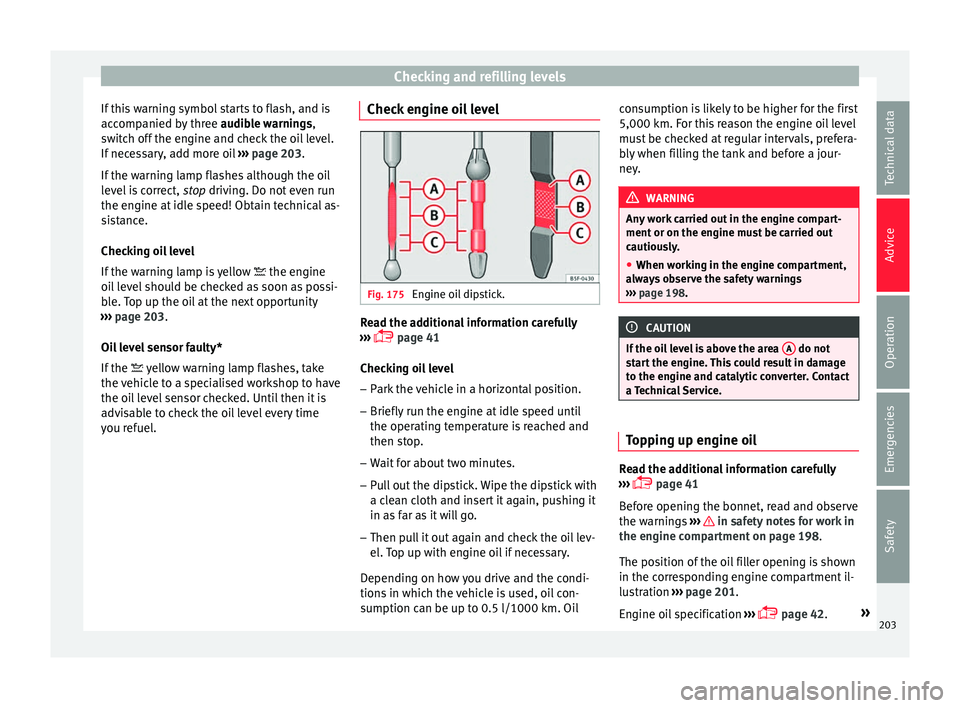
you refuel. Check engine oil level Fig. 175
Engine oil dipstick. Read the additional information carefully
› ›
›
page 41
Checking oil level
– Park the vehicle in a horizontal position.
– Briefly run the engine at idle speed until
the operating t
emperature is reached and
then stop.
– Wait for about two minutes.
– Pull out the dipstick. Wipe the dipstick with
a cle
an cloth and insert it again, pushing it
in as far as it will go.
– Then pull it out again and check the oil lev-
el. T
op up with engine oil if necessary.
Depending on how you drive and the condi-
tions in which the vehicle is used, oil con-
sumption can be up to 0.5 l/1000 km. Oil consumption is likely to be higher for the first
5,000 km. For this
reason the engine oil level
must be checked at regular intervals, prefera-
bly when filling the tank and before a jour-
ney. WARNING
Any work carried out in the engine compart-
ment or on the en gine mu
st be carried out
cautiously.
● When working in the engine compartment,
alwa
ys observe the safety warnings
››› page 198. CAUTION
If the oil level is above the area A do not
st ar
t the engine. This could result in damage
to the engine and catalytic converter. Contact
a Technical Service. Topping up engine oil
Read the additional information carefully
› ›
›
page 41
Before opening the bonnet, read and observe
the warnings ››› in safety notes for work in
the en gine c
omp
artment on page 198.
The position of the oil filler opening is shown
in the corresponding engine compartment il-
lustration ›››
page 201.
Engine oil specification ›››
page 42. »
203
Technical data
Advice
Operation
Emergencies
Safety
Page 207 of 248
Checking and refilling levels
and switch the engine off. C ont
act a Techni-
cal Service or a specialised workshop.
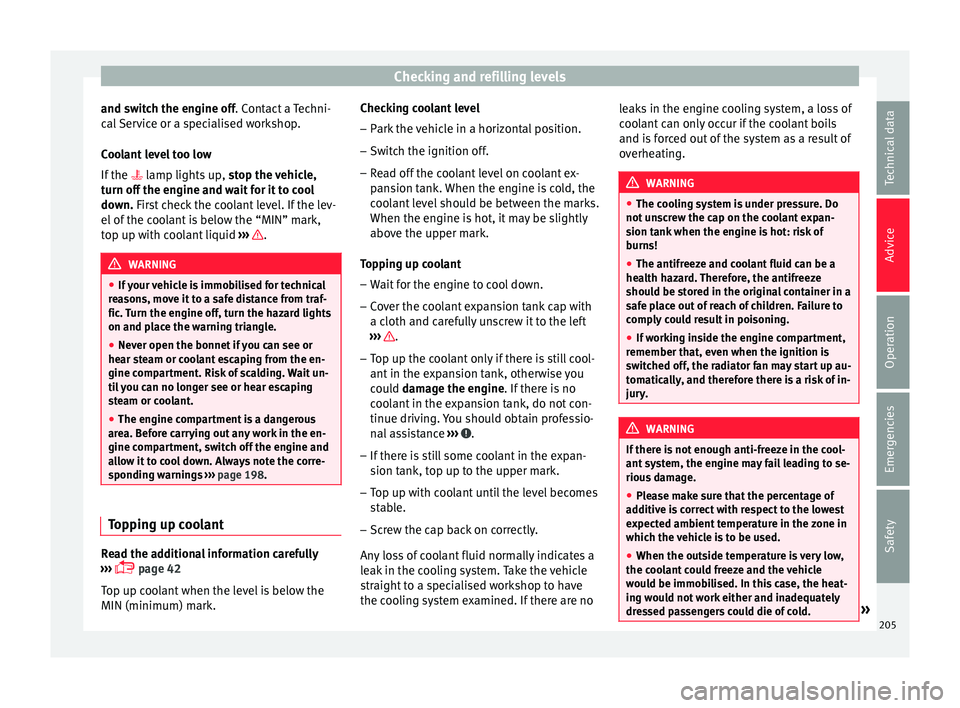
Coolant level too low
If the lamp lights up, stop the vehicle,
turn off the engine and wait for it to cool
down. First check the coolant level. If the lev-
el of the coolant is below the “MIN” mark,
top up with coolant liquid ››› .
WARNING
● If y
our vehicle is immobilised for technical
reasons, move it to a safe distance from traf-
fic. Turn the engine off, turn the hazard lights
on and place the warning triangle.
● Never open the bonnet if you can see or
hear st
eam or coolant escaping from the en-
gine compartment. Risk of scalding. Wait un-
til you can no longer see or hear escaping
steam or coolant.
● The engine compartment is a dangerous
area. B
efore carrying out any work in the en-
gine compartment, switch off the engine and
allow it to cool down. Always note the corre-
sponding warnings ››› page 198. Topping up coolant
Read the additional information carefully
› ›
›
page 42
Top up coolant when the level is below the
MIN (minimum) mark. Checking coolant level
– Park the vehicle in a horizontal position.
– Switch the ignition off.
– Read off the coolant level on coolant ex-
pans
ion tank. When the engine is cold, the
coolant level should be between the marks.
When the engine is hot, it may be slightly
above the upper mark.
Topping up coolant – Wait for the engine to cool down.
– Cover the coolant expansion tank cap with
a cloth and car
efully unscrew it to the left
››› .
– Top up the coolant only if there is still cool-
ant in the e
xp
ansion tank, otherwise you
could damage the engine. If there is no
coolant in the expansion tank, do not con-
tinue driving. You should obtain professio- nal assistance ››› .
– If there is still some coolant in the expan-
sion t
ank, t
op up to the upper mark.
– Top up with coolant until the level becomes
stab
le.
– Screw the cap back on correctly.
Any lo
ss of coolant fluid normally indicates a
leak in the cooling system. Take the vehicle
straight to a specialised workshop to have
the cooling system examined. If there are no leaks in the engine cooling system, a loss of
cool
ant can only occur if the coolant boils
and is forced out of the system as a result of
overheating. WARNING
● The coo lin
g system is under pressure. Do
not unscrew the cap on the coolant expan-
sion tank when the engine is hot: risk of
burns!
● The antifreeze and coolant fluid can be a
health h
azard. Therefore, the antifreeze
should be stored in the original container in a
safe place out of reach of children. Failure to
comply could result in poisoning.
● If working inside the engine compartment,
remember that, ev
en when the ignition is
switched off, the radiator fan may start up au-
tomatically, and therefore there is a risk of in-
jury. WARNING
If there is not enough anti-freeze in the cool-
ant sy s
tem, the engine may fail leading to se-
rious damage.
● Please make sure that the percentage of
additiv
e is correct with respect to the lowest
expected ambient temperature in the zone in
which the vehicle is to be used.
● When the outside temperature is very low,
the cool
ant could freeze and the vehicle
would be immobilised. In this case, the heat-
ing would not work either and inadequately
dressed passengers could die of cold. » 205
Technical data
Advice
Operation
Emergencies
Safety
Page 221 of 248
Technical specifications
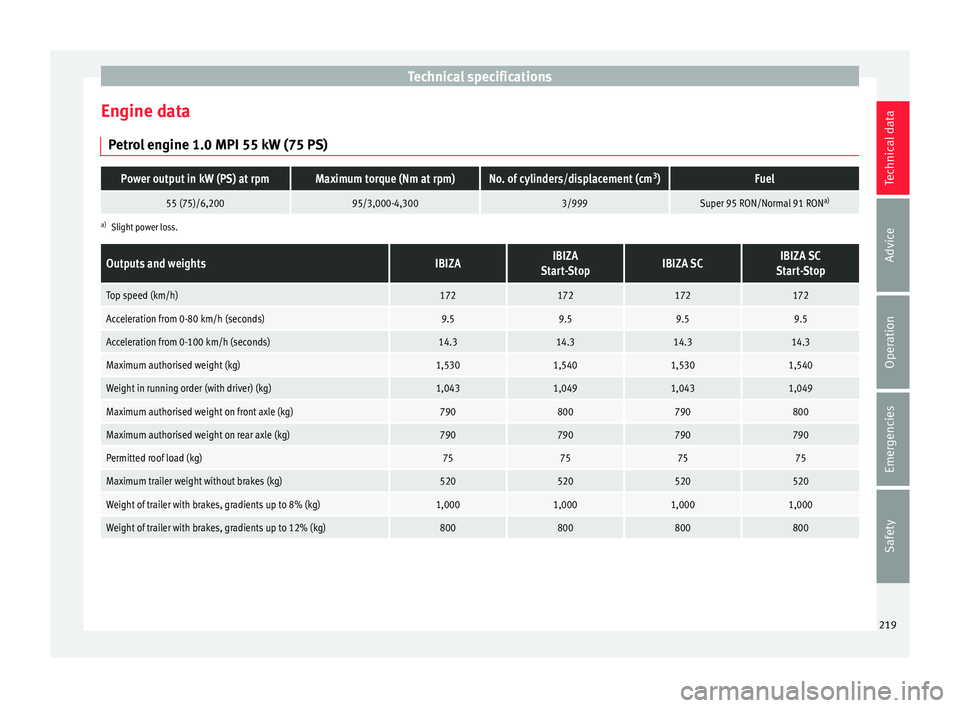
Engine data P etr
o
l engine 1.0 MPI 55 kW (75 PS)
Power output in kW (PS) at rpmMaximum torque (Nm at rpm)No. of cylinders/displacement (cm 3
)Fuel
55 (75)/6,20095/3,000-4,3003/999Super 95 RON/Normal 91 RON a)
a)
Slight power loss.
Outputs and weightsIBIZAIBIZA
Start-StopIBIZA SCIBIZA SC
Start-Stop
Top speed (km/h)172172172172
Acceleration from 0-80 km/h (seconds)9.59.59.59.5
Acceleration from 0-100 km/h (seconds)14.314.314.314.3
Maximum authorised weight (kg)1,5301,5401,5301,540
Weight in running order (with driver) (kg)1,0431,0491,0431,049
Maximum authorised weight on front axle (kg)790800790800
Maximum authorised weight on rear axle (kg)790790790790
Permitted roof load (kg)75757575
Maximum trailer weight without brakes (kg)520520520520
Weight of trailer with brakes, gradients up to 8% (kg)1,0001,0001,0001,000
Weight of trailer with brakes, gradients up to 12% (kg)800800800800 219
Technical data
Advice
Operation
Emergencies
Safety
Page 224 of 248
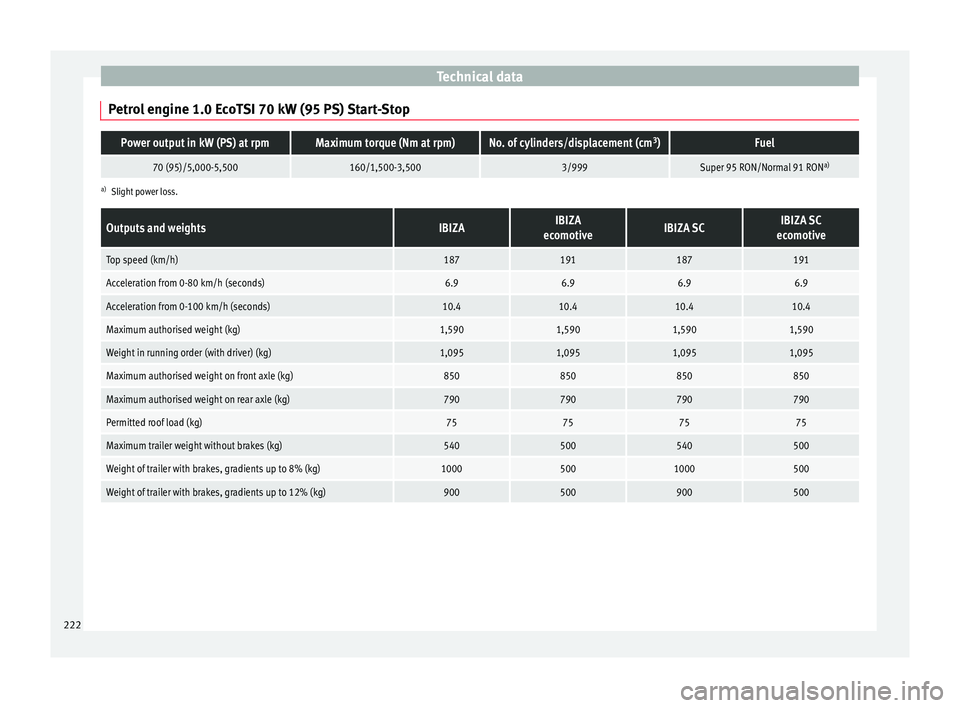
Technical data
Petrol engine 1.0 EcoTSI 70 kW (95 PS) Start-StopPower output in kW (PS) at rpmMaximum torque (Nm at rpm)No. of cylinders/displacement (cm 3
)Fuel
70 (95)/5,000-5,500160/1,500-3,5003/999Super 95 RON/Normal 91 RON a)
a)
Slight power loss.
Outputs and weightsIBIZAIBIZA
ecomotiveIBIZA SCIBIZA SC
ecomotive
Top speed (km/h)187191187191
Acceleration from 0-80 km/h (seconds)6.96.96.96.9
Acceleration from 0-100 km/h (seconds)10.410.410.410.4
Maximum authorised weight (kg)1,5901,5901,5901,590
Weight in running order (with driver) (kg)1,0951,0951,0951,095
Maximum authorised weight on front axle (kg)850850850850
Maximum authorised weight on rear axle (kg)790790790790
Permitted roof load (kg)75757575
Maximum trailer weight without brakes (kg)540500540500
Weight of trailer with brakes, gradients up to 8% (kg)10005001000500
Weight of trailer with brakes, gradients up to 12% (kg)900500900500 222
Page 225 of 248
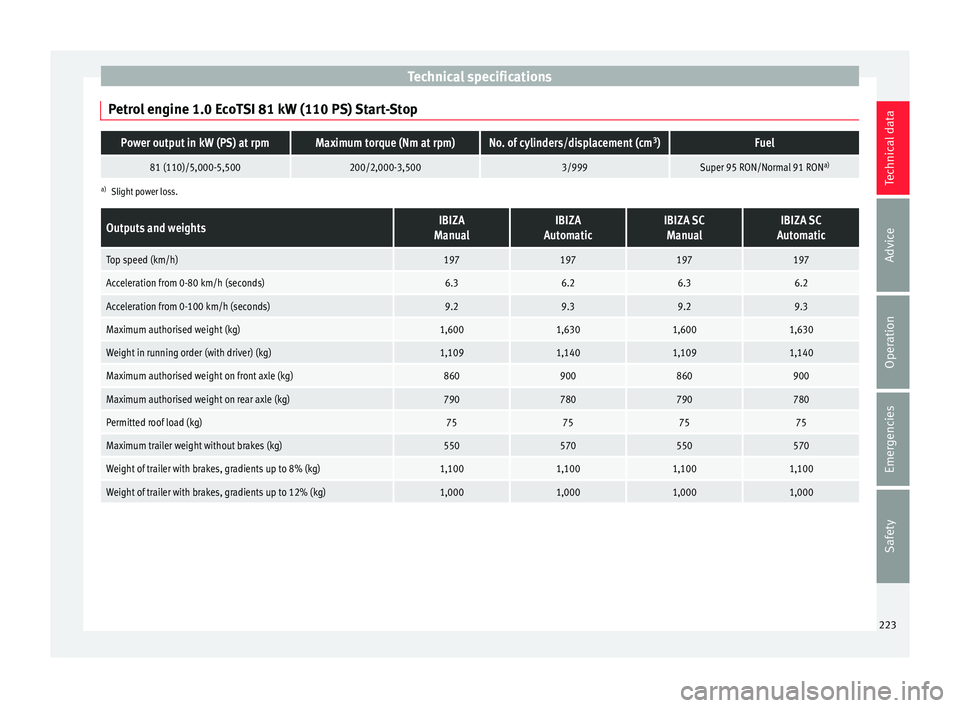
Technical specifications
Petrol engine 1.0 EcoTSI 81 kW (110 PS) Start-StopPower output in kW (PS) at rpmMaximum torque (Nm at rpm)No. of cylinders/displacement (cm 3
)Fuel
81 (110)/5,000-5,500200/2,000-3,5003/999Super 95 RON/Normal 91 RON a)
a)
Slight power loss.
Outputs and weightsIBIZA
ManualIBIZA
AutomaticIBIZA SC ManualIBIZA SC
Automatic
Top speed (km/h)197197197197
Acceleration from 0-80 km/h (seconds)6.36.26.36.2
Acceleration from 0-100 km/h (seconds)9.29.39.29.3
Maximum authorised weight (kg)1,6001,6301,6001,630
Weight in running order (with driver) (kg)1,1091,1401,1091,140
Maximum authorised weight on front axle (kg)860900860900
Maximum authorised weight on rear axle (kg)790780790780
Permitted roof load (kg)75757575
Maximum trailer weight without brakes (kg)550570550570
Weight of trailer with brakes, gradients up to 8% (kg)1,1001,1001,1001,100
Weight of trailer with brakes, gradients up to 12% (kg)1,0001,0001,0001,000 223
Technical data
Advice
Operation
Emergencies
Safety
Page 228 of 248
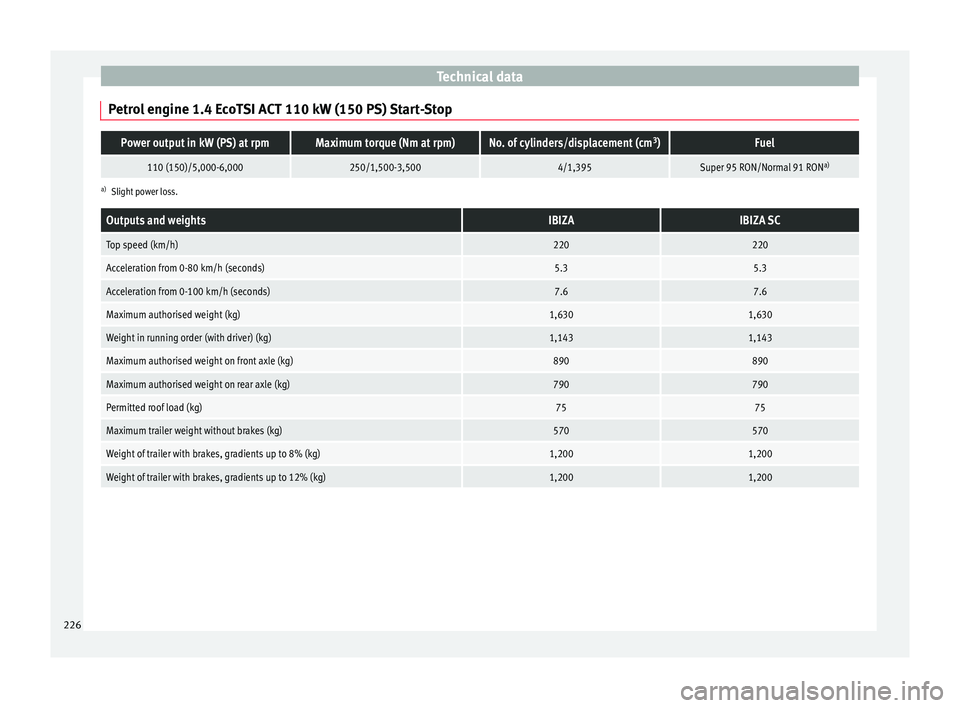
Technical data
Petrol engine 1.4 EcoTSI ACT 110 kW (150 PS) Start-StopPower output in kW (PS) at rpmMaximum torque (Nm at rpm)No. of cylinders/displacement (cm 3
)Fuel
110 (150)/5,000-6,000250/1,500-3,5004/1,395Super 95 RON/Normal 91 RON a)
a)
Slight power loss.
Outputs and weightsIBIZAIBIZA SC
Top speed (km/h)220220
Acceleration from 0-80 km/h (seconds)5.35.3
Acceleration from 0-100 km/h (seconds)7.67.6
Maximum authorised weight (kg)1,6301,630
Weight in running order (with driver) (kg)1,1431,143
Maximum authorised weight on front axle (kg)890890
Maximum authorised weight on rear axle (kg)790790
Permitted roof load (kg)7575
Maximum trailer weight without brakes (kg)570570
Weight of trailer with brakes, gradients up to 8% (kg)1,2001,200
Weight of trailer with brakes, gradients up to 12% (kg)1,2001,200 226
Page 229 of 248
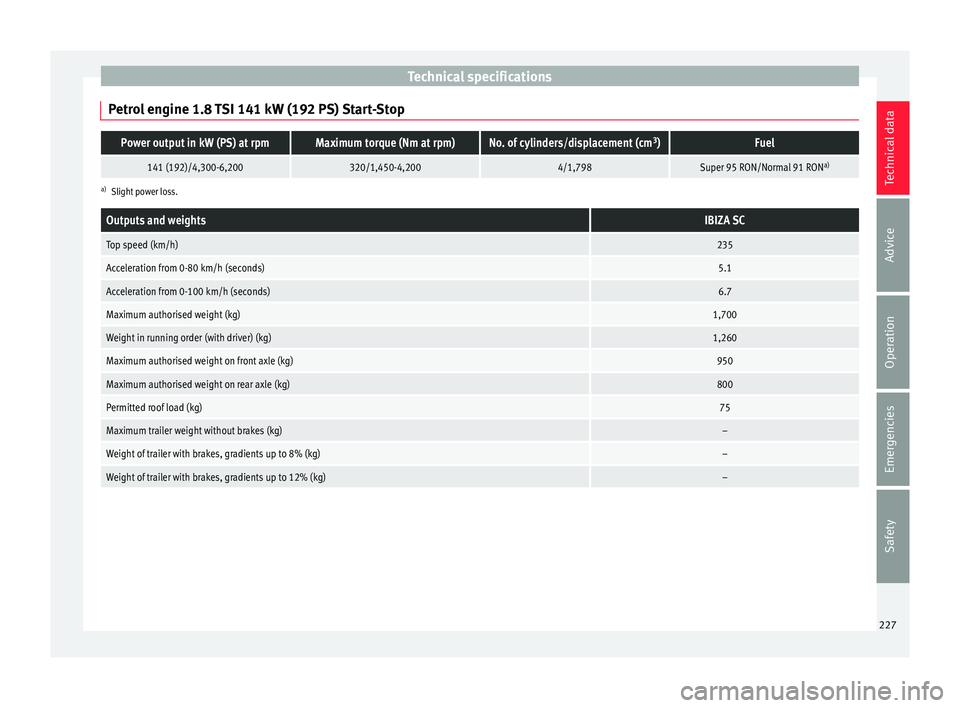
Technical specifications
Petrol engine 1.8 TSI 141 kW (192 PS) Start-StopPower output in kW (PS) at rpmMaximum torque (Nm at rpm)No. of cylinders/displacement (cm 3
)Fuel
141 (192)/4,300-6,200320/1,450-4,2004/1,798Super 95 RON/Normal 91 RON a)
a)
Slight power loss.
Outputs and weightsIBIZA SC
Top speed (km/h)235
Acceleration from 0-80 km/h (seconds)5.1
Acceleration from 0-100 km/h (seconds)6.7
Maximum authorised weight (kg)1,700
Weight in running order (with driver) (kg)1,260
Maximum authorised weight on front axle (kg)950
Maximum authorised weight on rear axle (kg)800
Permitted roof load (kg)75
Maximum trailer weight without brakes (kg)–
Weight of trailer with brakes, gradients up to 8% (kg)–
Weight of trailer with brakes, gradients up to 12% (kg)– 227
Technical data
Advice
Operation
Emergencies
Safety
Page 230 of 248
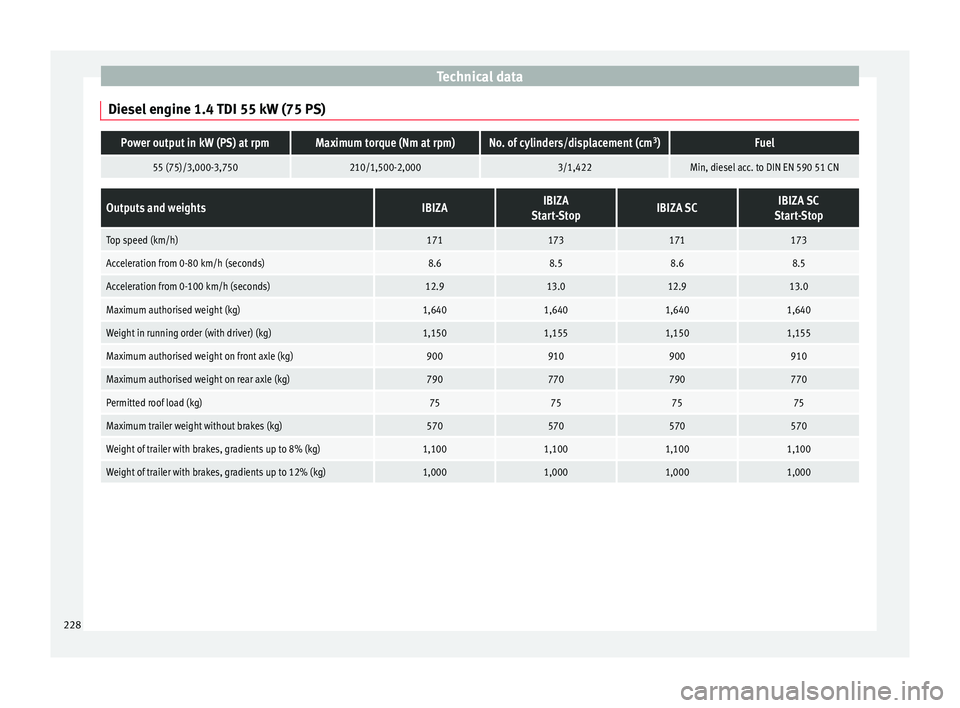
Technical data
Diesel engine 1.4 TDI 55 kW (75 PS)Power output in kW (PS) at rpmMaximum torque (Nm at rpm)No. of cylinders/displacement (cm 3
)Fuel
55 (75)/3,000-3,750210/1,500-2,0003/1,422Min, diesel acc. to DIN EN 590 51 CN
Outputs and weightsIBIZAIBIZA
Start-StopIBIZA SCIBIZA SC
Start-Stop
Top speed (km/h)171173171173
Acceleration from 0-80 km/h (seconds)8.68.58.68.5
Acceleration from 0-100 km/h (seconds)12.913.012.913.0
Maximum authorised weight (kg)1,6401,6401,6401,640
Weight in running order (with driver) (kg)1,1501,1551,1501,155
Maximum authorised weight on front axle (kg)900910900910
Maximum authorised weight on rear axle (kg)790770790770
Permitted roof load (kg)75757575
Maximum trailer weight without brakes (kg)570570570570
Weight of trailer with brakes, gradients up to 8% (kg)1,1001,1001,1001,100
Weight of trailer with brakes, gradients up to 12% (kg)1,0001,0001,0001,000 228
Page 231 of 248
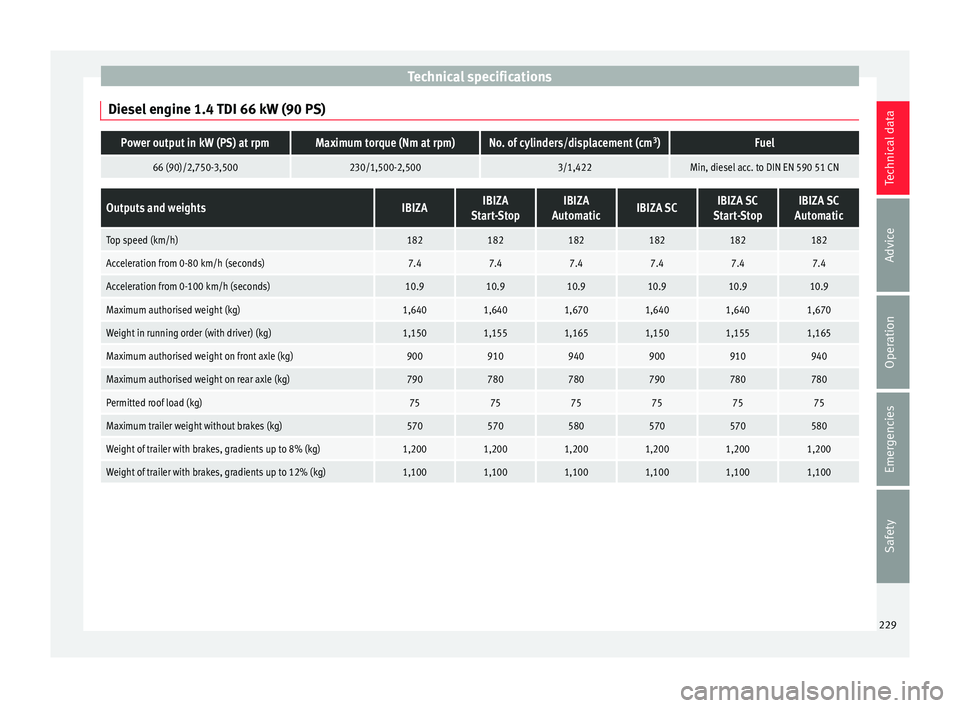
Technical specifications
Diesel engine 1.4 TDI 66 kW (90 PS)Power output in kW (PS) at rpmMaximum torque (Nm at rpm)No. of cylinders/displacement (cm 3
)Fuel
66 (90)/2,750-3,500230/1,500-2,5003/1,422Min, diesel acc. to DIN EN 590 51 CN
Outputs and weightsIBIZAIBIZA
Start-StopIBIZA
AutomaticIBIZA SCIBIZA SC
Start-StopIBIZA SC
Automatic
Top speed (km/h)182182182182182182
Acceleration from 0-80 km/h (seconds)7.47.47.47.47.47.4
Acceleration from 0-100 km/h (seconds)10.910.910.910.910.910.9
Maximum authorised weight (kg)1,6401,6401,6701,6401,6401,670
Weight in running order (with driver) (kg)1,1501,1551,1651,1501,1551,165
Maximum authorised weight on front axle (kg)900910940900910940
Maximum authorised weight on rear axle (kg)790780780790780780
Permitted roof load (kg)757575757575
Maximum trailer weight without brakes (kg)570570580570570580
Weight of trailer with brakes, gradients up to 8% (kg)1,2001,2001,2001,2001,2001,200
Weight of trailer with brakes, gradients up to 12% (kg)1,1001,1001,1001,1001,1001,100 229
Technical data
Advice
Operation
Emergencies
Safety