Seat Leon 2019 User Guide
Leon 2019
Seat
Seat
https://www.carmanualsonline.info/img/39/29360/w960_29360-0.png
Seat Leon 2019 User Guide
Page 286 of 396
Driving
Overheated brakes
If the br ak
es o v
erheat, f
or example on long
and steep descents, the ACC may be deacti-
vated temporarily. A message will be dis-
played stating this. In this case, adaptive
cruise control cannot be activated.
Cruise control may be reactivated once the
brake temperature has dropped. The mes-
sage will disappear. If the message ACC not
available remains on for quite a long time it
means that there is a fault. Contact a speci-
alised workshop. SEAT recommends visiting a
SEAT dealership. WARNING
If you do not pay attention to the Press
the brake message, the vehicle may mo v
e
and crash into the vehicle ahead. Before
driving off again, check that the road is
clear. The radar sensor may not detect ob-
stacles on the road. This could cause an
accident and serious injuries. If necessary,
apply the brake. Lane Assist*
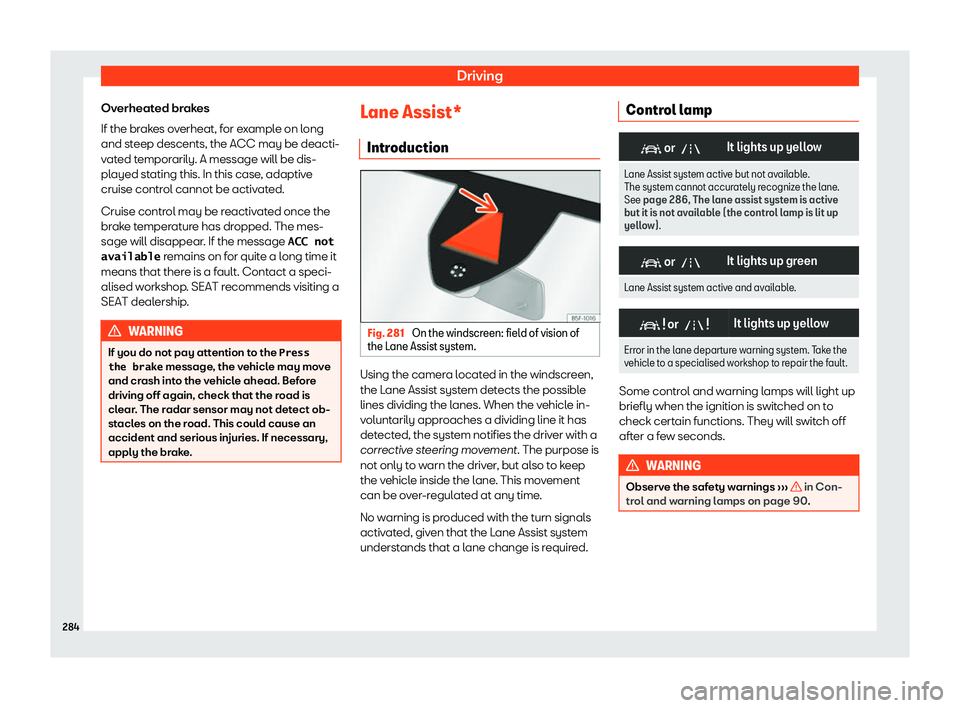
Intr oduction Fig. 281
On the windscreen: field of vision of
the L ane Assist syst
em. Using the camera located in the windscreen,
the L
ane Assist syst
em detects the possibl
e
lines dividing the l
anes. When the vehicle in-
voluntarily approaches a dividing line it has
detected, the system notifies the driver with a
corrective steering movement. The purpose is
not only to warn the driver, but also to keep
the vehicle inside the lane. This movement
can be over-regulated at any time.
No warning is produced with the turn signals
activated, given that the Lane Assist system
understands that a lane change is required. Control lamp
Page 291 of 396
Driver assistance systems
acoustic warnings and by applying the
br ak
es.
If the driv er continues t
o do nothing, the sys-
t
em automatically takes over the accelerator,
brakes and steering in order to brake the ve-
hicle and keep it in its lane
Page 293 of 396
Braking and parking
temperature, air humidity, etc.) noises may be
pr oduced when br
aking.
W et r
oads or r
oad salt
In certain situations (for example, on driving
through flooded areas, in severe downpours
or after washing the vehicle) the braking ac-
tion could be delayed if the discs and pads
are damp, or frozen in winter. In this case the
brakes should be “dried” by pressing the
brake pedal several times.
At high speed and with the windscreen wipers
activated, the brake pads will briefly touch
the brake discs. This takes place, although
unnoticeable to the driver, at regular intervals
to improve the response time of the brakes
when they are wet.
The effectiveness of the brakes can also be
temporarily reduced if the vehicle is driven for
some distance without using the brakes when
there is a lot of salt on the road in winter. The
layer of salt that accumulates on the discs
and pads can be removed by gently apply-
ing the brakes a few times.
Corrosion
There may be a tendency for corrosion to
form on the discs and dirt to build up on the
brake pads if the vehicle is used infrequently
or the brakes are not used very often.
If the brakes are not used frequently, or if rust
has formed on the disks, it is advisable to clean off the pads and disks by braking firmly
a few times at a moderately high speed
Page 295 of 396
Braking and parking
The parking brake can be prevented from be-
ing aut omatically r
eleased by continuously
pulling up the
Page 296 of 396
Driving
Releasing the handbrake
Page 298 of 396
Driving
conditions. Depress the brake pedal or use
the hand brake immediately.
�
Page 299 of 396
Braking and parking
Electronic differential lock (EDL)
When the EDL det ects wheel
spin, it brak
es
the spinning wheel and dir
ects the power to
the other driven wheel. This function is active
up to approximately 100 km/h (62 mph).
To prevent the disc brake of the braked wheel
from overheating, the EDL cuts out automati-
cally if subjected to excessive loads. The ve-
hicle can still be driven. The EDL will switch on
again automatically when the brake has
cooled down.
Tractor-trailer sway mitigation*
If the vehicle is pulling a trailer, it will control
the following: tractor-trailers tend to sway.
When the swaying of the trailer is felt by the
vehicle and detected by the ESC, it will auto-
matically brake the towing vehicle within the
limits of the system and mitigate the sway.
Tractor-trailer sway mitigation is not available
in all countries
Page 305 of 396
Help with parking and manoeuvring
CAUTION
The automatic connection of the Parking
Aid only works when you are driving slo wly.
If driving st
yle is not adapted to the circum-
stances, an accident and serious injury or
damage may be caused. Visual indication segments
Fig. 293
Parking Aid display on the Easy Con-
nect syst em screen. The optical indication of the segments works
as f
ollo
ws:
Whit e segments:
the obstacle is more
than approx. 30 cm away from the path
or in the direction opposite to travel.
They are also displayed when the elec-
tronic parking brake is activated.
Page 312 of 396
Driving
prepared for the additional effort involved in
driving with a tr ail
er.
T r
ailer brakes
If the trailer has its own brake system, please
take the relevant legal requirements into ac-
count. Never connect the trailer
Page 342 of 396
Practical tips
Changing brake fluid
W e r
ecommend that you hav e the br
ak
e fluid
changed by a Technical Service. WARNING
If the brake fluid level is low or unsuita-
ble/old brak e fluid is used, the br
ake sys-
tem may fail or braking power may be re-
duced.
�