maintenance Seat Leon 5D 2007 Owner's manual
[x] Cancel search | Manufacturer: SEAT, Model Year: 2007, Model line: Leon 5D, Model: Seat Leon 5D 2007Pages: 302, PDF Size: 9.14 MB
Page 251 of 302

If and when249
Safety First
Operating instructions
Tips and Maintenance
Te c h n i c a l D a t a
Main beam lights–Raise the bonnet
– Remove the cover ⇒fig. 166 by pulling on this. – Remove the connector
⇒fig. 167 from the bulb.
– Press the spring ⇒fig. 167 inwards and to the right.
– Extract the bulb and fit the replacement so that it sits correctly into the cut-out on the reflector.
– Installation is done in the reverse order.
Fig. 166 Main beam
headlightsFig. 167 Main beam
headlights
AC
A1
A2
leon ingles.book Seite 249 Dienst ag, 11. September 2007 1:47 13
Page 253 of 302
If and when251
Safety First
Operating instructions
Tips and Maintenance
Te c h n i c a l D a t a
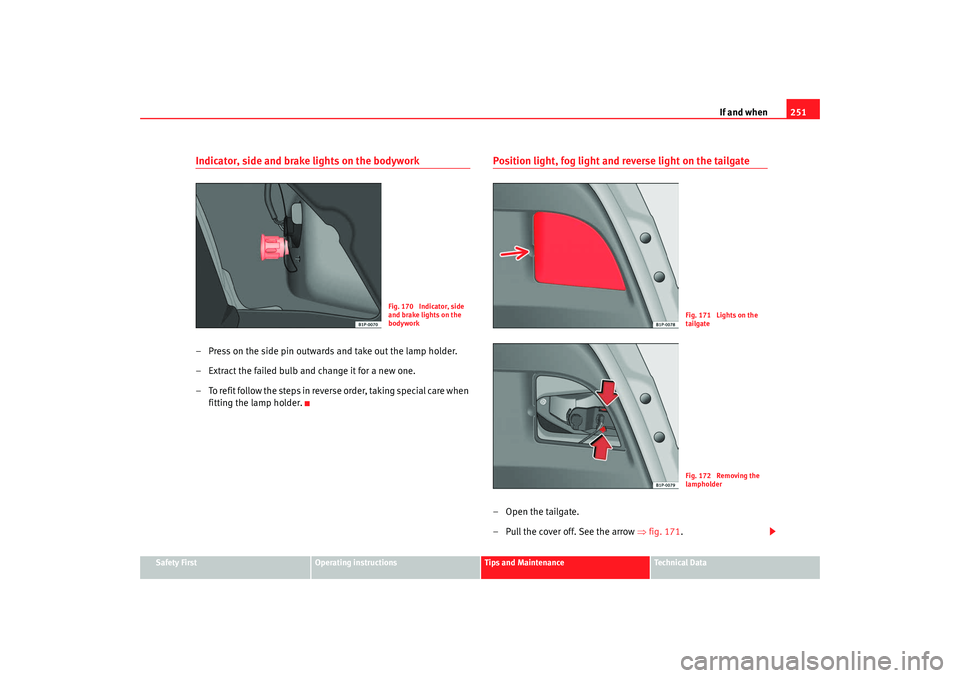
Indicator, side and brake lights on the bodywork– Press on the side pin outwards and take out the lamp holder.
– Extract the failed bulb and change it for a new one.
– To refit follow the steps in reverse order, taking special care when
fitting the lamp holder.
Position light, fog light and reverse light on the tailgate–Open the tailgate.
– Pull the cover off. See the arrow ⇒ fig. 171.
Fig. 170 Indicator, side
and brake lights on the
bodywork
Fig. 171 Lights on the
tailgateFig. 172 Removing the
lampholder
leon ingles.book Seite 251 Dienstag, 11. September 2007 1:47 13
Page 255 of 302
If and when253
Safety First
Operating instructions
Tips and Maintenance
Te c h n i c a l D a t a
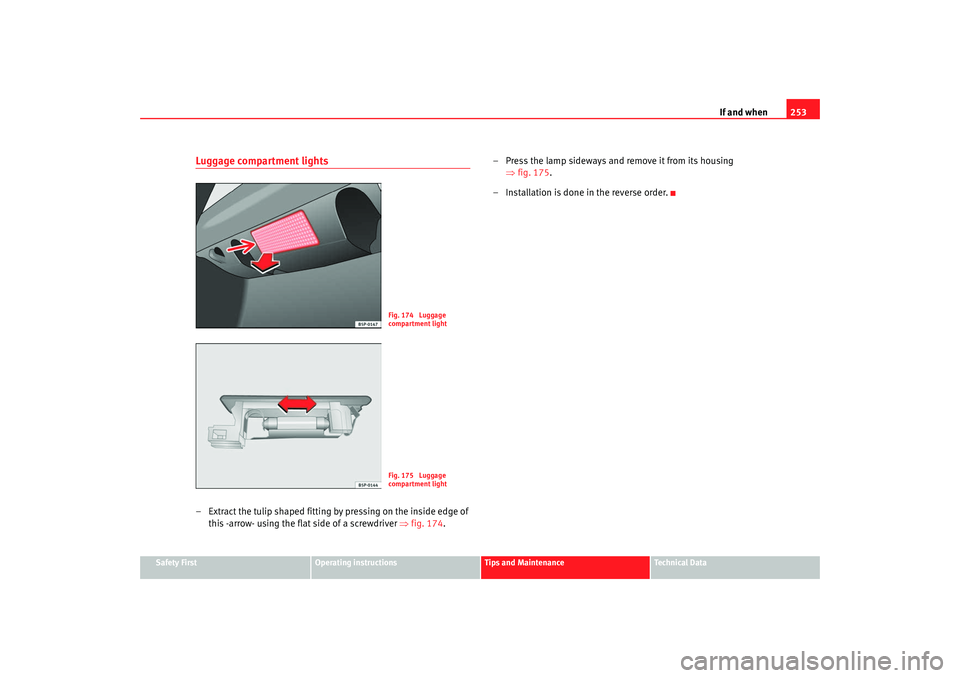
Luggage compartment lights– Extract the tulip shaped fitting by pressing on the inside edge of
this -arrow- using the flat side of a screwdriver ⇒fig. 174. – Press the lamp sideways and remove it from its housing
⇒fig. 175.
– Installation is done in the reverse order.
Fig. 174 Luggage
compartment lightFig. 175 Luggage
compartment light
leon ingles.book Seite 253 Dienst ag, 11. September 2007 1:47 13
Page 257 of 302

If and when255
Safety First
Operating instructions
Tips and Maintenance
Te c h n i c a l D a t a
Sunroof light– Carefully remove the lamp, using the flat side of the screwdriver,
as shown in the figure ⇒fig. 179. – Remove the lamp, moving it in the direction of the arrow and
outwards ⇒fig. 179.
– Installation is done in the reverse order.
Jump-startingJump leads
The jump lead must have a sufficient wire cross section.If the engine fails to start because of a discharged battery, the battery can be
connected to the battery of another vehicle to start the engine.
Jump leads
Jump leads must comply with the standard DIN 72553 (see manufacturer's
documentation). The wire cross section must be at least 25 mm
2 for petrol
engines and at least 35 mm
2 for diesel engines.
Note
•
The vehicles must not touch each othe r, otherwise electricity could flow as
soon as the positive terminals are connected.
•
The discharged battery must be properly connected to the vehicles elec-
trical system.
Fig. 178 Removing
sunroof lightFig. 179 Removing
sunroof light
leon ingles.book Seite 255 Dienst ag, 11. September 2007 1:47 13
Page 259 of 302
If and when257
Safety First
Operating instructions
Tips and Maintenance
Te c h n i c a l D a t a
WARNING
•
Please note the safety warnings referring to working in the engine
compartment ⇒page 204, “Working in the engine compartment”.
•
The battery providing assistance must have the same voltage as the flat
battery (12V) and approximately the same capacity (see imprint on
battery). Failure to comply could result in an explosion.
•
Never use jump leads when one of the batteries is frozen. Danger of
explosion! Even after the battery has thawed, battery acid could leak and
cause chemical burns. If a battery freezes, it should be replaced.
•
Keep sparks, flames and lighted cigarettes away from batteries, danger
of explosion. Failure to comply could result in an explosion.
•
Observe the instructions provided by the manufacturer of the jump
leads.
•
Do not connect the negative cable from the other vehicle directly to the
negative terminal of the flat battery. The gas emitted from the battery could
be ignited by sparks. Danger of explosion.
•
Do not attach the negative cable from the other vehicle to parts of the
fuel system or to the brake line.
•
The non-insulated parts of the battery clamps must not be allowed to
touch. The jump lead attached to the positive battery terminal must not
touch metal parts of the vehicle, this can cause a short circuit.
•
Position the leads in such a way that they cannot come into contact
with any moving parts in the engine compartment.
•
Do not bend over the batteries. This could result in chemical burns.Note
The vehicles must not touch each other, otherwise electricity could flow as
soon as the positive terminals are connected.
leon ingles.book Seite 257 Dienst ag, 11. September 2007 1:47 13
Page 261 of 302
If and when259
Safety First
Operating instructions
Tips and Maintenance
Te c h n i c a l D a t a
Do not pull too hard with the towing vehi
cle and take care to avoid jerking the
tow-rope. When towing on an unpaved road, there is always a risk of over-
loading and damaging the anchorage points.
The ignition of the vehicle being towed must be switched on to prevent the
steering wheel from locking and also to allow the use of the turn signals,
horn, windscreen wipers and washers.
As the brake servo does not work if th e engine is not running, you must apply
considerably more pressure to the brake pedal than you normally would.
As the power assisted steering does not wo rk if the engine is not running, you
will need more strength to steer than you normally would.
Towing vehicles with an automatic gearbox
•
Put the selector lever into position “N”.
•
Do not drive faster than 50 km/h when towing a vehicle.
•
Do not tow further than 50 km.
•
If a breakdown vehicle is used, the vehicle must be towed with the front
wheels raised.Note
•
Observe legal requirements when towing or tow-starting.
•
Switch on the hazard warning lights of both vehicles. However, observe
any regulations to the contrary.
•
For technical reasons, vehicles with an automatic gearbox must not be
tow-started.
•
If damage to your vehicle means that there is no lubricant in the gearbox,
you must raise the drive wheels while the vehicle is being towed.
•
If the vehicle has to be towed more than 50 km, the front wheels must be
raised during towing, and towing should be carried out by a qualified person.
•
The steering wheel is locked when the vehicle has no electrical power. The
vehicle must then be towed with the front wheels raised. Towing should be
carried out by a qualified person.
•
The towing eye should always be kept in the vehicle. Please refer to the
notes on ⇒page 258.
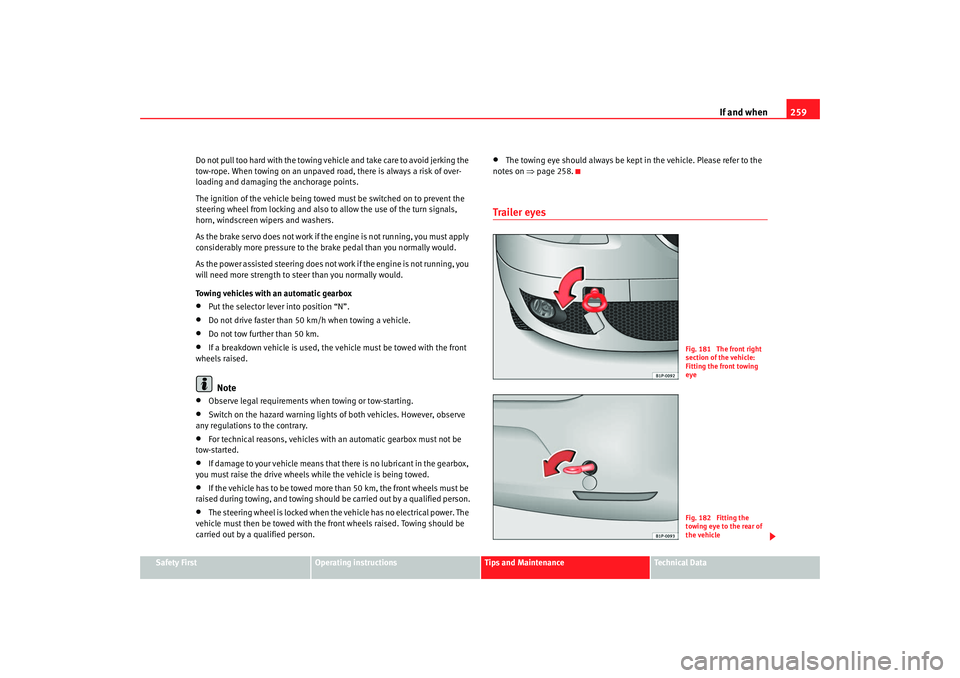
Trailer eyes
Fig. 181 The front right
section of the vehicle:
Fitting the front towing
eyeFig. 182 Fitting the
towing eye to the rear of
the vehicle
leon ingles.book Seite 259 Dienst ag, 11. September 2007 1:47 13
Page 263 of 302

General notes on the technical data 261
Safety First
Operating instructions
Tips and Maintenance
Te c h n i c a l D a t a
Te c h n i c a l D a t aGeneral notes on the technical dataWhat you should be aware ofGeneral notes
All data in the official vehicle documents take precedence over this data.All data in these documents are valid for the basic model as offered in Spain.
The vehicle data card included in the Maintenance Programme or the vehicle
registration documents sh ows which engine is installed in the vehicle. The figures may be different if addition
al equipment is fitted, for different
models, for special vehicles and for other countries.
Abbreviations used in this paragraph of the Technical Data Abbreviation MeaningkW Kilowatt, engine power measurement.
bhp Brake horse power, formerly used to denote engine power
at rpm Revolutions per minute - engine speed. Nm Newton metres, unit of engine torque.
l/100 km Fuel consumption in litres per 100 kilometres g/km Carbon dioxide emission s in grams per kilometre.
CO
2
Carbon dioxide
CN Cetane number, indication of the ignition quality of the diesel.
RON Research octane number, indication of the knock resistance of petrol.
leon ingles.book Seite 261 Dienstag, 11. September 2007 1:47 13
Page 264 of 302

General notes on the technical data
262Vehicle identification data
The most important data are given on the type plate and the
vehicle data sticker.Vehicles for certain export countries do not have a type plate.
Type plate
The type plate is located on the left rib inside the engine compartment.
Vehicle identification number
The vehicle identification number (chass is number) can be read from outside
the vehicle through a viewer in the windscreen. This is located on the left-
hand side of the vehicle in the lower area of the windscreen. It is also located
on the right hand side of the engine compartment. Vehicle data
The data sticker is placed on the inside of the spare wheel recess in the
luggage compartment.
The following information can be fo
und in the vehicle information: ⇒fig. 183
This information also figures in the Maintenance Program. Production control number
Vehicle identification number (chassis number)
Model code number
Model designation / engine power output
Engine and gearbox code letters
Paint number / interior trim code
Optional equipment codes
Consumption values
CO emissions
2
The data of 2 to 9 also figure in the Maintenance Program.
CO emissions and consumption
2
Consumption (litres/100 km) / CO
2 emissions (g/km) urban
Consumption (litres/100 km) / CO2 emissions (g/km) motorway
Consumption (litres/100 km) / CO2 emissions (g/km) mixed
Fig. 183 Vehicle data
sticker – luggage
compartment
A1A2A3A4A5A6A7A8A9AAABAC
leon ingles.book Seite 262 Dienst ag, 11. September 2007 1:47 13
Page 265 of 302

General notes on the technical data 263
Safety First
Operating instructions
Tips and Maintenance
Te c h n i c a l D a t a
How are the figures measured?Fuel consumption
The consumption and emission details shown on the vehi cle data sticker differ from one vehicle to another.The fuel consumption and CO
2 emissions of the vehicle can be found on the
vehicle data sticker.
The fuel consumption and emissions figures given are based on the weight
category of the car, which is determined according to the engine/gearbox
combination and the equipment fitted. The consumption and emission figures are calculated in accordance with the
EC test requirements 1999/100/EC. The
se test requirements specify a real-
istic test method based on normal everyday driving.
The following test conditions are applied:
Note
•
Actual consumption may vary from quoted test values, depending on
personal driving style, road and traffic conditions, the weather and the condi-
tion of the vehicle. Urban cycle
The urban cycle starts with an engine cold start. City driving is then simulated.
Extra urban cycle In the extra urban cycle the vehicle undergoes frequent acceleration
and braking in all gears, as in normal everyday driving. The
road speed ranges from 0 to 120 km/h.
Combined The average overall consumption is calculat
ed with a weighting of around 37% for the urban cycle and 63% for the extra urban
cycle.
CO2 emissions The exhaust gases are collected during both driving cycles to calculate carbon dioxide emissions. The gas composition is then
analysed to evaluate the CO
2 content and other emissions.
leon ingles.book Seite 263 Dienst
ag, 11. September 2007 1:47 13
Page 267 of 302

General notes on the technical data 265
Safety First
Operating instructions
Tips and Maintenance
Te c h n i c a l D a t a
Snow chains
Snow chains may be fitted only to the
front wheels.
Consult the chapter “wheels” of this manual.
Wheel bolts
After the wheels have been changed, the tightening torque of the wheel bolts
should be checked as soon as possible with a torque wrench ⇒. The tight-
ening torque for steel and alloy wheels is 120 Nm.
WARNING
•
Check the tyre pressure at least once per month. Correct tyre pressure
is very important. If the tyre pressure is too high or too low, there is an
increased danger of accidents, particularly at high speeds.
•
If the torque of the wheel bolts is too low, they could loosen whilst the
vehicle is in motion. Risk of accident! If the tightening torque is too high,
the wheel bolts and threads could be damaged.Note
We recommend that you ask your Authorised Service Centre for information
about appropriate wheel, tyre and snow chain size.
leon ingles.book Seite 265 Dienst ag, 11. September 2007 1:47 13