oil change Seat Leon 5D 2008 User Guide
[x] Cancel search | Manufacturer: SEAT, Model Year: 2008, Model line: Leon 5D, Model: Seat Leon 5D 2008Pages: 293, PDF Size: 8.67 MB
Page 226 of 293
Wheels and tyres225
Safety First
Operating instructions
Practical tips
Te c h n i c a l D a t a
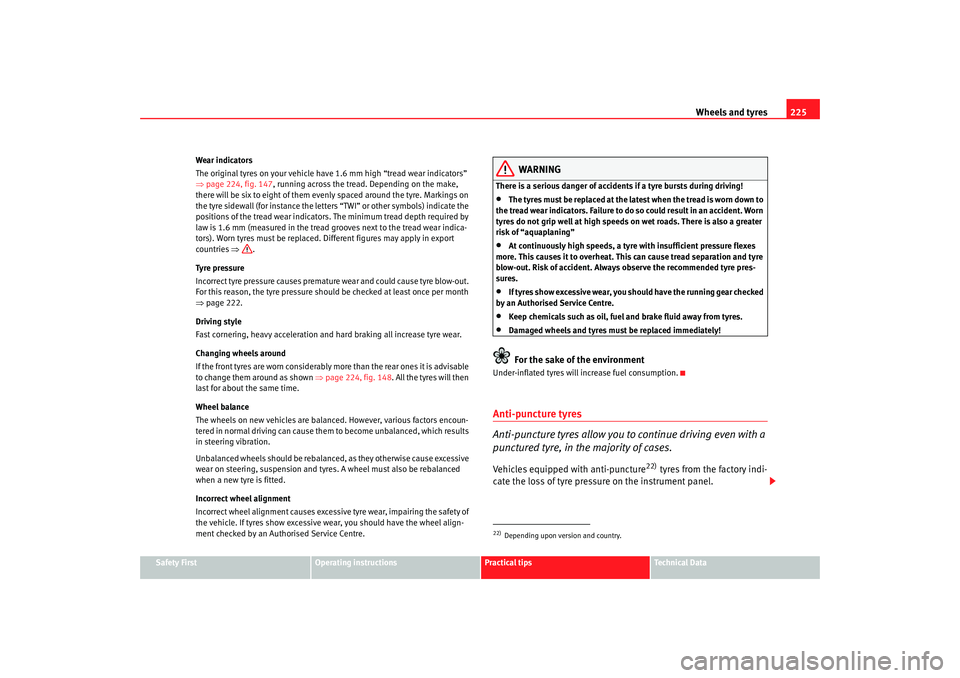
Wear indicators
The original tyres on your vehicle have 1.6 mm high “tread wear indicators”
⇒
page 224, fig. 147 , running across the tread. Depending on the make,
there will be six to eight of them evenly spaced around the tyre. Markings on
the tyre sidewall (for instance the letters “TWI” or other symbols) indicate the
positions of the tread wear indicators. The minimum tread depth required by
law is 1.6 mm (measured in the tread grooves next to the tread wear indica-
tors). Worn tyres must be replaced. Different figures may apply in export
countries ⇒.
Tyre pressure
Incorrect tyre pressure causes premature wear and could cause tyre blow-out.
For this reason, the tyre pressure should be checked at least once per month
⇒ page 222.
Driving style
Fast cornering, heavy acceleration and hard braking all increase tyre wear.
Changing wheels around
If the front tyres are worn considerably more than the rear ones it is advisable
to change them around as shown ⇒page 224, fig. 148 . All the tyres will then
last for about the same time.
Wheel balance
The wheels on new vehicles are balanced. However, various factors encoun-
tered in normal driving can cause them to become unbalanced, which results
in steering vibration.
Unbalanced wheels should be rebalanced, as they otherwise cause excessive
wear on steering, suspension and tyres. A wheel must also be rebalanced
when a new tyre is fitted.
Incorrect wheel alignment
Incorrect wheel alignment causes excessive tyre wear, impairing the safety of
the vehicle. If tyres show excessive wear, you should have the wheel align-
ment checked by an Authorised Service Centre.
WARNING
There is a serious danger of accidents if a tyre bursts during driving!•
The tyres must be replaced at the latest when the tread is worn down to
the tread wear indicators. Failure to do so could result in an accident. Worn
tyres do not grip well at high speeds on wet roads. There is also a greater
risk of “aquaplaning”
•
At continuously high speeds, a tyre with insufficient pressure flexes
more. This causes it to overheat. This can cause tread separation and tyre
blow-out. Risk of accident. Always observe the recommended tyre pres-
sures.
•
If tyres show excessive wear, you should have the running gear checked
by an Authorised Service Centre.
•
Keep chemicals such as oil, fuel and brake fluid away from tyres.
•
Damaged wheels and tyres must be replaced immediately!For the sake of the environment
Under-inflated tyres will increase fuel consumption.Anti-puncture tyres
Anti-puncture tyres allow you to continue driving even with a
punctured tyre, in the majority of cases.Vehicles equipped with anti-puncture
22)
tyres from the factory indi-
cate the loss of tyre pressure on the instrument panel.
22)Depending upon version and country.
leon_ingles Seite 225 Montag, 26. Januar 2009 4:29 16
Page 229 of 293
Wheels and tyres
228Wheel bolts
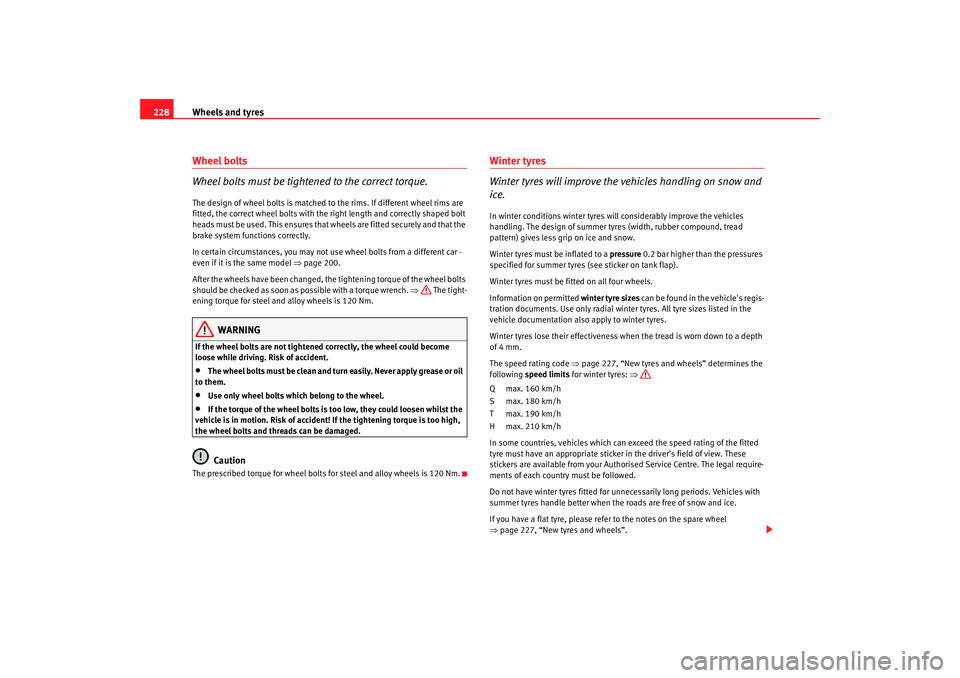
Wheel bolts must be tightened to the correct torque.The design of wheel bolts is matched to the rims. If different wheel rims are
fitted, the correct wheel bolts with the right length and correctly shaped bolt
heads must be used. This ensures that wheels are fitted securely and that the
brake system functions correctly.
In certain circumstances, you may not use wheel bolts from a different car -
even if it is the same model ⇒page 200.
After the wheels have been changed, the tightening torque of the wheel bolts
should be checked as soon as possible with a torque wrench. ⇒ The tight-
ening torque for steel and alloy wheels is 120 Nm.
WARNING
If the wheel bolts are not tightened correctly, the wheel could become
loose while driving. Risk of accident.•
The wheel bolts must be clean and turn easily. Never apply grease or oil
to them.
•
Use only wheel bolts which belong to the wheel.
•
If the torque of the wheel bolts is to o low, they could loosen whilst the
vehicle is in motion. Risk of accident! If the tightening torque is too high,
the wheel bolts and threads can be damaged.Caution
The prescribed torque for wheel bolts for steel and alloy wheels is 120 Nm.
Winter tyres
Winter tyres will improve the vehicles handling on snow and
ice.In winter conditions winter tyres will considerably improve the vehicles
handling. The design of summer tyres (width, rubber compound, tread
pattern) gives less grip on ice and snow.
Winter tyres must be inflated to a pressure 0.2 bar higher than the pressures
specified for summer tyres (see sticker on tank flap).
Winter tyres must be fitted on all four wheels.
Information on permitted winter tyre sizes can be found in the vehicle's regis-
tration documents. Use only radial winter tyres. All tyre sizes listed in the
vehicle documentation also apply to winter tyres.
Winter tyres lose their effectiveness when the tread is worn down to a depth
of 4 mm.
The speed rating code ⇒page 227, “New tyres and wheels” determines the
following speed limits for winter tyres: ⇒
Q max. 160 km/h
S max. 180 km/h
T max. 190 km/h
H max. 210 km/h
In some countries, vehicles which can exceed the speed rating of the fitted
tyre must have an appropriate sticker in the driver's field of view. These
stickers are available from your Authorised Service Centre. The legal require-
ments of each country must be followed.
Do not have winter tyres fitted for unnecessarily long periods. Vehicles with
summer tyres handle better when the roads are free of snow and ice.
If you have a flat tyre, please refer to the notes on the spare wheel
⇒ page 227, “New tyres and wheels”.
leon_ingles Seite 228 Montag, 26. Januar 2009 4:29 16
Page 266 of 293

Technical Data265
Safety First
Operating instructions
Practical tips
Te c h n i c a l D a t a
Trailer weights
Engine oil filling capacity
Petrol engine 1.4 92 kW (125 bhp)General engine data
Performance figures
Trailer without brakes
620
Trailer with brakes, gradients up to 8% 1200
Trailer with brakes, gradients up to 12% 1000
Approximate engine oil capacity with oil filter change 2.8 litres
Power output in kW (bhp) rpm 92 (125)/ 5000
Maximum torque in Nm at 1/min 200/ 1500-4000
No. of cylinders, capacity in cm
3
4/ 1390
Compression 10
Fuel Premium unleaded 95 RON or regular unleaded 91 RON
a)
a)With a slight power lossMaximum speedin km/h 197
Acceleration from 0-80 km/h in sec. 6,6
Acceleration from 0-100 km/h in sec. 9,8
leon_ingles Seite 265 Montag, 26. Januar 2009 4:29 16
Page 267 of 293

Technical Data
266Weights
Trailer weights
Engine oil filling capacityPetrol engine 1.6 75 kW (102 bhp)General engine data Gross vehicle weight
in kg 1819
Weight in working order (with driver) in kg 1324
Front gross axle weight in kg 969
Rear gross axle weight in kg 899
Permitted roof load in kg 75
Trailer without brakes 710
Trailer with brakes, gradients up to 8% 1500
Trailer with brakes, gradients up to 12% 1300
Approximate engine oil capacity with oil filter change 3.3 litres
Power output in kW (bhp) rpm 75 (102)/ 5600
Maximum torque in Nm at 1/min 148/ 3800
No. of cylinders, capacity in cm
3
4/ 1595
Compression 10,3 ± 0,5
Fuel Super Plus 98 RON or Premium 95 RON
a)
a)With a slight power loss
leon_ingles Seite 266 Montag, 26. Januar 2009 4:29 16
Page 268 of 293

Technical Data267
Safety First
Operating instructions
Practical tips
Te c h n i c a l D a t a
Performance figures
Weights
Trailer weights
Engine oil filling capacity
Maximum speed
in km/h 184
Acceleration from 0-80 km/h in sec. 7,8
Acceleration from 0-100 km/h in sec. 11,7
Gross vehicle weight in kg 1783
Weight in working order (with driver) in kg 1280
Front gross axle weight in kg 936
Rear gross axle weight in kg 890
Permitted roof load in kg 75
Trailer without brakes 640
Trailer with brakes, gradients up to 8% 1500
Trailer with brakes, gradients up to 12% 1200
Approximate engine oil capacity with oil filter change 4.1 litres
leon_ingles Seite 267 Montag, 26. Januar 2009 4:29 16
Page 270 of 293

Technical Data269
Safety First
Operating instructions
Practical tips
Te c h n i c a l D a t a
Trailer weights
Engine oil filling capacity
Petrol engine 1.8 118 kW (160 HP) AutomaticGeneral engine data
Performance figures
Trailer without brakes
670
Trailer with brakes, gradients up to 8% 1500
Trailer with brakes, gradients up to 12% 1400
Approximate engine oil capacity with oil filter change 4.6 litres
Power output in kW (HP) rpm 118 (160)/ 4500-6200
Maximum torque in Nm at rpm 250/ 1500-4500
No. of cylinders, capacity in cm
3
4/ 1798
Compression 9,6 -0,5
Fuel Premium unleaded 95 RON or regular unleaded 91 RON
a)
a)With a slight power lossMaximum speedin km/h 213
Acceleration from 0-80 km/h in sec. 5,5
Acceleration from 0-100 km/h in sec. 7,8
leon_ingles Seite 269 Montag, 26. Januar 2009 4:29 16
Page 271 of 293
Technical Data
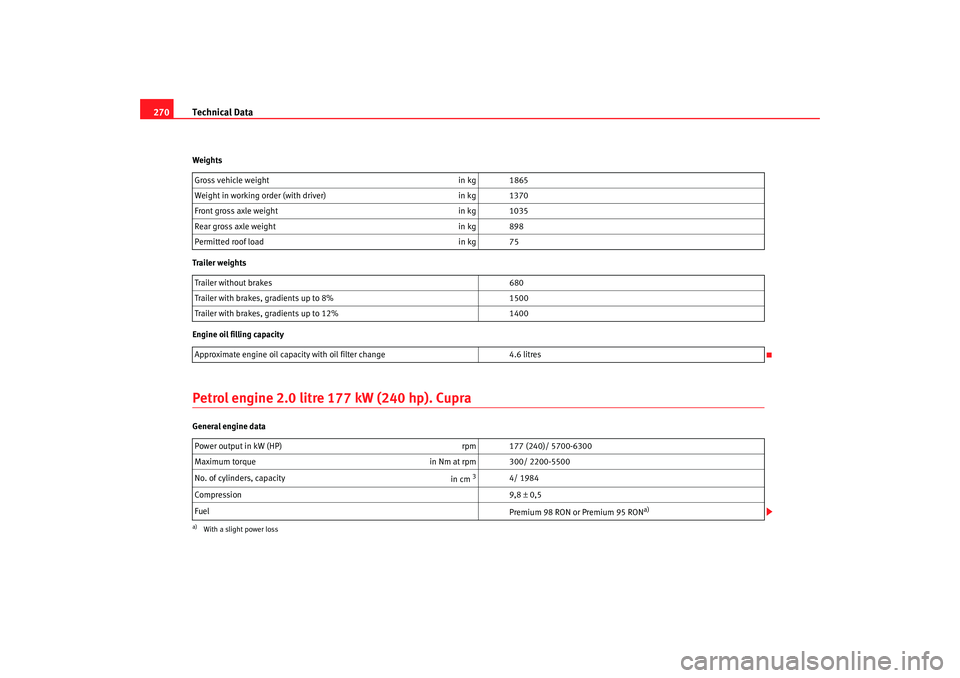
270Weights
Trailer weights
Engine oil filling capacityPetrol engine 2.0 litre 177 kW (240 hp). CupraGeneral engine data Gross vehicle weight
in kg 1865
Weight in working order (with driver) in kg 1370
Front gross axle weight in kg 1035
Rear gross axle weight in kg 898
Permitted roof load in kg 75
Trailer without brakes 680
Trailer with brakes, gradients up to 8% 1500
Trailer with brakes, gradients up to 12% 1400
Approximate engine oil capacity with oil filter change 4.6 litres
Power output in kW (HP) rpm 177 (240)/ 5700-6300
Maximum torque in Nm at rpm 300/ 2200-5500
No. of cylinders, capacity in cm
3
4/ 1984
Compression 9,8 ± 0,5
Fuel Premium 98 RON or Premium 95 RON
a)
a)With a slight power loss
leon_ingles Seite 270 Montag, 26. Januar 2009 4:29 16
Page 272 of 293
Technical Data271
Safety First
Operating instructions
Practical tips
Te c h n i c a l D a t a
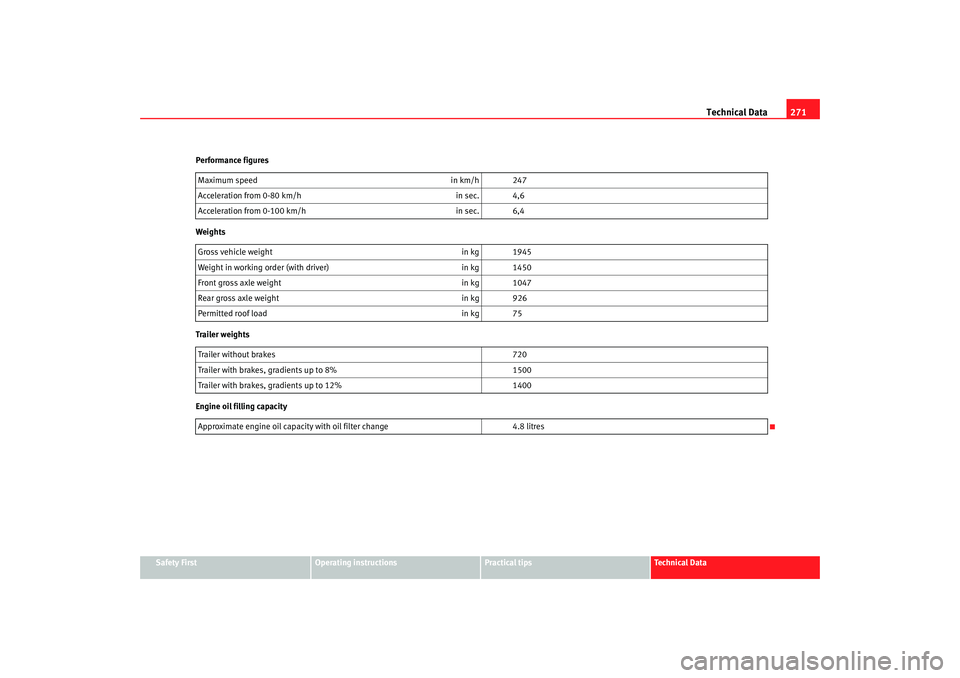
Performance figures
Weights
Trailer weights
Engine oil filling capacity
Maximum speed
in km/h 247
Acceleration from 0-80 km/h in sec. 4,6
Acceleration from 0-100 km/h in sec. 6,4
Gross vehicle weight in kg 1945
Weight in working order (with driver) in kg 1450
Front gross axle weight in kg 1047
Rear gross axle weight in kg 926
Permitted roof load in kg 75
Trailer without brakes 720
Trailer with brakes, gradients up to 8% 1500
Trailer with brakes, gradients up to 12% 1400
Approximate engine oil capacity with oil filter change 4.8 litres
leon_ingles Seite 271 Montag, 26. Januar 2009 4:29 16
Page 274 of 293
Technical Data273
Safety First
Operating instructions
Practical tips
Te c h n i c a l D a t a
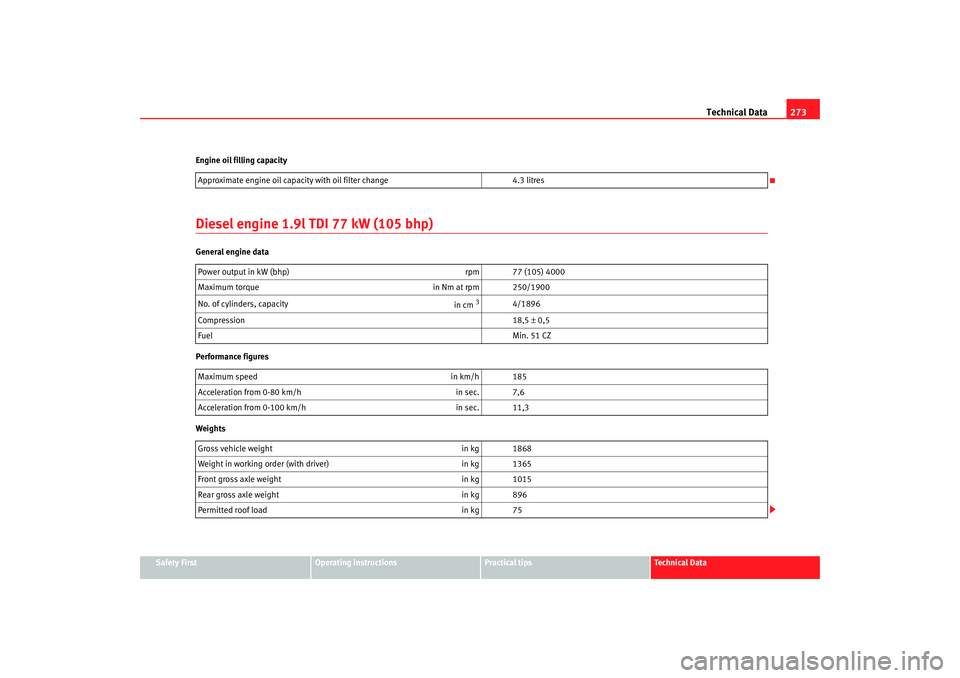
Engine oil filling capacity
Diesel engine 1.9l TDI 77 kW (105 bhp)General engine data
Performance figures
Weights
Approximate engine oil capacity with oil filter change
4.3 litres
Power output in kW (bhp) rpm 77 (105) 4000
Maximum torque in Nm at rpm 250/1900
No. of cylinders, capacity in cm
3
4/1896
Compression 18,5 ± 0,5
Fuel Min. 51 CZ
Maximum speed in km/h 185
Acceleration from 0-80 km/h in sec. 7,6
Acceleration from 0-100 km/h in sec. 11,3
Gross vehicle weight in kg 1868
Weight in working order (with driver) in kg 1365
Front gross axle weight in kg 1015
Rear gross axle weight in kg 896
Permitted roof load in kg 75
leon_ingles Seite 273 Montag, 26. Januar 2009 4:29 16
Page 275 of 293
Technical Data
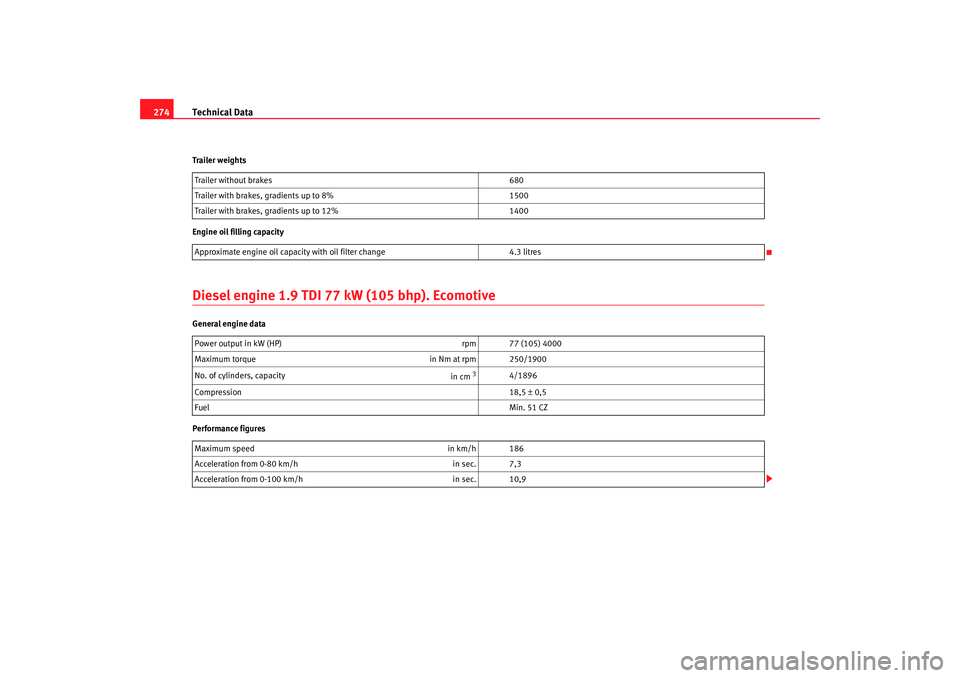
274Trailer weights
Engine oil filling capacityDiesel engine 1.9 TDI 77 kW (105 bhp). EcomotiveGeneral engine data
Performance figures Trailer without brakes
680
Trailer with brakes, gradients up to 8% 1500
Trailer with brakes, gradients up to 12% 1400
Approximate engine oil capacity with oil filter change 4.3 litres
Power output in kW (HP) rpm 77 (105) 4000
Maximum torque in Nm at rpm 250/1900
No. of cylinders, capacity in cm
3
4/1896
Compression 18,5 ± 0,5
Fuel Min. 51 CZ
Maximum speed in km/h 186
Acceleration from 0-80 km/h in sec. 7,3
Acceleration from 0-100 km/h in sec. 10,9
leon_ingles Seite 274 Montag, 26. Januar 2009 4:29 16