wheel Seat Leon 5D 2008 Manual PDF
[x] Cancel search | Manufacturer: SEAT, Model Year: 2008, Model line: Leon 5D, Model: Seat Leon 5D 2008Pages: 293, PDF Size: 8.67 MB
Page 237 of 293

If and when
236a large and stable base, if necessary. On a hard, slippery surface (such as
tiles) use a rubber mat or similar to prevent the jack from slipping.
WARNING
•
Take all precautions so that the base of the jack does not slip. Failure to
do so could result in an accident.
•
The vehicle can be damaged if the jack is not applied at the correct
jacking points. There is also a risk of injury since the jack can slip off
suddenly if it is not properly engaged.
Removing and fitting the wheel
For removal and fitting the wheel, the following tasks must be
completed.After loosening the wheel bolts and raising the vehicle with the jack,
cange the wheel as described below: Removing a wheel
– Unscrew the bolts using the
hexagonal tool in the handle of the
screwdriver (vehicle tool) and place them on a clean surface
⇒ fig. 154.
Fitting a wheel
– Screw in the wheel bolts and tighten them lightly using the hexagonal socket in the screwdriver handle.
The wheel bolts should be clean and easily screwed. Before fitting the spare
wheel, inspect the wheel condition and hub mounting surfaces. These
surfaces must be clean before fitting the wheel.
The hexagonal socket in the screwdriver handle makes it easier to turn the
wheel bolts. The reversible screwdriver blade should be removed when the
tool is used for this purpose.
If tyres with a specific di rection of rotation are fitt ed, note the direction of
rotation.
Note
Do not use the hexagonal socket in the screwdriver handle to loosen or
tighten the wheel bolts.
Fig. 154 Changing the
wheel: Hexagonal socket
in screwdriver handle to
turn the wheel bolts
leon_ingles Seite 236 Montag, 26. Januar 2009 4:29 16
Page 238 of 293

If and when237
Safety First
Operating instructions
Practical tips
Te c h n i c a l D a t a
Anti-theft wheel bolts
A special adapter is required to turn the anti-theft wheel
bolts.– Insert the adapter onto the wheel bolt and push it on as far as it
will go ⇒fig. 155 .
– Fit the box spanner as far as it will go over the adapter.
– Loosen or tighten the wheel bolt as appropriate.Error code
The code number of the anti-t heft wheel bolt is stamped onto the front part of
the adaptor.
The code number should be noted and kept in a safe place, as it is only by
using the code number that a duplicat e adaptor can be obtained from an
Authorised Service Centre.
Tyres with directional tread pattern
Tyres with directional tread pattern must be fitted so that they
rotate in the correct direction.A directional tread pattern can be ident ified by arrows on the sidewall that
point in the direction of rotation. Always note the direction of rotation indi-
cated when fitting the wheel. This is important so that these tyres can give
maximum grip and avoid excessive noise, tread wear and aquaplaning.
If, in an emergency, you have to mount the spare wheel so it rotates in the
wrong direction, you must drive extremel y carefully. The tyre will not give
optimum performance. This is particul arly important when driving on wet
roads.
To benefit from the advantages of tyres with this type of tread pattern, the
defective tyre should be replaced as soon as possible so that all tyres again
rotate in the correct direction.Tyre repair kit (Tyre-Mobility-System)*General information and safety notesYour vehicle is equipped with a tyre repair kit: the Tyre Mobility System.
In the event of a tyre puncture, a sealing compound and an air compressor are
located in the luggage compartment under the floor panel.
The Tyre Mobility System will reliably seal punctures caused by the penetra-
tion of a foreign body of up to about 4 mm in diameter.
It is not necessary to remove the foreign body from the tyre.
Instructions for the sealing compound are located on the sealing compound
container.
Fig. 155 Anti-theft wheel
bolt
leon_ingles Seite 237 Montag, 26. Januar 2009 4:29 16
Page 239 of 293
If and when
238Notes for the proper use of the air comp ressor are included in an additional
instruction leaflet.
WARNING
•
Do not attempt to repair a puncture with the sealing compound if the
tyre has been damaged by driving the car after the tyre has lost its air.
•
Always observe warnings and follow instructions concerning
compressor and sealing compound carefully.
•
Do not drive faster than 80 km/h, avoid heavy acceleration, hard
braking and fast cornering.
•
Tyres which have been repaired with sealing compound are only suit-
able for temporary use over a short period. Therefore, please drive carefully
to the next available qualified workshop.For the sake of the environment
Used sealing compound cont ainers should be disposed of at a proper facility.
Note
Seek professional assistance if the repair of a tyre puncture is not possible
with the sealing compound.Preparation work
Certain steps must be taken before repairing a tyre.– If you have a flat tyre or puncture, park the vehicle as far away
from the flow of traffic as possible.
–Apply the handbrake firmly. – Engage
first gear, or put the selector lever to position P.
– All passengers should leave the vehicle. They should wait in a
safe area (for instance behind the roadside crash barrier).
– Check whether a repair is possible using the Tyre Mobility System “General information and safety notes.”
– Unscrew inflation cap from the affected wheel.
–Take the tyre repair kit out of the luggage compartment.
WARNING
Put the hazard warning lights on and place the warning triangle in position.
This is for your own safety and also warns other road users.
Caution
Take special care if you have to repair a tyre on a slope.
Note
Please observe legal requirements when doing so.Tyre repair
The following sections describe the procedures for repairing
a tyre.Using the sealing compound
– The instructions on the container give detailed information on
how to use the sealing compound.
leon_ingles Seite 238 Montag, 26. Januar 2009 4:29 16
Page 241 of 293

If and when
240
Fuse cover underneath the steering wheel
– Switch off the ignition and the component concerned.
– Identify the fuse corresponding to the damaged electric consumer ⇒page 242.
– Take the plastic clip from inside the fuse cover, fit it onto the
blown fuse and pull the fuse out.
– Replace the blown fuse (which will have a melted metal strip) with a new fuse of the same ampere rating.
Fuse cover in engine compartment
– Switch off the ignition and its failed electrical component.
– Prise off the fuse cover in the engine compartment by pressing the tabs towards the centre of the cover ⇒page 239, fig. 157 .
– Identify the fuse for the failed component ⇒page 242.
– Take the plastic clip from inside the fuse cover (at left-hand end of the dash panel), fit it onto the blown fuse and pull the fuse out.
– Replace the blown fuse (which will have a melted metal strip) with a new fuse of the same ampere rating.
– Carefully fit the fuse cover back on to ensure no water can enter
the fuse box.The individual electrical circuits are pr otected by fuses. The fuses are located
behind a cover at the left-hand end of the dash panel and on the left-hand
side of the engine compartment. The electric windows are protected by circuit breakers
. These reset automat-
ically after a few seconds when the ov erload (caused for example by frozen
windows) has been corrected.
Fuses colour code
WARNING
Never “repair” damaged fuses and neve r replace them with fuses with a
higher rating. Failure to comply could result in fire. This could also cause
damage to other parts of the electrical system.
Note
•
If a newly replaced fuse blows again after a short time, the electrical
system must be checked by a qualifi ed workshop as soon as possible.
Colour
Amperes
light brown
5
Red
10
Blue
15
Yellow
20
Natural (white)
25
Green
30
orange
40
Red
50
white
80
Blue
100
grey
150
violet
200
leon_ingles Seite 240 Montag, 26. Januar 2009 4:29 16
Page 258 of 293

If and when257
Safety First
Operating instructions
Practical tips
Te c h n i c a l D a t a
Do not pull too hard with the towing vehi
cle and take care to avoid jerking the
tow-rope. When towing on an unpaved road, there is always a risk of over-
loading and damaging the anchorage points.
The ignition of the vehicle being towed must be switched on to prevent the
steering wheel from locking and also to allow the use of the turn signals,
horn, windscreen wipers and washers.
As the brake servo does not work if th e engine is not running, you must apply
considerably more pressure to the brake pedal than you normally would.
As the power assisted steering does not wo rk if the engine is not running, you
will need more strength to steer than you normally would.
Towing vehicles with an automatic gearbox
•
Put the selector lever into position “N”.
•
Do not drive faster than 50 km/h when towing a vehicle.
•
Do not tow further than 50 km.
•
If a breakdown vehicle is used, the vehicle must be towed with the front
wheels raised.Note
•
Observe legal requirements when towing or tow-starting.
•
Switch on the hazard warning lights of both vehicles. However, observe
any regulations to the contrary.
•
For technical reasons, vehicles with an automatic gearbox must not be
tow-started.
•
If damage to your vehicle means that there is no lubricant in the gearbox,
you must raise the drive wheels while the vehicle is being towed.
•
If the vehicle has to be towed more than 50 km, the front wheels must be
raised during towing, and towing should be carried out by a qualified person.
•
The steering wheel is locked when the vehicle has no electrical power. The
vehicle must then be towed with the front wheels raised. Towing should be
carried out by a qualified person.
•
The towing eye should always be kept in the vehicle. Please refer to the
notes on ⇒page 256.
Trailer eyes
Fig. 177 The front right
section of the vehicle:
Fitting the front towing
eyeFig. 178 Fitting the
towing eye to the rear of
the vehicle
leon_ingles Seite 257 Montag, 26. Januar 2009 4:29 16
Page 261 of 293

General notes on the technical data
260Vehicle identification data
The most important data are given on the type plate and the
vehicle data sticker.Vehicles for certain export countries do not have a type plate.
Type plate
The type plate is located on the left rib inside the engine compartment.
Vehicle identification number
The vehicle identification number (chass is number) can be read from outside
the vehicle through a viewer in the windscreen. This is located on the left-
hand side of the vehicle in the lower area of the windscreen. It is also located
on the right hand side of the engine compartment. Vehicle data
The data sticker is placed on the inside of the spare wheel recess in the
luggage compartment.
The following information is provided on the vehicle data sticker:
⇒fig. 179 .
These data are also provided in the Maintenance Program. Production control number
Vehicle identification number (chassis number)
Model code number
Model designation / engine power output
Engine and gearbox code letters
Paintwork number / interior trim code
Optional equipment codes
Consumption values
CO
2 emissions values
Data from 2 to 9 are also provided in the Maintenance Program.
Consumption figures and CO
2
Consumption (litres/100 km) / CO
2 emissions (g/km) urban
Consumption (litres/100 km) / CO2 emissions (g/km) motorway
Consumption (l/100 km) / CO
2 Emissions (g/km) mixed
Fig. 179 Vehicle data
sticker – boot
A1A2A3A4A5A6A7A8A9AAABAC
leon_ingles Seite 260 Montag, 26. Januar 2009 4:29 16
Page 263 of 293

General notes on the technical data
262To w i n g a t r a i l e rTrailer weightsTrailer weights
The trailer weights and drawbar loads approved are selected in intensive
trials according to precisely defined criteria. The approved trailer weights are
valid for vehicles in the EU for maximum speeds of 80 km/h (in certain
circumstances up to 100 km/h). The figu res may be different in other coun-
tries. All data in the official vehicl e documents take precedence over these
data ⇒ .
Drawbar load
The maximum permitted weight exerted by the trailer drawbar on the ball joint
of the towing bracket must not exceed 75 kg.
In the interest of road safety, we recommend that you always tow
approaching the maximum drawbar load. The response of the trailer on the
road will be poor if the drawbar load is too small.
If the maximum permissible drawbar loa d cannot be met (e.g. with small,
empty and light-weight single axle trailers or tandem axle trailers with an axle
base of less than 1 metre), at least 4% of the actual trailer weight is a legal
stipulation for a drawbar load.
WARNING
•
For safety reasons, do not exceed the 80 km/h limit. This is also valid in
countries where higher speeds are permitted.
•
Never exceed the maximum trailer weights or the draw bar loading. If
the permissible axle load or the permissible total weight is exceeded, the
driving characteristics of the vehicle may change, leading to accidents,
injuries and damage to the vehicle.
WheelsTyre pressure, snow chains, wheel boltsTyre pressures
The sticker with the tyre pressure values can be found on the inside of the
tank flap. The tyre pressure values given there are for cold tyres. The slightly
raised pressures of warm tyres must not be reduced ⇒.
Snow chains
Snow chains may be fitted only to the front wheels.
Consult the chapter “wheels” of this manual.
Wheel bolts
After the wheels have been changed, the tightening torque of the wheel bolts
should be checked as soon as possible with a torque wrench ⇒. The tight-
ening torque for steel and alloy wheels is 120 Nm.
WARNING
•
Check the tyre pressure at least once per month. Checking tyre pressure
value is very important. If the tyre pressure is too high or too low, there is
an increased danger of accidents, particularly at high speeds.
•
If the torque of the wheel bolts is too low, they could loosen while the
vehicle is in motion. Risk of accident! If the tightening torque is too high,
the wheel bolts and threads can be damaged.Note
We recommend that you ask your Authorised Service Centre for information
about appropriate wheel, tyre and snow chain size.
leon_ingles Seite 262 Montag, 26. Januar 2009 4:29 16
Page 282 of 293
Technical Data281
Safety First
Operating instructions
Practical tips
Te c h n i c a l D a t a
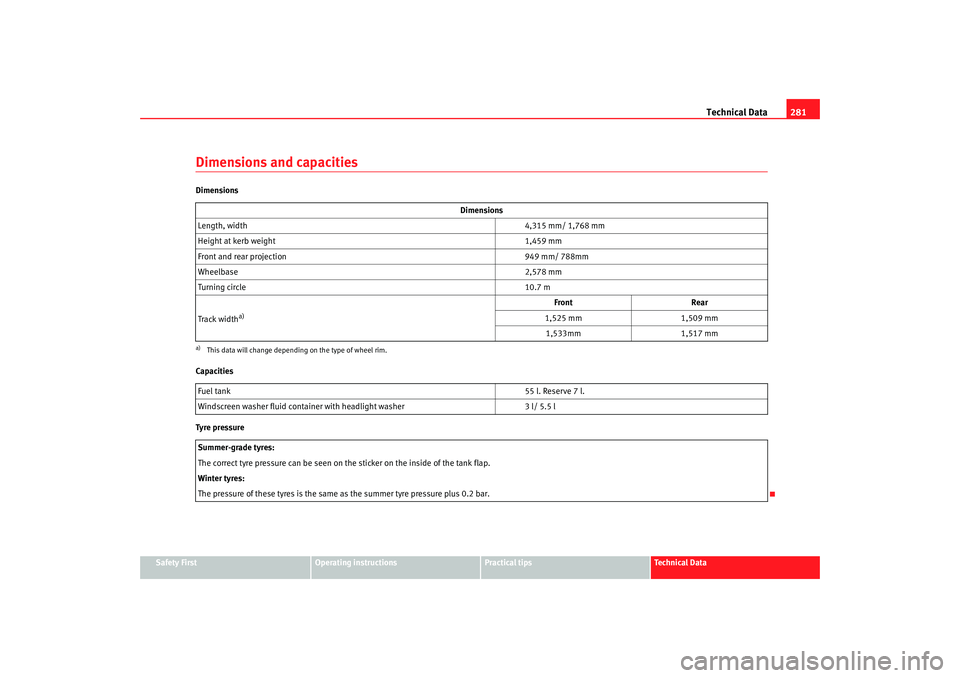
Dimensions and capacitiesDimensions
Capacities
Tyre pressure Dimensions
Length, width 4,315 mm/ 1,768 mm
Height at kerb weight 1,459 mm
Front and rear projection 949 mm/ 788mm
Wheelbase 2,578 mm
Turning circle 10.7 m
Track width
a)
a)This data will change depending on the type of wheel rim.
Front Rear
1,525 mm 1,509 mm
1,533mm 1,517 mm
Fuel tank 55 l. Reserve 7 l.
Windscreen washer fluid container with headlight washer 3 l/ 5.5 l
Summer-grade tyres:
The correct tyre pressure can be seen on the sticker on the inside of the tank flap.
Winter tyres:
The pressure of these tyres is the same as the summer tyre pressure plus 0.2 bar.
leon_ingles Seite 281 Montag, 26. Januar 2009 4:29 16
Page 284 of 293

Index283
Index
AABS . . . . . . . . . . . . . . . . . . . . . . . . . . . . . . . . . . . 176
Warning lamp . . . . . . . . . . . . . . . . . . . . . . . . . 77
Accessories . . . . . . . . . . . . . . . . . . . . . . . . . . . . 200
Acoustic signal . . . . . . . . . . . . . . . . . . . . . . . . . . 19
Acoustic warning . . . . . . . . . . . . . . . . . . . . . . . . 156
Adjusting the seat belt height . . . . . . . . . . . . . . 26
AFS (curve lights) . . . . . . . . . . . . . . . . . . . . . . . . 113
Air conditioner* 2C-Climatronic* . . . . . . . . . . . . . . . . . . . . . . 148
Air conditioning system General notes . . . . . . . . . . . . . . . . . . . . . . . . 152
Air conditioning* . . . . . . . . . . . . . . . . . . . . . . . . 144
Air recirculation mode 2C-Climatronic . . . . . . . . . . . . . . . . . . . . . . . 152
Manual air conditioning . . . . . . . . . . . . . . . 146
Airbag covers . . . . . . . . . . . . . . . . . . . . . . . . . . . . 35
Airbag system . . . . . . . . . . . . . . . . . . . . . . . . . . . 29 Curtain airbags . . . . . . . . . . . . . . . . . . . . . . . 40
front airbags . . . . . . . . . . . . . . . . . . . . . . . . . . 33
Side airbags . . . . . . . . . . . . . . . . . . . . . . . . . . 36
Warning lamp . . . . . . . . . . . . . . . . . . . . . . . . . 30
Alarm system Switching off . . . . . . . . . . . . . . . . . . . . . . . . 100
Alternator Warning lamp . . . . . . . . . . . . . . . . . . . . . . . . . 78
Ambient temperature display . . . . . . . . . . . . 62, 69 Anti-freeze . . . . . . . . . . . . . . . . . . . . . . . . . . . . . 212
Anti-lock brake system . . . . . . . . . . . . . . . . . . . 176
Warning lamp . . . . . . . . . . . . . . . . . . . . . . . . . 77
Anti-puncture tyres . . . . . . . . . . . . . . . . . . . . . . 225
Anti-theft alarm system . . . . . . . . . . . . . . . . . . . 100 Switching off . . . . . . . . . . . . . . . . . . . . . . . . 100
Anti-theft wheel bolts . . . . . . . . . . . . . . . . . . . . 234
Aquaplaning . . . . . . . . . . . . . . . . . . . . . . . . . . . 225
Ashtray* . . . . . . . . . . . . . . . . . . . . . . . . . . . . . . . 135
Aspects to take into account before starting the vehicle . . . . . . . . . . . . . . . . . . . . . . . . . . . . . . 8
Automatic anti-dazzle interior mirror* Activating the anti-dazzle function . . . . . . 124
Deactivating anti-dazzle function . . . . . . . . 124
Automatic car wash tunnel . . . . . . . . . . . . . . . . 192
Automatic gearbox / DS G automatic gearbox . 161
Automatic lighting . . . . . . . . . . . . . . . . . . . . . . . 110
Automatic mode 2C-Climatronic . . . . . . . . . . . . . . . . . . . . . . . 150
Automatic wiper/wash function for the rear window 122
Auxiliary audio connection: AUX-IN . . . . . . . . . 137
BBall coupling . . . . . . . . . . . . . . . . . . . . . . . . . . . 188
BAS . . . . . . . . . . . . . . . . . . . . . . . . . . . . . . . . . . . 175 Battery
Changing . . . . . . . . . . . . . . . . . . . . . . . . . . . 220
Charging . . . . . . . . . . . . . . . . . . . . . . . . . . . . 220
Winter conditions . . . . . . . . . . . . . . . . . . . . 219
Before starting the vehicle . . . . . . . . . . . . . . . . . . 8
Belt tension device Disposal . . . . . . . . . . . . . . . . . . . . . . . . . . . . . 27
Warning lamp . . . . . . . . . . . . . . . . . . . . . . . . 30
Belt tension devices . . . . . . . . . . . . . . . . . . . . . . 27
Biodiesel . . . . . . . . . . . . . . . . . . . . . . . . . . . . . . 204
Biodiesel fuel . . . . . . . . . . . . . . . . . . . . . . . . . . . 204
Bonnet . . . . . . . . . . . . . . . . . . . . . . . . . . . . . . . . 207
Boot . . . . . . . . . . . . . . . . . . . . . . . . . . . . . . . . . . 139
Brake assist system . . . . . . . . . . . . . . . . . . . . . 175
Brake fluid . . . . . . . . . . . . . . . . . . . . . . . . . . . . . 217 Brake fluid . . . . . . . . . . . . . . . . . . . . . . . . . . . 63
Changing . . . . . . . . . . . . . . . . . . . . . . . . . . . 218
Brake pads . . . . . . . . . . . . . . . . . . . . . . . . . . . . . 182
Brake servo . . . . . . . . . . . . . . . . . . . . . . . 175, 182
Brake system . . . . . . . . . . . . . . . . . . . . . . . . . . . 217 Brake servo . . . . . . . . . . . . . . . . . . . . . . . . . 180
Brakes . . . . . . . . . . . . . . . . . . . . . . . . . . . . . 180
Warning lamp . . . . . . . . . . . . . . . . . . . . . . . . 79
Brakes . . . . . . . . . . . . . . . . . . . . . . . . . . . . . . . . 182
Braking distance . . . . . . . . . . . . . . . . . . . . . . . . 182
Bulb changes general notes . . . . . . . . . . . . . . . . . . . . . . . . 244
leon_ingles Seite 283 Montag, 26. Januar 2009 4:29 16
Page 285 of 293

Index
284Bulb defect
warning lamp . . . . . . . . . . . . . . . . . . . . . . . . . 80
Buzzer . . . . . . . . . . . . . . . . . . . . . . . . . . . . 116, 156CCar care Exterior . . . . . . . . . . . . . . . . . . . . . . . . . . . . . 192
Catalytic converter . . . . . . . . . . . . . . . . . . . . . . 183
Central locking . . . . . . . . . . . . . . . . . . . . . . . . . . 91 Automatic locking system for involuntary unlocking . . . . . . . . . . . . . . . . . . . . . . . . . . 93
Automatic speed dependent locking and un- locking system* . . . . . . . . . . . . . . . . . . . . . 93
Emergency unlocking system . . . . . . . . . . . . 93
Selective unlocking system* . . . . . . . . . . . . 92
Unlocking system* . . . . . . . . . . . . . . . . . . . . 93
Central locking button Central locking . . . . . . . . . . . . . . . . . . . . . . . 94
unlocking . . . . . . . . . . . . . . . . . . . . . . . . . . . . 94
Centre console with drinks holder . . . . . . . . . . 133
Cetane number . . . . . . . . . . . . . . . . . . . . . . . . . 204
Changing gear See Manual gearbox . . . . . . . . . . . . . . . . . . 160
Changing the lamps Main headlight lamps . . . . . . . . . . . . . . . . . 245
rear lights . . . . . . . . . . . . . . . . . . . . . . . . . . . 248
Changing the main headlight lamps
dipped beam lights . . . . . . . . . . . . . . . . . . . 246
main beam lights . . . . . . . . . . . . . . . . . . . . 247
Side lights . . . . . . . . . . . . . . . . . . . . . . . . . . 248
turn signal lamps . . . . . . . . . . . . . . . . . . . . 246 Changing the rear light lamps
Position light, fog ligh t and rear light on the
tailgate . . . . . . . . . . . . . . . . . . . . . . . . . . . 249
Changing the rear lights Indicator, side and brake lights on the bodywork . . . . . . . . . . . . . . . . . . . . . . . . . 249
luggage compartment lights . . . . . . . . . . . 251
Chassis number . . . . . . . . . . . . . . . . . . . . . . . . 260
Checking . . . . . . . . . . . . . . . . . . . . . . . . . . . . . . 220
Checking battery electrolyte level . . . . . . . . . . 220
Checking engine oil level . . . . . . . . . . . . . . . . . 209
Child safety . . . . . . . . . . . . . . . . . . . . . . . . . . . . . 45
Child seat . . . . . . . . . . . . . . . . . . . . . . . . . . . . . . . 47 Categorisation in groups . . . . . . . . . . . . . . . 47
Group 1 . . . . . . . . . . . . . . . . . . . . . . . . . . . . . 48
Group 2 . . . . . . . . . . . . . . . . . . . . . . . . . . . . . 48
Group 3 . . . . . . . . . . . . . . . . . . . . . . . . . . . . . 48
Groups 0 and 0+ . . . . . . . . . . . . . . . . . . . . . . 47
ISOFIX system . . . . . . . . . . . . . . . . . . . . . . . . 50
Safety notes . . . . . . . . . . . . . . . . . . . . . . . . . . 46
Securing . . . . . . . . . . . . . . . . . . . . . . . . . . . . . 49
Child seats on the front passenger seat . . . . . . . . . . . . . 30
Cigarette lighter* . . . . . . . . . . . . . . . . . . . . . . . . 136
Cleaning alloy wheel rims . . . . . . . . . . . . . . . . 196
Cleaning and caring for your vehicle . . . . . . . . 191
Cleaning chrome . . . . . . . . . . . . . . . . . . . . . . . . 195
Cleaning engine compartment . . . . . . . . . . . . . 197
Cleaning steel wheel rims . . . . . . . . . . . . . . . . 196
Cleaning windows . . . . . . . . . . . . . . . . . . . . . . . 194
Climatic* . . . . . . . . . . . . . . . . . . . . . . . . . . . . . . 144 Climatronic
General notes . . . . . . . . . . . . . . . . . . . . . . . 152
Clock . . . . . . . . . . . . . . . . . . . . . . . . . . . . . . . . . . 57
Cloth seat covers cleaning . . . . . . . . . . . . . . . . 198
Clothes hook . . . . . . . . . . . . . . . . . . . . . . . . . . . 134
Cockpit . . . . . . . . . . . . . . . . . . . . . . . . . . . . . . . . . 53
Control lamps . . . . . . . . . . . . . . . . . . . . . . . . . . . 73
Control lighting . . . . . . . . . . . . . . . . . . . . . . . . . . 53
Controls Electric windows . . . . . . . . . . . . . . . . . . . . . 104
Light switches . . . . . . . . . . . . . . . . . . . . . . . 109
Convenience closing Sliding/tilting roof . . . . . . . . . . . . . . . . . . . 107
Windows . . . . . . . . . . . . . . . . . . . . . . . . . . . 106
Convenience opening Windows . . . . . . . . . . . . . . . . . . . . . . . . . . . 106
Coolant . . . . . . . . . . . . . . . . . . . . . . . . . . . 212, 213 Coolant . . . . . . . . . . . . . . . . . . . . . . . . . . . . . 63
Coolant Level . . . . . . . . . . . . . . . . . . . . . . . . . . . 213
Coolant level warning light . . . . . . . . . . . . . . . . . . . . . . . . . 75
Coolant Loss . . . . . . . . . . . . . . . . . . . . . . . . . . . 213
Coolant temperature Display . . . . . . . . . . . . . . . . . . . . . . . . . . . . . . 56
Safety instructions . . . . . . . . . . . . . . . . . . . . 76
Cruise control system . . . . . . . . . . . . . . . . . . . . 170 Warning lamp . . . . . . . . . . . . . . . . . . . . . . . . 80
Cruise control* Turning off the cruise control system . . . . 173
leon_ingles Seite 284 Montag, 26. Januar 2009 4:29 16