abs Seat Leon 5D 2013 User Guide
[x] Cancel search | Manufacturer: SEAT, Model Year: 2013, Model line: Leon 5D, Model: Seat Leon 5D 2013Pages: 339, PDF Size: 4.8 MB
Page 244 of 339
242Care and cleaning
Car polish or other abrasive agents should not be used for maintaining the
rims. If the protective coating is damaged, e.g. by stone impact, the dam-
aged area should be touched up immediately.
WARNING
Please note when cleaning the wheels that water, ice and road salt can
impair the effectiveness of the brakes; this can cause an accident.
Exhaust tail pipe
It is important to remove road salt and brake dust by washing the wheels at
regular intervals, otherwise the exhaust tail pipe material could be dam-
aged. To remove impurities, do not use rim, paint or chrome cleaners or oth-
er abrasive products. Clean the exhaust tail pipes with cleaning products
that are suitable for stainless steel.
SEAT Official Services carry stocks of cleaning products that have been tes-
ted and approved for use on your vehicle.
Care of the vehicle interior Radio display/Easy Connect* and control panel*
The display can be cleaned with a soft cloth and a professionally available
“LCD cleaner”. Moisten the cloth with a small amount of the cleaning fluid.
The Easy Connect control panel* should first be cleaned with a brush so
that no dirt goes into the device or between the keys and housing. Next, we
recommend cleaning the Easy Connect control panel* using a cloth damp-
ened with water and washing-up liquid.
CAUTION
● To avoid scratching the screen, do not wipe the display with a dry cloth.
● To avoid damage, ensure that no liquid goes into the Easy Connect con-
trol panel*.
Plastic and leatherette parts
Plastic parts and leatherette can be cleaned with a damp cloth. If this is not
sufficient, plastic parts and leatherette should only be treated with a special
solvent-free plastic cleaner .
Textile covers and trim parts
Textile covers and trim parts (e.g. seats, door trim) should be cleaned regu-
larly with a vacuum cleaner. This will remove surface dirt which could other-
wise be rubbed into the textile material during use. Do not use steam clean-
ers, as the steam could carry the dirt deeper into the textile material.
Normal cleaning
We recommend that you use a soft sponge or a commercially available lint-
free, micro-fibre cloth for normal cleaning. Only use brushes on floor cover-
ings and mats, as other textile surfaces could become damaged.
In the case of normal surface dirt you can use a foam cleaner. Use a sponge
to spread the foam on the textile surface and to work it into the material
lightly. However, make sure that the textile material does not become soak-
ing wet. Then dab off the foam with a dry and absorbent cloth (e.g. a micro-
fibre cloth) and vacuum off any residue once the surface is completely dry.
Cleaning stains
Treat drink stains (such as coffee or fruit juice, etc.) with a cleaning solution
for delicate fabrics. The cleaning product solution should be applied with a
Page 245 of 339
243
Care and cleaning
sponge. If the stains are difficult to remove, a washing paste can be applied
directly onto the stain and worked into the fabric. The surface will then have
to be wiped with clear water to remove any residue left by the paste. To do
so, use a damp cloth or sponge and then dab the stain with an absorbent
cloth.
Remove chocolate or make-up stains with a cleaning paste (for e.g., soft
soap). Then remove the soap with water (wet sponge).
A spirit-based cleaner can be used to remove grease, oil, lipstick or ball
point pen. Then dab the dissolved grease or colour particles off with an ab-
sorbent cloth or similar. You may also have to treat the stain once more us-
ing washing paste and water.
If the covers or textile trim panels are badly soiled we recommend that you
have them cleaned by a professional cleaning company with a shampoo
and spray.
Note
Open Velcro fasteners on clothes can damage the seat upholstery. Make
sure that Velcro fasteners are closed.
Natural leather
SEAT does everything possible to preserve the genuine qual-
ities of this natural product. General information
Our range of leathers is large. The main type used is nappa in various forms,
that is, leather with a smooth surface in various different colours.
The amount of dye used determines the appearance and properties of leath-
er. If the leather is left in a more natural state, it retains its typical natural
napped appearance and confers excellent all-weather properties to the
seats. Fine veins, healed scars, insect bites, wrinkles and a subtle variation in shading remain visible; these are the characteristic features of genuine
natural leather.
Natural napped leather does not have a protective surface coating of dye. It
is therefore somewhat more prone to damage. This should be borne in mind
if children or pets often travel in the car, or if there are other factors that
could lead to damage.
Types of leather with a coloured surface coating are likely to be more resist-
ant to damage. This has a great advantage for day-to-day use. However, this
means that the typical natural characteristics of the surface are less appa-
rent, though this does not affect quality.
Cleaning and care
Due to the natural properties of the specially selected hides employed, the
finished leather has a certain sensitivity to grease and dirt, etc. so a degree
of care is required in everyday use and when looking after the leather. Dark
clothing (especially if damp or incorrectly dyed) may stain leather uphols-
tery. Dust and grit in the pores and seams can scratch and damage the sur-
face. Therefore leather should be cleaned at regular intervals, depending on
the actual amount of use. When they have been in use for a certain time,
your car seats will acquire a typical and unmistakable patina. This is charac-
teristic for leather as a natural product and is a sign of genuine quality.
To maintain the value of natural leather you should note the following
points:CAUTION
● Avoid exposing leather to direct sunlight for long periods, otherwise it
may tend to lose some of its colour. If the car is left for a prolonged period
in the bright sun, it is best to cover the leather.
● Sharp-edged objects on clothing, such as belts, zip fasteners, rivets or
similar, can also leave permanent scratches and rough marks on the surface
of the leather.
Safety FirstOperating instructionsPractical TipsTechnical specifications
Page 246 of 339
244Care and cleaning
Note
● Use a suitable impregnating cream with ultra-violet protection at regular
intervals and after cleaning. The cream nourishes and moisturises the leath-
er, keeps it supple and able to breathe. It will also form a protective film.
● Clean the leather every 2 to 3 months and remove fresh dirt as soon as
possible.
● Remove stains from fresh ball-pen and other inks, lipstick, shoe cream
and similar stains as soon as possible.
● Preserve the colour of the leather. A special coloured cream will renew
the colour of the leather when required and will eliminate differences in col-
our.
Cleaning and care of leather upholstery
Natural leather requires an extra degree of attention and
care.
Normal cleaning
– Moisten a cotton or woollen cloth with water and wipe over the
leather surfaces.
More stubborn dirt
– More stubborn dirt can be removed using a mild soap solution
(pure liquid soap: two tablespoons dissolved in one litre of wa-
ter).
– Do not let the water soak through the leather or penetrate into
the seams.
– Then wipe off with a soft, dry cloth. Removal of stains
–
Remove fresh water-based stains such as coffee, tea, juices,
blood etc. with an absorbent cloth or kitchen roll, dried-on
stains with the cleaning agent from the care set.
– Remove fresh fat-based stains that have not penetrated the sur-
face such as butter, mayonnaise, chocolate, etc. with an ab-
sorbent cloth or kitchen roll or with the cleaning agent from the
care set.
– Treat fat-based, dried-in stains with grease-dissolving spray.
– Treat less common stains such as ball-pen and other inks, felt-
tip pens, nail polish, dispersion paint, shoe cream etc. with a
special leather stain remover.
Leather maintenance
– The leather should be treated regularly (about twice a year) with
a special leather-care product.
– Apply these products very sparingly.
– Then wipe off with a soft, dry cloth.
Should you have questions regarding the care and cleaning of the leather
upholstery in your vehicle, we recommend that you contact your SEAT Offi-
cial Service. Our representatives will be happy to advise you and tell you
about the product range for leather conservation, for example:
● Cleaning and care set
● Coloured leather-care cream
● Stain remover for ball-pen inks, shoe cream etc.
● Grease dissolving spray
● New products and further developments
Page 254 of 339

252Checking and refilling levels
WARNING (Continued)
● Protect face, hands and arms by covering the cap with a large, thick
rag to protect against escaping coolant and steam.
● If it is necessary to work in the engine compartment while the engine
is running, the rotating components (for example, poly-V belt, alternator,
radiator fan) and the high voltage ignition system are an additional haz-
ard.
● Observe the following additional warnings if work on the fuel system
or the electrical system is necessary:
–Always disconnect the battery from the on-board network.
– Do not smoke.
– Never work near naked flames.
– Always keep an approved fire extinguisher immediately available.
CAUTION
When changing or topping up service fluids, make absolutely certain that
you fill the fluids into the correct reservoirs. Using the wrong fluids could
cause serious malfunctions and engine damage!
For the sake of the environment
Inspect the ground underneath your vehicle regularly so that any leaks are
detected at an early stage. If you find spots of oil or other fluids, have your
vehicle inspected at the workshop.
Note
On right-hand drive vehicles* some of the containers/reservoirs mentioned
below are located on the other side of the engine compartment. Opening the bonnet
The bonnet is released from inside the vehicle.
Fig. 153 Release lever in driver footwell and cam below the bonnet
Check that the windscreen wiper arms are not unfolded. Otherwise
the paint may be damaged.
The bonnet can only be unlocked when the driver door is open.
– Pull the lever under the dash panel in the direction of the arrow
1
⇒ Fig. 153.
– Lift the bonnet slightly ⇒
.
– Press the release catch under the bonnet upwards ⇒ Fig. 153
2
. This will release the arrester hook under the bonnet.
– Open the bonnet. Release the bonnet stay and secure it in fix-
ture designed for this in the bonnet.
Page 276 of 339
274Emergencies
Emergencies
General information
– If you have a flat tyre or puncture, park the car as far away from
the flow of traffic as possible in a safe place. If you have a punc-
ture, stop the vehicle on a horizontal surface. If you are on a
slope, take extra care.
– Apply the handbrake.
– Switch on the hazard warning lights.
– Always wear a reflective vest ⇒ page 274.
– Set up the warning triangle.
– All vehicle occupants should leave the car. They should wait in
a safe place (for instance behind the roadside crash barrier).
WARNING
Always observe the above steps and protect yourself and other road
users.
Equipment
Reflective vests
Wearing a reflective vest makes you more visible to other road
users.
Note
● Always wear a reflective vest when you get out of the vehicle in moving
traffic (for example, in the event of breakdown or to load/unload the vehi-
cle).
● Observe the applicable legislation for each country.
Vehicle tools/Tyre repair kit/Compressor*
The vehicle tools, the tyre repair kit and the compressor* are stor-
ed under the floor panel in the luggage compartment.
To access the vehicle tools:
– Lift up the floor panel by the plastic handle until it is fastened to
the tabs on both sides.
Depending on the vehicle equipment, you will find the tyre repair set and
the compressor* under the floor panel cover.
Page 294 of 339
292Fuses and bulbs
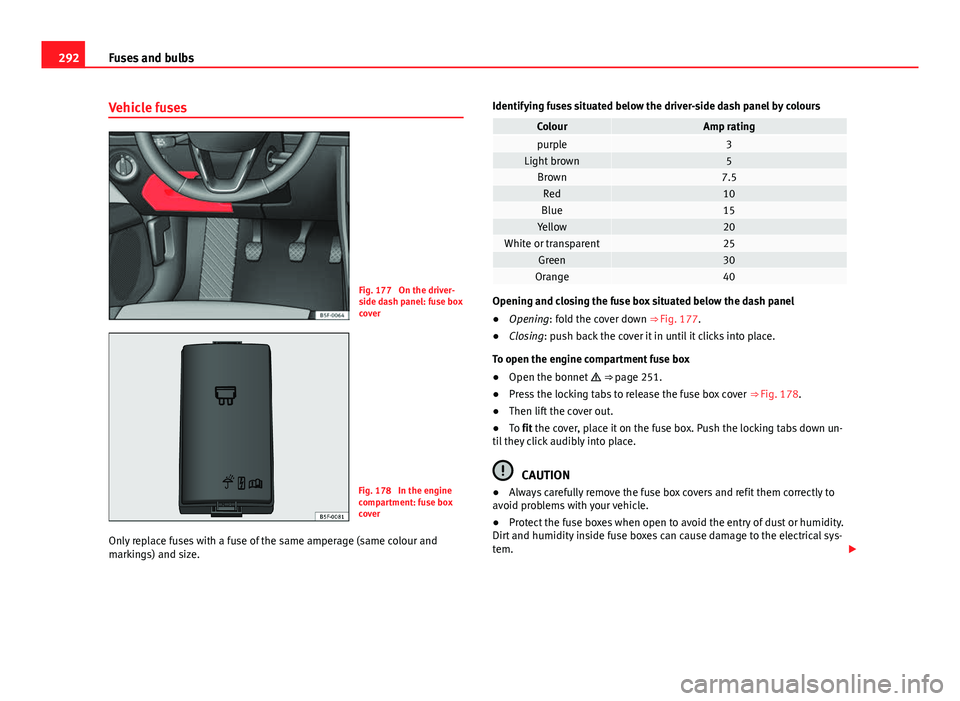
Vehicle fuses
Fig. 177 On the driver-
side dash panel: fuse box
cover
Fig. 178 In the engine
compartment: fuse box
cover
Only replace fuses with a fuse of the same amperage (same colour and
markings) and size. Identifying fuses situated below the driver-side dash panel by colours
ColourAmp ratingpurple3Light brown5Brown7.5Red10Blue15Yellow20White or transparent25Green30Orange40
Opening and closing the fuse box situated below the dash panel
●
Opening: fold the cover down ⇒ Fig. 177.
● Closing: push back the cover it in until it clicks into place.
To open the engine compartment fuse box
● Open the bonnet ⇒ page 251.
● Press the locking tabs to release the fuse box cover ⇒ Fig. 178.
● Then lift the cover out.
● To fit the cover, place it on the fuse box. Push the locking tabs down un-
til they click audibly into place.
CAUTION
● Always carefully remove the fuse box covers and refit them correctly to
avoid problems with your vehicle.
● Protect the fuse boxes when open to avoid the entry of dust or humidity.
Dirt and humidity inside fuse boxes can cause damage to the electrical sys-
tem.
Page 302 of 339
300Fuses and bulbs
–Remove the cover by prying the flat side of a screwdriver into
the recess and remove the cover from the opening ⇒ Fig. 192
1
.
– Carefully loosen the screw located behind the cover with a
screwdriver, turning it anti-clockwise (arrows) ⇒ Fig. 192 2
.
– Tilt the light in the direction of the arrows until it comes out (po-
sitions 3
and 4 ⇒ Fig. 193).
– Remove the bulb holder ⇒ page 300.
CAUTION
Take care when removing the rear light unit to make sure there is no dam-
age to the paintwork or any of its components.
Note
Make sure you have a soft cloth ready to place under the glass on the rear
light unit, to avoid any scratches. Remove the bulb holder
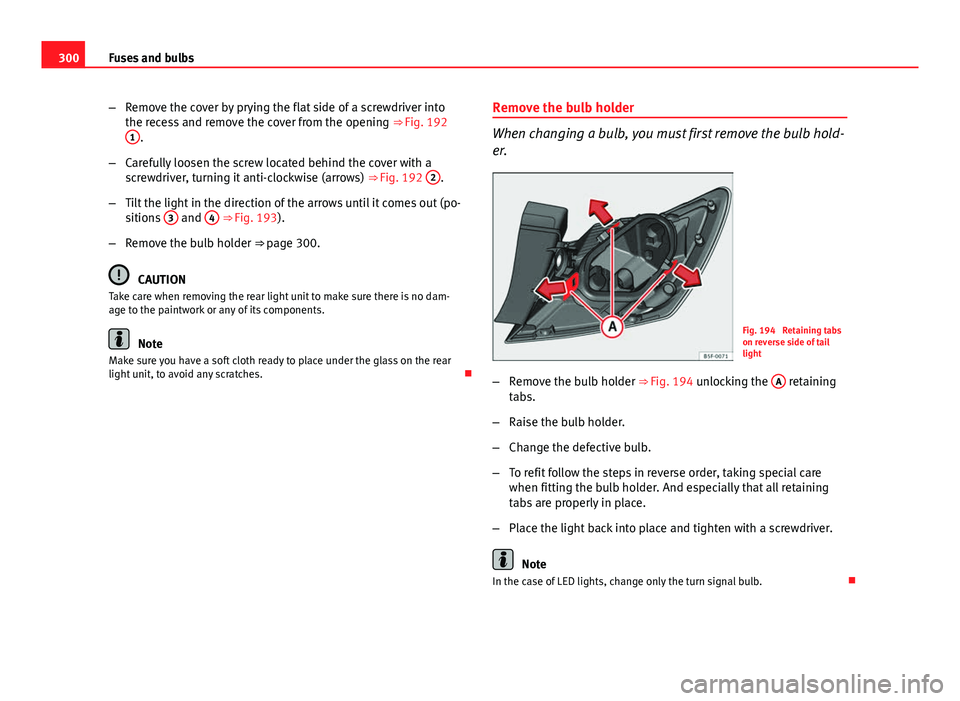
When changing a bulb, you must first remove the bulb hold-
er.
Fig. 194 Retaining tabs
on reverse side of tail
light
– Remove the bulb holder ⇒ Fig. 194 unlocking the A
retaining
tabs.
– Raise the bulb holder.
– Change the defective bulb.
– To refit follow the steps in reverse order, taking special care
when fitting the bulb holder. And especially that all retaining
tabs are properly in place.
– Place the light back into place and tighten with a screwdriver.
Note
In the case of LED lights, change only the turn signal bulb.
Page 304 of 339
302Fuses and bulbs
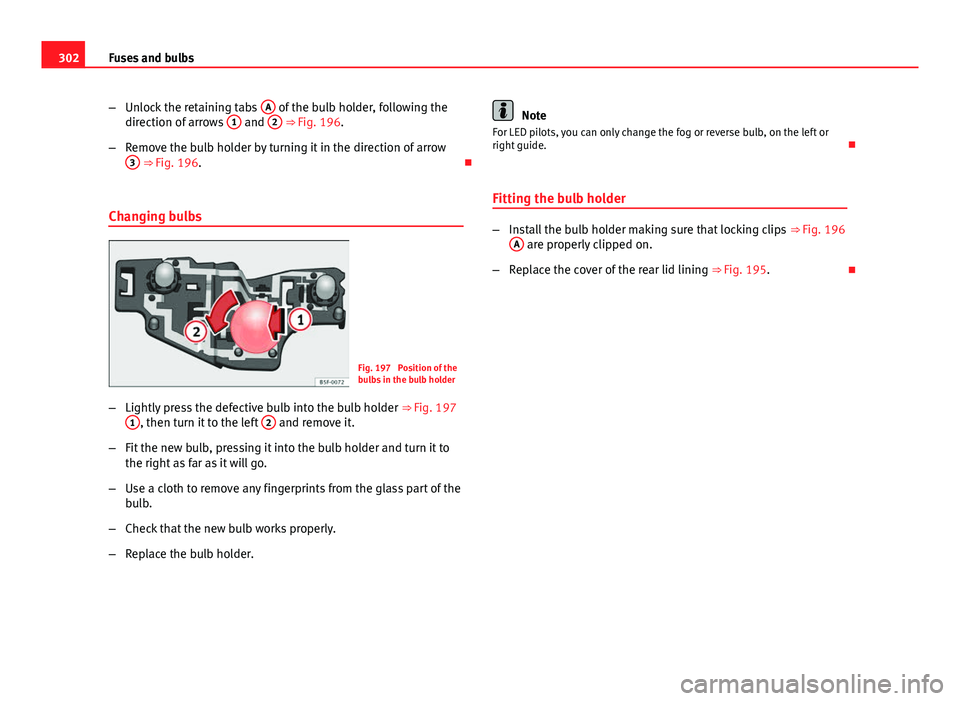
–Unlock the retaining tabs A
of the bulb holder, following the
direction of arrows 1 and 2 ⇒ Fig. 196.
– Remove the bulb holder by turning it in the direction of arrow
3
⇒ Fig. 196.
Changing bulbs
Fig. 197 Position of the
bulbs in the bulb holder
– Lightly press the defective bulb into the bulb holder ⇒ Fig. 197
1
, then turn it to the left 2 and remove it.
– Fit the new bulb, pressing it into the bulb holder and turn it to
the right as far as it will go.
– Use a cloth to remove any fingerprints from the glass part of the
bulb.
– Check that the new bulb works properly.
– Replace the bulb holder.
Note
For LED pilots, you can only change the fog or reverse bulb, on the left or
right guide.
Fitting the bulb holder
– Install the bulb holder making sure that locking clips ⇒ Fig. 196
A are properly clipped on.
– Replace the cover of the rear lid lining ⇒ Fig. 195.
Page 327 of 339
Index
A
ABSsee Anti-lock brake system . . . . . . . . . . . . 222
ACC . . . . . . . . . . . . . . . . . . . . . . . . . . . . . . . . . . 189 radar sensor . . . . . . . . . . . . . . . . . . . . . . . . 191
Accessories . . . . . . . . . . . . . . . . . . . . . . . . . . . . 135
Acoustic parking aid . . . . . . . . . . . . . . . . . . . . 217
Acoustic warnings Headlights . . . . . . . . . . . . . . . . . . . . . . . . . 111
Adaptive cruise control . . . . . . . . . . . . . . . . . . 189 control lamp . . . . . . . . . . . . . . . . . . . . . . . . 190
malfunction . . . . . . . . . . . . . . . . . . . . . . . . 190
messages on the display . . . . . . . . . . . . . . 190
radar sensor . . . . . . . . . . . . . . . . . . . . . . . . 191
Special driving situations . . . . . . . . . . . . . 199
switching off temporarily . . . . . . . . . . . . . . 198
using . . . . . . . . . . . . . . . . . . . . . . . . . . . . . . 193
warning lamp . . . . . . . . . . . . . . . . . . . . . . . 190
Additional electrical appliances (efficiency pro- gramme) . . . . . . . . . . . . . . . . . . . . . . . . . . . . . 77
Adjusting front head restraints . . . . . . . . . . . . . . . . . 131
front seats . . . . . . . . . . . . . . . . . . . . . . . . . . 129
rear head restraints . . . . . . . . . . . . . . . . . . 132
Adjusting the head restraints Front head restraints . . . . . . . . . . . . . . . . . 131
Airbag . . . . . . . . . . . . . . . . . . . . . . . . . . . . . . . . . 31
Airbag covers . . . . . . . . . . . . . . . . . . . . . . . . . . . 38 Airbag system . . . . . . . . . . . . . . . . . . . . . . . . . . . 31
Control lamp . . . . . . . . . . . . . . . . . . . . . . . . . 34
curtain airbags . . . . . . . . . . . . . . . . . . . . . . . 43
Differences between front passenger frontairbag systems . . . . . . . . . . . . . . . . . . . . . 33
Front airbags . . . . . . . . . . . . . . . . . . . . . . . . 36
Knee airbag . . . . . . . . . . . . . . . . . . . . . . . . . 39
side airbags . . . . . . . . . . . . . . . . . . . . . . . . . 40
Air pressure (tyres) . . . . . . . . . . . . . . . . . . . . . . 265
Alarm system . . . . . . . . . . . . . . . . . . . . . . . . . . . 95
Alcantara: cleaning . . . . . . . . . . . . . . . . . . . . . 245
Ambient lighting . . . . . . . . . . . . . . . . . . . . . . . 118
Anti-dazzle rear vision mirror . . . . . . . . . . . . . . 126
Anti-freeze protection Windscreen washer system . . . . . . . . . . . . 262
Anti-lock brake system . . . . . . . . . . . . . . . . . . . 222
Anti-theft alarm . . . . . . . . . . . . . . . . . . . . . . 87, 95 see also Anti-theft alarm system . . . . . . . . . 87
Anti-theft alarm system Interior monitoring . . . . . . . . . . . . . . . . . . . . 97
Tow-away protection . . . . . . . . . . . . . . . . . . 97
Anti-theft security system . . . . . . . . . . . . . . 87, 98
Anti-theft wheel bolts . . . . . . . . . . . . . . . . . . . 279
Antifreeze . . . . . . . . . . . . . . . . . . . . . . . . . . . . . 257
Aspects to take into account before starting the vehicle . . . . . . . . . . . . . . . . . . . . . . . . . . . . . . . . 8
ASR see Traction control system . . . . . . . . . . . . 222 Assistance systems . . . . . . . . . . . . . . . . . . . . . 184
ACC . . . . . . . . . . . . . . . . . . . . . . . . . . . . . . . 189
adaptive cruise control . . . . . . . . . . . . . . . 189
Cruise control . . . . . . . . . . . . . . . . . . . . . . . 184
monitoring system Front Assist . . . . . . . . . 202
Parking aid . . . . . . . . . . . . . . . . . . . . . . . . . 218
Assisted starting . . . . . . . . . . . . . . . . . . . . . . . 283
Assist systems Tyre monitoring indicator . . . . . . . . . . . . . . 216
Audible warning . . . . . . . . . . . . . . . . . . . . . . . . . 21
Auto Lock (central locking) . . . . . . . . . . . . . . . . 87
Automatic car washes see Washing . . . . . . . . . . . . . . . . . . . . . . . . 238
Automatic dipped beam control . . . . . . . . . . . 112
Automatic gearbox . . . . . . . . . . . . . . . . . . . . . . 173 Backup programme . . . . . . . . . . . . . . . . . . 181
Downhill speed control . . . . . . . . . . . . . . . 178
Driving tips . . . . . . . . . . . . . . . . . . . . . . . . . 176
Kick-down feature . . . . . . . . . . . . . . . . . . . . 179
Launch Control Programme . . . . . . . . . . . . 179
Manual release of selector lever . . . . . . . . 182
Safety interlock for ignition key . . . . . . . . . 163
Selector lever lock . . . . . . . . . . . . . . . . . . . 175
Selector lever positions . . . . . . . . . . . . . . . 173
Steering wheel with gearshift paddles . . . 178
tiptronic . . . . . . . . . . . . . . . . . . . . . . . 173, 178
B
Back support . . . . . . . . . . . . . . . . . . . . . . . . . . 129
325
Index