weight Seat Leon 5D 2013 User Guide
[x] Cancel search | Manufacturer: SEAT, Model Year: 2013, Model line: Leon 5D, Model: Seat Leon 5D 2013Pages: 339, PDF Size: 4.8 MB
Page 137 of 339

135
Seats and storage
Other storage compartments
You will find more object holders, compartments and supports in other
parts of the vehicle:
● In the top of the glove compartment in vehicles that do not have a CD
reader. The load must not exceed 1.2 kg.
● In the centre console under the centre armrest*.
● In the driver side panel there is a removable box for access to fuses and
relays. The load of the compartment should not exceed 0.2 kg.
● Coat hooks in the pillar B ⇒
.
● Other storage compartments are found in the rear seat, to the left and
the right of the seats.
WARNING
● Please make sure that any items of clothing hanging from the coat
hooks do not obstruct your view to the rear.
● The coat hooks should only be used for lightweight clothing. Do not
leave any heavy or sharp objects in the pockets.
● Do not use clothes hangers to hang up the clothing, as this could in-
terfere with the function of the head-protection airbags.
Power sockets
Electrical equipment can be connected to the 12 volt power
socket.
Fig. 87 Centre console:
front/rear 12-volt power
socket
Fig. 88 Detailed view of
the side trim in the lug-
gage compartment: 12-
volt power sockets (valid
only for the LEON ST
model)
Safety FirstOperating instructionsPractical TipsTechnical specifications
Page 151 of 339
149
Seats and storage
WARNING
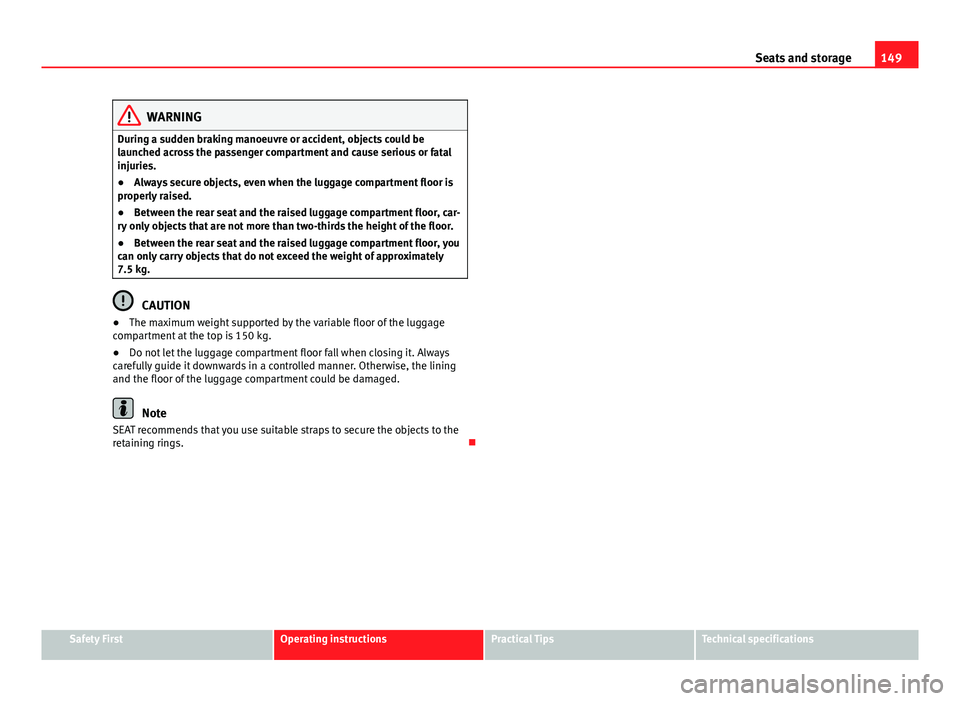
During a sudden braking manoeuvre or accident, objects could be
launched across the passenger compartment and cause serious or fatal
injuries.
● Always secure objects, even when the luggage compartment floor is
properly raised.
● Between the rear seat and the raised luggage compartment floor, car-
ry only objects that are not more than two-thirds the height of the floor.
● Between the rear seat and the raised luggage compartment floor, you
can only carry objects that do not exceed the weight of approximately
7.5 kg.
CAUTION
● The maximum weight supported by the variable floor of the luggage
compartment at the top is 150 kg.
● Do not let the luggage compartment floor fall when closing it. Always
carefully guide it downwards in a controlled manner. Otherwise, the lining
and the floor of the luggage compartment could be damaged.
Note
SEAT recommends that you use suitable straps to secure the objects to the
retaining rings.
Safety FirstOperating instructionsPractical TipsTechnical specifications
Page 153 of 339
151
Seats and storage
Applies to the model: LEON ST
Securing the cross bars and roof carrier system
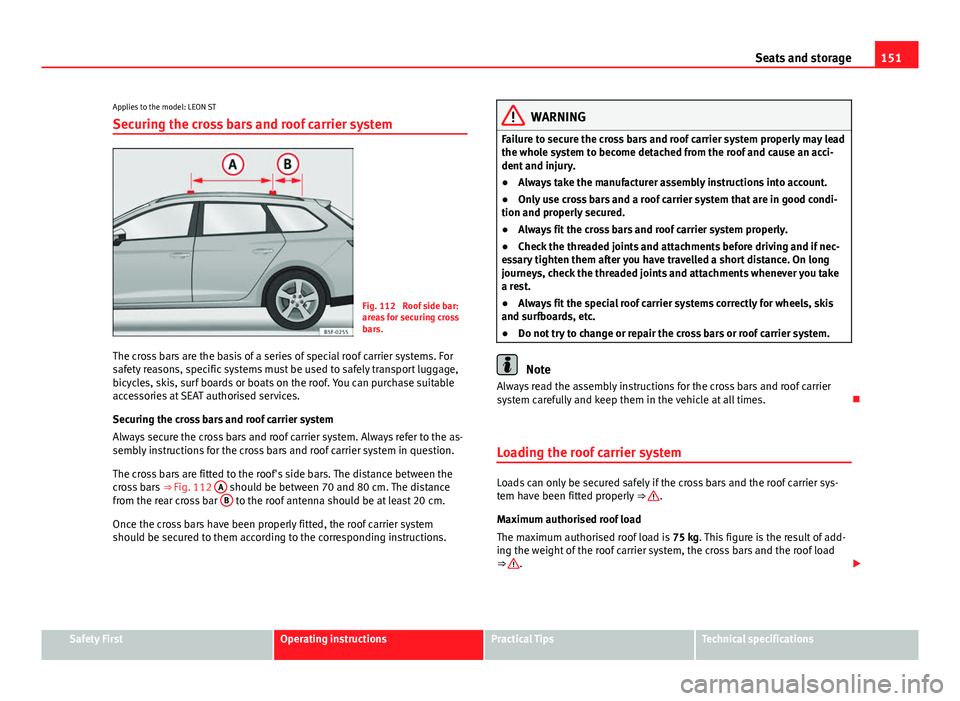
Fig. 112 Roof side bar:
areas for securing cross
bars.
The cross bars are the basis of a series of special roof carrier systems. For
safety reasons, specific systems must be used to safely transport luggage,
bicycles, skis, surf boards or boats on the roof. You can purchase suitable
accessories at SEAT authorised services.
Securing the cross bars and roof carrier system
Always secure the cross bars and roof carrier system. Always refer to the as-
sembly instructions for the cross bars and roof carrier system in question.
The cross bars are fitted to the roof's side bars. The distance between the
cross bars ⇒ Fig. 112 A
should be between 70 and 80 cm. The distance
from the rear cross bar B to the roof antenna should be at least 20 cm.
Once the cross bars have been properly fitted, the roof carrier system
should be secured to them according to the corresponding instructions.
WARNING
Failure to secure the cross bars and roof carrier system properly may lead
the whole system to become detached from the roof and cause an acci-
dent and injury.
● Always take the manufacturer assembly instructions into account.
● Only use cross bars and a roof carrier system that are in good condi-
tion and properly secured.
● Always fit the cross bars and roof carrier system properly.
● Check the threaded joints and attachments before driving and if nec-
essary tighten them after you have travelled a short distance. On long
journeys, check the threaded joints and attachments whenever you take
a rest.
● Always fit the special roof carrier systems correctly for wheels, skis
and surfboards, etc.
● Do not try to change or repair the cross bars or roof carrier system.
Note
Always read the assembly instructions for the cross bars and roof carrier
system carefully and keep them in the vehicle at all times.
Loading the roof carrier system
Loads can only be secured safely if the cross bars and the roof carrier sys-
tem have been fitted properly ⇒ .
Maximum authorised roof load
The maximum authorised roof load is 75 kg. This figure is the result of add-
ing the weight of the roof carrier system, the cross bars and the roof load
⇒
.
Safety FirstOperating instructionsPractical TipsTechnical specifications
Page 154 of 339
152Seats and storage
Make sure you know the weight of the roof carrier system, the cross bars
and the roof load; weigh them if necessary. Never exceed the maximum au-
thorised roof load.
However, if you are using cross bars and a roof carrier system with a lower
load rating you will not be able to carry the maximum roof load. In this case,
you can only load the roof carrier to the weight limit listed in the fitting in-
structions.
Distributing a load
Uniformly distribute loads and secure them correctly ⇒
.
Check attachments.
Once the cross bars and roof carrier system have been fitted, check bolted
joins and the attachments after you have travelled a short distance and
then regularly.
WARNING
Exceeding the maximum authorised roof load can result in accidents and
considerable vehicle damage.
● Never exceed the indicated roof load, the authorised load on the
axles or the vehicle's authorised maximum load.
● Do not exceed the load capacity of the cross bars and roof carrier sys-
tem, even if the maximum roof load has not been exceeded.
● Always secure heavy items as far forward as possible and distribute
the vehicle load uniformly.
WARNING
If the load is loose and is not properly secured it could fall from the roof
carrier system and cause accidents and injury.
● Always use belts or retaining straps that are suitable and in a good
condition.
● Secure the load properly.
Page 186 of 339
184Driver assistance systems
Driver assistance systems
Cruise control system (CCS)*
Introduction
The cruise control system (CCS) is able to maintain the set speed from 20
km/h (15 mph).
A constant speed is maintained using the engine power control or by apply-
ing the active brake ⇒
.
Additional information and warnings:
● Change gear ⇒ page 173.
● Accessories and technical modifications ⇒ page 272.
WARNING
Use of the cruise control could cause accidents and severe injuries if it is
not possible to drive at a constant speed maintaining the safety distance.
● Do not use the cruise control in heavy traffic, if the distance from the
vehicle in front is insufficient, on steep roads, with several bends or in
slippery circumstances (snow, ice, rain or loose gravel), or on flooded
roads.
● Never use the CCS when driving off-road or on unpaved roads.
● Always adapt your speed and the distance to the vehicles ahead in
line with visibility, weather conditions, the condition of the road and the
traffic situation.
● To avoid unexpected operation of the cruise control system, turn it off
every time you finish using it.
WARNING (Continued)
● It is dangerous to use a set speed which is too high for the prevailing
road, traffic or weather conditions.
● When travelling down hills, the CCS cannot maintain a constant
speed. The vehicle tends to accelerate under its own weight. Select a
lower gear or use the foot brake to slow the vehicle.
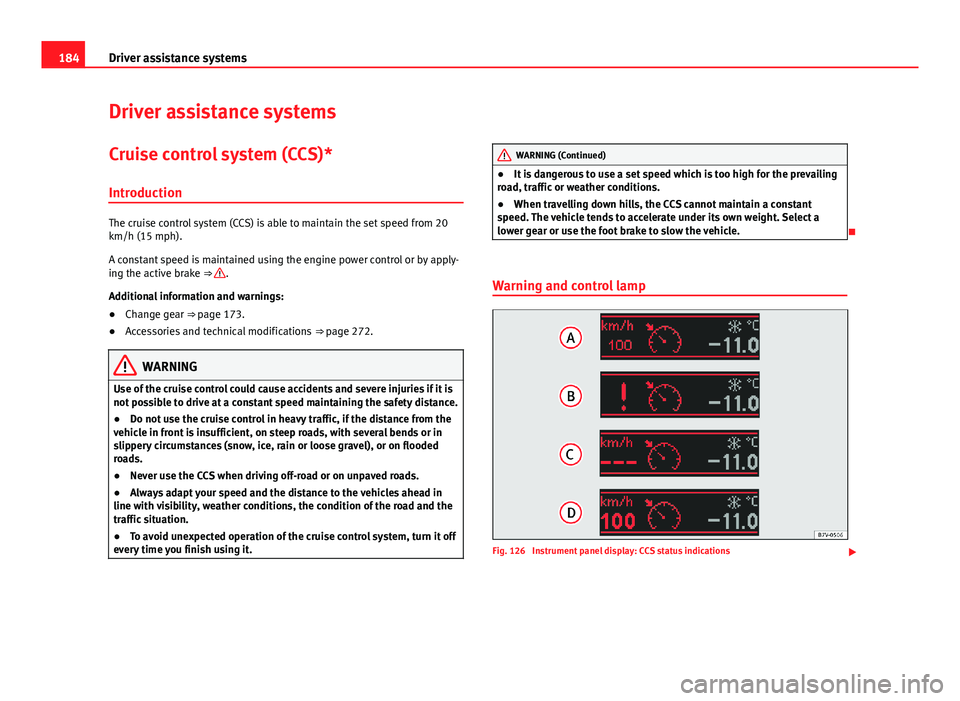
Warning and control lamp
Fig. 126 Instrument panel display: CCS status indications
Page 234 of 339

232Driving and the environment
Reduce idling time
In vehicles with the Start-Stop system idling is automatically reduced. In ve-
hicles without the Start-Stop system it is worth switching off the engine, for
example, at level crossings and at traffic lights that remain red for long peri-
ods of time. When an engine has reached operating temperature, and de-
pending on the cylinder capacity, keeping it switched off for a minimum of
about 5 seconds already saves more than the amount of fuel necessary for
restarting.
The engine takes a long time to warm up when it is idling. Mechanical wear
and pollutant emissions are also especially high during this initial warm-up
phase. It is therefore best to drive off immediately after starting the engine.
Avoid running the engine at high speed.
Regular maintenance
Regular servicing helps in saving fuel even before the engine is started. A
well-serviced engine gives you the benefit of improved fuel efficiency as
well as maximum reliability and an enhanced resale value. A badly serviced
engine can consume up to 10% more fuel than necessary.
Avoid short journeys
The engine and catalytic converter need to reach their optimal operating
temperature in order to minimise fuel consumption and emissions.
A cold engine consumes a disproportionate amount of fuel. The engine only
reaches its working temperature after about four kilometres (2.5 miles),
when fuel consumption will return to a normal level.
Check tyre pressure
Always make sure the tyres are inflated to the correct pressures
⇒ page 265 to save fuel. If the pressure is below half bar, fuel consumption
may increase by 5%. Due to the greater rolling resistance, under-inflation
also increases tyre wear and impairs handling.
Do not use winter tyres all year round as they increase fuel consumption by
up to 10%. Avoid carrying unnecessary loads
Given that every kilo of
extra weight will increase the fuel consumption, it is
advisable to always check the luggage compartment to make sure that no
unnecessary loads are being transported.
Since the luggage rack increases the aerodynamic drag of the vehicle, you
should remove it when not needed. This will save, at a speed of 100-120
km/h (60-75 mph), approximately 12% of fuel.
Save electrical energy
The engine drives the alternator, thereby generating electricity. This implies
that any increase in power consumption also increases fuel consumption!
For this reason, switch off any unneeded consumption of electricity. Electri-
cal equipment which uses a lot of electricity includes the blower (at a high
setting), the rear window heating and the seat heating*.
Environmental friendliness
Environmental protection is a top priority in the design, choice of materials
and manufacture of your new SEAT.
Constructive measures to encourage recycling
● Joints and connections designed for easy dismantling
● Modular construction to facilitate dismantling
● Increased use of single-grade materials.
● Plastic parts and elastomers are marked in accordance with ISO 1043,
ISO 11469 and ISO 1629.
Choice of materials
● Use of recycled materials.
● Use of compatible plastics in the same part if its components are not
easily separated.
Page 236 of 339
234Trailer
Trailer
Trailer towing What do you need to bear in mind when towing a trailer?
Your vehicle may be used to tow a trailer when fitted with the correct equip-
ment.
If you wish to retrofit a towing bracket, consult ⇒ page 236.
Connectors
Your vehicle is fitted with a 12-pin connector for the electrical connection
between the trailer and the vehicle.
If the trailer has a 7-pin plug you will need to use an adapter cable. This is
available in any Technical Service.
Trailer weight/drawbar load
Never exceed the authorised trailer weight. If you do not load the trailer up
to the maximum permitted trailer weight, you can then climb correspond-
ingly steeper slopes.
The maximum trailer weights listed are only applicable for altitudes up to
1000 m above sea level. With increasing altitude the engine power and
therefore the vehicle climbing ability are impaired because of the reduced
air density. The maximum trailer weight has to be reduced accordingly. The
weight of the vehicle and trailer combination must be reduced by 10% for
every further 1000 m (or part thereof). The gross combination weight is the
actual weight of the laden vehicle plus the actual weight of the laden trailer.
When possible, operate the trailer with the maximum permitted drawbar
load on the ball joint of the towing bracket, but do not exceed the specified
limit. The figures for
trailer weights and drawbar loads that are given on the data
plate of the towing bracket are for certification purposes only. The correct
figures for your specific model, which may be lower than these figures for
the towing bracket, are given in the vehicle documentation or in ⇒ chap-
ter Technical Data.
Distributing the load
Distribute loads in the trailer so that heavy objects are as near to the axle as
possible. Loads carried in the trailer must be secured to prevent them mov-
ing.
Tyre pressure
Set tyre pressure to the maximum permissible pressure shown on the stick-
er on the inside of the fuel tank flap. Set the tyre pressure of the trailer tyres
in accordance with the trailer manufacturer's recommendations.
Exterior mirrors
Check whether you can see enough of the road behind the trailer with the
standard rear vision mirrors. If this is not the case, you should have addi-
tional exterior mirrors fitted. Both exterior mirrors should be mounted on
hinged extension brackets. Adjust the mirrors to give sufficient vision to the
rear.
WARNING
Never transport people in a trailer. This could result in fatal accidents.
Page 237 of 339
235
Trailer
Note
● Towing a trailer places additional demands on the vehicle. We recom-
mend additional services between the normal inspection intervals if the ve-
hicle is used frequently for towing a trailer.
● Find out whether special regulations apply to towing a trailer in your
country.
Ball coupling of towing bracket*
The ball coupling is provided with instructions on fitting and removing the
ball coupling of the towing bracket.
WARNING
The towing bracket ball coupling must be stored securely in the luggage
compartment to prevent them being flung through the vehicle and caus-
ing injury.
Note
● By law, the ball coupling must be removed if a trailer is not being towed
if it obscures the number plate.
Driving tips
Driving with a trailer always requires extra care. Weight distribution
The weight distribution of a loaded trailer with an unladen vehicle is very
unfavourable. However, if this cannot be avoided, drive extra slowly to allow
for the unbalanced weight distribution. Speed
The stability of the vehicle and trailer is reduced with increasing speed. For
this reason, it is advisable not to drive at the maximum permissible speed
in an unfavourable road, weather or wind conditions. This applies especially
when driving downhill.
You should always reduce speed immediately if the trailer shows the slight-
est sign of
snaking. Never try to stop the “snaking” by increasing speed.
Always brake in due course. If the trailer has an overrun brake, apply the
brakes gently at first and then, firmly. This will prevent the jerking that can
be caused by locking of trailer wheels. Select a low gear in due course be-
fore going down a steep downhill. This enables you to use the engine brak-
ing to slow down the vehicle.
Reheating
At very high temperatures and during prolonged slopes, driving in a low
gear and high engine speed, always monitor the coolant temperature gauge
⇒ page 69.
Electronic Stability Control*
The ESC* system helps to stabilise the trailer in case of skidding or rocking.
Safety FirstOperating instructionsPractical TipsTechnical specifications
Page 272 of 339

270Wheels and tyres
–Also note that winter tyres are no longer effective when the
tread is worn down.
– After fitting the wheels you must always check the tyre pres-
sures. The correct tyre pressures are listed on the sticker on the
inside of the fuel tank flap ⇒ page 265.
In winter road conditions winter tyres will considerably improve vehicle han-
dling. The design of summer tyres (width, rubber compound, tread pattern)
gives less grip on ice and snow. This applies particularly to vehicles equip-
ped with wide section tyres or high speed tyres (code letters H, V or Y on
the sidewall).
Only use winter tyres of the correct type approved for your vehicle. The sizes
of the winter tyres approved for your vehicle are listed in the vehicle docu-
mentation (e.g. EC Certificate of Conformity or COC document 1)
). The vehicle
documentation varies depending on the country of residence. See also
⇒ page 268.
Winter tyres lose a great deal of their properties when the tread is worn
down to a depth of 4 mm.
The performance of winter tyres is also severely impaired by ageing, even if
the tread is still much deeper than 4 mm.
Winter tyres are subject to the following maximum speed limits according to
speed rating code letter: ⇒
Speed rating code letter
⇒ page 268Maximum speed limit
Q160 km/h (140 mph)S180 km/h (140 mph)T190 km/h (140 mph)
Speed rating code letter
⇒ page 268Maximum speed limit
H210 km/h (140 mph)
V240 km/h (150 mph)
(note restrictions)
Vehicles capable of exceeding these speeds must have an appropriate
sticker attached so that it is visible to the driver. Suitable stickers are availa-
ble from the SEAT Official Service and specialised workshop. Please note
regulations to this effect in your country.
“All-weather” tyres can also be used instead of winter tyres.
Using winter tyres with V-rating
Please note that the generally applicable 240 km/h (150 mph) speed rating
for winter tyres with the letter V is subject to technical restrictions; the max-
imum permissible speed for your vehicle may be significantly lower . The
maximum speed limit for tyres with a V-rating depends directly on the maxi-
mum axle weights for your car and on the listed weight rating of the tyres
being used.
It is best to contact a SEAT Official Service to check the maximum speed
which is permissible for the V-rated tyres fitted on your car on the basis of
this information.
WARNING
Exceeding the maximum speed permitted for the winter tyres fitted on
your car can cause tyre failure, resulting in a loss of control of the vehicle
– risk of accident.
1)
COC = certificate of conformity
Page 308 of 339
306Technical specifications
Identifying letters
The identifying letters of the engine can be viewed on the instrument panel.
Important: The engine must be off and the ignition on.
● Hold down the 0.0/SET
4 ⇒ Fig. 38 button for more than 15 seconds.
Information on fuel consumption
Fuel consumption
The consumption and emission details shown on the vehicle
data sticker differ from one vehicle to another. The vehicle fuel consumption and CO 2 emissions can be consulted on the
vehicle data sticker in the spare wheel well, inside the luggage compart-
ment and on the rear cover of the Maintenance Programme.
The fuel consumption and CO 2 emission values refer to the weight category
assigned to your vehicle according to the engine and gearbox combination,
as well as the specific equipment fitted, and is only used to compare be-
tween the different models.
The fuel consumption and CO 2 emissions do not depend only on the per-
formance of the vehicle, they can also differ from the established values de-
pending on other factors such as driving style, road conditions, traffic con-
ditions, environmental conditions, load and number of passengers.
Calculation of fuel consumption
The consumption values have been calculated based on measurements per-
formed or supervised by certified CE laboratories according to the latest ver-
sion of directives 715/2007/EC and 80/1268/CEE (for more information
consult the European Union Publications Office at EUR-Lex: © European Un- ion, http://eur-lex.europa.eu/en/index.htm) and are valid for the kerb
weight indicated for the vehicle.
Note
In practice, and considering all the factors mentioned here, consumption
values can differ from those calculated in the current European regulations.
Weights
Kerb weight refers to the basic model with a fuel tank filled to 90% capacity
and without optional extras. The figure quoted includes 75 kg to allow for
the weight of the driver.
For special versions and optional equipment fittings or for the addition of
accessories, the weight of the vehicle will increase ⇒
.
WARNING
● Please note that the centre of gravity may shift when transporting
heavy objects; this may affect vehicle handling and lead to an accident.
Always adjust your speed and driving style to suit road conditions and re-
quirements.
● Never exceed the gross axle weight rating or the gross vehicle weight
rating. If the allowed axle load or the allowed total weight is exceeded,
the driving characteristics of the vehicle may change, leading to acci-
dents, injuries and damage to the vehicle.