wipers Seat Leon 5D 2013 User Guide
[x] Cancel search | Manufacturer: SEAT, Model Year: 2013, Model line: Leon 5D, Model: Seat Leon 5D 2013Pages: 339, PDF Size: 4.8 MB
Page 127 of 339
125
Lights and visibility
Recommended windscreen wipers
● For the hottest seasons we recommend summer G 052 184 A1 for clear
glass. Proportions of the mixture in the washer fluid tank: 1:100 (1 part con-
centrate per 100 parts water).
● All year round, G 052 164 A2 for clear glass. Approximate proportion of
the winter mixture, up to -18 °C (0 °F): 1:2 (1 part concentrate per 2 parts
water); otherwise, a 1:4 proportion of mixture in the washer fluid tank.
Reservoir capacity
The reservoir holds approximately 3 - 4 litres; in vehicles with headlight
washer, it is approximately 3 -6 litres.
WARNING
Never mix an unsuitable antifreeze or other similar additives with the
windscreen washer water. A greasy layer may be formed on the wind-
screen which will impair visibility.
● Use clean water with a window cleaner recommended by SEAT.
● If necessary, add a suitable antifreeze to the water in the reservoir.
CAUTION
● Do not mix cleaning products recommended by SEAT with other prod-
ucts. This could lead to flocculation and may block the windscreen washer
jets.
● When topping up service fluids, make absolutely certain that you fill the
fluids into the correct reservoirs. Using the wrong fluids could cause serious
malfunctions and engine damage! Rear vision mirror
Adjusting the exterior mirrors
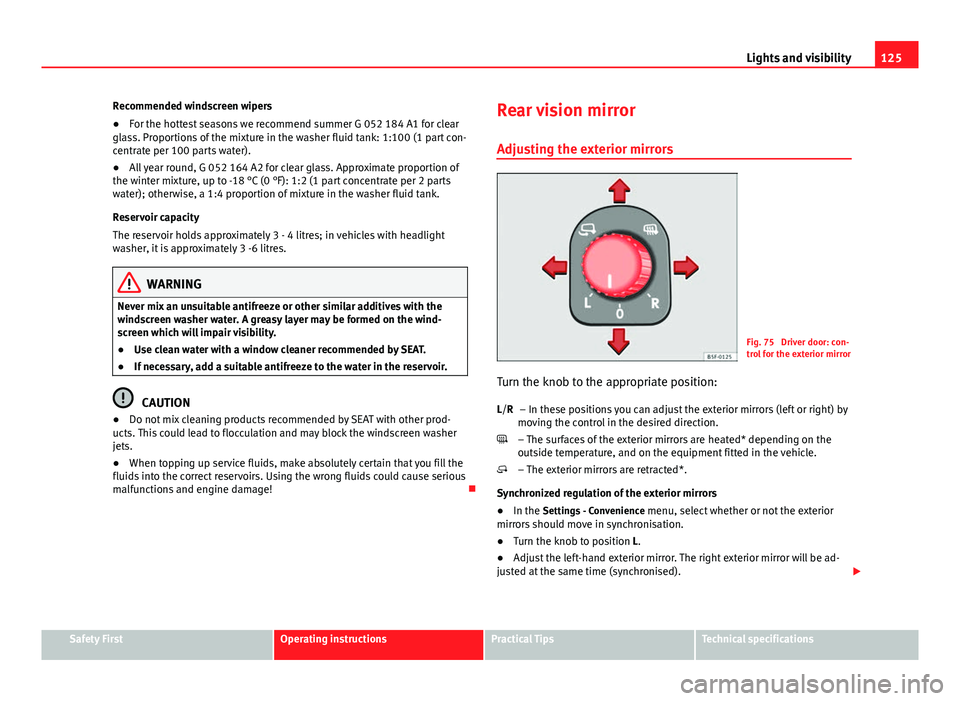
Fig. 75 Driver door: con-
trol for the exterior mirror
Turn the knob to the appropriate position: – In these positions you can adjust the exterior mirrors (left or right) by
moving the control in the desired direction.
– The surfaces of the exterior mirrors are heated* depending on the
outside temperature, and on the equipment fitted in the vehicle.
– The exterior mirrors are retracted*.
Synchronized regulation of the exterior mirrors
● In the Settings - Convenience menu, select whether or not the exterior
mirrors should move in synchronisation.
● Turn the knob to position L.
● Adjust the left-hand exterior mirror. The right exterior mirror will be ad-
justed at the same time (synchronised).
L/R
Safety FirstOperating instructionsPractical TipsTechnical specifications
Page 155 of 339
153
Air conditioning
Air conditioning Heating, ventilation, cooling
Introduction
Viewing Climatronic information
On the screen of Climatronic control unit and on the screen of the factory-
fitted Easy Connect system, the theoretical values of the temperature zones
are shown.
The unit of temperature measurement can be changed in the Easy Connect
system.
Dust and pollen filter
The dust and pollen filter with its activated charcoal cartridge serves as a
barrier against impurities in the air taken into the vehicle interior.
The dust and pollen filter must be changed regularly so that air conditioner
performance is not adversely affected.
If the filter loses efficiency prematurely due to use in areas with very high
levels of air pollution, the filter must be changed more frequently than sta-
ted in the Service Schedule.
Additional information and warnings:
● Easy Connect system
● Seat functions
● Windscreen wipers and washers
● Caring for and cleaning the vehicle exterior
WARNING
Reduced visibility through the windows increases the risk of serious acci-
dents.
● Always ensure that all windows are free of ice and snow, and that
they are not fogged, so as to maintain good visibility of everything out-
side.
● The maximum heat output required to defrost windows as quickly as
possible is only available when the engine has reached its normal run-
ning temperature. Only drive when you have good visibility.
● Always ensure that you use the heating system, fresh air system, air
conditioner and the heated rear window to maintain good visibility to the
outside.
● Never leave the air recirculation on for a long period of time. If the
cooling system is switched off and air recirculation mode switched on,
the windows can mist over very quickly, considerably limiting visibility.
● Switch air recirculation mode off when it is not required.
WARNING
Stuffy or used air will increase fatigue and reduce driver concentration
possibly resulting in a serious accident.
● Never leave the fresh air fan turned off or use the air recirculation for
long periods of time; the air in the vehicle interior will not be refreshed.
Safety FirstOperating instructionsPractical TipsTechnical specifications
Page 163 of 339
161
Air conditioning
● The cooling system is switched on (the * button lamp is on) and the am-
bient temperature is below +3 °C (+38 °F).
● The cooling system and the windscreen wipers are switched off and the
outside temperature is below +10 °C (+50 °F).
● The cooling system is switched on, the outside temperature is below
+15 °C (+59 °F) and the windscreen wipers are switched on.
Activation/deactivation of automatic air recirculation is done in the air con-
ditioner menu, under Configuration.
WARNING
Stuffy or used air will increase fatigue and reduce driver concentration
possibly resulting in a serious accident.
● Never use recirculation mode for long periods as it does not refresh
the air inside the vehicle.
● If the cooling system is switched off and air recirculation mode
switched on, the windows can mist over very quickly, considerably limit-
ing visibility.
● Switch air recirculation mode off when it is not required.
CAUTION
Do not smoke when air recirculation is switched on in vehicles with an air
conditioner. The smoke taken in could lie on the cooling system vaporiser
and on the activated charcoal cartridge of the dust and pollen filter, leading
to a permanently unpleasant smell.
Note
Climatronic: Air recirculation mode switches on to prevent exhaust gas from
entering the vehicle interior when it is in reverse and while the automatic
windscreen wash and wipe is working.
Safety FirstOperating instructionsPractical TipsTechnical specifications
Page 226 of 339
224Intelligent technology
Disable ASR
ASR mode is deactivated ⇒ page 79 through the Easy Connect system
menu. The traction control system will be disabled.
The control lamp will light up. For vehicles with a driver information sys-
tem* the driver will be informed that ASR is disabled.
In the following exceptional circumstances enabling the ESC Sport mode to
improve the traction of the wheels is tenable:
● “Swing” the vehicle to unblock it.
● Driving in deep snow or on loose surfaces.
Activate ASR
ASR mode is activated ⇒ page 79 through the Easy Connect system menu.
The traction control system will be enabled.
The control lamp switches off. For vehicles with a driver information sys-
tem* the driver will be informed that ASR is enabled.
WARNING
You should switch on the ESC Sport mode only if the traffic conditions
and your driving ability allow you to do so safely: risk of skidding!
● With ESC in Sport mode, the stabilising function will be limited to al-
low for a sportier drive. The driving wheels could spin and the vehicle
could skid.
Note
If the ASR is disconnected or the ESC’s Sport mode is selected, cruise con-
trol* will be switched off. Brakes
New brake pads
For the first 400 km (250 miles), new brake pads have not yet reached their
maximum braking capacity, and need to be “run in” first. However, you can
compensate for the slightly reduced braking effect by applying more pres-
sure on the brake pedal. Avoid overloading the brakes while running them
in.
Wear
The rate of wear on the
brake pads depends a great deal on how you drive
and the conditions in which the vehicle is operated. This is a particular
problem in urban traffic and short stretches, or with very sporty driving.
Depending on the speed, the braking force, and the environmental condi-
tions (for example, the temperature, air humidity, etc.) noises may be pro-
duced on braking.
Wet roads or road salt
In certain situations (for example, on driving through flooded areas, in se-
vere downpours or after washing the vehicle) the braking action could be
delayed if the discs and pads are damp, or frozen in winter. In this case the
brakes should be dried by pressing the brake pedal several times.
At high speed and with the windscreen wipers activated, the brake pads will
briefly touch the brake discs. This takes place, although unnoticeable to the
driver, at regular intervals to improve the response time of the brakes when
they are wet.
The effectiveness of the brakes can also be temporarily reduced if the vehi-
cle is driven for some distance without using the brakes when there is a lot
of salt on the road in winter. The layer of salt that accumulates on the discs
and pads can be removed by gently applying the brakes a few times.
Page 243 of 339
241
Care and cleaning
Carbon components
The carbon parts on your vehicle have a painted surface. They do not need
any special care and are cleaned just like any other painted part
⇒ page 238.
Paint damage
Minor damage to the paint, such as scratches or stone chips, should be
touched up without delay before the metal starts to corrode. Suitable touch-
up brushes or sprays for your car can be obtained from a SEAT Official Serv-
ice.
The number of the original paint finish on the vehicle is given on the data
sticker ⇒ page 305.
If corrosion is already visible it must be thoroughly removed by a special-
ised workshop.
Windows
Clear vision is an essential safety factor.
The windscreen must not be cleaned with insect remover or wax, otherwise
the windscreen wipers will not function properly (juddering).
Traces of rubber, oil, grease or silicone can be removed with a window
cleaning solution or a silicone remover. Wax residue can only be removed
with a special cleaner. Your SEAT Official Service will be able to provide you
with more detailed information.
The windows should also be cleaned on the inside at regular intervals. Use a separate cloth or chamois to dry the windows. Cloths used for waxing
and polishing contain residues that will cause smears on the glass.
WARNING
Do not use water-repellent coatings on the windscreen. In bad visibility
conditions (e.g. in the rain, dark or with a low sun), these coatings may
cause dazzle: risk of accident! Such coatings can also cause the wind-
screen wiper blades to make noise.
CAUTION
● Remove snow and ice from windows and exterior mirrors with a plastic
scraper only. To avoid scratches caused by dirt on the glass, the scraper
should only be pushed in one direction and not moved to and fro.
● The heating element for the rear window is located on the inner side of
the window. To avoid damaging them, do not apply stickers to the heating
elements.
● Never use warm or hot water to remove snow and ice from windows and
mirrors. This could cause the glass to crack!
Rims
The wheels require regular attention to preserve their appearance. It is im-
portant to remove road salt and brake dust by washing the wheels at regu-
lar intervals, otherwise the finish will be impaired.
After washing, the wheels should only be cleaned with an "acid-free" clean-
ing agent for alloy wheels. This is available from SEAT Official Services and
specialist retailers. Never leave the cleaning agent on the rims for any lon-
ger than specified in the instructions before rinsing it off. If the wheel clean-
er fluid contains acid it can attack the surfaces of the wheel bolts.
Safety FirstOperating instructionsPractical TipsTechnical specifications
Page 265 of 339
263
Checking and refilling levels
The windscreen washer reservoir contains the cleaning fluid for the wind-
screen, the rear window and the headlight washer system* ⇒ Fig. 158. Res-
ervoir capacity: ⇒ page 323.
To prevent the nozzles from becoming blocked with chalk deposits, fill res-
ervoir with water with a low calcium content (distilled water). Always add
washer fluid to the water (with anti-freeze additive in winter).
CAUTION
● Never put radiator anti-freeze or other additives into the windscreen
washer fluid.
● Never use washer fluid which contains paint thinners or solvents as it
can damage the paintwork.
Cleaning and changing the wiper blades of the windscreen
and rear window
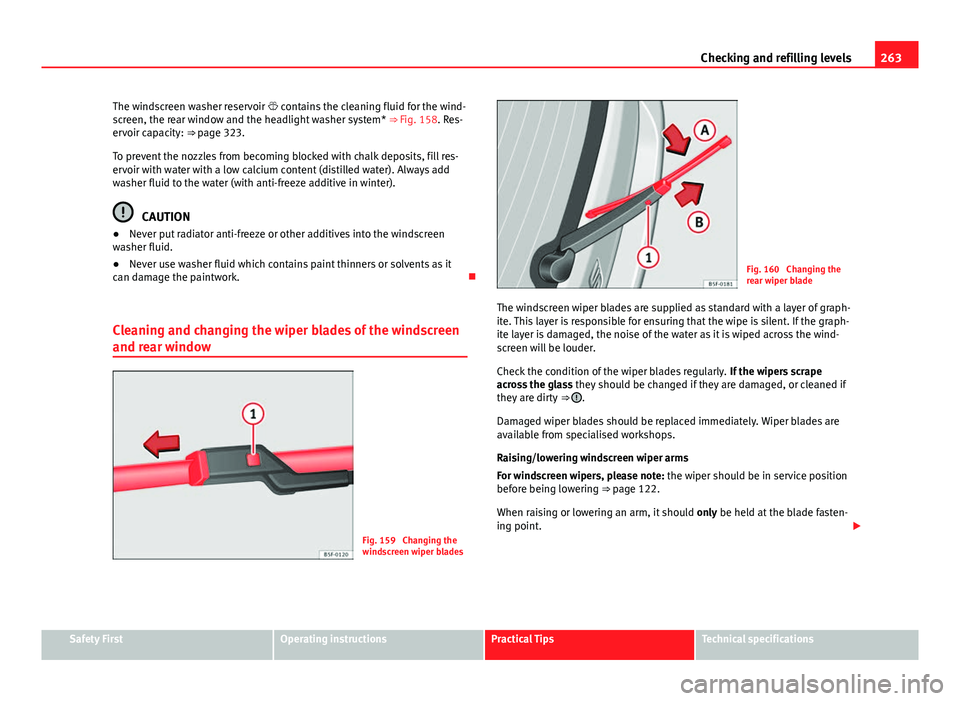
Fig. 159 Changing the
windscreen wiper blades
Fig. 160 Changing the
rear wiper blade
The windscreen wiper blades are supplied as standard with a layer of graph-
ite. This layer is responsible for ensuring that the wipe is silent. If the graph-
ite layer is damaged, the noise of the water as it is wiped across the wind-
screen will be louder.
Check the condition of the wiper blades regularly. If the wipers scrape
across the glass they should be changed if they are damaged, or cleaned if
they are dirty ⇒
.
Damaged wiper blades should be replaced immediately. Wiper blades are
available from specialised workshops.
Raising/lowering windscreen wiper arms
For windscreen wipers, please note: the wiper should be in service position
before being lowering ⇒ page 122. When raising or lowering an arm, it should only be held at the blade fasten-
ing point.
Safety FirstOperating instructionsPractical TipsTechnical specifications
Page 266 of 339
264Checking and refilling levels
Cleaning windscreen wiper blades
● Raising the wiper arms.
● Use a soft cloth to remove dust and dirt from the windscreen wiper
blades.
● If the blades are very dirty, a sponge or damp cloth may be used ⇒
.
Changing the windscreen wiper blades
● Raising/lowering wiper arms
● Hold down the release button ⇒ Fig. 159 1
while gently pulling the
blade in the direction of the arrow.
● Fit a new wiper blade of the same length and design on to the wiper arm
and hook it into place.
● Rest the wiper arms back onto the windscreen.
Changing the rear wiper blade
● Raising/lowering the wiper arm.
● Turn the blade slightly ⇒ Fig. 160 (arrow A
).
● Hold down the release button 1 while gently pulling the blade in the
direction of the arrow B.
● Insert a new blade of the same length and type in the rear wiper arm in
the opposite direction to the arrow B
and hook into place button 1.
● Replace the wiper arm on the rear window.
WARNING
Worn or dirty wiper blades reduce visibility and increase the risk of acci-
dent and serious injury.
● Always replace damaged or worn blades or blades which do not clean
the windscreen correctly.
CAUTION
● Damaged or dirty windscreen wipers could scratch the glass.
● If products containing solvents, rough sponges or sharp objects are
used to clean the blades, the graphite layer will be damaged.
● Never use fuel, nail varnish remover, paint thinner or similar products to
clean the windows.
Page 288 of 339
286Emergencies
Towing and tow-starting the vehicle
General information
Points to observe when tow-starting or towing away If you use a tow rope:
Notes for the driver of the towing vehicle
– The tow rope must be taut before you drive off.
– Release the clutch very carefully when starting the vehicle
(manual gearbox), or accelerate gently (automatic gearbox).
Notes for the driver of the towed vehicle
– The ignition should be switched on so that the turn signals,
windscreen wipers and washers can be used. Please ensure
that the steering wheel is unlocked when you switch on the ig-
nition, and that it moves freely.
– Put the gearbox lever in neutral (manual gearbox) or move the
selector lever to position N (automatic gearbox).
– The brake servo only works when the engine is running. Consid-
erably more effort is required on the brake pedal when the en-
gine is switched off.
– Remember that the power steering only works when the ignition
is switched on and the vehicle is moving 1)
. Otherwise, consider-
ably more strength than usual will be required when steering. –
Ensure that the tow rope remains taut at all times.
Tow rope or tow bar
It is easier and safer to tow a vehicle with a tow bar. You should only use a
tow rope if you do not have a tow bar.
A tow rope should be slightly elastic to avoid damage to both vehicles. It is
advisable to use a tow rope made of synthetic fibre or similarly elastic mate-
rial.
Only attach the tow rope or the tow bar to the towing rings ⇒ page 287.
Driving style
Towing requires some experience, especially when using a tow rope. Both
drivers should be familiar with the technique required for towing. Inexper-
ienced drivers should not attempt to tow.
Do not pull too hard with the towing vehicle and take care to avoid jerking
the tow rope. When towing on an unpaved road, there is always a risk of
overloading and damaging the anchorage points.
WARNING
If the vehicle has no electrical power, the brake lights, turn signals and
all other lights will no longer function. Do not have the vehicle towed
away. Failure to do so could result in an accident.
CAUTION
If there is no oil in the gearbox or no lubricant in the automatic transmission
the car may only be towed with the driven wheels lifted clear of the road, or
transported on a special car transporter or trailer.
1)
Important: the battery must be correctly charged.
Page 335 of 339
Safety interlock for ignition key . . . . . . . . . . . . 163
Safety notesAirbags . . . . . . . . . . . . . . . . . . . . . . . . . . . . . 34
Curtain airbags . . . . . . . . . . . . . . . . . . . . . . . 44
Front airbags . . . . . . . . . . . . . . . . . . . . . . . . 38
Seat belt tensioners . . . . . . . . . . . . . . . . . . . 30
Side airbags . . . . . . . . . . . . . . . . . . . . . . . . . 42
Using child seats . . . . . . . . . . . . . . . . . . . . . 48
Using seat belts . . . . . . . . . . . . . . . . . . . . . . 24
Saving fuel Conscientious driving . . . . . . . . . . . . . . . . 231
Inertia mode . . . . . . . . . . . . . . . . . . . . . . . . 180
Saving tips (efficiency programme) . . . . . . . . . 78
Seat adjuster . . . . . . . . . . . . . . . . . . . . . . . . . . . 10
Seat belt control lamp . . . . . . . . . . . . . . . . . . . . 20
Seat belt position Pregnant women . . . . . . . . . . . . . . . . . . . . . 28
Seat belts . . . . . . . . . . . . . . . . . . . . . . . . . . . 27
Seat belt protection . . . . . . . . . . . . . . . . . . . . . . 24
Seat belt release . . . . . . . . . . . . . . . . . . . . . . . . 28
Seat belts . . . . . . . . . . . . . . . . . . . . . . . . . . . . . . 20 Adjustment . . . . . . . . . . . . . . . . . . . . . . . . . . 26
Cleaning . . . . . . . . . . . . . . . . . . . . . . . . . . . 245
control lamp . . . . . . . . . . . . . . . . . . . . . . . . . 20
Incorrectly fastened . . . . . . . . . . . . . . . . . . . 29
Not worn . . . . . . . . . . . . . . . . . . . . . . . . . . . . 23
Safety notes . . . . . . . . . . . . . . . . . . . . . . . . . 24
Seat belt tensioners . . . . . . . . . . . . . . . . . . . . . . 29
SEAT Drive Mode . . . . . . . . . . . . . . . . . . . . . . . 211 Seats
adjustment . . . . . . . . . . . . . . . . . . . . . . . . . 129
heating . . . . . . . . . . . . . . . . . . . . . . . . . . . . 130
rear seat backrest . . . . . . . . . . . . . . . . . . . . 138
Selective unlocking system . . . . . . . . . . . . . . . . 92
Selector lever Automatic gearbox . . . . . . . . . . . . . . . . . . . 173
Function fault . . . . . . . . . . . . . . . . . . . . . . . 175
Selector lever (automatic gearbox) Manual release . . . . . . . . . . . . . . . . . . . . . . 182
Service interval display . . . . . . . . . . . . . . . . . . . 65
Service intervals . . . . . . . . . . . . . . . . . . . . . . . . 253
Service notification: read . . . . . . . . . . . . . . . . . . 65
Setting Headlight range . . . . . . . . . . . . . . . . . . . . . 117
Side airbags . . . . . . . . . . . . . . . . . . . . . . . . . . . . 40 Description . . . . . . . . . . . . . . . . . . . . . . . . . . 40
Operation . . . . . . . . . . . . . . . . . . . . . . . . . . . 41
Safety notes . . . . . . . . . . . . . . . . . . . . . . . . . 42
Side light . . . . . . . . . . . . . . . . . . . . . . . . . . . . . 111
Sitting position driver . . . . . . . . . . . . . . . . . . . . . . . . . . . . . . . 11
Sitting position for vehicle occupants . . . . . . . 10
Sliding/tilting sunroof Convenience opening/closing . . . . . . . . . 103
Smell of gas . . . . . . . . . . . . . . . . . . . . . . . . . . . 248
Snow chains . . . . . . . . . . . . . . . . . . . . . . . 271, 307
Spanner symbol . . . . . . . . . . . . . . . . . . . . . . . . . 65
Special features Windscreen wipers . . . . . . . . . . . . . . . . . . . 121
Speedometer . . . . . . . . . . . . . . . . . . . . . . . . . . . 73
Speed warning function . . . . . . . . . . . . . . . . . . 168 Sport Mode . . . . . . . . . . . . . . . . . . . . . . . . . . . . 223
Start-Stop system . . . . . . . . . . . . . . . . . . . . . . . 169
Driver messages . . . . . . . . . . . . . . . . . . . . . 172
Stop/Start the engine . . . . . . . . . . . . . . . . 170
Switching on/off . . . . . . . . . . . . . . . . . . . . . 171
The engine does not switch off . . . . . . . . . 170
The engine starts by itself . . . . . . . . . . . . . 170
Warning lamps . . . . . . . . . . . . . . . . . . . . . . 170
Starting up (engine) . . . . . . . . . . . . . . . . . . . . . 163
Steering Electro-mechanical steering . . . . . . . . . . . 225
Engage the steering lock (ignitionkey) . . . . . . . . . . . . . . . . . . . . . . . . . . 163, 165
Steering wheel Gearshift paddles (automatic gearbox) . . 178
Setting . . . . . . . . . . . . . . . . . . . . . . . . . . . . 162
Storage area front seat . . . . . . . . . . . . . . . . . . . . . . . . . . . 133
Storage compartment . . . . . . . . . . . . . . . . . . . 135
Storage compartments . . . . . . . . . . . . . . . . . . 133 Glove compartment lighting . . . . . . . . . . . 118
Storing the rear shelf . . . . . . . . . . . . . . . . . . . . 141
Sun blind . . . . . . . . . . . . . . . . . . . . . . . . . . . . . 119
Sun protection . . . . . . . . . . . . . . . . . . . . . . . . . 118
Sun visor . . . . . . . . . . . . . . . . . . . . . . . . . . . . . . 119
Switch Hazard warning lights . . . . . . . . . . . . . . . . 113
Switching ignition on/off . . . . . . . . . . . . . . . . . 163
Switching off using inertia . . . . . . . . . . . . . . . . 231
Switching off (engine) With the key . . . . . . . . . . . . . . . . . . . . . . . . 165
333
Index
Page 337 of 339
Sticker . . . . . . . . . . . . . . . . . . . . . . . . . . . . . 305
Vehicle identification data . . . . . . . . . . . . . 305
Vehicle battery Disconnect . . . . . . . . . . . . . . . . . . . . . . . . . . 66
Vehicle care Changing wiper blades of the windscreenand rear window . . . . . . . . . . . . . . . . . . . 263
Cleaning windscreen and rear window wip- er blades . . . . . . . . . . . . . . . . . . . . . . . . . 263
Service position . . . . . . . . . . . . . . . . . . . . . 122
Vehicle interior monitoring and anti-tow system Activation . . . . . . . . . . . . . . . . . . . . . . . . . . . 96
Vehicle key Synchronising . . . . . . . . . . . . . . . . . . . . . . . . 91
Vehicle tools . . . . . . . . . . . . . . . . . . . . . . . . . . . 274
Ventilation slits . . . . . . . . . . . . . . . . . . . . . . . . . 18
W Warning lamp Cruise control . . . . . . . . . . . . . . . . . . . . . . . 184
Warning lamps adaptive cruise control . . . . . . . . . . . . . . . 190
applying foot brake . . . . . . . . . . . . . . . . . . 203
applying the brake . . . . . . . . . . . . . . . . . . . 162
step on the brake pedal . . . . . . . . . . . . . . . 190
Washing Care of the vehicle exterior . . . . . . . . . . . . 238
Wearing suitable shoes . . . . . . . . . . . . . . . . . . . 17
Wheel changing . . . . . . . . . . . . . . . . . . . . . . . . . . . 267 Wheel bolts . . . . . . . . . . . . . . . . . . . . . . . . 269, 307
Anti-theft . . . . . . . . . . . . . . . . . . . . . . . . . . . 279
Loosening . . . . . . . . . . . . . . . . . . . . . . . . . . 279
Removing the cap . . . . . . . . . . . . . . . . . . . . 278
Wheel brace . . . . . . . . . . . . . . . . . . . . . . . . . . . 274
Wheel cover (wheel bolts): removing . . . . . . . 278
Wheels . . . . . . . . . . . . . . . . . . . . . . . . . . . 265, 307 Changing . . . . . . . . . . . . . . . . . . . . . . 277, 281
Why assume the correct sitting position? . . . . . 31
Why should head restraints be correctly adjus- ted? . . . . . . . . . . . . . . . . . . . . . . . . . . . . . . . . . 14
Why wear seat belts? . . . . . . . . . . . . . . . 20, 22, 31
Windows Electric windows . . . . . . . . . . . . . . . . . . . . . 102
Windscreen washer system . . . . . . . . . . . . . . . 262
Windscreen washer water Checking . . . . . . . . . . . . . . . . . . . . . . . . . . . 124
Topping up . . . . . . . . . . . . . . . . . . . . . . . . . 124
Windscreen wiper . . . . . . . . . . . . . . . . . . . . . . . 120 Window wiper lever . . . . . . . . . . . . . . . . . . 121
Windscreen wiper fluid Control lamp . . . . . . . . . . . . . . . . . . . . . . . . 120
Windscreen wipers Functions . . . . . . . . . . . . . . . . . . . . . . . . . . 122
Headlight washer system . . . . . . . . . . . . . 122
Heated windscreen washer jets . . . . . . . . 122
Lifting the wiper blades . . . . . . . . . . . . . . . 122
Rain sensor . . . . . . . . . . . . . . . . . . . . . . . . . 123
Replacing the wiper blades . . . . . . . . . . . . 122
Service position . . . . . . . . . . . . . . . . . . . . . 122
Special features . . . . . . . . . . . . . . . . . . . . . 121
Windscreen wipers service position . . . . . . . . 122 Winter conditions
Battery . . . . . . . . . . . . . . . . . . . . . . . . . . . . . 260
Care of vehicle . . . . . . . . . . . . . . . . . . . . . . 238
De-icing the glass . . . . . . . . . . . . . . . . . . . . 241
Diesel . . . . . . . . . . . . . . . . . . . . . . . . . . . . . 247
Snow chains . . . . . . . . . . . . . . . . . . . . . . . . 271
Tyres . . . . . . . . . . . . . . . . . . . . . . . . . . . . . . 269
Windscreen washer system . . . . . . . . . . . . 262
Winter operation Headlight washers . . . . . . . . . . . . . . . . . . . 122
Heated windscreen washer jets . . . . . . . . 122
Salt on the roads . . . . . . . . . . . . . . . . . . . . 124
Winter tyres . . . . . . . . . . . . . . . . . . . . . . . . . . . . 269
335
Index