seats Seat Leon 5D 2013 Workshop Manual
[x] Cancel search | Manufacturer: SEAT, Model Year: 2013, Model line: Leon 5D, Model: Seat Leon 5D 2013Pages: 339, PDF Size: 4.8 MB
Page 148 of 339
146Seats and storage
In order to use the fastening rings, they must be lifted beforehand 1)
.
WARNING
If unsuitable or damaged belts or retaining straps are used, they could
break in the event of braking or an accident. Objects could then be
launched across the passenger compartment and cause serious or fatal
injuries.
● Always use belts or retaining straps that are suitable and in a good
condition.
● Fasten the belts and straps to the fastening rings safely.
● Objects in the luggage compartment that are unsecured could move
suddenly and modify the handling of the vehicle.
● Secure all objects, small and light.
● The maximum tensile load of the fastening ring should never be ex-
ceeded for securing objects.
● Never secure a child seat to the fastening rings.
Note
● The maximum tensile load that the fastening rings can support is 3.5
kN.
● Belts and securing systems for the appropriate load can be obtained
from specialised dealerships. SEAT recommends visiting a SEAT dealership
for this. Retaining hooks
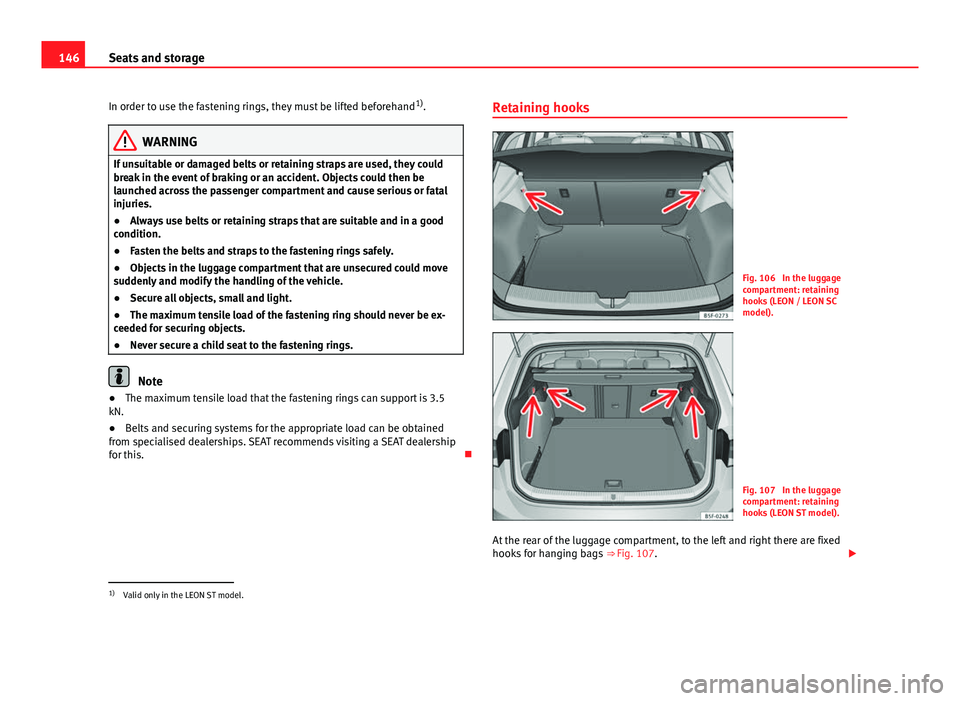
Fig. 106 In the luggage
compartment: retaining
hooks (LEON / LEON SC
model).
Fig. 107 In the luggage
compartment: retaining
hooks (LEON ST model).
At the rear of the luggage compartment, to the left and right there are fixed
hooks for hanging bags ⇒ Fig. 107.
1)
Valid only in the LEON ST model.
Page 149 of 339
147
Seats and storage
The retaining hooks have been designed to hold light shopping bags.
At the front and rear of the luggage compartment there are fastening rings
for securing luggage ⇒ Fig. 104, ⇒ Fig. 105.
WARNING
Never use retaining hooks as fastening rings. In the event of sudden
braking or an accident, the hooks could break.
CAUTION
Each hook is designed for a maximum load of 2.5 kg.
Net bag*
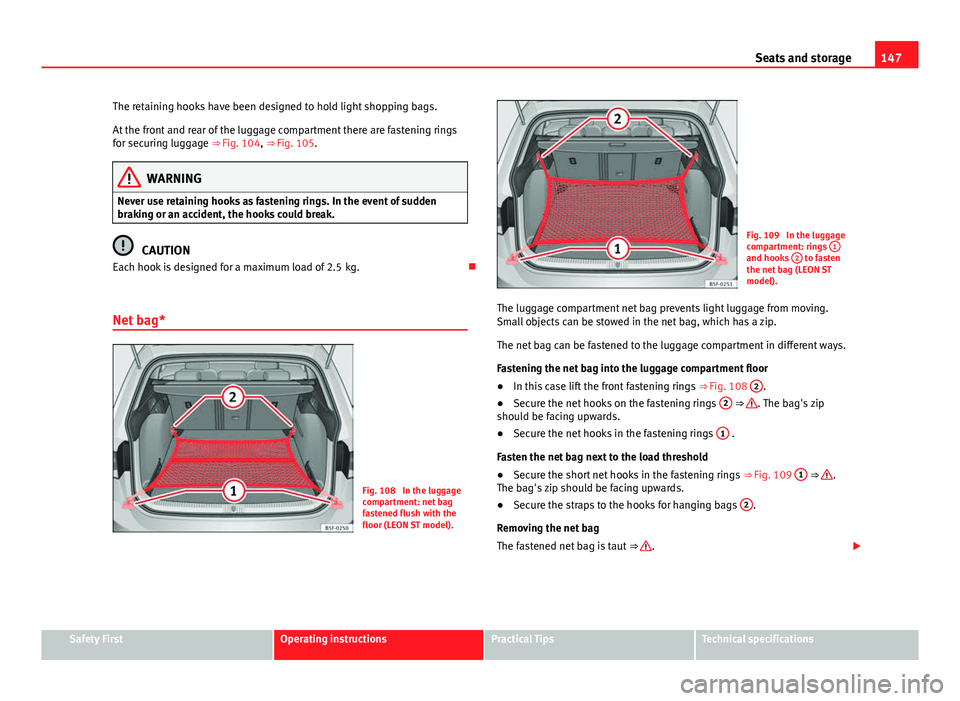
Fig. 108 In the luggage
compartment: net bag
fastened flush with the
floor (LEON ST model).
Fig. 109 In the luggage
compartment: rings 1
and hooks 2 to fasten
the net bag (LEON ST
model).
The luggage compartment net bag prevents light luggage from moving.
Small objects can be stowed in the net bag, which has a zip.
The net bag can be fastened to the luggage compartment in different ways.
Fastening the net bag into the luggage compartment floor
● In this case lift the front fastening rings
⇒ Fig. 108 2
.
● Secure the net hooks on the fastening rings 2
⇒ . The bag's zip
should be facing upwards.
● Secure the net hooks in the fastening rings 1
.
Fasten the net bag next to the load threshold
● Secure the short net hooks in the fastening rings
⇒ Fig. 109 1
⇒ .
The bag's zip should be facing upwards.
● Secure the straps to the hooks for hanging bags 2
.
Removing the net bag
The fastened net bag is taut ⇒
.
Safety FirstOperating instructionsPractical TipsTechnical specifications
Page 150 of 339
148Seats and storage
● Remove the hooks and the straps of the net bag from the fastening rings
and the hooks for hanging bags.
● Store the net bag in the luggage compartment.
WARNING
Draw out the elastic net bag to secure it to the fastening rings. Once fas-
tened it remains taut. If the elastic net bag is hooked up and unhooked
wrongly, its hooks may cause injuries.
● Always ensure that the hooks do not suddenly release from the fas-
tening rings when hooking or unhooking them.
● When hooking or unhooking the hooks, protect your eyes and face to
prevent injury in case the hooks were suddenly released.
● Always hook up the net bag hooks in the described order. If a hook is
unexpectedly released, the risk of injury increases.
Applies to the model: LEON ST
Luggage compartment variable floor
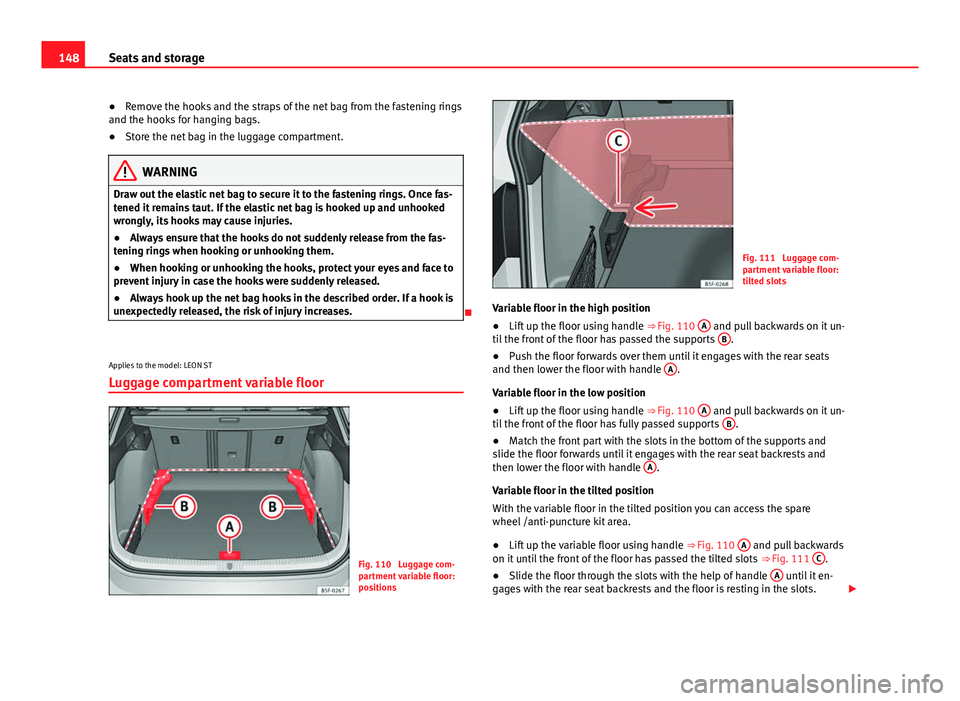
Fig. 110 Luggage com-
partment variable floor:
positions
Fig. 111 Luggage com-
partment variable floor:
tilted slots
Variable floor in the high position
● Lift up the floor using handle
⇒ Fig. 110 A
and pull backwards on it un-
til the front of the floor has passed the supports B.
● Push the floor forwards over them until it engages with the rear seats
and then lower the floor with handle A
.
Variable floor in the low position
● Lift up the floor using handle
⇒ Fig. 110 A
and pull backwards on it un-
til the front of the floor has fully passed supports B.
● Match the front part with the slots in the bottom of the supports and
slide the floor forwards until it engages with the rear seat backrests and
then lower the floor with handle A
.
Variable floor in the tilted position
With the variable floor in the tilted position you can access the spare
wheel /anti-puncture kit area.
● Lift up the variable floor using handle
⇒ Fig. 110 A
and pull backwards
on it until the front of the floor has passed the tilted slots ⇒ Fig. 111 C.
● Slide the floor through the slots with the help of handle A until it en-
gages with the rear seat backrests and the floor is resting in the slots.
Page 151 of 339
149
Seats and storage
WARNING
During a sudden braking manoeuvre or accident, objects could be
launched across the passenger compartment and cause serious or fatal
injuries.
● Always secure objects, even when the luggage compartment floor is
properly raised.
● Between the rear seat and the raised luggage compartment floor, car-
ry only objects that are not more than two-thirds the height of the floor.
● Between the rear seat and the raised luggage compartment floor, you
can only carry objects that do not exceed the weight of approximately
7.5 kg.
CAUTION
● The maximum weight supported by the variable floor of the luggage
compartment at the top is 150 kg.
● Do not let the luggage compartment floor fall when closing it. Always
carefully guide it downwards in a controlled manner. Otherwise, the lining
and the floor of the luggage compartment could be damaged.
Note
SEAT recommends that you use suitable straps to secure the objects to the
retaining rings.
Safety FirstOperating instructionsPractical TipsTechnical specifications
Page 152 of 339
150Seats and storage
Roof carrier
Introduction
The vehicle roof has been designed to optimise aerodynamics. This is why it
is not possible to mount cross bars or conventional roof carrier systems in
the roof's rain channels.
Given that the rain channels have been incorporated into the roof for aero-
dynamic reasons, only SEAT-approved cross bars and roof carrier systems
can be used.
Cases in which the cross bars and roof carrier systems should be
dismounted
● When they are no longer needed.
● When the vehicle is to be washed in a car wash.
● When the vehicle height exceeds the maximum height, for example, in a
garage.
Additional information and warnings:
● Lights ⇒ page 109
● Storing objects ⇒ page 17
● Driving ecologically ⇒ page 231
● Wheels and tyres ⇒ page 265
● Accessories, parts replacement, repairs and modifications ⇒ page 272
WARNING
Transporting heavy or bulky loads on the roof carrier system affects car
handling due to the shift in the centre of gravity and increased air resist-
ance.
● It is important to always use belts or retaining straps that are suita-
ble and in good condition to secure loads.
● A bulky, heavy, long or flat load has a negative effect on aerodynam-
ics and on the vehicle's centre of gravity and driving behaviour.
● Avoid sudden braking and other brusque manoeuvres.
● Adapt your speed and driving style to suit visibility, weather, road
and traffic conditions.
CAUTION
● Remove the cross bars and the roof carrier system before entering a car
wash.
● The height of your vehicle increases with the installation of the cross
bars and roof carrier system and with the load secured on them. To do so,
make sure that vehicle height does not exceed the height limit when going
through underpasses or garage doors.
● The cross bars, roof carrier system and load on them should not inter-
fere with the roof antenna or hamper the panoramic sliding roof and the
⇒ page 106 rear lid.
● On opening the rear lid, make sure that it does not bump into the roof
load.
For the sake of the environment
Fitting the cross bars and roof carrier system increases fuel consumption
due to greater aerodynamic resistance.
Page 153 of 339
151
Seats and storage
Applies to the model: LEON ST
Securing the cross bars and roof carrier system
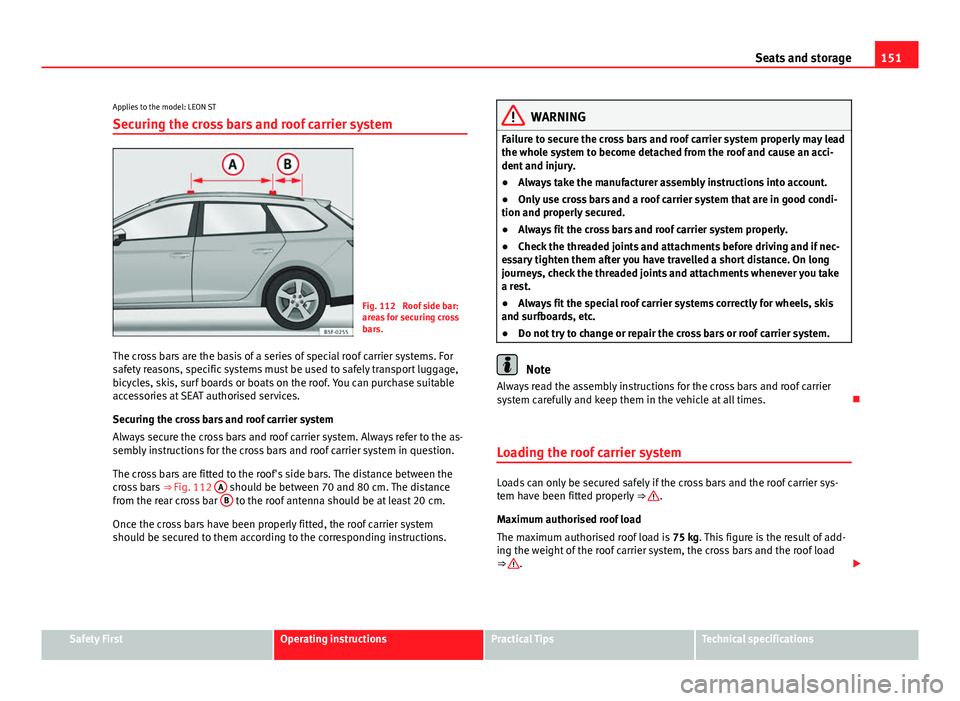
Fig. 112 Roof side bar:
areas for securing cross
bars.
The cross bars are the basis of a series of special roof carrier systems. For
safety reasons, specific systems must be used to safely transport luggage,
bicycles, skis, surf boards or boats on the roof. You can purchase suitable
accessories at SEAT authorised services.
Securing the cross bars and roof carrier system
Always secure the cross bars and roof carrier system. Always refer to the as-
sembly instructions for the cross bars and roof carrier system in question.
The cross bars are fitted to the roof's side bars. The distance between the
cross bars ⇒ Fig. 112 A
should be between 70 and 80 cm. The distance
from the rear cross bar B to the roof antenna should be at least 20 cm.
Once the cross bars have been properly fitted, the roof carrier system
should be secured to them according to the corresponding instructions.
WARNING
Failure to secure the cross bars and roof carrier system properly may lead
the whole system to become detached from the roof and cause an acci-
dent and injury.
● Always take the manufacturer assembly instructions into account.
● Only use cross bars and a roof carrier system that are in good condi-
tion and properly secured.
● Always fit the cross bars and roof carrier system properly.
● Check the threaded joints and attachments before driving and if nec-
essary tighten them after you have travelled a short distance. On long
journeys, check the threaded joints and attachments whenever you take
a rest.
● Always fit the special roof carrier systems correctly for wheels, skis
and surfboards, etc.
● Do not try to change or repair the cross bars or roof carrier system.
Note
Always read the assembly instructions for the cross bars and roof carrier
system carefully and keep them in the vehicle at all times.
Loading the roof carrier system
Loads can only be secured safely if the cross bars and the roof carrier sys-
tem have been fitted properly ⇒ .
Maximum authorised roof load
The maximum authorised roof load is 75 kg. This figure is the result of add-
ing the weight of the roof carrier system, the cross bars and the roof load
⇒
.
Safety FirstOperating instructionsPractical TipsTechnical specifications
Page 154 of 339
152Seats and storage
Make sure you know the weight of the roof carrier system, the cross bars
and the roof load; weigh them if necessary. Never exceed the maximum au-
thorised roof load.
However, if you are using cross bars and a roof carrier system with a lower
load rating you will not be able to carry the maximum roof load. In this case,
you can only load the roof carrier to the weight limit listed in the fitting in-
structions.
Distributing a load
Uniformly distribute loads and secure them correctly ⇒
.
Check attachments.
Once the cross bars and roof carrier system have been fitted, check bolted
joins and the attachments after you have travelled a short distance and
then regularly.
WARNING
Exceeding the maximum authorised roof load can result in accidents and
considerable vehicle damage.
● Never exceed the indicated roof load, the authorised load on the
axles or the vehicle's authorised maximum load.
● Do not exceed the load capacity of the cross bars and roof carrier sys-
tem, even if the maximum roof load has not been exceeded.
● Always secure heavy items as far forward as possible and distribute
the vehicle load uniformly.
WARNING
If the load is loose and is not properly secured it could fall from the roof
carrier system and cause accidents and injury.
● Always use belts or retaining straps that are suitable and in a good
condition.
● Secure the load properly.
Page 168 of 339
166Driving
CAUTION
If the engine has been running under high load for a long time, there is a
risk of heat building up in the engine compartment after the engine has
been switched off; this could cause engine damage. For this reason, you
should idle the engine for approx. 2 minutes before you switch it off.
Note
● After the engine is switched off the radiator fan may run on for up to 10
minutes, even if the ignition is switched off. It is also possible that the fan
turns itself on once more if the coolant temperature increases due to the
heat accumulated in the engine compartment or due to its prolonged expo-
sure to solar radiation.
● If the vehicle is stopped and the Start-Stop system* switches off the en-
gine, the ignition remains switched on. Make sure that the ignition is
switched off before leaving the vehicle, otherwise the battery could dis-
charge.
Kick-down
The kick-down feature allows maximum acceleration to be
reached. If the eco*
⇒ page 212 mode has been selected in SEAT Drive Mode*, and
the accelerator is pressed beyond a hard point, the engine power is auto-
matically controlled to give your vehicle maximum acceleration.
WARNING
Please note that if the road surface is slippery or wet, the kick-down fea-
ture could cause the driving wheels to spin, which could result in skid-
ding.
Handbrake
Using the handbrake
The handbrake should be applied firmly to prevent the vehi-
cle from accidentally rolling away.
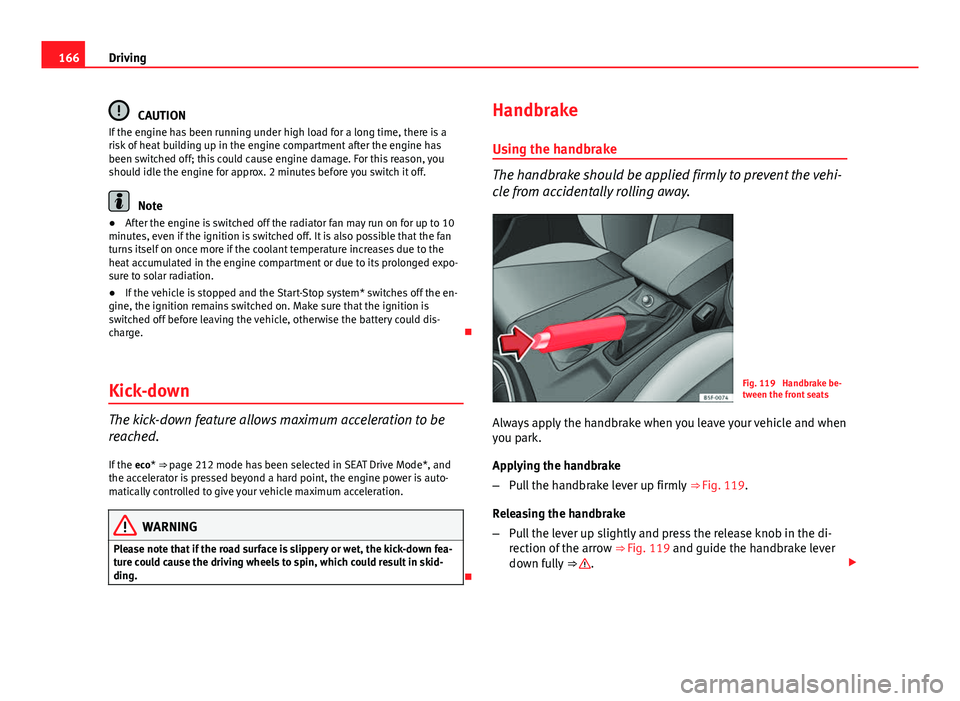
Fig. 119 Handbrake be-
tween the front seats
Always apply the handbrake when you leave your vehicle and when
you park.
Applying the handbrake
– Pull the handbrake lever up firmly ⇒ Fig. 119.
Releasing the handbrake
– Pull the lever up slightly and press the release knob in the di-
rection of the arrow ⇒ Fig. 119 and guide the handbrake lever
down fully ⇒
.
Page 244 of 339
242Care and cleaning
Car polish or other abrasive agents should not be used for maintaining the
rims. If the protective coating is damaged, e.g. by stone impact, the dam-
aged area should be touched up immediately.
WARNING
Please note when cleaning the wheels that water, ice and road salt can
impair the effectiveness of the brakes; this can cause an accident.
Exhaust tail pipe
It is important to remove road salt and brake dust by washing the wheels at
regular intervals, otherwise the exhaust tail pipe material could be dam-
aged. To remove impurities, do not use rim, paint or chrome cleaners or oth-
er abrasive products. Clean the exhaust tail pipes with cleaning products
that are suitable for stainless steel.
SEAT Official Services carry stocks of cleaning products that have been tes-
ted and approved for use on your vehicle.
Care of the vehicle interior Radio display/Easy Connect* and control panel*
The display can be cleaned with a soft cloth and a professionally available
“LCD cleaner”. Moisten the cloth with a small amount of the cleaning fluid.
The Easy Connect control panel* should first be cleaned with a brush so
that no dirt goes into the device or between the keys and housing. Next, we
recommend cleaning the Easy Connect control panel* using a cloth damp-
ened with water and washing-up liquid.
CAUTION
● To avoid scratching the screen, do not wipe the display with a dry cloth.
● To avoid damage, ensure that no liquid goes into the Easy Connect con-
trol panel*.
Plastic and leatherette parts
Plastic parts and leatherette can be cleaned with a damp cloth. If this is not
sufficient, plastic parts and leatherette should only be treated with a special
solvent-free plastic cleaner .
Textile covers and trim parts
Textile covers and trim parts (e.g. seats, door trim) should be cleaned regu-
larly with a vacuum cleaner. This will remove surface dirt which could other-
wise be rubbed into the textile material during use. Do not use steam clean-
ers, as the steam could carry the dirt deeper into the textile material.
Normal cleaning
We recommend that you use a soft sponge or a commercially available lint-
free, micro-fibre cloth for normal cleaning. Only use brushes on floor cover-
ings and mats, as other textile surfaces could become damaged.
In the case of normal surface dirt you can use a foam cleaner. Use a sponge
to spread the foam on the textile surface and to work it into the material
lightly. However, make sure that the textile material does not become soak-
ing wet. Then dab off the foam with a dry and absorbent cloth (e.g. a micro-
fibre cloth) and vacuum off any residue once the surface is completely dry.
Cleaning stains
Treat drink stains (such as coffee or fruit juice, etc.) with a cleaning solution
for delicate fabrics. The cleaning product solution should be applied with a
Page 245 of 339
243
Care and cleaning
sponge. If the stains are difficult to remove, a washing paste can be applied
directly onto the stain and worked into the fabric. The surface will then have
to be wiped with clear water to remove any residue left by the paste. To do
so, use a damp cloth or sponge and then dab the stain with an absorbent
cloth.
Remove chocolate or make-up stains with a cleaning paste (for e.g., soft
soap). Then remove the soap with water (wet sponge).
A spirit-based cleaner can be used to remove grease, oil, lipstick or ball
point pen. Then dab the dissolved grease or colour particles off with an ab-
sorbent cloth or similar. You may also have to treat the stain once more us-
ing washing paste and water.
If the covers or textile trim panels are badly soiled we recommend that you
have them cleaned by a professional cleaning company with a shampoo
and spray.
Note
Open Velcro fasteners on clothes can damage the seat upholstery. Make
sure that Velcro fasteners are closed.
Natural leather
SEAT does everything possible to preserve the genuine qual-
ities of this natural product. General information
Our range of leathers is large. The main type used is nappa in various forms,
that is, leather with a smooth surface in various different colours.
The amount of dye used determines the appearance and properties of leath-
er. If the leather is left in a more natural state, it retains its typical natural
napped appearance and confers excellent all-weather properties to the
seats. Fine veins, healed scars, insect bites, wrinkles and a subtle variation in shading remain visible; these are the characteristic features of genuine
natural leather.
Natural napped leather does not have a protective surface coating of dye. It
is therefore somewhat more prone to damage. This should be borne in mind
if children or pets often travel in the car, or if there are other factors that
could lead to damage.
Types of leather with a coloured surface coating are likely to be more resist-
ant to damage. This has a great advantage for day-to-day use. However, this
means that the typical natural characteristics of the surface are less appa-
rent, though this does not affect quality.
Cleaning and care
Due to the natural properties of the specially selected hides employed, the
finished leather has a certain sensitivity to grease and dirt, etc. so a degree
of care is required in everyday use and when looking after the leather. Dark
clothing (especially if damp or incorrectly dyed) may stain leather uphols-
tery. Dust and grit in the pores and seams can scratch and damage the sur-
face. Therefore leather should be cleaned at regular intervals, depending on
the actual amount of use. When they have been in use for a certain time,
your car seats will acquire a typical and unmistakable patina. This is charac-
teristic for leather as a natural product and is a sign of genuine quality.
To maintain the value of natural leather you should note the following
points:CAUTION
● Avoid exposing leather to direct sunlight for long periods, otherwise it
may tend to lose some of its colour. If the car is left for a prolonged period
in the bright sun, it is best to cover the leather.
● Sharp-edged objects on clothing, such as belts, zip fasteners, rivets or
similar, can also leave permanent scratches and rough marks on the surface
of the leather.
Safety FirstOperating instructionsPractical TipsTechnical specifications