power steering Seat Leon 5D 2013 Owner's manual
[x] Cancel search | Manufacturer: SEAT, Model Year: 2013, Model line: Leon 5D, Model: Seat Leon 5D 2013Pages: 339, PDF Size: 4.8 MB
Page 5 of 339

Table of Contents
About this manual . . . . . . . . . . . . . . . . . . . 5
Content . . . . . . . . . . . . . . . . . . . . . . . . . . . . . . . . 6
Safety First . . . . . . . . . . . . . . . . . . . . . . . . . . . . 7
Safe driving . . . . . . . . . . . . . . . . . . . . . . . . . . . . . . . 7
Brief introduction . . . . . . . . . . . . . . . . . . . . . . . . . 7
Sitting position for vehicle occupants . . . . . . . . . 10
Pedal area . . . . . . . . . . . . . . . . . . . . . . . . . . . . . . . 16
Storing objects . . . . . . . . . . . . . . . . . . . . . . . . . . . 17
Seat belts . . . . . . . . . . . . . . . . . . . . . . . . . . . . . . . . . 20
Brief introduction . . . . . . . . . . . . . . . . . . . . . . . . . 20
Why wear seat belts? . . . . . . . . . . . . . . . . . . . . . . 22
Seat belts . . . . . . . . . . . . . . . . . . . . . . . . . . . . . . . 26
Seat belt tensioners . . . . . . . . . . . . . . . . . . . . . . . 29
Airbag system . . . . . . . . . . . . . . . . . . . . . . . . . . . . . 31
Brief introduction . . . . . . . . . . . . . . . . . . . . . . . . . 31
Front airbags . . . . . . . . . . . . . . . . . . . . . . . . . . . . . 36
Knee airbag* . . . . . . . . . . . . . . . . . . . . . . . . . . . . . 39
Side airbags* . . . . . . . . . . . . . . . . . . . . . . . . . . . . 40
Curtain airbags . . . . . . . . . . . . . . . . . . . . . . . . . . . 43
Deactivating airbags . . . . . . . . . . . . . . . . . . . . . . . 45
Child safety . . . . . . . . . . . . . . . . . . . . . . . . . . . . . . . 48
Brief introduction . . . . . . . . . . . . . . . . . . . . . . . . . 48
Child seats . . . . . . . . . . . . . . . . . . . . . . . . . . . . . . . 50
Securing child seats . . . . . . . . . . . . . . . . . . . . . . . 53 Operating instructions
. . . . . . . . . . . . . 59
Controls and displays . . . . . . . . . . . . . . . . . . . . . . 59
Overview . . . . . . . . . . . . . . . . . . . . . . . . . . . . . . . . 58
Instruments and warning/control lamps . . . . 61
Instruments . . . . . . . . . . . . . . . . . . . . . . . . . . . . . . 61
Control lamps . . . . . . . . . . . . . . . . . . . . . . . . . . . . 69
Driver information system . . . . . . . . . . . . . . . . . . 73
Information system . . . . . . . . . . . . . . . . . . . . . . . . 73
Introduction to the Easy Connect system* . . . 79
System settings (CAR)* . . . . . . . . . . . . . . . . . . . . . 79
Opening and closing . . . . . . . . . . . . . . . . . . . . . . 87
Central locking system . . . . . . . . . . . . . . . . . . . . . 87
Anti-theft alarm system* . . . . . . . . . . . . . . . . . . . 95
Emergency locking and unlocking . . . . . . . . . . . . 98
Rear lid (luggage compartment) . . . . . . . . . . . . . 100
Electric windows . . . . . . . . . . . . . . . . . . . . . . . . . . 102
Panoramic sliding sunroof* . . . . . . . . . . . . . . . . . 106
Lights and visibility . . . . . . . . . . . . . . . . . . . . . . . . 109
Lights . . . . . . . . . . . . . . . . . . . . . . . . . . . . . . . . . . . 109
Sun protection equipment . . . . . . . . . . . . . . . . . . 118
Windscreen wiper and rear wiper systems . . . . . 120
Rear vision mirror . . . . . . . . . . . . . . . . . . . . . . . . . 125
Seats and storage . . . . . . . . . . . . . . . . . . . . . . . . . 128
General notes . . . . . . . . . . . . . . . . . . . . . . . . . . . . 128
Front seats . . . . . . . . . . . . . . . . . . . . . . . . . . . . . . . 129
Seat functions . . . . . . . . . . . . . . . . . . . . . . . . . . . . 130
Head restraints . . . . . . . . . . . . . . . . . . . . . . . . . . . 131
Storage compartments . . . . . . . . . . . . . . . . . . . . . 133
Power sockets . . . . . . . . . . . . . . . . . . . . . . . . . . . . 135
Luggage compartment . . . . . . . . . . . . . . . . . . . . . 136
Roof carrier . . . . . . . . . . . . . . . . . . . . . . . . . . . . . . 150 Air conditioning
. . . . . . . . . . . . . . . . . . . . . . . . . . . 153
Heating, ventilation, cooling . . . . . . . . . . . . . . . . 153
Driving . . . . . . . . . . . . . . . . . . . . . . . . . . . . . . . . . . . . 162
Steering . . . . . . . . . . . . . . . . . . . . . . . . . . . . . . . . . 162
Ignition lock . . . . . . . . . . . . . . . . . . . . . . . . . . . . . . 162
Kick-down . . . . . . . . . . . . . . . . . . . . . . . . . . . . . . . 166
Handbrake . . . . . . . . . . . . . . . . . . . . . . . . . . . . . . . 166
Hill driving assistant* . . . . . . . . . . . . . . . . . . . . . . 168
Speed warning function . . . . . . . . . . . . . . . . . . . . 168
Start-Stop system* . . . . . . . . . . . . . . . . . . . . . . . . 169
Manual gearbox . . . . . . . . . . . . . . . . . . . . . . . . . . 172
Automatic gearbox/DSG automatic gearbox* . . . 173
Driver assistance systems . . . . . . . . . . . . . . . . . . 184
Cruise control system (CCS)* . . . . . . . . . . . . . . . . 184
Adaptive cruise control (ACC)* . . . . . . . . . . . . . . . 189
Monitoring system Front Assist* . . . . . . . . . . . . . 202
Lane Assist system* . . . . . . . . . . . . . . . . . . . . . . . 207
SEAT Drive Modes* . . . . . . . . . . . . . . . . . . . . . . . . 211
Tiredness detection (break recommendation)* . 213
Tyre monitoring systems . . . . . . . . . . . . . . . . . . . . 214
Parking aid . . . . . . . . . . . . . . . . . . . . . . . . . . . . . . 217
Practical Tips . . . . . . . . . . . . . . . . . . . . . . . . . 222
Intelligent technology . . . . . . . . . . . . . . . . . . . . . 222
Electronic Stability Control (ESC) . . . . . . . . . . . . . 222
Brakes . . . . . . . . . . . . . . . . . . . . . . . . . . . . . . . . . . 224
Electro-mechanical steering . . . . . . . . . . . . . . . . . 225
Progressive steering . . . . . . . . . . . . . . . . . . . . . . . 226
Power Management . . . . . . . . . . . . . . . . . . . . . . . 226
Information recorded in the control units . . . . . . 228
3
Table of Contents
Page 167 of 339
165
Driving
WARNING
● Never run the engine in confined spaces, as the exhaust gases are
poisonous.
● Never remove the key from the ignition if the vehicle is in motion.
Otherwise, the steering could suddenly lock, making it impossible to
steer the vehicle: risk of accident!
● Always take the key with you when you leave the vehicle. This is par-
ticularly important if there are children in the vehicle, as they might oth-
erwise be able to start the engine or use power-operated equipment (e.g.
the electric windows), which could cause injuries.
CAUTION
Avoid high engine speeds, full throttle and extreme load conditions until
the engine has reached its normal operating temperature, otherwise this
can damage the engine.
For the sake of the environment
Do not warm up the engine by running it with the car stationary. You should
drive off as soon as you start the engine. This will help avoid unnecessary
exhaust emissions.
Note
● If it is difficult to turn the ignition key to the position 1, turn the steer-
ing wheel to both sides to release the steering lock.
● When starting from cold, the engine may be a little noisy for the first few
seconds until oil pressure has built up in the hydraulic valve lifters. This is
quite normal, and no cause for concern.
● If the vehicle battery is disconnected and reconnected, the key must re-
main in the position 1
for around 5 seconds before starting up.
● Vehicles with automatic gearbox: After switching off the ignition, you
can only remove the ignition key if the selector lever is in position “P” (park-
ing lock). Next, the selector lever is locked. Switching off the engine with the key
Switching off the engine
–
Stop the vehicle.
– Turn the ignition key to position 1
⇒ Fig. 118.
Engaging the steering wheel lock
Important: selector lever (automatic gearbox*) must be in position
P.
– Remove the key from the ignition in position 1
⇒ Fig. 118
⇒ .
– Turn the steering wheel until you hear it engage.
Possible vehicle theft is prevented with the steering lock engaged.
WARNING
● Never switch the engine off until the vehicle is stationary. The brake
servo and power steering functions will not be completely covered under
warranty. More force may also be needed to turn the steering wheel or to
brake. As you cannot steer and brake in the normal manner, there is a
greater risk of accidents and serious injury.
● Never remove the key from the ignition if the vehicle is in motion.
Otherwise, the steering could lock making it impossible to steer the vehi-
cle.
● Always take the ignition key with you whenever you leave the vehicle,
even temporarily. This is particularly important if there are children in
the vehicle, as they might otherwise be able to start the engine or use
power-operated equipment (e.g. the electric windows), which could
cause injuries.
Safety FirstOperating instructionsPractical TipsTechnical specifications
Page 171 of 339
169
Driving
countries with general speed limits, or if a particular speed should not be
exceeded when winter tyres are fitted etc.
Note
● Please bear in mind that, even with the speed warning function, it is still
important to keep an eye on the vehicle speed with the speedometer and to
observe the legal speed limits.
● The speed limit warning function in the version for several countries
warns you at a speed of 120 km/h (80 mph). This is a factory-set speed lim-
it.
Setting speed limit warning
You can use the radio or the Easy Connect* to set, alter or
cancel the speed limit warning.
Vehicles with radio
– Select: SETUP
button > control button
Driver assistant > Speed
warning.
Vehicles with Easy Connect
– Select: Systems control button or Vehicle systems > Driver assis-
tant > Speed warning.
The warning limit can be set from 30 to 240 km/h (20 to 150 mph). The ad-
justment is done in 10 km/h (mph) intervals. Start-Stop system*
Description and operation
The Start-Stop system helps save fuel and reduce CO 2 emissions.
In Start-Stop mode, the engine will automatically switch off when the vehi-
cle stops, when stopping at traffic lights for example. The ignition remains
switched on during the stopping phase. The engine automatically switches
back on when required.
As soon as the ignition is switched on, the Start-Stop function is automati-
cally activated.
Basic requirements for the Start-Stop mode
● The driver door must be closed.
● The driver must have their seat belt fastened.
● The bonnet must be closed.
● The vehicle must have travelled at more than 4 km/h since the last stop.
● The vehicle cannot be towing a trailer.
WARNING
● Never switch the engine off until the vehicle is stationary. The brake
servo and power steering functions will not be completely covered under
warranty. More force may also be needed to turn the steering wheel or to
brake. As you cannot steer and brake in the normal manner, there is a
greater risk of accidents and serious injury.
● Never remove the key from the ignition if the vehicle is in motion.
Otherwise, the steering could lock making it impossible to steer the vehi-
cle.
Safety FirstOperating instructionsPractical TipsTechnical specifications
Page 173 of 339
171
Driving
● The engine has not yet reached the minimum required temperature for
the Start-Stop mode.
● The interior temperature selected for the air conditioner has not yet
been reached.
● The interior temperature is very high/low.
● Defrost function button activated ⇒ page 154.
● The parking aid* is switched on.
● The battery is very low.
● The steering wheel is overly turned or is being turned.
● If there is a danger of misting.
● After engaging reverse gear.
● In case of a very steep gradient.
The indication is shown on the instrument panel display, and in addition,
the driver information system* shows, .
The engine starts by itself
During a stopping phase the normal Start-Stop mode can be interrupted in
the following situations: The engine restarts by itself without involvement
from the driver.
● The interior temperature differs from the value selected on the air condi-
tioner.
● Defrost function button activated ⇒ page 154.
● The brake has been pressed several times consecutively.
● The battery is too low.
● High power consumption.
Note
In vehicles with an automatic gearbox, if the selector lever is placed in posi-
tion D, N or S after engaging reverse gear, the vehicle must be driven at a
speed faster than 10 km/h (5 mph) for the system to return to conditions in
which the engine can be stopped. Manually switching on/off the Start-Stop system
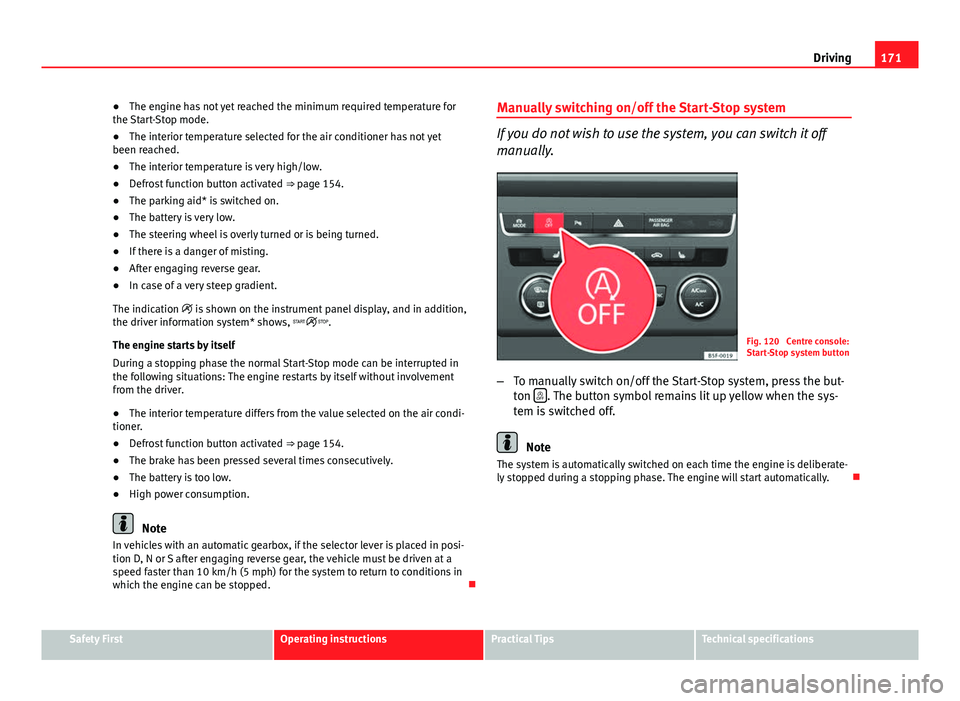
If you do not wish to use the system, you can switch it off
manually.
Fig. 120 Centre console:
Start-Stop system button
– To manually switch on/off the Start-Stop system, press the but-
ton
. The button symbol remains lit up yellow when the sys-
tem is switched off.
Note
The system is automatically switched on each time the engine is deliberate-
ly stopped during a stopping phase. The engine will start automatically.
Safety FirstOperating instructionsPractical TipsTechnical specifications
Page 214 of 339
212Driver assistance systems
If the DCC has a fault, the instrument panel display shows the message
Fault: Damping control.
Steering
Power steering becomes more robust in sport mode to enable a more sporty
driving style.
Air conditioning
In vehicles with Climatronic, this can operate in eco mode, especially re-
stricting fuel consumption.
Ambient lighting
The ambient lighting guides located in the interior front door panels of the
Leon FR change colour from white to red when sport mode is activated.
Setting driving mode
You can select from Normal, Sport, Eco and Individual.
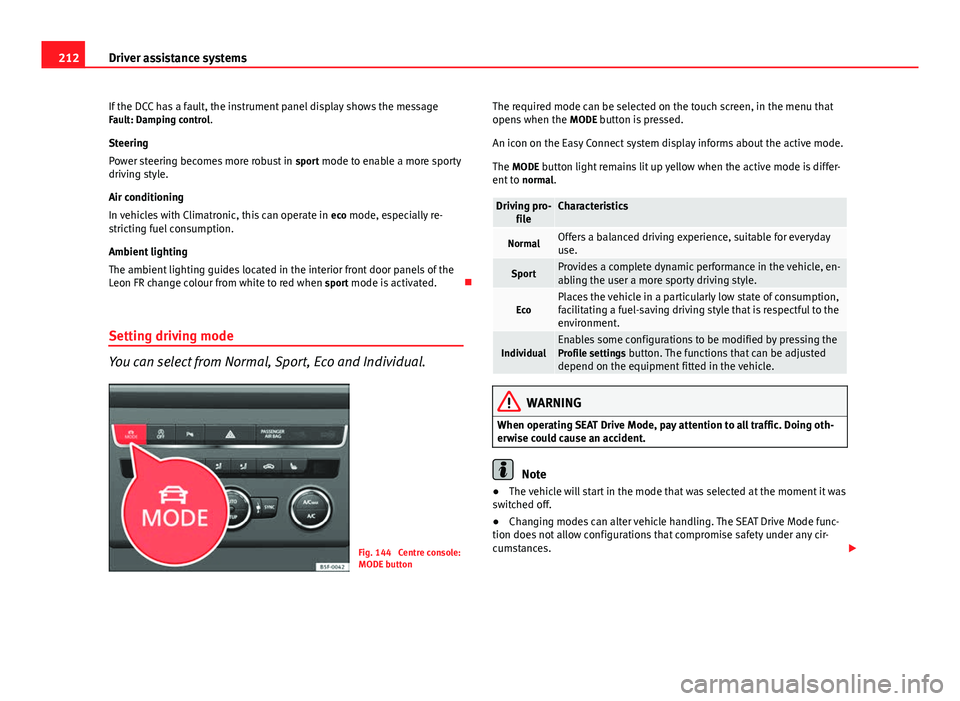
Fig. 144 Centre console:
MODE button The required mode can be selected on the touch screen, in the menu that
opens when the
MODE button is pressed.
An icon on the Easy Connect system display informs about the active mode.
The MODE button light remains lit up yellow when the active mode is differ- ent to normal.
Driving pro-
fileCharacteristics
NormalOffers a balanced driving experience, suitable for everyday
use.
SportProvides a complete dynamic performance in the vehicle, en-
abling the user a more sporty driving style.
EcoPlaces the vehicle in a particularly low state of consumption,
facilitating a fuel-saving driving style that is respectful to the
environment.
IndividualEnables some configurations to be modified by pressing the
Profile settings button. The functions that can be adjusted
depend on the equipment fitted in the vehicle.
WARNING
When operating SEAT Drive Mode, pay attention to all traffic. Doing oth-
erwise could cause an accident.
Note
● The vehicle will start in the mode that was selected at the moment it was
switched off.
● Changing modes can alter vehicle handling. The SEAT Drive Mode func-
tion does not allow configurations that compromise safety under any cir-
cumstances.
Page 227 of 339
225
Intelligent technology
Corrosion
There may be a tendency for corrosion to form on the discs and dirt to build
up on the brake pads if the vehicle is used infrequently or the brakes are
not used very often.
If the brakes are not used frequently, or if rust has formed on the disks, it is
advisable to clean off the pads and disks by braking firmly a few times at a
moderately high speed ⇒
.
Fault in the brake system
If the brake pedal travel should ever increase suddenly, this may mean that
one of the two brake circuits has failed. Drive immediately to the nearest
specialised workshop and have the fault repaired. Drive there slowly and re-
member that you will have to apply more pressure on the brake pedal and
allow for longer stopping distances.
Low brake fluid level
Malfunctions can occur in the brake system if the brake fluid level is too
low. The brake fluid level is monitored electronically.
Brake servo
The brake servo increases the pressure you apply to the brake pedal. It
works only when the engine is running.
WARNING
● Apply the brakes heavily to clean the brake system only in a suitable
traffic situation. Do not put other road users in danger: risk of causing an
accident.
● Ensure the vehicle does not move while in neutral, when the engine is
stopped. Failure to do so could result in an accident.
CAUTION
● Never let the brakes “drag” by leaving your foot on the pedal when it is
not necessary to brake. This overheats the brakes, resulting in longer stop-
ping distances and greater wear.
● Before driving down a long, steep gradient, it is advisable to reduce
speed and select a lower gear. This makes use of engine braking and re-
lieves the brakes. If you still have to use the brakes, it is better to brake
firmly at intervals than to apply the brakes continuously.
Note
● If the brake servo is out of action due to a malfunction, or if the car has
to be towed, you will have to press the brake pedal considerably harder to
make up for the lack of servo assistance.
● If you wish to equip the vehicle with accessories such as a front spoiler
or wheel covers, it is important that the flow of air to the front wheels is not
obstructed, otherwise the brakes can overheat.
Electro-mechanical steering
Electro-mechanical power steering assists the driver when
steering.
Electro-mechanical power steering adapts electronically to the speed of the
car, torque and turning angle.
If the power steering should fail at any time or the engine is switched off (for
instance when being towed), the car can still be steered. However, more ef-
fort than normal will be required to turn the steering wheel.
Driver warning lamps and messages
(in red) Faulty steering! To park the vehicle
Safety FirstOperating instructionsPractical TipsTechnical specifications
Page 228 of 339
226Intelligent technology
If the warning lamp remains on and the driver indication appears, the power
steering could be faulty.
Do not continue driving. Seek specialist assistance. (in yellow) Steering: System fault! You may continue driving.
If the warning lamp comes on, the steering could react with more difficultly
or more sensitivity than normal. In addition, when driving in a straight line
the steering wheel may be off-centre.
Drive slowly to a specialised workshop and have the fault repaired. (in yellow) Steering lock: fault! Go to an Official Service
The electronic steering lock is malfunctioning.
Go to a specialised workshop as soon as possible and have the fault re-
paired.
WARNING
Take it immediately to a specialised workshop and have the fault re-
paired: risk of accident!
Note
If a red or yellow warning lamp come on briefly, you can continue driv-
ing.
Progressive steering
Depending on the vehicle's equipment, the progressive steering can adapt
steering hardness to the driving conditions. Progressive steering only works
when the engine is running. In city traffic
there is no need to turn the wheel so much when parking, ma-
noeuvring or in tight turns.
On the road or on motorways, the progressive steering transmits, e.g., on
bends, a sportier, more direct and perceptibly more dynamic sensation to
the steering wheel
Power Management This system helps to ensure reliable starting
The power management controls the distribution of electri-
cal energy and thus helps to ensure that there is always
enough power available to start the engine.
If a vehicle with a conventional electrical system is left parked for a long
time, the battery will gradually lose its charge because certain electrical
equipment (such as the electronic gearbox lock) continues to draw current
even when the ignition is off. In some cases there may not be enough power
available to start the engine.
Your vehicle is equipped with an intelligent power management system to
control the distribution of electrical energy. This significantly improves relia-
bility when starting the engine, and also prolongs the useful life of the bat-
tery.
The main functions incorporated in the power management system are bat-
tery diagnosis , residual current management and dynamic power manage-
ment.
Page 288 of 339
286Emergencies
Towing and tow-starting the vehicle
General information
Points to observe when tow-starting or towing away If you use a tow rope:
Notes for the driver of the towing vehicle
– The tow rope must be taut before you drive off.
– Release the clutch very carefully when starting the vehicle
(manual gearbox), or accelerate gently (automatic gearbox).
Notes for the driver of the towed vehicle
– The ignition should be switched on so that the turn signals,
windscreen wipers and washers can be used. Please ensure
that the steering wheel is unlocked when you switch on the ig-
nition, and that it moves freely.
– Put the gearbox lever in neutral (manual gearbox) or move the
selector lever to position N (automatic gearbox).
– The brake servo only works when the engine is running. Consid-
erably more effort is required on the brake pedal when the en-
gine is switched off.
– Remember that the power steering only works when the ignition
is switched on and the vehicle is moving 1)
. Otherwise, consider-
ably more strength than usual will be required when steering. –
Ensure that the tow rope remains taut at all times.
Tow rope or tow bar
It is easier and safer to tow a vehicle with a tow bar. You should only use a
tow rope if you do not have a tow bar.
A tow rope should be slightly elastic to avoid damage to both vehicles. It is
advisable to use a tow rope made of synthetic fibre or similarly elastic mate-
rial.
Only attach the tow rope or the tow bar to the towing rings ⇒ page 287.
Driving style
Towing requires some experience, especially when using a tow rope. Both
drivers should be familiar with the technique required for towing. Inexper-
ienced drivers should not attempt to tow.
Do not pull too hard with the towing vehicle and take care to avoid jerking
the tow rope. When towing on an unpaved road, there is always a risk of
overloading and damaging the anchorage points.
WARNING
If the vehicle has no electrical power, the brake lights, turn signals and
all other lights will no longer function. Do not have the vehicle towed
away. Failure to do so could result in an accident.
CAUTION
If there is no oil in the gearbox or no lubricant in the automatic transmission
the car may only be towed with the driven wheels lifted clear of the road, or
transported on a special car transporter or trailer.
1)
Important: the battery must be correctly charged.
Page 330 of 339

E
E10see Ethanol (fuel) . . . . . . . . . . . . . . . . . . . . 246
Easy Connect . . . . . . . . . . . . . . . . . . . . . . . . . . . 79
Economic driving . . . . . . . . . . . . . . . . . . . . . . . 231
EDL see Electronic differential lock . . . . . . . . . 222
Efficiency programme Additional electrical appliances . . . . . . . . . 77
Saving tips . . . . . . . . . . . . . . . . . . . . . . . . . . 78
Electrical accessories see Power socket . . . . . . . . . . . . . . . . . . . . 135
Electric windows . . . . . . . . . . . . . . . . . . . . . . . . 102 Convenience opening/closing . . . . . . . . . 103
Electro-mechanical steering . . . . . . . . . . . . . . 225 Warning lamp . . . . . . . . . . . . . . . . . . . . . . . 225
Electronic differential lock . . . . . . . . . . . . . . . . 222
Electronic Self-locking . . . . . . . . . . . . . . . . . . . 222
Electronic Stability Control (ESC) . . . . . . . . . . 222
Emergencies . . . . . . . . . . . . . . . . . . . . . . . . . . . 274 Automatic gearbox Backup programme . . 181
Replacing the battery . . . . . . . . . . . . . . . . . 262
Emergency braking warning . . . . . . . . . . . . . . 114
Emergency locking and unlocking . . . . . . . . . . 98
Engine Assisted starting . . . . . . . . . . . . . . . . . . . . 283
Preheating . . . . . . . . . . . . . . . . . . . . . . . . . 163
Start-Stop system . . . . . . . . . . . . . . . . . . . . 169
Starting up . . . . . . . . . . . . . . . . . . . . . . . . . 163 Starting up (driver messages with the me-
chanical contact) . . . . . . . . . . . . . . . . . . . 164
Switching off (engine) . . . . . . . . . . . . . . . . 165
Engine compartment Closing the bonnet . . . . . . . . . . . . . . . . . . . 253
Opening the bonnet . . . . . . . . . . . . . . . . . . 252
Safety notes . . . . . . . . . . . . . . . . . . . . . . . . 251
Engine coolant G 12 plus-plus . . . . . . . . . . . . . . . . . . . . . . 257
G 13 . . . . . . . . . . . . . . . . . . . . . . . . . . . . . . . 257
Specifications . . . . . . . . . . . . . . . . . . . . . . . 257
Engine oil . . . . . . . . . . . . . . . . . . . . . . . . . . . . . 253 Changing . . . . . . . . . . . . . . . . . . . . . . . . . . 256
Checking oil level . . . . . . . . . . . . . . . . . . . . 255
Consumption . . . . . . . . . . . . . . . . . . . . . . . 255
Engine oil dipstick . . . . . . . . . . . . . . . . . . . 255
Inspection service . . . . . . . . . . . . . . . . . . . 253
Longlife inspection service . . . . . . . . . . . . 253
Oil properties . . . . . . . . . . . . . . . . . . . . . . . 254
Replace . . . . . . . . . . . . . . . . . . . . . . . . . . . . 253
Service intervals . . . . . . . . . . . . . . . . . . . . . 253
Specifications . . . . . . . . . . . . . . . . . . . . . . . 253
Temperature display . . . . . . . . . . . . . . . . . . . 77
Topping up . . . . . . . . . . . . . . . . . . . . . . . . . 256
Environment Ecological driving . . . . . . . . . . . . . . . . . . . . 231
Environmental friendliness . . . . . . . . . . . . 232
Environmental tip Leaks . . . . . . . . . . . . . . . . . . . . . . . . . . . . . . 252
Environmental tips Filling the tank . . . . . . . . . . . . . . . . . . 248, 250
Environment warning . . . . . . . . . . . . . . . . . . . . 219 ESC
Electronic stability control . . . . . . . . . . . . . 222
Multi-collision brake . . . . . . . . . . . . . . . . . 223
Sport Mode . . . . . . . . . . . . . . . . . . . . . . . . . 223
Ethanol (fuel) . . . . . . . . . . . . . . . . . . . . . . . . . . 246
Exhaust tail pipe: Cleaning . . . . . . . . . . . . . . . 242
extending the rear lid locking time see rear lid . . . . . . . . . . . . . . . . . . . . . . . . . 100
Exterior lighting Changing a bulb . . . . . . . . . . . . . . . . . . . . . 293
Exterior mirrors Adjust . . . . . . . . . . . . . . . . . . . . . . . . . . . . . 125
heated . . . . . . . . . . . . . . . . . . . . . . . . . . . . . 125
Heating . . . . . . . . . . . . . . . . . . . . . . . . . . . . 125
F
Fastening rings . . . . . . . . . . . . . . . . . . . . . . 18, 145
Fault in the gearbox (warning lamp) . . . . . . . . 181
Fault memory . . . . . . . . . . . . . . . . . . . . . . . . . . 228
Faults Panoramic sliding sunroof . . . . . . . . . . . . . 106
Faults in the gearbox (warning lamps) . . . . . . 182
Faulty bulbs Changing a bulb . . . . . . . . . . . . . . . . . . . . . 293
Filling the tank . . . . . . . . . . . . . . . . . . . . . . . . . 248 Fuel gauge . . . . . . . . . . . . . . . . . . . . . . . . . . 67
Opening the fuel tank cap . . . . . . . . . . . . . 248
Floor mats . . . . . . . . . . . . . . . . . . . . . . . . . . . . . . 17
Fog light . . . . . . . . . . . . . . . . . . . . . . . . . . . . . . 111
Fold the seats . . . . . . . . . . . . . . . . . . . . . . . . . . . 137
328 Index
Page 334 of 339
Fault . . . . . . . . . . . . . . . . . . . . . . . . . . . . . . 221
Parking system plus . . . . . . . . . . . . . . . . . . 219
Rear parking aid . . . . . . . . . . . . . . . . . . . . . 218
Sensors/Camera: cleaning . . . . . . . . . . . . 239
Towing bracket . . . . . . . . . . . . . . . . . . . . . . 221
Parking aid system see Parking aid . . . . . . . . . . . . . . . . . . . . . . 219
Parking light . . . . . . . . . . . . . . . . . . . . . . . . . . . 112
Parking (automatic gearbox) . . . . . . . . . . . . . . 176
Particulate filter (Diesel) . . . . . . . . . . . . . . . . . 230
Passenger see Correct sitting position . . . . . . . 11, 12, 13
Passenger's seat backrest folding . . . . . . . . . . . . . . . . . . . . . . . . . . . . . 129
lifting . . . . . . . . . . . . . . . . . . . . . . . . . . . . . . 129
Pedals . . . . . . . . . . . . . . . . . . . . . . . . . . . . . . . . . 16
Physical principles of a frontal collision . . . . . . 22
Plastic parts: Cleaning . . . . . . . . . . . . . . . 240, 242
Polishing . . . . . . . . . . . . . . . . . . . . . . . . . . . . . . 240
Power Management . . . . . . . . . . . . . . . . . . . . . 226
Power socket . . . . . . . . . . . . . . . . . . . . . . . . . . 135
Preheating . . . . . . . . . . . . . . . . . . . . . . . . . . . . 163
Pressure (tyres) . . . . . . . . . . . . . . . . . . . . . . . . . 265
Progressive steering . . . . . . . . . . . . . . . . . . . . 226
R Racks . . . . . . . . . . . . . . . . . . . . . . . . . . . . . . . . . 135
Radar sensor . . . . . . . . . . . . . . . . . . . . . . . 191, 204
Radio display: cleaning . . . . . . . . . . . . . . . . . . 242
Radio transmitters . . . . . . . . . . . . . . . . . . . . . . 272 Rain sensor . . . . . . . . . . . . . . . . . . . . . . . . . . . . 123
Control of function . . . . . . . . . . . . . . . . . . . 123
Rear lid automatic locking . . . . . . . . . . . . . . . . . . . . 100
Central locking system . . . . . . . . . . . . . . . . 100
Manual release in an emergency . . . . . . . 101
see also luggage compartment . . . . . . . . . 100
Rear lights Changing a bulb . . . . . . . . . . . . . . . . . . . . . 293
Rear seat folding down and lifting backrest . . . . . . . 138
Rear seat backrest folding down . . . . . . . . . . . . . . . . . . . . . . . . 138
lifting . . . . . . . . . . . . . . . . . . . . . . . . . . . . . . 138
Rear vision mirror . . . . . . . . . . . . . . . . . . . . . . . 125
Rear vision mirrors Adjusting the exterior mirrors . . . . . . . . . . 125
see also Rear vision mirrors . . . . . . . . . . . . 126
Rear wiper . . . . . . . . . . . . . . . . . . . . . . . . . . . . . 120
Reflective vests . . . . . . . . . . . . . . . . . . . . . . . . . 274
Refuelling natural gas . . . . . . . . . . . . . . . . . . . . . . . . . 250
Remote control See "Keys" . . . . . . . . . . . . . . . . . . . . . . . . . . 89
Remote control key Unlocking/Locking . . . . . . . . . . . . . . . . . . . . 92
Remove the wheel cover . . . . . . . . . . . . . . . . . 278
Repairs . . . . . . . . . . . . . . . . . . . . . . . . . . . . . . . 272 Airbags . . . . . . . . . . . . . . . . . . . . . . . . . . . . . 34
Replacement parts . . . . . . . . . . . . . . . . . . . . . . 272
Reservoir capacity Windscreen washer water reservoir . . . . . 125 Reset button (trip recorder) . . . . . . . . . . . . . . . . 67
Reset the trip recorder to zero . . . . . . . . . . . . . . 67
Retaining hooks . . . . . . . . . . . . . . . . . . . . . . . . 146
retractable rear shelf . . . . . . . . . . . . . . . . . . . . 140
Retrofitting a towing bracket . . . . . . . . . . . . . . 236
Rev counter . . . . . . . . . . . . . . . . . . . . . . . . . . 61, 66
Reverse gear (automatic gearbox) . . . . . . . . . 173
Rims
Cleaning . . . . . . . . . . . . . . . . . . . . . . . . . . . 241
RME (fuel) . . . . . . . . . . . . . . . . . . . . . . . . . . . . . 247
Roll-back function Panoramic sliding sunroof . . . . . . . . . . . . . 107
Windows . . . . . . . . . . . . . . . . . . . . . . . . . . . 104
Roof carrier . . . . . . . . . . . . . . . . . . . . . . . . . . . . 150
Roof carrier system . . . . . . . . . . . . . . . . . . . . . . 150
Roof load . . . . . . . . . . . . . . . . . . . . . . . . . . . . . . 151 technical data . . . . . . . . . . . . . . . . . . . . . . . 151
Running in New brake pads . . . . . . . . . . . . . . . . . . . . . 224
New engine . . . . . . . . . . . . . . . . . . . . . . . . . 230
New tyres . . . . . . . . . . . . . . . . . . . . . . . . . . 265
S Safe driving . . . . . . . . . . . . . . . . . . . . . . . . . . . . . 7
Safelock see Anti-theft security system . . . . . . . . . . . 87
Safety . . . . . . . . . . . . . . . . . . . . . . . . . . . . . . . . . . 8 child safety . . . . . . . . . . . . . . . . . . . . . . . . . . 48
child seats . . . . . . . . . . . . . . . . . . . . . . . . . . 48
Safety equipment . . . . . . . . . . . . . . . . . . . . . . . . . 7
Safety first . . . . . . . . . . . . . . . . . . . . . . . . . . . . . . . 7
332 Index