fuel consumption Seat Leon 5D 2015 User Guide
[x] Cancel search | Manufacturer: SEAT, Model Year: 2015, Model line: Leon 5D, Model: Seat Leon 5D 2015Pages: 308, PDF Size: 5.93 MB
Page 208 of 308

Operation
Setting driving mode Fig. 209
Centre console: MODE button. You can select from
Normal, Sport, Eco
and Individual .
Y ou c
an sel
ect the required mode either by
repeatedly pressing the button MODE
››› Fig. 209, or on the touch screen, in the
menu that opens when the above button is
pressed.
An icon on the Easy Connect system display
informs about the active mode.
The MODE button light remains lit up yellow
when the active mode is different to Normal.
Driving
profileCharacteristics
NormalOffers a balanced driving experience, suit-
able for everyday use.
DrivingprofileCharacteristics
SportProvides a complete dynamic performance
in the vehicle, enabling the user a more
sporty driving style.
Eco
Places the vehicle in a particularly low
state of consumption, facilitating a fuel-
saving driving style that is respectful to
the environment.
Individ- ual
Enables some configurations to be modi-
fied by pressing the Profile settings
button. The functions that can be adjusted
depend on the equipment fitted in the ve-
hicle.
Conven- ience a)It permits more relaxed and comfortable
driving, for example for long motorway
journeys. Its main characteristic is the soft
suspension setting (DCC).
a)
Only for FR and X-PERIENCE models equipped with dynamic
chassis control and Navi System Plus. WARNING
When operating SEAT Drive Profile, pay atten-
tion to a l
l traffic: doing otherwise could cause
an accident. Note
● When the v ehic
le is switched off it will al-
ways store the driving profile that was selec-
ted when the ignition key was removed. Nev-
ertheless, when the engine is restarted the
engine and the gear will not restart in its sportier mode in order to save fuel. For en-
gine and ge
ar t
o revert to a sportier mode,
select the corresponding driving profile again
on the Easy Connect system screen.
● Your speed and driving style must always
be adjus
ted to visibility, weather, and traffic
conditions.
● The eco mode is not
available when towing
a trailer. Setting driving mode
3 App
lies to the model: Leon Cupra Fig. 210
Centre console: Cupra Drive Profile
b utt on.
›› ›
table on page 2
You can select from Convenience, Sport,
Cupra and Individual .
206
Page 247 of 308

Checking and refilling levels
by a specialised workshop. If water is allowed
to c
o
llect in the filter, this can cause engine
performance problems. Natural gas
›› ›
table on page 2
Natural gas
Natural gas can be compressed or in liquid
form, addition to others.
Liquefied natural gas (LNG) is the result of
heavy cooling of natural gas. Therefore its
volume is considerably reduced compared
with compressed natural gas (CNG). In vehi-
cles with a natural gas engine, liquefied nat-
ural gas cannot be directly refilled, as the gas
would expand excessively in the vehicle gas
tank.
Therefore, vehicles with a natural gas engine
must only be refuelled using compressed
natural gas ››› .
Nat ur
a
l gas quality and consumption
Natural gas is divided into the groups H and
L depending on its quality.
Gas type H has a superior heating power and
inferior nitrogen and carbon dioxide content
than type L. The higher the heating power of the natural gas, the lower the consumption
wil
l be.
However, the heating power and the propor-
tion of nitrogen and carbon dioxide can fluc-
tuate within the quality groups. Therefore, ve-
hicle consumption can also vary when using
a single type of gas only.
The engine management automatically
adapts to the natural gas used according to
its quality. Therefore, different quality gases
can be mixed in the tank, without the need
for comprehensive draining before applying a
different quality gas.
Updated information relating to natural gas
quality is displayed on the instrument panel
››› page 31.
Natural gas and safety
If you can smell gas or suspect that there is a
leak ››› :
● Stop the vehicle immediately.
● Switch the ignition off.
● Open the doors to appropriately ventilate
the v
ehic
le.
● Extinguish cigarettes immediately.
● Move away from the vehicle or switch off
obj
ects that may cause sparks or a fire.
● If you continue to smell gas, do not contin-
ue drivin g! ●
Seek s pec
ialist assistance. Have the fault
repaired. WARNING
Failure to act when you can smell gas in the
vehic l
e or when refuelling can cause serious
injuries.
● Carry out the necessary operations.
● Leave the danger zone.
● If necessary, warn the emergency services. WARNING
The vehicle is not prepared to use liquefied
nat ur
al gas (LNG) and this fuel must not be
added under any circumstances. Liquefied
natural gas can cause the natural gas tank to
explode, resulting in serious injury. Note
Have the natural gas system checked regular-
ly b y
a specialised workshop, according to
the Maintenance Programme. 245
Technical data
Advice
Operation
Emergencies
Safety
Page 266 of 308

Advice
lower. The maximum speed limit for these
ty r
es depends directly on the maximum axle
weights for your car and on the listed weight
rating of the tyres being used.
It is best to contact a SEAT Official Service to
check the maximum speed which is permissi-
ble for the V-rated tyres fitted on your car on
the basis of this information. WARNING
Exceeding the maximum speed permitted for
the wint er ty
res fitted on your car can cause
tyre failure, resulting in a loss of control of
the vehicle – risk of accident. For the sake of the environment
Summer tyres should be fitted again as soon
as po
ssible after the winter period; they give
better handling on roads which are free of
snow and ice. Summer tyres perform with
less rolling noise, tyre wear and – most im-
portant – reduce fuel consumption. 264
Page 267 of 308

Technical specifications
Technical data
T ec
hnic
al specifications
Important The information in the vehicle documentation
alwa
y
s takes precedence over the informa-
tion in this Instruction Manual.
All technical specifications provided in this
documentation are valid for the standard
model in Spain. The vehicle data card inclu-
ded in the Maintenance Programme or the
vehicle registration documents shows which
engine is installed in the vehicle.
The figures may be different depending
whether additional equipment is fitted, for
different models, for special vehicles and for
other countries. Abbreviations used in the Technical Specifi-
cation
s
section
kWKilowatt, engine power measurement.
PSPferdestärke (horsepower), formerly used
to denote engine power.
rpmRevolutions per minute - engine speed.
NmNewton metres, unit of engine torque.
litres per100 kmFuel consumption in litres per 100 km
(70 miles).
g/kmCarbon dioxide emissions in grams per
km (mile) travelled.
CO 2Carbon dioxide
CNCetane number, indication of the diesel
combustion power.
RONResearch octane number, indication of
the knock resistance of petrol. Vehicle identification data
Fig. 243
Vehicle data sticker (boot). Fig. 244
Chassis number. » 265
Technical data
Advice
Operation
Emergencies
Safety
Page 268 of 308

Technical data
VIN in the Easy Connect – Select: Function button CAR > control but-
t on
(Car) *
Systems > Service & Con-
trol > Chassis number .
Chassis number
The VIN is located in the Easy Connect, on the
vehicle data sticker and under the wind-
screen, on the driver side ››› Fig. 244. Addi-
tionally, the chassis number is located in the
engine compartment, on the right-hand side.
The number is engraved on the top side rail,
and is partially covered.
Type plate
The type plate is located on the right side
door pillar. Vehicles for certain export coun-
tries do not have a type plate.
Vehicle data sticker
The vehicle data sticker is under the carpet
trim in the luggage compartment, in the
spare wheel well. A sticker with the vehicle
data is attached to the inside cover of the
Maintenance Programme.
The following information is provided on the
vehicle data sticker: ››› Fig. 243
Vehicle identification number (chassis
number)
1 Vehicle type, model, capacity, engine
type, fini
sh, en
gine po
wer and gearbox
type
Engine code, gearbox code, external
paint code and internal equipment code
Optional extras and PR numbers
Consumption (l/100 km) and CO 2 emis-
sions (g/km)
A Urban cycle consumption
B Out-of-town consumption
C Combined consumption and CO
2
emi s
s
ions
Identifying letters
The identifying letters of the engine can be
viewed on the instrument panel when the en-
gine is switched off and the ignition is on.
● Hold down the 0.0/SET
4
› ›
› Fig. 124
but-
ton for more than 15 seconds.
Information on fuel consump-
tion
Fuel c
onsumption The consumption and emission details
sho
wn on the v
ehicle data sticker differ from
one vehicle to another. 2 3
4
5 Vehicle fuel consumption and CO
2 emi
s
s
ions
appear on the vehicle data sticker in the
spare wheel well, inside the boot and on the
rear cover of the Maintenance Programme.
The fuel consumption and CO 2 emission val-
ues refer to the weight category assigned to
your vehicle according to the engine and
gearbox combination, as well as the specific
equipment fitted, and is only used to com-
pare between the different models.
The fuel consumption and CO 2 emissions do
not depend only on the performance of the
vehicle, they can also differ from the estab-
lished values depending on other factors
such as driving style, road conditions, traffic
conditions, environmental conditions, load
and number of passengers.
Calculation of fuel consumption
The consumption values have been calcula-
ted based on measurements performed or
supervised by certified CE laboratories ac-
cording to the latest version of directives
715/2007/EC and 80/1268/CEE (for more in-
formation consult the European Union Publi-
cations Office at EUR-Lex: © European Union,
http://eur-lex.europa.eu/en/index.htm) and
are valid for the kerb weight indicated for the
vehicle.
266
Page 298 of 308
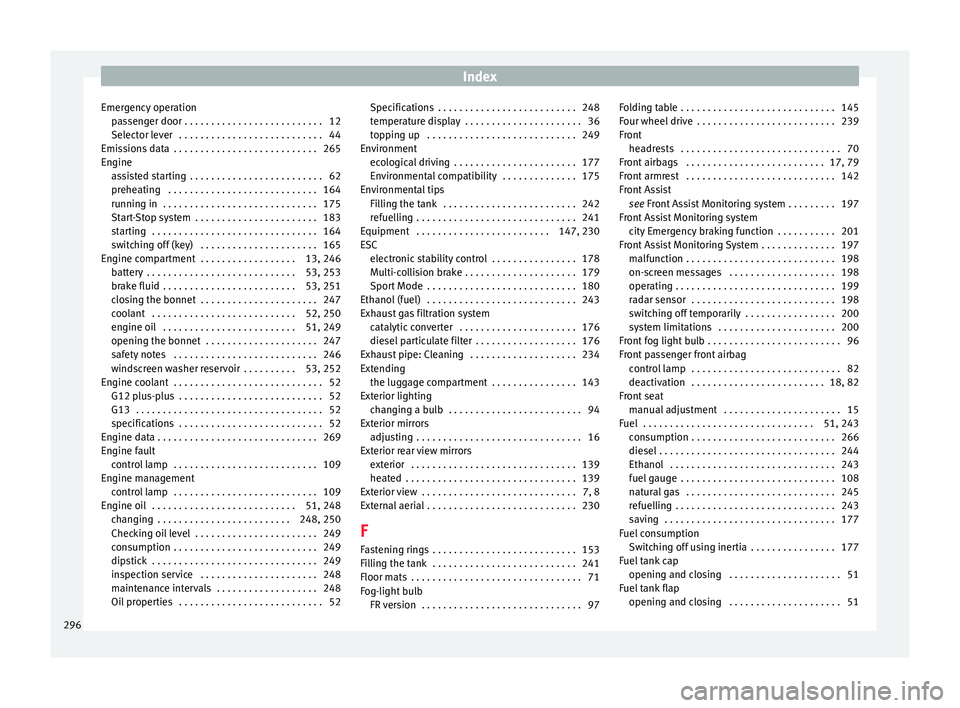
Index
Emergency operation pa
s
senger door . . . . . . . . . . . . . . . . . . . . . . . . . . 12
Selector lever . . . . . . . . . . . . . . . . . . . . . . . . . . . 44
Emissions data . . . . . . . . . . . . . . . . . . . . . . . . . . . 265
Engine assisted starting . . . . . . . . . . . . . . . . . . . . . . . . . 62
preheating . . . . . . . . . . . . . . . . . . . . . . . . . . . . 164
running in . . . . . . . . . . . . . . . . . . . . . . . . . . . . . 175
Start-Stop system . . . . . . . . . . . . . . . . . . . . . . . 183
starting . . . . . . . . . . . . . . . . . . . . . . . . . . . . . . . 164
switching off (key) . . . . . . . . . . . . . . . . . . . . . . 165
Engine compartment . . . . . . . . . . . . . . . . . . 13, 246 battery . . . . . . . . . . . . . . . . . . . . . . . . . . . . 53, 253
brake fluid . . . . . . . . . . . . . . . . . . . . . . . . . 53, 251
closing the bonnet . . . . . . . . . . . . . . . . . . . . . . 247
coolant . . . . . . . . . . . . . . . . . . . . . . . . . . . 52, 250
engine oil . . . . . . . . . . . . . . . . . . . . . . . . . 51, 249
opening the bonnet . . . . . . . . . . . . . . . . . . . . . 247
safety notes . . . . . . . . . . . . . . . . . . . . . . . . . . . 246
windscreen washer reservoir . . . . . . . . . . 53, 252
Engine coolant . . . . . . . . . . . . . . . . . . . . . . . . . . . . 52 G12 plus-plus . . . . . . . . . . . . . . . . . . . . . . . . . . . 52
G13 . . . . . . . . . . . . . . . . . . . . . . . . . . . . . . . . . . . 52
specifications . . . . . . . . . . . . . . . . . . . . . . . . . . . 52
Engine data . . . . . . . . . . . . . . . . . . . . . . . . . . . . . . 269
Engine fault control lamp . . . . . . . . . . . . . . . . . . . . . . . . . . . 109
Engine management control lamp . . . . . . . . . . . . . . . . . . . . . . . . . . . 109
Engine oil . . . . . . . . . . . . . . . . . . . . . . . . . . . 51, 248 changing . . . . . . . . . . . . . . . . . . . . . . . . . 248, 250
Checking oil level . . . . . . . . . . . . . . . . . . . . . . . 249
consumption . . . . . . . . . . . . . . . . . . . . . . . . . . . 249
dipstick . . . . . . . . . . . . . . . . . . . . . . . . . . . . . . . 249
inspection service . . . . . . . . . . . . . . . . . . . . . . 248
maintenance intervals . . . . . . . . . . . . . . . . . . . 248
Oil properties . . . . . . . . . . . . . . . . . . . . . . . . . . . 52 Specifications . . . . . . . . . . . . . . . . . . . . . . . . . . 248
temperat
ure display . . . . . . . . . . . . . . . . . . . . . . 36
topping up . . . . . . . . . . . . . . . . . . . . . . . . . . . . 249
Environment ecological driving . . . . . . . . . . . . . . . . . . . . . . . 177
Environmental compatibility . . . . . . . . . . . . . . 175
Environmental tips Filling the tank . . . . . . . . . . . . . . . . . . . . . . . . . 242
refuelling . . . . . . . . . . . . . . . . . . . . . . . . . . . . . . 241
Equipment . . . . . . . . . . . . . . . . . . . . . . . . . 147, 230
ESC electronic stability control . . . . . . . . . . . . . . . . 178
Multi-collision brake . . . . . . . . . . . . . . . . . . . . . 179
Sport Mode . . . . . . . . . . . . . . . . . . . . . . . . . . . . 180
Ethanol (fuel) . . . . . . . . . . . . . . . . . . . . . . . . . . . . 243
Exhaust gas filtration system catalytic converter . . . . . . . . . . . . . . . . . . . . . . 176
diesel particulate filter . . . . . . . . . . . . . . . . . . . 176
Exhaust pipe: Cleaning . . . . . . . . . . . . . . . . . . . . 234
Extending the luggage compartment . . . . . . . . . . . . . . . . 143
Exterior lighting changing a bulb . . . . . . . . . . . . . . . . . . . . . . . . . 94
Exterior mirrors adjusting . . . . . . . . . . . . . . . . . . . . . . . . . . . . . . . 16
Exterior rear view mirrors exterior . . . . . . . . . . . . . . . . . . . . . . . . . . . . . . . 139
heated . . . . . . . . . . . . . . . . . . . . . . . . . . . . . . . . 139
Exterior view . . . . . . . . . . . . . . . . . . . . . . . . . . . . . 7, 8
External aerial . . . . . . . . . . . . . . . . . . . . . . . . . . . . 230
F Fastening rings . . . . . . . . . . . . . . . . . . . . . . . . . . . 153
Filling the tank . . . . . . . . . . . . . . . . . . . . . . . . . . . 241
Floor mats . . . . . . . . . . . . . . . . . . . . . . . . . . . . . . . . 71
Fog-light bulb FR version . . . . . . . . . . . . . . . . . . . . . . . . . . . . . . 97 Folding table . . . . . . . . . . . . . . . . . . . . . . . . . . . . . 145
Four wheel driv
e . . . . . . . . . . . . . . . . . . . . . . . . . . 239
Front headrests . . . . . . . . . . . . . . . . . . . . . . . . . . . . . . 70
Front airbags . . . . . . . . . . . . . . . . . . . . . . . . . . 17, 79
Front armrest . . . . . . . . . . . . . . . . . . . . . . . . . . . . 142
Front Assist see Front Assist Monitoring system . . . . . . . . . 197
Front Assist Monitoring system city Emergency braking function . . . . . . . . . . . 201
Front Assist Monitoring System . . . . . . . . . . . . . . 197 malfunction . . . . . . . . . . . . . . . . . . . . . . . . . . . . 198
on-screen messages . . . . . . . . . . . . . . . . . . . . 198
operating . . . . . . . . . . . . . . . . . . . . . . . . . . . . . . 199
radar sensor . . . . . . . . . . . . . . . . . . . . . . . . . . . 198
switching off temporarily . . . . . . . . . . . . . . . . . 200
system limitations . . . . . . . . . . . . . . . . . . . . . . 200
Front fog light bulb . . . . . . . . . . . . . . . . . . . . . . . . . 96
Front passenger front airbag control lamp . . . . . . . . . . . . . . . . . . . . . . . . . . . . 82
deactivation . . . . . . . . . . . . . . . . . . . . . . . . . 18, 82
Front seat manual adjustment . . . . . . . . . . . . . . . . . . . . . . 15
Fuel . . . . . . . . . . . . . . . . . . . . . . . . . . . . . . . . 51, 243 consumption . . . . . . . . . . . . . . . . . . . . . . . . . . . 266
diesel . . . . . . . . . . . . . . . . . . . . . . . . . . . . . . . . . 244
Ethanol . . . . . . . . . . . . . . . . . . . . . . . . . . . . . . . 243
fuel gauge . . . . . . . . . . . . . . . . . . . . . . . . . . . . . 108
natural gas . . . . . . . . . . . . . . . . . . . . . . . . . . . . 245
refuelling . . . . . . . . . . . . . . . . . . . . . . . . . . . . . . 243
saving . . . . . . . . . . . . . . . . . . . . . . . . . . . . . . . . 177
Fuel consumption Switching off using inertia . . . . . . . . . . . . . . . . 177
Fuel tank cap opening and closing . . . . . . . . . . . . . . . . . . . . . 51
Fuel tank flap opening and closing . . . . . . . . . . . . . . . . . . . . . 51
296