airbag Seat Leon 5D 2015 Owner's Guide
[x] Cancel search | Manufacturer: SEAT, Model Year: 2015, Model line: Leon 5D, Model: Seat Leon 5D 2015Pages: 308, PDF Size: 5.93 MB
Page 86 of 308
Safety
Follow the manufacturer's instructions and
o b
ser
ve any statutory requirements when in-
stalling and using child seats. Always read
and note ››› page 84.
We recommend you always carry the manu-
facturer's Child Seat Instruction Manual to-
gether with the on-board documentation.
Important information regarding the
front p
assenger's airbag Read the additional information carefully
› ›
›
page 20.
Read and always observe the safety informa-
tion included in the following chapters:
● Safety distance with respect to the passen-
ger airbag ›
›› page 77.
● Objects between the passenger and the
pas
senger side airbag ››› in Front airbags
on p ag
e 79
.
The passenger side front airbag, when ena-
bled, is a serious risk for a child that is facing
backward since the airbag can strike the seat
with such force that it can cause serious or
fatal injuries. Children up to 12 years old
should always travel on the rear seat.
Therefore we strongly recommend you to
transport children on the rear seats. This is
the safest location in the vehicle. Alternative-
ly, the front passenger airbag can be disa- bled with a key-operated switch
›››
page 82.
When transporting children, use a child seat
suitable for the age and size of each child
››› page 85. WARNING
● If a c hi
ld seat is secured to the front pas-
senger seat, the risk to the child of sustain-
ing critical or fatal injuries in the event of an
accident increases.
● An inflating front passenger airbag can
strike the r
ear-facing child seat and project it
with great force against the door, the roof or
the backrest.
● Never install a child seat facing backwards
on the front p
assenger seat unless the front
passenger front airbag has been disabled.
Risk of potentially fatal injuries to the child!
However, if it is necessary, in exceptional ca-
ses, to transport a child in the front passen-
ger seat, the front passenger front airbag
must always be disabled ››› page 81. If the
passenger seat has a height adjustment op-
tion, move it to the highest, most upright po-
sition. If you have a fixed seat, do not install
any child restraint system in this location.
● For those vehicles that do not include a key
lock sw
itch to deactivate the airbag, the vehi-
cle must be taken to a technical service.
● All vehicle occupants, especially children,
must
assume the proper sitting position and
be properly belted in while travelling. ●
Never ho l
d children or babies on your lap,
this can result in potentially fatal injuries to
the child!
● Never allow a child to be transported in a
vehicl
e without being properly secured, or to
stand up or kneel on a seat while travelling.
In an accident, the child could be flung
through the vehicle, causing possibly fatal in-
juries to themselves and to the other vehicle
occupants.
● If children assume an improper sitting posi-
tion when the vehic
le is moving, they expose
themselves to greater risk of injury in the
event of a sudden braking manoeuvre or in an
accident. This is particularly important if the
child is travelling on the front passenger seat
and the airbag system is triggered in an acci-
dent; as this could cause serious injury or
even death.
● A suitable child seat can protect your child!
● Never leave a child alone in the child seat
or inside the
vehicle because depending on
the season, very high temperatures may be
reached inside a parked vehicle, which could
be fatal.
● Children who are less than 1.5 metres tall
must
not wear a normal seat belt without a
child seat, as this could cause injuries to the
abdominal and neck areas during a sudden
braking manoeuvre or in an accident.
● Do not allow the seat belt to become twis-
ted and the seat
belt should be properly in
place ››› page 72.
● Only one child may occupy a child seat
›››
page 85, Child seats. 84
Page 95 of 308
Fuses and bulbsNo.Consumers/Amps
13Driving mode.15
14Air conditioner fan30
17Instrument panel5
18Rear camera7.5
214x4 Haldex Control Unit15
22Trailer15
23Right lights40
24Electric sunroof30
25Left door30
26Heated seats20
28Trailer25
31Left lights40
32Parking aid control unit7.5
33Airbag5
34Reverse switch, clima sensor, electro-
chromic mirror7.5
35Diagnosis, headlight control unit,
headlight adjuster10
36Front camera, Radar10
38Trailer25
39Right door30
4012V socket20
No.Consumers/Amps
42Central locking40
43Interior light30
44Trailer15
45Electric driver's seat15
47Rear window wiper15
49Starter motor; clutch sensor5
53Heated rear window30
Fuse arrangement in engine compartment
No.Consumers/Amps
1ESP control unit40/20
2ESP control unit40
3Engine control unit (diesel/pet-
rol)30/15
4Engine sensors5/10
5Engine sensors7.5/10
6Brake light sensor5
7Engine power supply5/10
8Lambda probe10/15
9Engine5/10/20
10Fuel pump control unit10/15/20
11PTC40
No.Consumers/Amps
12PTC40
13Automatic gearbox control unit15/30
15Horn15
16Fuel pump control unit5/15/20
17Engine control unit7.5
18Terminal 30 (positive reference)5
19Front windscreen washer30
20Alarm horn10
22Engine control unit5
23Starter motor30
24PTC40
31Electronic differential CUPRA15
CAUTION
● Alw a
ys carefully remove the fuse box cov-
ers and refit them correctly to avoid problems
with your vehicle.
● Protect the fuse boxes when open to avoid
the entry of
dust or humidity. Dirt and humid-
ity inside fuse boxes can cause damage to
the electrical system. » 93
Technical data
Advice
Operation
Emergencies
Safety
Page 105 of 308
Controls and displays
Operation
C ontr
o
ls and displays
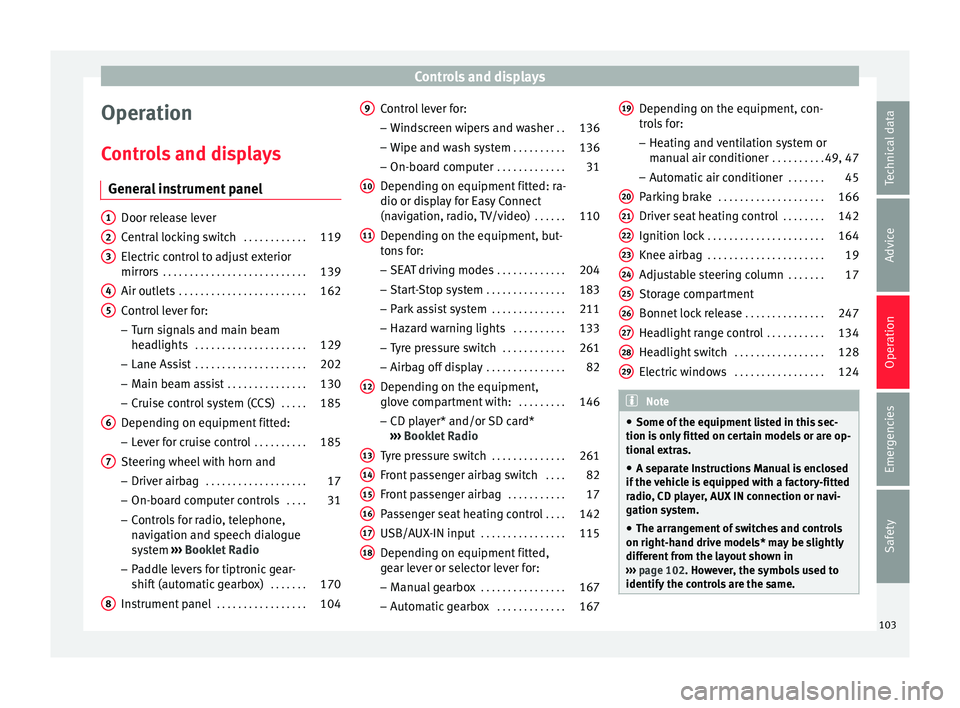
General instrument panel Door release lever
Centr
al
locking switch . . . . . . . . . . . .119
Electric control to adjust exterior
mirrors . . . . . . . . . . . . . . . . . . . . . . . . . . . 139
Air outl
ets . . . . . . . . . . . . . . . . . . . . . . . . 162
Control lever for:
– Turn s ign
als and main beam
headlights . . . . . . . . . . . . . . . . . . . . . 129
– Lane Ass i
st . . . . . . . . . . . . . . . . . . . . . 202
– Main beam a
ssist . . . . . . . . . . . . . . . 130
– Cruise c
ontrol system (CCS) . . . . .185
Depending on equipment fitted:
– Lev er f
or cruise control . . . . . . . . . .185
Steering wheel with horn and – Driver airbag . . . . . . . . . . . . . . . . . . . 17
– On-boar d c
omputer controls . . . .31
– Contro
ls for radio, telephone,
navigation and speech dialogue
system ›››
Booklet Radio
– Paddle levers for tiptronic gear-
shift (automatic gearbox) . . . . . . .170
Instrument panel . . . . . . . . . . . . . . . . . 104
1 2
3
4
5
6
7
8 Control lever for:
– Wind
s
creen wipers and washer . .136
– Wipe and wa
sh system . . . . . . . . . . 136
– On-board c
omputer . . . . . . . . . . . . . 31
Depending on equipment fitted: ra-
dio or disp
lay for Easy Connect
(navigation, radio, TV/video) . . . . . .110
Depending on the equipment, but-
tons
for:
– SEAT driving modes . . . . . . . . . . . . .204
– Star t
-Stop system . . . . . . . . . . . . . . . 183
– Park a
ssist system . . . . . . . . . . . . . . 211
– Hazard w
arning lights . . . . . . . . . .133
– Tyr
e pressure switch . . . . . . . . . . . .261
– Airbag off di
splay . . . . . . . . . . . . . . . 82
Depending on the equipment,
glov e c
ompartment with: . . . . . . . . .146
– CD pl a
yer* and/or SD card*
››› Booklet Radio
Tyre pressure switch . . . . . . . . . . . . . .261
Front passenger airbag switch . . . .82
Front passenger airbag . . . . . . . . . . .17
Passenger seat heating control . . . .142
USB/AUX-IN input . . . . . . . . . . . . . . . . 115
Depending on equipment fitted,
ge ar l
ever or selector lever for:
– Manual gearbox . . . . . . . . . . . . . . . . 167
– Autom atic
gearbox . . . . . . . . . . . . . 167
9
10
11
12
13
14
15
16
17
18 Depending on the equipment, con-
tr
o
l
s for:
– Heating and ventilation system or
manual air conditioner . . . . . . . . . .49, 47
– Automatic
air conditioner . . . . . . .45
Parking brake . . . . . . . . . . . . . . . . . . . . 166
Driver seat heating control . . . . . . . .142
Ignition lock . . . . . . . . . . . . . . . . . . . . . . 164
Knee airbag . . . . . . . . . . . . . . . . . . . . . . 19
Adjustable steering column . . . . . . .17
Storage compartment
Bonnet lock
release . . . . . . . . . . . . . . . 247
Headlight range control . . . . . . . . . . .134
Headlight switch . . . . . . . . . . . . . . . . . 128
Electric windows . . . . . . . . . . . . . . . . . 124 Note
● Some of the equipment li
sted in this sec-
tion is only fitted on certain models or are op-
tional extras.
● A separate Instructions Manual is enclosed
if the v
ehicle is equipped with a factory-fitted
radio, CD player, AUX IN connection or navi-
gation system.
● The arrangement of switches and controls
on right-hand driv
e models* may be slightly
different from the layout shown in
››› page 102. However, the symbols used to
identify the controls are the same. 19
20
21
22
23
24
25
26
27
28
29
103
Technical data
Advice
Operation
Emergencies
Safety
Page 142 of 308

Operation
when changing lane, you could misjudge the
dis
t
ance. Risk of accident! CAUTION
● If one of the mirr
or housings is knocked out
of position (e.g. when parking), the mirrors
must first be fully retracted with the electric
control. Do not readjust the mirror housing by
hand, as this will interfere with the mirror ad-
juster function.
● Before washing the vehicle in an automatic
car wa
sh, please make sure to retract the ex-
terior mirrors to prevent them from being
damaged. Electrically retractable exterior
mirrors must not be folded in or out by hand.
Always use the electrical power control. Note
If the electrical adjustment should fail to op-
erat e, both of
the mirrors can be adjusted by
hand by lightly pressing the edge of the mir-
ror glass. Seats and head restraints
Adju
s
tin
g the seats and headr-
ests
Manual adjustment of seats Read the additional information carefully
›› ›
page 15 WARNING
The safe driving chapter contains important
inform ation, tip
s, suggestions and warnings
that you should read and observe for your
own safety and the safety of your passengers
››› page 66. WARNING
● Adjus t
the front seats only when the vehi-
cle is stationary. Failure to follow this instruc-
tion could result in an accident.
● Be careful when adjusting the seat height.
Carel
ess or uncontrolled adjustment can
cause injuries.
● The front seat backrests must not be re-
clined for driv
ing. Otherwise, seat belts and
the airbag system might not protect as they
should, with the subsequent danger of injury. Electric driver seat adjustment*
Read the additional information carefully
›› ›
page 15 WARNING
● If the el ectric
front seats are used negli-
gently or without paying due attention, it can
cause serious injury.
● The front seats can also be electrically ad-
just
ed when the ignition is switched off. Nev-
er leave a child or any other person who may
need help in the vehicle.
● In the event of an emergency, electrical ad-
justment
can be stopped by pressing any
control. CAUTION
To avoid damaging the electrical components
of the fr ont
seats, please refrain from kneel-
ing on the seat or applying sharp pressure at
a single point to the seat cushion and back-
rest. Note
● It m a
y not be possible to electrically adjust
the seat if the vehicle battery is very low.
● If the engine is started while the seats are
being electric
ally adjusted, the adjustment
will stop. 140
Page 149 of 308
Transport and practical equipment
load of the compartment should not exceed
0.2 k g.
● Co
at hooks in the door frames ›››
.
● Other storage compartments are found in
the r e
ar se
at, to the left and the right of the
seats. WARNING
● Ple a
se make sure that any items of clothing
hanging from the coat hooks do not obstruct
your view to the rear.
● The coat hooks should only be used for
lightweight c
lothing. Do not leave any heavy
or sharp objects in the pockets.
● Do not use clothes hangers to hang up the
clothing, a
s this could interfere with the func-
tion of the head-protection airbags. Power sockets
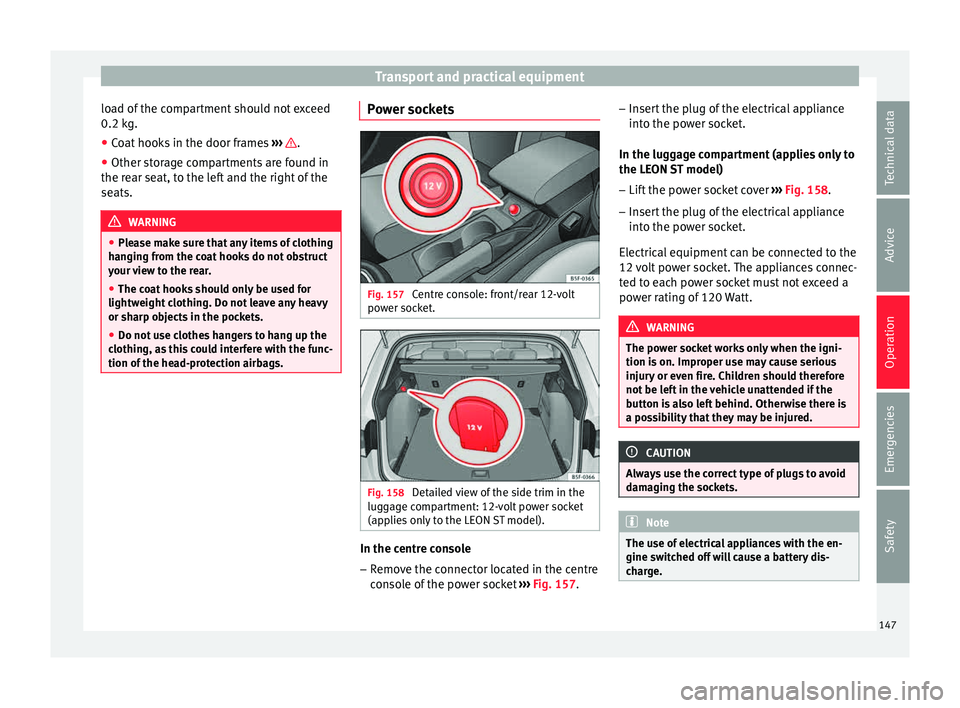
Fig. 157
Centre console: front/rear 12-volt
po w
er soc
ket. Fig. 158
Detailed view of the side trim in the
lug g
ag
e compartment: 12-volt power socket
(applies only to the LEON ST model). In the centre console
– Remove the connector located in the centre
con
so
le of the power socket ››› Fig. 157. –
Insert
the plug of the electrical appliance
into the power socket.
In the luggage compartment (applies only to
the LEON ST model)
– Lift the power socket cover ›››
Fig. 158.
– Insert the plug of the electrical appliance
into the pow
er socket.
Electrical equipment can be connected to the
12 volt power socket. The appliances connec-
ted to each power socket must not exceed a
power rating of 120 Watt. WARNING
The power socket works only when the igni-
tion is on. Impr
oper use may cause serious
injury or even fire. Children should therefore
not be left in the vehicle unattended if the
button is also left behind. Otherwise there is
a possibility that they may be injured. CAUTION
Always use the correct type of plugs to avoid
dam agin
g the sockets. Note
The use of electrical appliances with the en-
gine swit c
hed off will cause a battery dis-
charge. 147
Technical data
Advice
Operation
Emergencies
Safety
Page 181 of 308
Driver assistance systems
Brake assist system
The br ak
e a
ssist system can reduce the re-
quired braking distance. The braking force is
automatically boosted if you press the brake
pedal quickly in an emergency. You must
keep pressing the brake pedal until the dan-
ger has passed.
Traction control system (ASR)
In the event of wheelspin, the traction control
system reduces the engine torque to match
the amount of grip available. This helps the
car to start moving, accelerate or climb a gra-
dient.
Electronic differential lock (EDL)
When the EDL detects wheelspin, it brakes
the spinning wheel and directs the power to
the other driven wheel. This function is active
up to approximately 100 km/h.
To prevent the disc brake of the braked wheel
from overheating, the EDL cuts out automati-
cally if subjected to excessive loads. The ve-
hicle can still be driven. The EDL will switch
on again automatically when the brake has
cooled down.
Tractor-trailer sway mitigation*
If the vehicle is pulling a trailer, it will control
the following: Tractor-trailers tend to sway.
When the swaying of the trailer is felt by the
vehicle and detected by the ESC, it will auto- matically brake the towing vehicle within the
limits of the sy
stem and mitigate the sway.
Tractor-trailer sway mitigation is not available
in all countries.
Electronic torque management (XDS)
When taking a curve, the driveshaft differen-
tial mechanism allows the outer wheel to turn
at a higher speed than the inner wheel. In
this way, the wheel that is turning faster (out-
er wheel) receives less drive torque than the
inner wheel. This may mean that in certain
situations the torque delivered to the inner
wheel is too high, causing the wheels to
spin. On the other hand, the outer wheel is
receiving a lower drive torque than it could
transmit. This causes an overall loss of lateral
grip on the front axle, resulting in understeer
or “lengthening” of the trajectory.
The XDS system can detect and correct this
effect via the sensors and signals of the ESC.
Via the ESC, the XDS will brake the inside
wheel and counter the excess driving torque
of that wheel. This means that the driver's
desired trajectory is much more precise.
The XDS system works in combination with
the ESC and is always active, even when ASR
traction control is disconnected, or the ESC in
Sport mode or disconnected. Multi-collision brake
In an accident, the mu
lti-collision brake can
help the driver by braking to avoid the risk of
skidding during the accident, which could
lead to further collisions.
The multi-collision brake works for front, side
or rear accidents, when the airbag control
unit records its activation level and the acci-
dent takes place at a speed of over 10 km/h
(6 mph). The ESC automatically brakes the
vehicle, as long as the accident has not dam-
aged the ESC, the brake hydraulics or the on-
board network.
The following actions control automatic brak-
ing during the accident:
● When the driver presses the accelerator,
the automatic
braking does not take place.
● When the braking pressure through press-
ing the brak
e pedal is greater than the sys-
tem’s braking pressure the vehicle will brake
automatically.
● Multi-collision braking will not be available
if ESC
is malfunctioning. WARNING
● The ESC, ABS, ASR, EDL, el ectr
onic self-
locking differential or selective torque control
systems cannot exceed the limits imposed by
the laws of physics. Always bear this in mind, » 179
Technical data
Advice
Operation
Emergencies
Safety
Page 188 of 308

Operation
Several warning and indication lamps light
up f or a f
ew sec
onds when the ignition is
switched on, signalling that the function is
being verified. They will switch off after a few
seconds.
Displayed on the CCS screen
Status Fig. 192:
CCS temporarily switched off. The set
speed is displayed in small figures.
System error. Contact a specialised work-
shop.
CCS switched on. The speed memory is
empty.
The CCS is switched on. The set speed is
displayed in large figures. WARNING
Use of the cruise control could cause acci-
dents and sev
ere injuries if it is not possible
to drive at a constant speed maintaining the
safety distance.
● Do not use the cruise control in heavy traf-
fic, if the dis
tance from the vehicle in front is
insufficient, on steep roads, with several
bends or in slippery circumstances (snow,
ice, rain or loose gravel), or on flooded roads.
● Never use the CCS when driving off-road or
on unpav
ed roads.
● Always adapt your speed and the distance
to the v
ehicles ahead in line with visibility, A
B
C
D weather conditions, the condition of the road
and the traffic
s
ituation.
● To avoid unexpected operation of the cruise
contro
l system, turn it off every time you fin-
ish using it.
● It is dangerous to use a set speed which is
too high for the pr
evailing road, traffic or
weather conditions.
● When travelling down hills, the CCS cannot
maintain a c
onstant speed. The vehicle tends
to accelerate under its own weight. Select a
lower gear or use the foot brake to slow the
vehicle. WARNING
Observe the safety warnings ›››
in Warning
and indication l amp
s on page 109. Operating the cruise control system*
Read the additional information carefully
› ›
›
page 40
The value indicated in the table in brackets
(in mph, miles per hour) only refers to instru-
ment panels with indications in miles.
Changing gear in CCS mode
The CCS decelerates as soon as the clutch
pedal is pressed, intervening again automati-
cally after a gear is engaged. Travelling down hills with the CCS
When travel
ling down hills the CCS cannot
maintain a constant speed. Slow the vehicle
down using the brake pedal and reduce
gears if required.
Automatic off
The cruise control system (CCS) is switched
off automatically or temporarily:
● If the system detects a fault that could af-
fect the w
orking order of the CCS.
● If you press and maintain the accelerator
pedal f
or a certain time, driving faster than
the stored speed.
● If the dynamic driving control systems in-
terv
ene (e.g. ASR or ESC).
● If the airbag is triggered.
186
Page 232 of 308

Advice
Advice
C ar
e and m
aintenance
Accessories and modifications to the vehicle
Accessories, replacement parts and
repair work Always ask your dealer or specialist retailer
f
or a
dv
ice before purchasing accessories and
replacement parts.
Your vehicle is designed to offer a high
standard of active and passive safety. For this
reason, we recommend that you ask a SEAT
Official Service for advice before fitting ac-
cessories or replacement parts. Your SEAT Of-
ficial Service has the latest information from
the manufacturer and can recommend acces-
sories and replacement parts which are suita-
ble for your requirements. They can also an-
swer any questions you might have regarding
official regulations.
We recommend you to use only SEAT acces-
sories and Genuine SEAT parts ®
. SEAT has
tested these parts and accessories for suita-
bility, reliability and safety. SEAT Official
Services have the necessary experience and
facilities to ensure that the parts are installed
correctly and professionally. Any
retro-fitted equipment which has a direct
effect
on the vehicle and/or the way it is driv-
en, such as a cruise control system or elec-
tronically-controlled suspension, must be
approved for use in your vehicle and bear the
e mark (the European Union's authorisation
symbol).
If any additional electrical devices are fitted
which do not serve to control the vehicle it-
self (for instance a refrigerator box, laptop or
ventilator fan, etc.), they must bear the
sign (manufacturer conformity declaration in
the European Union). WARNING
Accessories, for example telephone holders
or cup ho l
ders, should never be fitted on the
covers, or within the working range of the air-
bags. Otherwise, there is a danger of injury if
the airbag is triggered in an accident. Modifications
Modifications must always be carried out ac-
c
or
din
g to our specifications.
Unauthorised modifications to the electronic
components, software, wiring or data transfer
in the vehicle may cause malfunctioning. Due
to the way the electronic components are
linked together in networks, other indirect
systems may be affected by the faults. This
can seriously impair safety, lead to excessive wear of components, and also invalidate your
vehicl
e registration documents.
You will appreciate that your SEAT dealership
cannot be held liable for any damage caused
by modifications and/or work performed in-
correctly.
We therefore recommend that all work should
be performed by a SEAT Official Service using
genuine SEAT parts ®
. WARNING
Incorrectly performed modifications or other
work on
your vehicle can lead to malfunctions
and cause accidents. Radio transmitters and office equip-
ment
Radio transmitters (fixed installation)
An
y
r
etrofit installations of radio transmitters
in the vehicle require prior approval. SEAT
generally authorises in-vehicle installations
of approved types of radio transmitters provi-
ded that:
● The aerial is installed correctly.
● The aerial is installed on the exterior of the
vehicl
e (and shielded cables are used togeth-
er with non-reflective aerial trimming).
● The effective transmitting power does not
exc
eed 10 Watts at the aerial base.
230
Page 295 of 308

Index
Index
A
ABS se
e
Anti-lock brake system . . . . . . . . . . . . . . . 178
ACC . . . . . . . . . . . . . . . . . . . . . . . . . . . . . . . . . . . . 187 radar sensor . . . . . . . . . . . . . . . . . . . . . . . . . . . 189
Accessories . . . . . . . . . . . . . . . . . . . . . . . . . 147, 230
Adaptive cruise control . . . . . . . . . . . . . . . . . . . . 187 indications on the display . . . . . . . . . . . . . . . . 188
malfunction . . . . . . . . . . . . . . . . . . . . . . . . . . . . 188
radar sensor . . . . . . . . . . . . . . . . . . . . . . . . . . . 189
special driving situations . . . . . . . . . . . . . . . . . 195
warning and indication lamp . . . . . . . . . . . . . . 188
Adaptive Cruise Control deactivating temporarily . . . . . . . . . . . . . . . . . 194
operating . . . . . . . . . . . . . . . . . . . . . . . . . . . . . . 190
Additional electrical appliances (efficiency pro- gramme) . . . . . . . . . . . . . . . . . . . . . . . . . . . . . . . 36
Adjusting front seats . . . . . . . . . . . . . . . . . . . . . . . . . . . . . 140
Adjusting the head restraints front head restraints . . . . . . . . . . . . . . . . . . . . . 141
Adjustment CAR menu . . . . . . . . . . . . . . . . . . . . . . . . . . . . . 110
front head restraints . . . . . . . . . . . . . . . . . 70, 141
lights . . . . . . . . . . . . . . . . . . . . . . . . . . . . . . . . . 134
rear head restraints . . . . . . . . . . . . . . . . . 70, 141
seats . . . . . . . . . . . . . . . . . . . . . . . . . . . . . . . . . . 67
Airbag system . . . . . . . . . . . . . . . . . . . . . . . . . . 17, 77 activation . . . . . . . . . . . . . . . . . . . . . . . . . . . . . . 78
covers . . . . . . . . . . . . . . . . . . . . . . . . . . . . . . . . . 17
deactivation of front airbag . . . . . . . . . . . . . . . . 81
description . . . . . . . . . . . . . . . . . . . . . . . . . . . . . 78
front airbags . . . . . . . . . . . . . . . . . . . . . . . . . 17, 79
functioning . . . . . . . . . . . . . . . . . . . . . . . . . . . . . 78 head-protection airbags . . . . . . . . . . . . . . . . . . 20
Knee airbag . . . . . . . . . . . . . . . . . . . . . . . . . . . . .
19
side airbags . . . . . . . . . . . . . . . . . . . . . . . . . . . . 19
Air conditioning Climatronic . . . . . . . . . . . . . . . . . . . . . . . . 45, 159
heating and fresh air . . . . . . . . . . . . . . . . . . . . . 49
manual air conditioning . . . . . . . . . . . . . . . . . . . 47
User instructions . . . . . . . . . . . . . . . . . . . . . . . 161
Air outlets . . . . . . . . . . . . . . . . . . . . . . . . . . . . . . . 162
Air recirculation . . . . . . . . . . . . . . . . . . . . . . . . . . 163
Alcantara: cleaning . . . . . . . . . . . . . . . . . . . . . . . 237
All-wheel drive snow chains . . . . . . . . . . . . . . . . . . . . . . . . . . . 239
winter tyres . . . . . . . . . . . . . . . . . . . . . . . . . . . . 239
Ambient lighting . . . . . . . . . . . . . . . . . . . . . . . . . 135
Anti-freeze . . . . . . . . . . . . . . . . . . . . . . . . . . . . . . . 52
Anti-lock brake system . . . . . . . . . . . . . . . . . . . . . 178
Anti-puncture kit . . . . . . . . . . . . . . . . . . . . . . . . 57, 86 check after 10 minutes . . . . . . . . . . . . . . . . . . . . 88
components . . . . . . . . . . . . . . . . . . . . . . . . . . . . 87
inflating a tyre . . . . . . . . . . . . . . . . . . . . . . . . . . . 87
sealing a tyre . . . . . . . . . . . . . . . . . . . . . . . . . . . 87
Anti-theft alarm . . . . . . . . . . . . . . . . . . . . . . . . . . 121 vehicle interior monitoring and anti-tow sys-tem . . . . . . . . . . . . . . . . . . . . . . . . . . . . . . . . . 123
Anti-theft alarm system . . . . . . . . . . . . . . . . . . . . 116 trailer . . . . . . . . . . . . . . . . . . . . . . . . . . . . . . . . . 228
Anti-theft security system . . . . . . . . . . . . . . 11, 119
Anti-tow protection . . . . . . . . . . . . . . . . . . . . . . . 123
Aspects to take into account before starting the vehicle . . . . . . . . . . . . . . . . . . . . . . . . . . . . . . . . . 66
ASR see Traction control system . . . . . . . . . . . . . . . 178
Assistance systems cruise control system . . . . . . . . . . . . . . . . . . . . 185
front assist monitoring system . . . . . . . . . . . . 197
parking aid . . . . . . . . . . . . . . . . . . . . . . . . . . . . 211
Parking aid . . . . . . . . . . . . . . . . . . . . . . . . . . . . 213 tiredness detection . . . . . . . . . . . . . . . . . . . . . 210
traffic s
ign detection system . . . . . . . . . . . . . . 208
tyre monitoring . . . . . . . . . . . . . . . . . . . . . . . . . 260
tyre monitoring indicator . . . . . . . . . . . . . . . . . 261
tyre monitoring system . . . . . . . . . . . . . . . . . . 259
Assisted starting . . . . . . . . . . . . . . . . . . . . . . . . . . 62
Assist systems ACC . . . . . . . . . . . . . . . . . . . . . . . . . . . . . . . . . . 187
adaptive cruise control . . . . . . . . . . . . . . . . . . . 187
Audible signal lights . . . . . . . . . . . . . . . . . . . . . . . . . . . . . . . . . 128
Audible warning signal seat belt not fastened . . . . . . . . . . . . . . . . . . . . 72
warning and indication lamps . . . . . . . . . . . . . 108
Auto Lock (central locking) . . . . . . . . . . . . . . . . . 116
Automatic dipped beam control . . . . . . . . . . . . . 130
Automatic gear Safety interlock for ignition key . . . . . . . . . . . . 164
Automatic gearbox . . . . . . . . . . . . . . . . . . . . . . . . 167 backup programme . . . . . . . . . . . . . . . . . . . . . 174
downhill speed control . . . . . . . . . . . . . . . . . . 173
driving tips . . . . . . . . . . . . . . . . . . . . . . . . . . . . 171
kick-down feature . . . . . . . . . . . . . . . . . . . . . . . 172
launch control programme . . . . . . . . . . . . . . . . 172
manual release of selector lever . . . . . . . . . . . . 44
selector lever lock . . . . . . . . . . . . . . . . . . . . . . . 169
selector lever positions . . . . . . . . . . . . . . . . . . 168
Steering wheel with gearshift paddles . . . . . . 170
tiptronic . . . . . . . . . . . . . . . . . . . . . . . . . . 167, 170
AUX-IN . . . . . . . . . . . . . . . . . . . . . . . . . . . . . . . . . . 115
B Battery . . . . . . . . . . . . . . . . . . . . . . . . . . . . . . . . . . 120
Before starting the vehicle . . . . . . . . . . . . . . . . . . 66
Belt tightening . . . . . . . . . . . . . . . . . . . . . . . . . . . . 76
Bench seat . . . . . . . . . . . . . . . . . . . . . . . . . . . . . . 144
Biodiesel . . . . . . . . . . . . . . . . . . . . . . . . . . . . . . . . 244
293
Page 297 of 308
Index
Cornering lights . . . . . . . . . . . . . . . . . . . . . . . . . . . . . . . . .
131
C orr
ect position . . . . . . . . . . . . . . . . . . . . . . . . . . . 67
Correct sitting position front passenger . . . . . . . . . . . . . . . . . . . . . . . . . 68
rear seat passengers . . . . . . . . . . . . . . . . . . . . . 69
Cruise control system . . . . . . . . . . . . . . . . . . 40, 185 operation . . . . . . . . . . . . . . . . . . . . . . . . . . . . . . 186
warning and indication lamp . . . . . . . . . . . . . . 185
D Dangers in not using the seat belt . . . . . . . . . . . . 74
Dash panel . . . . . . . . . . . . . . . . . . . . . . . . . . . . . . . 41
Data sticker . . . . . . . . . . . . . . . . . . . . . . . . . . . . . . 265
Deactivating the front passenger front airbag . . . 18
Deactivation of front airbag . . . . . . . . . . . . . . . . . . 81
Detachable ball Assembling . . . . . . . . . . . . . . . . . . . . . . . . . . . . 222
Checking attachment . . . . . . . . . . . . . . . . . . . . 223
Placing in standby position . . . . . . . . . . . . . . . 221
removing . . . . . . . . . . . . . . . . . . . . . . . . . 223, 224
standby position . . . . . . . . . . . . . . . . . . . . . . . . 221
Diesel Diesel particulate filter . . . . . . . . . . . . . . . . . . . 176
engine oil . . . . . . . . . . . . . . . . . . . . . . . . . . . . . 248
Preheating . . . . . . . . . . . . . . . . . . . . . . . . . . . . . 164
refuelling . . . . . . . . . . . . . . . . . . . . . . . . . . . . . . 244
Digital clock . . . . . . . . . . . . . . . . . . . . . . . . . . . . . 104
Dimensions . . . . . . . . . . . . . . . . . . . . . . . . . . . . . . 292
Direction of rotation tyres . . . . . . . . . . . . . . . . . . . . . . . . . . . . . . . . . . . 60
Display . . . . . . . . . . . . . . . . . . . . . . . . . . . . 104, 105
Display of traffic signs on the instrument panel activate . . . . . . . . . . . . . . . . . . . . . . . . . . . . . . . 210
deactivate . . . . . . . . . . . . . . . . . . . . . . . . . . . . . 210
Disposal Seat belt tensioners . . . . . . . . . . . . . . . . . . . . . . 76 Distance control
see Adaptive cruise control . . . . . . . . . . . . . . . 187
Door cylinder . . . . . . . . . . . . . . . . . . . . . . . . . . . . . 11
Door handle . . . . . . . . . . . . . . . . . . . . . . . . . . . . . . 11
Door lock . . . . . . . . . . . . . . . . . . . . . . . . . . . . . . . . . 11
Door release lever . . . . . . . . . . . . . . . . . . . . . . . . 103
Doors Childproof locks . . . . . . . . . . . . . . . . . . . . . . . . 121
opening and closing . . . . . . . . . . . . . . . . . . . . . 11
Downhill speed control . . . . . . . . . . . . . . . . . . . . 173
Drawer . . . . . . . . . . . . . . . . . . . . . . . . . . . . . . . . . . 145
Drink holders . . . . . . . . . . . . . . . . . . . . . . . . . . . . 146
Driver see Correct sitting position . . . . . . . . . 67, 68, 69
Driver information system CD/radio indication . . . . . . . . . . . . . . . . . . . . . . 31
engine oil temperature display . . . . . . . . . . . . . 36
Operation with the windscreen wiper lever . . . 31
Driving Driving abroad . . . . . . . . . . . . . . . . . . . . . . . . . 134
with a trailer . . . . . . . . . . . . . . 220, 225, 227, 267
With a trailer . . . . . . . . . . . . . . . . . . . . . . . . . . . 228
Driving abroad headlights . . . . . . . . . . . . . . . . . . . . . . . . . . . . . 134
Driving mode . . . . . . . . . . . . . . . . . . . . . . . . . . . . 206
Driving profile . . . . . . . . . . . . . . . . . . . . . . . . . . . . 206
Driving safety . . . . . . . . . . . . . . . . . . . . . . . . . . . . . 66
Driving through water . . . . . . . . . . . . . . . . . . . . . 176
DSG . . . . . . . . . . . . . . . . . . . . . . . . . . . . . . . . . . . . 167
Duplicate keys . . . . . . . . . . . . . . . . . . . . . . . . . . . 117
Dust and pollen filter . . . . . . . . . . . . . . . . . . . . . . 159
Dynamic headlight range control . . . . . . . . . . . . 134
E
E10 see Ethanol (fuel) . . . . . . . . . . . . . . . . . . . . . . . 243
Easy Connect . . . . . . . . . . . . . . . . . . . . . . . . 28, 110 Economical
driving . . . . . . . . . . . . . . . . . . . . . . . . . . . . . . . . 177
EDL see Electronic differential lock . . . . . . . . . . . . . 178
Efficiency programme additional electrical appliances . . . . . . . . . . . . 36
saving tips . . . . . . . . . . . . . . . . . . . . . . . . . . . . . . 37
Electrical accessories see Power socket . . . . . . . . . . . . . . . . . . . . . . . 147
Electrical socket trailer . . . . . . . . . . . . . . . . . . . . . . . . . . . . . . . . . 226
Electric windows . . . . . . . . . . . . . . . . . . . . . . 14, 124 convenience opening and closing . . . . . . . . . 125
Electromechanical steering . . . . . . . . . . . . . . . . . 238 lamp . . . . . . . . . . . . . . . . . . . . . . . . . . . . . . . . . 238
Electronic differential lock . . . . . . . . . . . . . . . . . . 178
Electronic immobiliser . . . . . . . . . . . . . . . . . . . . . . 11
Electronic self-locking . . . . . . . . . . . . . . . . . . . . . 178
Electronic Stability Control (ESC) . . . . . . . . . . . . 178
Electronic torque management (XDS) . . . . . . . . . 179
Emergencies . . . . . . . . . . . . . . . . . . . . . . . . . . . . . . 86 anti-puncture kit . . . . . . . . . . . . . . . . . . . . . . . . . 86
automatic gearbox backup programme . . . . . 174
bulbs . . . . . . . . . . . . . . . . . . . . . . . . . . . . . . . . . . 56
changing a wheel . . . . . . . . . . . . . . . . . . . . . . . . 58
emergency towing of the vehicle . . . . . . . . . . . . 61
fuses . . . . . . . . . . . . . . . . . . . . . . . . . . . . . . . . . . 55
hazard warning lights . . . . . . . . . . . . . . . . . . . 133
jump leads . . . . . . . . . . . . . . . . . . . . . . . . . . . . . 62
Manual unlocking and locking . . . . . . . . . . . . . 88
puncture . . . . . . . . . . . . . . . . . . . . . . . . . . . . . . . 56
replacing a blown fuse . . . . . . . . . . . . . . . . . . . . 55
replacing the battery . . . . . . . . . . . . . . . . . . . . 254
vehicle tool kit . . . . . . . . . . . . . . . . . . . . . . . . . . 86
Emergency braking warning . . . . . . . . . . . . . . . . 133
295