sport mode Seat Leon 5D 2015 Owner's Guide
[x] Cancel search | Manufacturer: SEAT, Model Year: 2015, Model line: Leon 5D, Model: Seat Leon 5D 2015Pages: 308, PDF Size: 5.93 MB
Page 207 of 308

Driver assistance systems
In the FR and X-PERIENCE models equipped
w ith dy
n
amic chassis control and Navi Sys-
tem Plus, the Comfort profile is also
available.
In the Leon Cupra model the four profiles are Comfort , Sport, Cupra and Individual .
The Individual profile can be configured
according to personal preferences. The other
profiles are fixed.
Description Depending on the equipment fitted in the ve-
hic
l
e,
SEAT Drive Profile can operate on the
following functions:
Engine
Depending on the profile selected, the en-
gine responds more spontaneously or more
in harmony with the movements of the accel-
erator. Additionally, when Eco mode is selec-
ted, the Start-stop function is automatically
activated.
In vehicles with automatic transmission, the
gear change points are modified to position
them in lower or higher engine speed ranges.
Additionally, the Eco 1)
mode activates the In- ertia function, enabling consumption to be
further r
educed.
In manual gearbox vehicles, Eco1)
mode cau-
ses the gear change recommendation indica-
tions that appear on the instrument panel to
vary, facilitating more efficient driving.
Dynamic chassis control (DCC)
››› table on page 2
DCC continuously adapts the shock absorb-
ers to the condition of the road and current
driving conditions, according to the pre-set
programme.
In the event of a fault in the DCC, the follow-
ing message is displayed on the instrument
screen Fault: damping setting .
Address
Power steering becomes more robust in
Sport mode to enable a sportier driving
style. In the Leon Cupra the power steering
becomes more robust in Cupra mode.
Air conditioning
In vehicles with Climatronic, this can operate
in eco 1)
mode, especially restricting fuel con-
sumption. Ambient lighting
The ambient lightin
g guides located in the in-
terior front door panels of the Leon FR and
the Leon Cupra change colour from white to
red depending on the driving mode selected.
Adaptive Cruise Control (ACC) 2)
According to the active driving profile, the ac-
celeration gradient of the adaptive cruise
control varies.
Electronic self-locking differential 2)
The self-locking differential adapts its behav-
iour depending on the driving profile chosen.
Normal mode or Cupra mode can be selected
to prioritise improved traction in sport driv-
ing. 1)
In the Leon Cupra model, Ec o
mode is selected
through the Individual profile.
2) Applies to the Leon Cupra model.
205
Technical data
Advice
Operation
Emergencies
Safety
Page 208 of 308

Operation
Setting driving mode Fig. 209
Centre console: MODE button. You can select from
Normal, Sport, Eco
and Individual .
Y ou c
an sel
ect the required mode either by
repeatedly pressing the button MODE
››› Fig. 209, or on the touch screen, in the
menu that opens when the above button is
pressed.
An icon on the Easy Connect system display
informs about the active mode.
The MODE button light remains lit up yellow
when the active mode is different to Normal.
Driving
profileCharacteristics
NormalOffers a balanced driving experience, suit-
able for everyday use.
DrivingprofileCharacteristics
SportProvides a complete dynamic performance
in the vehicle, enabling the user a more
sporty driving style.
Eco
Places the vehicle in a particularly low
state of consumption, facilitating a fuel-
saving driving style that is respectful to
the environment.
Individ- ual
Enables some configurations to be modi-
fied by pressing the Profile settings
button. The functions that can be adjusted
depend on the equipment fitted in the ve-
hicle.
Conven- ience a)It permits more relaxed and comfortable
driving, for example for long motorway
journeys. Its main characteristic is the soft
suspension setting (DCC).
a)
Only for FR and X-PERIENCE models equipped with dynamic
chassis control and Navi System Plus. WARNING
When operating SEAT Drive Profile, pay atten-
tion to a l
l traffic: doing otherwise could cause
an accident. Note
● When the v ehic
le is switched off it will al-
ways store the driving profile that was selec-
ted when the ignition key was removed. Nev-
ertheless, when the engine is restarted the
engine and the gear will not restart in its sportier mode in order to save fuel. For en-
gine and ge
ar t
o revert to a sportier mode,
select the corresponding driving profile again
on the Easy Connect system screen.
● Your speed and driving style must always
be adjus
ted to visibility, weather, and traffic
conditions.
● The eco mode is not
available when towing
a trailer. Setting driving mode
3 App
lies to the model: Leon Cupra Fig. 210
Centre console: Cupra Drive Profile
b utt on.
›› ›
table on page 2
You can select from Convenience, Sport,
Cupra and Individual .
206
Page 209 of 308

Driver assistance systems
Cupra Drive Profile button
Y ou c
an sel
ect the required mode either by
repeatedly pressing the button with the Cu-
pra logotype ››› Fig. 210, or on the touch
screen, in the menu that opens when the
above button is pressed.
An icon on the Easy Connect system display
informs about the active mode.
The light of the button with the Cupra logo-
type remains lit up only when the Cupra pro-
file is active.
Driving profileCharacteristics
Conven- ienceIt permits more relaxed and comfortable
driving, for example for long motorway
journeys. Its main characteristic is the
soft suspension setting (DCC).
SportIt represents the vehicle's default behav-
iour, suitable for dynamic driving.
CupraIt gives the vehicle a decidedly sportier
nature, and makes for maximum perform-
ance.
Individ- ual
Enables some configurations to be modi-
fied by pressing the Profile settings
button. The functions that can be adjus-
ted depend on the equipment fitted in the
vehicle. WARNING
When operating SEAT Drive Profile, pay atten-
tion to a l
l traffic: doing otherwise could cause
an accident. Note
● When the v ehic
le is switched off it will al-
ways store the driving profile that was selec-
ted when the ignition key was removed. Nev-
ertheless, when the engine is restarted the
engine and the gear will not restart in its
sportier mode in order to save fuel. For en-
gine and gear to revert to a sportier mode,
select the corresponding driving profile again
on the Easy Connect system screen.
● Your speed and driving style must always
be adjus
ted to visibility, weather, and traffic
conditions. Kick-down
The kick-down feature allows maximum ac-
c
el
er
ation to be reached.
If the eco* ›››
page 206 mode has been se-
lected in SEAT Drive Profile*, and the acceler-
ator is pressed beyond a hard point, the en-
gine power is automatically controlled to give
your vehicle maximum acceleration. WARNING
Please note that if the road surface is slip-
pery or w
et, the kick-down feature could
cause the driving wheels to spin, which could
result in skidding. 207
Technical data
Advice
Operation
Emergencies
Safety
Page 227 of 308
Towing bracket device
Trailer towing Wh at
do
you need to bear in mind
when towing a trailer? Your vehicle may be used to tow a trailer
when fitted w
ith the c
orrect equipment.
If you wish to retrofit a towing bracket, con-
sult ››› page 228.
Connectors
Your vehicle is fitted with a 13-pin connector
for the electrical connection between the
trailer and the vehicle.
If the trailer has a 7-pin plug you will need to
use an adapter cable. It is available at any
Technical Service.
Trailer weight/drawbar load
Never exceed the authorised trailer weight. If
you do not load the trailer up to the maxi-
mum permitted trailer weight, you can then
climb correspondingly steeper slopes.
The maximum trailer weights listed are only
applicable for altitudes up to 1000 m above
sea level. With increasing altitude the engine
power and therefore the vehicle climbing
ability are impaired because of the reduced
air density. The maximum trailer weight has
to be reduced accordingly. The weight of the
vehicle and trailer combination must be re- duced by 10% for every further 1000 m (or
par
t
thereof). The gross combination weight
is the actual weight of the laden vehicle plus
the actual weight of the laden trailer. When
possible, operate the trailer with the maxi-
mum permitted drawbar load on the ball joint
of the towing bracket, but do not exceed the
specified limit.
The figures for trailer weights and drawbar
loads that are given on the data plate of the
towing bracket are for certification purposes
only. The correct figures for your specific
model, which may be lower than these fig-
ures for the towing bracket, are given in the
vehicle documentation or in ››› chapter Tech-
nical Data .
Distributing the load
Distribute loads in the trailer so that heavy
objects are as near to the axle as possible.
Loads carried in the trailer must be secured
to prevent them moving.
Tyre pressure
Set tyre pressure to the maximum permissi-
ble pressure shown on the sticker on the in-
side of the fuel tank flap. Set the tyre pres-
sure of the trailer tyres in accordance with the
trailer manufacturer's recommendations. Exterior mirrors
Check whether
you can see enough of the
road behind the trailer with the standard rear
vision mirrors. If this is not the case, you
should have additional exterior mirrors fitted.
Both exterior mirrors should be mounted on
hinged extension brackets. Adjust the mirrors
to give sufficient vision to the rear.
Tow rope
Always use a cable between the vehicle and
the trailer ››› page 226.
Trailer rear lights
The trailer's rear lights should comply with
the statutory safety regulations ››› page 226. WARNING
Never transport people in a trailer. This could
re s
ult in fatal accidents. Note
● To w
ing a trailer places additional demands
on the vehicle. We recommend additional
services between the normal inspection inter-
vals if the vehicle is used frequently for tow-
ing a trailer.
● Find out whether special regulations apply
to to
wing a trailer in your country. 225
Technical data
Advice
Operation
Emergencies
Safety
Page 241 of 308
Intelligent technology
sportier, more direct and noticeably more dy-
n amic
driv
ing sensation.
Four-wheel drive 3
Valid for vehicles: with four-wheel drive
› ›
› table on page 2
On all-wheel drive models, the engine power
is distributed to all four wheels
General notes
On four-wheel drive vehicles, the engine
power is distributed to all four wheels. The
distribution of power is controlled automati-
cally according to your driving style and the
road conditions. Also see ›››
page 178, Brak-
ing and stability systems .
The all-wheel drive is specially designed to
complement the superior engine power. This
combination gives the vehicle exceptional
handling and performance capabilities, both
on normal roads and in more difficult condi-
tions, such as snow and ice. Even so (or per-
haps especially for this reason), it is impor-
tant to observe certain safety points ››› .
W int
er ty
res
Thanks to all-wheel drive, your vehicle will
have plenty of traction in winter conditions,
even with the standard tyres. Nevertheless,
we still recommend that winter tyres or all- season tyres be fitted on all
four wheels t
o
give even better braking response.
Snow chains
On roads where snow chains are mandatory,
this also applies to cars with four-wheel drive
››› page 61.
Changing tyres
On vehicles with four-wheel drive, all four
tyres must have the same rolling circumfer-
ence. Also avoid using tyres with varying
tread depths ››› page 257.
Off-roader?
Your SEAT is not an off-road vehicle: it does
not have enough ground clearance to be
used as such. It is therefore best to avoid
rough tracks and uneven terrain as much as
possible. WARNING
● Ev en w
ith all-wheel drive, you should al-
ways adjust your speed to suit the condi-
tions. Do not let the extra safety features
tempt you into taking any risks when driving.
Risk of accident!
● The braking capability of your vehicle is
limited by
the tyres' grip. It is therefore no
different from a car without four-wheel drive.
So do not be tempted to drive too fast on firm
or slippery roads just because the vehicle still has good acceleration in these condi-
tions. Ri
sk
of accident!
● On wet roads bear in mind that the front
wheels m
ay start to “aquaplane” and lose
contact with the road if the car is driven too
fast. If this should happen, there will be no
sudden increase in engine speed to warn the
driver, as occurs with a front-wheel drive car.
For this reason you should always choose a
driving speed suitable for the road condi-
tions. Risk of accident! Power Management
Thi s
sy
stem helps to ensure reliable
starting The power management controls the distribu-
tion of
el
ectric
al energy and thus helps to en-
sure that there is always enough power avail-
able to start the engine.
If a vehicle with a conventional electrical sys-
tem is left parked for a long time, the battery
will gradually lose its charge because certain
electrical devices, such as the electronic
gearbox lock continues to draw current even
when the ignition is off. In some cases there
may not be enough power available to start
the engine.
Your vehicle is equipped with an intelligent
power management system to control the »
239
Technical data
Advice
Operation
Emergencies
Safety
Page 269 of 308
Technical specifications
Note
In practice, and considering all the factors
mentioned here, c on
sumption values can dif-
fer from those calculated in the current Euro-
pean regulations. Weights
Kerb weight refers to the basic model with a
fuel
t
ank filled to 90% capacity and without
optional extras. The figure quoted includes
75 kg to allow for the weight of the driver.
Special versions, optional equipment fittings
or retro-fitting accessories will increase the
weight of the vehicle ››› .
WARNING
● Ple a
se note that the centre of gravity may
shift when transporting heavy objects; this
may affect vehicle handling and lead to an ac-
cident. Always adjust your speed and driving
style to suit road conditions and require-
ments.
● Never exceed the gross axle weight rating
or the gros
s vehicle weight rating. If the per-
missible axle load or the permissible total
weight is exceeded, the driving characteris-
tics of the vehicle may change, which could
lead to accidents, injuries and damage to the
vehicle. Driving with a trailer
Tr
ai
ler weights Trailer weight
The trai
l
er weights and drawbar loads ap-
proved are selected in intensive trials accord-
ing to precisely defined criteria. The ap-
proved trailer weights apply to vehicles in the
EU and generally for maximum speeds of 80
km/h (100 km/h in certain circumstances).
The figures may be different in other coun-
tries. All data in the official vehicle documen-
tation takes precedence over these data at all
times ››› .
Dr a
wb
ar loads
The maximum permitted drawbar load on the
ball joint of the towing bracket must not ex-
ceed 80 kg.
In the interest of road safety, we recommend
that you always tow approaching the maxi-
mum drawbar load. The response of the trail-
er on the road will be poor, if the drawbar
load is too small.
If the maximum permissible drawbar load
cannot be met (e.g. with small, empty and
light-weight single axle trailers or tandem
axle trailers with a wheelbase of less than 1
metre), a minimum of 4% of the actual trailer
weight is legally required for the drawbar
load. WARNING
● For s af
ety reasons, do not exceed the 80
km/h (50 mph) limit. This is also valid in
countries where higher speeds are permitted.
● Never exceed the maximum trailer weights
or the drawb
ar load. If the permissible axle
load or the permissible total weight is excee-
ded, the driving characteristics of the vehicle
may change, leading to accidents, injuries
and damage to the vehicle. Wheels
Ty
r
e pressure, snow chains, wheel
bolts Tyre pressures
The s
tic
k
er with the tyre pressure values can
be found on the inside of the fuel tank flap.
The tyre pressure values given there are for
cold tyres. The slightly raised pressures of
warm tyres must not be reduced. ››› The pressure for win
t
er
tyres is 0.2 bar
(2.9 psi / 20 kPa) higher than that of summer
tyres.
Snow chains
Snow chains may be fitted only to the front
wheels, and only for the following tyres: »
267
Technical data
Advice
Operation
Emergencies
Safety
Page 298 of 308
Index
Emergency operation pa
s
senger door . . . . . . . . . . . . . . . . . . . . . . . . . . 12
Selector lever . . . . . . . . . . . . . . . . . . . . . . . . . . . 44
Emissions data . . . . . . . . . . . . . . . . . . . . . . . . . . . 265
Engine assisted starting . . . . . . . . . . . . . . . . . . . . . . . . . 62
preheating . . . . . . . . . . . . . . . . . . . . . . . . . . . . 164
running in . . . . . . . . . . . . . . . . . . . . . . . . . . . . . 175
Start-Stop system . . . . . . . . . . . . . . . . . . . . . . . 183
starting . . . . . . . . . . . . . . . . . . . . . . . . . . . . . . . 164
switching off (key) . . . . . . . . . . . . . . . . . . . . . . 165
Engine compartment . . . . . . . . . . . . . . . . . . 13, 246 battery . . . . . . . . . . . . . . . . . . . . . . . . . . . . 53, 253
brake fluid . . . . . . . . . . . . . . . . . . . . . . . . . 53, 251
closing the bonnet . . . . . . . . . . . . . . . . . . . . . . 247
coolant . . . . . . . . . . . . . . . . . . . . . . . . . . . 52, 250
engine oil . . . . . . . . . . . . . . . . . . . . . . . . . 51, 249
opening the bonnet . . . . . . . . . . . . . . . . . . . . . 247
safety notes . . . . . . . . . . . . . . . . . . . . . . . . . . . 246
windscreen washer reservoir . . . . . . . . . . 53, 252
Engine coolant . . . . . . . . . . . . . . . . . . . . . . . . . . . . 52 G12 plus-plus . . . . . . . . . . . . . . . . . . . . . . . . . . . 52
G13 . . . . . . . . . . . . . . . . . . . . . . . . . . . . . . . . . . . 52
specifications . . . . . . . . . . . . . . . . . . . . . . . . . . . 52
Engine data . . . . . . . . . . . . . . . . . . . . . . . . . . . . . . 269
Engine fault control lamp . . . . . . . . . . . . . . . . . . . . . . . . . . . 109
Engine management control lamp . . . . . . . . . . . . . . . . . . . . . . . . . . . 109
Engine oil . . . . . . . . . . . . . . . . . . . . . . . . . . . 51, 248 changing . . . . . . . . . . . . . . . . . . . . . . . . . 248, 250
Checking oil level . . . . . . . . . . . . . . . . . . . . . . . 249
consumption . . . . . . . . . . . . . . . . . . . . . . . . . . . 249
dipstick . . . . . . . . . . . . . . . . . . . . . . . . . . . . . . . 249
inspection service . . . . . . . . . . . . . . . . . . . . . . 248
maintenance intervals . . . . . . . . . . . . . . . . . . . 248
Oil properties . . . . . . . . . . . . . . . . . . . . . . . . . . . 52 Specifications . . . . . . . . . . . . . . . . . . . . . . . . . . 248
temperat
ure display . . . . . . . . . . . . . . . . . . . . . . 36
topping up . . . . . . . . . . . . . . . . . . . . . . . . . . . . 249
Environment ecological driving . . . . . . . . . . . . . . . . . . . . . . . 177
Environmental compatibility . . . . . . . . . . . . . . 175
Environmental tips Filling the tank . . . . . . . . . . . . . . . . . . . . . . . . . 242
refuelling . . . . . . . . . . . . . . . . . . . . . . . . . . . . . . 241
Equipment . . . . . . . . . . . . . . . . . . . . . . . . . 147, 230
ESC electronic stability control . . . . . . . . . . . . . . . . 178
Multi-collision brake . . . . . . . . . . . . . . . . . . . . . 179
Sport Mode . . . . . . . . . . . . . . . . . . . . . . . . . . . . 180
Ethanol (fuel) . . . . . . . . . . . . . . . . . . . . . . . . . . . . 243
Exhaust gas filtration system catalytic converter . . . . . . . . . . . . . . . . . . . . . . 176
diesel particulate filter . . . . . . . . . . . . . . . . . . . 176
Exhaust pipe: Cleaning . . . . . . . . . . . . . . . . . . . . 234
Extending the luggage compartment . . . . . . . . . . . . . . . . 143
Exterior lighting changing a bulb . . . . . . . . . . . . . . . . . . . . . . . . . 94
Exterior mirrors adjusting . . . . . . . . . . . . . . . . . . . . . . . . . . . . . . . 16
Exterior rear view mirrors exterior . . . . . . . . . . . . . . . . . . . . . . . . . . . . . . . 139
heated . . . . . . . . . . . . . . . . . . . . . . . . . . . . . . . . 139
Exterior view . . . . . . . . . . . . . . . . . . . . . . . . . . . . . 7, 8
External aerial . . . . . . . . . . . . . . . . . . . . . . . . . . . . 230
F Fastening rings . . . . . . . . . . . . . . . . . . . . . . . . . . . 153
Filling the tank . . . . . . . . . . . . . . . . . . . . . . . . . . . 241
Floor mats . . . . . . . . . . . . . . . . . . . . . . . . . . . . . . . . 71
Fog-light bulb FR version . . . . . . . . . . . . . . . . . . . . . . . . . . . . . . 97 Folding table . . . . . . . . . . . . . . . . . . . . . . . . . . . . . 145
Four wheel driv
e . . . . . . . . . . . . . . . . . . . . . . . . . . 239
Front headrests . . . . . . . . . . . . . . . . . . . . . . . . . . . . . . 70
Front airbags . . . . . . . . . . . . . . . . . . . . . . . . . . 17, 79
Front armrest . . . . . . . . . . . . . . . . . . . . . . . . . . . . 142
Front Assist see Front Assist Monitoring system . . . . . . . . . 197
Front Assist Monitoring system city Emergency braking function . . . . . . . . . . . 201
Front Assist Monitoring System . . . . . . . . . . . . . . 197 malfunction . . . . . . . . . . . . . . . . . . . . . . . . . . . . 198
on-screen messages . . . . . . . . . . . . . . . . . . . . 198
operating . . . . . . . . . . . . . . . . . . . . . . . . . . . . . . 199
radar sensor . . . . . . . . . . . . . . . . . . . . . . . . . . . 198
switching off temporarily . . . . . . . . . . . . . . . . . 200
system limitations . . . . . . . . . . . . . . . . . . . . . . 200
Front fog light bulb . . . . . . . . . . . . . . . . . . . . . . . . . 96
Front passenger front airbag control lamp . . . . . . . . . . . . . . . . . . . . . . . . . . . . 82
deactivation . . . . . . . . . . . . . . . . . . . . . . . . . 18, 82
Front seat manual adjustment . . . . . . . . . . . . . . . . . . . . . . 15
Fuel . . . . . . . . . . . . . . . . . . . . . . . . . . . . . . . . 51, 243 consumption . . . . . . . . . . . . . . . . . . . . . . . . . . . 266
diesel . . . . . . . . . . . . . . . . . . . . . . . . . . . . . . . . . 244
Ethanol . . . . . . . . . . . . . . . . . . . . . . . . . . . . . . . 243
fuel gauge . . . . . . . . . . . . . . . . . . . . . . . . . . . . . 108
natural gas . . . . . . . . . . . . . . . . . . . . . . . . . . . . 245
refuelling . . . . . . . . . . . . . . . . . . . . . . . . . . . . . . 243
saving . . . . . . . . . . . . . . . . . . . . . . . . . . . . . . . . 177
Fuel consumption Switching off using inertia . . . . . . . . . . . . . . . . 177
Fuel tank cap opening and closing . . . . . . . . . . . . . . . . . . . . . 51
Fuel tank flap opening and closing . . . . . . . . . . . . . . . . . . . . . 51
296
Page 300 of 308

Index
Journey data . . . . . . . . . . . . . . . . . . . . . . . . . . . . . . 31 dat
a s
ummary . . . . . . . . . . . . . . . . . . . . . . . . . . . 35
memory . . . . . . . . . . . . . . . . . . . . . . . . . . . . . . . . 35
Jump leads . . . . . . . . . . . . . . . . . . . . . . . . . . . . . . . 62
K Key-operated switch . . . . . . . . . . . . . . . . . . . . . . . . 81
Keys Assign key . . . . . . . . . . . . . . . . . . . . . . . . . . . . . 117
car key . . . . . . . . . . . . . . . . . . . . . . . . . . . . . . . . 117
driver messages (mechanical contact) . . . . . . 164
remote control . . . . . . . . . . . . . . . . . . . . . . . . . 117
replacing the battery . . . . . . . . . . . . . . . . . . . . 120
spare key . . . . . . . . . . . . . . . . . . . . . . . . . . . . . . 117
Synchronising . . . . . . . . . . . . . . . . . . . . . . . . . . 121
unlocking and locking . . . . . . . . . . . . . . . 11, 118
Kick-down automatic gearbox . . . . . . . . . . . . . . . . . . . . . . 172
manual gear change . . . . . . . . . . . . . . . . . . . . . 207
Knee airbags safety information . . . . . . . . . . . . . . . . . . . . . . . 19
L Lane Assist . . . . . . . . . . . . . . . . . . . . . . . . . . . . . . 202 cleaning the camera area . . . . . . . . . . . . . . . . . 233
Lane Assist System see Lane Assist . . . . . . . . . . . . . . . . . . . . . . . . . 202
Launch control programme (automatic gearbox) 172
Leather: care . . . . . . . . . . . . . . . . . . . . . . . . . . . . . 236
Leaving Home . . . . . . . . . . . . . . . . . . . . . . . . . . . . 132
Level control . . . . . . . . . . . . . . . . . . . . . . . . . . . . . . 51
Lifting the vehicle . . . . . . . . . . . . . . . . . . . . . . . . . . 59
Light Assist . . . . . . . . . . . . . . . . . . . . . . . . . . . . . . 130
Lighting of the instrument panel . . . . . . . . . . . . . 134
Lights . . . . . . . . . . . . . . . . . . . . . . . . . . . . . . 25, 128 audible signals . . . . . . . . . . . . . . . . . . . . . . . . . 128
AUTO . . . . . . . . . . . . . . . . . . . . . . . . . . . . . . . . . 130 changing a bulb . . . . . . . . . . . . . . . . . . . . . . . . . 94
coming home
. . . . . . . . . . . . . . . . . . . . . . . . . . 132
cornering lights . . . . . . . . . . . . . . . . . . . . . . . . 131
Daytime running lights . . . . . . . . . . . . . . . . . . . 129
dipped beam headlight . . . . . . . . . . . . . . . . . . 128
Fog light . . . . . . . . . . . . . . . . . . . . . . . . . . . . . . 131
Hazard warning lights . . . . . . . . . . . . . . . . . . . . 26
Headlight range control . . . . . . . . . . . . . . . . . . 134
interior lights . . . . . . . . . . . . . . . . . . . . . . . . . . 135
leaving home . . . . . . . . . . . . . . . . . . . . . . . . . . 132
light control . . . . . . . . . . . . . . . . . . . . . . . . . . . 128
lighting of the instruments . . . . . . . . . . . . . . . 134
lighting of the switches . . . . . . . . . . . . . . . . . . 134
main beam lever . . . . . . . . . . . . . . . . . . . . . . . . 129
main beam lights . . . . . . . . . . . . . . . . . . . . . . . 128
main beams . . . . . . . . . . . . . . . . . . . . . . . . . . . . 26
Motorway light . . . . . . . . . . . . . . . . . . . . . . . . . 134
parking lights . . . . . . . . . . . . . . . . . . . . . . . . . . 133
reading lights . . . . . . . . . . . . . . . . . . . . . . . . . . 135
side lights . . . . . . . . . . . . . . . . . . . . . . . . . . . . . 128
switch . . . . . . . . . . . . . . . . . . . . . . . . . . . . . . . . . 25
turn signal lever . . . . . . . . . . . . . . . . . . . . . . . . 129
Load compartment in the luggage compartment see Loading the luggage compartment . . . . . 148
Loading the luggage compartment . . . . . . . . . . . 148
Loading the vehicle fastening rings . . . . . . . . . . . . . . . . . . . . . . . . . 153
luggage compartment . . . . . . . . . . . . . . . . . . . . 12
roof carrier system . . . . . . . . . . . . . . . . . . . . . . 159
tailboard for transporting long items . . . . . . . 153
Locking and unlocking in the door cylinder . . . . . . . . . . . . . . . . . . . . . . 11
with the central locking switch . . . . . . . . . . . . 119
Luggage . . . . . . . . . . . . . . . . . . . . . . . . . . . . . . . . 148 Luggage compartment . . . . . . . . . . . . . . . . . . . . . . 12
automatic lock . . . . . . . . . . . . . . . . . . . . . . . . . 123
luggage compartment lighting . . . . . . . . . . . . 135
luggage compartment variable floor . . . . . . . . 156
net bag . . . . . . . . . . . . . . . . . . . . . . . . . . . . . . . 155
net partition . . . . . . . . . . . . . . . . . . . . . . 151, 152
rear shelf . . . . . . . . . . . . . . . . . . . . . . . . . . . . . . 148
retractable rear shelf . . . . . . . . . . . . . . . . . . . . 149
storing the rear shelf . . . . . . . . . . . . . . . . . . . . 150
Unlocking manually . . . . . . . . . . . . . . . . . . . . . . 13
see also Loading the luggage compartment . 148
Luggage compartment floor . . . . . . . . . . . . . . . . 156
Luggage compartment variable floor . . . . . . . . . 156
Luggage net luggage compartment . . . . . . . . . . . . . . . . . . . 155
Lumbar support . . . . . . . . . . . . . . . . . . . . . . . . . . 140
M Main beam assist . . . . . . . . . . . . . . . . . . . . . . . . . 130
Main beam lever . . . . . . . . . . . . . . . . . . . . . . . . . . 129
Main panel turn signal and main beam lever . . . . . . . . . . . 129
maintenance intervals . . . . . . . . . . . . . . . . . . . . . 248
Malfunction Adaptive cruise control . . . . . . . . . . . . . . . . . . 188
clutch . . . . . . . . . . . . . . . . . . . . . . . . . . . . . . . . . 174
front assist monitoring system . . . . . . . . . . . . 198
gearbox . . . . . . . . . . . . . . . . . . . . . . . . . . . . . . . 174
Manual air conditioning . . . . . . . . . . . . . . . . . . . . 47
Manual gearbox . . . . . . . . . . . . . . . . . . . . . . . . . . 167
Manual unlocking and locking . . . . . . . . . . . . . . . 88
Mobile . . . . . . . . . . . . . . . . . . . . . . . . . . . . . . . . . . 230
Mobile telephones . . . . . . . . . . . . . . . . . . . . . . . . 230
Model plate . . . . . . . . . . . . . . . . . . . . . . . . . . . . . . 265
Modifications . . . . . . . . . . . . . . . . . . . . . . . . . . . . 230
Moving off Hill driving assistant . . . . . . . . . . . . . . . . . . . . . 182
298
Page 303 of 308
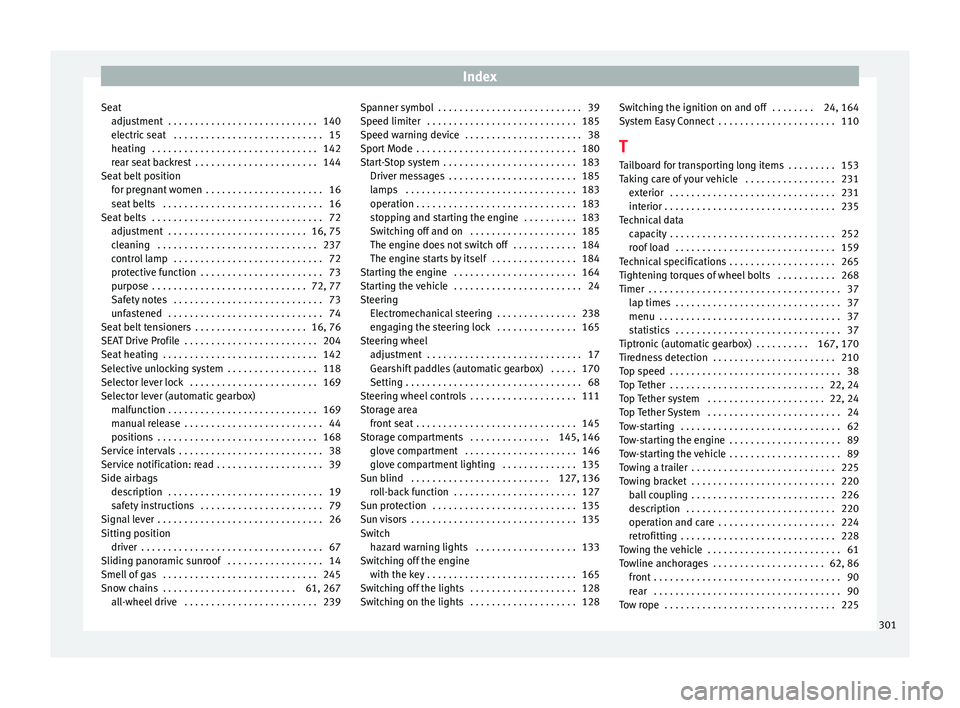
Index
Seat adju
s
tment . . . . . . . . . . . . . . . . . . . . . . . . . . . . 140
electric seat . . . . . . . . . . . . . . . . . . . . . . . . . . . . 15
heating . . . . . . . . . . . . . . . . . . . . . . . . . . . . . . . 142
rear seat backrest . . . . . . . . . . . . . . . . . . . . . . . 144
Seat belt position for pregnant women . . . . . . . . . . . . . . . . . . . . . . 16
seat belts . . . . . . . . . . . . . . . . . . . . . . . . . . . . . . 16
Seat belts . . . . . . . . . . . . . . . . . . . . . . . . . . . . . . . . 72 adjustment . . . . . . . . . . . . . . . . . . . . . . . . . . 16, 75
cleaning . . . . . . . . . . . . . . . . . . . . . . . . . . . . . . 237
control lamp . . . . . . . . . . . . . . . . . . . . . . . . . . . . 72
protective function . . . . . . . . . . . . . . . . . . . . . . . 73
purpose . . . . . . . . . . . . . . . . . . . . . . . . . . . . . 72, 77
Safety notes . . . . . . . . . . . . . . . . . . . . . . . . . . . . 73
unfastened . . . . . . . . . . . . . . . . . . . . . . . . . . . . . 74
Seat belt tensioners . . . . . . . . . . . . . . . . . . . . . 16, 76
SEAT Drive Profile . . . . . . . . . . . . . . . . . . . . . . . . . 204
Seat heating . . . . . . . . . . . . . . . . . . . . . . . . . . . . . 142
Selective unlocking system . . . . . . . . . . . . . . . . . 118
Selector lever lock . . . . . . . . . . . . . . . . . . . . . . . . 169
Selector lever (automatic gearbox) malfunction . . . . . . . . . . . . . . . . . . . . . . . . . . . . 169
manual release . . . . . . . . . . . . . . . . . . . . . . . . . . 44
positions . . . . . . . . . . . . . . . . . . . . . . . . . . . . . . 168
Service intervals . . . . . . . . . . . . . . . . . . . . . . . . . . . 38
Service notification: read . . . . . . . . . . . . . . . . . . . . 39
Side airbags description . . . . . . . . . . . . . . . . . . . . . . . . . . . . . 19
safety instructions . . . . . . . . . . . . . . . . . . . . . . . 79
Signal lever . . . . . . . . . . . . . . . . . . . . . . . . . . . . . . . 26
Sitting position driver . . . . . . . . . . . . . . . . . . . . . . . . . . . . . . . . . . 67
Sliding panoramic sunroof . . . . . . . . . . . . . . . . . . 14
Smell of gas . . . . . . . . . . . . . . . . . . . . . . . . . . . . . 245
Snow chains . . . . . . . . . . . . . . . . . . . . . . . . . 61, 267 all-wheel drive . . . . . . . . . . . . . . . . . . . . . . . . . 239 Spanner symbol . . . . . . . . . . . . . . . . . . . . . . . . . . . 39
Speed limiter
. . . . . . . . . . . . . . . . . . . . . . . . . . . . 185
Speed warning device . . . . . . . . . . . . . . . . . . . . . . 38
Sport Mode . . . . . . . . . . . . . . . . . . . . . . . . . . . . . . 180
Start-Stop system . . . . . . . . . . . . . . . . . . . . . . . . . 183 Driver messages . . . . . . . . . . . . . . . . . . . . . . . . 185
lamps . . . . . . . . . . . . . . . . . . . . . . . . . . . . . . . . 183
operation . . . . . . . . . . . . . . . . . . . . . . . . . . . . . . 183
stopping and starting the engine . . . . . . . . . . 183
Switching off and on . . . . . . . . . . . . . . . . . . . . 185
The engine does not switch off . . . . . . . . . . . . 184
The engine starts by itself . . . . . . . . . . . . . . . . 184
Starting the engine . . . . . . . . . . . . . . . . . . . . . . . 164
Starting the vehicle . . . . . . . . . . . . . . . . . . . . . . . . 24
Steering Electromechanical steering . . . . . . . . . . . . . . . 238
engaging the steering lock . . . . . . . . . . . . . . . 165
Steering wheel adjustment . . . . . . . . . . . . . . . . . . . . . . . . . . . . . 17
Gearshift paddles (automatic gearbox) . . . . . 170
Setting . . . . . . . . . . . . . . . . . . . . . . . . . . . . . . . . . 68
Steering wheel controls . . . . . . . . . . . . . . . . . . . . 111
Storage area front seat . . . . . . . . . . . . . . . . . . . . . . . . . . . . . . 145
Storage compartments . . . . . . . . . . . . . . . 145, 146 glove compartment . . . . . . . . . . . . . . . . . . . . . 146
glove compartment lighting . . . . . . . . . . . . . . 135
Sun blind . . . . . . . . . . . . . . . . . . . . . . . . . . 127, 136 roll-back function . . . . . . . . . . . . . . . . . . . . . . . 127
Sun protection . . . . . . . . . . . . . . . . . . . . . . . . . . . 135
Sun visors . . . . . . . . . . . . . . . . . . . . . . . . . . . . . . . 135
Switch hazard warning lights . . . . . . . . . . . . . . . . . . . 133
Switching off the engine with the key . . . . . . . . . . . . . . . . . . . . . . . . . . . . 165
Switching off the lights . . . . . . . . . . . . . . . . . . . . 128
Switching on the lights . . . . . . . . . . . . . . . . . . . . 128 Switching the ignition on and off . . . . . . . . 24, 164
Sys
tem Easy Connect . . . . . . . . . . . . . . . . . . . . . . 110
T Tailboard for transporting long items . . . . . . . . . 153
Taking care of your vehicle . . . . . . . . . . . . . . . . . 231 exterior . . . . . . . . . . . . . . . . . . . . . . . . . . . . . . . 231
interior . . . . . . . . . . . . . . . . . . . . . . . . . . . . . . . . 235
Technical data capacity . . . . . . . . . . . . . . . . . . . . . . . . . . . . . . . 252
roof load . . . . . . . . . . . . . . . . . . . . . . . . . . . . . . 159
Technical specifications . . . . . . . . . . . . . . . . . . . . 265
Tightening torques of wheel bolts . . . . . . . . . . . 268
Timer . . . . . . . . . . . . . . . . . . . . . . . . . . . . . . . . . . . . 37 lap times . . . . . . . . . . . . . . . . . . . . . . . . . . . . . . . 37
menu . . . . . . . . . . . . . . . . . . . . . . . . . . . . . . . . . . 37
statistics . . . . . . . . . . . . . . . . . . . . . . . . . . . . . . . 37
Tiptronic (automatic gearbox) . . . . . . . . . . 167, 170
Tiredness detection . . . . . . . . . . . . . . . . . . . . . . . 210
Top speed . . . . . . . . . . . . . . . . . . . . . . . . . . . . . . . . 38
Top Tether . . . . . . . . . . . . . . . . . . . . . . . . . . . . . 22, 24
Top Tether system . . . . . . . . . . . . . . . . . . . . . . 22, 24
Top Tether System . . . . . . . . . . . . . . . . . . . . . . . . . 24
Tow-starting . . . . . . . . . . . . . . . . . . . . . . . . . . . . . . 62
Tow-starting the engine . . . . . . . . . . . . . . . . . . . . . 89
Tow-starting the vehicle . . . . . . . . . . . . . . . . . . . . . 89
Towing a trailer . . . . . . . . . . . . . . . . . . . . . . . . . . . 225
Towing bracket . . . . . . . . . . . . . . . . . . . . . . . . . . . 220 ball coupling . . . . . . . . . . . . . . . . . . . . . . . . . . . 226
description . . . . . . . . . . . . . . . . . . . . . . . . . . . . 220
operation and care . . . . . . . . . . . . . . . . . . . . . . 224
retrofitting . . . . . . . . . . . . . . . . . . . . . . . . . . . . . 228
Towing the vehicle . . . . . . . . . . . . . . . . . . . . . . . . . 61
Towline anchorages . . . . . . . . . . . . . . . . . . . . . 62, 86 front . . . . . . . . . . . . . . . . . . . . . . . . . . . . . . . . . . . 90
rear . . . . . . . . . . . . . . . . . . . . . . . . . . . . . . . . . . . 90
Tow rope . . . . . . . . . . . . . . . . . . . . . . . . . . . . . . . . 225
301