child lock Seat Leon 5D 2016 User Guide
[x] Cancel search | Manufacturer: SEAT, Model Year: 2016, Model line: Leon 5D, Model: Seat Leon 5D 2016Pages: 324, PDF Size: 6.93 MB
Page 146 of 324

Operation
Adjusting the front head restraints Read the additional information carefully
›› ›
page 14
Adjust the head restraint ›››
page 14 so
that as far as possible the top of the head re-
straint is level with the top of your head.
When this is not possible, try to get as close
as possible to this position.
Adjusting the rear head restraints Fig. 146
Rear centre head restraint: release
point . When transporting people in the back seat,
p
l
ac
e the head restraints of the occupied
seats at a minimum of the next socket up
››› . Adjusting the head restraints
– To set the head restraint higher, grasp the
side
s
with both hands and move it up-
wards, until you see it engage.
– To set the head restraint lower down, press
the 1
› ››
Fig. 146
b
utton and move it
downwards.
Removing the head restraint
To remove the head restraint, the correspond-
ing backrest must be partially folded forward. – Unlock the backrest ›››
page 147.
– Move the head restraint upwards until it ar-
rives
to the top.
– Press button 1
› ›
› Fig. 146
, while simulta-
neously pressing on the security hole 2 ›››
Fig. 146 with a fl at
screwdriver a maxi-
mum of 5 mm wide, and remove the head
restraint.
– Move the backrest until it engages properly
›› ›
.
Fittin g the he
a
d restraint
To mount the external head restraints, the
corresponding backrest must be partially fol-
ded forward.
– Unlock the backrest ›››
page 147.
– Insert the head restraint bars into the
guides u
ntil they perceptibly engage. It should not be possible to remove the head
res
traint from the backrest.
– Move the backrest until it engages properly
›››
.
WARNING
● Ple a
se observe the general notes
››› page 69.
● Remove the rear head restraints only when
it is
necessary for the placement of a child
seat ››› page 82. After removing a child seat,
remount the head restraint immediately.
Travelling with the head restraints removed
or improperly adjusted increases the risk of
severe injuries. Seat functions
Intr oduction WARNING
Inappropriate use of the seat functions can
cau se sev
ere injuries.
● Assume the proper sitting position before
your trip and rem
ain in it throughout. This al-
so applies to the other occupants.
● Always keep hands, fingers, feet and other
part
s of the body away from the operating ra-
dius and the adjustment of seats. 144
Page 149 of 324
Seats and head restraints
compartment will not fly forward through the
interior durin
g s
udden braking.CAUTION
● With the b ac
krest inclined there is a danger
of damaging the rear head restraints when
adjusting the front seats backwards.
● When folding the backrest forwards, make
sure t
o place the side seat belts in the trim
clip to prevent them from being damaged by
becoming trapped in the backrest lock. Folding down and lifting the rear seat
b
ac
k
rest 3 App
lies to the model: LEON ST Fig. 151
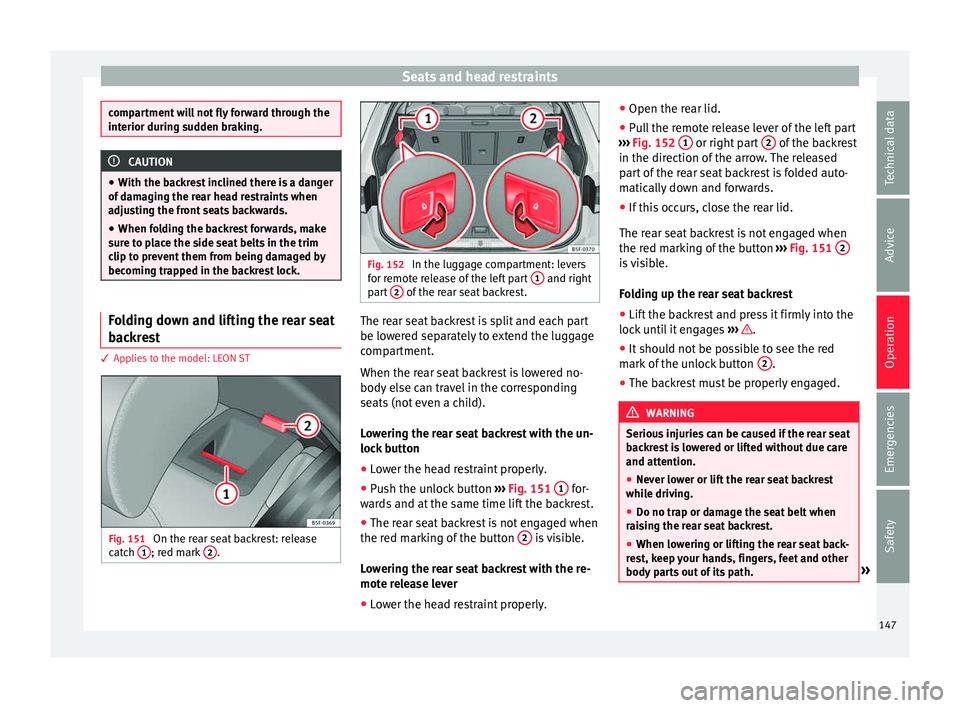
On the rear seat backrest: release
c at
c
h 1 ; red mark
2 . Fig. 152
In the luggage compartment: levers
for r emot
e release of the left part 1 and right
par t
2 of the rear seat backrest.
The rear seat backrest is split and each part
be lo
w
er
ed separately to extend the luggage
compartment.
When the rear seat backrest is lowered no-
body else can travel in the corresponding
seats (not even a child).
Lowering the rear seat backrest with the un-
lock button
● Lower the head restraint properly.
● Push the unlock button ›››
Fig. 151 1 for-
w ar
d
s and at the same time lift the backrest.
● The rear seat backrest is not engaged when
the red mark
ing of the button 2 is visible.
L o
w
ering the rear seat backrest with the re-
mote release lever
● Lower the head restraint properly. ●
Open the rear lid.
● P
ull the remote release lever of the left part
›››
Fig. 152 1 or right part
2 of the backrest
in the dir ection of
the arr
ow. The released
part of the rear seat backrest is folded auto-
matically down and forwards.
● If this occurs, close the rear lid.
The rear se
at backrest is not engaged when
the red marking of the button ››› Fig. 151 2 is visible.
F
o
l
ding up the rear seat backrest
● Lift the backrest and press it firmly into the
lock u
ntil it engages ››› .
● It should not be possible to see the red
m ark
of
the unlock button 2 .
● The backrest must be properly engaged. WARNING
Serious injuries can be caused if the rear seat
bac k
rest is lowered or lifted without due care
and attention.
● Never lower or lift the rear seat backrest
while driv
ing.
● Do no trap or damage the seat belt when
rais
ing the rear seat backrest.
● When lowering or lifting the rear seat back-
res
t, keep your hands, fingers, feet and other
body parts out of its path. » 147
Technical data
Advice
Operation
Emergencies
Safety
Page 150 of 324

Operation
●
For the r e
ar seat belts to offer the necessa-
ry protection all the parts of the rear backrest
must be properly engaged. This is particular-
ly important in the case of the centre rear
seat. If someone is seated in a seat whose
backrest is not properly engaged they will fly
forward, along with the backrest, during an
accident or a sudden driving or braking ma-
noeuvre.
● A red signal on the button 2 warns that
the bac k
rest is not engaged. Always check
that the red marking is not visible when the
backrest is in the upright position.
● When the rear seat backrest is lowered or is
not properly
engaged nobody else can travel
in the corresponding seats (not even a child). CAUTION
Serious damage can be caused to the vehicle
and other ob j
ects if the rear seat backrest is
lowered or lifted without due care and atten-
tion.
● Before lowering the rear seat backrest, al-
way
s adjust the front seats so that neither
the head restraints nor the cushions of the
rear backrest can hit them. Transport and practical
equipment
St or
ag
e compartments
Storage areas under the front seats* Fig. 153
Storage compartment under the
fr ont
se
ats. There is a storage compartment with a cover
u
nder e
ac
h front seat.
The drawer* is opened by pulling on the han-
dle of the cover ››› Fig. 153.
To close the drawer, press the cover until it
locks into position. WARNING
● The dra w
ers will hold a maximum weight of
1.5 kg. ●
Do not driv e w
ith the drawer cover open.
There is an injury risk for passengers if the
cargo is released in case of sudden braking or
an accident. Folding table*
3 Applies to the model: LEON ST
Fig. 154
Left-hand front seat: folding table. –
To open the tray, open it up in the direction
of the arr
o
w ››› Fig. 154. WARNING
● The fo l
ding trays may not be folded down
whilst the vehicle is in motion and anyone is
seated on the second row of seats. There is a
risk of injury during a sudden braking ma-
noeuvre! The tray must therefore be closed
and properly secured whilst the vehicle is in
motion. 148
Page 153 of 324

Transport and practical equipment
Storing objects Lo
a
ding the luggage compartment
›› ›
table on page 2
All luggage and other loose objects must be
safely secured in the luggage compartment.
Unsecured objects which shift back and forth
could impair the driving safety or driving
characteristics of the vehicle by shifting the
centre of gravity. – Distribute the load evenly in the luggage
comp ar
tment.
– Place heavy objects as far forward as possi-
ble in the lug
gage compartment.
– Place the heavy objects first.
– Secure heavy objects to the fitted fastening
rings
›››
page 157. WARNING
● Loo se lug
gage and other objects in the lug-
gage compartment could cause serious inju-
ries.
● Always stow objects in the luggage com-
partment
and secure them on the fastening
rings.
● Use suitable straps to secure heavy ob-
jects.
● D
uring sudden manoeuvres or accidents,
loose ob
jects can be thrown forward, injuring vehicle occupants or passers-by. This in-
cr
e
ased risk of injury will be further increased
if a loose object is struck by an inflating air-
bag. If this happens, objects may shoot out-
ward like a missile. Risk of fatal injury.
● Please note that the centre of gravity may
shift when tr
ansporting heavy objects; this
may affect vehicle handling and lead to an ac-
cident. Therefore, it is essential to adjust
your speed and driving style accordingly, to
avoid accidents.
● Never exceed the allowed axle weights or
allo
wed maximum weight. If said weights are
exceeded, the driving characteristics of the
vehicle may change, leading to accidents, in-
juries and damage to the vehicle.
● Never leave your vehicle unattended, espe-
cia
lly when the rear lid is open. Children
could climb into the luggage compartment,
closing the door behind them; they will be
trapped and run the risk of death.
● Never allow children to play in or around
the vehic
le. Close and lock all the doors and
rear lid when you leave the vehicle. Before
you lock the vehicle, make sure that there are
no adults or children in the vehicle. Note
● Air cir c
ulation in the vehicle helps reduce
fogging of the windows. Used air escapes
through ventilation slits in the side trim of
the luggage compartment. Ensure that the
ventilation slots are never covered. ●
Strap s
for securing the load to the fasten-
ing rings are commercially available. Luggage compartment cover
3 Applies to the model: LEON/LEON SC
Fig. 159
In the luggage compartment: remov-
in g and in
s
talling the rear shelf. Fig. 160
In the luggage compartment: remov-
in g and in s
talling the rear shelf. » 151
Technical data
Advice
Operation
Emergencies
Safety
Page 171 of 324
Driving
●
Vehic l
es with automatic gearbox: after
switching off the ignition, you can only re-
move the ignition key if the selector lever is
in position “P” (parking lock). Next, the se-
lector lever is locked. Switching off the engine with the key
Switching off the engine
– Stop the vehicle.
– Turn the ignition key to position 1›››
Fig. 186.
Eng agin
g the steering wheel lock
In vehicles with automatic gearbox, the igni-
tion key can only be removed when the selec-
tor lever is in position P.
– Remove the key from the ignition in posi-
tion 1
› ›
› Fig. 186
››› .
– Turn the steering wheel until you hear it en-
gag
e.
P
ossible vehicle theft is prevented with the
steering lock engaged. WARNING
● Never sw it
ch the engine off until the vehi-
cle is stationary. The brake servo and power
steering functions will not be completely cov-
ered under warranty. More force may also be
needed to turn the steering wheel or to brake. As you cannot steer and brake in the normal
manner
, ther
e is a greater risk of accidents
and serious injury.
● Never remove the key from the ignition if
the vehic
le is in motion. Otherwise, the steer-
ing could suddenly lock, making it impossible
to steer the vehicle: risk of accident!
● Always take the key with you when you
leav
e the vehicle. This is particularly impor-
tant if there are children in the vehicle, as
they might otherwise be able to start the en-
gine or use power-operated equipment (e.g.
the electric windows), which could cause in-
juries. CAUTION
If the engine has been running under high
loa d f
or a long time, there is a risk of heat
building up in the engine compartment after
it has been switched off; this could cause en-
gine damage. For this reason, you should idle
the engine for approximately 2 minutes be-
fore you switch it off. Note
● Aft er the en
gine is switched off the radiator
fan may run on for up to 10 minutes, even if
the ignition is switched off. It is also possible
that the fan turns itself on once more if the
coolant temperature increases due to the
heat accumulated in the engine compartment
or due to its prolonged exposure to solar ra-
diation. ●
If the v
ehicle is stopped and the Start-Stop
system* switches off the engine, the ignition
remains switched on. Make sure that the igni-
tion is switched off before leaving the vehi-
cle, otherwise the battery could discharge. Starter button*
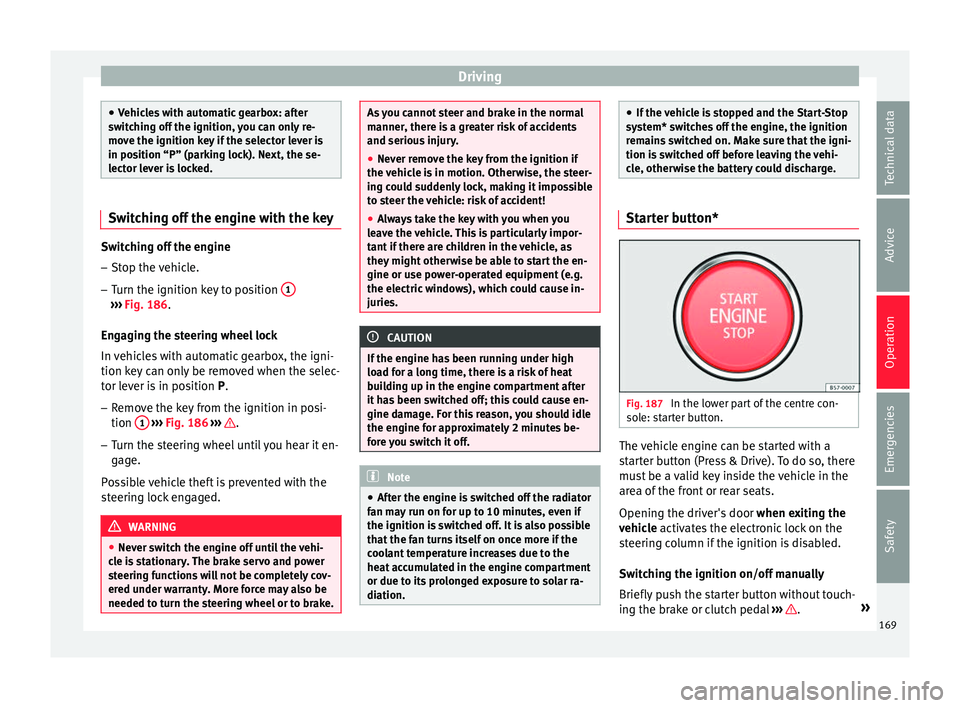
Fig. 187
In the lower part of the centre con-
so l
e: s
tarter button. The vehicle engine can be started with a
s
t
ar
ter button (Press & Drive). To do so, there
must be a valid key inside the vehicle in the
area of the front or rear seats.
Opening the driver's door when exiting the
vehicle activates the electronic lock on the
steering column if the ignition is disabled.
Switching the ignition on/off manually
Briefly push the starter button without touch-
ing the brake or clutch pedal ››› .
»
169
Technical data
Advice
Operation
Emergencies
Safety
Page 172 of 324

Operation
For vehicles with both manual and automatic
tr an
smi
ssion, the starter button text
START ENGINE STOP flashes like a heartbeat
when the sy s
t
em is preset for switching the
ignition on and off.
Automatic ignition switch-off
If the driver leaves the vehicle, taking the ve-
hicle key with them but leaving the ignition
on, the ignition is switched off automatically
after a certain time. If at that time the dipped
beam is on, the parking lights will stay on for
approx. 30 minutes. The side light can be
turned off by blocking the vehicle
››› page 116 or manually ››› page 131.
Emergency starting function
If no valid key is detected inside the vehicle,
an emergency start-up will be required. The
relevant message will appear in the dash
panel display. This may happen when, for ex-
ample, the battery of the vehicle key button
is very low or flat: ● Immediately after pushing the starter but-
ton, keep the
vehicle key next to the right
trim of the steering column.
● The ignition connects and the engine starts
automatic
ally. Emergency disconnection
If the engine doe
s not switch off after briefly
pressing the starter button, an emergency
disconnect will be required:
● Press the starter button twice within 3 sec-
onds or pr
ess it once for more than 1 sec-
ond ››› .
● The engine turns off automatically.
En gine r
e
start feature
If no valid key is detected inside the vehicle
after the engine stops, you will only have 5
seconds to restart it. A warning will display
on the dash panel screen.
After this interval, it will not be possible to
start the engine without a valid key inside
the vehicle.
Automatic deactivation of the ignition on ve-
hicles with the Start-Stop system
The ignition is switched off automatically
when the vehicle is stopped and the auto-
matic engine shutdown is active, if:
● The driver's seat belt is not fastened,
● the driver does not step on any pedal,
● the driver door is opened.
After aut
omatically turning off the ignition, if
the dipped beam is on, the side light re-
mains on for approx. 30 minutes (if the bat-
tery is sufficiently charged). If the driver locks the vehicle or manually turns off the light, the
side light g
oes out. WARNING
Any accidental movement of the vehicle could
re s
ult in serious injury.
● When switching on the ignition, do not
pre
ss the brake or clutch pedal, otherwise
the engine could start immediately. WARNING
If vehicle keys are used negligently or with-
out due c ar
e, this may cause accidents and
serious injury.
● Never leave any key inside the vehicle
when exitin
g. Otherwise, a child or unauthor-
ised person could lock the vehicle, start the
engine or connect the ignition and, in this
way, operate electronic equipment (e.g. the
windows). Note
● Bef or
e leaving the vehicle, always discon-
nect the ignition manually and, if appropri-
ate, take into account the instructions on the
screen of the dash panel.
● If the vehicle is stationary for a long time
with the ignition on, the v
ehicle battery
might be discharged and it might not be pos-
sible to start the engine.
● In diesel vehicles, there may be a delay in
the engine st
arting if it requires preheating.170
Page 177 of 324
Driving
● Sec ur
e the
vehicle as usual by applying the
handbrake firmly and putting it in 1st gear. WARNING
● Tak e me
asures to reduce the risk of injury
when you leave your vehicle unattended.
● Never park where the hot exhaust system
coul
d ignite inflammable materials, such as
dry grass, low bushes, spilt fuel etc.
● Never allow vehicle occupants to remain in
the vehic
le when it is locked. They would be
unable to open the vehicle from the inside,
and could become trapped in the vehicle in
an emergency. In the event of an emergency,
locked doors will delay assistance to vehicle
occupants.
● Never leave children alone in the vehicle.
They cou
ld set the vehicle in motion, for ex-
ample, by releasing the handbrake or the
gearbox lever.
● Depending on weather conditions, it may
become extr
emely hot or cold inside the vehi-
cle. This can be fatal. Brakes
New brake pads
F
or the fir
s
t 400 km (250 miles), new brake
pads have not yet reached their maximum
braking capacity, and need to be “run in”
first. However, you can compensate for the
slightly reduced braking effect by applying more pressure on the brake pedal. Avoid
overlo
ading the brakes while running them
in.
Wear
The rate of wear on the brake pads depends
a great deal on how you drive and the condi-
tions in which the vehicle is operated. This is
a particular problem in urban traffic and
short stretches, or with very sporty driving.
Depending on the speed, the braking force
and the environmental conditions (for exam-
ple, the temperature, air humidity, etc.)
noises may be produced on braking.
Wet roads or road salt
In certain situations (for example, on driving
through flooded areas, in severe downpours
or after washing the vehicle) the braking ac-
tion could be delayed if the discs and pads
are damp, or frozen in winter. In this case the
brakes should be “dried” by pressing the
brake pedal several times.
At high speed and with the windscreen wip-
ers activated, the brake pads will briefly
touch the brake discs. This takes place, al-
though unnoticeable to the driver, at regular
intervals to improve the response time of the
brakes when they are wet.
The effectiveness of the brakes can also be
temporarily reduced if the vehicle is driven
for some distance without using the brakes when there is a lot of salt on the road in win-
ter.
The layer of salt that accumulates on the
discs and pads can be removed by gently ap-
plying the brakes a few times.
Corrosion
There may be a tendency for corrosion to
form on the discs and dirt to build up on the
brake pads if the vehicle is used infrequently
or the brakes are not used very often.
If the brakes are not used frequently, or if
rust has formed on the disks, it is advisable
to clean off the pads and disks by braking
firmly a few times at a moderately high speed
››› .
F au
lt
in the brake system
If the brake pedal travel should ever increase
suddenly, this may mean that one of the two
brake circuits has failed. Drive immediately
to the nearest specialised workshop and
have the fault repaired. Drive there slowly
and remember that you will have to apply
more pressure on the brake pedal and allow
for longer stopping distances.
Low brake fluid level
Malfunctions can occur in the brake system if
the brake fluid level is too low. The brake flu-
id level is monitored electronically. »
175
Technical data
Advice
Operation
Emergencies
Safety
Page 271 of 324
Checking and refilling levels
CAUTION
● Do not mi x
cleaning products recommen-
ded by SEAT with other products. This could
lead to flocculation and may block the wind-
screen washer jets.
● When topping up service fluids, make abso-
lutely c
ertain that you fill the fluids into the
correct reservoirs. Using the wrong fluids
could cause serious malfunctions and engine
damage!
● Not having windscreen wiper fluid reduces
vis
ibility through the windscreen, and leads
to loss of visibility in headlights in models
with headlight washer. Battery
Gener a
l
informationRead the additional information carefully
› ›
›
page 52.
The battery is located in the engine compart-
ment and is almost maintenance-free. It is
checked as part of the Inspection Service.
Nevertheless, check the terminals are clean
and have the correct tightening torque, espe-
cially in summer and winter.
Disconnecting the battery
The battery should only be disconnected in
exceptional cases. When the battery is dis- connected, some of the vehicle's functions
are “los
t” (››› table on page 269). These
functions will require resetting after the bat-
tery is reconnected.
Deactivate the anti-theft alarm* before you
disconnect the battery Otherwise the alarm
will be triggered.
FunctionReprogramming
One-touch function of
the electric windows››› page 128, One-touch
opening and closing*.
Remote control key
If the vehicle does not re-
spond to the key, they
should be synchronised
››› page 123.
Digital clock››› page 106.
ESC warning lampAfter driving for a few me-
tres, the warning lamp goes
out again. If the vehicle is not used for long periods
The
v
ehic
le has a system for monitoring the
current consumption when the engine is left
unused for long periods of time ››› page 255.
Some functions, such as the interior lights, or
the remote door opening, may be temporarily
disabled to prevent the battery from running
flat. These functions will come back on as
soon as the ignition is switched on and the
engine started. Winter conditions
During the w
inter, the starting power may be
reduced, and if necessary, the battery should
be charged ››› in Important safety warn-
in g
s
for handling a vehicle battery on
page 270
Important safety warnings for han-
dling a v
ehicle battery All work on batteries requires specialist
kno
wl
edg
e. Please refer to a SEAT Official
Service or a workshop specialising in batter-
ies: risk of burns or exploding battery!
The battery must not be opened. Never try to
change the fluid level of the battery. Other-
wise explosive gas is released from the bat-
tery that could cause an explosion.
Wear eye protection.
Battery acid is very corrosive and caustic. Wear
protective gloves and eye protection. In the event
of electrolyte splashes, rinse off with plenty of
water.
Fires, sparks, open flames and smoking are pro-
hibited.
The battery should only be charged in a well-ven-
tilated zone. Risk of explosion!
Keep children away from acid and batteries!»
269
Technical data
Advice
Operation
Emergencies
Safety
Page 310 of 324
Index
selector lever lock . . . . . . . . . . . . . . . . . . . . . . . 181
sel ect
or l
ever positions . . . . . . . . . . . . . . . . . . 180
steering wheel with gearshift paddles . . . . . . 182
tiptronic . . . . . . . . . . . . . . . . . . . . . . . . . . 180, 182
AUX-IN . . . . . . . . . . . . . . . . . . . . . . . . . . . . . . . . . . 115
B Battery . . . . . . . . . . . . . . . . . . . . . . . . . . . . . . . . . . 122
Before starting the vehicle . . . . . . . . . . . . . . . . . . 65
Belt tightening . . . . . . . . . . . . . . . . . . . . . . . . . . . . 75
Bench seat . . . . . . . . . . . . . . . . . . . . . . . . . . . . . . 147
Biodiesel . . . . . . . . . . . . . . . . . . . . . . . . . . . . . . . . 259
Bonnet . . . . . . . . . . . . . . . . . . . . . . . . . . . . . 12, 262 opening the bonnet . . . . . . . . . . . . . . . . . . . . . 263
Brake emergency braking function . . . . . . . . . . . . . . 173
Brake assist system . . . . . . . . . . . . . . . . . . . . . . . 176
Brake fluid . . . . . . . . . . . . . . . . . . . . . . . . . . . . . . . 52
Brakes . . . . . . . . . . . . . . . . . . . . . . . . . . . . . . . . . . 175 brake fluid . . . . . . . . . . . . . . . . . . . . . . . . . . . . . 267
brake servo . . . . . . . . . . . . . . . . . . . . . . . . . . . . 175
electronic parking brake . . . . . . . . . . . . . . . . . 172
new brake pads . . . . . . . . . . . . . . . . . . . . . . . . 175
Braking brake assist system . . . . . . . . . . . . . . . . . . . . . 176
moving off on hills . . . . . . . . . . . . . . . . . . . . . . 179
C
Camera cleaning . . . . . . . . . . . . . . . . . . . . . . . . . . . . . . 248
cleanliness . . . . . . . . . . . . . . . . . . . . . . . . . . . . 222
Lane Assist . . . . . . . . . . . . . . . . . . . . . . . . . . . . 215
Capacities . . . . . . . . . . . . . . . . . . . . . . . . . . . . . . . . 50 fuel tank . . . . . . . . . . . . . . . . . . . . . . . . . . . . . . 108
windscreen washer water . . . . . . . . . . . . . . . . 268
Capacity natural gas tank . . . . . . . . . . . . . . . . . . . . . . . . 257 Car-care products . . . . . . . . . . . . . . . . . . . . . . . . . 246
Catalytic
converter . . . . . . . . . . . . . . . . . . . . . . . . 189
malfunction . . . . . . . . . . . . . . . . . . . . . . . . . . . . 189
CCS . . . . . . . . . . . . . . . . . . . . . . . . . . . . . . . . . . . . . 39
CD-ROM player (navigation) . . . . . . . . . . . . . . . . 149
Central locking anti-theft alarm . . . . . . . . . . . . . . . . . . . . . . . . . 124
central locking switch . . . . . . . . . . . . . . . . . . . . 119
electric windows . . . . . . . . . . . . . . . . . . . . . . . . 128
Keyless Access . . . . . . . . . . . . . . . . . . . . . . . . . 120
manual locking . . . . . . . . . . . . . . . . . . . . . . . . . . 11
programming . . . . . . . . . . . . . . . . . . . . . . . . . . 119
remote control key . . . . . . . . . . . . . . . . . . . . . . 118
selective unlocking system . . . . . . . . . . . . . . . 118
sliding/tilting sunroof . . . . . . . . . . . . . . . . . . . 128
Central locking system . . . . . . . . . . . . . . . . . . . . . 116
Cetane number (diesel fuel) . . . . . . . . . . . . . . . . 259
Changing parts . . . . . . . . . . . . . . . . . . . . . . . . . . . . . . . . . 245
Changing a bulb . . . . . . . . . . . . . . . . . . . . . . . . . . . 93 rear light bulbs . . . . . . . . . . . . . . . . . . . . . . . . . . 97
rear light in the side panel . . . . . . . . . . . . . . . . . 98
Changing a wheel . . . . . . . . . . . . . . . . . . . . . . . . . 57 subsequent work . . . . . . . . . . . . . . . . . . . . . . . . 59
Changing bulbs fog light . . . . . . . . . . . . . . . . . . . . . . . . . . . . . . . . 96
number plate light . . . . . . . . . . . . . . . . . . . . . . 100
Changing gear engaging gears (manual gearbox) . . . . . . . . . 179
Changing main headlight turn signal . . . . . . . . . . . . . . . . . . . . . . . . . . . . . . 95
Changing settings CAR menu . . . . . . . . . . . . . . . . . . . . . . . . . . . . . . 27
Changing the blades . . . . . . . . . . . . . . . . . . . . . . . 87
Changing the main beam headlight bulb main beam headlight . . . . . . . . . . . . . . . . . . . . . 96 Changing the main headlight bulb
day light . . . . . . . . . . . . . . . . . . . . . . . . . . . . . . . 95
dipped headlight . . . . . . . . . . . . . . . . . . . . . . . . 95
Changing the wiper blades . . . . . . . . . . . . . . . . . . 63
Charging the battery . . . . . . . . . . . . . . . . . . . . . . 270
Checking levels engine compartment . . . . . . . . . . . . . . . . . . . . 262
Child-proof locking electric windows . . . . . . . . . . . . . . . . . . . . . . . . 127
Child seat categorisation in groups . . . . . . . . . . . . . . . . . . 84
Child seats . . . . . . . . . . . . . . . . . . . . . . . . . . . . 19, 84 ISOFIX system . . . . . . . . . . . . . . . . . . . . . . . . . . . 21
safety instructions . . . . . . . . . . . . . . . . . . . . 19, 83
securing with seat belt . . . . . . . . . . . . . . . . . . . . 20
Top Tether system . . . . . . . . . . . . . . . . . . . . . 21, 23
City Emergency braking function . . . . . . . . . . . . . 211
Cleaning . . . . . . . . . . . . . . . . . . . . . . . . . . . . . . . . 246 alcantara . . . . . . . . . . . . . . . . . . . . . . . . . . . . . . 252
carbon parts . . . . . . . . . . . . . . . . . . . . . . . . . . . 249
Easy Connect control panel . . . . . . . . . . . . . . . 250
exhaust pipe . . . . . . . . . . . . . . . . . . . . . . . . . . . 250
fabrics . . . . . . . . . . . . . . . . . . . . . . . . . . . . . . . . 250
leather . . . . . . . . . . . . . . . . . . . . . . . . . . . . . . . . 251
natural leather . . . . . . . . . . . . . . . . . . . . . . . . . 252
plastic parts . . . . . . . . . . . . . . . . . . . . . . 249, 250
radio display . . . . . . . . . . . . . . . . . . . . . . . . . . . 250
seat belts . . . . . . . . . . . . . . . . . . . . . . . . . . . . . 253
trims . . . . . . . . . . . . . . . . . . . . . . . . . . . . . . . . . 248
washing the vehicle . . . . . . . . . . . . . . . . . . . . . 246
wheels . . . . . . . . . . . . . . . . . . . . . . . . . . . . . . . . 249
windows . . . . . . . . . . . . . . . . . . . . . . . . . . . . . . 249
Climatronic . . . . . . . . . . . . . . . . . . . . . . . . . . . . . . . 45
Close . . . . . . . . . . . . . . . . . . . . . . . . . . . . . . . . . . . 116
308
Page 317 of 324

Index
Radio display: cleaning . . . . . . . . . . . . . . . . . . . . 250
R a
dio tr
ansmitters . . . . . . . . . . . . . . . . . . . . . . . . 245
Rain sensor . . . . . . . . . . . . . . . . . . . . . . . . . . . . . . 140 control of the function . . . . . . . . . . . . . . . . . . . 141
Raising the vehicle . . . . . . . . . . . . . . . . . . . . . . . . . 58
Rear headrests . . . . . . . . . . . . . . . . . . . . . . . . . . . . . . 69
Rear Assist . . . . . . . . . . . . . . . . . . . . . . . . . . . . . . 231 instructions for use . . . . . . . . . . . . . . . . . . . . . 232
parking . . . . . . . . . . . . . . . . . . . . . . . . . . . . . . . 233
screen . . . . . . . . . . . . . . . . . . . . . . . . . . . . . . . . 232
special characteristics . . . . . . . . . . . . . . . . . . . 232
Rear Assist system . . . . . . . . . . . . . . . . . . . . . . . . 231
Rear bulbs in the side panel disassembling the rear light . . . . . . . . . . . . . . . 98
Rear lid . . . . . . . . . . . . . . . . . . . . . . . . . . . . . . . 11, 12 see also Luggage compartment . . . . . . . . . . . 126
Rear light bulbs . . . . . . . . . . . . . . . . . . . . . . . . . . . 97
Rear lights changing a bulb . . . . . . . . . . . . . . . . . . . . . . . . . 97
Rear lights in the rear lid disassembling the bulb holder . . . . . . . . . . . . . 99
Rear lights on the side panel summary . . . . . . . . . . . . . . . . . . . . . . . . . . . . . . . 97
Rear seat folding down and raising the backrest . . . . . . 146
Rear seat backrest folding down . . . . . . . . . . . . . . . . . . . . . . . . . . . 147
folding down and lifting the backrest . . . . . . . 147
lifting . . . . . . . . . . . . . . . . . . . . . . . . . . . . . . . . . 147
Rear seat passengers see Correct sitting position . . . . . . . . . 66, 67, 68
Rear shelf storing . . . . . . . . . . . . . . . . . . . . . . . . . . . 153, 154
Rear View Camera . . . . . . . . . . . . . . . . . . . . . . . . . 231
Rear view mirrors adjusting the exterior rear view mirrors . . . . . 142 Rear vision mirror
interior anti-dazz le . . . . . . . . . . . . . . . . . . . . . . 141
Refuelling fuel gauge . . . . . . . . . . . . . . . . . . . . . . . . . . . . . 108
gas gauge . . . . . . . . . . . . . . . . . . . . . . . . . . . . . 108
natural gas . . . . . . . . . . . . . . . . . . . . . . . . . . . . 257
opening fuel tank flap . . . . . . . . . . . . . . . . . . . 256
Remote control key unlocking and locking . . . . . . . . . . . . . . . . . . . 118
Removing and installing head restraints . . . . . . 144
Repair work . . . . . . . . . . . . . . . . . . . . . . . . . . . . . . 245
Replacement parts . . . . . . . . . . . . . . . . . . . . . . . . 245
Replacing the battery of the vehicle key . . . . . . . . . . . . . . . . . . . . . . . 122
Reset the trip recorder . . . . . . . . . . . . . . . . . . . . . 107
Retaining hooks . . . . . . . . . . . . . . . . . . . . . . . . . . 158
Retractable rear shelf . . . . . . . . . . . . . . . . . . . . . . 152
Rev counter . . . . . . . . . . . . . . . . . . . . . . . . . 104, 105
Reverse gear (automatic gearbox) . . . . . . . . . . . 180
Rims changing a wheel . . . . . . . . . . . . . . . . . . . . . . . . 57
Roll-back function panoramic sliding sunroof . . . . . . . . . . . . . . . . 130
sun blind . . . . . . . . . . . . . . . . . . . . . . . . . . . . . . 130
windows . . . . . . . . . . . . . . . . . . . . . . . . . . . . . . 127
Roof carrier . . . . . . . . . . . . . . . . . . . . . . . . . . . . . . 160
Roof carrier system . . . . . . . . . . . . . . . . . . . . . . . . 160
Roof load . . . . . . . . . . . . . . . . . . . . . . . . . . . . . . . . 162 technical data . . . . . . . . . . . . . . . . . . . . . . . . . . 162
Roof luggage rack attach the cross bars . . . . . . . . . . . . . . . . . . . . 161
Roof rack . . . . . . . . . . . . . . . . . . . . . . . . . . . . . . . . 160
Running-in new engine . . . . . . . . . . . . . . . . . . . . . . . . . . . . 187
Running in new brake pads . . . . . . . . . . . . . . . . . . . . . . . . 175
new tyres . . . . . . . . . . . . . . . . . . . . . . . . . . . . . . 271 S
Safe drivin
g safe . . . . . . . . . . . . . . . . . . . . . . . . . . . . . 65
Safelock . . . . . . . . . . . . . . . . . . . . . . . . . . . . . . . . 122 see also Anti-theft security system . . . . . . . . . 116
Safety . . . . . . . . . . . . . . . . . . . . . . . . . . . . . . . . . . . 65 child safety . . . . . . . . . . . . . . . . . . . . . . . . . . . . . 82
child seats . . . . . . . . . . . . . . . . . . . . . . . . . . . . . . 82
deactivating the front passenger airbag . . . . . . 17
Safe driving . . . . . . . . . . . . . . . . . . . . . . . . . . . . . 65
Safety equipment . . . . . . . . . . . . . . . . . . . . . . . . . . 65
Safety information knee airbags . . . . . . . . . . . . . . . . . . . . . . . . . . . . 17
Safety instructions head-protection airbags . . . . . . . . . . . . . . . . . . 79
side airbags . . . . . . . . . . . . . . . . . . . . . . . . . . . . 78
using child seats . . . . . . . . . . . . . . . . . . . . . 19, 83
Safety interlock for ignition key . . . . . . . . . . . . . . 167
Safety notes seat belt tensioners . . . . . . . . . . . . . . . . . . . . . . 75
using seat belts . . . . . . . . . . . . . . . . . . . . . . . . . 72
Saving fuel inertia mode . . . . . . . . . . . . . . . . . . . . . . . . . . . 186
Saving tips (efficiency programme) . . . . . . . . . . . 36
Seat electric seat . . . . . . . . . . . . . . . . . . . . . . . . . . . . 14
heating . . . . . . . . . . . . . . . . . . . . . . . . . . . . . . . 145
Seat belt position for pregnant women . . . . . . . . . . . . . . . . . . . . . . 15
seat belts . . . . . . . . . . . . . . . . . . . . . . . . . . . . . . 15
Seat belts . . . . . . . . . . . . . . . . . . . . . . . . . . . . . . . . 71 adjustment . . . . . . . . . . . . . . . . . . . . . . . . . . 15, 74
cleaning . . . . . . . . . . . . . . . . . . . . . . . . . . . . . . 253
control lamp . . . . . . . . . . . . . . . . . . . . . . . . . . . . 71
protective function . . . . . . . . . . . . . . . . . . . . . . . 72
purpose . . . . . . . . . . . . . . . . . . . . . . . . . . . . . 71, 76
315