warning lights Seat Leon 5D 2016 Workshop Manual
[x] Cancel search | Manufacturer: SEAT, Model Year: 2016, Model line: Leon 5D, Model: Seat Leon 5D 2016Pages: 324, PDF Size: 6.93 MB
Page 242 of 324

Operation
Exterior mirrors
Chec k
whether
you can see enough of the
road behind the trailer with the standard rear
vision mirrors. If this is not the case, you
should have additional exterior mirrors fitted.
Both exterior mirrors should be mounted on
hinged extension brackets. Adjust the mirrors
to give sufficient vision to the rear.
Tow rope
Always use a cable between the vehicle and
the trailer ››› page 240.
Trailer rear lights
The trailer's rear lights should comply with
the statutory safety regulations ››› page 240. WARNING
Never transport people in a trailer. This could
re s
ult in fatal accidents. Note
● To w
ing a trailer places additional demands
on the vehicle. We recommend additional
services between the normal inspection inter-
vals if the vehicle is used frequently for tow-
ing a trailer.
● Find out whether special regulations apply
to to
wing a trailer in your country. Hitching and connecting the trailer
Fig. 236
Schematic diagram: assignment of
the pins of
the trailer's electrical socket.
Key of the Schematic diagram ››› Fig. 236:
PinMeaning
1Left turn signal
2Rear fog light
3Earth, pins 1, 2, 4 to 8
4Right turn signal
5Rear light, right
6Brake lights
7Rear light, left
8Reverse lights
9Permanent live
10Cable without positive charge
11Earth, pin 10
Key of the Schematic diagram ››› Fig. 236:
PinMeaning
12Unassigned
13Earth, pin 9 Electrical socket for trailer
The v
ehic
le is fitted with a 13-pole power
socket for the electrical connection between
the trailer and the vehicle. If the system de-
tects that a trailer has been connected elec-
trically, the electrical equipment on the trailer
will receive voltage through this connection.
Pin 9 has a permanent live. This powers, for
example, the trailer's interior lighting. Pin 10
is only powered when the engine is running.
The charge wire (pin 10) charges, for exam-
ple, a caravan battery.
Pin 9 and 10 should not be connected to
each other to avoid discharging or damaging
the vehicle's battery.
The earth wires, pin 3, pin 11 and pin 13,
should never be connected to each other to
avoid overloading the electrical system.
If the trailer has a 7-contact connector , you
will need to use an adapter cable. In this case
the function corresponding to pin 10 will not
be available.
240
Page 243 of 324
Towing bracket device
Trailer maximum electricity consumptionBrake lights (total)84 Watts
Turn signal, on each side42 Watts
Side lights (total)100 Watts
Rear lights (total)42 Watts
Rear fog light42 Watts
Never exceed the values indicated! Note
● If the r e
ar lights of the trailer are not cor-
rectly connected, the vehicle electronics may
be damaged.
● If the trailer absorbs excessive electric cur-
rent, the v
ehicle electronics may be dam-
aged.
● Never connect the trailer's electric system
directly t
o the electrical connections of the
tail lights or any other power sources. Only
use the connections intended for providing
electric current to the trailer. Ball coupling of towing bracket de-
v
ic
e* The ball coupling is provided with instruc-
tions
on fittin
g and removing the ball cou-
pling of the towing bracket. WARNING
The towing bracket ball coupling must be
st or
ed securely in the luggage compartment
to prevent them being flung through the vehi-
cle and causing injury. Note
● By l
aw, the ball coupling must be removed
if a trailer is not being towed if it obscures
the number plate. Driving with a trailer
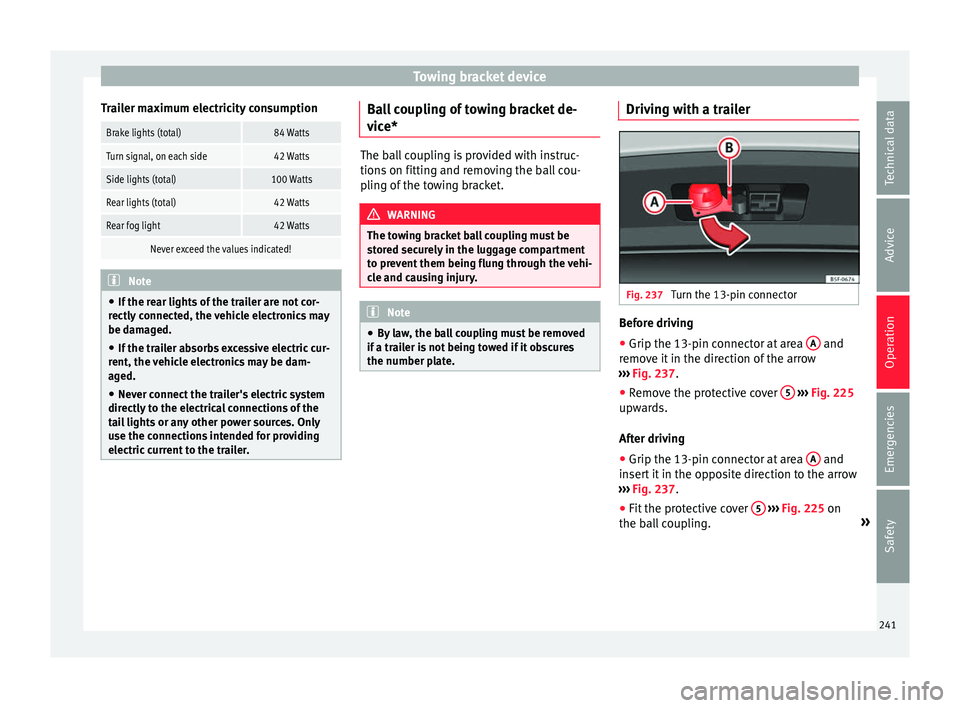
Fig. 237
Turn the 13-pin connector Before driving
● Grip the 13-pin connector at area A and
r emo
v
e it in the direction of the arrow
››› Fig. 237.
● Remove the protective cover 5
› ›
› Fig. 225
up
wards.
After driving
● Grip the 13-pin connector at area A and
in ser
t
it in the opposite direction to the arrow
››› Fig. 237.
● Fit the protective cover 5
› ›
›
Fig. 225 on
the ball coupling. »
241
Technical data
Advice
Operation
Emergencies
Safety
Page 244 of 324
Operation
Safety lug
The s af
ety
lug B
› ››
Fig. 237
i
s used to hook
up the trailer's retainer cable.
On hooking it up to the safety lug, the retain-
er cable should have slack in all the trailer
positions with respect to the vehicle (sharp
bends, reverse gear, etc.).
Headlights
The front part of the vehicle may be raised
when the trailer is connected and the light
may dazzle the rest of the traffic.
Adapt the height of the headlights using the
headlight range rotary adjuster 1)
. WARNING
● Never u se the s
afety lug to tow!
● Adjust your speed to suit the road and traf-
fic condition
s.
● All work on the electrical system must be
carried out on
ly by specialised workshops.
● Never connect the trailer's electric system
to the electric
al connections of the rear lights
or any other power sources.
● After hooking up the trailer and connecting
the socket, c
heck that all the trailer's rear
lights are working properly. Note
● If ther e i
s any fault in the trailer's lighting,
check the fuses in the instrument panel fuse
box ›››
page 54.
● The contact between the retainer cable and
the safety
lug may give rise to mechanical
wear in the lug's surface protection. This
wear will not prevent the safety lug from op-
erating properly or cause any fault and is ex-
cluded from the warranty.
● When connecting and disconnecting the
trail
er, the towing vehicle's handbrake
should be applied. Anti-theft alarm system
When the vehicle is locked, the alarm is trig-
g
er
ed when the el
ectrical connection be-
tween vehicle and trailer is interrupted.
Always turn off the anti-theft alarm system
before connecting or disconnecting a trailer
››› page 124.
Conditions for the integration of a trailer in
the anti-theft alarm system.
● The vehicle is factory-equipped with an an-
ti-theft al
arm system and a towing bracket
device. ●
The trail
er is connected electrically to the
towing vehicle by the trailer connector.
● The electrical system of the vehicle and the
trail
er are prepared for operation.
● The vehicle is locked with the ignition key
and the anti-theft al
arm system is activated. CAUTION
For technical reasons, trailers fitted with rear
LED lights ar
e not integrated in the anti-theft
alarm system. Driving tips
Driving with a trailer always requires extra
c
ar
e.
W
eight distribution
The weight distribution of a loaded trailer
with an unladen vehicle is very unfavourable.
However, if this cannot be avoided, drive ex-
tra slowly to allow for the unbalanced weight
distribution.
Speed
The stability of the vehicle and trailer is re-
duced with increasing speed. For this reason,
it is advisable not to drive at the maximum 1)
This does not apply for vehicles with bi-xenon
hea dlights.
242
Page 249 of 324
Care and maintenance
Automatic car washes
B ef
or
e going through a car wash, be sure to
take the usual precautions such as closing
the windows and roof. If the vehicle has spe-
cial accessories such as spoilers or a roof
rack or two-way radio aerial, etc., it is advisa-
ble to consult the car wash tunnel operator.
It is best to use a car wash without revolving
bristles if possible.
Washing the vehicle with a high pressure
cleaner
When washing the vehicle with a high-pres-
sure cleaner, always follow the operating in-
structions for the equipment. This applies
particularly to the operating pressure and the
spraying distance. Do not hold the nozzle too
close to soft materials such as rubber hoses
or seals. The same applies to the parking aid
sensors*, which are located in the rear bump-
er.
Do not use a nozzle that sprays the water out
in a direct stream or one that has a rotating
jet for forcing off dirt.
Stickers attached by the factory
Follow these directions to avoid damaging
the stickers:
● Do not use high pressure cleaners.
● To remove ice or snow from the stickers do
not use w
indow scrapers or ice scrapers. ●
Do not poli
sh the stickers.
● Do not use dirty cloths or sponges.
● Preferably wash using a soft sponge and
soft neutr
al soap.
Washing the car by hand
When washing the car by hand, use plenty of
water to soften the dirt first, and rinse off as
well as possible.
Then clean the vehicle with a soft sponge,
glove or brush using only slight pressure.
You should start on the roof and work down.
Special car soap should only be used for very
persistent dirt.
Rinse the sponge or glove thoroughly and of-
ten.
Wheels, sills and similar should be cleaned
last. Use a second sponge for this. WARNING
● The v ehic
le should only be washed with the
ignition switched off. Failure to follow this in-
struction could result in an accident.
● Do not clean the underside of chassis, the
inside of
wheel arches or wheel trims without
protecting your hands and arms. You may cut
yourself on sharp-edged metal parts. Other-
wise, there is a risk of sustaining cuts.
● When washing the car during the winter
season: w
ater and ice in the brake system
can reduce braking effectiveness: risk of acci-
dent! CAUTION
● Do not w a
sh the vehicle in direct sunlight –
otherwise the paint can be damaged.
● Do not use sponges, abrasive household
spong
es or similar to clean insect remains.
This could damage the surface.
● Clean off stubborn dirt (insects, etc.) from
the headlight
s at regular intervals, for in-
stance when filling the fuel tank. The head-
lights should only be washed with water, do
not wipe them with a dry cloth or sponge. It
is best to use soapy water.
● Never wash tyres with a jet that sprays the
water out
in a direct stream. This could dam-
age the tyres even if the spray is kept at a
distance and only used for a very short time.
● Before washing the vehicle in an automatic
car wa
sh, please make sure to retract the ex-
terior mirrors to prevent them from being
damaged. Electrically retractable exterior
mirrors must not be folded in or out by hand,
always use the electrical power control. CAUTION
● Bef or
e washing the vehicle in an automatic
car wash, please proceed as follows to lock
the wiper arms so that they are not moved to-
wards the top of the windscreen:
–the bonnet must be closed.
– switch the ignition on and off.
– press the windscreen wiper lever forward
briefly (windscreen washer function).
This will lock the wiper arms. » 247
Technical data
Advice
Operation
Emergencies
Safety
Page 256 of 324
Advice
Drive slowly to a specialised workshop and
h av
e the f
ault repaired.
(in yellow) Steering lock:
fault! Go to an Official Service
The electronic steering lock is malfunction-
ing.
Go to a specialised workshop as soon as
possible and have the fault repaired. WARNING
Take it immediately to a specialised work-
shop and hav e the f
ault repaired: risk of acci-
dent! Note
If the lamp (in red) or el se
(in yellow)
lights up briefly, you may continue driving. Progressive steering
Depending on the vehicle equipment, the
pr
ogr
e
ssive steering can adapt steering hard-
ness to the current driving situation. The
power steering only works when the engine
is running.
In city traffic you do not need to turn so much
on parking, manoeuvring or in very tight
turns.
On the road or on the motorway, progressive
steering transmits, for example, in bends, a sportier, more direct and noticeably more dy-
namic driv
ing sensation.
Four-wheel drive 3 Valid for vehicles: with four-wheel drive
› ›
› table on page 2
On four-wheel drive models, the engine pow-
er is distributed to all four wheels
General notes
On four-wheel drive vehicles, the engine
power is distributed to all four wheels. The
distribution of power is controlled automati-
cally according to your driving style and the
road conditions. Also see ›››
page 176, Brak-
ing and stability systems .
The four-wheel drive is specially designed to
complement the superior engine power. This
combination gives the vehicle exceptional
handling and performance capabilities, both
on normal roads and in more difficult condi-
tions, such as snow and ice. Even so (or per-
haps especially for this reason), it is impor-
tant to observe certain safety points ››› .
W int
er ty
res
Thanks to four-wheel drive, your vehicle will
have plenty of traction in winter conditions,
even with the standard tyres. Nevertheless,
we still recommend that winter tyres or all- season tyres be fitted on all
four wheels t
o
give even better braking response.
Snow chains
On roads where snow chains are mandatory,
this also applies to cars with four-wheel drive
››› page 60.
Changing tyres
On vehicles with four-wheel drive, all four
tyres must have the same rolling circumfer-
ence. Also avoid using tyres with varying
tread depths ››› page 273.
Off-roader?
Your SEAT is not an off-road vehicle: it does
not have enough ground clearance to be
used as such. It is therefore best to avoid
rough tracks and uneven terrain as much as
possible. WARNING
● Ev en w
ith four-wheel drive, you should al-
ways adjust your speed to suit the condi-
tions. Do not let the extra safety features
tempt you into taking any risks when driving.
Risk of accident!
● The braking capability of your vehicle is
limited by
the tyres' grip. It is therefore no
different from a car without four-wheel drive.
So do not be tempted to drive too fast on firm
or slippery roads just because the vehicle 254
Page 271 of 324
Checking and refilling levels
CAUTION
● Do not mi x
cleaning products recommen-
ded by SEAT with other products. This could
lead to flocculation and may block the wind-
screen washer jets.
● When topping up service fluids, make abso-
lutely c
ertain that you fill the fluids into the
correct reservoirs. Using the wrong fluids
could cause serious malfunctions and engine
damage!
● Not having windscreen wiper fluid reduces
vis
ibility through the windscreen, and leads
to loss of visibility in headlights in models
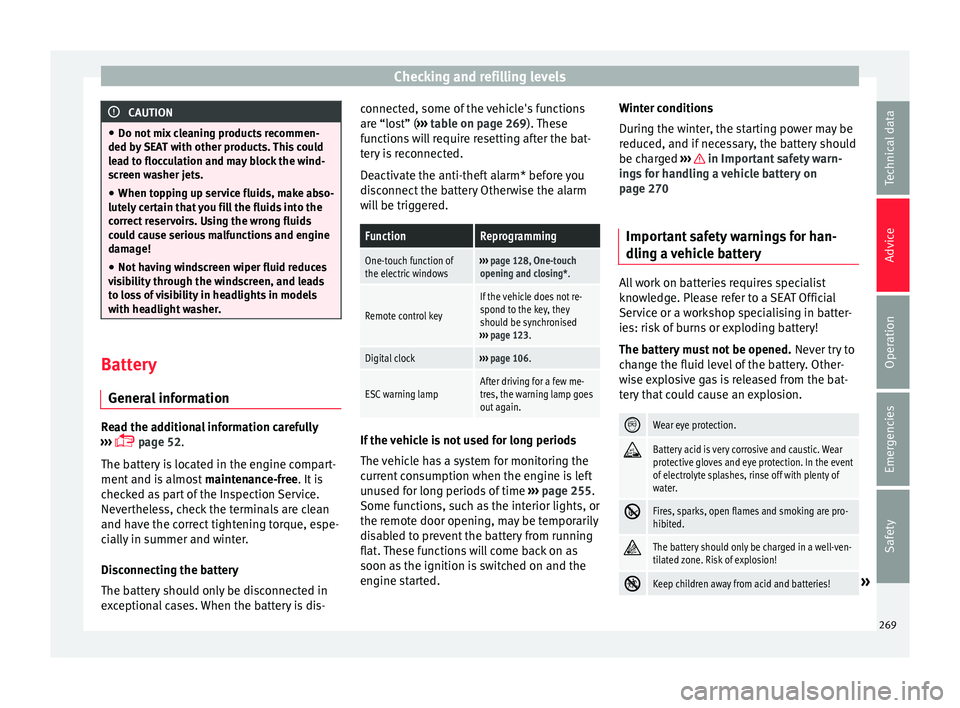
with headlight washer. Battery
Gener a
l
informationRead the additional information carefully
› ›
›
page 52.
The battery is located in the engine compart-
ment and is almost maintenance-free. It is
checked as part of the Inspection Service.
Nevertheless, check the terminals are clean
and have the correct tightening torque, espe-
cially in summer and winter.
Disconnecting the battery
The battery should only be disconnected in
exceptional cases. When the battery is dis- connected, some of the vehicle's functions
are “los
t” (››› table on page 269). These
functions will require resetting after the bat-
tery is reconnected.
Deactivate the anti-theft alarm* before you
disconnect the battery Otherwise the alarm
will be triggered.
FunctionReprogramming
One-touch function of
the electric windows››› page 128, One-touch
opening and closing*.
Remote control key
If the vehicle does not re-
spond to the key, they
should be synchronised
››› page 123.
Digital clock››› page 106.
ESC warning lampAfter driving for a few me-
tres, the warning lamp goes
out again. If the vehicle is not used for long periods
The
v
ehic
le has a system for monitoring the
current consumption when the engine is left
unused for long periods of time ››› page 255.
Some functions, such as the interior lights, or
the remote door opening, may be temporarily
disabled to prevent the battery from running
flat. These functions will come back on as
soon as the ignition is switched on and the
engine started. Winter conditions
During the w
inter, the starting power may be
reduced, and if necessary, the battery should
be charged ››› in Important safety warn-
in g
s
for handling a vehicle battery on
page 270
Important safety warnings for han-
dling a v
ehicle battery All work on batteries requires specialist
kno
wl
edg
e. Please refer to a SEAT Official
Service or a workshop specialising in batter-
ies: risk of burns or exploding battery!
The battery must not be opened. Never try to
change the fluid level of the battery. Other-
wise explosive gas is released from the bat-
tery that could cause an explosion.
Wear eye protection.
Battery acid is very corrosive and caustic. Wear
protective gloves and eye protection. In the event
of electrolyte splashes, rinse off with plenty of
water.
Fires, sparks, open flames and smoking are pro-
hibited.
The battery should only be charged in a well-ven-
tilated zone. Risk of explosion!
Keep children away from acid and batteries!»
269
Technical data
Advice
Operation
Emergencies
Safety
Page 278 of 324

Advice
Tyre monitoring indicator If a light appears
The pressure in one or more tyres has
clearly reduced in comparison to the
tyre pressure set by the driver or the
tyre has structural damage.
Additionally, an audible warning can be heard and a text
message can be seen on the instrument panel display.
Stop! Reduce speed immediately! Stop the vehicle
safely as soon as possible. Avoid sudden manoeuvres
and braking! Check all tyres and pressures. Replace any
damaged tyres. If flashing
System malfunction
The control lamp flashes for approximately one minute
and then lights up permanently.
If tyre pressure is correct, switch the ignition off and on
again. If the control lamp remains lit up, the tyre moni-
toring indicator can be calibrated. Have the system
checked by a specialised workshop.
Several warning and control lamps light up
f
or a f
ew sec
onds when the ignition is switch-
ed on while the function is verified. They will
switch off after a few seconds. WARNING
When the tyres are inflated at different pres-
sur e
s or at a pressure that is too low then a
tyre may be damaged resulting in a loss of control of the vehicle and a serious or fatal
acc
ident
.
● If the warning lamp lights up
, stop im-
mediately and check the tyres.
● If the tyres are inflated at different pres-
sure
s or if a tyre pressure is too low, this will
increase tyre wear, negatively affecting vehi-
cle stability and increasing braking distan-
ces.
● If tyres are inflated at different pressures or
a tyre pr
essure is too low, a tyre may be dam-
aged and burst resulting in a loss of control
of the vehicle.
● The driver is responsible for ensuring that
all
of the vehicle tyres are correctly inflated
to the right pressure. The recommended tyre
pressure is indicated on the label
››› page 283.
● The tyre monitoring system can only oper-
ate corr
ectly if all of the tyres are inflated to
the correct pressure when cold.
● Driving with tyres at the wrong pressure
can dam
age them and result in an accident.
Ensure that the tyre pressures of all the tyres
correspond to the vehicle load.
● Before starting a journey, always inflate
tyre
s to the correct pressure.
● Tyres with insufficient pressure are subjec-
ted to mor
e flexing. Due to this, the tyre
could become excessively hot, causing tread
separation and also tyre blow-out.
● With an overloaded vehicle at high speed,
the tyre
s can overheat and burst resulting in
a loss of vehicle control. ●
Ty r
e pressures which are too high or too
low reduce the useful life of the tyre, affect-
ing vehicle performance.
● If a tyre has not been punctured and it does
not hav
e to be changed immediately, drive to
the nearest specialised workshop at a moder-
ate speed and have the tyre checked and in-
flated to the correct pressure. WARNING
Observe the safety warnings ›
››
in Warning
and contr o
l lamps on page 109. Note
● If e x
cessively low tyre pressure is detected
with the ignition on, an audible warning will
sound. In the event that there is a fault in the
system, an audible warning will sound.
● Driving on dirt tracks for a long period of
time or driving in a s
porty style can tempora-
rily deactivate the TPMS. The control lamp
shows a fault, but disappears when road con-
ditions or the driving style change. 276
Page 309 of 324

Index
Index
A
ABS se
e
Anti-lock brake system . . . . . . . . . . . . . . . 176
ACC . . . . . . . . . . . . . . . . . . . . . . . . . . . . . . . . . . . . 196 radar sensor . . . . . . . . . . . . . . . . . . . . . . . . . . . 199
Accessories . . . . . . . . . . . . . . . . . . . . . . . . . 150, 245
Adaptive cruise control . . . . . . . . . . . . . . . . . . . . 196 function to avoid overtaking on the wrongside . . . . . . . . . . . . . . . . . . . . . . . . . . . . . . . . 204
indications on the display . . . . . . . . . . . . . . . . 198
malfunction . . . . . . . . . . . . . . . . . . . . . . . . . . . . 197
radar sensor . . . . . . . . . . . . . . . . . . . . . . . . . . . 199
special driving situations . . . . . . . . . . . . . . . . . 205
warning and control lamp . . . . . . . . . . . . . . . . 198
Adaptive Cruise Control deactivating temporarily . . . . . . . . . . . . . . . . . 204
operating . . . . . . . . . . . . . . . . . . . . . . . . . . . . . . 200
Additional electrical appliances (efficiency pro- gramme) . . . . . . . . . . . . . . . . . . . . . . . . . . . . . . . 35
Adjusting front head restraints . . . . . . . . . . . . . . . . . . . . . . 69
front seats . . . . . . . . . . . . . . . . . . . . . . . . . . . . . 143
Adjusting the head restraints front head restraints . . . . . . . . . . . . . . . . . . . . . 144
Adjustment CAR menu . . . . . . . . . . . . . . . . . . . . . . . . . . . . . 110
front head restraints . . . . . . . . . . . . . . . . . . . . . 144
lights . . . . . . . . . . . . . . . . . . . . . . . . . . . . . . . . . 137
rear head restraints . . . . . . . . . . . . . . . . . 69, 144
seats . . . . . . . . . . . . . . . . . . . . . . . . . . . . . . . . . . 66
Airbag covers . . . . . . . . . . . . . . . . . . . . . . . . . . . . . 16
Airbags . . . . . . . . . . . . . . . . . . . . . . . . . . . . . . . . . . 76 description . . . . . . . . . . . . . . . . . . . . . . . . . . . . . 77 Airbag system . . . . . . . . . . . . . . . . . . . . . . . . . . 16, 76
activation . . . . . . . . . . . . . . . . . . . . . . . . . . . . . . 77
deactivation of front airbag . . . . . . . . . . . . . . . . 80
description . . . . . . . . . . . . . . . . . . . . . . . . . . . . . 77
front airbags . . . . . . . . . . . . . . . . . . . . . . . . . 16, 78
functioning . . . . . . . . . . . . . . . . . . . . . . . . . . . . . 77
head-protection airbags . . . . . . . . . . . . . . . . . . 18
knee airbag . . . . . . . . . . . . . . . . . . . . . . . . . . . . . 17
side airbags . . . . . . . . . . . . . . . . . . . . . . . . . . . . 18
Air conditioning Climatronic . . . . . . . . . . . . . . . . . . . . . . . . 45, 163
heating and fresh air . . . . . . . . . . . . . . . . . . . . . 48
manual air conditioning . . . . . . . . . . . . . . . . . . . 47
user instructions . . . . . . . . . . . . . . . . . . . . . . . . 165
Air outlets . . . . . . . . . . . . . . . . . . . . . . . . . . . . . . . 166
Air recirculation . . . . . . . . . . . . . . . . . . . . . . . . . . 166
Alcantara: cleaning . . . . . . . . . . . . . . . . . . . . . . . 252
Anchoring the front tow line. . . . . . . . . . . . . . . . . . . . . . . . . 89
Anti-freeze . . . . . . . . . . . . . . . . . . . . . . . . . . . . . . . 51
Anti-lock brake system . . . . . . . . . . . . . . . . . . . . . 176
Anti-puncture . . . . . . . . . . . . . . . . . . . . . . . . . . 56, 85
Anti-puncture kit . . . . . . . . . . . . . . . . . . . . . . . . 56, 85 check after 10 minutes . . . . . . . . . . . . . . . . . . . . 87
Anti-puncture set . . . . . . . . . . . . . . . . . . . . . . . . . . 85
Anti-theft alarm . . . . . . . . . . . . . . . . . . . . . 116, 124 vehicle interior monitoring and anti-tow sys-tem . . . . . . . . . . . . . . . . . . . . . . . . . . . . . . . . . 126
Anti-theft alarm system trailer . . . . . . . . . . . . . . . . . . . . . . . . . . . . . . . . . 242
see also Anti-theft alarm system . . . . . . . . . . . 116
Anti-theft security system . . . . . . . . . . 10, 116, 122
Anti-tow protection . . . . . . . . . . . . . . . . . . . . . . . 126
Aspects to take into account before starting the vehicle . . . . . . . . . . . . . . . . . . . . . . . . . . . . . . . . . 65
ASR see Traction control system . . . . . . . . . . . . . . . 176 Assistance systems
ACC . . . . . . . . . . . . . . . . . . . . . . . . . . . . . . . . . . 196
adaptive cruise control . . . . . . . . . . . . . . . . . . . 196
Auto Hold function . . . . . . . . . . . . . . . . . . . . . . 194
cruise control system . . . . . . . . . . . . . . . . . . . . 195
Emergency Assist . . . . . . . . . . . . . . . . . . . . . . . 217
Front Assist . . . . . . . . . . . . . . . . . . . . . . . . . . . . 207
parking aid . . . . . . . . . . . . . . . . . . . . . . . 225, 227
Pedestrian Monitoring system . . . . . . . . . . . . . 212
Traffic Jam Assist . . . . . . . . . . . . . . . . . . . . . . . . 216
traffic sign detection system . . . . . . . . . . . . . . 222
tyre monitoring . . . . . . . . . . . . . . . . . . . . . . . . . 276
tyre monitoring indicator . . . . . . . . . . . . . . . . . 277
Assistance Systems fatigue detection . . . . . . . . . . . . . . . . . . . . . . . 224
tyre monitoring systems . . . . . . . . . . . . . . . . . 275
Assisted starting . . . . . . . . . . . . . . . . . . . . . . . . . . 61
Audible signal lights . . . . . . . . . . . . . . . . . . . . . . . . . . . . . . . . . 131
Audible warning signal seat belt not fastened . . . . . . . . . . . . . . . . . . . . 71
warning and control lamps . . . . . . . . . . . . . . . 109
Auto Hold . . . . . . . . . . . . . . . . . . . . . . . . . . . . . . . 194
Auto Hold function . . . . . . . . . . . . . . . . . . . . . . . . 194
Auto Lock (central locking) . . . . . . . . . . . . . . . . . 116
Automatic car washes switching the Auto Hold function off . . . . . . . . 195
Automatic dipped beam control . . . . . . . . . . . . . 132
Automatic gear safety interlock for ignition key . . . . . . . . . . . . 167
Automatic gearbox . . . . . . . . . . . . . . . . . . . . . . . . 180 backup programme . . . . . . . . . . . . . . . . . . . . . 186
downhill speed control . . . . . . . . . . . . . . . . . . 185
driving tips . . . . . . . . . . . . . . . . . . . . . . . . . . . . 183
kick-down feature . . . . . . . . . . . . . . . . . . . . . . . 184
launch control programme . . . . . . . . . . . . . . . . 184
manual release of selector lever . . . . . . . . . . . . 43
307
Page 311 of 324
Index
Closing . . . . . . . . . . . . . . . . . . . . . . . . . . . . . . . . . 116 bonnet . . . . . . . . . . . . . . . . . . . . . . . . . . . . . . . .
263
p anor
amic sliding sunroof . . . . . . . . . . . . . . . . 129
windows . . . . . . . . . . . . . . . . . . . . . . . . . . . . . . 127
Clutch (warning lamp) . . . . . . . . . . . . . . . . . . . . . 186
Coming Home . . . . . . . . . . . . . . . . . . . . . . . . . . . . 134
Connectivity Box . . . . . . . . . . . . . . . . . . . . . . . . . . 115
Control and warning lamps diesel particulate filter . . . . . . . . . . . . . . . . . . . 189
emission control . . . . . . . . . . . . . . . . . . . . . . . . 190
Controls and displays general instrument panel . . . . . . . . . . . . . . . . . 103
Controls on the steering wheel operating the audio system . . . . . . . . . . . . . . . 112
operating the telephone and audio system . . 113
Convenience closing panoramic sliding sunroof . . . . . . . . . . . . . . . . 130
Convenience opening panoramic sliding sunroof . . . . . . . . . . . . . . . . 130
Coolant checking level . . . . . . . . . . . . . . . . . . . . . . . . . . 266
Cooling system checking coolant . . . . . . . . . . . . . . . . . . . . . . . 266
coolant temperature gauge . . . . . . . . . . . . . . . 107
topping up coolant . . . . . . . . . . . . . . . . . . . . . . 266
Cornering lights . . . . . . . . . . . . . . . . . . . . . . . . . . . . . . . . . 134
Correct position . . . . . . . . . . . . . . . . . . . . . . . . . . . 66
Correct sitting position front passenger . . . . . . . . . . . . . . . . . . . . . . . . . 67
rear seat passengers . . . . . . . . . . . . . . . . . . . . . 68
Cruise control . . . . . . . . . . . . . . . . . . . . . . . . 39, 195 operation . . . . . . . . . . . . . . . . . . . . . . . . . . . . . . 196
Cruise control system . . . . . . . . . . . . . . . . . . . . . . 195 warning and indication lamp . . . . . . . . . . . . . . 195 D
Danger
s in not using the seat belt . . . . . . . . . . . . 73
Dash panel . . . . . . . . . . . . . . . . . . . . . . . . . . . . . . . 40
Data sticker . . . . . . . . . . . . . . . . . . . . . . . . . . . . . . 281
Deactivating the front passenger front airbag . . . 17
Deactivation of front airbag . . . . . . . . . . . . . . . . . . 80
Defective bulbs changing a bulb . . . . . . . . . . . . . . . . . . . . . . . . . 93
Detachable ball assembling . . . . . . . . . . . . . . . . . . . . . . . 236, 237
checking attachment . . . . . . . . . . . . . . . . . . . . 237
placing in standby position . . . . . . . . . . . . . . . 235
removing . . . . . . . . . . . . . . . . . . . . . . . . . . . . . . 238
standby position . . . . . . . . . . . . . . . . . . . . . . . . 236
Diesel diesel particulate filter . . . . . . . . . . . . . . . . . . . 189
engine oil . . . . . . . . . . . . . . . . . . . . . . . . . . . . . 264
preheating . . . . . . . . . . . . . . . . . . . . . . . . . . . . 167
refuelling . . . . . . . . . . . . . . . . . . . . . . . . . . . . . . 259
Diesel particulate filter malfunction . . . . . . . . . . . . . . . . . . . . . . . . . . . . 189
Digital clock . . . . . . . . . . . . . . . . . . . . . . . . . . . . . 104
Dimensions . . . . . . . . . . . . . . . . . . . . . . . . . . . . . . 305
Direction of rotation tyres . . . . . . . . . . . . . . . . . . . . . . . . . . . . . . . . . . . 59
Display . . . . . . . . . . . . . . . . . . . . . . . . . . . . 104, 105
Display of traffic signs on the instrument panel activate . . . . . . . . . . . . . . . . . . . . . . . . . . . . . . . 224
deactivate . . . . . . . . . . . . . . . . . . . . . . . . . . . . . 224
Disposal seat belt tensioners . . . . . . . . . . . . . . . . . . . . . . 75
Distance control see Adaptive cruise control . . . . . . . . . . . . . . . 196
Door cylinder . . . . . . . . . . . . . . . . . . . . . . . . . . . . . 10
Door handle . . . . . . . . . . . . . . . . . . . . . . . . . . . . . . 10
Door lock . . . . . . . . . . . . . . . . . . . . . . . . . . . . . . . . . 10
Door release lever . . . . . . . . . . . . . . . . . . . . . . . . 103 Doors
chil dproof locks . . . . . . . . . . . . . . . . . . . . . . . . 123
opening and closing . . . . . . . . . . . . . . . . . . . . . 10
Downhill speed control . . . . . . . . . . . . . . . . . . . . 185
Downhill speed control function . . . . . . . . . . . . . 185
Drawer . . . . . . . . . . . . . . . . . . . . . . . . . . . . . . . . . . 148
Drink holders . . . . . . . . . . . . . . . . . . . . . . . . . . . . 149
Driver see Correct sitting position . . . . . . . . . 66, 67, 68
Driver information system CD/radio indication . . . . . . . . . . . . . . . . . . . . . . 30
engine oil temperature display . . . . . . . . . . . . . 35
operation with the windscreen wiper lever . . . . 30
Driving driving abroad . . . . . . . . . . . . . . . . . . . . . . . . . 136
with a trailer . . . . . . . . . . . . . . 234, 239, 241, 242
Driving abroad headlights . . . . . . . . . . . . . . . . . . . . . . . . . . . . . 136
Driving data . . . . . . . . . . . . . . . . . . . . . . . . . . . . . . 30 data summary . . . . . . . . . . . . . . . . . . . . . . . . . . . 34
memory . . . . . . . . . . . . . . . . . . . . . . . . . . . . . . . . 34
Driving mode . . . . . . . . . . . . . . . . . . . . . . . . . . . . 220
Driving profile . . . . . . . . . . . . . . . . . . . . . . . . . . . . 220
Driving safety . . . . . . . . . . . . . . . . . . . . . . . . . . . . . 65
Driving through water . . . . . . . . . . . . . . . . . . . . . 191
DSG . . . . . . . . . . . . . . . . . . . . . . . . . . . . . . . . . . . . 180
Duplicate keys . . . . . . . . . . . . . . . . . . . . . . . . . . . 117
Dust and pollen filter . . . . . . . . . . . . . . . . . . . . . . 163
Dynamic headlight range control . . . . . . . . . . . . 137
E E10 see Ethanol (fuel) . . . . . . . . . . . . . . . . . . . . . . . 258
Easy Connect . . . . . . . . . . . . . . . . . . . . . . . . 27, 110
Economical driving . . . . . . . . . . . . . . . . . . . . . . . . . . . . . . . . 188
309
Page 312 of 324

Index
EDL se
e
Electronic differential lock . . . . . . . . . . . . . 176
Efficiency programme additional electrical appliances . . . . . . . . . . . . 35
saving tips . . . . . . . . . . . . . . . . . . . . . . . . . . . . . . 36
Electrical accessories see Power socket . . . . . . . . . . . . . . . . . . . . . . . 150
Electrical socket trailer . . . . . . . . . . . . . . . . . . . . . . . . . . . . . . . . . 240
Electric windows . . . . . . . . . . . . . . . . . . . . . . 13, 127 convenience opening and closing . . . . . . . . . 128
Electromechanical steering . . . . . . . . . . . . . . . . . 253 lamp . . . . . . . . . . . . . . . . . . . . . . . . . . . . . . . . . 253
Electronic differential lock . . . . . . . . . . . . . . . . . . 176
Electronic immobiliser . . . . . . . . . . . . . . . . . . . . . . 10
Electronic self-locking . . . . . . . . . . . . . . . . . . . . . 176
Electronic Stability Control (ESC) . . . . . . . . . . . . 176
Electronic torque management (XDS) . . . . . . . . . 177
Emergencies . . . . . . . . . . . . . . . . . . . . . . . . . . . . . . 85 anti-puncture kit . . . . . . . . . . . . . . . . . . . . . . . . . 85
automatic gearbox backup programme . . . . . 186
bulbs . . . . . . . . . . . . . . . . . . . . . . . . . . . . . . . . . . 55
changing a wheel . . . . . . . . . . . . . . . . . . . . . . . . 57
emergency towing of the vehicle . . . . . . . . . . . . 60
fuses . . . . . . . . . . . . . . . . . . . . . . . . . . . . . . . . . . 54
hazard warning lights . . . . . . . . . . . . . . . . . . . 135
jump leads . . . . . . . . . . . . . . . . . . . . . . . . . . . . . 61
manual unlocking and locking . . . . . . . . . . . . . 87
puncture . . . . . . . . . . . . . . . . . . . . . . . . . . . . . . . 55
replacing a blown fuse . . . . . . . . . . . . . . . . . . . . 54
replacing the battery . . . . . . . . . . . . . . . . . . . . 270
vehicle tool kit . . . . . . . . . . . . . . . . . . . . . . . . . . 85
Emergency Assist . . . . . . . . . . . . . . . . . . . . . . . . . 217 see Emergency Assist . . . . . . . . . . . . . . . . . . . . 217
switching off . . . . . . . . . . . . . . . . . . . . . . . . . . . 218
switching on . . . . . . . . . . . . . . . . . . . . . . . . . . . 218
Emergency braking function . . . . . . . . . . . . . . . . 173 Emergency braking warning . . . . . . . . . . . . . . . . 136
Emergency
operation
passenger door . . . . . . . . . . . . . . . . . . . . . . . . . . 11
selector lever . . . . . . . . . . . . . . . . . . . . . . . . . . . 43
Emission control system control lamp . . . . . . . . . . . . . . . . . . . . . . . . . . . 190
Emissions data . . . . . . . . . . . . . . . . . . . . . . . . . . . 281
Engine assisted starting . . . . . . . . . . . . . . . . . . . . . . . . . 61
noises . . . . . . . . . . . . . . . . . . . . . . . . . . . . . . . . 171
preheating . . . . . . . . . . . . . . . . . . . . . . . . . . . . 167
running in . . . . . . . . . . . . . . . . . . . . . . . . . . . . . 187
Start-Stop system . . . . . . . . . . . . . . . . . . . . . . . 191
starting . . . . . . . . . . . . . . . . . . . . . . . . . . . . . . . 167
starting up (driver messages with the mechan-ical contact) . . . . . . . . . . . . . . . . . . . . . . . . . . 168
switching off (key) . . . . . . . . . . . . . . . . . . . . . . 169
Engine and ignition automatic ignition switch-off . . . . . . . . . . . . . . 170
My Beat . . . . . . . . . . . . . . . . . . . . . . . . . . . . . . . 172
preheating the engine . . . . . . . . . . . . . . . . . . . 171
starting the engine . . . . . . . . . . . . . . . . . . . . . . 171
starting the engine with Press & Drive . . . . . . 171
stopping the engine . . . . . . . . . . . . . . . . . . . . . 171
Engine compartment . . . . . . . . . . . . . . . . . . 12, 262 battery . . . . . . . . . . . . . . . . . . . . . . . . . . . . 52, 269
brake fluid . . . . . . . . . . . . . . . . . . . . . . . . . 52, 267
closing the bonnet . . . . . . . . . . . . . . . . . . . . . . 263
coolant . . . . . . . . . . . . . . . . . . . . . . . . . . . 51, 266
engine oil . . . . . . . . . . . . . . . . . . . . . . . . . 50, 265
opening the bonnet . . . . . . . . . . . . . . . . . . . . . 263
safety notes . . . . . . . . . . . . . . . . . . . . . . . . . . . 262
windscreen washer reservoir . . . . . . . . . . 52, 268
Engine coolant . . . . . . . . . . . . . . . . . . . . . . . . . . . . 51 G 12 plus-plus . . . . . . . . . . . . . . . . . . . . . . . . . . 51
G 13 . . . . . . . . . . . . . . . . . . . . . . . . . . . . . . . . . . . 51
specifications . . . . . . . . . . . . . . . . . . . . . . . . . . . 51
Engine data . . . . . . . . . . . . . . . . . . . . . . . . . . . . . . 284 Engine fault
contro l lamp . . . . . . . . . . . . . . . . . . . . . . . . . . . 190
Engine management . . . . . . . . . . . . . . . . . . . . . . 189 control lamp . . . . . . . . . . . . . . . . . . . . . . . . . . . 190
Engine oil . . . . . . . . . . . . . . . . . . . . . . . . . . . 50, 264 changing . . . . . . . . . . . . . . . . . . . . . . . . . 264, 266
checking oil level . . . . . . . . . . . . . . . . . . . . . . . 265
consumption . . . . . . . . . . . . . . . . . . . . . . . . . . . 265
dipstick . . . . . . . . . . . . . . . . . . . . . . . . . . . . . . . 265
inspection service . . . . . . . . . . . . . . . . . . . . . . 264
maintenance intervals . . . . . . . . . . . . . . . . . . . 264
oil properties . . . . . . . . . . . . . . . . . . . . . . . . . . . 51
specifications . . . . . . . . . . . . . . . . . . . . . . . . . . 264
temperature display . . . . . . . . . . . . . . . . . . . . . . 35
topping up . . . . . . . . . . . . . . . . . . . . . . . . . . . . 265
Environment ecological driving . . . . . . . . . . . . . . . . . . . . . . . 188
environmental compatibility . . . . . . . . . . . . . . 187
Environmental tips filling the tank . . . . . . . . . . . . . . . . . . . . . . . . . 257
refuelling . . . . . . . . . . . . . . . . . . . . . . . . . . . . . . 256
Equipment . . . . . . . . . . . . . . . . . . . . . . . . . 150, 245
ESC electronic stability control . . . . . . . . . . . . . . . . 176
multi-collision brake . . . . . . . . . . . . . . . . . . . . . 177
Sport Mode . . . . . . . . . . . . . . . . . . . . . . . . . . . . 178
Ethanol (fuel) . . . . . . . . . . . . . . . . . . . . . . . . . . . . 258
Exhaust gas purification system catalytic converter . . . . . . . . . . . . . . . . . . . . . . 189
diesel particulate filter . . . . . . . . . . . . . . . . . . . 189
Exhaust pipe: Cleaning . . . . . . . . . . . . . . . . . . . . 250
Extending the luggage compartment . . . . . . . . . . . . . . . . 146
Exterior lighting changing a bulb . . . . . . . . . . . . . . . . . . . . . . . . . 93
Exterior mirrors adjusting . . . . . . . . . . . . . . . . . . . . . . . . . . . . . . . 15
310