engine oil Seat Leon 5D 2017 User Guide
[x] Cancel search | Manufacturer: SEAT, Model Year: 2017, Model line: Leon 5D, Model: Seat Leon 5D 2017Pages: 332, PDF Size: 7.25 MB
Page 181 of 332

Driving
WARNING
● Never ru n the en
gine in confined spaces, as
the exhaust gases are poisonous. CAUTION
Avoid high engine speeds, full throttle and
extr eme lo
ad conditions until the engine has
reached its normal operating temperature,
otherwise this can damage the engine. For the sake of the environment
Do not warm up the engine by idling it. You
shoul d driv
e off as soon as you start the en-
gine. This will help avoid unnecessary ex-
haust emissions. Note
● If it i
s difficult to turn the ignition key to
the position 1 , move the steering wheel to
both side s
to release the steering lock.
● When starting from cold, the engine may be
a little noisy
for the first few seconds until oil
pressure has built up in the hydraulic valve
lifters. This is quite normal, and no cause for
concern.
● If the vehicle battery is disconnected and
reconnect
ed, the key must remain in the posi-
tion 1 for around 5 seconds before starting
up.
● Vehic
les with automatic gearbox without
electronic
brake, depending on the country:
after switching off the ignition, you can only remove the ignition key if the selector lever is
in pos
ition “P” (p
arking lock). Next, the se-
lector lever is locked. Switching off the engine with the key
Switching off the engine
– Stop the vehicle.
– Turn the ignition key to position
›› ›
Fig. 191 1 .
Eng agin
g the steering wheel lock
In vehicles with automatic gearbox, the igni-
tion key can only be removed when the selec-
tor lever is in position P.
– Remove the key from the ignition in posi-
tion ›››
Fig. 191 1
› ›
› .
– Turn the steering wheel until you hear it en-
gag
e.
P
ossible vehicle theft is prevented with the
steering lock engaged. WARNING
● Never sw it
ch the engine off until the vehi-
cle is stationary. The brake servo and power
steering functions will not be completely cov-
ered under warranty. More force may also be
needed to turn the steering wheel or to brake.
As you cannot steer and brake in the normal manner, there is a greater risk of accidents
and serious
injur
y.
● Never remove the key from the ignition if
the vehic
le is in motion. Otherwise, the steer-
ing could suddenly lock, making it impossible
to steer the vehicle: risk of accident!
● Always take the key with you when you
leav
e the vehicle. This is particularly impor-
tant if there are children in the vehicle, as
they might otherwise be able to start the en-
gine or use power-operated equipment (e.g.
the electric windows), which could cause in-
juries. CAUTION
If the engine has been running under high
loa d f
or a long time, there is a risk of heat
building up in the engine compartment after
it has been switched off; this could cause en-
gine damage. For this reason, you should idle
the engine for approximately 2 minutes be-
fore you switch it off. Note
● Aft er the en
gine is switched off the radiator
fan may run on for up to 10 minutes, even if
the ignition is switched off. It is also possible
that the fan turns itself on once more if the
coolant temperature increases due to the
heat accumulated in the engine compartment
or due to its prolonged exposure to solar ra-
diation. » 179
Technical data
Advice
Operation
Emergencies
Safety
Page 189 of 332

Driving
CAUTION
● Never l et
the brakes “drag” by leaving your
foot on the pedal when it is not necessary to
brake. This overheats the brakes, resulting in
longer stopping distances and greater wear.
● Before driving down a long, steep gradient,
it is
advisable to reduce speed and select a
lower gear. This makes use of engine braking
and relieves the brakes. If you still have to
use the brakes, it is better to brake firmly at
intervals than to apply the brakes continu-
ously. Note
● If the br ak
e servo is out of action, for exam-
ple when the car is being towed, you will
have to press the brake pedal considerably
harder than normal to make up for the lack of
servo assistance.
● If you wish to equip the vehicle with acces-
sories s
uch as a front spoiler or wheel covers,
it is important that the flow of air to the front
wheels is not obstructed, otherwise the
brakes can overheat. Braking and stability systems
El ectr
onic
Stability Control (ESC)The ESC helps to improve safety. It reduces
the t
endency
t
o skid and improves the stabil-
ity and roadholding of the vehicle. The ESC detects critical handling situations, such as
vehicl
e understeer or oversteer, or wheelspin
on the driving wheels. It stabilises the vehi-
cle by braking individual wheels or by reduc-
ing the engine torque. The warning lamp will
flash on the instrument panel when the ESC
is intervening .
ESC includes the Anti-lock brake system
(ABS), the brake assist system, the traction
control system (ASR), electronic differential
lock (EDL), electronic self-locking*, selective
torque control* and tractor-trailer sway miti-
gation*. ESC also helps stabilise the vehicle
by changing the torque.
Anti-lock brake system (ABS)
ABS prevents the wheels from locking up un-
der braking until the vehicle has reached a
virtual standstill. You can continue to steer
the vehicle even when the brakes are on full.
Keep your foot on the brake pedal and do not
pump the brakes. You will feel the brake ped-
al pulsate while the ABS is working.
Brake assist system
The brake assist system can reduce the re-
quired braking distance. The braking force is
automatically boosted if you press the brake
pedal quickly in an emergency. You must
keep pressing the brake pedal until the dan-
ger has passed. Traction control system (ASR)
In the event of
wheelspin, the traction control
system reduces the engine torque to match
the amount of grip available. This helps the
car to start moving, accelerate or climb a gra-
dient.
Electronic differential lock (EDL)
When the EDL detects wheelspin, it brakes
the spinning wheel and directs the power to
the other driven wheel. This function is active
up to approximately 100 km/h (62 mph).
To prevent the disc brake of the braked wheel
from overheating, the EDL cuts out automati-
cally if subjected to excessive loads. The ve-
hicle can still be driven. The EDL will switch
on again automatically when the brake has
cooled down.
Tractor-trailer sway mitigation*
If the vehicle is pulling a trailer, it will control
the following: Tractor-trailers tend to sway.
When the swaying of the trailer is felt by the
vehicle and detected by the ESC, it will auto-
matically brake the towing vehicle within the
limits of the system and mitigate the sway.
Tractor-trailer sway mitigation is not available
in all countries.
Electronic torque management (XDS)
When taking a curve, the driveshaft differen-
tial mechanism allows the outer wheel to turn »
187
Technical data
Advice
Operation
Emergencies
Safety
Page 272 of 332
Advice
Engine compartment Chec k
in
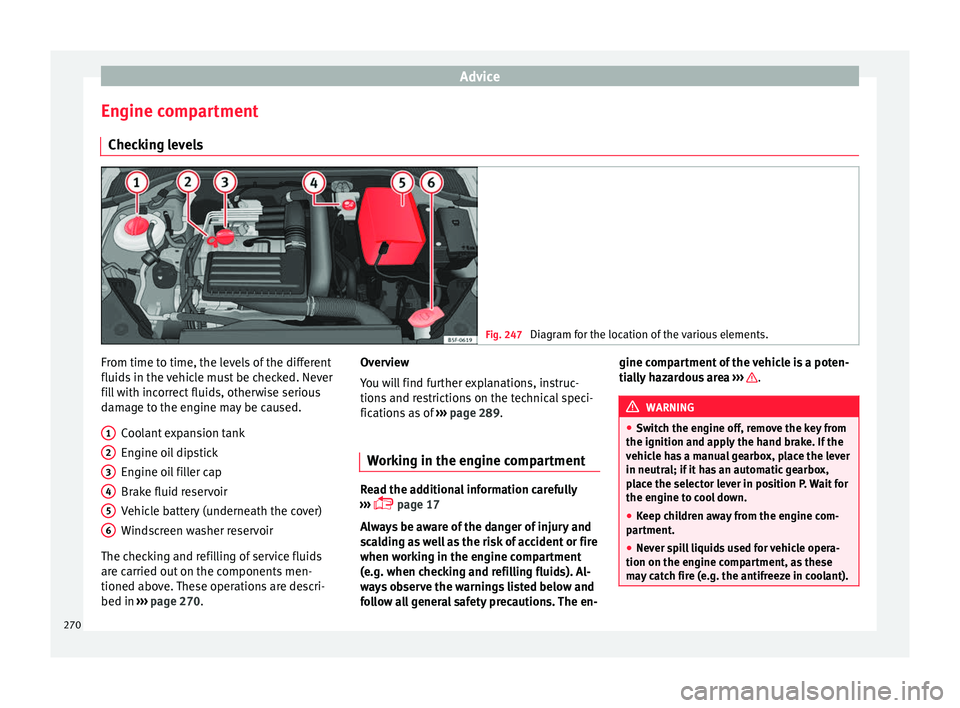
g levels Fig. 247
Diagram for the location of the various elements. From time to time, the levels of the different
fluid
s
in the
vehicle must be checked. Never
fill with incorrect fluids, otherwise serious
damage to the engine may be caused.
Coolant expansion tank
Engine oil dipstick
Engine oil filler cap
Brake fluid reservoir
Vehicle battery (underneath the cover)
Windscreen washer reservoir
The checking and refilling of service fluids
are carried out on the components men-
tioned above. These operations are descri-
bed in ››› page 270.
1 2
3
4
5
6 Overview
Y
ou w
i
ll find further explanations, instruc-
tions and restrictions on the technical speci-
fications as of ››› page 289.
Working in the engine compartment Read the additional information carefully
›› ›
page 17
Always be aware of the danger of injury and
scalding as well as the risk of accident or fire
when working in the engine compartment
(e.g. when checking and refilling fluids). Al-
ways observe the warnings listed below and
follow all general safety precautions. The en- gine compartment of the vehicle is a poten-
tia
l
ly hazardous area ››› .
WARNING
● Swit c
h the engine off, remove the key from
the ignition and apply the hand brake. If the
vehicle has a manual gearbox, place the lever
in neutral; if it has an automatic gearbox,
place the selector lever in position P. Wait for
the engine to cool down.
● Keep children away from the engine com-
partment
.
● Never spill liquids used for vehicle opera-
tion on the engine comp
artment, as these
may catch fire (e.g. the antifreeze in coolant). 270
Page 273 of 332
Checking and refilling levels
●
Tak e c
are not to cause short circuits in the
electrical system, especially when working
on the battery.
● If working inside the engine compartment,
remember that, ev
en when the ignition is
switched off, the radiator fan may start up au-
tomatically, and therefore there is a risk of in-
jury.
● Never cover the engine with additional in-
sul
ating materials such as a blanket. Risk of
fire!
● Do not unscrew the cap on the coolant ex-
pans
ion tank when the engine is hot. The
cooling system is under pressure.
● Protect face, hands and arms by covering
the cap with a l
arge, thick rag to protect
against escaping coolant and steam.
● If it is necessary to work in the engine com-
partment
while the engine is running, the ro-
tating components (for example, poly-V belt,
alternator, radiator fan) and the high voltage
ignition system are an additional hazard.
● Observe the following additional warnings
if work
on the fuel system or the electrical
system is necessary:
– Always disconnect the battery from the
on-board network.
– Do not smoke.
– Never work near naked flames.
– Always keep an approved fire extinguish-
er immediately available. CAUTION
When topping up fluids make sure the correct
fluid is p
ut into the correct filler opening, oth-
erwise this can cause serious malfunctions or
engine damage. For the sake of the environment
Inspect the ground underneath your vehicle
re gu
larly so that any leaks are detected at an
early stage. If you find spots of oil or other
fluids in the area where it was parked, have
your vehicle inspected at the workshop. Note
In right-hand drive vehicles* some brake flu-
id re ser
voirs are on the other side of the en-
gine compartment ››› Fig. 247. Opening the bonnet
Read the additional information carefully
› ›
›
page 17
The bonnet is released from inside the vehi-
cle.
Check that the windscreen wiper arms are
not unfolded. Otherwise the paint may be
damaged.
The bonnet can only be unlocked when the
driver door is open. WARNING
Never open the bonnet if you see steam or
drips of
coolant being released from the en-
gine compartment. Failure to comply could
result in burns. Wait until no steam or coolant
can be seen before opening the bonnet. Closing the bonnet
–
Slightly lift the bonnet.
– Release the bonnet stay before pressing it
bac k
into its support.
– Carefully close the bonnet.
– Press the bonnet down until it locks into
plac
e.
– Make sure that the bonnet catches onto its
cla
sp. Do not press down too hard ››› .
WARNING
● For s af
ety reasons the bonnet must always
be completely closed when the vehicle is
moving. Therefore, after closing the bonnet,
always check that the locking element is
properly engaged. This is the case if the bon-
net is flush with the adjacent body panels.
● Should you notice that the bonnet is not
safely
secured when the vehicle is moving,
stop the vehicle immediately and close the
bonnet. Failure to follow this instruction
could result in an accident. 271
Technical data
Advice
Operation
Emergencies
Safety
Page 274 of 332

Advice
Engine oil Gener a
l
notesThe engine comes with a special, multi-grade
oil
th
at can be used all year round.
Because the use of high-quality oil is essen-
tial for the correct operation of the engine
and its long useful life, when topping up or
changing oil, use only those oils that comply
with VW standards.
The specifications (VW standards) set out in
the following page should appear on the con-
tainer of the service oil; when the container
displays the specific standards for petrol and
diesel engines together, it means that the oil
can be used for both types of engines.
We recommend that the oil change indicated
in the Maintenance Programme, be per-
formed by a technical service or specialised
workshop.
The correct oil specifications for your engine
are listed in the ›››
page 60, Engine oil
specifications.
Service intervals
Service intervals can be flexible (LongLife
service) or fixed (dependent on time/dis-
tance travelled).
If the PR code that appears on the back of the
Maintenance Programme booklet is PR QI6, this means that your vehicle has the LongLife
serv
ic
e programmed. If it lists the codes QI1,
QI2, QI3, QI4 or QI7, the interval service is
dependent on time/distance travelled.
Flexible service intervals (LongLife service
intervals*)
Special oils and processes have been devel-
oped which, depending on the characteris-
tics and individual driving profiles, enable
the extension of the oil change service (Long-
Life service intervals).
Because this oil is essential for extending the
service intervals, it must only be used ob-
serving the following indications:
● Avoid mixing it with oil for fixed service in-
terv
als.
● Only in exceptional circumstances, if the
engine oil
level is too low ››› page 273 and
LongLife oil is not available, it is permitted to
top up (once) with oil for fixed service inter-
vals ›››
page 60 (up to a maximum of 0.5
litres).
Fixed service intervals*
If your vehicle does not have the “LongLife
service interval” or it has been disabled (by
request), you may use oils for fixed service
intervals, which also appear in
››› page 60, Engine oil specifications
. In
this case, your vehicle must be serviced after
a fixed interval of 1 year/15,000 km (10,000 miles)(whatever comes first)
›››
Booklet
Maintenance Programme.
● In exceptional circumstances, if the engine
oil l
evel is too low ››› page 273 and you can-
not obtain the oil specified for your vehicle,
you can add a small quantity of oil conform-
ing to the specification ACEA A2 or ACEA A3
(petrol engines) or ACEA B3 or ACEA B4 (die-
sel engines) (up to 0.5 l).
Vehicles with diesel particulate filter*
The Maintenance Programme states whether
your vehicle is fitted with a diesel particulate
filter.
Only VW 507 00 engine oil, with reduced ash
formation, may be used in diesel engines
equipped with particulate filter. Using other
types of oil will cause a higher soot concen-
tration and reduce the life of the DPF. There-
fore:
● Avoid mixing this oil with other engine oils.
● Only in exceptional circumstances, if the
engine oil
level is too low ››› page 273,
Checking engine oil level and you cannot ob-
tain the oil specified for your vehicle, you can
use a small quantity of oil (once) conforming
to the VW 506 00, VW 506 01, VW 505 00,
VW 505 01 or ACEA B3/ACEA B4 specification
(up to 0.5 l).
272
Page 275 of 332

Checking and refilling levels
Checking engine oil level Fig. 248
Engine oil dipstick. Read the additional information carefully
› ›
›
page 59
The engine oil dipstick indicates the level of
the oil.
Checking oil level
– Park the vehicle in a horizontal position.
– Briefly run the engine at idle speed until
the operating t
emperature is reached and
then stop.
– Wait for about two minutes.
– Pull out the dipstick. Wipe the dipstick with
a cle
an cloth and insert it again, pushing it
in as far as it will go.
– Then pull it out once more and check the oil
level
››› Fig. 248. Top up with engine oil if
necessary. Depending on how you drive and the condi-
tions in whic
h the vehicle is used, oil con-
sumption can be up to 0.5 l/1000 km. Oil
consumption is likely to be higher for the first
5,000 km. For this reason the engine oil level
must be checked at regular intervals, prefera-
bly when filling the tank and before a jour-
ney. WARNING
Any work carried out in the engine compart-
ment or on the en gine mu
st be carried out
cautiously.
● When working in the engine compartment,
alwa
ys observe the safety warnings
››› page 270. CAUTION
If the oil level is above area A , do not start
the engine. Thi
s could result in damage to the
engine and catalytic converter. Contact a
Technical Service. Topping up engine oil
Fig. 249
In the engine compartment: Engine
oi l
fi
ller cap. Read the additional information carefully
› ›
›
page 59
Before opening the bonnet, read and observe
the warnings ››› in Working in the engine
c omp
ar
tment on page 270.
The position of the oil filler opening is shown
in the corresponding engine compartment il-
lustration ››› page 270.
Engine oil specification ›››
page 60. WARNING
Oil is highly inflammable! Ensure that no oil
come s
into contact with hot engine compo-
nents when topping up. » 273
Technical data
Advice
Operation
Emergencies
Safety
Page 276 of 332

Advice
CAUTION
If the oil level is above area ››› Fig. 248 A , do
not s t
art the engine. This could result in dam-
age to the engine and catalytic converter.
Contact a specialised workshop. For the sake of the environment
The oil level must never be above area
›› ›
Fig. 248 A . Otherwise oil can be drawn in
through the c r
ankcase breather and escape
into the atmosphere via the exhaust system. Note
Before a long trip, we recommend finding an
engine oi l
that conforms to the correspond-
ing VW specifications and recommend keep-
ing it in the vehicle. This way, the correct en-
gine oil will always be available for a top-up if
needed. Changing engine oil
Read the additional information carefully
› ›
›
page 59.
The engine oil must be changed at the inter-
vals given in the service schedule.
We recommend that you have the engine oil
changed by a Technical Service.
The oil change intervals are shown in the
Maintenance Programme. WARNING
Only change the engine oil yourself if you
hav e the s
pecialist knowledge required!
● Before opening the bonnet, read and ob-
serve the w
arnings ››› page 270.
● Wait for the engine to cool down. Hot oil
may
cause burn injuries.
● Wear eye protection to avoid injuries, such
as ac
id burns, caused by splashes of oil.
● When removing the oil drain plug with your
finger
s, keep your arm horizontal to help pre-
vent oil from running down your arm.
● Wash your skin thoroughly if it comes into
contact
with engine oil.
● Engine oil is poisonous! Used oil must be
stor
ed in a safe place out of the reach of chil-
dren. CAUTION
No additives should be used with engine oil.
This c
ould result in engine damage. Any dam-
age caused by the use of such additives
would not be covered by the factory warranty. For the sake of the environment
● Bec au
se of disposal problems and the spe-
cial tools and specialist knowledge required,
we recommend that you have the engine oil
and filter changed by a Technical Service.
● Never pour oil down drains or into the
ground. ●
Use a s uit
able container when draining the
used oil. It must be large enough to hold all
the engine oil. Cooling system
Top pin
g up coolant Read the additional information carefully
›› ›
page 60
Top up coolant when the level is below the
MIN (minimum) mark.
Checking coolant level
– Park the vehicle in a horizontal position.
– Switch the ignition off.
– Read off the coolant level on coolant ex-
pan s
ion tank. When the engine is cold, the
coolant level should be between the marks.
When the engine is hot, it may be slightly
above the upper mark.
Topping up coolant
– Wait for the engine to cool down.
– Cover the coolant expansion tank cap with
a cloth and car
efully unscrew it to the left
››› .
– Top up the coolant only if there is still cool-
ant in the e xp
ansion tank, otherwise you
274
Page 277 of 332
Checking and refilling levels
could d amage the engine. If there is no
c oo
lant in the expansion tank, do not con-
tinue driving. You should obtain professio-
nal assistance ››› .
– If there is still some coolant in the expan-
sion t
ank, t
op up to the upper mark.
– Top up with coolant until the level becomes
stab
le.
– Screw the cap back on correctly.
Any lo
ss of coolant fluid normally indicates a
leak in the cooling system. Take the vehicle
straight to a specialised workshop to have
the cooling system examined. If there are no
leaks in the engine cooling system, a loss of
coolant can only occur if the coolant boils
and is forced out of the system as a result of
overheating. WARNING
● The coo lin
g system is under pressure. Do
not unscrew the cap on the coolant expan-
sion tank when the engine is hot: risk of
burns!
● The antifreeze and coolant fluid can be a
health h
azard. Therefore, the antifreeze
should be stored in the original container in a
safe place out of reach of children. Failure to
comply could result in poisoning.
● If working inside the engine compartment,
remember that, ev
en when the ignition is
switched off, the radiator fan may start up au- tomatically, and therefore there is a risk of in-
jury
. WARNING
If there is not enough anti-freeze in the cool-
ant sys
tem, the engine may fail leading to se-
rious damage.
● Please make sure that the percentage of
additiv
e is correct with respect to the lowest
expected ambient temperature in the zone in
which the vehicle is to be used.
● When the outside temperature is very low,
the cool
ant could freeze and the vehicle
would be immobilised. In this case, the heat-
ing would not work either and inadequately
dressed passengers could die of cold. CAUTION
Do not top up the expansion tank with cool-
ant fluid if it
is empty! Air could enter the
cooling system. In this case, stop driving.
Seek specialist assistance. Otherwise, there
is a risk of engine damage. CAUTION
The original additives should never be mixed
with c oo
lants which are not approved by
SEAT. Otherwise, you run the risk of causing
severe damage to the engine and the engine
cooling system.
● If the fluid in the expansion tank is not pur-
ple b
ut is, for example, brown, this indicates that the G13 additive has been mixed with an
ina
dequat
e coolant. The coolant must be
changed as soon as possible if this is the
case! This could result in serious faults and
engine damage. For the sake of the environment
Coolants and additives can contaminate the
en vir
onment. If any fluids are spilled, they
should be collected and correctly disposed
of, with respect to the environment. Brake fluid
Top up br
ak
e fluid Read the additional information carefully
› ›
›
page 61
Checking the brake fluid level
The brake fluid level must be between the
MIN and MAX markings.
However, if the brake fluid level goes down
noticeably in a short time, or drops below the
MIN mark, there may be a leak in the brake
system. Seek specialist assistance. A warn-
ing light on the instrument panel display
monitors the brake fluid level ››› page 119. »
275
Technical data
Advice
Operation
Emergencies
Safety
Page 319 of 332

Index
audible warning signal . . . . . . . . . . . . . . . . . . 119
c rui
se c
ontrol system (CCS) . . . . . . . . . . . . . . . 209
depress the brake . . . . . . . . . . . . . . . . . . . . . . . 210
diesel particulate filter . . . . . . . . . . . . . . . . . . . 203
electromechanical steering . . . . . . . . . . . . . . . 198
emission control . . . . . . . . . . . . . . . . . . . . . . . . 203
engine management . . . . . . . . . . . . . . . . . . . . 203
engine pre-heating/fault system . . . . . . . . . . . 203
ESC . . . . . . . . . . . . . . . . . . . . . . . . . . . . . . . . . . 188
gear change . . . . . . . . . . . . . . . . . . . . . . . . . . . 198
instrument panel . . . . . . . . . . . . . . . . . . . . . 47, 49
instrument panel display . . . . . . . . . . . . . . . . . . 48
Lane Assist . . . . . . . . . . . . . . . . . . . . . . . . . . . . 224
lights . . . . . . . . . . . . . . . . . . . . . . . . . . . . . . . . . 140
refuelling . . . . . . . . . . . . . . . . . . . . . . . . . . . . . . 264
seat belt . . . . . . . . . . . . . . . . . . . . . . . . . . . . . . . 80
Start-Stop . . . . . . . . . . . . . . . . . . . . . . . . . . . . . 206
tyre monitoring system . . . . . . . . . . . . . . . . . . 284
Controls and displays general instrument panel . . . . . . . . . . . . . . . . . 113
Controls for the windows . . . . . . . . . . . . . . . 18, 136
Controls on the steering wheel operating the audio, telephone and naviga-tion system . . . . . . . . . . . . . . . . . . . . . . . . . . 121
Convenience closing panoramic sliding sunroof . . . . . . . . . . . . . . . . 139
Convenience opening panoramic sliding sunroof . . . . . . . . . . . . . . . . 139
Coolant checking level . . . . . . . . . . . . . . . . . . . . . . . . . . 274
Cooling coolant temperature gauge . . . . . . . . . . . . . . . 117
Cooling system checking coolant . . . . . . . . . . . . . . . . . . . . . . . 274
topping up coolant . . . . . . . . . . . . . . . . . . . . . . 274
Cornering lights . . . . . . . . . . . . . . . . . . . . . . . . . . . . . . . . . 143 Correct position . . . . . . . . . . . . . . . . . . . . . . . . . . . 75
driver . . . . . . . . . . . . . . . . . . . . . . . . . . . . . . . . . . 75
fr
ont passenger . . . . . . . . . . . . . . . . . . . . . . . . . 76
Correct sitting position rear seat passengers . . . . . . . . . . . . . . . . . . . . . 77
Cruise control . . . . . . . . . . . . . . . . . . . . . . . . 45, 209 operation . . . . . . . . . . . . . . . . . . . . . . . . . . . . . . 210
Cruise control system . . . . . . . . . . . . . . . . . . . . . . 209 warning and indication lamp . . . . . . . . . . . . . . 209
D Dangers in not using the seat belt . . . . . . . . . . . . 82
Dash panel . . . . . . . . . . . . . . . . . . . . . . . . . . . . . . . 47
Data label . . . . . . . . . . . . . . . . . . . . . . . . . . . . . . . 289
Deactivating the front passenger front airbag . . . 23
Deactivation of front airbag . . . . . . . . . . . . . . . . . . 89
Defective bulbs changing a bulb . . . . . . . . . . . . . . . . . . . . . . . . 103
Detachable ball assembling . . . . . . . . . . . . . . . . . . . . . . . . . . . . 248
checking attachment . . . . . . . . . . . . . . . . . . . . 249
placing in standby position . . . . . . . . . . . . . . . 247
removing . . . . . . . . . . . . . . . . . . . . . . . . . 249, 250
standby position . . . . . . . . . . . . . . . . . . . . . . . . 247
Diesel diesel particulate filter . . . . . . . . . . . . . . . . . . . 203
engine oil . . . . . . . . . . . . . . . . . . . . . . . . . . . . . 272
preheating . . . . . . . . . . . . . . . . . . . . . . . . . . . . 178
refuelling . . . . . . . . . . . . . . . . . . . . . . . . . . . . . . 267
Diesel particulate filter . . . . . . . . . . . . . . . . . . . . 203 malfunction . . . . . . . . . . . . . . . . . . . . . . . . . . . . 203
Digital clock . . . . . . . . . . . . . . . . . . . . . . . . . . . . . 116
Dimensions . . . . . . . . . . . . . . . . . . . . . . . . . . . . . . 313
Direction of rotation tyres . . . . . . . . . . . . . . . . . . . . . . . . . . . . . . . . . . . 68
Display . . . . . . . . . . . . . . . . . . . . . . . . . . . . 114, 115 Display of traffic signs on the instrument panel
activate . . . . . . . . . . . . . . . . . . . . . . . . . . . . . . . 234
deactivate . . . . . . . . . . . . . . . . . . . . . . . . . . . . . 234
Disposal belt tensioners . . . . . . . . . . . . . . . . . . . . . . . . . . 84
Distance control see Adaptive cruise control . . . . . . . . . . . . . . . 214
Door cylinder . . . . . . . . . . . . . . . . . . . . . . . . . . . . . 15
Door handle . . . . . . . . . . . . . . . . . . . . . . . . . . . . . . 15
Door lock . . . . . . . . . . . . . . . . . . . . . . . . . . . . . . . . . 15
Door release lever . . . . . . . . . . . . . . . . . . . . . . . . 113
Doors childproof locks . . . . . . . . . . . . . . . . . . . . . . . . 133
opening and closing . . . . . . . . . . . . . . . . . . . . . 15
Downhill speed control . . . . . . . . . . . . . . . . . . . . 196
Downhill speed control function . . . . . . . . . . . . . 196
Drawer . . . . . . . . . . . . . . . . . . . . . . . . . . . . . . . . . . 157
Drink holders . . . . . . . . . . . . . . . . . . . . . . . . . . . . 158
Driver see Correct sitting position . . . . . . . . . 75, 76, 77
Driver-side general instrument panel left-hand drive . . . . . . . . . . . . . . . . . . . . . . . . . . . 9
right-hand drive . . . . . . . . . . . . . . . . . . . . . . . . . 10
Driver information system engine oil temperature display . . . . . . . . . . . . . 43
operation through the windscreen wiper lever . 36
Driving driving abroad . . . . . . . . . . . . . . . . . . . . . . . . . 146
economical . . . . . . . . . . . . . . . . . . . . . . . . . . . . 200
safe . . . . . . . . . . . . . . . . . . . . . . . . . . . . . . . . . . . 74
with a trailer . . . . . . . . . . . . . . . . . . 251, 253, 254
with trailer . . . . . . . . . . . . . . . . . . . . . . . . . . . . . 246
Driving abroad headlights . . . . . . . . . . . . . . . . . . . . . . . . . . . . . 146
Driving data data summary . . . . . . . . . . . . . . . . . . . . . . . . . . . 39
memories . . . . . . . . . . . . . . . . . . . . . . . . . . . . . . 38
317
Page 320 of 332

Index
Driving mode . . . . . . . . . . . . . . . . . . . . . . . . . . . . 231
Driv in
g pr
ofile . . . . . . . . . . . . . . . . . . . . . . . . . . . . 231
Driving through water . . . . . . . . . . . . . . . . . . . . . 204
DSG . . . . . . . . . . . . . . . . . . . . . . . . . . . . . . . . . . . . 191
Duplicate keys . . . . . . . . . . . . . . . . . . . . . . . . . . . 126
Dust and pollen filter . . . . . . . . . . . . . . . . . . . . . . 173
Dynamic lights range control . . . . . . . . . . . . . . . . 146
E E10 see Ethanol (fuel) . . . . . . . . . . . . . . . . . . . . . . . 266
Easy Connect . . . . . . . . . . . . . . . . . . . . . . . . 33, 120
Efficiency program additional consumers . . . . . . . . . . . . . . . . . . . . 43
saving tips . . . . . . . . . . . . . . . . . . . . . . . . . . . . . . 43
Electrical accessories see Power socket . . . . . . . . . . . . . . . . . . . . . . . 159
Electrical socket trailer . . . . . . . . . . . . . . . . . . . . . . . . . . . . . . . . . 252
Electric windows . . . . . . . . . . . . . . . . . . . . . . 18, 136 convenience opening and closing . . . . . . . . . 137
Electromechanical steering . . . . . . . . . . . . . . . . . 198 lamp . . . . . . . . . . . . . . . . . . . . . . . . . . . . . . . . . 198
Electronic differential lock control . . . . . . . . . . . 187
Electronic immobiliser . . . . . . . . . . . . . . . . . . . . . . 15
Electronic parking brake . . . . . . . . . . . . . . . . . . . 183
Electronic self-locking . . . . . . . . . . . . . . . . . . . . . 187
Electronic Stability Control (ESC) . . . . . . . . . . . . 187
Electronic torque management (XDS) . . . . . . . . . 187
Emergencies . . . . . . . . . . . . . . . . . . . . . . . . . . . . . . 95 anti-puncture kit . . . . . . . . . . . . . . . . . . . . . . . . . 95
automatic gearbox emergency program . . . . . 197
bulbs . . . . . . . . . . . . . . . . . . . . . . . . . . . . . . . . . . 64
changing a wheel . . . . . . . . . . . . . . . . . . . . . . . . 66
emergency towing of the vehicle . . . . . . . . . . . . 69
fuses . . . . . . . . . . . . . . . . . . . . . . . . . . . . . . . . . . 63
hazard warning lights . . . . . . . . . . . . . . . . . . . 145 jump leads . . . . . . . . . . . . . . . . . . . . . . . . . . . . . 70
manual u
nlocking and locking . . . . . . . . . . . . . 97
puncture . . . . . . . . . . . . . . . . . . . . . . . . . . . . . . . 64
replacing a blown fuse . . . . . . . . . . . . . . . . . . . . 63
replacing the battery . . . . . . . . . . . . . . . . . . . . 278
vehicle tool kit . . . . . . . . . . . . . . . . . . . . . . . . . . 95
Emergency Assist . . . . . . . . . . . . . . . . . . . . . . . . . 228 switching off . . . . . . . . . . . . . . . . . . . . . . . . . . . 229
switching on . . . . . . . . . . . . . . . . . . . . . . . . . . . 229
Emergency braking assistance system indications on the display . . . . . . . . . . . . . . . . 210
malfunction . . . . . . . . . . . . . . . . . . . . . . . . . . . . 212
operating . . . . . . . . . . . . . . . . . . . . . . . . . . . . . . 213
radar sensor . . . . . . . . . . . . . . . . . . . . . . . . . . . 212
switching off temporarily . . . . . . . . . . . . . . . . . 213
system limitations . . . . . . . . . . . . . . . . . . . . . . 214
Emergency braking function . . . . . . . . . . . . . . . . 184
Emergency braking warning . . . . . . . . . . . . . . . . 145
Emergency operation front passenger door . . . . . . . . . . . . . . . . . . . . . 16
selector lever . . . . . . . . . . . . . . . . . . . . . . . . . . . 50
Emission control system catalytic converter . . . . . . . . . . . . . . . . . . . . . . 203
control lamp . . . . . . . . . . . . . . . . . . . . . . . . . . . 203
diesel particulate filter . . . . . . . . . . . . . . . . . . . 203
Emissions data . . . . . . . . . . . . . . . . . . . . . . . . . . . 290
Engine assisted starting . . . . . . . . . . . . . . . . . . . . . . . . . 70
noises . . . . . . . . . . . . . . . . . . . . . . . . . . . . . . . . 182
preheating . . . . . . . . . . . . . . . . . . . . . . . . . . . . 178
running in . . . . . . . . . . . . . . . . . . . . . . . . . . . . . 199
Start-Stop system . . . . . . . . . . . . . . . . . . . . . . . 205
starting . . . . . . . . . . . . . . . . . . . . . . . . . . . . . . . 178
starting up (driver messages with the mechan- ical contact) . . . . . . . . . . . . . . . . . . . . . . . . . . 178
switching off (key) . . . . . . . . . . . . . . . . . . . . . . 179 Engine and ignition
automatic ignition switch-off . . . . . . . . . . . . . . 180
My Beat . . . . . . . . . . . . . . . . . . . . . . . . . . . . . . . 183
preheating the engine . . . . . . . . . . . . . . . . . . . 181
starting the engine . . . . . . . . . . . . . . . . . . . . . . 181
starting the engine with Press & Drive . . . . . . 181
stopping the engine . . . . . . . . . . . . . . . . . . . . . 182
Engine compartment . . . . . . . . . . . . . . . . . . 17, 270 battery . . . . . . . . . . . . . . . . . . . . . . . . . . . . 61, 277
brake fluid . . . . . . . . . . . . . . . . . . . . . . . . . 61, 275
closing the bonnet . . . . . . . . . . . . . . . . . . . . . . 271
coolant . . . . . . . . . . . . . . . . . . . . . . . . . . . 60, 274
engine oil . . . . . . . . . . . . . . . . . . . . . 59, 272, 273
opening the bonnet . . . . . . . . . . . . . . . . . . . . . 271
safety notes . . . . . . . . . . . . . . . . . . . . . . . . . . . 270
windscreen washer reservoir . . . . . . . . . . 61, 276
Engine coolant . . . . . . . . . . . . . . . . . . . . . . . . . . . . 60 G 12 plus-plus . . . . . . . . . . . . . . . . . . . . . . . . . . 60
G 13 . . . . . . . . . . . . . . . . . . . . . . . . . . . . . . . . . . . 60
specifications . . . . . . . . . . . . . . . . . . . . . . . . . . . 60
Engine data . . . . . . . . . . . . . . . . . . . . . . . . . . . . . . 292
Engine fault control lamp . . . . . . . . . . . . . . . . . . . . . . . . . . . 203
Engine management . . . . . . . . . . . . . . . . . . . . . . 202 control lamp . . . . . . . . . . . . . . . . . . . . . . . . . . . 203
Engine oil . . . . . . . . . . . . . . . . . . . . . . . . . . . 59, 272 changing . . . . . . . . . . . . . . . . . . . . . . . . . 272, 274
checking oil level . . . . . . . . . . . . . . . . . . . . . . . 273
consumption . . . . . . . . . . . . . . . . . . . . . . . . . . . 273
dipstick . . . . . . . . . . . . . . . . . . . . . . . . . . . . . . . 273
inspection service . . . . . . . . . . . . . . . . . . . . . . 272
maintenance intervals . . . . . . . . . . . . . . . . . . . 272
oil properties . . . . . . . . . . . . . . . . . . . . . . . . . . . 60
specifications . . . . . . . . . . . . . . . . . . . . . . 60, 272
temperature display . . . . . . . . . . . . . . . . . . . . . . 43
topping up . . . . . . . . . . . . . . . . . . . . . . . . . . . . 273
318