headlights Seat Leon 5D 2017 User Guide
[x] Cancel search | Manufacturer: SEAT, Model Year: 2017, Model line: Leon 5D, Model: Seat Leon 5D 2017Pages: 332, PDF Size: 7.25 MB
Page 147 of 332

Lights and visibility
Hazard warning lights Fig. 143
Dash panel: switch for hazard warn-
in g lights. Read the additional information carefully
› ›
›
page 31
The hazard warning lights are used to draw
the attention of other road users to your vehi-
cle in emergencies.
If your vehicle breaks down:
1. Park your vehicle at a safe distance from movin
g traffic.
2. Press the button to switch on the hazard warning lights
››› .
3. Switch the ignition off.
4. Apply the handbrake.
5. For a manual gearbox, engage 1st gear; for an aut
om
atic gearbox, move the gear
lever to P. 6. Use the warning triangle to draw the atten-
tion of other ro
ad users to your vehicle.
7. Always take the vehicle key with you when you le
ave the vehicle.
All turn signals flash simultaneously when
the hazard warning lights are switched on.
The two turn signal turn signal lamps
and the turn signal lamp in the switch will
flash at the same time. The simultaneous
hazard warning lights also work when the ig-
nition is switched off.
Emergency braking warning
If the vehicle brakes suddenly and continu-
ously at a speed of more than 80 km/h (50
mph), the brake light flashes several times
per second to warn the vehicles driving be-
hind. If you continue braking, the hazard
warning lights will come on automatically
when the vehicle comes to a standstill. They
switch off automatically when the vehicle
starts to move again. WARNING
● The risk of
an accident increases if your ve-
hicle breaks down. Always use the hazard
warning lights and a warning triangle to draw
the attention of other road users to your sta-
tionary vehicle.
● Due to the high temperatures that the cata-
lytic con
verter can reach, never park in an
area where the catalytic converter could come into contact with highly inflammable materi-
al
s, f
or example dry grass or spilt petrol. This
could start a fire. Note
● The b atter
y will run down if the hazard
warning lights are left on for a long time,
even if the ignition is switched off.
● The use of the hazard warning lights de-
scribed her
e is subject to the relevant statu-
tory requirements. Parking lights
When the parking light is switched on, (right
or l
ef
t
turn signal), the front side light and
the rear light on the corresponding side of
the vehicle stay lit. The parking lights can on-
ly be activated with the ignition switched off
and the turn signal and main beam lever in
the central position, before being triggered.
Parking light on both sides With the ignition switched off and the light
sw
it
c
h in position , when locking the vehi-
cle from the outside, the parking lights on
both sides of the vehicle light up. In doing
so, only the side lights of both headlights
light up, and additionally the tail lights will
do so partially.
145
Technical data
Advice
Operation
Emergencies
Safety
Page 148 of 332

Operation
Motorway light* The motorway light is available on vehicles
equipped w
ith f
ull-LED lights.
The function is connected/disconnected via
the corresponding Easy Connect system
menu.
● Activation: when going abo
ve 110 km/h
(68 mph) for more than 30 seconds, the dip-
ped beam raises slightly to increase the driv-
er's visibility distance.
● Deactivation: when reduc in
g the speed of
the car below 100 km/h (62 mph), the dip-
ped beam returns to its normal position.
Driving abroad The light beam of the dipped beam lights is
a
symmetric: the s
ide of
the road on which
you are driving is lit more intensely.
When a car that is manufactured in a country
that drives on the right travels to a country
that drives on the left (or vice versa), it is nor-
mally necessary to cover part of the headlight
bulbs with stickers or to change the adjust-
ment of the headlights to avoid dazzling oth-
er drivers.
In such cases, the regulations specify certain
light values that must be complied with for
designated points of the light distribution.
This is known as “Tourist light”. The light distribution that the halogen and
ful
l-LED headlights of the SEAT Leon range
have allows the specific “tourist light” values
to be met without the need for stickers or
changes in the settings. Note
“Tourist light” is only allowed temporarily. If
you ar e p
lanning a long stay in a country that
drives on the other side, you should take the
vehicle to an Authorised Technical Service to
change the headlights. Headlight range control
Fig. 144
Next to the steering wheel: Head-
light ran
ge control The lights range control adapts according to
the
v
alue of
the headlight beam and the ve-
hicle load status. This offers the driver opti-
mum visibility and the headlights do not daz-
zle oncoming drivers ››› .The headlights can only be adjusted when
the dip
ped be
am i
s switched on.
To reset, turn switch ››› Fig. 144:
ValueVehicle load status a)
Two front occupants, luggage compart-
ment empty
All seats occupied, luggage compartment
empty
All seats occupied, luggage compartment
full. With trailer and minimum drawbar
load.
Driver only, luggage compartment full With
trailer and maximum drawbar load.
a)
If the vehicle load does not correspond to those shown in the
table, it is possible to select intermediary positions.
OR:
Using the Easy Connect system, by means of
the button and the function button SET-
TINGS > Lights > Headlight height
adjustment
› ›
›
page 33).
Setting 0Two front occupants, luggage compart-
ment empty
Setting 1All seats occupied, luggage compart-
ment empty
Setting 2All seats occupied, luggage compart-
ment full. With trailer and minimum
drawbar load.146
Page 151 of 332

Lights and visibility
●
In icy c ondition
s, always check that the
wiper blades are not frozen to the glass be-
fore using the wipers. In cold weather, it may
help to leave the vehicle parked with the wip-
ers in service position ›››
page 72. Note
● The w inds
creen and window wipers only
function when the ignition is switched on and
the bonnet or rear lid, respectively, are
closed.
● The interval wipe speed varies according to
the vehic
le speed. The faster the vehicle is
moving, the more often the windscreen is
cleaned.
● The rear wiper is automatically switched on
when the winds
creen wiper is on and the car
is in reverse gear. Windscreen wiper functions
Windscreen wiper performance in different sit-
uations
If the vehicle is at a
standstillThe activated position provision-
ally changes to the previous posi-
tion.
During automatic
wipe
The air conditioner comes on for
approximately 30 seconds in air
recirculation mode to prevent the
smell of the windscreen washer
fluid entering the inside the vehi-
cle.
Windscreen wiper performance in different sit-
uations
For the interval wipe
Intervals between wipes depend
on the vehicle's speed. The high-
er the vehicle speed the shorter
the intervals. Heated windscreen washer jets
The heatin
g on
ly thaws the frozen jets, it
does not thaw the water in the washer hoses.
When the ignition is switched on the heated
windscreen washer jets automatically adjust
the heat depending on the ambient tempera-
ture.
Headlight wash/wipe system
The headlight washers/wipers clean the
headlight lenses.
After the ignition is switched on, the first and
every fifth time the windscreen washer is
switched on, the headlights are also washed.
Therefore, the windscreen wiper lever should
be pulled towards the steering wheel when
the dipped beam or main beam are on. Any
incrusted dirt (such as insects) should be
cleaned regularly (e.g. when refuelling).
To ensure the headlight washers work cor-
rectly in winter, any snow which has got into
the bumper jet supports should be cleaned
away. If necessary, remove snow with an anti-
icing spray. Note
The wiper will try to wipe away any obstacles
that ar
e on the windscreen. The wiper will
stop moving if the obstacle blocks its path.
Remove the obstacle and switch the wiper
back on again. 149
Technical data
Advice
Operation
Emergencies
Safety
Page 214 of 332

Operation
●
The Front As
sist does not react to animals
or vehicles crossing your path or approaching
head-on down the same lane.
● The Front Assist does not react to pedes-
trians
walking in the same direction or ap-
proaching head-on down the same lane.
● The driver must always be ready to take
over the c
ontrol of the vehicle.
● When the Front Assist causes a braking,
the brake ped
al is “harder”.
● Automatic interventions by the Front Assist
on the brake
s may be interrupted by pressing
the clutch, accelerator or moving the wheel. Note
● When the Front As
sist is connected, the in-
dications on the instrument panel screen may
be concealed by warnings from other func-
tions, such as an incoming call.
● When the Front Assist causes a braking,
the brake ped
al is “harder”.
● Automatic interventions by the Front Assist
on the brake
s may be interrupted by pressing
the clutch, accelerator or moving the wheel.
● The Front Assist may brake the vehicle until
it st
ops completely. However, the brake sys-
tem does not halt the vehicle permanently.
Use the foot brake!
● If the Front Assist does not work as descri-
bed in this c
hapter (e.g. in intervenes several
times unnecessarily), switch it off. Have the
system checked by a specialised workshop.
SEAT recommends visiting a SEAT dealership. Radar sensor
Fig. 205
On the front bumper: radar sensor. A radar sensor is installed on the front bump-
er t
o det
ermine the tr
affic situation
››› Fig. 205 1 .
The r a
d
ar sensor's visibility may be impaired
by dirt, mud or snow, or by environmental in-
fluences such as rain or mist. In this case, the
Front Assist does not work. The instrument
panel displays the following message:
Front Assist: No sensor vision! If
necessary clean the radar sensor ››› .
When the r a
d
ar sensor begins to operate
properly again, the Front Assist will automati-
cally be available again. The message will
disappear from the instrument panel display.
Front Assist operation may be affected by a
strong radar reverse reflection. This may oc-
cur, for example, in a closed car park or due to the presence of metallic objects (e.g. rails
on the roa
d or sheets used in road works).
The area in front of and around the radar sen-
sor should not be covered with adhesives,
additional or similar headlights, as this may
negatively affect Front Assist operation.
If the front of the vehicle is not properly re-
paired or structural modifications are made
to it, for example if the suspension is low-
ered, Front Assist operation may be affected.
SEAT recommends visiting a SEAT dealership
for this purpose. CAUTION
If you have the sensation that the radar sen-
sor is d
amaged or has lost its settings, dis-
connect the Front Assist. This will avoid pos-
sible dangerous situations caused by a sys-
tem malfunction. If this occurs have it adjus-
ted.
● The sensor may become damaged or lose
its settin
gs when knocked, for example, dur-
ing a parking manoeuvre. This may compro-
mise the system's efficacy or disconnect it.
● Repairs to the radar sensor require special-
ist
knowledge and special tools. SEAT recom-
mends visiting a SEAT dealership for this pur-
pose.
● A registration plate or plate holder on the
front th
at is larger than the space for the reg-
istration plate, or a registration plate that is
curved or warped can cause the radar to mal-
function. 212
Page 219 of 332
Driver assistance systems
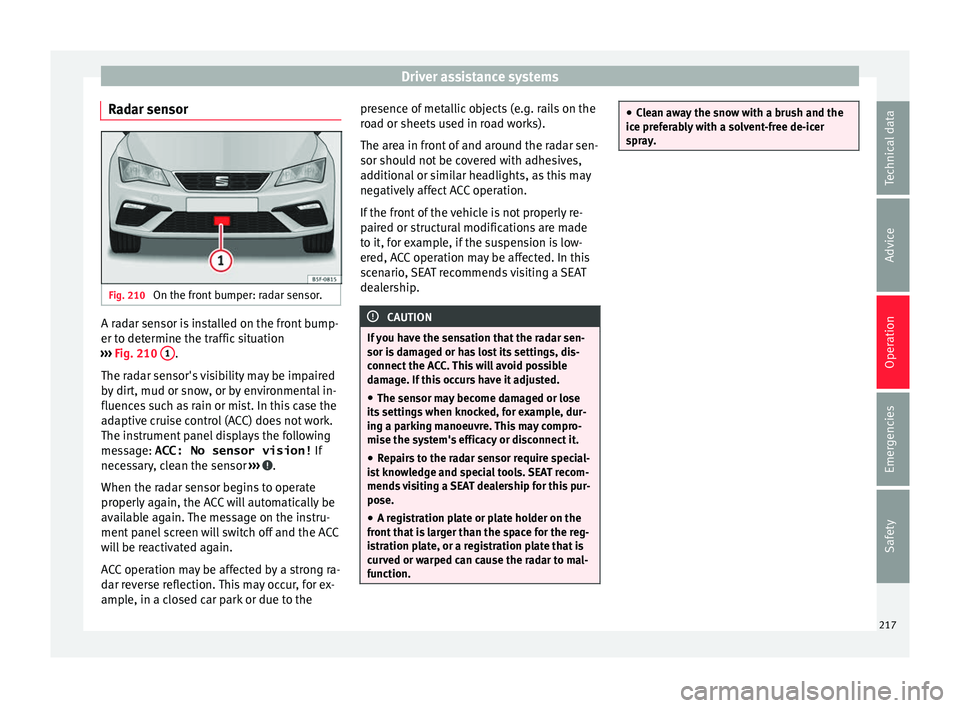
Radar sensor Fig. 210
On the front bumper: radar sensor. A radar sensor is installed on the front bump-
er t
o det
ermine the tr
affic situation
››› Fig. 210 1 .
The r a
d
ar sensor's visibility may be impaired
by dirt, mud or snow, or by environmental in-
fluences such as rain or mist. In this case the
adaptive cruise control (ACC) does not work.
The instrument panel displays the following
message: ACC: No sensor vision! If
necessary, clean the sensor ››› .
When the r a
d
ar sensor begins to operate
properly again, the ACC will automatically be
available again. The message on the instru-
ment panel screen will switch off and the ACC
will be reactivated again.
ACC operation may be affected by a strong ra-
dar reverse reflection. This may occur, for ex-
ample, in a closed car park or due to the presence of metallic objects (e.g. rails on the
roa
d or sheets used in road works).
The area in front of and around the radar sen-
sor should not be covered with adhesives,
additional or similar headlights, as this may
negatively affect ACC operation.
If the front of the vehicle is not properly re-
paired or structural modifications are made
to it, for example, if the suspension is low-
ered, ACC operation may be affected. In this
scenario, SEAT recommends visiting a SEAT
dealership. CAUTION
If you have the sensation that the radar sen-
sor is d
amaged or has lost its settings, dis-
connect the ACC. This will avoid possible
damage. If this occurs have it adjusted.
● The sensor may become damaged or lose
its settin
gs when knocked, for example, dur-
ing a parking manoeuvre. This may compro-
mise the system's efficacy or disconnect it.
● Repairs to the radar sensor require special-
ist
knowledge and special tools. SEAT recom-
mends visiting a SEAT dealership for this pur-
pose.
● A registration plate or plate holder on the
front th
at is larger than the space for the reg-
istration plate, or a registration plate that is
curved or warped can cause the radar to mal-
function. ●
Cle
an away the snow with a brush and the
ice preferably with a solvent-free de-icer
spray. 217
Technical data
Advice
Operation
Emergencies
Safety
Page 255 of 332

Towing bracket device
WARNING
The towing bracket ball coupling must be
st or
ed securely in the luggage compartment
to prevent them being flung through the vehi-
cle and causing injury. Note
● By l
aw, the ball coupling must be removed
if a trailer is not being towed if it obscures
the number plate. Driving with a trailer
Fig. 244
Turn the 13-pin connector. Before driving
●
Grip the 13-pin connector at area A and
r emo
v
e it in the direction of the arrow
››› Fig. 244.
● Remove the protective cover 5
› ››
Fig. 232
up w
ards.
After driving
● Grip the 13-pin connector at area A and
in ser
t
it in the opposite direction to the arrow
››› Fig. 244.
● Fit the protective cover 5
› ›
› Fig. 232
on
the ball coupling.
Safety lug
The safety lug B
› ›
› Fig. 244
is used to hook
up the trailer's retainer cable.
On hooking it up to the safety lug, the retain-
er cable should have slack in all the trailer
positions with respect to the vehicle (sharp
bends, reverse gear, etc.).
Headlights
The front part of the vehicle may be raised
when the trailer is connected and the light
may dazzle the rest of the traffic.
Adapt the height of the headlights using the
headlight range rotary adjuster 1)
. WARNING
● Never u se the s
afety lug to tow!
● Adjust your speed to suit the road and traf-
fic condition
s.
● All work on the electrical system must be
carried out on
ly by specialised workshops.
● Never connect the trailer's electric system
to the electric
al connections of the rear lights
or any other power sources.
● After hooking up the trailer and connecting
the socket, c
heck that all the trailer's rear
lights are working properly. Note
● If ther e i
s any fault in the trailer's lighting,
check the fuses in the instrument panel fuse
box ›››
page 63.
● The contact between the retainer cable and
the safety
lug may give rise to mechanical
wear in the lug's surface protection. This
wear will not prevent the safety lug from op-
erating properly or cause any fault and is ex-
cluded from the warranty.
● When connecting and disconnecting the
trail
er, the towing vehicle's handbrake
should be applied.
● When the tow hitch ball has not been fitted,
the socket
should remain concealed in its
housing on the bumper. 1)
This does not apply for vehicles with bi-xenon
hea dlights.
253
Technical data
Advice
Operation
Emergencies
Safety
Page 279 of 332

Checking and refilling levels
CAUTION
● Do not mi x
cleaning products recommen-
ded by SEAT with other products. This could
lead to flocculation and may block the wind-
screen washer jets.
● When topping up service fluids, make abso-
lutely c
ertain that you fill the fluids into the
correct reservoirs. Using the wrong fluids
could cause serious malfunctions and engine
damage!
● Not having windscreen wiper fluid reduces
vis
ibility through the windscreen, and leads
to loss of visibility in headlights in models
with headlight washer. Battery
Gener a
l
informationRead the additional information carefully
› ›
›
page 61.
The battery is located in the engine compart-
ment and is almost maintenance-free. It is
checked as part of the Inspection Service.
Nevertheless, check the terminals are clean
and have the correct tightening torque, espe-
cially in summer and winter.
Disconnecting the battery
The battery should only be disconnected in
exceptional cases. When the battery is dis- connected, some of the vehicle's functions
are “los
t” (››› table on page 277). These
functions will require resetting after the bat-
tery is reconnected.
Deactivate the anti-theft alarm* before you
disconnect the battery Otherwise the alarm
will be triggered.
FunctionReprogramming
One-touch function of
the electric windows››› page 138, One-touch
opening and closing*.
Remote control key
If the vehicle does not re-
spond to the key, they
should be synchronised
››› page 132.
Digital clock››› page 116.
ESC warning lampAfter driving for a few me-
tres, the warning lamp goes
out again. If the vehicle is not used for long periods
The
v
ehic
le has a system for monitoring the
current consumption when the engine is left
unused for long periods of time ››› page 201.
Some functions, such as the interior lights, or
the remote door opening, may be temporarily
disabled to prevent the battery from running
flat. These functions will come back on as
soon as the ignition is switched on and the
engine started. Winter conditions
During the w
inter, the starting power may be
reduced, and if necessary, the battery should
be charged ››› in Important safety warn-
in g
s
for handling a vehicle battery on
page 278
Important safety warnings for han-
dling a v
ehicle battery All work on batteries requires specialist
kno
wl
edg
e. Please refer to a SEAT Official
Service or a workshop specialising in batter-
ies: risk of burns or exploding battery!
The battery must not be opened. Never try to
change the fluid level of the battery. Other-
wise explosive gas is released from the bat-
tery that could cause an explosion.
Wear eye protection.
Battery acid is very corrosive and caustic. Wear
protective gloves and eye protection. In the event
of electrolyte splashes, rinse off with plenty of
water.
Fires, sparks, open flames and smoking are pro-
hibited.
The battery should only be charged in a well-ven-
tilated zone. Risk of explosion!
Keep children away from acid and batteries!»
277
Technical data
Advice
Operation
Emergencies
Safety
Page 319 of 332

Index
audible warning signal . . . . . . . . . . . . . . . . . . 119
c rui
se c
ontrol system (CCS) . . . . . . . . . . . . . . . 209
depress the brake . . . . . . . . . . . . . . . . . . . . . . . 210
diesel particulate filter . . . . . . . . . . . . . . . . . . . 203
electromechanical steering . . . . . . . . . . . . . . . 198
emission control . . . . . . . . . . . . . . . . . . . . . . . . 203
engine management . . . . . . . . . . . . . . . . . . . . 203
engine pre-heating/fault system . . . . . . . . . . . 203
ESC . . . . . . . . . . . . . . . . . . . . . . . . . . . . . . . . . . 188
gear change . . . . . . . . . . . . . . . . . . . . . . . . . . . 198
instrument panel . . . . . . . . . . . . . . . . . . . . . 47, 49
instrument panel display . . . . . . . . . . . . . . . . . . 48
Lane Assist . . . . . . . . . . . . . . . . . . . . . . . . . . . . 224
lights . . . . . . . . . . . . . . . . . . . . . . . . . . . . . . . . . 140
refuelling . . . . . . . . . . . . . . . . . . . . . . . . . . . . . . 264
seat belt . . . . . . . . . . . . . . . . . . . . . . . . . . . . . . . 80
Start-Stop . . . . . . . . . . . . . . . . . . . . . . . . . . . . . 206
tyre monitoring system . . . . . . . . . . . . . . . . . . 284
Controls and displays general instrument panel . . . . . . . . . . . . . . . . . 113
Controls for the windows . . . . . . . . . . . . . . . 18, 136
Controls on the steering wheel operating the audio, telephone and naviga-tion system . . . . . . . . . . . . . . . . . . . . . . . . . . 121
Convenience closing panoramic sliding sunroof . . . . . . . . . . . . . . . . 139
Convenience opening panoramic sliding sunroof . . . . . . . . . . . . . . . . 139
Coolant checking level . . . . . . . . . . . . . . . . . . . . . . . . . . 274
Cooling coolant temperature gauge . . . . . . . . . . . . . . . 117
Cooling system checking coolant . . . . . . . . . . . . . . . . . . . . . . . 274
topping up coolant . . . . . . . . . . . . . . . . . . . . . . 274
Cornering lights . . . . . . . . . . . . . . . . . . . . . . . . . . . . . . . . . 143 Correct position . . . . . . . . . . . . . . . . . . . . . . . . . . . 75
driver . . . . . . . . . . . . . . . . . . . . . . . . . . . . . . . . . . 75
fr
ont passenger . . . . . . . . . . . . . . . . . . . . . . . . . 76
Correct sitting position rear seat passengers . . . . . . . . . . . . . . . . . . . . . 77
Cruise control . . . . . . . . . . . . . . . . . . . . . . . . 45, 209 operation . . . . . . . . . . . . . . . . . . . . . . . . . . . . . . 210
Cruise control system . . . . . . . . . . . . . . . . . . . . . . 209 warning and indication lamp . . . . . . . . . . . . . . 209
D Dangers in not using the seat belt . . . . . . . . . . . . 82
Dash panel . . . . . . . . . . . . . . . . . . . . . . . . . . . . . . . 47
Data label . . . . . . . . . . . . . . . . . . . . . . . . . . . . . . . 289
Deactivating the front passenger front airbag . . . 23
Deactivation of front airbag . . . . . . . . . . . . . . . . . . 89
Defective bulbs changing a bulb . . . . . . . . . . . . . . . . . . . . . . . . 103
Detachable ball assembling . . . . . . . . . . . . . . . . . . . . . . . . . . . . 248
checking attachment . . . . . . . . . . . . . . . . . . . . 249
placing in standby position . . . . . . . . . . . . . . . 247
removing . . . . . . . . . . . . . . . . . . . . . . . . . 249, 250
standby position . . . . . . . . . . . . . . . . . . . . . . . . 247
Diesel diesel particulate filter . . . . . . . . . . . . . . . . . . . 203
engine oil . . . . . . . . . . . . . . . . . . . . . . . . . . . . . 272
preheating . . . . . . . . . . . . . . . . . . . . . . . . . . . . 178
refuelling . . . . . . . . . . . . . . . . . . . . . . . . . . . . . . 267
Diesel particulate filter . . . . . . . . . . . . . . . . . . . . 203 malfunction . . . . . . . . . . . . . . . . . . . . . . . . . . . . 203
Digital clock . . . . . . . . . . . . . . . . . . . . . . . . . . . . . 116
Dimensions . . . . . . . . . . . . . . . . . . . . . . . . . . . . . . 313
Direction of rotation tyres . . . . . . . . . . . . . . . . . . . . . . . . . . . . . . . . . . . 68
Display . . . . . . . . . . . . . . . . . . . . . . . . . . . . 114, 115 Display of traffic signs on the instrument panel
activate . . . . . . . . . . . . . . . . . . . . . . . . . . . . . . . 234
deactivate . . . . . . . . . . . . . . . . . . . . . . . . . . . . . 234
Disposal belt tensioners . . . . . . . . . . . . . . . . . . . . . . . . . . 84
Distance control see Adaptive cruise control . . . . . . . . . . . . . . . 214
Door cylinder . . . . . . . . . . . . . . . . . . . . . . . . . . . . . 15
Door handle . . . . . . . . . . . . . . . . . . . . . . . . . . . . . . 15
Door lock . . . . . . . . . . . . . . . . . . . . . . . . . . . . . . . . . 15
Door release lever . . . . . . . . . . . . . . . . . . . . . . . . 113
Doors childproof locks . . . . . . . . . . . . . . . . . . . . . . . . 133
opening and closing . . . . . . . . . . . . . . . . . . . . . 15
Downhill speed control . . . . . . . . . . . . . . . . . . . . 196
Downhill speed control function . . . . . . . . . . . . . 196
Drawer . . . . . . . . . . . . . . . . . . . . . . . . . . . . . . . . . . 157
Drink holders . . . . . . . . . . . . . . . . . . . . . . . . . . . . 158
Driver see Correct sitting position . . . . . . . . . 75, 76, 77
Driver-side general instrument panel left-hand drive . . . . . . . . . . . . . . . . . . . . . . . . . . . 9
right-hand drive . . . . . . . . . . . . . . . . . . . . . . . . . 10
Driver information system engine oil temperature display . . . . . . . . . . . . . 43
operation through the windscreen wiper lever . 36
Driving driving abroad . . . . . . . . . . . . . . . . . . . . . . . . . 146
economical . . . . . . . . . . . . . . . . . . . . . . . . . . . . 200
safe . . . . . . . . . . . . . . . . . . . . . . . . . . . . . . . . . . . 74
with a trailer . . . . . . . . . . . . . . . . . . 251, 253, 254
with trailer . . . . . . . . . . . . . . . . . . . . . . . . . . . . . 246
Driving abroad headlights . . . . . . . . . . . . . . . . . . . . . . . . . . . . . 146
Driving data data summary . . . . . . . . . . . . . . . . . . . . . . . . . . . 39
memories . . . . . . . . . . . . . . . . . . . . . . . . . . . . . . 38
317
Page 321 of 332

Index
Environment ec o
logic
al driving . . . . . . . . . . . . . . . . . . . . . . . 200
environmental compatibility . . . . . . . . . . . . . . 199
Environmental tips filling the tank . . . . . . . . . . . . . . . . . . . . . . . . . 265
refuelling . . . . . . . . . . . . . . . . . . . . . . . . . . . . . . 264
Equipment . . . . . . . . . . . . . . . . . . . . . . . . . 159, 256
ESC electronic stability control . . . . . . . . . . . . . . . . 187
Multi-collision Brake . . . . . . . . . . . . . . . . . . . . 188
Sport Mode . . . . . . . . . . . . . . . . . . . . . . . . . . . . 189
Ethanol (fuel) . . . . . . . . . . . . . . . . . . . . . . . . . . . . 266
Event Data Recorder . . . . . . . . . . . . . . . . . . . . . . . . 94
Exhaust pipe: cleaning . . . . . . . . . . . . . . . . . . . . 261
Extending the luggage compartment . . . . . . . . . . . . . . . . 155
Exterior lighting changing a bulb . . . . . . . . . . . . . . . . . . . . . . . . 103
Exterior mirrors adjusting . . . . . . . . . . . . . . . . . . . . . . . . . . . . . . . 21
Exterior rear-view mirrors adjusting the exterior rear-view mirrors . . . . . 151
exterior . . . . . . . . . . . . . . . . . . . . . . . . . . . . . . . 151
heated . . . . . . . . . . . . . . . . . . . . . . . . . . . . . . . . 151
Exterior view . . . . . . . . . . . . . . . . . . . . . . . . . . . . . 7, 8
External aerial . . . . . . . . . . . . . . . . . . . . . . . . . . . . 256
F Fastening rings . . . . . . . . . . . . . . . . . . . . . . . . . . . 167
Fatigue detection . . . . . . . . . . . . . . . . . . . . . . . . . 236
Filling the fuel tank . . . . . . . . . . . . . . . . . . . . . . . 264
Filling the tank . . . . . . . . . . . . . . . . . . . . . . . . . . . 264
Floor mats . . . . . . . . . . . . . . . . . . . . . . . . . . . . . . . . 79
Fluid level control . . . . . . . . . . . . . . . . . . . . . . . . . . 58
Fog light bulb . . . . . . . . . . . . . . . . . . . . . . . . . . . . 106
Folding table . . . . . . . . . . . . . . . . . . . . . . . . . . . . . 158 Four-wheel drive . . . . . . . . . . . . . . . . . . . . . . . . . . 204
snow c hains . . . . . . . . . . . . . . . . . . . . . . . . . . . 204
winter tyres . . . . . . . . . . . . . . . . . . . . . . . . . . . . 204
Front airbags . . . . . . . . . . . . . . . . . . . . . . . . . . 22, 87
Front armrest . . . . . . . . . . . . . . . . . . . . . . . . . . . . 155
Front Assist indications on the display . . . . . . . . . . . . . . . . 210
Front passenger front airbag control lamp . . . . . . . . . . . . . . . . . . . . . . . . . . . . 90
deactivation . . . . . . . . . . . . . . . . . . . . . . . . . . . . 23
Front seat manual adjustment . . . . . . . . . . . . . . . . . . . . . . 19
Fuel . . . . . . . . . . . . . . . . . . . . . . . . . . . . . . . . . . . . . 58 consumption . . . . . . . . . . . . . . . . . . . . . . . . . . . 290
diesel . . . . . . . . . . . . . . . . . . . . . . . . . . . . . . . . . 267
ethanol . . . . . . . . . . . . . . . . . . . . . . . . . . . . . . . 266
fuel gauge . . . . . . . . . . . . . . . . . . . . . . . . . . . . . 118
natural gas . . . . . . . . . . . . . . . . . . . . . . . . . . . . 268
petrol . . . . . . . . . . . . . . . . . . . . . . . . . . . . . . . . . 266
refuelling . . . . . . . . . . . . . . . . . . . . . . . . . . . . . . 266
saving . . . . . . . . . . . . . . . . . . . . . . . . . . . . . . . . 200
Fuel consumption engine cut-off due to inertia . . . . . . . . . . . . . . 200
why does fuel consumption increase? . . . . . . 203
Fuel tank cap opening and closing . . . . . . . . . . . . . . . . . . . . . 58
Full-LED Headlights . . . . . . . . . . . . . . . . . . . . . . . 103
Function Coming Home . . . . . . . . . . . . . . . . . . . . 143
Function Leaving Home . . . . . . . . . . . . . . . . . . . . 144
Fuses . . . . . . . . . . . . . . . . . . . . . . . . . . . . . . . 63, 101 fuse box . . . . . . . . . . . . . . . . . . . . . . . . . . . . . . . 102
identifying blown fuses . . . . . . . . . . . . . . . . . . . 63
identifying by colours . . . . . . . . . . . . . . . . . . . . . 63
preparation before replacing . . . . . . . . . . . . . . . 63
replacing . . . . . . . . . . . . . . . . . . . . . . . . . . . . . . . 63 G
Gear-c
hange indicator . . . . . . . . . . . . . . . . . . . . . . 42
Gearbox DSG see Automatic gearbox . . . . . . . . . . . . . . . . . . . 191
Gearbox lever . . . . . . . . . . . . . . . . . . . . . . . . . . . . . 50
Gear change . . . . . . . . . . . . . . . . . . . . . . . . . . . . . . 50 automatic . . . . . . . . . . . . . . . . . . . . . . . . . . . . . . 50
kick-down . . . . . . . . . . . . . . . . . . . . . . . . . . . . . 232
manual gearbox . . . . . . . . . . . . . . . . . . . . . . . . 190
manual gear change . . . . . . . . . . . . . . . . . . . . . . 50
Gear engaged . . . . . . . . . . . . . . . . . . . . . . . . . . . . . 50
Gear recommendation . . . . . . . . . . . . . . . . . . . . . . 42
Gear shift paddles (automatic gearbox) . . . . . . . 193
General instrument panel control lamps . . . . . . . . . . . . . . . . . . . . . . . . . . . 47
controls and displays . . . . . . . . . . . . . . . . . . . . 113
engine compartment . . . . . . . . . . . . . . . . . . . . 270
warning lamps . . . . . . . . . . . . . . . . . . . . . . . . . . 47
Glove compartment . . . . . . . . . . . . . . . . . . . . . . . 158
H Handbrake . . . . . . . . . . . . . . . . . . . . . . . . . . . . . . 184 warning lamp . . . . . . . . . . . . . . . . . . . . . . . . . . 185
see also Parking brake . . . . . . . . . . . . . . . . . . . 183
Hazard warning lights . . . . . . . . . . . . . . . . . 31, 145
Head-on collisions and their laws of physics . . . . 82
Head-protection airbags description . . . . . . . . . . . . . . . . . . . . . . . . . . . . . 24
safety instructions . . . . . . . . . . . . . . . . . . . . . . . 88
Headlights changing a bulb . . . . . . . . . . . . . . . . . . . . . . . . 103
driving abroad . . . . . . . . . . . . . . . . . . . . . . . . . 146
headlight washers . . . . . . . . . . . . . . . . . . . . . . 149
Head restraints . . . . . . . . . . . . . . . . . . . . . . . . . . . . 20 adjustment . . . . . . . . . . . . . . . . . . . . . . . . . . . . 153
front head restraints . . . . . . . . . . . . . . . . . . . . . . 78
rear head restraints . . . . . . . . . . . . . . . . . . . . . . 78 319