child restraint Seat Leon SC 2013 User Guide
[x] Cancel search | Manufacturer: SEAT, Model Year: 2013, Model line: Leon SC, Model: Seat Leon SC 2013Pages: 339, PDF Size: 4.8 MB
Page 51 of 339
49
Child safety
WARNING
● Never install a child seat facing backwards on the front passenger
seat unless the front passenger front airbag has been disabled. Risk of
potentially fatal injuries to the child! However, if it is necessary, in excep-
tional cases, to transport a child in the front passenger seat, the front
passenger front airbag must always be disabled ⇒ page 45. If the pas-
senger seat has a height adjustment option, move it to the highest, most
upright position. If you have a fixed seat, do not install any child restraint
system in this location.
● For those vehicles that do not include a key lock switch to deactivate
the airbag, the vehicle must be taken to a Technical Service.
● All vehicle occupants, especially children, must assume the proper
sitting position and be properly belted in while travelling.
● Never hold children or babies on your lap, this can result in potential-
ly fatal injuries to the child!
● Never allow a child to be transported in a vehicle without being prop-
erly secured, or to stand up or kneel on a seat while travelling. In an acci-
dent, the child could be flung through the vehicle, causing possibly fatal
injuries to themselves and to the other vehicle occupants.
● If children assume an improper sitting position when the vehicle is
moving, they expose themselves to greater risk of injury in the event of a
sudden braking manoeuvre or in an accident. This is particularly impor-
tant if the child is travelling on the front passenger seat and the airbag
system is triggered in an accident; as this could cause serious injury or
even death.
● A suitable child seat can protect your child!
● Never leave an unsupervised child alone on a child seat or in the vehi-
cle.
● Depending on weather conditions, it may become extremely hot or
cold inside the vehicle. This can be fatal.WARNING (Continued)
● Children who are less than 1.5 metres tall must not wear a normal
seat belt without a child seat, as this could cause injuries to the abdomi-
nal and neck areas during a sudden braking manoeuvre or in an accident.
● Do not allow the seat belt to become twisted or jammed, or to rub on
any sharp edges.
● Incorrectly worn seat belts can cause injuries even in a minor colli-
sion or in sudden braking manoeuvres.
● The seat belt provides maximum protection only when the seat belt is
properly positioned ⇒ page 26, Seat belts.
● Only one child may occupy a child seat ⇒ page 50, Child seats.
Safety FirstOperating instructionsPractical TipsTechnical specifications
Page 54 of 339
52Child safety
The child seats in groups 2 and 3 must be mounted in the direction of
movement and using the vehicle’s seatbelt.
Follow the manufacturer's instructions and observe any statutory require-
ments when installing and using child seats.
We recommend you to always include the manufacturer's Child Seat Instruc-
tion Manual together with the on-board documentation.
SEAT recommends the use of child seats from the Original Accessories cata-
logue. These child seats have been designed and tested for use in SEAT ve-
hicles. You can find the right child seat for your model and age group at
SEAT dealers.
Group 2 child seats
Children under 7 years of age weighing between 15 and 25 kg are best pro-
tected by group 2 child seats together with properly adjusted seat belts.
Group 3 child seats
Children over 7 years of age weighing between 22 and 36 kg but less than
1.5 metres tall are best protected by child seats with head restraints togeth-
er with properly worn seat belts ⇒ Fig. 32.
WARNING
● The shoulder part of the seat belt must lie approximately on the cen-
tre of the shoulder, never across the neck or the arm. The seat belt must
lie close to the upper part of the body. The lap belt part must lie across
the pelvis, not across the stomach, and always fit closely. Pull the belt
tight if necessary to take up any slack ⇒ page 26, Seat belts.
● Read and always observe information and warnings concerning the
use of child seats ⇒ page 48.
Page 55 of 339
53
Child safety
Securing child seats
Ways to secure a child seat
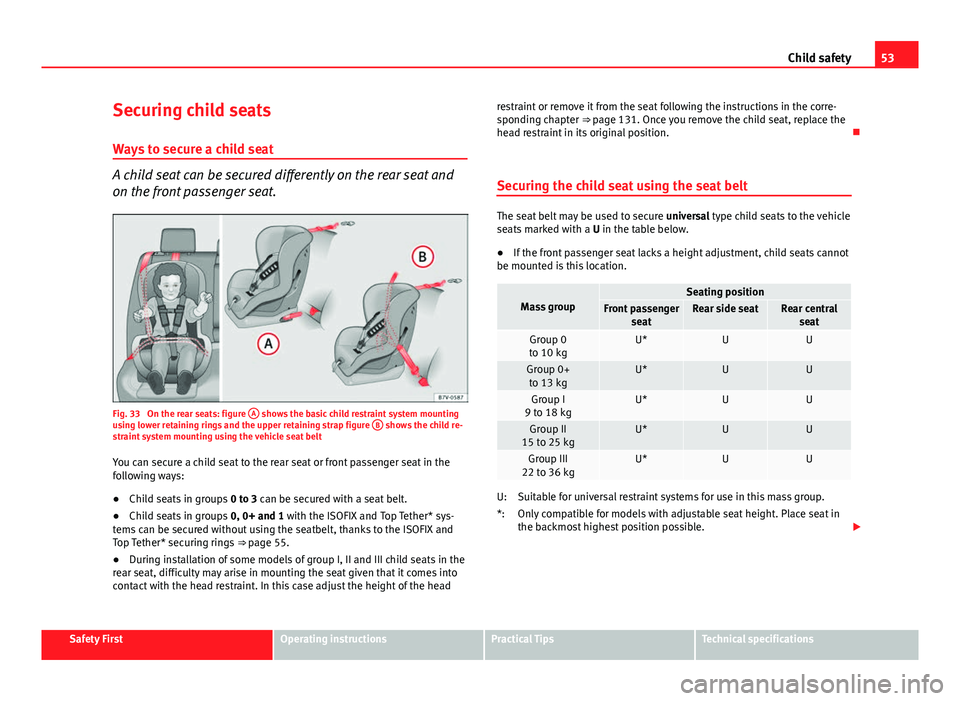
A child seat can be secured differently on the rear seat and
on the front passenger seat.
Fig. 33 On the rear seats: figure A shows the basic child restraint system mounting
using lower retaining rings and the upper retaining strap figure B shows the child re-
straint system mounting using the vehicle seat belt
You can secure a child seat to the rear seat or front passenger seat in the
following ways:
● Child seats in groups 0 to 3 can be secured with a seat belt.
● Child seats in groups 0, 0+ and 1 with the ISOFIX and Top Tether* sys-
tems can be secured without using the seatbelt, thanks to the ISOFIX and
Top Tether* securing rings ⇒ page 55.
● During installation of some models of group I, II and III child seats in the
rear seat, difficulty may arise in mounting the seat given that it comes into
contact with the head restraint. In this case adjust the height of the head restraint or remove it from the seat following the instructions in the corre-
sponding chapter ⇒
page 131. Once you remove the child seat, replace the
head restraint in its original position.
Securing the child seat using the seat belt
The seat belt may be used to secure universal type child seats to the vehicle
seats marked with a U in the table below.
● If the front passenger seat lacks a height adjustment, child seats cannot
be mounted is this location.
Mass groupSeating positionFront passenger seatRear side seatRear centralseat
Group 0
to 10 kgU*UU
Group 0+ to 13 kgU*UU
Group I
9 to 18 kgU*UU
Group II
15 to 25 kgU*UU
Group III
22 to 36 kgU*UU
Suitable for universal restraint systems for use in this mass group.
Only compatible for models with adjustable seat height. Place seat in
the backmost highest position possible.
U:
*:
Safety FirstOperating instructionsPractical TipsTechnical specifications
Page 57 of 339
55
Child safety
Child seats fastened with the “ISOFIX” and Top Tether* system
Child seats with the “ISOFIX” and Toptether* system can be secured quickly, easily and safely on the rear outer seats. Two “ISOFIX” retaining rings are fitted on each rear seat. In some vehicles,
the rings are secured to the seat frame and, in others, they are secured to
the rear floor. The access to the ISOFIX rings is between the rear seat back-
rest and the seat cushioning. The Top Tether* anchors are located at the
rear of the backrests of the rear seats (behind the seat backrest or in the
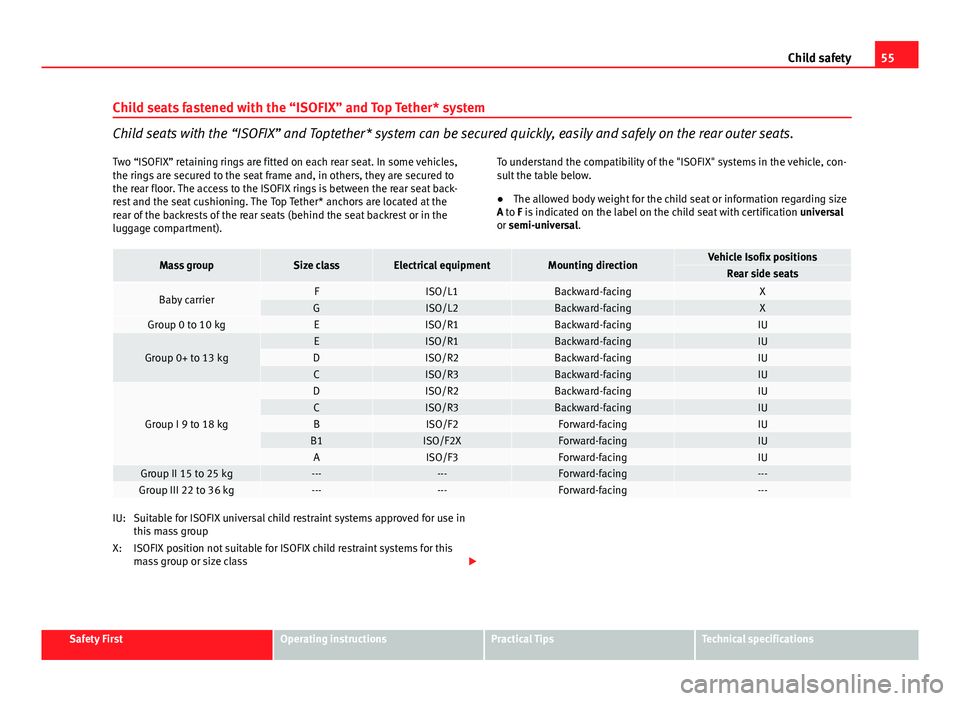
luggage compartment). To understand the compatibility of the "ISOFIX" systems in the vehicle, con-
sult the table below.
●
The allowed body weight for the child seat or information regarding size
A to F is indicated on the label on the child seat with certification universal
or semi-universal.
Mass groupSize classElectrical equipmentMounting directionVehicle Isofix positionsRear side seats
Baby carrierFISO/L1Backward-facingXGISO/L2Backward-facingXGroup 0 to 10 kgEISO/R1Backward-facingIU
Group 0+ to 13 kgEISO/R1Backward-facingIUDISO/R2Backward-facingIUCISO/R3Backward-facingIU
Group I 9 to 18 kg
DISO/R2Backward-facingIUCISO/R3Backward-facingIUBISO/F2Forward-facingIUB1ISO/F2XForward-facingIUAISO/F3Forward-facingIUGroup II 15 to 25 kg------Forward-facing---Group III 22 to 36 kg------Forward-facing---
Suitable for ISOFIX universal child restraint systems approved for use in
this mass group
ISOFIX position not suitable for ISOFIX child restraint systems for this
mass group or size class
IU:
X:
Safety FirstOperating instructionsPractical TipsTechnical specifications
Page 58 of 339
56Child safety
WARNING
● The securing rings are designed only for use with ISOFIX and Top
Tether* child seats.
● Never secure child seats that do not have the ISOFIX and Top Tether*
system, retaining belts or other objects to the securing rings – this could
result in potentially fatal injuries to the child!
● Ensure that the child seat is secured correctly using the “ISOFIX” and
Top Tether* securing rings.
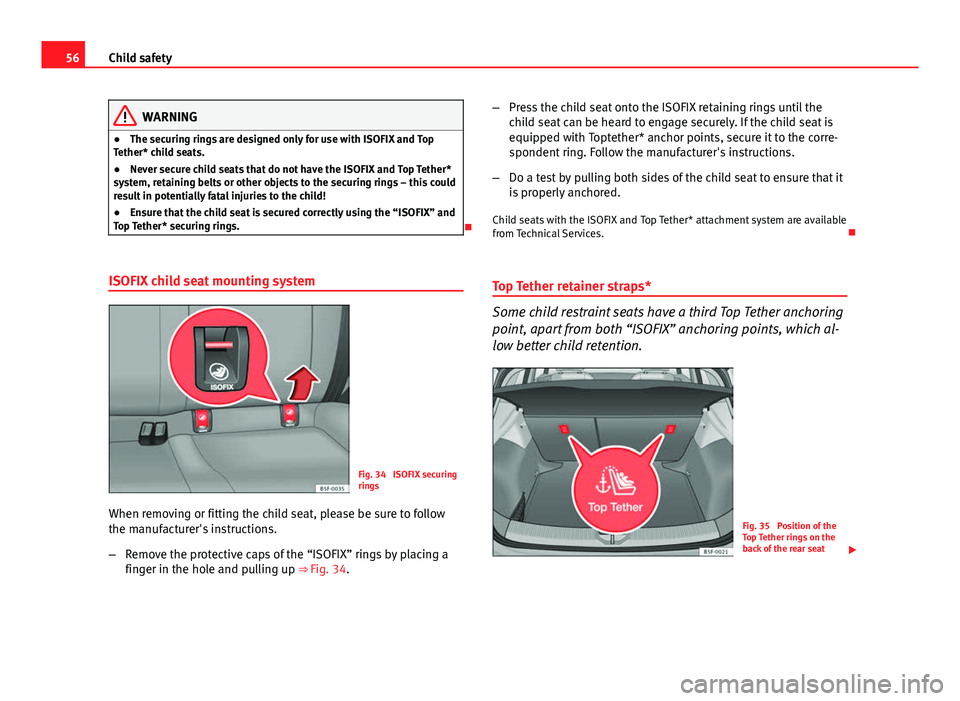
ISOFIX child seat mounting system
Fig. 34 ISOFIX securing
rings
When removing or fitting the child seat, please be sure to follow
the manufacturer's instructions.
– Remove the protective caps of the “ISOFIX” rings by placing a
finger in the hole and pulling up ⇒
Fig. 34. –
Press the child seat onto the ISOFIX retaining rings until the
child seat can be heard to engage securely. If the child seat is
equipped with Toptether* anchor points, secure it to the corre-
spondent ring. Follow the manufacturer's instructions.
– Do a test by pulling both sides of the child seat to ensure that it
is properly anchored.
Child seats with the ISOFIX and Top Tether* attachment system are available
from Technical Services.
Top Tether retainer straps*
Some child restraint seats have a third Top Tether anchoring
point, apart from both “ISOFIX” anchoring points, which al-
low better child retention.
Fig. 35 Position of the
Top Tether rings on the
back of the rear seat
Page 59 of 339
57
Child safety
Child seats with the Top Tether system come with a strap for securing the
seat to the vehicle anchor point, located at the back of the rear seat back-
rest.
The objective of the retainer strap is to reduce forward movements of the
child seat in a crash, helping reduce the risk of injuries to the head from hit-
ting the inside of the vehicle.
Using the Top Tether in rear-facing mounted seats
Currently, there are very few rear-facing child safety seats that have Top
Tether. Please carefully read and follow the seat manufacturer instructions
to learn the proper way to install the Top Tether strap.
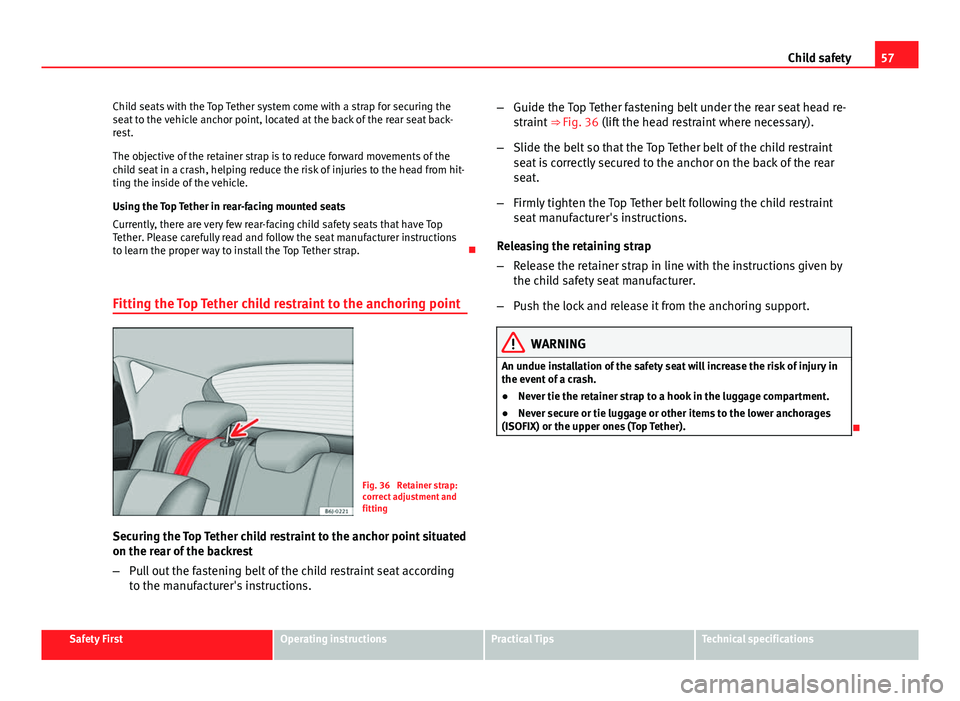
Fitting the Top Tether child restraint to the anchoring point
Fig. 36 Retainer strap:
correct adjustment and
fitting
Securing the Top Tether child restraint to the anchor point situated
on the rear of the backrest
– Pull out the fastening belt of the child restraint seat according
to the manufacturer's instructions. –
Guide the Top Tether fastening belt under the rear seat head re-
straint ⇒ Fig. 36 (lift the head restraint where necessary).
– Slide the belt so that the Top Tether belt of the child restraint
seat is correctly secured to the anchor on the back of the rear
seat.
– Firmly tighten the Top Tether belt following the child restraint
seat manufacturer's instructions.
Releasing the retaining strap
– Release the retainer strap in line with the instructions given by
the child safety seat manufacturer.
– Push the lock and release it from the anchoring support.
WARNING
An undue installation of the safety seat will increase the risk of injury in
the event of a crash.
● Never tie the retainer strap to a hook in the luggage compartment.
● Never secure or tie luggage or other items to the lower anchorages
(ISOFIX) or the upper ones (Top Tether).
Safety FirstOperating instructionsPractical TipsTechnical specifications
Page 133 of 339
131
Seats and storage
● The seat cushion is wet or damp.
● The indoor or outdoor temperature is greater than 25 °C (77 °F).
effectUsing seat heatingTo switch sys-
tem on:Press the button or . Seat heating is switched on fully.
Adjusting the
heating out-
put:Press the button or repeatedly until the desired inten-
sity level is reached.
To switch sys-
tem off:Press the button or until all warning lamps switch off.
WARNING
People who, because of medications, paralysis or chronic diseases (e.g.
diabetes) cannot perceive pain or temperature, or have a limited percep-
tion thereof, may suffer burns to the back, buttocks or legs when using
seat heating, an occurrence that may entail a very lengthy recovery peri-
od or from which it may not be possible to recover fully. Seek medical ad-
vice if you have doubts regarding your health.
● People with a limit pain and temperature threshold must never use
seat heating.
WARNING
If the fabric of the cushion is wet, this can adversely affect the operation
of the seat heating, increasing the risk of burns.
● Make sure the seat cushion is dry prior to using the seat heater.
● Do not sit on the seat with clothing that is wet or damp.
● Do not leave clothing that is wet or damp on the seat.
● Do not spill liquid on the seat.
CAUTION
● To avoid damaging the heating elements of the seat heating, please do
not kneel on the seat or apply sharp pressure at a single point to the seat
cushion and backrest.
● Liquids, sharps objects and insulating materials (e.g., covers or child
seats) can damage the seat heating.
● In the event of odours, switch off the seat heating immediately and have
the unit inspected by a specialised workshop.
For the sake of the environment
The seat heating should remain on only when needed. Otherwise, it is an
unnecessary fuel waste.
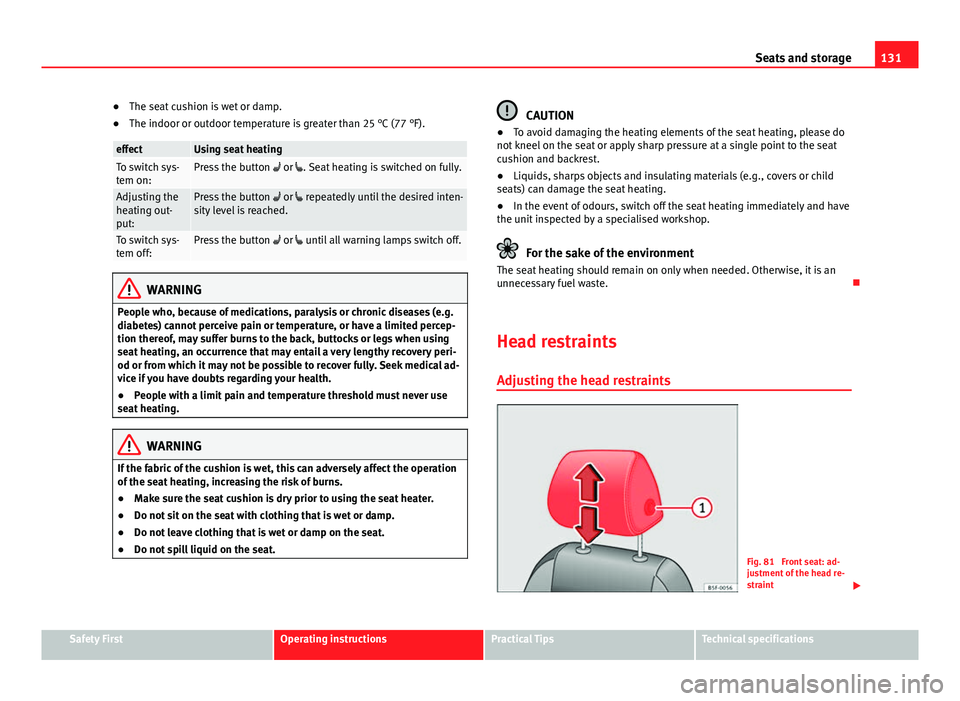
Head restraints Adjusting the head restraints
Fig. 81 Front seat: ad-
justment of the head re-
straint
Safety FirstOperating instructionsPractical TipsTechnical specifications
Page 134 of 339
132Seats and storage
Adjust the head restraint so that the top of the head restraint is lev-
el with the top of your head. When this is not possible, try to get as
close as possible to this position.
–Grasp the sides of the head restraint with both hands and move
it up/down (to lower you must press button 1
) until you see it
engage.
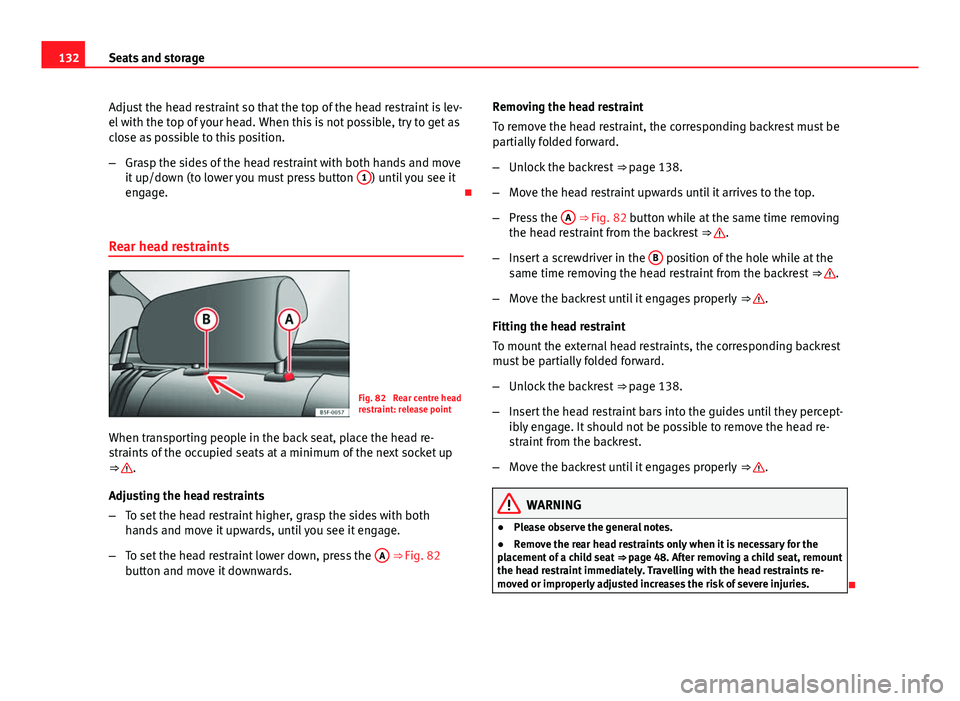
Rear head restraints
Fig. 82 Rear centre head
restraint: release point
When transporting people in the back seat, place the head re-
straints of the occupied seats at a minimum of the next socket up
⇒
.
Adjusting the head restraints
– To set the head restraint higher, grasp the sides with both
hands and move it upwards, until you see it engage.
– To set the head restraint lower down, press the A
⇒ Fig. 82
button and move it downwards. Removing the head restraint
To remove the head restraint, the corresponding backrest must be
partially folded forward.
–
Unlock the backrest ⇒ page 138.
– Move the head restraint upwards until it arrives to the top.
– Press the A
⇒ Fig. 82 button while at the same time removing
the head restraint from the backrest ⇒ .
– Insert a screwdriver in the B
position of the hole while at the
same time removing the head restraint from the backrest ⇒ .
– Move the backrest until it engages properly ⇒
.
Fitting the head restraint
To mount the external head restraints, the corresponding backrest
must be partially folded forward.
– Unlock the backrest ⇒ page 138.
– Insert the head restraint bars into the guides until they percept-
ibly engage. It should not be possible to remove the head re-
straint from the backrest.
– Move the backrest until it engages properly ⇒
.
WARNING
● Please observe the general notes.
● Remove the rear head restraints only when it is necessary for the
placement of a child seat ⇒ page 48. After removing a child seat, remount
the head restraint immediately. Travelling with the head restraints re-
moved or improperly adjusted increases the risk of severe injuries.
Page 140 of 339
138Seats and storage
Applies to the model: LEON ST
Folding down and lifting the rear seat backrest
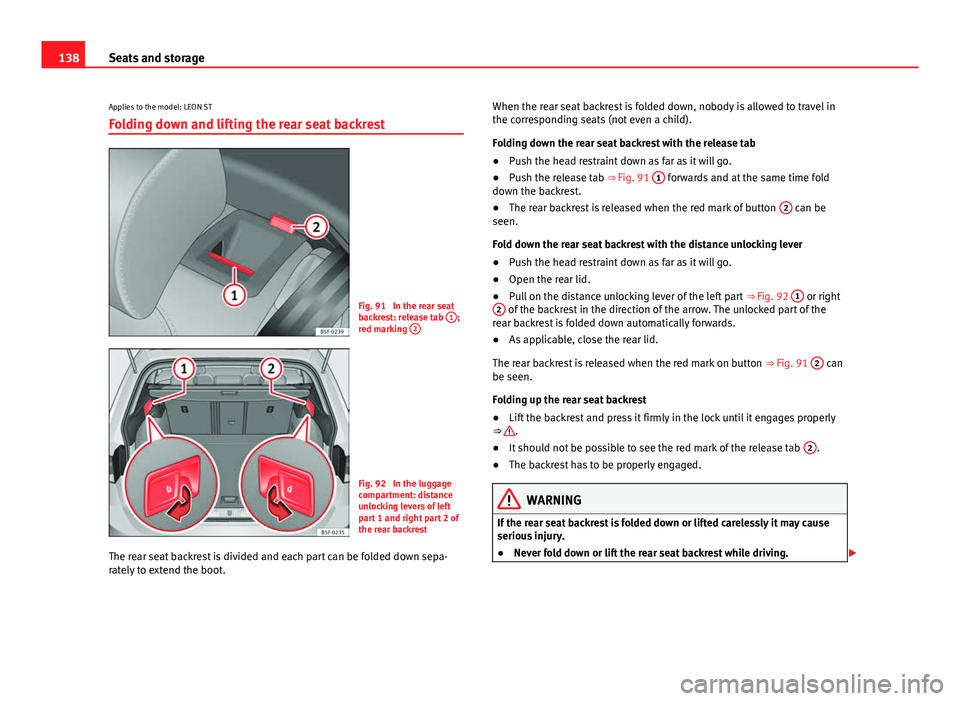
Fig. 91 In the rear seat
backrest: release tab 1;
red marking 2
Fig. 92 In the luggage
compartment: distance
unlocking levers of left
part 1 and right part 2 of
the rear backrest
The rear seat backrest is divided and each part can be folded down sepa-
rately to extend the boot. When the rear seat backrest is folded down, nobody is allowed to travel in
the corresponding seats (not even a child).
Folding down the rear seat backrest with the release tab
●
Push the head restraint down as far as it will go.
● Push the release tab ⇒ Fig. 91 1
forwards and at the same time fold
down the backrest.
● The rear backrest is released when the red mark of button 2
can be
seen.
Fold down the rear seat backrest with the distance unlocking lever
● Push the head restraint down as far as it will go.
● Open the rear lid.
● Pull on the distance unlocking lever of the left part ⇒ Fig. 92 1
or right
2 of the backrest in the direction of the arrow. The unlocked part of the
rear backrest is folded down automatically forwards.
● As applicable, close the rear lid.
The rear backrest is released when the red mark on button ⇒ Fig. 91 2
can
be seen.
Folding up the rear seat backrest
● Lift the backrest and press it firmly in the lock until it engages properly
⇒
.
● It should not be possible to see the red mark of the release tab 2.
● The backrest has to be properly engaged.
WARNING
If the rear seat backrest is folded down or lifted carelessly it may cause
serious injury.
● Never fold down or lift the rear seat backrest while driving.
Page 141 of 339
139
Seats and storage
WARNING (Continued)
● On lifting the rear seat backrest, avoid trapping or damaging the seat
belt.
● On folding down or lifting the rear seat backrest, always keep your
hands, fingers, feet and other body parts out of its path.
● For the safety belts to offer the necessary protection, all the parts of
the rear backrest should always be properly engaged. This is particularly
important in the case of the rear centre seat. Anyone sitting in a seat
whose backrest is not properly engaged could fly forward, together with
the backrest in the event of a sudden braking, a brusque manoeuvre or
an accident.
● A red mark on the button 2
warns that the backrest is not engaged.
Always check that the red marking is not visible when the backrest is in
the upright position.
● When the rear seat backrest is folded down or not properly engaged,
nobody is allowed to travel in the corresponding seats (not even a child).
CAUTION
If the rear seat backrest is folded down or lifted carelessly it may cause
damage to the vehicle or other objects.
● Before folding the rear seat backrest, adjust the front seats so that nei-
ther the head restraints nor the padding of the rear backrest hit them. Applies to the model: LEON / LEON SC
Luggage compartment cover
The luggage compartment cover blocks the view into the
luggage compartment.
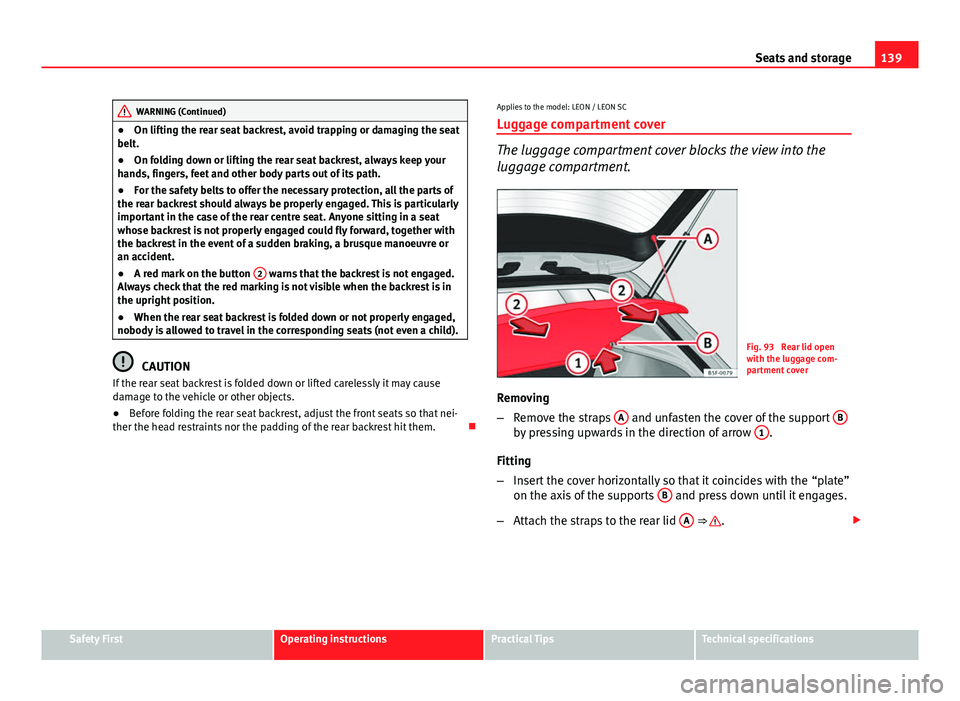
Fig. 93 Rear lid open
with the luggage com-
partment cover
Removing
– Remove the straps A
and unfasten the cover of the support Bby pressing upwards in the direction of arrow 1.
Fitting
– Insert the cover horizontally so that it coincides with the “plate”
on the axis of the supports B
and press down until it engages.
– Attach the straps to the rear lid A
⇒ .
Safety FirstOperating instructionsPractical TipsTechnical specifications