headlights Seat Leon SC 2013 User Guide
[x] Cancel search | Manufacturer: SEAT, Model Year: 2013, Model line: Leon SC, Model: Seat Leon SC 2013Pages: 339, PDF Size: 4.8 MB
Page 124 of 339
122Lights and visibility
Windscreen wiper functions
Windscreen wiper performance in different situations:If the vehicle is at a stand-
still:The activated position provisionally changes
to the previous position.
During the automatic wipe:
The air conditioner comes on for approxi-
mately 30 seconds in air recirculation mode
to prevent the smell of the windscreen wash-
er fluid entering the inside the vehicle.
For the interval wipe:The intervals between wipes vary according
to the speed of the vehicle. The higher the
vehicle speed the shorter the intervals.
Heated windscreen washer jets
The heating only thaws the frozen jets, it does not thaw the water in the
washer hoses. The heated windscreen washer jets automatically adjust the
heat depending on the ambient temperature, when the ignition is switched
on.
Headlight wash/wipe system
The headlight washers/wipers clean the headlight lenses.
After the ignition is switched on, the first and every fifth time the wind-
screen washer is switched on, the headlights are also washed. Therefore,
the windscreen wiper lever should be pulled towards the steering wheel
when the dipped beam or main beam are on. Any incrusted dirt (such as in-
sects) should be cleaned regularly (e.g. when refuelling).
To ensure the headlight washers work correctly in winter, any snow which
has got into the bumper jet supports should be cleaned away. If necessary,
remove snow with an anti-icing spray.
Note
The wiper will try to wipe away any obstacles that are on the windscreen.
The wiper will stop moving if the obstacle blocks its path. Remove the ob-
stacle and switch the wiper back on again.
Windscreen wipers service position
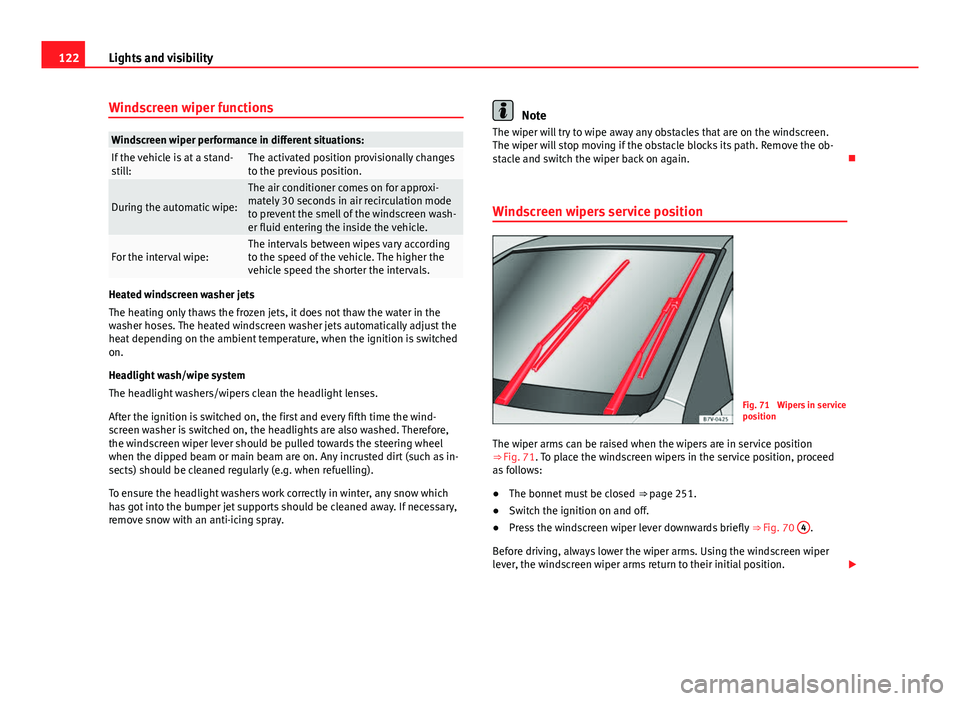
Fig. 71 Wipers in service
position
The wiper arms can be raised when the wipers are in service position
⇒ Fig. 71. To place the windscreen wipers in the service position, proceed
as follows:
● The bonnet must be closed ⇒ page 251.
● Switch the ignition on and off.
● Press the windscreen wiper lever downwards briefly ⇒ Fig. 70 4
.
Before driving, always lower the wiper arms. Using the windscreen wiper
lever, the windscreen wiper arms return to their initial position.
Page 129 of 339
127
Lights and visibility
Interior rear vision mirror with manual setting for anti-dazzle
position
– Position the small lever of the lower edge of the mirror to face
towards the rear.
Anti-dazzle rear vision mirror with automatic setting*
– Press the button A
. Warning lamp B will light up. The interior
mirror will darken automatically when bright light (e.g. from the
headlights of a following vehicle) shines on its.
WARNING
In the event that an automatic anti-dazzle rear vision mirror breaks, an
electrolyte fluid may leak. This could cause irritation to the skin, eyes
and respiratory organs. If you come into contact with this liquid, it must
be rinsed with large quantities of water. If necessary, get medial help.
CAUTION
In the event that an automatic anti-dazzle rear vision mirror breaks, an elec-
trolyte fluid may leak. This liquid attacks plastic surfaces. Clean the liquid
with a wet sponge as soon as possible.
Note
● If the light incident in the interior rear vision mirror is obstructed (e.g.
with the sun blind*), the anti-dazzle rear vision mirror with automatic set-
ting will not operate perfectly.
● When the interior lights are on or reverse gear engaged, the rear vision
mirrors do not darken with automatic adjustment for anti-dazzle position.
Safety FirstOperating instructionsPractical TipsTechnical specifications
Page 194 of 339
192Driver assistance systems
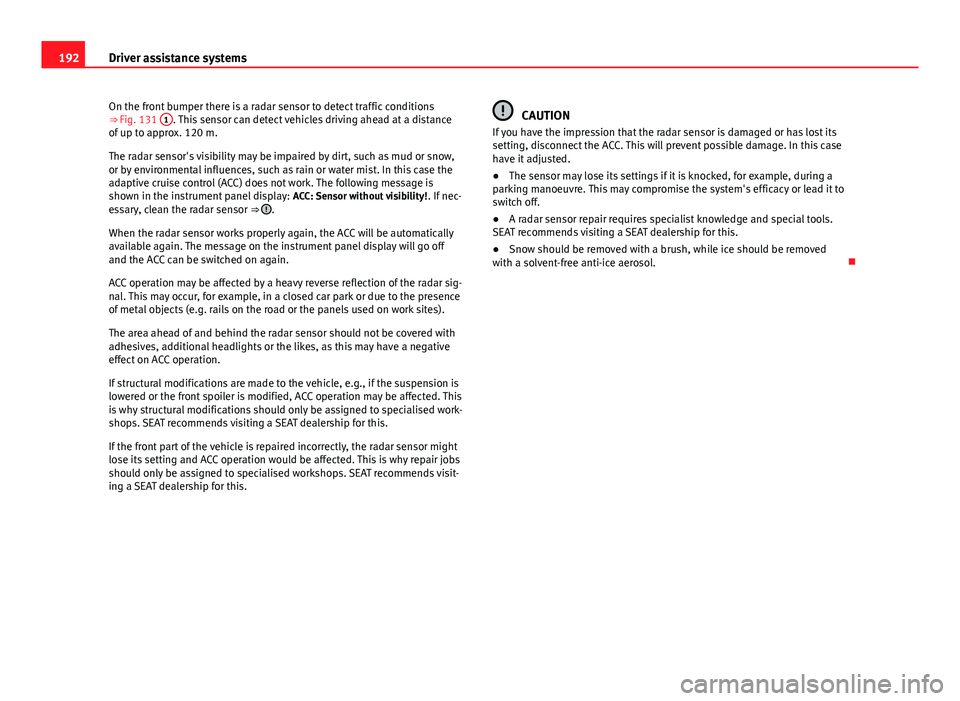
On the front bumper there is a radar sensor to detect traffic conditions
⇒ Fig. 131 1
. This sensor can detect vehicles driving ahead at a distance
of up to approx. 120 m.
The radar sensor's visibility may be impaired by dirt, such as mud or snow,
or by environmental influences, such as rain or water mist. In this case the
adaptive cruise control (ACC) does not work. The following message is
shown in the instrument panel display: ACC: Sensor without visibility!. If nec-
essary, clean the radar sensor ⇒
.
When the radar sensor works properly again, the ACC will be automatically
available again. The message on the instrument panel display will go off
and the ACC can be switched on again.
ACC operation may be affected by a heavy reverse reflection of the radar sig-
nal. This may occur, for example, in a closed car park or due to the presence
of metal objects (e.g. rails on the road or the panels used on work sites).
The area ahead of and behind the radar sensor should not be covered with
adhesives, additional headlights or the likes, as this may have a negative
effect on ACC operation.
If structural modifications are made to the vehicle, e.g., if the suspension is
lowered or the front spoiler is modified, ACC operation may be affected. This
is why structural modifications should only be assigned to specialised work-
shops. SEAT recommends visiting a SEAT dealership for this.
If the front part of the vehicle is repaired incorrectly, the radar sensor might
lose its setting and ACC operation would be affected. This is why repair jobs
should only be assigned to specialised workshops. SEAT recommends visit-
ing a SEAT dealership for this.
CAUTION
If you have the impression that the radar sensor is damaged or has lost its
setting, disconnect the ACC. This will prevent possible damage. In this case
have it adjusted.
● The sensor may lose its settings if it is knocked, for example, during a
parking manoeuvre. This may compromise the system's efficacy or lead it to
switch off.
● A radar sensor repair requires specialist knowledge and special tools.
SEAT recommends visiting a SEAT dealership for this.
● Snow should be removed with a brush, while ice should be removed
with a solvent-free anti-ice aerosol.
Page 206 of 339
204Driver assistance systems
WARNING
Failure to heed the warning lamps when they light up and the corre-
sponding messages may result in an accident and injury.
● Never ignore the warning lamps or on-screen messages.
Note
When the Front Assist is connected, the instrument panel display messages
pertaining to other functions may be hidden, such as an incoming call.
Radar sensor
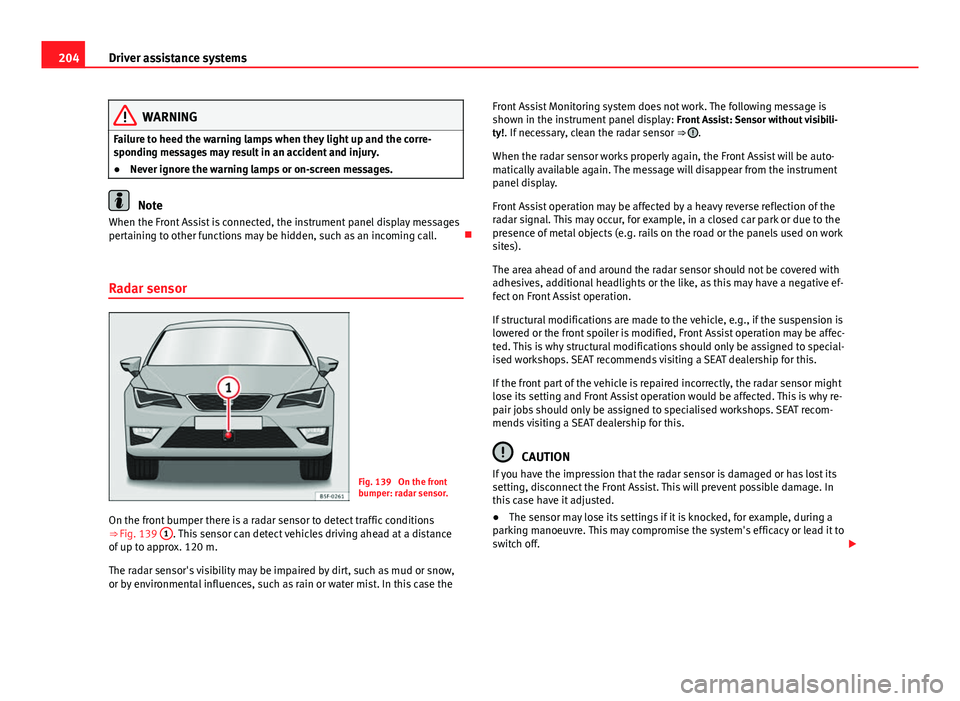
Fig. 139 On the front
bumper: radar sensor.
On the front bumper there is a radar sensor to detect traffic conditions
⇒ Fig. 139 1
. This sensor can detect vehicles driving ahead at a distance
of up to approx. 120 m.
The radar sensor's visibility may be impaired by dirt, such as mud or snow,
or by environmental influences, such as rain or water mist. In this case the Front Assist Monitoring system does not work. The following message is
shown in the instrument panel display:
Front Assist: Sensor without visibili-
ty!. If necessary, clean the radar sensor ⇒
.
When the radar sensor works properly again, the Front Assist will be auto-
matically available again. The message will disappear from the instrument
panel display.
Front Assist operation may be affected by a heavy reverse reflection of the
radar signal. This may occur, for example, in a closed car park or due to the
presence of metal objects (e.g. rails on the road or the panels used on work
sites).
The area ahead of and around the radar sensor should not be covered with
adhesives, additional headlights or the like, as this may have a negative ef-
fect on Front Assist operation.
If structural modifications are made to the vehicle, e.g., if the suspension is
lowered or the front spoiler is modified, Front Assist operation may be affec-
ted. This is why structural modifications should only be assigned to special-
ised workshops. SEAT recommends visiting a SEAT dealership for this.
If the front part of the vehicle is repaired incorrectly, the radar sensor might
lose its setting and Front Assist operation would be affected. This is why re-
pair jobs should only be assigned to specialised workshops. SEAT recom-
mends visiting a SEAT dealership for this.
CAUTION
If you have the impression that the radar sensor is damaged or has lost its
setting, disconnect the Front Assist. This will prevent possible damage. In
this case have it adjusted.
● The sensor may lose its settings if it is knocked, for example, during a
parking manoeuvre. This may compromise the system's efficacy or lead it to
switch off.
Page 241 of 339
239
Care and cleaning
Washing the car by hand
When washing the car by hand, use plenty of water to soften the dirt first,
and rinse off as well as possible.
Then clean the vehicle with a soft sponge, glove or brush using only slight
pressure. You should start on the roof and work down. Special car shampoo
should only be used for very persistent dirt.
Rinse the sponge or glove thoroughly and often.
Wheels, sills and similar should be cleaned last. Use a second sponge for
this.
WARNING
● The vehicle should only be washed with the ignition switched off.
Failure to do so could result in an accident.
● Do not clean the underside of chassis, the inside of wheel arches or
wheel trims without protecting your hands and arms. You may cut your-
self on sharp-edged metal parts. Otherwise, there is a risk of sustaining
cuts.
● When washing the car during the winter season: water and ice in the
brake system can reduce braking effectiveness: risk of accident!
CAUTION
● Do not wash the vehicle in direct sunlight – otherwise the paint can be
damaged.
● Do not use sponges, abrasive household sponges or similar to clean in-
sect remains. This could damage the surface.
● Clean off stubborn dirt (insects, etc.) from the headlights at regular in-
tervals, for instance when filling the fuel tank. The headlights should only
be washed with water, do not wipe them with a dry cloth or sponge. It is
best to use soapy water. ●
Never wash tyres with a jet that sprays the water out in a direct stream.
This could damage the tyres even if the spray is kept at a distance and only
used for a very short time.
● Before washing the vehicle in an automatic car wash, please make sure
to retract the exterior mirrors to prevent them from being damaged. Electri-
cally retractable exterior mirrors must not be folded in or out by hand. Al-
ways use the electrical power control.
CAUTION
● If you wash the vehicle in an automatic car wash, proceed as follows to
lock and prevent the windscreen wiper blades from being pushed up to-
wards the top of the windscreen:
–the bonnet must be closed
– switch the ignition on and off
– press the windscreen wiper lever downwards briefly towards the front
(windscreen wiper function). The windscreen wiper blades will be
locked.
For the sake of the environment
The car should only be washed in special wash bays. This prevents oily wa-
ter from getting into the public drains. In some places, washing vehicles
anywhere else may be prohibited.
Sensors and camera lenses
● Use a small brush to remove snow and a de-icer spray to remove ice.
● Clean the sensors with a solvent-free product and a soft, dry cloth.
● Moisten the camera lens using a standard alcohol-based glass cleaning
agent and clean the lens with a dry cloth. The area in front of the active
Lane Assist* lens area is normally cleaned with the windscreen washer.
Safety FirstOperating instructionsPractical TipsTechnical specifications
Page 287 of 339
285
Emergencies
6. Position the leads in such a way that they cannot come into contact with any moving parts in the engine compartment.
Starting
7. Start the engine of the vehicle with the boosting battery and let it run at idling speed.
8. Start the engine of the vehicle with the flat battery and wait two or three minutes until the engine is “running”.
Removing the jump leads
9. Before you remove the jump leads, switch off the dipped beam headlights (if they are switched on).
10.Turn on the heater blower and heated rear window in the vehi- cle with the flat battery. This helps minimise voltage peaks
which are generated when the leads are disconnected.
11.When the engine is running, disconnect the leads in reverse or- der to the details given above.
Connect the battery clamps so they have good metal-to-metal contact with
the battery terminals.
If the engine fails to start, switch off the starter after about 10 seconds and
try again after about half a minute.
WARNING
● Please note the safety warnings referring to working in the engine
compartment ⇒ page 251.
● The battery providing assistance must have the same voltage as the
flat battery (12V) and approximately the same capacity (see imprint on
battery). Failure to comply could result in an explosion.
● Never use jump leads when one of the batteries is frozen. Danger of
explosion! Even after the battery has thawed, battery acid could leak and
cause chemical burns. If a battery freezes, it should be replaced.
● Keep sparks, flames and lighted cigarettes away from batteries, dan-
ger of explosion. Failure to comply could result in an explosion.
● Observe the instructions provided by the manufacturer of the jump
leads.
● Do not connect the negative cable from the other vehicle directly to
the negative terminal of the flat battery. The gas emitted from the battery
could be ignited by sparks. Danger of explosion.
● Do not attach the negative cable from the other vehicle to parts of the
fuel system or to the brake line.
● The non-insulated parts of the battery clamps must not be allowed to
touch. The jump lead attached to the positive battery terminal must not
touch metal parts of the vehicle, this can cause a short circuit.
● Position the leads in such a way that they cannot come into contact
with any moving parts in the engine compartment.
● Do not lean on the batteries. This could result in chemical burns.
Note
The vehicles must not touch each other, otherwise electricity could flow as
soon as the positive terminals are connected.
Safety FirstOperating instructionsPractical TipsTechnical specifications
Page 295 of 339
293
Fuses and bulbs
Note
In the vehicle, there are more fuses than those indicated in this chapter.
These should only be changed by a specialised workshop.
Replacing a blown fuse
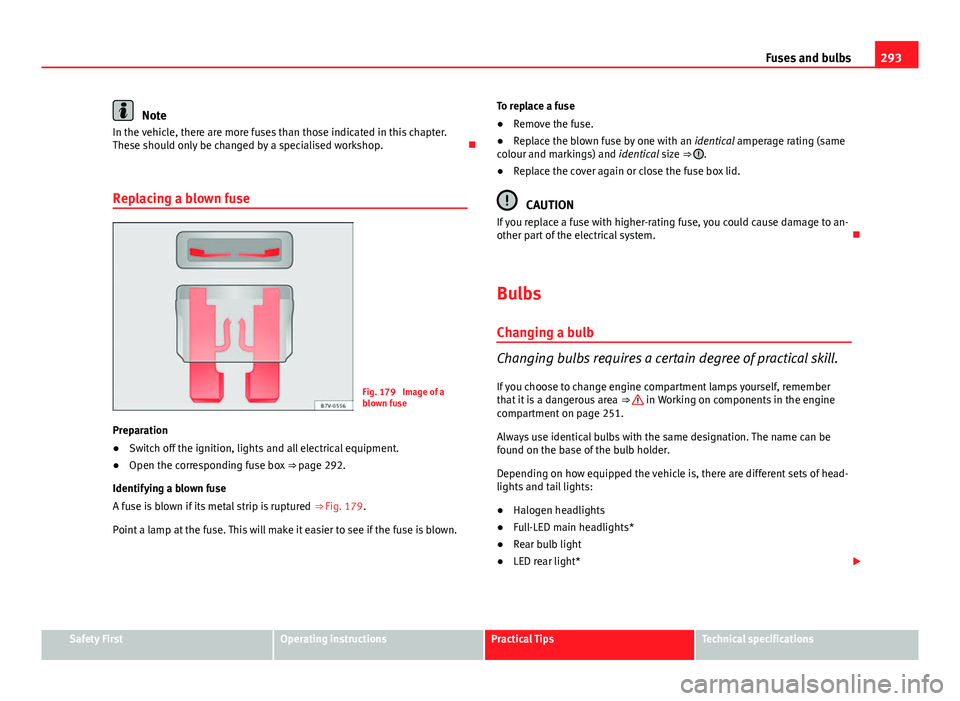
Fig. 179 Image of a
blown fuse
Preparation
● Switch off the ignition, lights and all electrical equipment.
● Open the corresponding fuse box ⇒ page 292.
Identifying a blown fuse
A fuse is blown if its metal strip is ruptured ⇒ Fig. 179.
Point a lamp at the fuse. This will make it easier to see if the fuse is blown. To replace a fuse
●
Remove the fuse.
● Replace the blown fuse by one with an identical amperage rating (same
colour and markings) and identical size ⇒
.
● Replace the cover again or close the fuse box lid.
CAUTION
If you replace a fuse with higher-rating fuse, you could cause damage to an-
other part of the electrical system.
Bulbs
Changing a bulb
Changing bulbs requires a certain degree of practical skill. If you choose to change engine compartment lamps yourself, remember
that it is a dangerous area ⇒
in Working on components in the engine
compartment on page 251.
Always use identical bulbs with the same designation. The name can be
found on the base of the bulb holder.
Depending on how equipped the vehicle is, there are different sets of head-
lights and tail lights:
● Halogen headlights
● Full-LED main headlights*
● Rear bulb light
● LED rear light*
Safety FirstOperating instructionsPractical TipsTechnical specifications
Page 296 of 339
294Fuses and bulbs
Full-LED headlight system*
Full-LED headlights handle all light functions (daylight, side light, turn sig-
nal, dipped beam and route light) with light emitting diodes (LEDs) as a
light source.
Full-LED headlights are designed to last the lifetime of the car and light
bulbs cannot be replaced. In case of headlight failure, go to an authorised
workshop to have it replaced.
Bulbs (12 V)
Halogen headlightsTypeDaytime driving light/side lightP21W SLLDipped beam headlightsH7 LLMain beam headlightsH7 LLTurn signalPY21W LL
Full-LED main headlightsTypeNo bulbs may be replaced. All functions are
with LEDs
Front fog lightTypeFog/cornering lights*H8
Rear bulb lightTypeBrake lights/tail lightsP21W LLSide lights2x W5W LLTurn signalPY21W LLRear fog lightH21WReverse lightsP21W LL
LED rear lightTypeTurn signalPY21W LLRear fog lightH21W
LED rear lightTypeReverse lightsP21W LLThe remaining functions work with LEDs
WARNING
● Take particular care when working on components in the engine com-
partment if the engine is warm. Risk of burns.
● Bulbs are highly sensitive to pressure. The glass can break when you
touch the bulb, causing injury.
● When changing bulbs, please take care not to injure yourself on sharp
edges, in particular on the headlight housing.
CAUTION
● Remove the ignition key before working on the electric system. Other-
wise, a short circuit could occur.
● Switch off the lights or parking lights before you change a bulb.
● Take good care to avoid damaging any components.
For the sake of the environment
Please ask your specialist retailer how to dispose of used bulbs in the prop-
er manner.
Note
● Please check at regular intervals that all lighting (especially the exterior
lighting) on your vehicle is functioning properly. This is not only in the inter-
est of your own safety, but also that of all other road users.
● Before changing a bulb, make sure you have the correct new bulb.
● Do not touch the glass part of the bulb with your bare hands, use a cloth
or paper towel instead. Otherwise, the fingerprints left on the glass will va-
porise as a result of the heat generated by the bulb, they will be deposited
on the reflector and will impair its surface.
Page 297 of 339
295
Fuses and bulbs
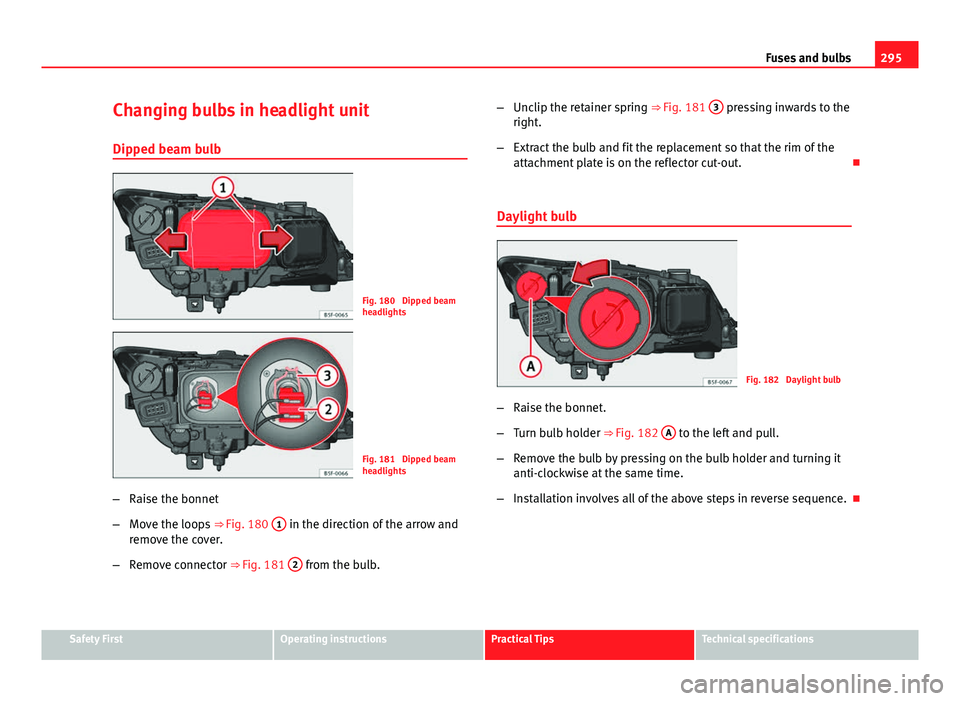
Changing bulbs in headlight unit Dipped beam bulb
Fig. 180 Dipped beam
headlights
Fig. 181 Dipped beam
headlights
– Raise the bonnet
– Move the loops ⇒ Fig. 180 1
in the direction of the arrow and
remove the cover.
– Remove connector ⇒ Fig. 181 2
from the bulb. –
Unclip the retainer spring ⇒ Fig. 181 3
pressing inwards to the
right.
– Extract the bulb and fit the replacement so that the rim of the
attachment plate is on the reflector cut-out.
Daylight bulb
Fig. 182 Daylight bulb
– Raise the bonnet.
– Turn bulb holder ⇒ Fig. 182 A
to the left and pull.
– Remove the bulb by pressing on the bulb holder and turning it
anti-clockwise at the same time.
– Installation involves all of the above steps in reverse sequence.
Safety FirstOperating instructionsPractical TipsTechnical specifications
Page 327 of 339
Index
A
ABSsee Anti-lock brake system . . . . . . . . . . . . 222
ACC . . . . . . . . . . . . . . . . . . . . . . . . . . . . . . . . . . 189 radar sensor . . . . . . . . . . . . . . . . . . . . . . . . 191
Accessories . . . . . . . . . . . . . . . . . . . . . . . . . . . . 135
Acoustic parking aid . . . . . . . . . . . . . . . . . . . . 217
Acoustic warnings Headlights . . . . . . . . . . . . . . . . . . . . . . . . . 111
Adaptive cruise control . . . . . . . . . . . . . . . . . . 189 control lamp . . . . . . . . . . . . . . . . . . . . . . . . 190
malfunction . . . . . . . . . . . . . . . . . . . . . . . . 190
messages on the display . . . . . . . . . . . . . . 190
radar sensor . . . . . . . . . . . . . . . . . . . . . . . . 191
Special driving situations . . . . . . . . . . . . . 199
switching off temporarily . . . . . . . . . . . . . . 198
using . . . . . . . . . . . . . . . . . . . . . . . . . . . . . . 193
warning lamp . . . . . . . . . . . . . . . . . . . . . . . 190
Additional electrical appliances (efficiency pro- gramme) . . . . . . . . . . . . . . . . . . . . . . . . . . . . . 77
Adjusting front head restraints . . . . . . . . . . . . . . . . . 131
front seats . . . . . . . . . . . . . . . . . . . . . . . . . . 129
rear head restraints . . . . . . . . . . . . . . . . . . 132
Adjusting the head restraints Front head restraints . . . . . . . . . . . . . . . . . 131
Airbag . . . . . . . . . . . . . . . . . . . . . . . . . . . . . . . . . 31
Airbag covers . . . . . . . . . . . . . . . . . . . . . . . . . . . 38 Airbag system . . . . . . . . . . . . . . . . . . . . . . . . . . . 31
Control lamp . . . . . . . . . . . . . . . . . . . . . . . . . 34
curtain airbags . . . . . . . . . . . . . . . . . . . . . . . 43
Differences between front passenger frontairbag systems . . . . . . . . . . . . . . . . . . . . . 33
Front airbags . . . . . . . . . . . . . . . . . . . . . . . . 36
Knee airbag . . . . . . . . . . . . . . . . . . . . . . . . . 39
side airbags . . . . . . . . . . . . . . . . . . . . . . . . . 40
Air pressure (tyres) . . . . . . . . . . . . . . . . . . . . . . 265
Alarm system . . . . . . . . . . . . . . . . . . . . . . . . . . . 95
Alcantara: cleaning . . . . . . . . . . . . . . . . . . . . . 245
Ambient lighting . . . . . . . . . . . . . . . . . . . . . . . 118
Anti-dazzle rear vision mirror . . . . . . . . . . . . . . 126
Anti-freeze protection Windscreen washer system . . . . . . . . . . . . 262
Anti-lock brake system . . . . . . . . . . . . . . . . . . . 222
Anti-theft alarm . . . . . . . . . . . . . . . . . . . . . . 87, 95 see also Anti-theft alarm system . . . . . . . . . 87
Anti-theft alarm system Interior monitoring . . . . . . . . . . . . . . . . . . . . 97
Tow-away protection . . . . . . . . . . . . . . . . . . 97
Anti-theft security system . . . . . . . . . . . . . . 87, 98
Anti-theft wheel bolts . . . . . . . . . . . . . . . . . . . 279
Antifreeze . . . . . . . . . . . . . . . . . . . . . . . . . . . . . 257
Aspects to take into account before starting the vehicle . . . . . . . . . . . . . . . . . . . . . . . . . . . . . . . . 8
ASR see Traction control system . . . . . . . . . . . . 222 Assistance systems . . . . . . . . . . . . . . . . . . . . . 184
ACC . . . . . . . . . . . . . . . . . . . . . . . . . . . . . . . 189
adaptive cruise control . . . . . . . . . . . . . . . 189
Cruise control . . . . . . . . . . . . . . . . . . . . . . . 184
monitoring system Front Assist . . . . . . . . . 202
Parking aid . . . . . . . . . . . . . . . . . . . . . . . . . 218
Assisted starting . . . . . . . . . . . . . . . . . . . . . . . 283
Assist systems Tyre monitoring indicator . . . . . . . . . . . . . . 216
Audible warning . . . . . . . . . . . . . . . . . . . . . . . . . 21
Auto Lock (central locking) . . . . . . . . . . . . . . . . 87
Automatic car washes see Washing . . . . . . . . . . . . . . . . . . . . . . . . 238
Automatic dipped beam control . . . . . . . . . . . 112
Automatic gearbox . . . . . . . . . . . . . . . . . . . . . . 173 Backup programme . . . . . . . . . . . . . . . . . . 181
Downhill speed control . . . . . . . . . . . . . . . 178
Driving tips . . . . . . . . . . . . . . . . . . . . . . . . . 176
Kick-down feature . . . . . . . . . . . . . . . . . . . . 179
Launch Control Programme . . . . . . . . . . . . 179
Manual release of selector lever . . . . . . . . 182
Safety interlock for ignition key . . . . . . . . . 163
Selector lever lock . . . . . . . . . . . . . . . . . . . 175
Selector lever positions . . . . . . . . . . . . . . . 173
Steering wheel with gearshift paddles . . . 178
tiptronic . . . . . . . . . . . . . . . . . . . . . . . 173, 178
B
Back support . . . . . . . . . . . . . . . . . . . . . . . . . . 129
325
Index