roof Seat Leon SC 2013 User Guide
[x] Cancel search | Manufacturer: SEAT, Model Year: 2013, Model line: Leon SC, Model: Seat Leon SC 2013Pages: 339, PDF Size: 4.8 MB
Page 110 of 339
108Opening and closing
Closing without the roll-back function
● The ⇒ Fig. 62 1
switch should be in the “closed” position A.
● Within five seconds of triggering the roll-back function, pull the control
all the way back ⇒ Fig. 63 (arrow E
) until the panoramic sliding sunroof
closes fully.
● The panoramic sliding sunroof closes without the roll-back function.
● If the panoramic sliding sunroof still cannot be closed, visit a special-
ised workshop.
WARNING
Closing the panoramic sliding sunroof without the roll-back function may
result in serious injury.
● Always close the panoramic sliding sunroof carefully.
● Make sure that nobody is in the way of the panoramic sliding sunroof,
especially when it is closed without the roll-back function.
● The anti-trap function does not prevent fingers or other parts of the
body getting pinched against the window frame and causing injury.
Note
The anti-trap function is activated if the windows and the panoramic sliding
sunroof are closed from the outside of the vehicle using the ignition key for
convenience closing ⇒ page 103.
Page 146 of 339
144Seats and storage
Retracting the net partition
● Remove the bar from the housings in the trims of the roof side member.
● Roll away the net in casing 4
by lowering it with your hand.
Removing the net partition
● Pull on the casing of the net approx. 5 cm in the opposite direction of
the arrow ⇒ Fig. 100 B
.
● Remove the casing from the securing tracks in the opposite direction of
the arrows A
.
● Lift the backrests of the rear seat.
WARNING
During a sudden braking manoeuvre or accident, objects could be
launched across the passenger compartment and cause serious or fatal
injuries.
● Always secure objects, even when the net partition is properly fitted.
● When the vehicle is moving, nobody should be allowed to remain be-
hind the fitted net partition.
WARNING
The rear seat backrests can only be lifted again if the net partition has
been lifted first.
CAUTION
Incorrect handling of the net partition may cause damage.
● Do not “release” the partition net on lowering it; otherwise the net and
other parts of the vehicle might be damaged. Roll down the net partition by
hand. Applies to the model: LEON ST
Tailboard for carrying long objects
Fig. 102 On the rear
seat backrest: tailboard
opening.
Fig. 103 In the luggage
compartment: tailboard
opening.
On the rear seat, behind the central armrest, there is a tailboard for trans-
porting long objects inside the vehicle, such as skis.
Page 152 of 339
150Seats and storage
Roof carrier
Introduction
The vehicle roof has been designed to optimise aerodynamics. This is why it
is not possible to mount cross bars or conventional roof carrier systems in
the roof's rain channels.
Given that the rain channels have been incorporated into the roof for aero-
dynamic reasons, only SEAT-approved cross bars and roof carrier systems
can be used.
Cases in which the cross bars and roof carrier systems should be
dismounted
● When they are no longer needed.
● When the vehicle is to be washed in a car wash.
● When the vehicle height exceeds the maximum height, for example, in a
garage.
Additional information and warnings:
● Lights ⇒ page 109
● Storing objects ⇒ page 17
● Driving ecologically ⇒ page 231
● Wheels and tyres ⇒ page 265
● Accessories, parts replacement, repairs and modifications ⇒ page 272
WARNING
Transporting heavy or bulky loads on the roof carrier system affects car
handling due to the shift in the centre of gravity and increased air resist-
ance.
● It is important to always use belts or retaining straps that are suita-
ble and in good condition to secure loads.
● A bulky, heavy, long or flat load has a negative effect on aerodynam-
ics and on the vehicle's centre of gravity and driving behaviour.
● Avoid sudden braking and other brusque manoeuvres.
● Adapt your speed and driving style to suit visibility, weather, road
and traffic conditions.
CAUTION
● Remove the cross bars and the roof carrier system before entering a car
wash.
● The height of your vehicle increases with the installation of the cross
bars and roof carrier system and with the load secured on them. To do so,
make sure that vehicle height does not exceed the height limit when going
through underpasses or garage doors.
● The cross bars, roof carrier system and load on them should not inter-
fere with the roof antenna or hamper the panoramic sliding roof and the
⇒ page 106 rear lid.
● On opening the rear lid, make sure that it does not bump into the roof
load.
For the sake of the environment
Fitting the cross bars and roof carrier system increases fuel consumption
due to greater aerodynamic resistance.
Page 153 of 339
151
Seats and storage
Applies to the model: LEON ST
Securing the cross bars and roof carrier system
Fig. 112 Roof side bar:
areas for securing cross
bars.
The cross bars are the basis of a series of special roof carrier systems. For
safety reasons, specific systems must be used to safely transport luggage,
bicycles, skis, surf boards or boats on the roof. You can purchase suitable
accessories at SEAT authorised services.
Securing the cross bars and roof carrier system
Always secure the cross bars and roof carrier system. Always refer to the as-
sembly instructions for the cross bars and roof carrier system in question.
The cross bars are fitted to the roof's side bars. The distance between the
cross bars ⇒ Fig. 112 A
should be between 70 and 80 cm. The distance
from the rear cross bar B to the roof antenna should be at least 20 cm.
Once the cross bars have been properly fitted, the roof carrier system
should be secured to them according to the corresponding instructions.
WARNING
Failure to secure the cross bars and roof carrier system properly may lead
the whole system to become detached from the roof and cause an acci-
dent and injury.
● Always take the manufacturer assembly instructions into account.
● Only use cross bars and a roof carrier system that are in good condi-
tion and properly secured.
● Always fit the cross bars and roof carrier system properly.
● Check the threaded joints and attachments before driving and if nec-
essary tighten them after you have travelled a short distance. On long
journeys, check the threaded joints and attachments whenever you take
a rest.
● Always fit the special roof carrier systems correctly for wheels, skis
and surfboards, etc.
● Do not try to change or repair the cross bars or roof carrier system.
Note
Always read the assembly instructions for the cross bars and roof carrier
system carefully and keep them in the vehicle at all times.
Loading the roof carrier system
Loads can only be secured safely if the cross bars and the roof carrier sys-
tem have been fitted properly ⇒ .
Maximum authorised roof load
The maximum authorised roof load is 75 kg. This figure is the result of add-
ing the weight of the roof carrier system, the cross bars and the roof load
⇒
.
Safety FirstOperating instructionsPractical TipsTechnical specifications
Page 154 of 339
152Seats and storage
Make sure you know the weight of the roof carrier system, the cross bars
and the roof load; weigh them if necessary. Never exceed the maximum au-
thorised roof load.
However, if you are using cross bars and a roof carrier system with a lower
load rating you will not be able to carry the maximum roof load. In this case,
you can only load the roof carrier to the weight limit listed in the fitting in-
structions.
Distributing a load
Uniformly distribute loads and secure them correctly ⇒
.
Check attachments.
Once the cross bars and roof carrier system have been fitted, check bolted
joins and the attachments after you have travelled a short distance and
then regularly.
WARNING
Exceeding the maximum authorised roof load can result in accidents and
considerable vehicle damage.
● Never exceed the indicated roof load, the authorised load on the
axles or the vehicle's authorised maximum load.
● Do not exceed the load capacity of the cross bars and roof carrier sys-
tem, even if the maximum roof load has not been exceeded.
● Always secure heavy items as far forward as possible and distribute
the vehicle load uniformly.
WARNING
If the load is loose and is not properly secured it could fall from the roof
carrier system and cause accidents and injury.
● Always use belts or retaining straps that are suitable and in a good
condition.
● Secure the load properly.
Page 161 of 339
159
Air conditioning
Instructions for use of the air conditioner
The interior cooling system only works when the engine is running and fan
is switched on.
The air conditioner operates most effectively with the windows and the pan-
oramic sliding sunroof closed. However, if the vehicle has heated up after
standing in the sun for some time, the air inside can be cooled more quickly
by opening the windows and the panoramic sliding sunroof briefly.
Setting for conditions of optimal visibility
When the air conditioning is switched on, the temperature and the air hu-
midity in the vehicle interior drop. Hence, when the outside air humidity is
high, the windows do not mist over and comfort for the vehicle occupants is
improved:
With manual air conditioning
● Switch off air recirculation.
● Set the fan to the required setting.
● Turn the temperature control to the centre position.
● Open and direct all the air outlets in the dash panel.
● Turn the air distribution control to the required position.
● Press the button
to switch on the cooling system. The button will
light up.
With Climatronic
● Press button
.
● Set the temperature to +22 °C (+72 °F).
● Open and direct all the air outlets in the dash panel.
Climatronic: change the temperature unit on the screen of the radio or on
the factory-fitted navigation system
Changing the temperature display from Celsius to Fahrenheit on radio or on
the factory-fitted navigation system is done using the menu on the instru-
ment panel ⇒ page 73. The cooling system cannot be activated
If the air conditioning system cannot be switched on, this may be caused by
the following:
●
The engine is not running.
● The fan is switched off.
● The air conditioner fuse has blown.
● The outside temperature is lower than approximately +3 °C (+38 °F).
● The air conditioner compressor has been temporarily switched off be-
cause the engine coolant temperature is too high.
● Another fault in the vehicle. Have the air conditioner checked by a speci-
alised workshop.
Special Characteristics
If the humidity and temperature outside the vehicle are high, condensation
can drip off the evaporator in the cooling system and form a pool under-
neath the vehicle. This is normal and does not indicate a leak!
Note
After starting the engine, any residual humidity in the air conditioner could
mist over the windscreen. Switch on the defrost function as soon as possi-
ble to clear the windscreen of condensation.
Safety FirstOperating instructionsPractical TipsTechnical specifications
Page 240 of 339
238Care and cleaning
Care and cleaning
General information
Regular care helps to maintain the value of the vehicle.
Regular and careful care helps to maintain the value of the vehicle. This may
also be one of the requirements for upholding any warranty claims in the
event of corrosion or paint defects.
SEAT Official Services and specialist retailers carry stocks of suitable car
care materials. Please follow the instructions for use on the packaging.
WARNING
● Cleaning products and other materials used for car care can be dam-
aging to your health if misused.
● Always keep care products in a safe place, out of the reach of chil-
dren. Failure to comply could result in poisoning.
For the sake of the environment
● If possible, use environmentally friendly products.
● The remains of car care products should not be disposed of with ordina-
ry household waste. Care of vehicle exterior
Washing the vehicle
The longer substances such as insects, bird droppings, resinous tree sap,
road dirt, industrial deposits, tar, soot or road salt and other aggressive ma-
terials remain on the vehicle, the more damage they do to the paintwork.
High temperatures (for instance due to strong sunlight) further intensify the
corrosive effect.
After the period when salt is put on the roads it is important to have the un-
derside of the vehicle washed thoroughly.
Automatic car washes
Before going through a car wash, be sure to take the usual precautions such
as closing the windows and roof. If the vehicle has special accessories such
as spoilers or a roof carrier or two-way radio aerial, etc., it is advisable to
consult the car wash operator.
It is best to use a car wash without revolving bristles if possible.
Washing the vehicle with a high pressure cleaner
When washing the vehicle with a high-pressure cleaner, always follow the
operating instructions for the equipment. This applies particularly to the op-
erating pressure and the spraying distance. Do not hold the nozzle too
close to soft materials such as rubber hoses or seals. The same applies to
the parking aid sensors*, which are located in the rear bumper.
Do not use a nozzle that sprays the water out in a direct stream or one that
has a rotating jet for forcing off dirt.
Page 241 of 339
239
Care and cleaning
Washing the car by hand
When washing the car by hand, use plenty of water to soften the dirt first,
and rinse off as well as possible.
Then clean the vehicle with a soft sponge, glove or brush using only slight
pressure. You should start on the roof and work down. Special car shampoo
should only be used for very persistent dirt.
Rinse the sponge or glove thoroughly and often.
Wheels, sills and similar should be cleaned last. Use a second sponge for
this.
WARNING
● The vehicle should only be washed with the ignition switched off.
Failure to do so could result in an accident.
● Do not clean the underside of chassis, the inside of wheel arches or
wheel trims without protecting your hands and arms. You may cut your-
self on sharp-edged metal parts. Otherwise, there is a risk of sustaining
cuts.
● When washing the car during the winter season: water and ice in the
brake system can reduce braking effectiveness: risk of accident!
CAUTION
● Do not wash the vehicle in direct sunlight – otherwise the paint can be
damaged.
● Do not use sponges, abrasive household sponges or similar to clean in-
sect remains. This could damage the surface.
● Clean off stubborn dirt (insects, etc.) from the headlights at regular in-
tervals, for instance when filling the fuel tank. The headlights should only
be washed with water, do not wipe them with a dry cloth or sponge. It is
best to use soapy water. ●
Never wash tyres with a jet that sprays the water out in a direct stream.
This could damage the tyres even if the spray is kept at a distance and only
used for a very short time.
● Before washing the vehicle in an automatic car wash, please make sure
to retract the exterior mirrors to prevent them from being damaged. Electri-
cally retractable exterior mirrors must not be folded in or out by hand. Al-
ways use the electrical power control.
CAUTION
● If you wash the vehicle in an automatic car wash, proceed as follows to
lock and prevent the windscreen wiper blades from being pushed up to-
wards the top of the windscreen:
–the bonnet must be closed
– switch the ignition on and off
– press the windscreen wiper lever downwards briefly towards the front
(windscreen wiper function). The windscreen wiper blades will be
locked.
For the sake of the environment
The car should only be washed in special wash bays. This prevents oily wa-
ter from getting into the public drains. In some places, washing vehicles
anywhere else may be prohibited.
Sensors and camera lenses
● Use a small brush to remove snow and a de-icer spray to remove ice.
● Clean the sensors with a solvent-free product and a soft, dry cloth.
● Moisten the camera lens using a standard alcohol-based glass cleaning
agent and clean the lens with a dry cloth. The area in front of the active
Lane Assist* lens area is normally cleaned with the windscreen washer.
Safety FirstOperating instructionsPractical TipsTechnical specifications
Page 242 of 339
240Care and cleaning
CAUTION
● When you clean the vehicle with a pressure washer,
– stay a suitable distance from the sensors on the front and rear bump-
ers.
– Do not clean the camera lenses or surrounding area with the pressure
washer.
● Never use warm or hot water to remove snow and ice from the reverse
camera lens, as it could crack the lens.
● Never use abrasive cleaning agents on the lens.
Care and polishing
Care
Waxing protects the paintwork. It is time to apply a good coat of wax when
water no longer forms droplets and rolls off the clean paintwork.
Even if a wax solution is used regularly in the vehicle washing tunnel, it is
advisable to protect the paint with a hard wax coating at least twice a year.
In the summer, you will find it is much easier to remove dead insects (which
accumulate on the bumper and the front of the bonnet) if the car has been
treated with care products recently.
Polishing
Polishing is only necessary if the paint has lost its shine, and the gloss can-
not be brought back by putting on wax.
If the polish does not contain wax, a wax product should be applied after
polishing.
CAUTION
● Do not use polishes and hard wax on painted parts with a matt finish or
on plastic parts.
● Do not apply paint polishes to the side trim that runs around the panor-
amic roof and ends on the windscreen. However, it can be treated with hard
wax.
Trims
In respect for the environment, the silver-plated trims on the body are made
of pure aluminium (they do not contain chrome).
Dirt or marks on the trim mouldings should be removed with a cleaning
product with a neutral PH (do not use a chrome cleaner). Body polish is also
unsuitable for use on trim mouldings. The intensive cleaning fluids often
used before the car goes into a car wash may contain alkaline substances,
which can cause dull or milky patches when they dry out.
SEAT Official Services carry stocks of cleaning products which have been
tested for use on your vehicle and are not harmful to the environment.
Plastic parts
Plastic parts are cleaned with a power washer. If this is not sufficient, plas-
tic parts should only be treated with a special solvent-free plastic cleaning
agent. Do not use paintwork cleaners, polishes or wax on plastic parts.
Page 312 of 339
310Technical specifications
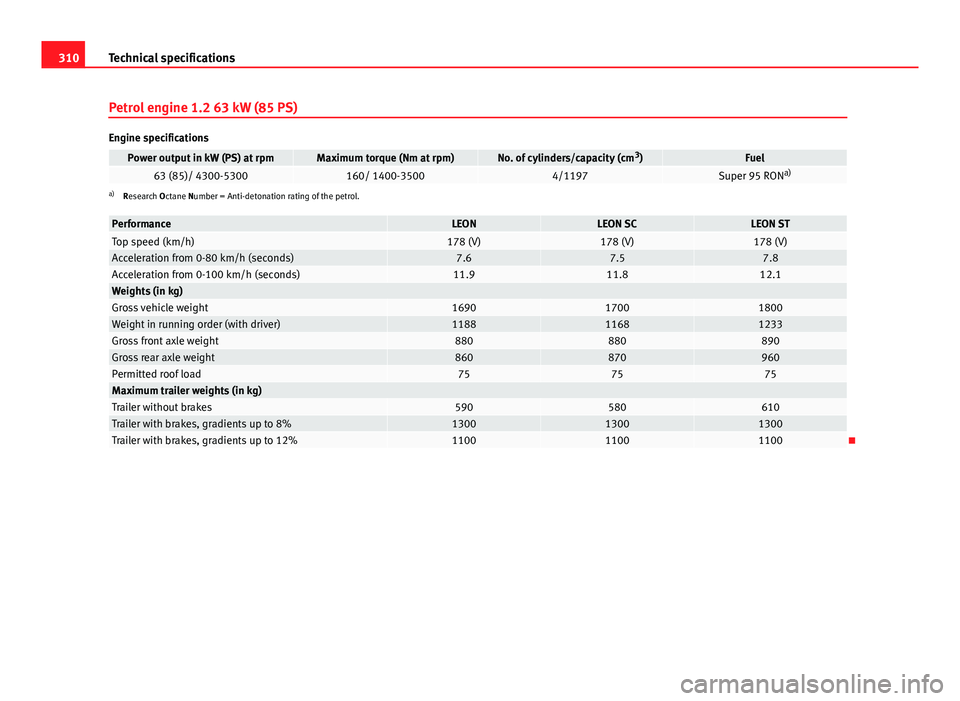
Petrol engine 1.2 63 kW (85 PS)
Engine specifications
Power output in kW (PS) at rpmMaximum torque (Nm at rpm)No. of cylinders/capacity (cm 3
)Fuel63 (85)/ 4300-5300160/ 1400-35004/1197Super 95 RON a)a)
Research Octane Number = Anti-detonation rating of the petrol.
PerformanceLEONLEON SCLEON STTop speed (km/h)178 (V)178 (V)178 (V)Acceleration from 0-80 km/h (seconds)7.67.57.8Acceleration from 0-100 km/h (seconds)11.911.812.1Weights (in kg)Gross vehicle weight169017001800Weight in running order (with driver)118811681233Gross front axle weight880880890Gross rear axle weight860870960Permitted roof load757575Maximum trailer weights (in kg)Trailer without brakes590580610Trailer with brakes, gradients up to 8%130013001300Trailer with brakes, gradients up to 12%110011001100