door lock Seat Leon SC 2013 Owner's Guide
[x] Cancel search | Manufacturer: SEAT, Model Year: 2013, Model line: Leon SC, Model: Seat Leon SC 2013Pages: 339, PDF Size: 4.8 MB
Page 127 of 339
125
Lights and visibility
Recommended windscreen wipers
● For the hottest seasons we recommend summer G 052 184 A1 for clear
glass. Proportions of the mixture in the washer fluid tank: 1:100 (1 part con-
centrate per 100 parts water).
● All year round, G 052 164 A2 for clear glass. Approximate proportion of
the winter mixture, up to -18 °C (0 °F): 1:2 (1 part concentrate per 2 parts
water); otherwise, a 1:4 proportion of mixture in the washer fluid tank.
Reservoir capacity
The reservoir holds approximately 3 - 4 litres; in vehicles with headlight
washer, it is approximately 3 -6 litres.
WARNING
Never mix an unsuitable antifreeze or other similar additives with the
windscreen washer water. A greasy layer may be formed on the wind-
screen which will impair visibility.
● Use clean water with a window cleaner recommended by SEAT.
● If necessary, add a suitable antifreeze to the water in the reservoir.
CAUTION
● Do not mix cleaning products recommended by SEAT with other prod-
ucts. This could lead to flocculation and may block the windscreen washer
jets.
● When topping up service fluids, make absolutely certain that you fill the
fluids into the correct reservoirs. Using the wrong fluids could cause serious
malfunctions and engine damage! Rear vision mirror
Adjusting the exterior mirrors
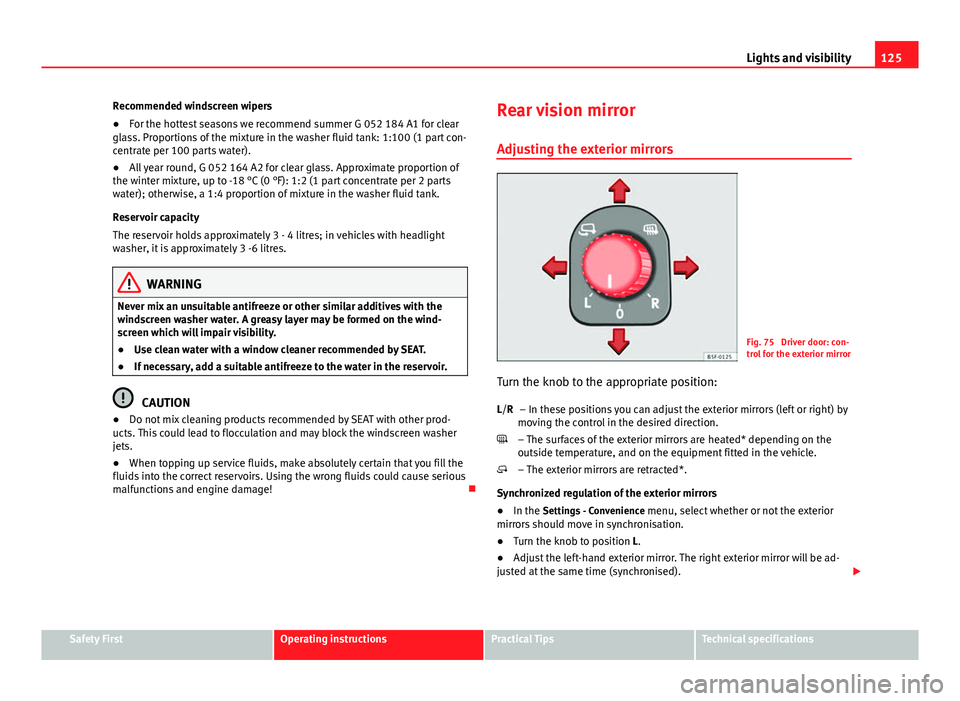
Fig. 75 Driver door: con-
trol for the exterior mirror
Turn the knob to the appropriate position: – In these positions you can adjust the exterior mirrors (left or right) by
moving the control in the desired direction.
– The surfaces of the exterior mirrors are heated* depending on the
outside temperature, and on the equipment fitted in the vehicle.
– The exterior mirrors are retracted*.
Synchronized regulation of the exterior mirrors
● In the Settings - Convenience menu, select whether or not the exterior
mirrors should move in synchronisation.
● Turn the knob to position L.
● Adjust the left-hand exterior mirror. The right exterior mirror will be ad-
justed at the same time (synchronised).
L/R
Safety FirstOperating instructionsPractical TipsTechnical specifications
Page 169 of 339
167
Driving
Always apply the handbrake as far as it will go in order to prevent yourself
from driving with the handbrake applied by mistake ⇒
.
The handbrake warning lamp lights up when the handbrake is applied
and the ignition switched on. The warning lamp turns off when the hand-
brake is released.
If you drive faster than 6 km/h (4 mph) with the handbrake on, the following
message* will appear on the instrument panel display: HANDBRAKE ON. You
will also hear an audible warning.
WARNING
● Never use the handbrake to stop the vehicle when it is in motion. The
braking distance is considerably longer, because braking is only applied
to the rear wheels. Risk of accident!
● If the handbrake is only partially released, this will cause the rear
brakes to overheat, which can impair the function of the brake system
and could lead to an accident. This also causes premature wear on the
rear brake pads.
CAUTION
Always apply the handbrake before you leave the vehicle. The first gear
should also be selected.
Parking
The handbrake should always be firmly applied when the
vehicle is parked.
Always note the following points when parking the vehicle:
– Use the brake pedal to stop the vehicle. –
Apply the handbrake.
– Select first gear.
– Switch the engine off and remove the key from the ignition. Turn
the steering wheel slightly to engage the steering lock.
– Always take you keys with you when you leave the vehicle ⇒
.
Additional notes on parking the vehicle on gradients:
Turn the steering wheel so that the vehicle rolls against the kerb if it started
to roll.
● If the vehicle is parked facing downhill, turn the front wheels so that
they point towards the kerb .
● If the vehicle is parked facing uphill, turn the front wheels so that they
point away from the kerb .
● Secure the vehicle as normal by applying the handbrake firmly and se-
lecting first gear.
WARNING
● Take measures to reduce the risk of injury when you leave your vehi-
cle unattended.
● Never park where the hot exhaust system could ignite inflammable
materials, such as dry grass, low bushes, spilt fuel etc.
● Never allow vehicle occupants to remain in the vehicle when it is
locked. They would be unable to open the vehicle from the inside, and
could become trapped in the vehicle in an emergency. In the event of an
emergency, locked doors will delay assistance to vehicle occupants.
● Never leave children alone in the vehicle. They could set the vehicle
in motion, for example, by releasing the handbrake or the gearbox lever.
● Depending on weather conditions, it may become extremely hot or
cold inside the vehicle. This can be fatal.
Safety FirstOperating instructionsPractical TipsTechnical specifications
Page 171 of 339
169
Driving
countries with general speed limits, or if a particular speed should not be
exceeded when winter tyres are fitted etc.
Note
● Please bear in mind that, even with the speed warning function, it is still
important to keep an eye on the vehicle speed with the speedometer and to
observe the legal speed limits.
● The speed limit warning function in the version for several countries
warns you at a speed of 120 km/h (80 mph). This is a factory-set speed lim-
it.
Setting speed limit warning
You can use the radio or the Easy Connect* to set, alter or
cancel the speed limit warning.
Vehicles with radio
– Select: SETUP
button > control button
Driver assistant > Speed
warning.
Vehicles with Easy Connect
– Select: Systems control button or Vehicle systems > Driver assis-
tant > Speed warning.
The warning limit can be set from 30 to 240 km/h (20 to 150 mph). The ad-
justment is done in 10 km/h (mph) intervals. Start-Stop system*
Description and operation
The Start-Stop system helps save fuel and reduce CO 2 emissions.
In Start-Stop mode, the engine will automatically switch off when the vehi-
cle stops, when stopping at traffic lights for example. The ignition remains
switched on during the stopping phase. The engine automatically switches
back on when required.
As soon as the ignition is switched on, the Start-Stop function is automati-
cally activated.
Basic requirements for the Start-Stop mode
● The driver door must be closed.
● The driver must have their seat belt fastened.
● The bonnet must be closed.
● The vehicle must have travelled at more than 4 km/h since the last stop.
● The vehicle cannot be towing a trailer.
WARNING
● Never switch the engine off until the vehicle is stationary. The brake
servo and power steering functions will not be completely covered under
warranty. More force may also be needed to turn the steering wheel or to
brake. As you cannot steer and brake in the normal manner, there is a
greater risk of accidents and serious injury.
● Never remove the key from the ignition if the vehicle is in motion.
Otherwise, the steering could lock making it impossible to steer the vehi-
cle.
Safety FirstOperating instructionsPractical TipsTechnical specifications
Page 178 of 339
176Driving
Note
● If the selector lever lock does not engage, there is a fault. The transmis-
sion is interrupted to prevent the vehicle from accidentally moving. Follow
the procedure below in order for the selector lever lock to engage again:
–With a 6-speed gearbox: press the brake pedal and release it again.
– With a 7-speed gearbox: press the brake pedal. Move the selector lev-
er to position P or N and subsequently engage a gear.
● Despite a gear being engaged, the vehicle does not move forwards or
back. Proceed to the next mode:
–When the vehicle does not move in the required direction, the system
may not have the gear range correctly engaged. Press the brake pedal
and engage the gear range again.
– If the vehicle still does not move in the required direction, there is a
system malfunction. Seek specialist assistance and have the system
checked.
Driving tips
The gearbox changes gear ratios automatically as the vehi-
cle moves.
The engine can only start with the selector lever in the position P or
N. At low temperatures, below -10 °C (50 °F), the engine can only
start with the selector lever in the position P.
Starting the vehicle
– Press and hold the brake pedal.
– Press and hold the interlock button (the button in the selector
lever handle), move the selector lever to the desired position,
for instance D ⇒ page 173, and release the interlock button. –
Wait for the gearbox to engage the gear (a slight movement can
be felt).
– Release the brake and press the accelerator ⇒
.
Stopping briefly
– Apply the foot brake to hold the vehicle when stationary (for in-
stance at traffic lights). Do not press the accelerator.
Stopping/Parking
If the driver door is opened and the selector lever is not in position
P, the vehicle could move. Driver message: Gear change: selector
lever in drive position! will be displayed. Additionally, a buzzer will sound.
– Press and hold the brake pedal ⇒
.
– Apply the handbrake.
– Move the selector lever to position P.
Holding the car on a hill
– Always apply the brake pedal firmly to prevent the vehicle from
“moving backwards; if necessary, apply the handbrake” ⇒
.
Do not try to stop the vehicle “rolling back” by increasing the
engine speed when a gear is engaged (pressing the accelera-
tor) ⇒
.
Moving off uphill in vehicles without Hill start assistant*
– Apply the handbrake.
– Once you have engaged a gear press the accelerator carefully
and disengage the handbrake.
Page 250 of 339
248Checking and refilling levels
The engine management automatically adapts to the natural gas used ac-
cording to its quality. Therefore, different quality gases can be mixed in the
tank, without the need for comprehensive draining before applying a differ-
ent quality gas.
The instrument panel display shows information on the current natural gas
quality ⇒ page 73.
Natural gas and safety
If you can smell gas or suspect that there is a leak ⇒
:
● Stop the vehicle immediately.
● Switch the ignition off.
● Open the doors to appropriately ventilate the vehicle.
● Extinguish cigarettes immediately.
● Move away from the vehicle or switch off objects that may cause sparks
or a fire.
● If you continue to smell gas, do not continue driving!
● Seek specialist assistance. Have the fault repaired.
WARNING
Failure to act when you can smell gas in the vehicle or when refuelling
can cause serious injuries.
● Carry out the necessary operations.
● Leave the danger zone.
● If necessary, warn the emergency services.
WARNING
The vehicle is not prepared to use liquefied natural gas (LNG) and this
fuel must not be added under any circumstances. Liquefied natural gas
can cause the natural gas tank to explode resulting in serious injury.
Note
Have natural gas system checked regularly by a specialised workshop in ac-
cordance with the Maintenance Programme.
Filling the tank Filling the tank
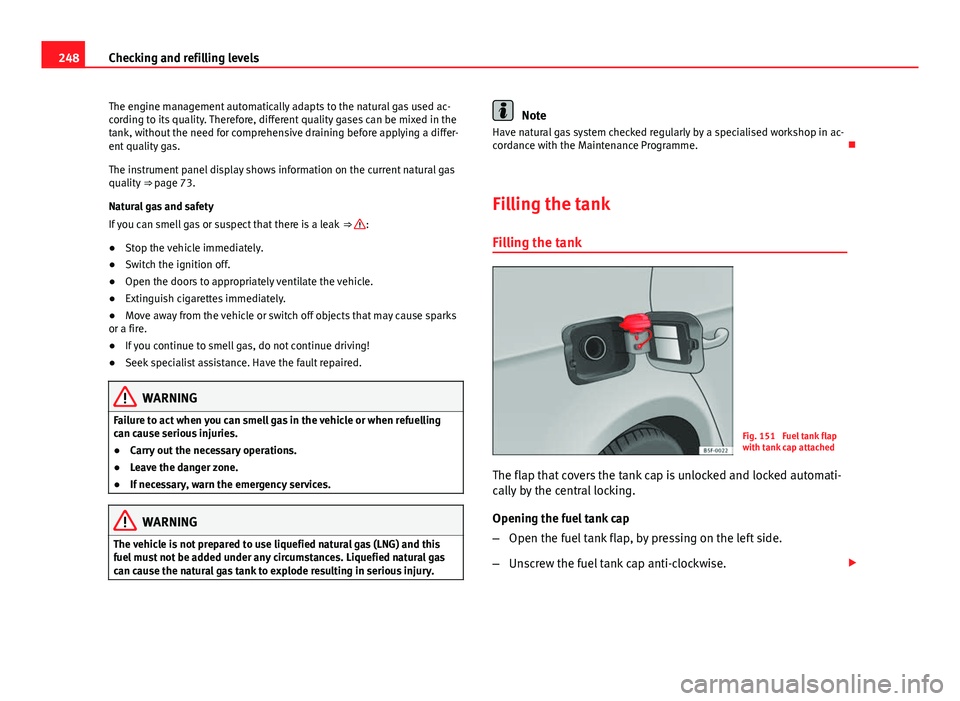
Fig. 151 Fuel tank flap
with tank cap attached
The flap that covers the tank cap is unlocked and locked automati-
cally by the central locking.
Opening the fuel tank cap
– Open the fuel tank flap, by pressing on the left side.
– Unscrew the fuel tank cap anti-clockwise.
Page 252 of 339
250Checking and refilling levels
For the sake of the environment
Do not overfill the fuel tank – it may cause the fuel to overflow if it becomes
warm.
Note
Diesel vehicles are fitted with a protective device that prevents the insertion
of the wrong fuel hose 1)
. It is only possible to refuel with Diesel nozzles.
● If the pump nozzle is worn, damaged, or if it is very small, it is possible
that it will not be able to open the protective device. Before trying to insert
the pump nozzle by turning it, try a different pump or request specialist
help.
● If you fill the tank from a reserve fuel canister, the protective device will
not open. One way to resolve this is to pour the fuel in very slowly.
Refuelling natural gas
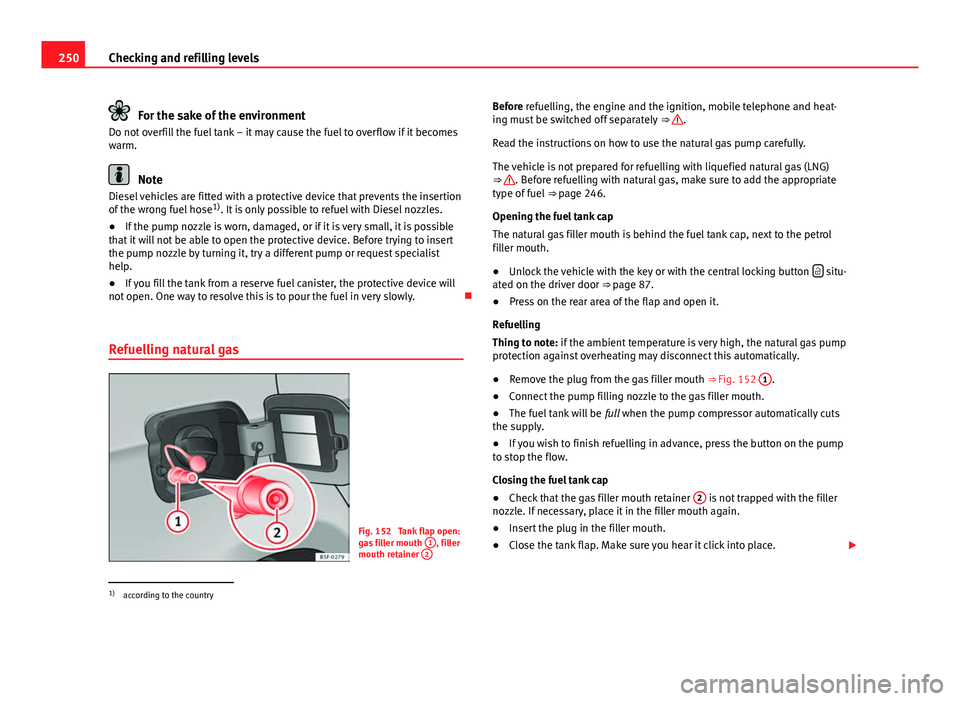
Fig. 152 Tank flap open:
gas filler mouth 1, filler
mouth retainer 2
Before refuelling, the engine and the ignition, mobile telephone and heat-
ing must be switched off separately
⇒ .
Read the instructions on how to use the natural gas pump carefully.
The vehicle is not prepared for refuelling with liquefied natural gas (LNG)
⇒
. Before refuelling with natural gas, make sure to add the appropriate
type of fuel ⇒ page 246.
Opening the fuel tank cap
The natural gas filler mouth is behind the fuel tank cap, next to the petrol
filler mouth.
● Unlock the vehicle with the key or with the central locking button
situ-
ated on the driver door ⇒ page 87.
● Press on the rear area of the flap and open it.
Refuelling
Thing to note: if the ambient temperature is very high, the natural gas pump
protection against overheating may disconnect this automatically.
● Remove the plug from the gas filler mouth ⇒ Fig. 152 1
.
● Connect the pump filling nozzle to the gas filler mouth.
● The fuel tank will be full when the pump compressor automatically cuts
the supply.
● If you wish to finish refuelling in advance, press the button on the pump
to stop the flow.
Closing the fuel tank cap
● Check that the gas filler mouth retainer 2
is not trapped with the filler
nozzle. If necessary, place it in the filler mouth again.
● Insert the plug in the filler mouth.
● Close the tank flap. Make sure you hear it click into place.
1)
according to the country
Page 254 of 339
252Checking and refilling levels
WARNING (Continued)
● Protect face, hands and arms by covering the cap with a large, thick
rag to protect against escaping coolant and steam.
● If it is necessary to work in the engine compartment while the engine
is running, the rotating components (for example, poly-V belt, alternator,
radiator fan) and the high voltage ignition system are an additional haz-
ard.
● Observe the following additional warnings if work on the fuel system
or the electrical system is necessary:
–Always disconnect the battery from the on-board network.
– Do not smoke.
– Never work near naked flames.
– Always keep an approved fire extinguisher immediately available.
CAUTION
When changing or topping up service fluids, make absolutely certain that
you fill the fluids into the correct reservoirs. Using the wrong fluids could
cause serious malfunctions and engine damage!
For the sake of the environment
Inspect the ground underneath your vehicle regularly so that any leaks are
detected at an early stage. If you find spots of oil or other fluids, have your
vehicle inspected at the workshop.
Note
On right-hand drive vehicles* some of the containers/reservoirs mentioned
below are located on the other side of the engine compartment. Opening the bonnet
The bonnet is released from inside the vehicle.
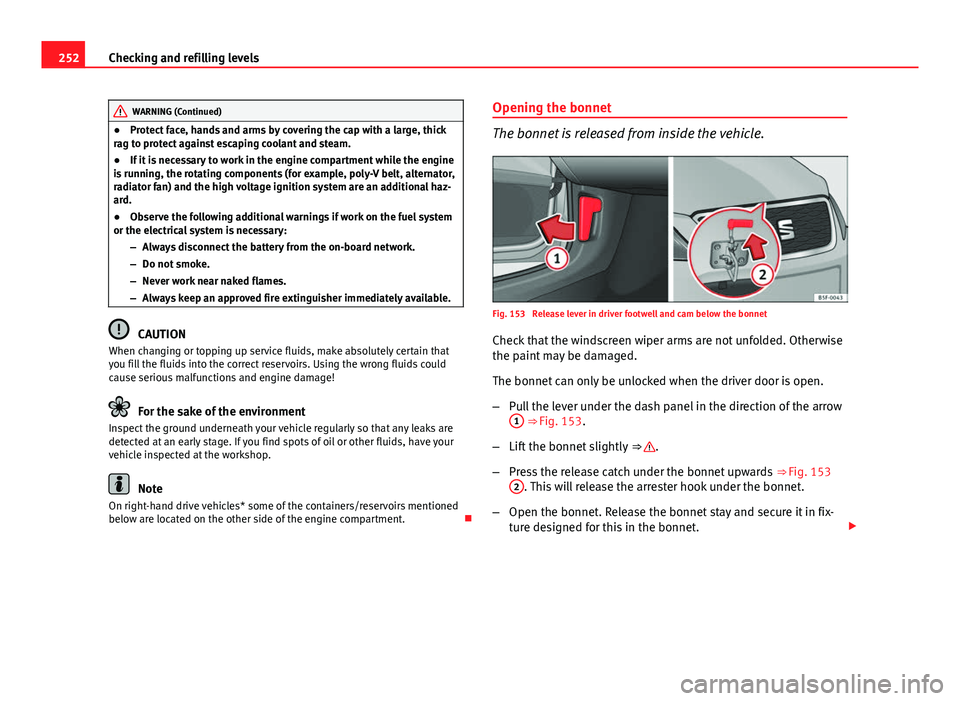
Fig. 153 Release lever in driver footwell and cam below the bonnet
Check that the windscreen wiper arms are not unfolded. Otherwise
the paint may be damaged.
The bonnet can only be unlocked when the driver door is open.
– Pull the lever under the dash panel in the direction of the arrow
1
⇒ Fig. 153.
– Lift the bonnet slightly ⇒
.
– Press the release catch under the bonnet upwards ⇒ Fig. 153
2
. This will release the arrester hook under the bonnet.
– Open the bonnet. Release the bonnet stay and secure it in fix-
ture designed for this in the bonnet.
Page 262 of 339
260Checking and refilling levels
WARNING
● Brake fluid should be stored in the closed original container in a safe
place out of reach of children. Risk of poisoning!
● If the brake fluid is left in the system for too long and the brakes are
subjected to heavy use, vapour bubbles may form in the brake system.
This would seriously affect the efficiency of the brakes and the safety of
the vehicle. This may cause an accident.
CAUTION
Brake fluid should not come into contact with the vehicle paintwork, as it is
abrasive.
Battery General information
The battery is located in the engine compartment and is almost mainte-
nance-free. It is checked as part of the Inspection Service. Nevertheless,
check the terminals are clean and have the correct tightening torque, espe-
cially in summer and winter.
Disconnecting the battery
The battery should only be disconnected in exceptional cases. When the
battery is disconnected, some of the vehicle's functions are “lost” ( ⇒ table
on page 260). These functions will require resetting after the battery is re-
connected.
Deactivate the anti-theft alarm* before you disconnect the battery Other-
wise the alarm will be triggered.
effectReprogrammingOne-touch function of the electric
windows⇒ page 104, One-touch opening and
closing*
Remote control keyIf the vehicle does not respond to the
key, they should be synchronised
⇒ page 91
Digital clock⇒ page 63
ESC warning lampAfter driving for a few metres, the
warning lamp goes out again.
If the vehicle is not used for long periods
The vehicle has a system for monitoring the current consumption when the
engine is left unused for long periods of time ⇒ page 226. Some functions,
such as the interior lights, or the remote door opening, may be temporarily
disabled to prevent the battery from running flat. These functions will come
back on as soon as the ignition is switched on and the engine started.
Winter conditions
During the winter, the starting power may be reduced, and if necessary, the
battery should be charged ⇒
in Important safety warnings for handling a
vehicle battery on page 261
Important safety warnings for handling a vehicle battery
All work on batteries requires specialist knowledge. Please refer to a SEAT
Official Service or a workshop specialising in batteries: risk of burns or ex-
ploding battery!
The battery must not be opened. Never try to change the fluid level of the
battery. Explosive gas is released from the battery that could cause an ex-
plosion.
Page 329 of 339
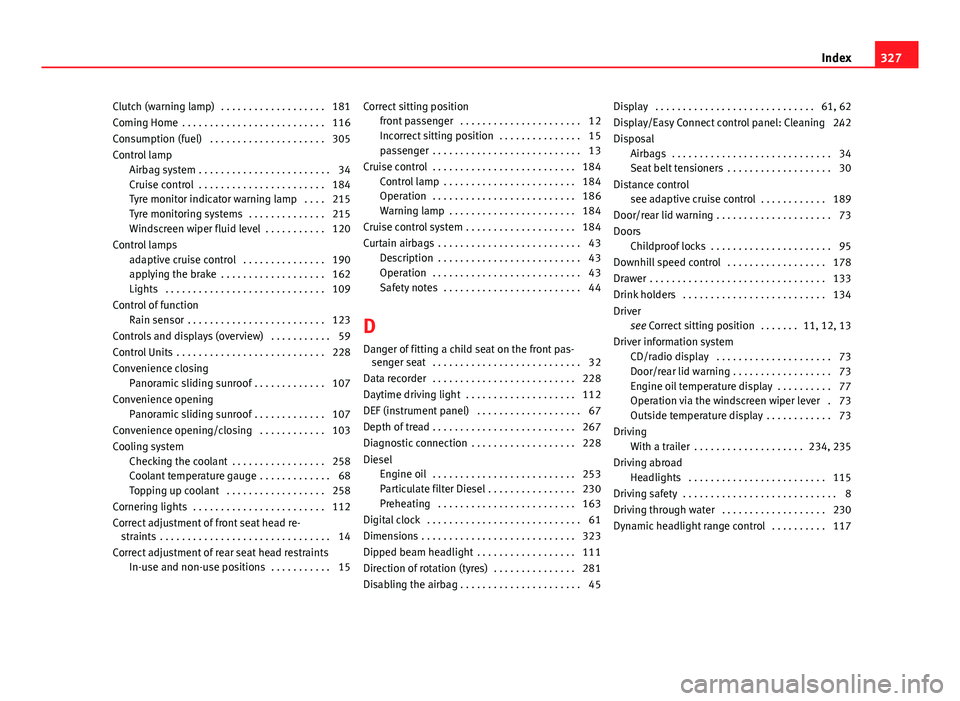
Clutch (warning lamp) . . . . . . . . . . . . . . . . . . . 181
Coming Home . . . . . . . . . . . . . . . . . . . . . . . . . . 116
Consumption (fuel) . . . . . . . . . . . . . . . . . . . . . 305
Control lampAirbag system . . . . . . . . . . . . . . . . . . . . . . . . 34
Cruise control . . . . . . . . . . . . . . . . . . . . . . . 184
Tyre monitor indicator warning lamp . . . . 215
Tyre monitoring systems . . . . . . . . . . . . . . 215
Windscreen wiper fluid level . . . . . . . . . . . 120
Control lamps adaptive cruise control . . . . . . . . . . . . . . . 190
applying the brake . . . . . . . . . . . . . . . . . . . 162
Lights . . . . . . . . . . . . . . . . . . . . . . . . . . . . . 109
Control of function Rain sensor . . . . . . . . . . . . . . . . . . . . . . . . . 123
Controls and displays (overview) . . . . . . . . . . . 59
Control Units . . . . . . . . . . . . . . . . . . . . . . . . . . . 228
Convenience closing Panoramic sliding sunroof . . . . . . . . . . . . . 107
Convenience opening Panoramic sliding sunroof . . . . . . . . . . . . . 107
Convenience opening/closing . . . . . . . . . . . . 103
Cooling system Checking the coolant . . . . . . . . . . . . . . . . . 258
Coolant temperature gauge . . . . . . . . . . . . . 68
Topping up coolant . . . . . . . . . . . . . . . . . . 258
Cornering lights . . . . . . . . . . . . . . . . . . . . . . . . 112
Correct adjustment of front seat head re- straints . . . . . . . . . . . . . . . . . . . . . . . . . . . . . . . 14
Correct adjustment of rear seat head restraints In-use and non-use positions . . . . . . . . . . . 15 Correct sitting position
front passenger . . . . . . . . . . . . . . . . . . . . . . 12
Incorrect sitting position . . . . . . . . . . . . . . . 15
passenger . . . . . . . . . . . . . . . . . . . . . . . . . . . 13
Cruise control . . . . . . . . . . . . . . . . . . . . . . . . . . 184 Control lamp . . . . . . . . . . . . . . . . . . . . . . . . 184
Operation . . . . . . . . . . . . . . . . . . . . . . . . . . 186
Warning lamp . . . . . . . . . . . . . . . . . . . . . . . 184
Cruise control system . . . . . . . . . . . . . . . . . . . . 184
Curtain airbags . . . . . . . . . . . . . . . . . . . . . . . . . . 43 Description . . . . . . . . . . . . . . . . . . . . . . . . . . 43
Operation . . . . . . . . . . . . . . . . . . . . . . . . . . . 43
Safety notes . . . . . . . . . . . . . . . . . . . . . . . . . 44
D Danger of fitting a child seat on the front pas- senger seat . . . . . . . . . . . . . . . . . . . . . . . . . . . 32
Data recorder . . . . . . . . . . . . . . . . . . . . . . . . . . 228
Daytime driving light . . . . . . . . . . . . . . . . . . . . 112
DEF (instrument panel) . . . . . . . . . . . . . . . . . . . 67
Depth of tread . . . . . . . . . . . . . . . . . . . . . . . . . . 267
Diagnostic connection . . . . . . . . . . . . . . . . . . . 228
Diesel Engine oil . . . . . . . . . . . . . . . . . . . . . . . . . . 253
Particulate filter Diesel . . . . . . . . . . . . . . . . 230
Preheating . . . . . . . . . . . . . . . . . . . . . . . . . 163
Digital clock . . . . . . . . . . . . . . . . . . . . . . . . . . . . 61
Dimensions . . . . . . . . . . . . . . . . . . . . . . . . . . . . 323
Dipped beam headlight . . . . . . . . . . . . . . . . . . 111
Direction of rotation (tyres) . . . . . . . . . . . . . . . 281
Disabling the airbag . . . . . . . . . . . . . . . . . . . . . . 45 Display . . . . . . . . . . . . . . . . . . . . . . . . . . . . . 61, 62
Display/Easy Connect control panel: Cleaning . .242
Disposal
Airbags . . . . . . . . . . . . . . . . . . . . . . . . . . . . . 34
Seat belt tensioners . . . . . . . . . . . . . . . . . . . 30
Distance control see adaptive cruise control . . . . . . . . . . . . 189
Door/rear lid warning . . . . . . . . . . . . . . . . . . . . . 73
Doors Childproof locks . . . . . . . . . . . . . . . . . . . . . . 95
Downhill speed control . . . . . . . . . . . . . . . . . . 178
Drawer . . . . . . . . . . . . . . . . . . . . . . . . . . . . . . . . 133
Drink holders . . . . . . . . . . . . . . . . . . . . . . . . . . 134
Driver see Correct sitting position . . . . . . . 11, 12, 13
Driver information system CD/radio display . . . . . . . . . . . . . . . . . . . . . 73
Door/rear lid warning . . . . . . . . . . . . . . . . . . 73
Engine oil temperature display . . . . . . . . . . 77
Operation via the windscreen wiper lever . 73
Outside temperature display . . . . . . . . . . . . 73
Driving With a trailer . . . . . . . . . . . . . . . . . . . . 234, 235
Driving abroad Headlights . . . . . . . . . . . . . . . . . . . . . . . . . 115
Driving safety . . . . . . . . . . . . . . . . . . . . . . . . . . . . 8
Driving through water . . . . . . . . . . . . . . . . . . . 230
Dynamic headlight range control . . . . . . . . . . 117
327
Index
Page 333 of 339
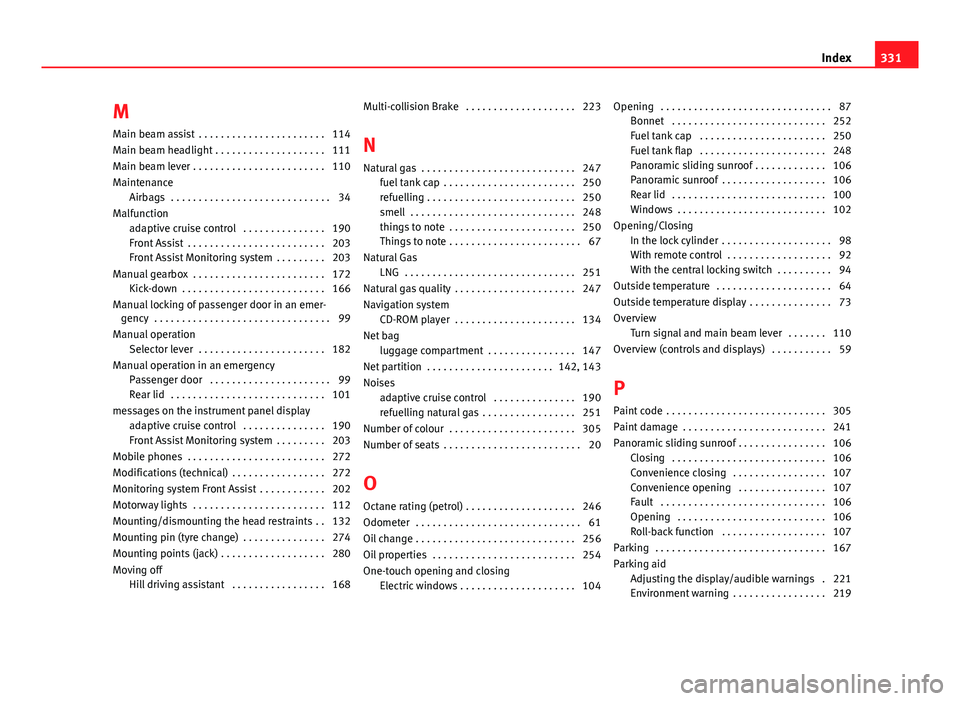
M
Main beam assist . . . . . . . . . . . . . . . . . . . . . . . 114
Main beam headlight . . . . . . . . . . . . . . . . . . . . 111
Main beam lever . . . . . . . . . . . . . . . . . . . . . . . . 110
Maintenance Airbags . . . . . . . . . . . . . . . . . . . . . . . . . . . . . 34
Malfunction adaptive cruise control . . . . . . . . . . . . . . . 190
Front Assist . . . . . . . . . . . . . . . . . . . . . . . . . 203
Front Assist Monitoring system . . . . . . . . . 203
Manual gearbox . . . . . . . . . . . . . . . . . . . . . . . . 172 Kick-down . . . . . . . . . . . . . . . . . . . . . . . . . . 166
Manual locking of passenger door in an emer- gency . . . . . . . . . . . . . . . . . . . . . . . . . . . . . . . . 99
Manual operation Selector lever . . . . . . . . . . . . . . . . . . . . . . . 182
Manual operation in an emergency Passenger door . . . . . . . . . . . . . . . . . . . . . . 99
Rear lid . . . . . . . . . . . . . . . . . . . . . . . . . . . . 101
messages on the instrument panel display adaptive cruise control . . . . . . . . . . . . . . . 190
Front Assist Monitoring system . . . . . . . . . 203
Mobile phones . . . . . . . . . . . . . . . . . . . . . . . . . 272
Modifications (technical) . . . . . . . . . . . . . . . . . 272
Monitoring system Front Assist . . . . . . . . . . . . 202
Motorway lights . . . . . . . . . . . . . . . . . . . . . . . . 112
Mounting/dismounting the head restraints . . 132
Mounting pin (tyre change) . . . . . . . . . . . . . . . 274
Mounting points (jack) . . . . . . . . . . . . . . . . . . . 280
Moving off Hill driving assistant . . . . . . . . . . . . . . . . . 168 Multi-collision Brake . . . . . . . . . . . . . . . . . . . . 223
N
Natural gas . . . . . . . . . . . . . . . . . . . . . . . . . . . . 247 fuel tank cap . . . . . . . . . . . . . . . . . . . . . . . . 250
refuelling . . . . . . . . . . . . . . . . . . . . . . . . . . . 250
smell . . . . . . . . . . . . . . . . . . . . . . . . . . . . . . 248
things to note . . . . . . . . . . . . . . . . . . . . . . . 250
Things to note . . . . . . . . . . . . . . . . . . . . . . . . 67
Natural Gas LNG . . . . . . . . . . . . . . . . . . . . . . . . . . . . . . . 251
Natural gas quality . . . . . . . . . . . . . . . . . . . . . . 247
Navigation system CD-ROM player . . . . . . . . . . . . . . . . . . . . . . 134
Net bag luggage compartment . . . . . . . . . . . . . . . . 147
Net partition . . . . . . . . . . . . . . . . . . . . . . . 142, 143
Noises adaptive cruise control . . . . . . . . . . . . . . . 190
refuelling natural gas . . . . . . . . . . . . . . . . . 251
Number of colour . . . . . . . . . . . . . . . . . . . . . . . 305
Number of seats . . . . . . . . . . . . . . . . . . . . . . . . . 20
O
Octane rating (petrol) . . . . . . . . . . . . . . . . . . . . 246
Odometer . . . . . . . . . . . . . . . . . . . . . . . . . . . . . . 61
Oil change . . . . . . . . . . . . . . . . . . . . . . . . . . . . . 256
Oil properties . . . . . . . . . . . . . . . . . . . . . . . . . . 254
One-touch opening and closing Electric windows . . . . . . . . . . . . . . . . . . . . . 104 Opening . . . . . . . . . . . . . . . . . . . . . . . . . . . . . . . 87
Bonnet . . . . . . . . . . . . . . . . . . . . . . . . . . . . 252
Fuel tank cap . . . . . . . . . . . . . . . . . . . . . . . 250
Fuel tank flap . . . . . . . . . . . . . . . . . . . . . . . 248
Panoramic sliding sunroof . . . . . . . . . . . . . 106
Panoramic sunroof . . . . . . . . . . . . . . . . . . . 106
Rear lid . . . . . . . . . . . . . . . . . . . . . . . . . . . . 100
Windows . . . . . . . . . . . . . . . . . . . . . . . . . . . 102
Opening/Closing In the lock cylinder . . . . . . . . . . . . . . . . . . . . 98
With remote control . . . . . . . . . . . . . . . . . . . 92
With the central locking switch . . . . . . . . . . 94
Outside temperature . . . . . . . . . . . . . . . . . . . . . 64
Outside temperature display . . . . . . . . . . . . . . . 73
Overview Turn signal and main beam lever . . . . . . . 110
Overview (controls and displays) . . . . . . . . . . . 59
P
Paint code . . . . . . . . . . . . . . . . . . . . . . . . . . . . . 305
Paint damage . . . . . . . . . . . . . . . . . . . . . . . . . . 241
Panoramic sliding sunroof . . . . . . . . . . . . . . . . 106 Closing . . . . . . . . . . . . . . . . . . . . . . . . . . . . 106
Convenience closing . . . . . . . . . . . . . . . . . 107
Convenience opening . . . . . . . . . . . . . . . . 107
Fault . . . . . . . . . . . . . . . . . . . . . . . . . . . . . . 106
Opening . . . . . . . . . . . . . . . . . . . . . . . . . . . 106
Roll-back function . . . . . . . . . . . . . . . . . . . 107
Parking . . . . . . . . . . . . . . . . . . . . . . . . . . . . . . . 167
Parking aid Adjusting the display/audible warnings . 221
Environment warning . . . . . . . . . . . . . . . . . 219
331
Index