trailer Seat Leon SC 2013 Owner's Guide
[x] Cancel search | Manufacturer: SEAT, Model Year: 2013, Model line: Leon SC, Model: Seat Leon SC 2013Pages: 339, PDF Size: 4.8 MB
Page 239 of 339
237
Trailer
Note
● SEAT recommends that the towing hooks be fitted at a specialised work-
shop. Consult your SEAT dealer in case additional modifications to your ve-
hicle are necessary.
● Due to the specific design of the exhaust, the fitting of a conventional
towing hook is not recommended for some sportier versions. Please consult
your Technical Service.
Safety FirstOperating instructionsPractical TipsTechnical specifications
Page 279 of 339
277
Emergencies
Note
Do not use the compressor for longer than 6 minutes at a time, as it could
overheat. Once it has cooled down, the compressor may be used again.
After changing a wheel
– Attach the “max label. 80 km/h” from the tyre repair kit on the
instrument panel, clearly within driver's field of view.
– Stop the vehicle after 10 minutes driving and check the tyre
pressure.
– If tyre pressure is less than 1.3 bar, the tyre is too badly dam-
aged. Do not carry on driving!
WARNING
After repairing a tyre please note the following points:
● Do not drive faster than 80 km/h.
● Avoid heavy acceleration, hard braking and fast cornering.
● Vehicle handling could be impaired.
● If the tyre is very damaged, seek professional assistance.
For the sake of the environment
You can dispose of the used bottle of sealing compound at a SEAT Official
Service.
Note
After repairing a tyre, remember to purchase a new bottle of sealing com-
pound from a SEAT Official Service or a specialised workshop. Changing a wheel
What to do first
Before changing the wheel, the following preliminary steps
are required. – Please observe the important safety notes ⇒ page 274.
– Apply the handbrake.
– Manual gearbox: Select first gear.
– Automatic gearbox: Move the selector lever to P.
– When towing a trailer: Unhitch the trailer from your vehicle.
– Have the vehicle tool kit ⇒ page 274 and the spare wheel ready
⇒ page 282.
WARNING
If you change the wheel on a slope, block the wheel on the opposite side
of the car with a stone or similar to prevent the vehicle from moving.
Safety FirstOperating instructionsPractical TipsTechnical specifications
Page 288 of 339
286Emergencies
Towing and tow-starting the vehicle
General information
Points to observe when tow-starting or towing away If you use a tow rope:
Notes for the driver of the towing vehicle
– The tow rope must be taut before you drive off.
– Release the clutch very carefully when starting the vehicle
(manual gearbox), or accelerate gently (automatic gearbox).
Notes for the driver of the towed vehicle
– The ignition should be switched on so that the turn signals,
windscreen wipers and washers can be used. Please ensure
that the steering wheel is unlocked when you switch on the ig-
nition, and that it moves freely.
– Put the gearbox lever in neutral (manual gearbox) or move the
selector lever to position N (automatic gearbox).
– The brake servo only works when the engine is running. Consid-
erably more effort is required on the brake pedal when the en-
gine is switched off.
– Remember that the power steering only works when the ignition
is switched on and the vehicle is moving 1)
. Otherwise, consider-
ably more strength than usual will be required when steering. –
Ensure that the tow rope remains taut at all times.
Tow rope or tow bar
It is easier and safer to tow a vehicle with a tow bar. You should only use a
tow rope if you do not have a tow bar.
A tow rope should be slightly elastic to avoid damage to both vehicles. It is
advisable to use a tow rope made of synthetic fibre or similarly elastic mate-
rial.
Only attach the tow rope or the tow bar to the towing rings ⇒ page 287.
Driving style
Towing requires some experience, especially when using a tow rope. Both
drivers should be familiar with the technique required for towing. Inexper-
ienced drivers should not attempt to tow.
Do not pull too hard with the towing vehicle and take care to avoid jerking
the tow rope. When towing on an unpaved road, there is always a risk of
overloading and damaging the anchorage points.
WARNING
If the vehicle has no electrical power, the brake lights, turn signals and
all other lights will no longer function. Do not have the vehicle towed
away. Failure to do so could result in an accident.
CAUTION
If there is no oil in the gearbox or no lubricant in the automatic transmission
the car may only be towed with the driven wheels lifted clear of the road, or
transported on a special car transporter or trailer.
1)
Important: the battery must be correctly charged.
Page 292 of 339
290Emergencies
Note
● If it is not possible to tow the vehicle in the normal way, or if it has to be
towed further than 50 km (30 miles), it must be transported on a special car
transporter or trailer.
● Should the power supply to the selector lever be interrupted in posi-
tion P, the selector lever will be locked. Before the vehicle can be recovered/
manoeuvred you must manually release the selector lever ⇒ page 182.
Page 309 of 339
307
Technical specifications
Towing a trailer Trailer weights
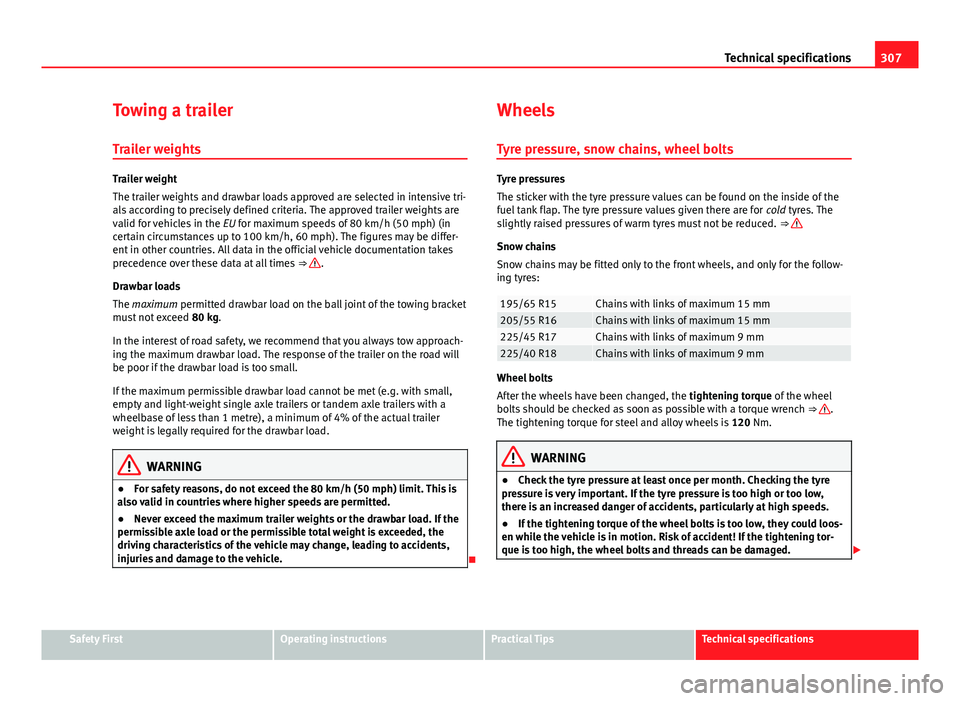
Trailer weight
The trailer weights and drawbar loads approved are selected in intensive tri-
als according to precisely defined criteria. The approved trailer weights are
valid for vehicles in the EU for maximum speeds of 80 km/h (50 mph) (in
certain circumstances up to 100 km/h, 60 mph). The figures may be differ-
ent in other countries. All data in the official vehicle documentation takes
precedence over these data at all times ⇒
.
Drawbar loads
The maximum permitted drawbar load on the ball joint of the towing bracket
must not exceed 80 kg.
In the interest of road safety, we recommend that you always tow approach-
ing the maximum drawbar load. The response of the trailer on the road will
be poor if the drawbar load is too small.
If the maximum permissible drawbar load cannot be met (e.g. with small,
empty and light-weight single axle trailers or tandem axle trailers with a
wheelbase of less than 1 metre), a minimum of 4% of the actual trailer
weight is legally required for the drawbar load.
WARNING
● For safety reasons, do not exceed the 80 km/h (50 mph) limit. This is
also valid in countries where higher speeds are permitted.
● Never exceed the maximum trailer weights or the drawbar load. If the
permissible axle load or the permissible total weight is exceeded, the
driving characteristics of the vehicle may change, leading to accidents,
injuries and damage to the vehicle.
Wheels
Tyre pressure, snow chains, wheel bolts
Tyre pressures
The sticker with the tyre pressure values can be found on the inside of the
fuel tank flap. The tyre pressure values given there are for cold tyres. The
slightly raised pressures of warm tyres must not be reduced. ⇒
Snow chains
Snow chains may be fitted only to the front wheels, and only for the follow-
ing tyres:
195/65 R15Chains with links of maximum 15 mm205/55 R16Chains with links of maximum 15 mm225/45 R17Chains with links of maximum 9 mm225/40 R18Chains with links of maximum 9 mm
Wheel bolts
After the wheels have been changed, the tightening torque of the wheel
bolts should be checked as soon as possible with a torque wrench ⇒
.
The tightening torque for steel and alloy wheels is 120 Nm.
WARNING
● Check the tyre pressure at least once per month. Checking the tyre
pressure is very important. If the tyre pressure is too high or too low,
there is an increased danger of accidents, particularly at high speeds.
● If the tightening torque of the wheel bolts is too low, they could loos-
en while the vehicle is in motion. Risk of accident! If the tightening tor-
que is too high, the wheel bolts and threads can be damaged.
Safety FirstOperating instructionsPractical TipsTechnical specifications
Page 312 of 339
310Technical specifications
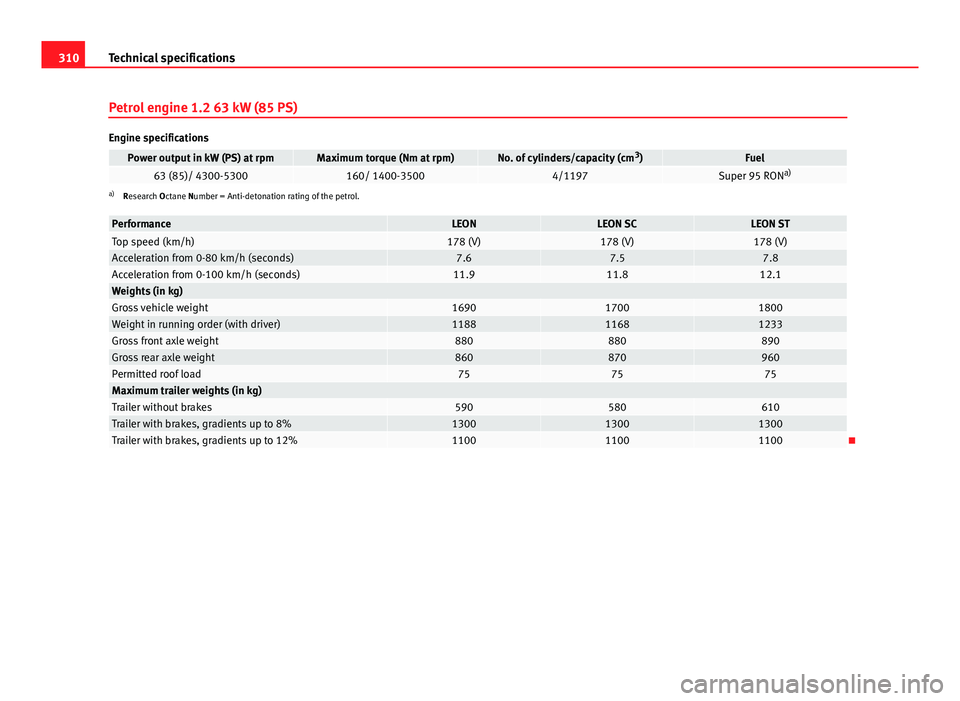
Petrol engine 1.2 63 kW (85 PS)
Engine specifications
Power output in kW (PS) at rpmMaximum torque (Nm at rpm)No. of cylinders/capacity (cm 3
)Fuel63 (85)/ 4300-5300160/ 1400-35004/1197Super 95 RON a)a)
Research Octane Number = Anti-detonation rating of the petrol.
PerformanceLEONLEON SCLEON STTop speed (km/h)178 (V)178 (V)178 (V)Acceleration from 0-80 km/h (seconds)7.67.57.8Acceleration from 0-100 km/h (seconds)11.911.812.1Weights (in kg)Gross vehicle weight169017001800Weight in running order (with driver)118811681233Gross front axle weight880880890Gross rear axle weight860870960Permitted roof load757575Maximum trailer weights (in kg)Trailer without brakes590580610Trailer with brakes, gradients up to 8%130013001300Trailer with brakes, gradients up to 12%110011001100
Page 313 of 339
311
Technical specifications
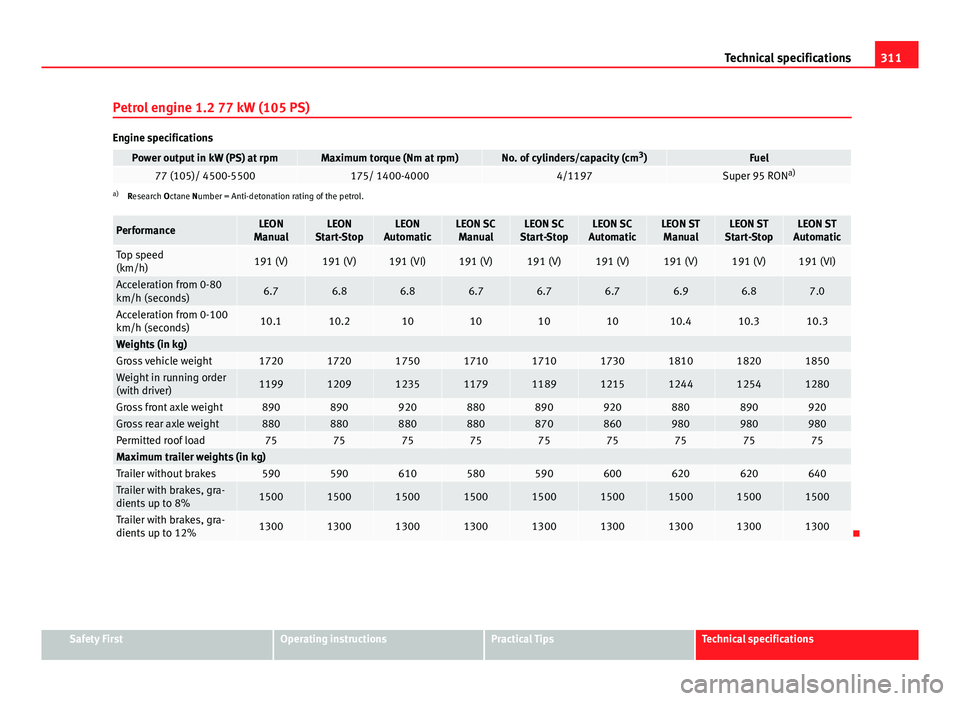
Petrol engine 1.2 77 kW (105 PS)
Engine specifications
Power output in kW (PS) at rpmMaximum torque (Nm at rpm)No. of cylinders/capacity (cm 3
)Fuel77 (105)/ 4500-5500175/ 1400-40004/1197Super 95 RON a)a)
Research Octane Number = Anti-detonation rating of the petrol.
PerformanceLEON
ManualLEON
Start-StopLEON
AutomaticLEON SC ManualLEON SC
Start-StopLEON SC
AutomaticLEON ST ManualLEON ST
Start-StopLEON ST
Automatic
Top speed
(km/h)191 (V)191 (V)191 (VI)191 (V)191 (V)191 (V)191 (V)191 (V)191 (VI)
Acceleration from 0-80
km/h (seconds)6.76.86.86.76.76.76.96.87.0
Acceleration from 0-100
km/h (seconds)10.110.21010101010.410.310.3
Weights (in kg)Gross vehicle weight172017201750171017101730181018201850Weight in running order
(with driver)119912091235117911891215124412541280
Gross front axle weight890890920880890920880890920Gross rear axle weight880880880880870860980980980Permitted roof load757575757575757575Maximum trailer weights (in kg)Trailer without brakes590590610580590600620620640Trailer with brakes, gra-
dients up to 8%150015001500150015001500150015001500
Trailer with brakes, gra-
dients up to 12%130013001300130013001300130013001300
Safety FirstOperating instructionsPractical TipsTechnical specifications
Page 314 of 339
312Technical specifications
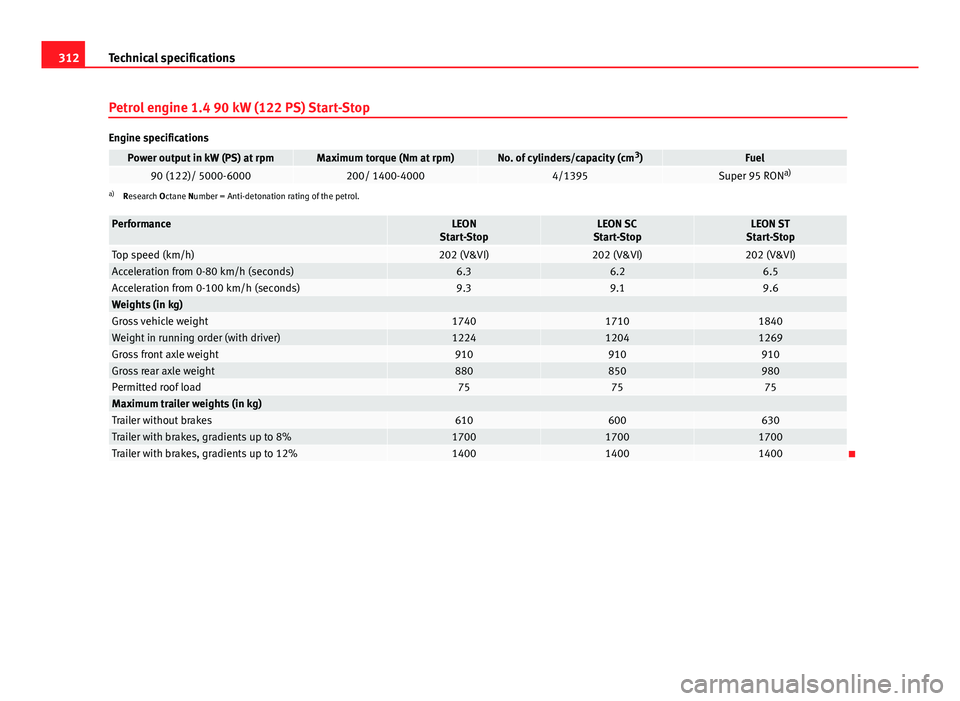
Petrol engine 1.4 90 kW (122 PS) Start-Stop
Engine specifications
Power output in kW (PS) at rpmMaximum torque (Nm at rpm)No. of cylinders/capacity (cm 3
)Fuel90 (122)/ 5000-6000200/ 1400-40004/1395Super 95 RON a)a)
Research Octane Number = Anti-detonation rating of the petrol.
PerformanceLEON
Start-StopLEON SC
Start-StopLEON ST
Start-Stop
Top speed (km/h)202 (V&VI)202 (V&VI)202 (V&VI)Acceleration from 0-80 km/h (seconds)6.36.26.5Acceleration from 0-100 km/h (seconds)9.39.19.6Weights (in kg)Gross vehicle weight174017101840Weight in running order (with driver)122412041269Gross front axle weight910910910Gross rear axle weight880850980Permitted roof load757575Maximum trailer weights (in kg)Trailer without brakes610600630Trailer with brakes, gradients up to 8%170017001700Trailer with brakes, gradients up to 12%140014001400
Page 315 of 339
313
Technical specifications
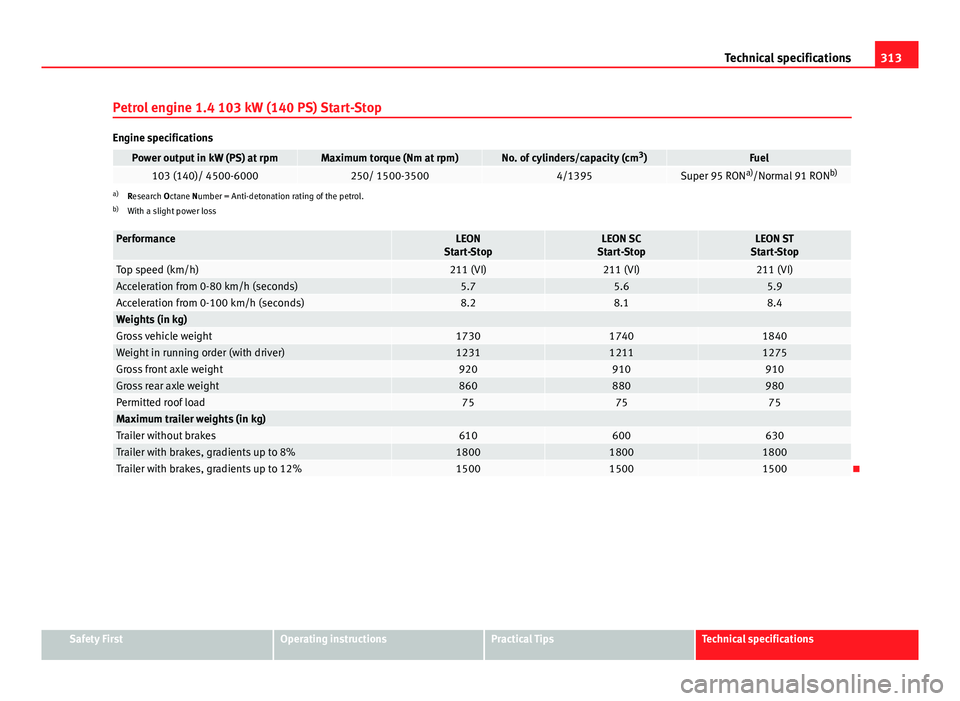
Petrol engine 1.4 103 kW (140 PS) Start-Stop
Engine specifications
Power output in kW (PS) at rpmMaximum torque (Nm at rpm)No. of cylinders/capacity (cm 3
)Fuel103 (140)/ 4500-6000250/ 1500-35004/1395Super 95 RON a)
/Normal 91 RON b)a)
Research Octane Number = Anti-detonation rating of the petrol.
b) With a slight power loss
PerformanceLEON
Start-StopLEON SC
Start-StopLEON ST
Start-Stop
Top speed (km/h)211 (VI)211 (VI)211 (VI)Acceleration from 0-80 km/h (seconds)5.75.65.9Acceleration from 0-100 km/h (seconds)8.28.18.4Weights (in kg)Gross vehicle weight173017401840Weight in running order (with driver)123112111275Gross front axle weight920910910Gross rear axle weight860880980Permitted roof load757575Maximum trailer weights (in kg)Trailer without brakes610600630Trailer with brakes, gradients up to 8%180018001800Trailer with brakes, gradients up to 12%150015001500
Safety FirstOperating instructionsPractical TipsTechnical specifications
Page 316 of 339
314Technical specifications
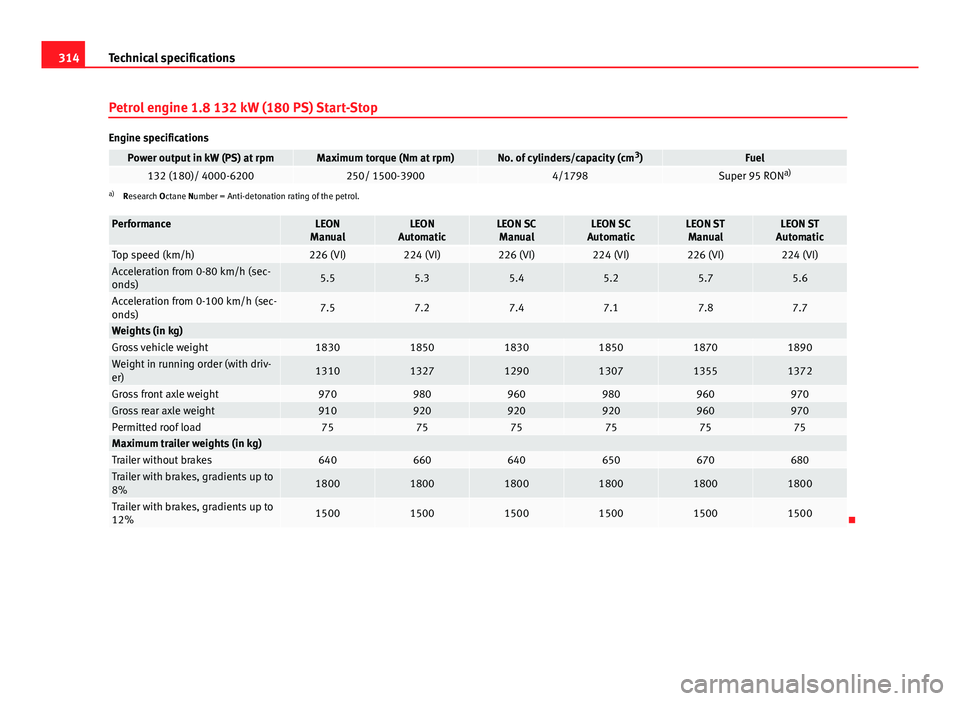
Petrol engine 1.8 132 kW (180 PS) Start-Stop
Engine specifications
Power output in kW (PS) at rpmMaximum torque (Nm at rpm)No. of cylinders/capacity (cm 3
)Fuel132 (180)/ 4000-6200250/ 1500-39004/1798Super 95 RON a)a)
Research Octane Number = Anti-detonation rating of the petrol.
PerformanceLEON
ManualLEON
AutomaticLEON SC ManualLEON SC
AutomaticLEON ST ManualLEON ST
Automatic
Top speed (km/h)226 (VI)224 (VI)226 (VI)224 (VI)226 (VI)224 (VI)Acceleration from 0-80 km/h (sec-
onds)5.55.35.45.25.75.6
Acceleration from 0-100 km/h (sec-
onds)7.57.27.47.17.87.7
Weights (in kg)Gross vehicle weight183018501830185018701890Weight in running order (with driv-
er)131013271290130713551372
Gross front axle weight970980960980960970Gross rear axle weight910920920920960970Permitted roof load757575757575Maximum trailer weights (in kg)Trailer without brakes640660640650670680Trailer with brakes, gradients up to
8%180018001800180018001800
Trailer with brakes, gradients up to
12%150015001500150015001500