spare wheel Seat Leon SC 2014 User Guide
[x] Cancel search | Manufacturer: SEAT, Model Year: 2014, Model line: Leon SC, Model: Seat Leon SC 2014Pages: 284, PDF Size: 5.85 MB
Page 219 of 284
Emergencies
Snow chains will improve braking ability as
well as traction in winter conditions.
F or t
echnical reasons snow chains may only
be used with the following wheel rim/tyre
combination.
195/65 R15Chains with links of maximum 15 mm
205/55 R16Chains with links of maximum 15 mm
225/45 R17Chains with links of maximum 9 mm
225/40 R18Chains with links of maximum 9 mm Remove wheel covers and any
integral trim
ring before fitting snow chains.
R emo
ve the chains when roads are free of
snow
. Otherwise they will impair handling,
damage the tyres and wear out very quickly. Emergencies
Changing a wheel What to do first Read the additional information carefully
››› page 34
– If you have a flat tyre or puncture, park the
car as far away from the flow of traffic as
possible in a safe place. If you have a punc-
ture, stop the vehicle on a horizontal sur-
face. If you are on a slope, take extra care.
– Apply the handbrake.
– Switch on the hazard warning lights.
– Manual gearbox: select the 1st gear.
– Automatic gearbox: move the selector lever
to P.
– When towing a trailer: unhitch the trailer
from your vehicle.
– Have the vehicle tool kit ›››
page 220 and
the spare wheel ready ›››
page 214.
– Observe the applicable legislation for each
country (reflective vest, warning triangles,
etc.).
– All vehicle occupants should leave the car.
They should wait in a safe area (for in-
stance behind the roadside crash barrier). WARNING
● Always observe the above steps and pro-
tect yourself and other road users.
● If you change the wheel on a slope, block
the wheel on the opposite side of the car with
a stone or similar to prevent the vehicle from
moving. Wheel covers*
Fig. 182
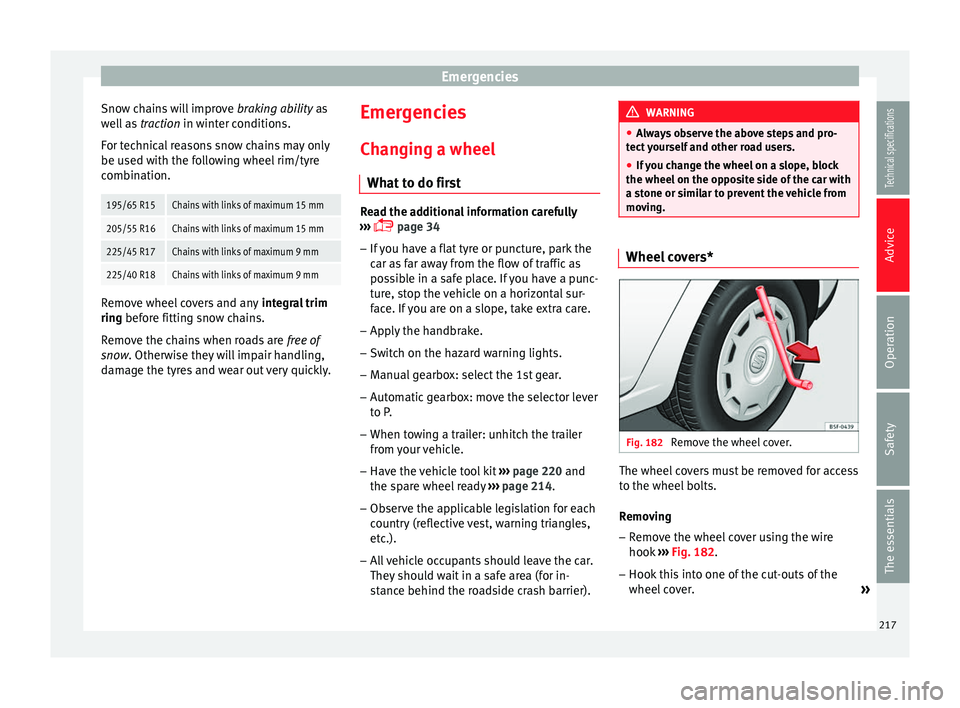
Remove the wheel cover. The wheel covers must be removed for access
to the wheel bolts.
Removing
– Remove the wheel cover using the wire
hook ›››
Fig. 182 .
– Hook thi
s into one of the cut-outs of the
wheel cover. »
217
Technical specifications
Advice
Operation
Safety
The essentials
Page 221 of 284
Emergencies
Raising the vehicle Fig. 186
Crossbar: marks. Fig. 187
Strut: mounting the jack on the vehi-
cle. –
Place the jack* (vehicle tools) on a firm sur-
face. If necessary use a large, strong board
or similar support. On a slippery surface
(such as tiles) place the jack on a rubber
mat or similar to prevent it from slipping.
››› . –
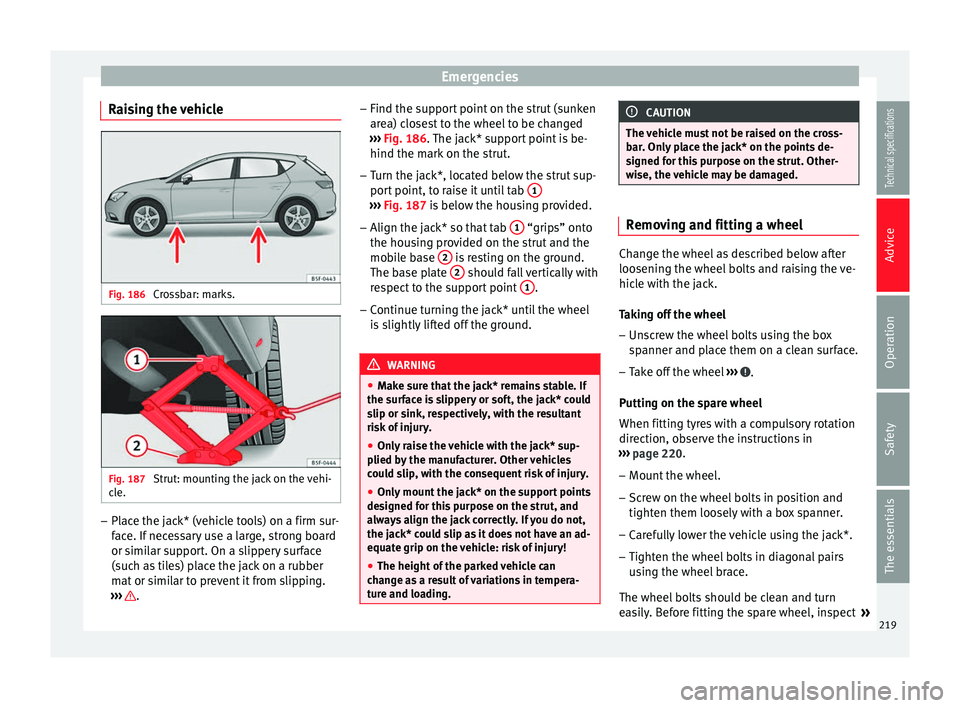
Find the support point on the strut (sunken
area) closest to the wheel to be changed
››› Fig. 186 . The jack* support point is be-
hind the m ark
on the strut.
– Turn the jack*, located below the strut sup-
port point, to raise it until tab 1 ›››
Fig. 187 is below the housing provided.
– Align the j
ack* so that tab 1 “grips” onto
the housing provided on the strut and the
mobile base 2 is resting on the ground.
The base plate 2 should fall vertically with
respect to the support point 1 .
– Continue turning the jack* until the wheel
is slightly lifted off the ground. WARNING
● Make sure that the jack* remains stable. If
the surface is slippery or soft, the jack* could
slip or sink, respectively, with the resultant
risk of injury.
● Only raise the vehicle with the jack* sup-
plied by the manufacturer. Other vehicles
could slip, with the consequent risk of injury.
● Only mount the jack* on the support points
designed for this purpose on the strut, and
always align the jack correctly. If you do not,
the jack* could slip as it does not have an ad-
equate grip on the vehicle: risk of injury!
● The height of the parked vehicle can
change as a result of variations in tempera-
ture and loading. CAUTION
The vehicle must not be raised on the cross-
bar. Only place the jack* on the points de-
signed for this purpose on the strut. Other-
wise, the vehicle may be damaged. Removing and fitting a wheel
Change the wheel as described below after
loosening the wheel bolts and raising the ve-
hicle with the jack.
Taking off the wheel
– Unscrew the wheel bolts using the box
spanner and place them on a clean surface.
– Take off the wheel ››› .
Putting on the spare wheel
When fitting tyres with a compulsory rotation
direction, observe the instructions in
››› page 220 .
– Mou nt
the wheel.
– Screw on the wheel bolts in position and
tighten them loosely with a box spanner.
– Carefully lower the vehicle using the jack*.
– Tighten the wheel bolts in diagonal pairs
using the wheel brace.
The wheel bolts should be clean and turn
easily. Before fitting the spare wheel, inspect »
219
Technical specifications
Advice
Operation
Safety
The essentials
Page 222 of 284
Advice
the wheel condition and hub mounting surfa-
ces. These surfaces must be clean before fit-
ting the wheel. CAUTION
When removing/fitting the wheel, the rim
may hit and damage the brake disc. For this
reason, please take care and get a second
person to assist you. Tyres with compulsory direction of
rotation
A directional tread pattern can be identified
by arrows on the sidewall that point in the di-
rection of rotation. Always observe the direc-
tion of rotation indicated when mounting the
wheel. This is important so that these tyres
can give maximum grip and avoid excessive
noise, tread wear and aquaplaning.
If, exceptionally, it is necessary to mount the
spare wheel* in the opposite direction of ro-
tation, please drive carefully, as in this case
the tyre does not have optimum conditions of
use. This is particularly important when driv-
ing on wet roads.
To benefit from the advantages of tyres with
this type of tread pattern, the defective tyre
should be replaced as soon as possible so
that all tyres again rotate in the correct direc-
tion. After changing a wheel –
On alloy wheels: replace the wheel bolt
caps.
– On plate wheels: replace the wheel hubcap
››› page 217.
– Put the tools and jack back in the luggage
compartment.
– If the replaced wheel does not fit in the
spare wheel housing, store it safely in the
luggage compartment ››› page 114.
– Check the tyre pressure of the newly moun-
ted tyre as soon as possible.
– In vehicles fitted with a tyre pressure indi-
cator, adjust the pressure and store the
reading in the radio/ Easy Connect system*
››› page 212.
– The wheel bolts should be tightened to 120
Nm. Check the torque as soon as possible
with a torque wrench. Meanwhile, drive
carefully.
– Have the flat tyre replaced as quickly as
possible. Tyre repair
Tools, anti-puncture kit* The tools and anti-puncture kit* are stored
under the floor panel in the luggage compart-
ment.
To access the vehicle tools:
– Lift up the floor surface by the plastic han-
dle until it is fastened to the tabs on both
sides.
Depending on the vehicle equipment, the
tyre repair kit* is located under the floor pan-
el in the luggage compartment.
The tool kit includes: ● Jack*
● Wire hook for pulling off the wheel cov-
er* /wheel bolt cap clip.
● Box spanner for wheel bolts*
● Towline anchorage
● Adapter for the anti-theft wheel bolts*
Some of the items listed are only provided in
certain model versions, or are optional ex-
tras. Note
The jack does not generally require any main-
tenance. If required, it should be greased us-
ing universal type grease. 220
Page 224 of 284
Advice
Contents of the tyre mobility system* Fig. 188
Standard representation: Contents
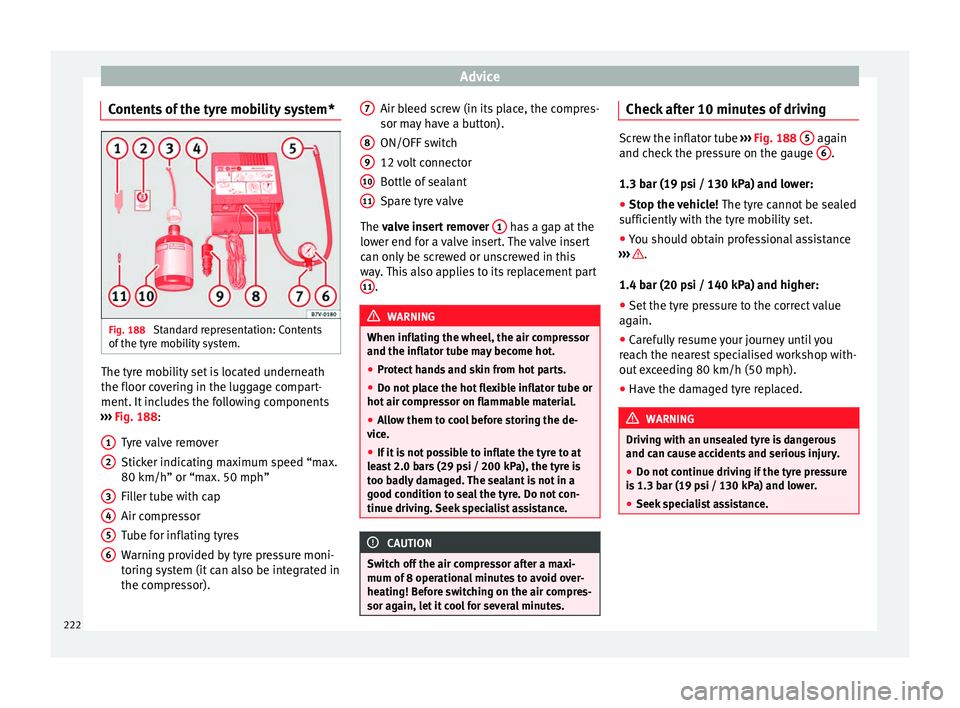
of the tyre mobility system. The tyre mobility set is located underneath
the floor covering in the luggage compart-
ment. It includes the following components
››› Fig. 188 :
T y
re valve remover
Sticker indicating maximum speed “max.
80 km/h” or “max. 50 mph”
Filler tube with cap
Air compressor
Tube for inflating tyres
Warning provided by tyre pressure moni-
toring system (it can also be integrated in
the compressor).
1 2
3
4
5
6 Air bleed screw (in its place, the compres-
sor may have a button).
ON/OFF switch
12 volt connector
Bottle of sealant
Spare tyre valve
The valve insert remover
1 has a gap at the
lower end for a valve insert. The valve insert
can only be screwed or unscrewed in this
way. This also applies to its replacement part 11 .
WARNING
When inflating the wheel, the air compressor
and the inflator tube may become hot.
● Protect hands and skin from hot parts.
● Do not place the hot flexible inflator tube or
hot air compressor on flammable material.
● Allow them to cool before storing the de-
vice.
● If it is not possible to inflate the tyre to at
least 2.0 bars (29 psi / 200 kPa), the tyre is
too badly damaged. The sealant is not in a
good condition to seal the tyre. Do not con-
tinue driving. Seek specialist assistance. CAUTION
Switch off the air compressor after a maxi-
mum of 8 operational minutes to avoid over-
heating! Before switching on the air compres-
sor again, let it cool for several minutes. 7
8
9
10
11 Check after 10 minutes of driving
Screw the inflator tube
››› Fig. 188 5 again
and check the pressure on the gauge 6 .
1.3 bar (19 psi / 130 kPa) and lower:
● Stop the vehicle! The tyre cannot be sealed
sufficiently with the tyre mobility set.
● You should obtain professional assistance
››› .
1.4 bar (20 psi / 140 kPa) and higher:
● Set the tyre pressure to the correct value
again.
● Carefully resume your journey until you
reach the nearest specialised workshop with-
out exceeding 80 km/h (50 mph).
● Have the damaged tyre replaced. WARNING
Driving with an unsealed tyre is dangerous
and can cause accidents and serious injury.
● Do not continue driving if the tyre pressure
is 1.3 bar (19 psi / 130 kPa) and lower.
● Seek specialist assistance. 222
Page 244 of 284
Technical specifications
VIN in the Easy Connect – Select: Function button CAR > control but-
ton (Car)* Systems > Service & Control >
Ch a
ssis number .
Chassis number
The VIN is located in the Easy Connect, on the
vehicle data sticker and under the wind-
screen, on the driver side ››› Fig. 226. Addi-
tional
ly, the chassis number is located in the
engine compartment, on the right-hand side.
The number is engraved on the top side rail,
and is partially covered.
Type plate
The type plate is located on the right side
door pillar. Vehicles for certain export coun-
tries do not have a type plate.
Vehicle data sticker
The vehicle data sticker is under the carpet
trim in the luggage compartment, in the
spare wheel well. A sticker with the vehicle
data is attached to the inside cover of the
Maintenance Programme.
The following information is provided on the
vehicle data sticker: ››› Fig. 225
Vehicle identification number (chassis
number)
1 Vehicle type, model, capacity, engine
type, finish, engine power and gearbox
type
Engine code, gearbox code, external
paint code and internal equipment code
Optional extras and PR numbers
Consumption values (l/100 km) and CO
2
emissions (g/km)
A Urban cycle consumption
B Out-of-town consumption
C Combined consumption and CO
2
emissions
Identifying letters
The identifying letters of the engine can be
viewed on the instrument panel when the en-
gine is switched off and the ignition is on.
● Hold down the 0.0/SET
4
››› Fig. 82 button
for more than 15 seconds.
Information on fuel
consumption
Fuel consumption The consumption and emission details
shown on the vehicle data sticker differ from
one vehicle to another.2 3
4
5 Vehicle fuel consumption and CO
2 emissions
appear on the vehicle data sticker in the
spare wheel well, inside the boot and on the
rear cover of the Maintenance Programme.
The fuel consumption and CO 2 emission val-
ues refer to the weight category assigned to
your vehicle according to the engine and
gearbox combination, as well as the specific
equipment fitted, and is only used to com-
pare between the different models.
The fuel consumption and CO 2 emissions do
not depend only on the performance of the
vehicle, they can also differ from the estab-
lished values depending on other factors
such as driving style, road conditions, traffic
conditions, environmental conditions, load
and number of passengers.
Calculation of fuel consumption
The consumption values have been calcula-
ted based on measurements performed or
supervised by certified CE laboratories ac-
cording to the latest version of directives
715/2007/EC and 80/1268/CEE (for more in-
formation consult the European Union Publi-
cations Office at EUR-Lex: © European Union,
http://eur-lex.europa.eu/en/index.htm) and
are valid for the kerb weight indicated for the
vehicle.
242
Page 278 of 284
Index
Rev counter . . . . . . . . . . . . . . . . . . . . . . . . . . . . 66, 67
Reverse gear (automatic gearbox) . . . . . . . . . . . 133
RME (fuel) . . . . . . . . . . . . . . . . . . . . . . . . . . . . . . . 196
Roll-back function Windows . . . . . . . . . . . . . . . . . . . . . . . . . . . . . . . 91
Roof carrier . . . . . . . . . . . . . . . . . . . . . . . . . . . . . . 122
Roof carrier system . . . . . . . . . . . . . . . . . . . . . . . . 122
Roof load . . . . . . . . . . . . . . . . . . . . . . . . . . . . . . . . 124 technical data . . . . . . . . . . . . . . . . . . . . . . . . . . 124
Roof rack . . . . . . . . . . . . . . . . . . . . . . . . . . . . . . . . 122
Running in New brake pads . . . . . . . . . . . . . . . . . . . . . . . . 146
New engine . . . . . . . . . . . . . . . . . . . . . . . . . . . . 140
New tyres . . . . . . . . . . . . . . . . . . . . . . . . . . . . . 208
S Safe driving . . . . . . . . . . . . . . . . . . . . . . . . . . . . . . 37
Safelock . . . . . . . . . . . . . . . . . . . . . . . . . . . . . . . . . 85 see also Anti-theft security system . . . . . . . . . . 82
Saf ety
. . . . . . . . . . . . . . . . . . . . . . . . . . . . . . . . . . . 37
child safety . . . . . . . . . . . . . . . . . . . . . . . . . . . . . 56
child seats . . . . . . . . . . . . . . . . . . . . . . . . . . . . . . 56
Safety equipment . . . . . . . . . . . . . . . . . . . . . . . . . . 37
Safety instructions head-protection airbags . . . . . . . . . . . . . . . . . . 53
side airbags . . . . . . . . . . . . . . . . . . . . . . . . . . . . 53
using child seats . . . . . . . . . . . . . . . . . . . . . . . . 57
Safety interlock for ignition key . . . . . . . . . . . . . . 129
Safety notes Seat belt tensioners . . . . . . . . . . . . . . . . . . . . . . 47
Using seat belts . . . . . . . . . . . . . . . . . . . . . . . . . 44
Saving fuel Conscientious driving . . . . . . . . . . . . . . . . . . . . 142
Inertia mode . . . . . . . . . . . . . . . . . . . . . . . . . . . 138
Saving tips (efficiency programme) . . . . . . . . . . . 78
Seat adjuster . . . . . . . . . . . . . . . . . . . . . . . . . . . . . 38 Seat belt
Adjusting . . . . . . . . . . . . . . . . . . . . . . . . . . . . . . . 13
Seat belt control lamp . . . . . . . . . . . . . . . . . . . . . . 43
Seat belt position for pregnant women . . . . . . . . . . . . . . . . . . . . . . 46
seat belts . . . . . . . . . . . . . . . . . . . . . . . . . . . . . . 46
Seat belt protection . . . . . . . . . . . . . . . . . . . . . . . . 44
Seat belts . . . . . . . . . . . . . . . . . . . . . . . . . . . . . . . . 43 adjustment . . . . . . . . . . . . . . . . . . . . . . . . . . . . . 46
Cleaning . . . . . . . . . . . . . . . . . . . . . . . . . . . . . . 189
control lamp . . . . . . . . . . . . . . . . . . . . . . . . . . . . 43
Safety notes . . . . . . . . . . . . . . . . . . . . . . . . . . . . 44
unfastened . . . . . . . . . . . . . . . . . . . . . . . . . . . . . 45
Seat belt tensioners . . . . . . . . . . . . . . . . . . . . . . . . 47
SEAT Drive Profile . . . . . . . . . . . . . . . . . . . . . . . . . 169
Seats adjustment . . . . . . . . . . . . . . . . . . . . . . . . . . . . 106
heating . . . . . . . . . . . . . . . . . . . . . . . . . . . . . . . 108
rear seat backrest . . . . . . . . . . . . . . . . . . . . . . . 110
Selective unlocking system . . . . . . . . . . . . . . . . . . 84
Selector lever Automatic gearbox . . . . . . . . . . . . . . . . . . . . . . 133
Selector lever (automatic gearbox) Malfunction . . . . . . . . . . . . . . . . . . . . . . . . . . . . 134
Manual release . . . . . . . . . . . . . . . . . . . . . . . . . 229
Service interval display . . . . . . . . . . . . . . . . . . . . . 80
Service intervals . . . . . . . . . . . . . . . . . . . . . . . . . . 200
Service notification: read . . . . . . . . . . . . . . . . . . . . 80
Setting Headlight range . . . . . . . . . . . . . . . . . . . . . . . . 100
Side airbags description . . . . . . . . . . . . . . . . . . . . . . . . . . . . . 52
safety instructions . . . . . . . . . . . . . . . . . . . . . . . 53
Side light . . . . . . . . . . . . . . . . . . . . . . . . . . . . . . . . 94
Sitting position driver . . . . . . . . . . . . . . . . . . . . . . . . . . . . . . . . . . 38
Sitting position for vehicle occupants . . . . . . . . . 38 Sliding/tilting sunroof
Convenience opening/closing . . . . . . . . . . . . . . 91
Smell of gas . . . . . . . . . . . . . . . . . . . . . . . . . . . . . 197
Snow chains . . . . . . . . . . . . . . . . . . . . . . . . 216, 243 All-wheel drive . . . . . . . . . . . . . . . . . . . . . . . . . 191
Spanner symbol . . . . . . . . . . . . . . . . . . . . . . . . . . . 80
Spare wheel . . . . . . . . . . . . . . . . . . . . . . . . . . . . . . 34
Special features Windscreen wipers . . . . . . . . . . . . . . . . . . . . . . 102
Speedometer . . . . . . . . . . . . . . . . . . . . . . . . . . . . . 72
Speed warning function . . . . . . . . . . . . . . . . . . . . . 79
Sport Mode . . . . . . . . . . . . . . . . . . . . . . . . . . . . . . 145
Start-Stop system . . . . . . . . . . . . . . . . . . . . . . . . . 148 Driver messages . . . . . . . . . . . . . . . . . . . . . . . . 150
Stop/Start the engine . . . . . . . . . . . . . . . . . . . 148
Switching on/off . . . . . . . . . . . . . . . . . . . . . . . . 149
The engine does not switch off . . . . . . . . . . . . 149
The engine starts by itself . . . . . . . . . . . . . . . . 149
Warning lamps . . . . . . . . . . . . . . . . . . . . . . . . . 148
Starting the vehicle . . . . . . . . . . . . . . . . . . . . . . . . 14
Starting (engine) . . . . . . . . . . . . . . . . . . . . . . . . . 129
Steering Electro-mechanical steering . . . . . . . . . . . . . . 190
Engage the steering lock (ignition key) . . . . . 130
Locking the steering (ignition key) . . . . . . . . . 129
Steering wheel Adjusting . . . . . . . . . . . . . . . . . . . . . . . . . . . . . . . 14
Gearshift paddles (automatic gearbox) . . . . . 135
Setting . . . . . . . . . . . . . . . . . . . . . . . . . . . . . . . . . 39
Storage area front seat . . . . . . . . . . . . . . . . . . . . . . . . . . . . . . 111
Storage compartment . . . . . . . . . . . . . . . . . . . . . 112
Storage compartments . . . . . . . . . . . . . . . . . . . . 111 Glove compartment lighting . . . . . . . . . . . . . . 101
Storing the rear shelf . . . . . . . . . . . . . . . . . . . . . . 116
Sun blind . . . . . . . . . . . . . . . . . . . . . . . . . . . 93, 102 Anti-trap function . . . . . . . . . . . . . . . . . . . . . . . . 93
276