brake Seat Leon SC 2014 Workshop Manual
[x] Cancel search | Manufacturer: SEAT, Model Year: 2014, Model line: Leon SC, Model: Seat Leon SC 2014Pages: 284, PDF Size: 5.85 MB
Page 200 of 284
Advice
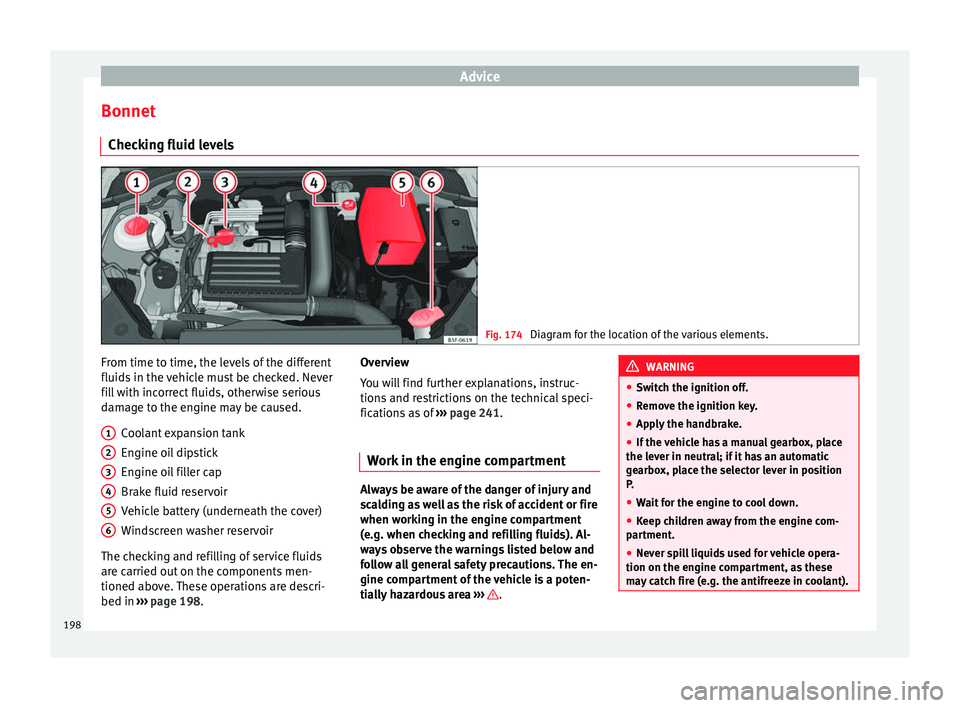
Bonnet Checking fluid levels Fig. 174
Diagram for the location of the various elements. From time to time, the levels of the different
fluids in the vehicle must be checked. Never
fill with incorrect fluids, otherwise serious
damage to the engine may be caused.
Coolant expansion tank
Engine oil dipstick
Engine oil filler cap
Brake fluid reservoir
Vehicle battery (underneath the cover)
Windscreen washer reservoir
The checking and refilling of service fluids
are carried out on the components men-
tioned above. These operations are descri-
bed in ››› page 198 .
1 2
3
4
5
6 Overview
You will find further explanations, instruc-
tions and restrictions on the technical speci-
fications as of
››› page 241 .
W ork
in the engine compartment Always be aware of the danger of injury and
scalding as well as the risk of accident or fire
when working in the engine compartment
(e.g. when checking and refilling fluids). Al-
ways observe the warnings listed below and
follow all general safety precautions. The en-
gine compartment of the vehicle is a poten-
tially hazardous area
››› . WARNING
● Switch the ignition off.
● Remove the ignition key.
● Apply the handbrake.
● If the vehicle has a manual gearbox, place
the lever in neutral; if it has an automatic
gearbox, place the selector lever in position
P.
● Wait for the engine to cool down.
● Keep children away from the engine com-
partment.
● Never spill liquids used for vehicle opera-
tion on the engine compartment, as these
may catch fire (e.g. the antifreeze in coolant). 198
Page 206 of 284
Advice
could damage the engine
. If there is no
c
oolant in the expansion tank, do not con-
tinue driving. You should obtain professio-
nal assistance ››› .
– If there is still some coolant in the expan-
sion tank, top up to the upper mark.
– Top up with coolant until the level becomes
stable.
– Screw the cap back on correctly.
Any loss of coolant fluid normally indicates a
leak in the cooling system. Take the vehicle
straight to a specialised workshop to have
the cooling system examined. If there are no
leaks in the engine cooling system, a loss of
coolant can only occur if the coolant boils
and is forced out of the system as a result of
overheating. WARNING
● The cooling system is under pressure. Do
not unscrew the cap on the coolant expan-
sion tank when the engine is hot: risk of
burns!
● The antifreeze and coolant fluid can be a
health hazard. Therefore, the antifreeze
should be stored in the original container in a
safe place out of reach of children. Failure to
comply could result in poisoning.
● If working inside the engine compartment,
remember that, even when the ignition is
switched off, the radiator fan may start up au- tomatically, and therefore there is a risk of in-
jury.
CAUTION
Do not top up the expansion tank with cool-
ant fluid if it is empty! Air could enter the
cooling system. In this case, stop driving.
Seek specialist assistance. Otherwise, there
is a risk of engine damage. Brake fluid
Topping up the brake fluid Read the additional information carefully
››› page 32
Checking the brake fluid level
The brake fluid level must be between the
MIN and MAX markings.
However, if the brake fluid level goes down
noticeably in a short time, or drops below the
MIN mark, there may be a leak in the brake
system. Seek specialist assistance. A warn-
ing light on the instrument panel display
monitors the brake fluid level ››› page 71.
In right-hand drive vehicles the brake fluid
reservoir is on the other side of the engine
compartment. Changing brake fluid
The regular intervals at which the brake fluid
should be replaced are listed in the Mainte-
nance Programme. We recommend you have
it replaced at a SEAT Official Service, during
an Inspection Service.
WARNING
● Brake fluid should be stored in the closed
original container in a safe place out of reach
of children. Risk of poisoning!
● If the brake fluid is left in the system for
too long and the brakes are subjected to
heavy use, vapour bubbles may form in the
brake system. This would seriously affect the
efficiency of the brakes and the safety of the
vehicle. This may cause an accident. CAUTION
Brake fluid should not come into contact with
the vehicle paintwork, as it is abrasive. Windscreen washer reservoir
Checking and topping up the
windscreen washer reservoir with
water Read the additional information carefully
››› page 32
204
Page 213 of 284
Wheels
205/55 R16 91V
This contains the following information:205Tyre width in mm
55Height/width ratio in %
RTyre construction: Radial
16Rim diameter in inches
91Load rating code
VSpeed index The
manufacturing date
is also indicated on
the ty
re sidewall (possibly only on the inner
part):
DOT... 2212...
it means, for example, that the tyre was man-
ufactured in the 22nd week of 2012.
But note that with some types of tyre, the ac-
tual tyre size can differ from the nominal size
marked on the tyre (for instance 205/55 R 16
91 W), and there may be significant differen-
ces in the contours of the tyres, even though
the tyres are marked with the same nominal
size designation. When replacing the tyres,
it is therefore important to make sure that
the actual size of the new tyres does not ex-
ceed the dimensions of the factory-approved
makes of tyre.
Failure to observe this requirement can af-
fect the clearance needed for the tyres. If the tyres rub against the bodywork, in certain
circumstances the tyres , suspension or
bodywork and pipes may be damaged, and
vehicle safety could be severely impaired
››› .
If you use tyres that are approved by SEAT
you can be sure that the actual tyre dimen-
sions will be correct for your vehicle. If you
decide to fit a different type of tyre, you must
obtain the appropriate manufacturer's certif-
icate from the tyre retailer to confirm that
the tyres are suitable for your vehicle. Keep
this certificate in a safe place.
Your SEAT Official Service will be able to ad-
vise you on which tyres may be fitted to your
vehicle.
It is best to have all servicing of wheels and
tyres performed by a specialised workshop.
They are familiar with the procedure and
have the necessary special tools and spare
parts as well as the proper facilities for dis-
posing of the old tyres respecting the envi-
ronment. WARNING
● It is very important to ensure that the tyres
you have chosen have adequate clearance.
When selecting replacement tyres, do not re-
ly entirely on the nominal tyre size marked on
the tyre, since the effective tyre size can dif-
fer significantly depending on the manufac-
turer. Inadequate tyre clearance can result in
damage to the tyres or the vehicle, causing a serious safety risk. Risk of accident! It may
also invalidate the vehicle's registration for
use on public roads.
●
Avoid running the vehicle on tyres that are
more than 6 years old. If you have no alterna-
tive, you should drive slowly and with extra
care at all times.
● If wheel trims are fitted after the car is pur-
chased, ensure that there is an adequate flow
of air for cooling the brake system. For the sake of the environment
Old tyres must be disposed of according to
the laws in the country concerned. Note
● Never mount used tyres if you are not sure
of their “previous history”.
● For technical reasons, it is not generally
possible to use the wheels from other vehi-
cles. In some cases, this may also be true for
the same model of wheel. Wheel bolts
The
wheel bolts
ar
e m
atched to the rims.
When installing different wheels (for instance
alloy wheels or wheels with winter tyres) it is
important to use the correct wheel bolts with
the right length and correctly shaped bolt
heads. This ensures that wheels are fitted »
211
Technical specifications
Advice
Operation
Safety
The essentials
Page 214 of 284
Advice
securely and that the brake system functions
correctly.
The wheel bolts must be clean and turn easi-
ly.
A special adapter is required to turn the anti-
theft wheel bolts* ››› page 218.
Tyre monitoring systems Introduction WARNING
Unsuitable handling of the wheels and tyres
may lead to sudden tyre pressure losses, to
tread separation or even to a blow-out.
● Check tyre pressures regularly and ensure
they are maintained at the pressures indica-
ted. Tyre pressure that is too low could cause
overheating, resulting in tread detachment or
even burst tyres.
● Tyre pressure should be that indicated on
the label when the tyres are cold at all times
››› page 243.
● Re
gularly check the cold inflation pressure
of the tyres. If necessary, change the tyre
pressure of the vehicle tyres while they are
cold.
● Regularly check your tyres for damage and
wear. ●
Never exceed the maximum permitted
speed or loads specified for the type of tyre
fitted on your vehicle. For the sake of the environment
Under-inflated tyres lead to increased fuel
consumption and tyre wear. Note
● Driving for the first time with new tyres at a
high speed can cause them to slightly ex-
pand, which could then produce an air pres-
sure warning.
● Only replace used tyres with those author-
ised by SEAT for the corresponding type vehi-
cle.
● Do not only rely on the tyre monitoring sys-
tem. Regularly check your tyres to ensure
that the tyre pressure is correct and that the
tyres are not damaged due to puncture, cuts,
tears and impacts/dents. Remove objects
from the tyres only when they have not
pierced the tyres. Tyre monitor indicator warning lamp
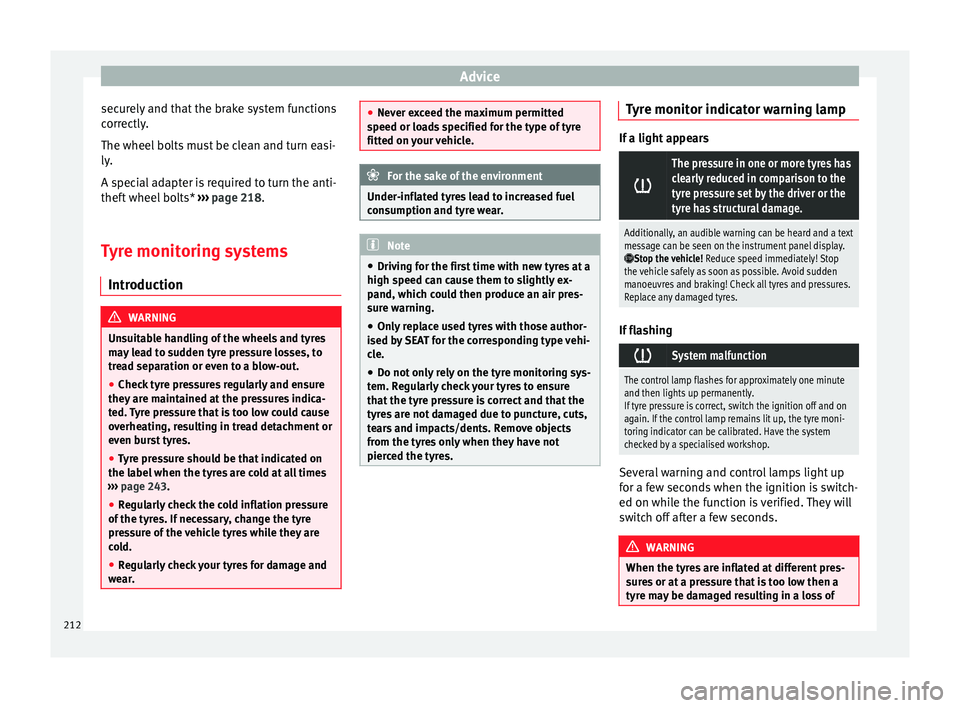
If a light appears
The pressure in one or more tyres has
clearly reduced in comparison to the
tyre pressure set by the driver or the
tyre has structural damage.
Additionally, an audible warning can be heard and a text
message can be seen on the instrument panel display.
Stop the vehicle!
Reduce speed immediately! Stop
the vehicle safely as soon as possible. Avoid sudden
manoeuvres and braking! Check all tyres and pressures.
Replace any damaged tyres. If flashing
System malfunction
The control lamp flashes for approximately one minute
and then lights up permanently.
If tyre pressure is correct, switch the ignition off and on
again. If the control lamp remains lit up, the tyre moni-
toring indicator can be calibrated. Have the system
checked by a specialised workshop.
Several warning and control lamps light up
for a few seconds when the ignition is switch-
ed on while the function is verified. They will
switch off after a few seconds.
WARNING
When the tyres are inflated at different pres-
sures or at a pressure that is too low then a
tyre may be damaged resulting in a loss of 212
Page 219 of 284
Emergencies
Snow chains will improve braking ability as
well as traction in winter conditions.
F or t
echnical reasons snow chains may only
be used with the following wheel rim/tyre
combination.
195/65 R15Chains with links of maximum 15 mm
205/55 R16Chains with links of maximum 15 mm
225/45 R17Chains with links of maximum 9 mm
225/40 R18Chains with links of maximum 9 mm Remove wheel covers and any
integral trim
ring before fitting snow chains.
R emo
ve the chains when roads are free of
snow
. Otherwise they will impair handling,
damage the tyres and wear out very quickly. Emergencies
Changing a wheel What to do first Read the additional information carefully
››› page 34
– If you have a flat tyre or puncture, park the
car as far away from the flow of traffic as
possible in a safe place. If you have a punc-
ture, stop the vehicle on a horizontal sur-
face. If you are on a slope, take extra care.
– Apply the handbrake.
– Switch on the hazard warning lights.
– Manual gearbox: select the 1st gear.
– Automatic gearbox: move the selector lever
to P.
– When towing a trailer: unhitch the trailer
from your vehicle.
– Have the vehicle tool kit ›››
page 220 and
the spare wheel ready ›››
page 214.
– Observe the applicable legislation for each
country (reflective vest, warning triangles,
etc.).
– All vehicle occupants should leave the car.
They should wait in a safe area (for in-
stance behind the roadside crash barrier). WARNING
● Always observe the above steps and pro-
tect yourself and other road users.
● If you change the wheel on a slope, block
the wheel on the opposite side of the car with
a stone or similar to prevent the vehicle from
moving. Wheel covers*
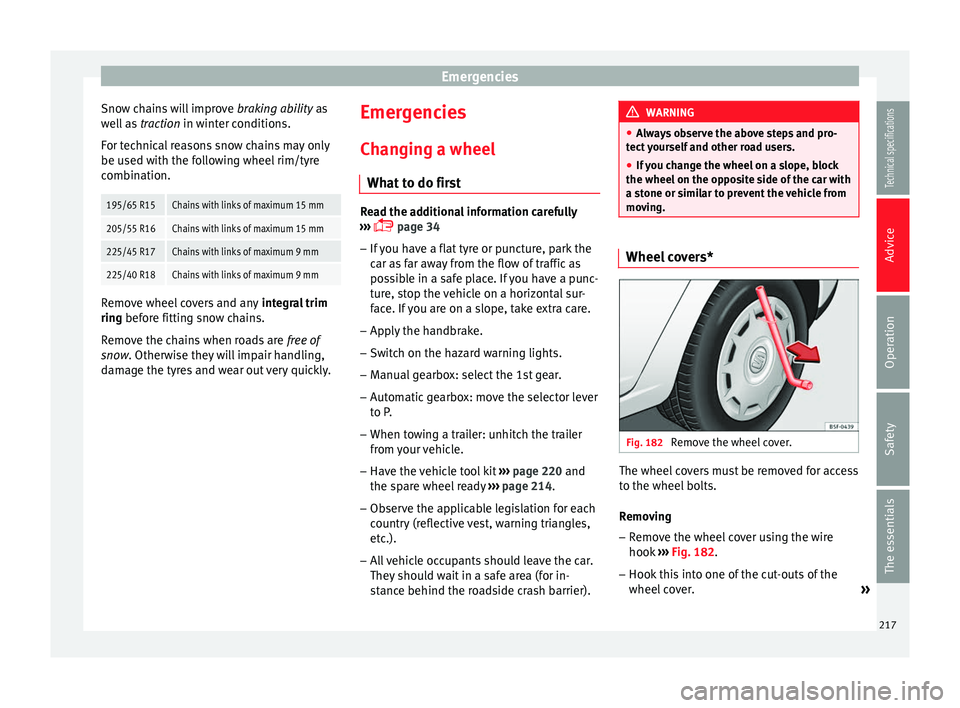
Fig. 182
Remove the wheel cover. The wheel covers must be removed for access
to the wheel bolts.
Removing
– Remove the wheel cover using the wire
hook ›››
Fig. 182 .
– Hook thi
s into one of the cut-outs of the
wheel cover. »
217
Technical specifications
Advice
Operation
Safety
The essentials
Page 222 of 284
Advice
the wheel condition and hub mounting surfa-
ces. These surfaces must be clean before fit-
ting the wheel. CAUTION
When removing/fitting the wheel, the rim
may hit and damage the brake disc. For this
reason, please take care and get a second
person to assist you. Tyres with compulsory direction of
rotation
A directional tread pattern can be identified
by arrows on the sidewall that point in the di-
rection of rotation. Always observe the direc-
tion of rotation indicated when mounting the
wheel. This is important so that these tyres
can give maximum grip and avoid excessive
noise, tread wear and aquaplaning.
If, exceptionally, it is necessary to mount the
spare wheel* in the opposite direction of ro-
tation, please drive carefully, as in this case
the tyre does not have optimum conditions of
use. This is particularly important when driv-
ing on wet roads.
To benefit from the advantages of tyres with
this type of tread pattern, the defective tyre
should be replaced as soon as possible so
that all tyres again rotate in the correct direc-
tion. After changing a wheel –
On alloy wheels: replace the wheel bolt
caps.
– On plate wheels: replace the wheel hubcap
››› page 217.
– Put the tools and jack back in the luggage
compartment.
– If the replaced wheel does not fit in the
spare wheel housing, store it safely in the
luggage compartment ››› page 114.
– Check the tyre pressure of the newly moun-
ted tyre as soon as possible.
– In vehicles fitted with a tyre pressure indi-
cator, adjust the pressure and store the
reading in the radio/ Easy Connect system*
››› page 212.
– The wheel bolts should be tightened to 120
Nm. Check the torque as soon as possible
with a torque wrench. Meanwhile, drive
carefully.
– Have the flat tyre replaced as quickly as
possible. Tyre repair
Tools, anti-puncture kit* The tools and anti-puncture kit* are stored
under the floor panel in the luggage compart-
ment.
To access the vehicle tools:
– Lift up the floor surface by the plastic han-
dle until it is fastened to the tabs on both
sides.
Depending on the vehicle equipment, the
tyre repair kit* is located under the floor pan-
el in the luggage compartment.
The tool kit includes: ● Jack*
● Wire hook for pulling off the wheel cov-
er* /wheel bolt cap clip.
● Box spanner for wheel bolts*
● Towline anchorage
● Adapter for the anti-theft wheel bolts*
Some of the items listed are only provided in
certain model versions, or are optional ex-
tras. Note
The jack does not generally require any main-
tenance. If required, it should be greased us-
ing universal type grease. 220
Page 223 of 284
Emergencies
TMS (Tyre Mobility System)* Read the additional information carefully
››› page 33
The Anti-puncture kit* (Tyre Mobility System)
will reliably seal punctures caused by the
penetration of a foreign body of up to about
4 mm in diameter. Do not remove foreign ob-
j
ects, e.g. screws or nails, from the tyre.
After inserting the sealant residue in the tyre,
you must again check the tyre pressure about
10 minutes after starting the engine.
You should only use the tire mobility set if
the vehicle is parked in a safe place, you are
familiar with the procedure and you have the
necessary tire mobility set! Otherwise, you
should seek professional assistance.
The tyre sealant must not be used in the
following cases:
● If the wheel rim has been damaged.
● In outside temperatures below -20°C (-4°F).
● In the event of cuts or perforations in the
tyre greater than 4 mm.
● If you have been driving with very low pres-
sure or a completely flat tyre.
● If the sealant bottle has passed its use by
date. WARNING
Using the tyre mobility system can be dan-
gerous, especially when filling the tyre at the
roadside. Please observe the following rules
to minimise the risk of injury:
● Stop the vehicle safely as soon as possible.
Park it at a safe distance from surrounding
traffic to fill the tyre.
● Ensure the ground on which you park is flat
and solid.
● All passengers and particularly children
must keep a safe distance from the work area.
● Turn on the hazard warning lights to warn
other road users.
● Use the tyre mobility system only if you are
familiar with the necessary procedures. Oth-
erwise, you should seek professional assis-
tance.
● The tyre mobility set is intended for tempo-
rary emergency use only until you can reach
the nearest specialised workshop.
● Replace the repaired tyre with the tire mo-
bility set as soon as possible.
● The sealant is a health hazard and must be
cleaned immediately if it comes into contact
with the skin.
● Always keep the tire mobility set out of the
reach of small children.
● Never use an equivalent jack, even if it has
been approved for your vehicle.
● Always stop the engine, apply the hand-
brake lever firmly and engage gear if using a manual gearbox, in order to reduce the risk of
vehicle involuntary movement.
WARNING
A tyre filled with sealant does not have the
same performance properties as a conven-
tional tyre.
● Never drive faster than 80 km/h (50 mph).
● Avoid heavy acceleration, hard braking and
fast cornering.
● Drive for only 10 minutes at a maximum
speed of 80 km/h (50 mph) and then check
the tyre. For the sake of the environment
Dispose of used or expired sealant observing
any legal requirements. Note
A new bottle of sealant can be purchased at
SEAT dealerships. Note
Take into account the separate instruction
manual of the tyre mobility set* manufactur-
er. 221
Technical specifications
Advice
Operation
Safety
The essentials
Page 226 of 284
Advice
8. Start the engine of the vehicle with the flat battery and wait 2 or 3 minutes until the
engine is “running”.
Removing the jump leads
9. Before you remove the jump leads, switch off the dipped beam headlights (if they
are switched on).
10.Turn on the heater blower and heated rear window in the vehicle with the flat battery.
This helps minimise voltage peaks which
are generated when the leads are discon-
nected.
11. When the engine is running, disconnect
the l e
ads in reverse order to the details
given above.
Connect the battery clamps so they have
good metal-to-metal contact with the battery
terminals.
If the engine fails to start, switch off the start-
er after about 10 seconds and try again after
about 1 minute. WARNING
● Please note the safety warnings referring to
working in the engine compartment
››› page 198.
● The b att
ery providing assistance must have
the same voltage as the flat battery (12V) and
approximately the same capacity (see imprint on battery). Failure to comply could result in
an explosion.
●
Never use jump leads when one of the bat-
teries is frozen. Danger of explosion! Even af-
ter the battery has thawed, battery acid could
leak and cause chemical burns. If a battery
freezes, it should be replaced.
● Keep sparks, flames and lighted cigarettes
away from batteries, danger of explosion.
Failure to comply could result in an explo-
sion.
● Observe the instructions provided by the
manufacturer of the jump leads.
● Do not connect the negative cable from the
other vehicle directly to the negative terminal
of the flat battery. The gas emitted from the
battery could be ignited by sparks. Danger of
explosion.
● Do not attach the negative cable from the
other vehicle to parts of the fuel system or to
the brake line.
● The non-insulated parts of the battery
clamps must not be allowed to touch. The
jump lead attached to the positive battery
terminal must not touch metal parts of the ve-
hicle, this can cause a short circuit.
● Position the leads in such a way that they
cannot come into contact with any moving
parts in the engine compartment.
● Do not lean on the batteries. This could re-
sult in chemical burns. Note
The vehicles must not touch each other, oth-
erwise electricity could flow as soon as the
positive terminals are connected. Towing and tow-starting the
vehicle
General information Read the additional information carefully
››› page 35
Points to observe when tow-starting or tow-
ing away
If you use a tow rope:
Notes for the driver of the towing vehicle
– The tow rope must be taut before you drive
off.
– Release the clutch very carefully when start-
ing the vehicle (manual gearbox), or accel-
erate gently (automatic gearbox).
Driving style
Towing requires some experience, especially
when using a tow rope
. Both drivers should
be f
amiliar with the technique required for
towing. Inexperienced drivers should not at-
tempt to tow.
224
Page 227 of 284
Emergencies
Do not pull too hard with the towing vehicle
and take care to avoid jerking the tow rope.
When towing on an unpaved road, there is al-
ways a risk of overloading and damaging the
anchorage points. WARNING
If the vehicle has no electrical power, the
brake lights, turn signals and all other lights
will no longer function. Do not have the vehi-
cle towed away. Failure to follow this instruc-
tion could result in an accident. CAUTION
If there is no oil in the gearbox or no lubricant
in the automatic transmission the car may
only be towed with the driven wheels lifted
clear of the road, or transported on a special
car transporter or trailer. Note
● Please observe related legal requirements.
● Switch on the hazard warning lights of both
vehicles. However, observe any regulations
to the contrary.
● The tow rope must not be twisted. Other-
wise the front towline anchorage could be
pulled off the vehicle. Towline anchorage at the front of the
vehicle
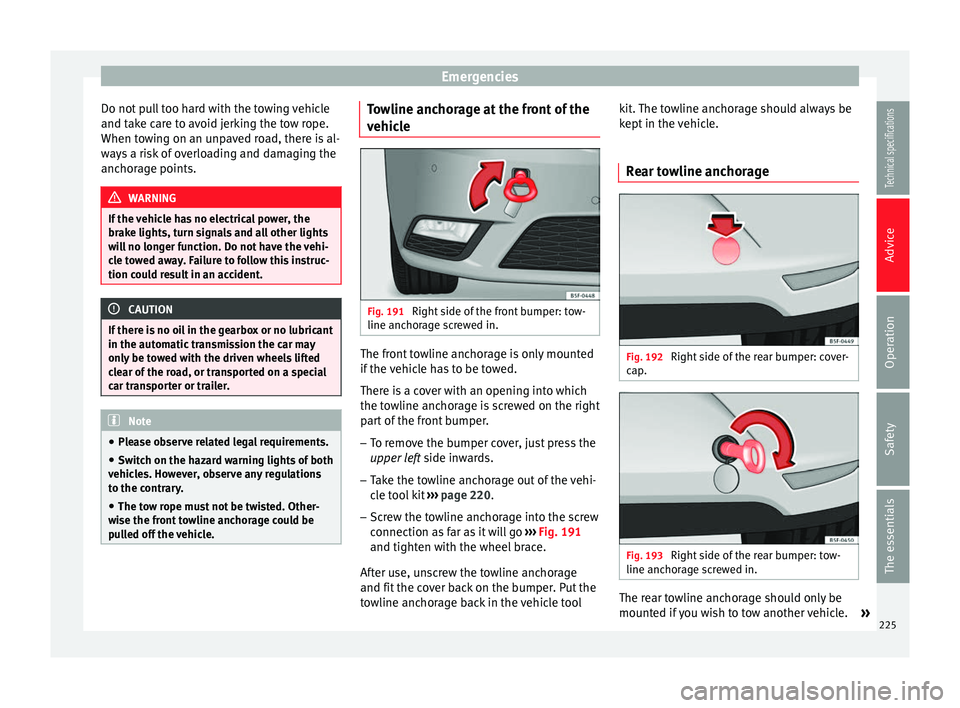
Fig. 191
Right side of the front bumper: tow-
line anchorage screwed in. The front towline anchorage is only mounted
if the vehicle has to be towed.
There is a cover with an opening into which
the towline anchorage is screwed on the right
part of the front bumper.
– To remove the bumper cover, just press the
upper left side inwards.
– Take the towline anchorage out of the vehi-
cle tool kit ››› page 220 .
– Sc r
ew the towline anchorage into the screw
connection as far as it will go ››› Fig. 191
and tighten with the wheel brace.
After use, unscrew the towline anchorage
and fit the cover back on the bumper. Put the
towline anchorage back in the vehicle tool kit. The towline anchorage should always be
kept in the vehicle.
Rear towline anchorage Fig. 192
Right side of the rear bumper: cover-
cap. Fig. 193
Right side of the rear bumper: tow-
line anchorage screwed in. The rear towline anchorage should only be
mounted if you wish to tow another vehicle.
»
225
Technical specifications
Advice
Operation
Safety
The essentials
Page 231 of 284
Emergencies
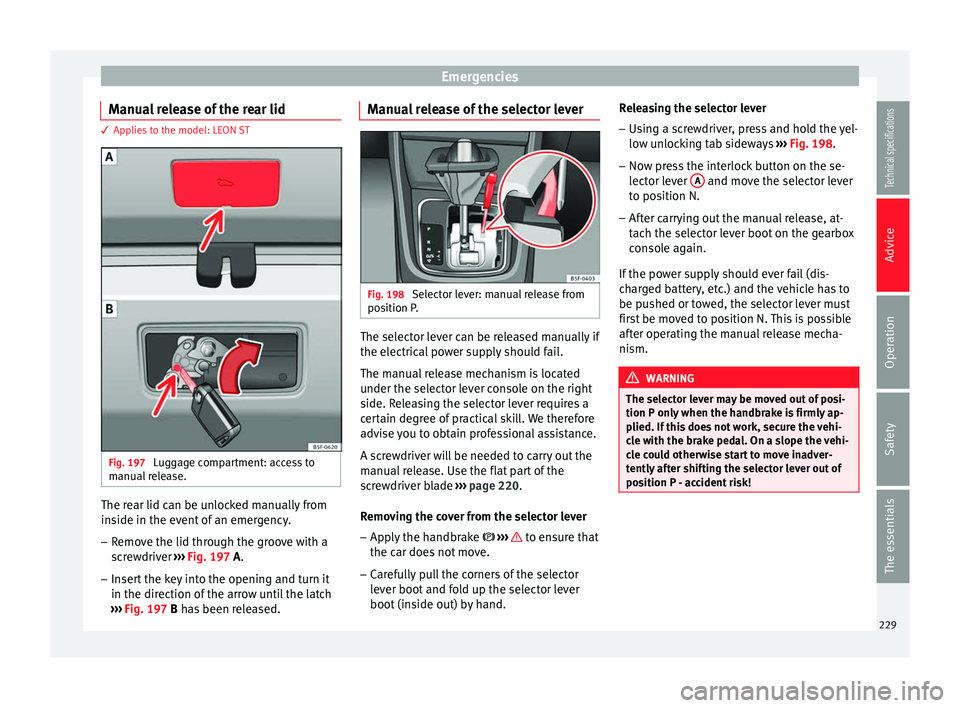
Manual release of the rear lid 3 Applies to the model: LEON ST
Fig. 197
Luggage compartment: access to
manual release. The rear lid can be unlocked manually from
inside in the event of an emergency.
– Remove the lid through the groove with a
screwdriver ››› Fig. 197
A.
– Insert the key into the opening and turn it
in the direction of the arrow until the latch
››› Fig. 197 B
has been released. Manual release of the selector lever
Fig. 198
Selector lever: manual release from
position P. The selector lever can be released manually if
the electrical power supply should fail.
The manual release mechanism is located
under the selector lever console on the right
side. Releasing the selector lever requires a
certain degree of practical skill. We therefore
advise you to obtain professional assistance.
A screwdriver will be needed to carry out the
manual release. Use the flat part of the
screwdriver blade
››› page 220.
Removing the cover from the selector lever
– Apply the handbrake ››› to ensure that
the car does not move.
– Carefully pull the corners of the selector
lever boot and fold up the selector lever
boot (inside out) by hand. Releasing the selector lever
– Using a screwdriver, press and hold the yel-
low unlocking tab sideways ››› Fig. 198 .
– No w pr
ess the interlock button on the se-
lector lever A and move the selector lever
to position N.
– After carrying out the manual release, at-
tach the selector lever boot on the gearbox
console again.
If the power supply should ever fail (dis-
charged battery, etc.) and the vehicle has to
be pushed or towed, the selector lever must
first be moved to position N. This is possible
after operating the manual release mecha-
nism. WARNING
The selector lever may be moved out of posi-
tion P only when the handbrake is firmly ap-
plied. If this does not work, secure the vehi-
cle with the brake pedal. On a slope the vehi-
cle could otherwise start to move inadver-
tently after shifting the selector lever out of
position P - accident risk! 229
Technical specifications
Advice
Operation
Safety
The essentials