trip Seat Leon Sportstourer 2013 Owner's manual
[x] Cancel search | Manufacturer: SEAT, Model Year: 2013, Model line: Leon Sportstourer, Model: Seat Leon Sportstourer 2013Pages: 339, PDF Size: 4.8 MB
Page 10 of 339
8Safe driving
passengers are sitting in a correct position and use this equipment proper-
ly.
Therefore, information is provided about why this equipment is so impor-
tant, how it protects you, what you have to consider when using it and how
you and your passengers can achieve the greatest possible benefit from the
safety equipment fitted. This manual includes important warnings that you
and your passengers should note in order to reduce the risk of injury.
Safety is everyone's business!
Before starting every trip
The driver is always responsible for the safety of the passen-
gers and the safe operation of the vehicle.
For your own safety and the safety of your passengers, always note
the following points before every trip:
– Make sure that the vehicle's lights and turn signals are working
properly.
– Check tyre pressure.
– Ensure that all windows provide a clear and good view of the
surroundings.
– Make sure all luggage is secured ⇒ page 17.
– Make sure that no objects can interfere with the pedals.
– Adjust front seat, head restraint and rear vision mirrors properly
according to your size. –
Ensure that the passengers in the rear seats always have the
head restraints in the in-use position ⇒ page 15
– Instruct passengers to adjust the head restraints according to
their height.
– Protect children with appropriate child seats and properly ap-
plied seat belts ⇒ page 48.
– Assume the correct sitting position. Instruct your passengers al-
so to assume a proper sitting position. ⇒ page 10.
– Fasten your seat belt securely. Instruct your passengers also to
fasten their seat belts properly. ⇒ page 20.
What affects driving safety?
Driving safety is largely determined by your driving style
and the personal behaviour of all vehicle occupants.
As a driver, you are responsible for yourself and your passengers.
When your concentration or driving safety is affected by any cir-
cumstance, you endanger yourself as well as others on the road
⇒
, for this reason:
– Always pay attention to traffic and do not get distracted by pas-
sengers or telephone calls.
– Never drive when your driving ability is impaired (e.g. by medi-
cation, alcohol, drugs).
– Observe traffic laws and speed limits.
Page 11 of 339
9
Safe driving
– Always reduce your speed as appropriate for road, traffic and
weather conditions.
– When travelling long distances, take breaks regularly - at least
every two hours.
– If possible, avoid driving when you are tired or stressed.
WARNING
When driving safety is impaired during a trip, the risk of injury and acci-
dents increases.
Safety FirstOperating instructionsPractical TipsTechnical specifications
Page 18 of 339
16Safe driving
injury due to incorrect seat belt position. As the driver, you are re-
sponsible for all passengers, especially children.
–Never allow anyone to assume an incorrect sitting position in
the vehicle while travelling ⇒
.
The following list contains examples of sitting positions that could be dan-
gerous for all vehicle occupants. The list is not complete, but we would like
to make you aware of this issue.
Therefore, whenever the vehicle is in motion:
● Never stand in the vehicle.
● Never stand on the seats.
● Never kneel on the seats.
● Never tilt your seat backrest far to the rear.
● Never lean against the dash panel.
● Never lie on the rear bench.
● Never sit on the front edge of a seat.
● Never sit sideways.
● Never lean out of a window.
● Never put your feet out of a window.
● Never put your feet on the dash panel.
● Never put your feet on the surface of a seat.
● Do not allow anyone to travel in the footwell.
● Never travel without wearing the seat belt.
● Do not allow anyone to travel in the luggage compartment.
WARNING
● Any incorrect sitting position increases the risk of severe injuries.
● Sitting in an incorrect position exposes the vehicle occupants to se-
vere injuries if airbags are triggered, by striking a vehicle occupant who
has assumed an incorrect sitting position.
● Before the vehicle moves, assume the proper sitting position and
maintain it throughout the trip. Before every trip, instruct your passen-
gers to sit properly and to stay in this position during the trip ⇒ page 10,
Sitting position for vehicle occupants.
Pedal area Pedals
The operation of all pedals must never be impaired by ob-
jects or floor mats.
– Ensure that you can always press the accelerator, brake and
clutch pedals unimpaired to the floor.
– Ensure that the pedals can return unimpaired to their initial po-
sitions.
Use only floor mats which leave the pedal area free and can be securely fas-
tened on the footwell.
If a brake circuit fails, the brake pedal must be pressed down thoroughly in
order to stop the vehicle.
Page 19 of 339
17
Safe driving
Wearing suitable shoes
Always wear shoes which support your feet properly and give you a good
feeling for the pedals.
WARNING
● Restricting pedal operation can lead to critical situations while driv-
ing.
● Never place objects on the driver footwell. An object could move into
the pedal area and impair pedal operation. In the event of a sudden driv-
ing or braking manoeuvre, you will not be able to operate the brake,
clutch or accelerator pedal. Risk of accident!
Floor mats on the driver side
Only floor mats may be used which can be securely fastened
in the footwell and do not impair operation of the pedals.
– Ensure that the floor mats are securely fastened during the trip
and do not obstruct the pedals ⇒
.
Only use floor mats which leave the pedals clear and which are secured to
prevent them from slipping. You can obtain suitable floor mats from a speci-
alised dealership. Fasteners* for floor mats are fitted in the footwells.
WARNING
● If the pedals are obstructed, an accident may occur. Risk of serious
injuries.
● Ensure that the floor mats are always securely attached.
● Never lay or fit floor mats or other floor coverings over the original
floor mats. This would reduce the pedal area and could obstruct the ped-
als. Risk of accident.
Storing objects Loading the luggage compartment
All luggage and other loose objects must be safely secured
in the luggage compartment.
Unsecured objects which shift back and forth could impair the driv-
ing safety or driving characteristics of the vehicle by shifting the
centre of gravity.
– Distribute the load evenly in the luggage compartment.
– Place heavy objects as far forward as possible in the luggage
compartment.
– Place the heavy objects first.
– Secure heavy objects to the fitted fastening rings ⇒ page 18.
Safety FirstOperating instructionsPractical TipsTechnical specifications
Page 25 of 339
23
Seat belts
Vehicle occupants not wearing seat belts are not “attached” to the vehicle.
In a head-on collision, they will move forward at the same speed their vehi-
cle was travelling just before the impact. This example applies not only to
head-on collisions, but to all accidents and collisions.
The danger of not using the seat belt
The general belief that the passengers can protect them-
selves with their hands in a minor collision is false.
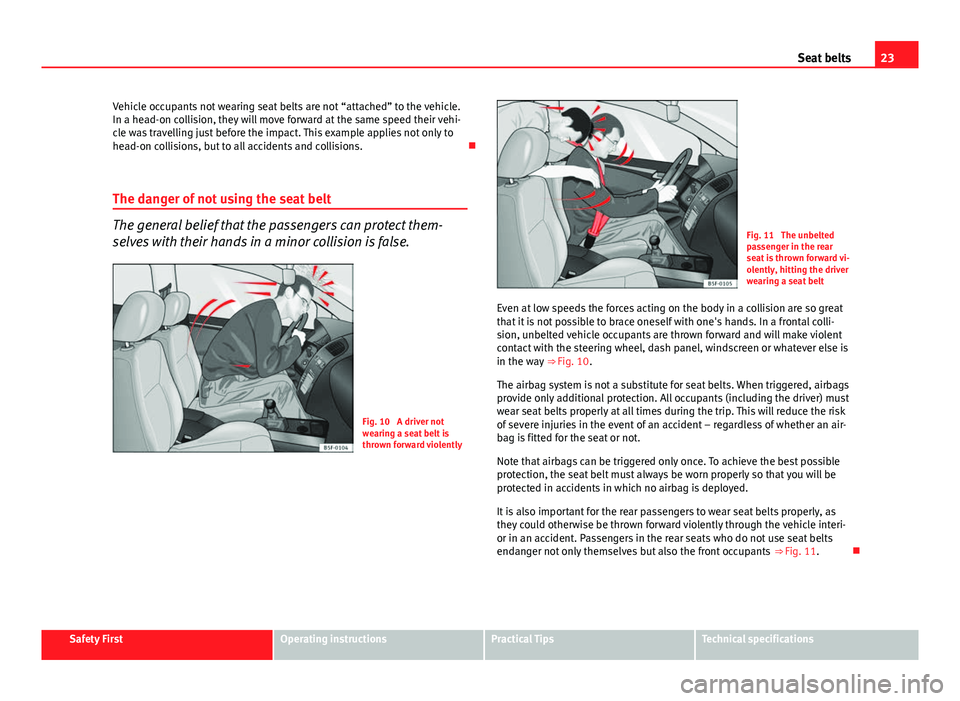
Fig. 10 A driver not
wearing a seat belt is
thrown forward violently
Fig. 11 The unbelted
passenger in the rear
seat is thrown forward vi-
olently, hitting the driver
wearing a seat belt
Even at low speeds the forces acting on the body in a collision are so great
that it is not possible to brace oneself with one's hands. In a frontal colli-
sion, unbelted vehicle occupants are thrown forward and will make violent
contact with the steering wheel, dash panel, windscreen or whatever else is
in the way ⇒ Fig. 10.
The airbag system is not a substitute for seat belts. When triggered, airbags
provide only additional protection. All occupants (including the driver) must
wear seat belts properly at all times during the trip. This will reduce the risk
of severe injuries in the event of an accident – regardless of whether an air-
bag is fitted for the seat or not.
Note that airbags can be triggered only once. To achieve the best possible
protection, the seat belt must always be worn properly so that you will be
protected in accidents in which no airbag is deployed.
It is also important for the rear passengers to wear seat belts properly, as
they could otherwise be thrown forward violently through the vehicle interi-
or in an accident. Passengers in the rear seats who do not use seat belts
endanger not only themselves but also the front occupants ⇒ Fig. 11.
Safety FirstOperating instructionsPractical TipsTechnical specifications
Page 26 of 339
24Seat belts
Seat belt protection
Passengers not wearing seat belts risk severe injuries in the
event of an accident.
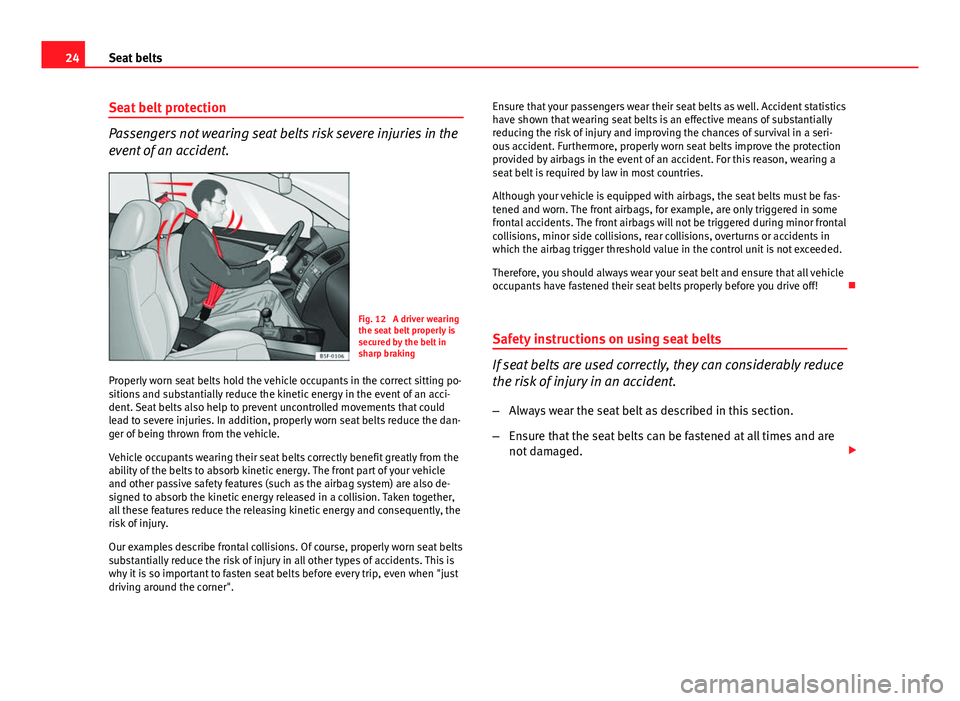
Fig. 12 A driver wearing
the seat belt properly is
secured by the belt in
sharp braking
Properly worn seat belts hold the vehicle occupants in the correct sitting po-
sitions and substantially reduce the kinetic energy in the event of an acci-
dent. Seat belts also help to prevent uncontrolled movements that could
lead to severe injuries. In addition, properly worn seat belts reduce the dan-
ger of being thrown from the vehicle.
Vehicle occupants wearing their seat belts correctly benefit greatly from the
ability of the belts to absorb kinetic energy. The front part of your vehicle
and other passive safety features (such as the airbag system) are also de-
signed to absorb the kinetic energy released in a collision. Taken together,
all these features reduce the releasing kinetic energy and consequently, the
risk of injury.
Our examples describe frontal collisions. Of course, properly worn seat belts
substantially reduce the risk of injury in all other types of accidents. This is
why it is so important to fasten seat belts before every trip, even when "just
driving around the corner". Ensure that your passengers wear their seat belts as well. Accident statistics
have shown that wearing seat belts is an effective means of substantially
reducing the risk of injury and improving the chances of survival in a seri-
ous accident. Furthermore, properly worn seat belts improve the protection
provided by airbags in the event of an accident. For this reason, wearing a
seat belt is required by law in most countries.
Although your vehicle is equipped with airbags, the seat belts must be fas-
tened and worn. The front airbags, for example, are only triggered in some
frontal accidents. The front airbags will not be triggered during minor frontal
collisions, minor side collisions, rear collisions, overturns or accidents in
which the airbag trigger threshold value in the control unit is not exceeded.
Therefore, you should always wear your seat belt and ensure that all vehicle
occupants have fastened their seat belts properly before you drive off!
Safety instructions on using seat belts
If seat belts are used correctly, they can considerably reduce
the risk of injury in an accident.
– Always wear the seat belt as described in this section.
– Ensure that the seat belts can be fastened at all times and are
not damaged.
Page 27 of 339
25
Seat belts
WARNING
● If the seat belts are worn incorrectly or not at all, the risk of severe
injuries increases. The optimal protection from seat belts can be ach-
ieved only if you use them properly.
● Fasten your seat belt before every trip - even when driving in town.
The other vehicle occupants must also wear the seat belts at all times,
otherwise they run the risk of being injured.
● The seat belt cannot offer its full protection if the seat belt is not
positioned correctly.
● Never allow two passengers (even children) to share the same seat
belt.
● Always keep both feet in the footwell in front of your seat as long as
the vehicle is in motion.
● Never unbuckle a seat belt while the vehicle is in motion. Risk of fatal
injury.
● The seat belt must never be twisted while it is being worn.
● The seat belt should never lie on hard or fragile objects (such as
glasses or pens, etc.) because this can cause injuries.
● Do not allow the seat belt to be damaged or jammed, or to rub on any
sharp edges.
● Never wear the seat belt under the arm or in any other incorrect posi-
tion.
● Loose, bulky clothing (such as an overcoat over a jacket) impairs the
proper fit and function of the seat belts, reducing their capacity to pro-
tect.
● The slot in the seat belt buckle must not be blocked with paper or
other objects, as this can prevent the latch plate from engaging securely.
● Never use seat belt clips, fastening rings or similar instruments to al-
ter the position of the belt webbing.WARNING (Continued)
● Frayed or torn seat belts or damage to the connections, belt retrac-
tors or parts of the buckle could cause severe injuries in the event of an
accident. Therefore, you must check the condition of all seat belts at reg-
ular intervals.
● Seat belts which have been worn in an accident and stretched must
be replaced by a specialised workshop. Renewal may be necessary even
if there is no apparent damage. The belt anchorage should also be
checked.
● Do not attempt to repair a damaged seat belt yourself. The seat belts
must not be removed or modified in any way.
● The belts must be kept clean, otherwise the retractors may not work
properly.
Safety FirstOperating instructionsPractical TipsTechnical specifications
Page 31 of 339
29
Seat belts
– Guide the belt back by hand so that it rolls up easily and the
trim is not damaged.
WARNING
Never unbuckle a seat belt while the vehicle is in motion. If you do, you
increase the risk of sustaining severe or fatal injuries.
Incorrectly fastened seat belts
Incorrectly worn seat belts can cause severe or even mortal
injuries. Seat belts can provide optimal protection only if the belt web is
properly worn. The seat belts must be fastened exactly in the order
described in this chapter. An incorrect sitting position impairs sub-
stantially the protection a seat belt offers and can lead to severe or
fatal injuries. The risk of severe or fatal injuries is especially in-
creased when a deploying airbag strikes a vehicle occupant who
has assumed an incorrect sitting position. As the driver, you are re-
sponsible for yourself and all passengers, especially children.
Therefore:
– Never allow anyone to wear the seat belt incorrectly while the
vehicle is moving ⇒
.
WARNING
● An incorrectly worn seat belt increases the risk of severe injuries.
● Before every trip, instruct your passengers to adjust their seat belts
properly and to wear them for the whole journey.
● Read and always observe information and warnings concerning the
use of seat belts ⇒ page 24.
Seat belt tensioners
Function of the seat belt tensioner
During a frontal collision, the seat belts on the front seats
are retracted automatically. The seat belts for the occupants in the front seats are equipped with belt
tensioners. Sensors will only trigger the belt tensioners during severe head-
on, lateral and rear collisions, and only if the seat belt is actually being
worn. This retracts and tightens the seat belts, reducing the forward motion
of the occupants.
The seat belt tensioner can be triggered only once.
The seat belt tensioners will not be triggered in the event of a light frontal,
side or rear collision, if the vehicle overturns or in situations where no large
forces act on the front, side or rear of the vehicle.
Safety FirstOperating instructionsPractical TipsTechnical specifications
Page 50 of 339
48Child safety
Child safety
Brief introduction Introduction
Statistics show that children are generally safer on the rear
seat than on the front passenger seat.For safety reasons we recommend that children under 12 years of age travel
on the rear seats. Depending on their age, height and weight, children trav-
elling on the rear seat must use a child seat or a seat belt. For safety rea-
sons, the child seat should be installed in the centre of the rear seat or be-
hind the front passenger seat.
The physical laws involved and the forces acting in a collision apply also to
children ⇒ page 22.
But unlike adults, children do not have fully developed muscle and bone
structures. This means that children are subject to a greater risk of injury.
To reduce this risk, children must always use special child restraint systems
when travelling in the vehicle.
We recommend the use of child safety products from the SEAT Original Ac-
cessories Programme, which includes systems for all ages made by
“Peke” 1)
.
These systems have been especially designed and approved, complying
with the ECE-R44. regulation. Follow the manufacturer's instructions and observe any statutory require-
ments when installing and using child seats. Always read and note
⇒ page 48.
We recommend you to always include the manufacturer's Child Seat Instruc-
tion Manual together with the on-board documentation.
Safety notes on using child seats
Proper use of child seats substantially reduces the risk of in-
jury in an accident!
As the driver, you are responsible for any children you transport in your vehi-
cle.
● Protect your children by properly using the appropriate child seats
⇒ page 50.
● Always ensure that the seat belt is properly positioned according to the
instructions provided by the manufacturer of the child seat.
● When travelling, do not allow children to distract you from traffic.
● Take breaks regularly during long trips. Take a break at least every two
hours.
1)
Not for all countries
Page 65 of 339
63
Instruments and warning/control lamps
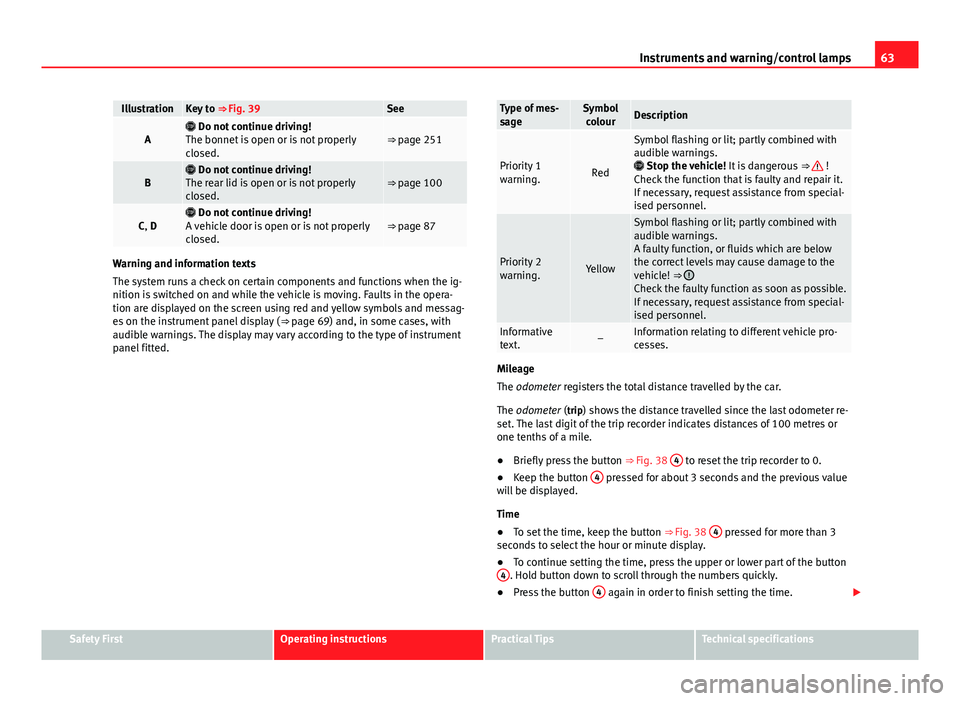
IllustrationKey to ⇒ Fig. 39See
A Do not continue driving!
The bonnet is open or is not properly
closed.⇒ page 251
B Do not continue driving!
The rear lid is open or is not properly
closed.⇒ page 100
C, D Do not continue driving!
A vehicle door is open or is not properly
closed.⇒ page 87
Warning and information texts
The system runs a check on certain components and functions when the ig-
nition is switched on and while the vehicle is moving. Faults in the opera-
tion are displayed on the screen using red and yellow symbols and messag-
es on the instrument panel display ( ⇒ page 69) and, in some cases, with
audible warnings. The display may vary according to the type of instrument
panel fitted.
Type of mes-
sageSymbol colourDescription
Priority 1
warning.Red
Symbol flashing or lit; partly combined with
audible warnings.
Stop the vehicle! It is dangerous ⇒
!
Check the function that is faulty and repair it.
If necessary, request assistance from special-
ised personnel.
Priority 2
warning.Yellow
Symbol flashing or lit; partly combined with
audible warnings.
A faulty function, or fluids which are below
the correct levels may cause damage to the
vehicle! ⇒
Check the faulty function as soon as possible.
If necessary, request assistance from special-
ised personnel.
Informative
text.–Information relating to different vehicle pro-
cesses.
Mileage
The odometer registers the total distance travelled by the car.
The odometer (trip) shows the distance travelled since the last odometer re- set. The last digit of the trip recorder indicates distances of 100 metres or
one tenths of a mile.
● Briefly press the button ⇒ Fig. 38 4
to reset the trip recorder to 0.
● Keep the button 4 pressed for about 3 seconds and the previous value
will be displayed.
Time
● To set the time, keep the button ⇒ Fig. 38 4
pressed for more than 3
seconds to select the hour or minute display.
● To continue setting the time, press the upper or lower part of the button
4
. Hold button down to scroll through the numbers quickly.
● Press the button 4 again in order to finish setting the time.
Safety FirstOperating instructionsPractical TipsTechnical specifications