tyre pressure Seat Leon Sportstourer 2014 User Guide
[x] Cancel search | Manufacturer: SEAT, Model Year: 2014, Model line: Leon Sportstourer, Model: Seat Leon Sportstourer 2014Pages: 284, PDF Size: 5.85 MB
Page 214 of 284
Advice
securely and that the brake system functions
correctly.
The wheel bolts must be clean and turn easi-
ly.
A special adapter is required to turn the anti-
theft wheel bolts* ››› page 218.
Tyre monitoring systems Introduction WARNING
Unsuitable handling of the wheels and tyres
may lead to sudden tyre pressure losses, to
tread separation or even to a blow-out.
● Check tyre pressures regularly and ensure
they are maintained at the pressures indica-
ted. Tyre pressure that is too low could cause
overheating, resulting in tread detachment or
even burst tyres.
● Tyre pressure should be that indicated on
the label when the tyres are cold at all times
››› page 243.
● Re
gularly check the cold inflation pressure
of the tyres. If necessary, change the tyre
pressure of the vehicle tyres while they are
cold.
● Regularly check your tyres for damage and
wear. ●
Never exceed the maximum permitted
speed or loads specified for the type of tyre
fitted on your vehicle. For the sake of the environment
Under-inflated tyres lead to increased fuel
consumption and tyre wear. Note
● Driving for the first time with new tyres at a
high speed can cause them to slightly ex-
pand, which could then produce an air pres-
sure warning.
● Only replace used tyres with those author-
ised by SEAT for the corresponding type vehi-
cle.
● Do not only rely on the tyre monitoring sys-
tem. Regularly check your tyres to ensure
that the tyre pressure is correct and that the
tyres are not damaged due to puncture, cuts,
tears and impacts/dents. Remove objects
from the tyres only when they have not
pierced the tyres. Tyre monitor indicator warning lamp
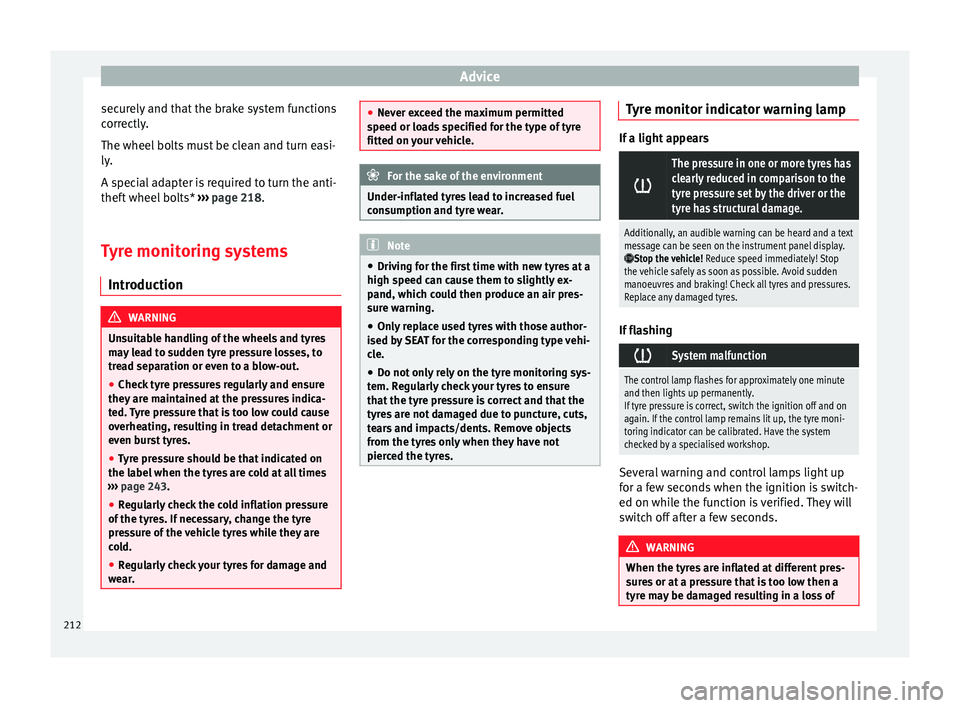
If a light appears
The pressure in one or more tyres has
clearly reduced in comparison to the
tyre pressure set by the driver or the
tyre has structural damage.
Additionally, an audible warning can be heard and a text
message can be seen on the instrument panel display.
Stop the vehicle!
Reduce speed immediately! Stop
the vehicle safely as soon as possible. Avoid sudden
manoeuvres and braking! Check all tyres and pressures.
Replace any damaged tyres. If flashing
System malfunction
The control lamp flashes for approximately one minute
and then lights up permanently.
If tyre pressure is correct, switch the ignition off and on
again. If the control lamp remains lit up, the tyre moni-
toring indicator can be calibrated. Have the system
checked by a specialised workshop.
Several warning and control lamps light up
for a few seconds when the ignition is switch-
ed on while the function is verified. They will
switch off after a few seconds.
WARNING
When the tyres are inflated at different pres-
sures or at a pressure that is too low then a
tyre may be damaged resulting in a loss of 212
Page 215 of 284
Wheels
control of the vehicle and a serious or fatal
accident.
●
If the warning lamp lights up, stop im-
mediately and check the tyres.
● If the tyres are inflated at different pres-
sures or if a tyre pressure is too low, this will
increase tyre wear, negatively affecting vehi-
cle stability and increasing braking distan-
ces.
● If tyres are inflated at different pressures or
a tyre pressure is too low, a tyre may be dam-
aged and burst resulting in a loss of control
of the vehicle.
● The driver is responsible for ensuring that
all of the vehicle tyres are correctly inflated
to the right pressure. The recommended tyre
pressure is indicated on the label
››› page 243.
● The ty r
e monitoring system can only oper-
ate correctly if all of the tyres are inflated to
the correct pressure when cold.
● Driving with tyres at the wrong pressure
can damage them and result in an accident.
Ensure that the tyre pressures of all the tyres
correspond to the vehicle load.
● Before starting a journey, always inflate
tyres to the correct pressure.
● Tyres with insufficient pressure are subjec-
ted to more flexing. Due to this, the tyre
could become excessively hot, causing tread
separation and also tyre blow-out.
● With an overloaded vehicle at high speed,
the tyres can overheat and burst resulting in
a loss of vehicle control. ●
Tyre pressures which are too high or too
low reduce the useful life of the tyre, affect-
ing vehicle performance.
● If a tyre has not been punctured and it does
not have to be changed immediately, drive to
the nearest specialised workshop at a moder-
ate speed and have the tyre checked and in-
flated to the correct pressure. WARNING
Observe the safety warnings ››› in Control
and warning lamps on page 71. Note
● If excessively low tyre pressure is detected
with the ignition on, an audible warning will
sound. In the event that there is a fault in the
system, an audible warning will sound.
● Driving on dirt tracks for a long period of
time or driving in a sporty style can tempora-
rily deactivate the TPMS. The control lamp
shows a fault, but disappears when road con-
ditions or the driving style change. Tyre monitoring indicator
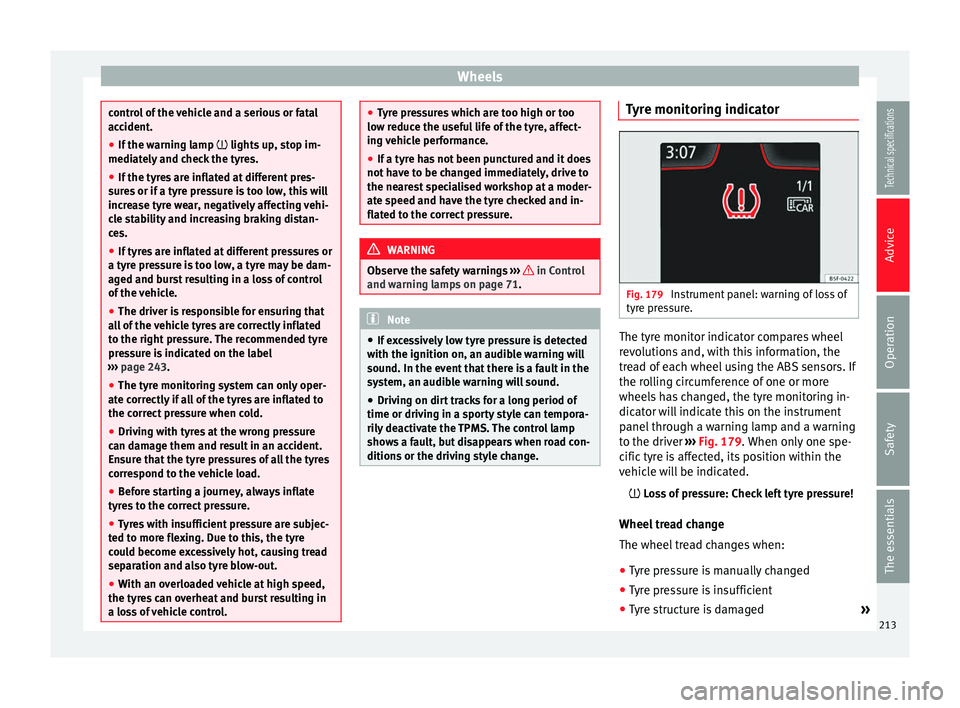
Fig. 179
Instrument panel: warning of loss of
tyre pressure. The tyre monitor indicator compares wheel
revolutions and, with this information, the
tread of each wheel using the ABS sensors. If
the rolling circumference of one or more
wheels has changed, the tyre monitoring in-
dicator will indicate this on the instrument
panel through a warning lamp and a warning
to the driver
››› Fig. 179 . When only one spe-
c ific
tyre is affected, its position within the
vehicle will be indicated.
Loss of pressure: Check left tyre pressure!
Wheel tread change
The wheel tread changes when: ● Tyre pressure is manually changed
● Tyre pressure is insufficient
● Tyre structure is damaged »
213
Technical specifications
Advice
Operation
Safety
The essentials
Page 216 of 284
Advice
● The vehicle is unbalanced because of a
load
● The wheels on an axle are subject to a
heavier load (e.g. with a heavy load).
● The vehicle is fitted with snow chains
● The temporary spare wheel is fitted
● The wheel on one axle is changed
There may be a delay in the reaction of the
tyre
monitoring indicator or it may not in-
dic
ate anything under certain circumstances
(e.g. sporty driving, snow-covered or un-
paved roads, or when driving with snow
chains).
Calibrating the tyre monitoring
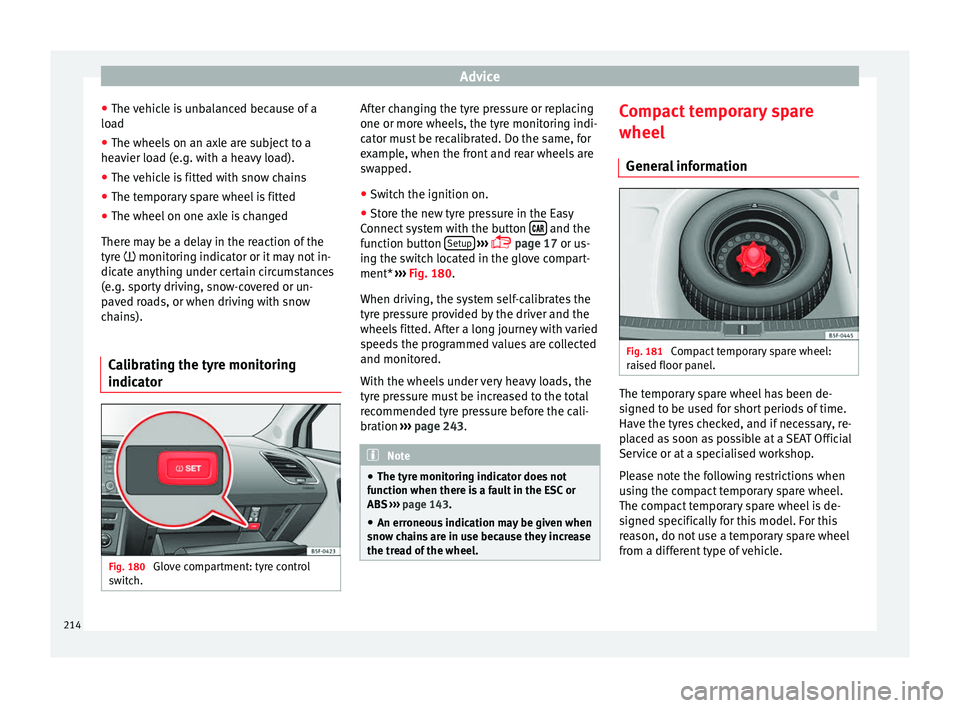
indicator Fig. 180
Glove compartment: tyre control
switch. After changing the tyre pressure or replacing
one or more wheels, the tyre monitoring indi-
cator must be recalibrated. Do the same, for
example, when the front and rear wheels are
swapped.
● Switch the ignition on.
● Store the new tyre pressure in the Easy
Connect system with the button and the
function button Setup
›››
page 17 or us-
ing the switch located in the glove compart-
ment* ››› Fig. 180 .
When driv in
g, the system self-calibrates the
tyre pressure provided by the driver and the
wheels fitted. After a long journey with varied
speeds the programmed values are collected
and monitored.
With the wheels under very heavy loads, the
tyre pressure must be increased to the total
recommended tyre pressure before the cali-
bration ››› page 243
. Note
● The tyre monitoring indicator does not
function when there is a fault in the ESC or
ABS ››› page 143.
● An err oneou
s indication may be given when
snow chains are in use because they increase
the tread of the wheel. Compact temporary spare
wheel
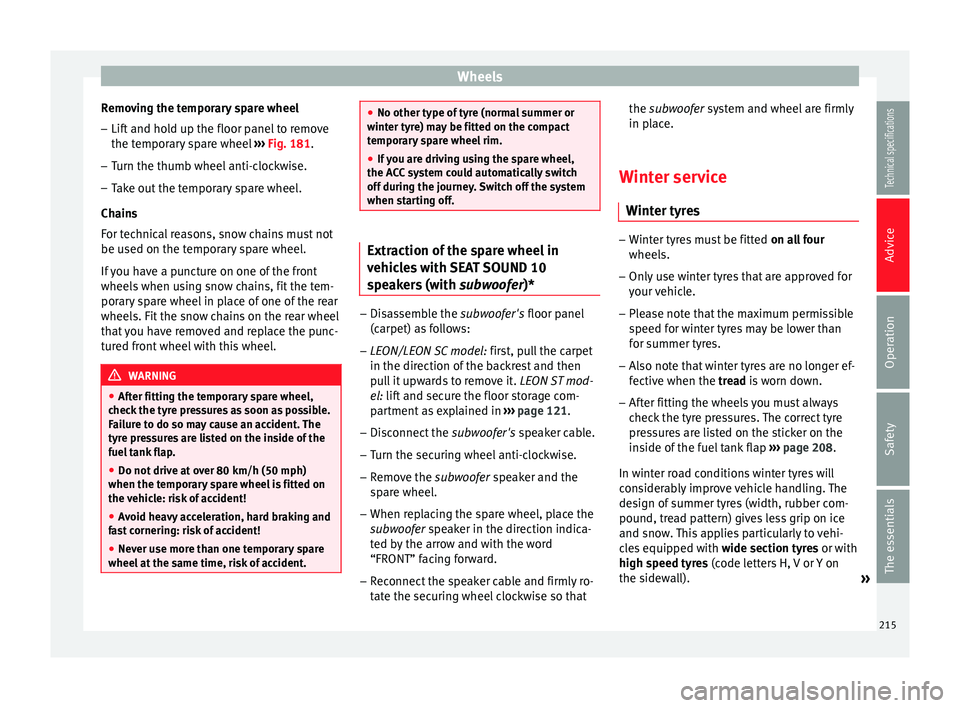
General information Fig. 181
Compact temporary spare wheel:
raised floor panel. The temporary spare wheel has been de-
signed to be used for short periods of time.
Have the tyres checked, and if necessary, re-
placed as soon as possible at a SEAT Official
Service or at a specialised workshop.
Please note the following restrictions when
using the compact temporary spare wheel.
The compact temporary spare wheel is de-
signed specifically for this model. For this
reason, do not use a temporary spare wheel
from a different type of vehicle.
214
Page 217 of 284
Wheels
Removing the temporary spare wheel
– Lift and hold up the floor panel to remove
the temporary spare wheel ››› Fig. 181 .
– Turn the thumb wheel anti-clockwise.
– Take out the temporary spare wheel.
Chains
For technical reasons, snow chains must not
be used on the temporary spare wheel.
If you have a puncture on one of the front
wheels when using snow chains, fit the tem-
porary spare wheel in place of one of the rear
wheels. Fit the snow chains on the rear wheel
that you have removed and replace the punc-
tured front wheel with this wheel. WARNING
● After fitting the temporary spare wheel,
check the tyre pressures as soon as possible.
Failure to do so may cause an accident. The
tyre pressures are listed on the inside of the
fuel tank flap.
● Do not drive at over 80 km/h (50 mph)
when the temporary spare wheel is fitted on
the vehicle: risk of accident!
● Avoid heavy acceleration, hard braking and
fast cornering: risk of accident!
● Never use more than one temporary spare
wheel at the same time, risk of accident. ●
No other type of tyre (normal summer or
winter tyre) may be fitted on the compact
temporary spare wheel rim.
● If you are driving using the spare wheel,
the ACC system could automatically switch
off during the journey. Switch off the system
when starting off. Extraction of the spare wheel in
vehicles with SEAT SOUND 10
speakers (with
subwoofer)* –
Disassemble the subwoofer's
floor panel
(c
arpet) as follows:
– LEON/LEON SC model: first, pull the carpet
in the direction of the backrest and then
pull it upwards to remove it. LEON ST mod-
el: lift and secure the floor storage com-
par
tment as explained in ››› page 121.
– Disconnect the subwoofer's speaker cable.
– Turn the sec
uring wheel anti-clockwise.
– Remove the subwoofer speaker and the
s
pare wheel.
– When replacing the spare wheel, place the
subwoofer speaker in the direction indica-
ted b
y the arrow and with the word
“FRONT” facing forward.
– Reconnect the speaker cable and firmly ro-
tate the securing wheel clockwise so that the subwoofer system and wheel are firmly
in place.
Winter service Winter tyres –
Winter tyres must be fitted on all four
wheels.
– Only use winter tyres that are approved for
your vehicle.
– Please note that the maximum permissible
speed for winter tyres may be lower than
for summer tyres.
– Also note that winter tyres are no longer ef-
fective when the tread is worn down.
– Af
ter fitting the wheels you must always
check the tyre pressures. The correct tyre
pressures are listed on the sticker on the
inside of the fuel tank flap ›››
page 208.
In winter road conditions winter tyres will
considerably improve vehicle handling. The
design of summer tyres (width, rubber com-
pound, tread pattern) gives less grip on ice
and snow. This applies particularly to vehi-
cles equipped with wide section tyres or with
high speed tyres (code letters H, V or Y on
the sidew
all). »
215
Technical specifications
Advice
Operation
Safety
The essentials
Page 222 of 284
Advice
the wheel condition and hub mounting surfa-
ces. These surfaces must be clean before fit-
ting the wheel. CAUTION
When removing/fitting the wheel, the rim
may hit and damage the brake disc. For this
reason, please take care and get a second
person to assist you. Tyres with compulsory direction of
rotation
A directional tread pattern can be identified
by arrows on the sidewall that point in the di-
rection of rotation. Always observe the direc-
tion of rotation indicated when mounting the
wheel. This is important so that these tyres
can give maximum grip and avoid excessive
noise, tread wear and aquaplaning.
If, exceptionally, it is necessary to mount the
spare wheel* in the opposite direction of ro-
tation, please drive carefully, as in this case
the tyre does not have optimum conditions of
use. This is particularly important when driv-
ing on wet roads.
To benefit from the advantages of tyres with
this type of tread pattern, the defective tyre
should be replaced as soon as possible so
that all tyres again rotate in the correct direc-
tion. After changing a wheel –
On alloy wheels: replace the wheel bolt
caps.
– On plate wheels: replace the wheel hubcap
››› page 217.
– Put the tools and jack back in the luggage
compartment.
– If the replaced wheel does not fit in the
spare wheel housing, store it safely in the
luggage compartment ››› page 114.
– Check the tyre pressure of the newly moun-
ted tyre as soon as possible.
– In vehicles fitted with a tyre pressure indi-
cator, adjust the pressure and store the
reading in the radio/ Easy Connect system*
››› page 212.
– The wheel bolts should be tightened to 120
Nm. Check the torque as soon as possible
with a torque wrench. Meanwhile, drive
carefully.
– Have the flat tyre replaced as quickly as
possible. Tyre repair
Tools, anti-puncture kit* The tools and anti-puncture kit* are stored
under the floor panel in the luggage compart-
ment.
To access the vehicle tools:
– Lift up the floor surface by the plastic han-
dle until it is fastened to the tabs on both
sides.
Depending on the vehicle equipment, the
tyre repair kit* is located under the floor pan-
el in the luggage compartment.
The tool kit includes: ● Jack*
● Wire hook for pulling off the wheel cov-
er* /wheel bolt cap clip.
● Box spanner for wheel bolts*
● Towline anchorage
● Adapter for the anti-theft wheel bolts*
Some of the items listed are only provided in
certain model versions, or are optional ex-
tras. Note
The jack does not generally require any main-
tenance. If required, it should be greased us-
ing universal type grease. 220
Page 223 of 284

Emergencies
TMS (Tyre Mobility System)* Read the additional information carefully
››› page 33
The Anti-puncture kit* (Tyre Mobility System)
will reliably seal punctures caused by the
penetration of a foreign body of up to about
4 mm in diameter. Do not remove foreign ob-
j
ects, e.g. screws or nails, from the tyre.
After inserting the sealant residue in the tyre,
you must again check the tyre pressure about
10 minutes after starting the engine.
You should only use the tire mobility set if
the vehicle is parked in a safe place, you are
familiar with the procedure and you have the
necessary tire mobility set! Otherwise, you
should seek professional assistance.
The tyre sealant must not be used in the
following cases:
● If the wheel rim has been damaged.
● In outside temperatures below -20°C (-4°F).
● In the event of cuts or perforations in the
tyre greater than 4 mm.
● If you have been driving with very low pres-
sure or a completely flat tyre.
● If the sealant bottle has passed its use by
date. WARNING
Using the tyre mobility system can be dan-
gerous, especially when filling the tyre at the
roadside. Please observe the following rules
to minimise the risk of injury:
● Stop the vehicle safely as soon as possible.
Park it at a safe distance from surrounding
traffic to fill the tyre.
● Ensure the ground on which you park is flat
and solid.
● All passengers and particularly children
must keep a safe distance from the work area.
● Turn on the hazard warning lights to warn
other road users.
● Use the tyre mobility system only if you are
familiar with the necessary procedures. Oth-
erwise, you should seek professional assis-
tance.
● The tyre mobility set is intended for tempo-
rary emergency use only until you can reach
the nearest specialised workshop.
● Replace the repaired tyre with the tire mo-
bility set as soon as possible.
● The sealant is a health hazard and must be
cleaned immediately if it comes into contact
with the skin.
● Always keep the tire mobility set out of the
reach of small children.
● Never use an equivalent jack, even if it has
been approved for your vehicle.
● Always stop the engine, apply the hand-
brake lever firmly and engage gear if using a manual gearbox, in order to reduce the risk of
vehicle involuntary movement.
WARNING
A tyre filled with sealant does not have the
same performance properties as a conven-
tional tyre.
● Never drive faster than 80 km/h (50 mph).
● Avoid heavy acceleration, hard braking and
fast cornering.
● Drive for only 10 minutes at a maximum
speed of 80 km/h (50 mph) and then check
the tyre. For the sake of the environment
Dispose of used or expired sealant observing
any legal requirements. Note
A new bottle of sealant can be purchased at
SEAT dealerships. Note
Take into account the separate instruction
manual of the tyre mobility set* manufactur-
er. 221
Technical specifications
Advice
Operation
Safety
The essentials
Page 224 of 284
Advice
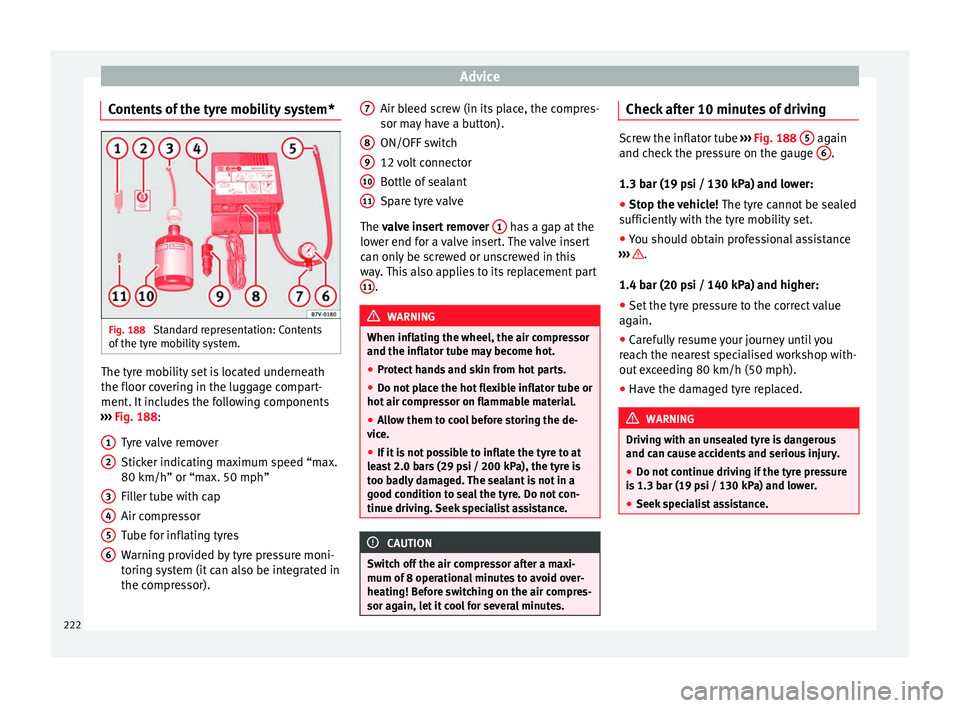
Contents of the tyre mobility system* Fig. 188
Standard representation: Contents
of the tyre mobility system. The tyre mobility set is located underneath
the floor covering in the luggage compart-
ment. It includes the following components
››› Fig. 188 :
T y
re valve remover
Sticker indicating maximum speed “max.
80 km/h” or “max. 50 mph”
Filler tube with cap
Air compressor
Tube for inflating tyres
Warning provided by tyre pressure moni-
toring system (it can also be integrated in
the compressor).
1 2
3
4
5
6 Air bleed screw (in its place, the compres-
sor may have a button).
ON/OFF switch
12 volt connector
Bottle of sealant
Spare tyre valve
The valve insert remover
1 has a gap at the
lower end for a valve insert. The valve insert
can only be screwed or unscrewed in this
way. This also applies to its replacement part 11 .
WARNING
When inflating the wheel, the air compressor
and the inflator tube may become hot.
● Protect hands and skin from hot parts.
● Do not place the hot flexible inflator tube or
hot air compressor on flammable material.
● Allow them to cool before storing the de-
vice.
● If it is not possible to inflate the tyre to at
least 2.0 bars (29 psi / 200 kPa), the tyre is
too badly damaged. The sealant is not in a
good condition to seal the tyre. Do not con-
tinue driving. Seek specialist assistance. CAUTION
Switch off the air compressor after a maxi-
mum of 8 operational minutes to avoid over-
heating! Before switching on the air compres-
sor again, let it cool for several minutes. 7
8
9
10
11 Check after 10 minutes of driving
Screw the inflator tube
››› Fig. 188 5 again
and check the pressure on the gauge 6 .
1.3 bar (19 psi / 130 kPa) and lower:
● Stop the vehicle! The tyre cannot be sealed
sufficiently with the tyre mobility set.
● You should obtain professional assistance
››› .
1.4 bar (20 psi / 140 kPa) and higher:
● Set the tyre pressure to the correct value
again.
● Carefully resume your journey until you
reach the nearest specialised workshop with-
out exceeding 80 km/h (50 mph).
● Have the damaged tyre replaced. WARNING
Driving with an unsealed tyre is dangerous
and can cause accidents and serious injury.
● Do not continue driving if the tyre pressure
is 1.3 bar (19 psi / 130 kPa) and lower.
● Seek specialist assistance. 222
Page 245 of 284
Technical specifications
Note
In practice, and considering all the factors
mentioned here, consumption values can dif-
fer from those calculated in the current Euro-
pean regulations. Weights
Kerb weight refers to the basic model with a
fuel tank filled to 90% capacity and without
optional extras. The figure quoted includes
75 kg to allow for the weight of the driver.
Special versions, optional equipment fittings
or retro-fitting accessories will increase the
weight of the vehicle
››› .
WARNING
● Please note that the centre of gravity may
shift when transporting heavy objects; this
may affect vehicle handling and lead to an ac-
cident. Always adjust your speed and driving
style to suit road conditions and require-
ments.
● Never exceed the gross axle weight rating
or the gross vehicle weight rating. If the per-
missible axle load or the permissible total
weight is exceeded, the driving characteris-
tics of the vehicle may change, which could
lead to accidents, injuries and damage to the
vehicle. Towing a trailer
Trailer weights Trailer weight
The trailer weights and drawbar loads ap-
proved are selected in intensive trials accord-
ing to precisely defined criteria. The ap-
proved trailer weights apply to vehicles in the
EU and generally for maximum speeds of 80
km/h (100 km/h in c
er
tain circumstances).
The figures may be different in other coun-
tries. All data in the official vehicle documen-
tation takes precedence over these data at all
times ››› .
Drawbar loads
The maximum
permitted drawbar load on the
b
all joint of the towing bracket must not ex-
ceed
80 kg.
In the interest of road safety, we recommend
that you always tow approaching the maxi-
mum drawbar load. The response of the trail-
er on the road will be poor, if the drawbar
load is too small.
If the maximum permissible drawbar load
cannot be met (e.g. with small, empty and
light-weight single axle trailers or tandem
axle trailers with a wheelbase of less than 1
metre), a minimum of 4% of the actual trailer
weight is legally required for the drawbar
load. WARNING
● For safety reasons, do not exceed the 80
km/h (50 mph) limit. This is also valid in
countries where higher speeds are permitted.
● Never exceed the maximum trailer weights
or the drawbar load. If the permissible axle
load or the permissible total weight is excee-
ded, the driving characteristics of the vehicle
may change, leading to accidents, injuries
and damage to the vehicle. Wheels
Tyre pressure, snow chains, wheel
bolts Tyre pressures
The sticker with the tyre pressure values can
be found on the inside of the fuel tank flap.
The tyre pressure values given there are for
cold
tyres. The slightly raised pressures of
w arm ty
res must not be reduced. ››› Snow chains
Snow chains may be fitted only to the front
wheels, and only for the following tyres:
»
243
Technical specifications
Advice
Operation
Safety
The essentials
Page 246 of 284
Technical specifications195/65 R15Chains with links of maximum 15 mm
205/55 R16Chains with links of maximum 15 mm
205/50 R17Chains with links of maximum 15 mm
225/45 R17Chains with links of maximum 9 mm
225/40 R18Chains with links of maximum 9 mm
225/35 R19Chains with links of maximum 7 mm
205/55 R17Snow chains are not permitted
225/45 R18Snow chains are not permitted
Wheel bolts
After the wheels have been changed, the
tightening torque
of the wheel bolts should
be c hec
ked as soon as possible with a torque
wrench ››› . The tightening torque for steel
and alloy wheels is 120 Nm. WARNING
● Check the tyre pressure at least once per
month. Checking the tyre pressure is very im-
portant. If the tyre pressure is too high or too
low, there is an increased danger of accidents
- particularly at high speeds.
● If the tightening torque of the wheel bolts
is too low, they could loosen while the vehi-
cle is in motion. Risk of accident! If the tight-
ening torque is too high, the wheel bolts and
threads can be damaged. Note
We recommend that you ask your Technical
Service for information about appropriate
wheel, tyre and snow chain size. 244
Page 270 of 284
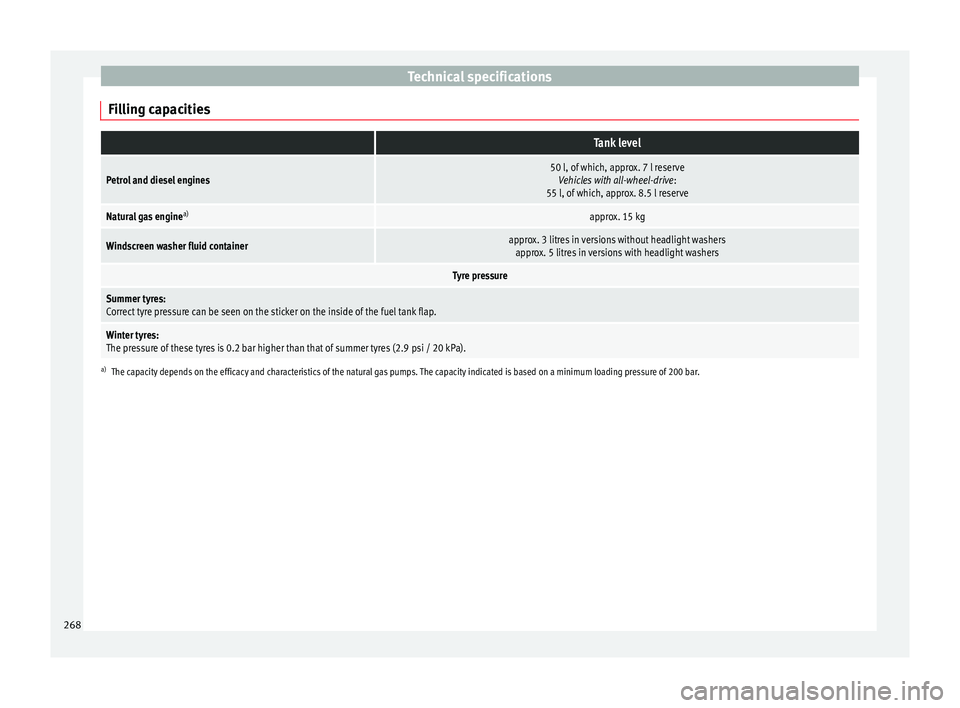
Technical specifications
Filling capacities Tank level
Petrol and diesel engines50 l, of which, approx. 7 l reserve Vehicles with all-wheel-drive :
55 l, of which, approx. 8.5 l reserve
Natural gas engine a)approx. 15 kg
Windscreen washer fluid containerapprox. 3 litres in versions without headlight washers
approx. 5 litres in versions with headlight washers
Tyre pressure
Summer tyres:
Correct tyre pressure can be seen on the sticker on the inside of the fuel tank flap.
Winter tyres:
The pressure of these tyres is 0.2 bar higher than that of summer tyres (2.9 psi / 20 kPa).
a) The capacity depends on the efficacy and characteristics of the natural gas pumps. The capacity indicated is based on a minimum loading pressure of 200 bar.
268