light Seat Mii 2012 Owner's manual
[x] Cancel search | Manufacturer: SEAT, Model Year: 2012, Model line: Mii, Model: Seat Mii 2012Pages: 308, PDF Size: 4.13 MB
Page 269 of 308

267
Practical information
Complete operations only in the sequence given:
⇒ Fig. 150ABCDipped beam and main beam headlightsSide light and daytime driving lightTurn signals (front)
6.Insert the bulb, return it to its position and
insert the retaining clip D.Insert the bulb holder in the headlight and
turn it clockwise as far as the stop.Insert the bulb holder in the headlight and
turn it clockwise as far as the stop.
7.Place the rubber cover and check that is
correctly in position. Insert the connector to the bulb H4.
Note
The images show the left hand headlight from behind. The structure of the
right hand side headlight is symmetric.
Replacing the front bumper bulbs
Fig. 151 In the front
right wheel arch: Remove
the retaining screws (ar-
rows) and take out the
expansive rivet A
.
Fig. 152 Changing the
bulbs in the headlights
Complete operations only in the sequence given:
1.Always take the checklist into account and take the necessary ac-
tions
⇒ page 265.
2.Unscrew the 2 retaining screws of the wheel arch trim ⇒ Fig. 151
(arrows) with the screwdriver from the vehicle took kit ⇒ page 246.
3.Unscrew the expansive rivet in the lower front part of the wheel arch
trim A with the screwdriver from the vehicle tool kit and complete-
ly remove it ⇒ page 246.
4.Carefully fold the wheel arch trim to the side.5.Release the connector ⇒ Fig. 152 1 and remove it.
Vehicle diagramPrior to a journey...While drivingCare, cleaning and mainte-
nanceIf and whenTechnical Data
Page 270 of 308

268Practical information
Complete operations only in the sequence given:
6.Turn the bulb holder ⇒ Fig. 152 in the direction of the arrow, in an
anticlockwise direction as far as it will go and remove it, along with
the bulb, pulling backwards.
7.Replace the faulty bulb by a new identical bulb.
8.Insert the bulb holder in the headlight and turn it clockwise as far
as the stop.
9.Plug the connector 1 into the bulb holder. The connector must au-
dibly click into place.
Complete operations only in the sequence given:10.Replace the wheel arch trim into its position.
11.Place the expansive rivet in the wheel arch trim and bumper and
press it completely inwards ⇒ Fig. 151 A.
12.Securely screw the 2 retaining screws
⇒ Fig. 151 (arrows) with a
screwdriver.
Page 271 of 308
269
Practical information
Changing the bulbs in the rear lights
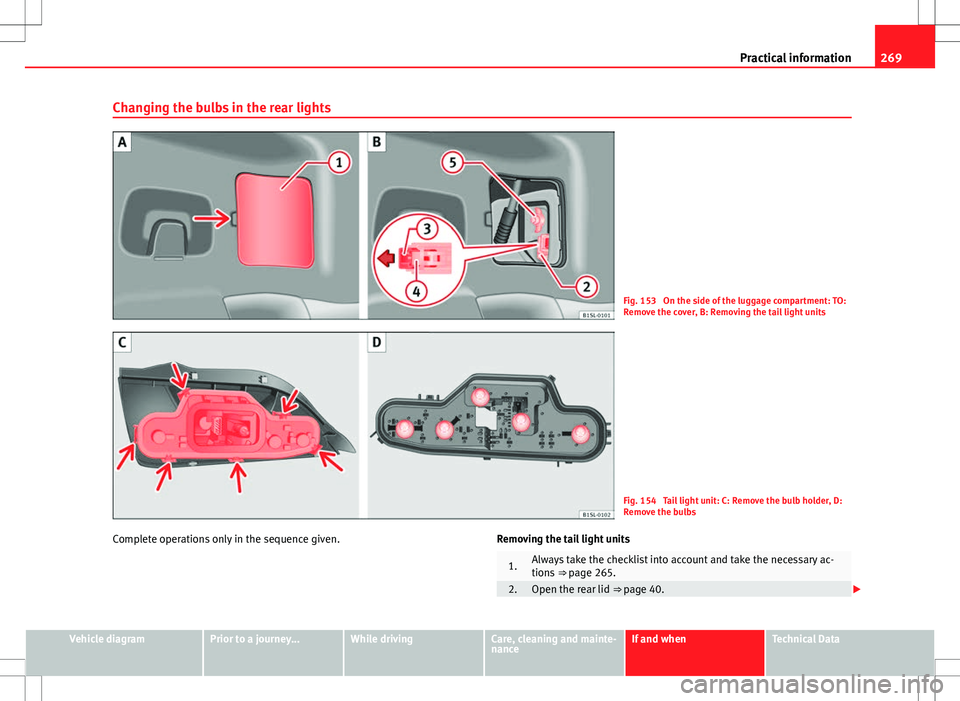
Fig. 153 On the side of the luggage compartment: TO:
Remove the cover, B: Removing the tail light units
Fig. 154 Tail light unit: C: Remove the bulb holder, D:
Remove the bulbs
Complete operations only in the sequence given. Removing the tail light units
1.Always take the checklist into account and take the necessary ac-
tions
⇒ page 265.
2.Open the rear lid ⇒ page 40.
Vehicle diagramPrior to a journey...While drivingCare, cleaning and mainte-
nanceIf and whenTechnical Data
Page 272 of 308
270Practical information
3.Carefully remove the cover 1 towards the lever
⇒ Fig. 153 A.
4.Pull the release 3 in the connector 2 in the direction of the arrow
⇒ Fig. 153 B. Use the screwdriver in the vehicle tool kit.
5.Press position 4 and remove the connector 2 ⇒ Fig. 153 B.6.Unscrew the wing nut 5 ⇒ Fig. 153 B.
7.Remove the tail light from the bodywork by carefully pulling back-
wards.
8.Disassemble the tail light unit and place it on a flat, clean surface.
To change the bulb
9.Unlock the bulb holder locking tab (arrow)
⇒ Fig. 154 C and remove
the bulb holder from the tail light.
10.Replace the faulty bulb by a new identical bulb ⇒ Fig. 154 D.
11.Place the lamp holder in the tail light unit. The attachment tabs (ar-
row) should audibly click into place ⇒ Fig. 154 C.
Assembling the tail light units
12.Carefully insert the tail light unit into the opening in the bodywork.
13.Support the tail light with one hand in the assembly position and
securely screw the wing nut with the other 5 ⇒ Fig. 153 B.
14.Ensure that the tail light unit has been correctly fitted and is firmly
secured.
15.Insert the connector 2 into the bulb holder and press the lock 3on the connector in the opposite direction to the arrow ⇒ Fig. 153
B.
16.Insert the cover. The cover should lock into place.17.Close the rear lid ⇒ page 40.Changing the number plate light
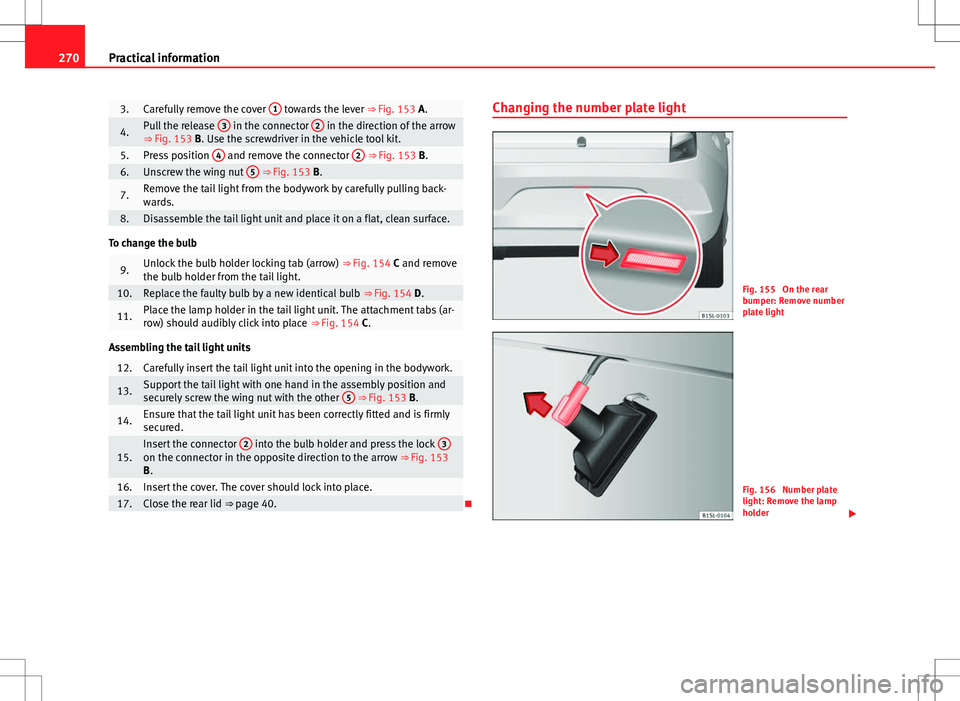
Fig. 155 On the rear
bumper: Remove number
plate light
Fig. 156 Number plate
light: Remove the lamp
holder
Page 273 of 308
271
Practical information
Only carry out the operations in the sequence indicated:
1.Always take the checklist into account and take the necessary ac-
tions ⇒ page 265.
2.With one hand, press on the number plate light from left to right
and remove it from the bumper ⇒ Fig. 155.
3.Detach the number plate light carefully from the bumper.
4.Turn the bulb holder with the bulb anticlockwise and remove it in
the direction of the arrow ⇒ Fig. 156.
5.Replace the faulty bulb by a new identical bulb.
6.Place the bulb holder in the number plate light and press in the op-
posite direction to the arrow as far as possible ⇒ Fig. 156.
7.
Insert the number plate light carefully into the left edge of the open-
ing on the bumper. During this process, check that the assembly di-
rection of the number plate light is correct, i.e. the spring must be
on the right.
8.Insert the number plate light into the bumper until it audibly clicks
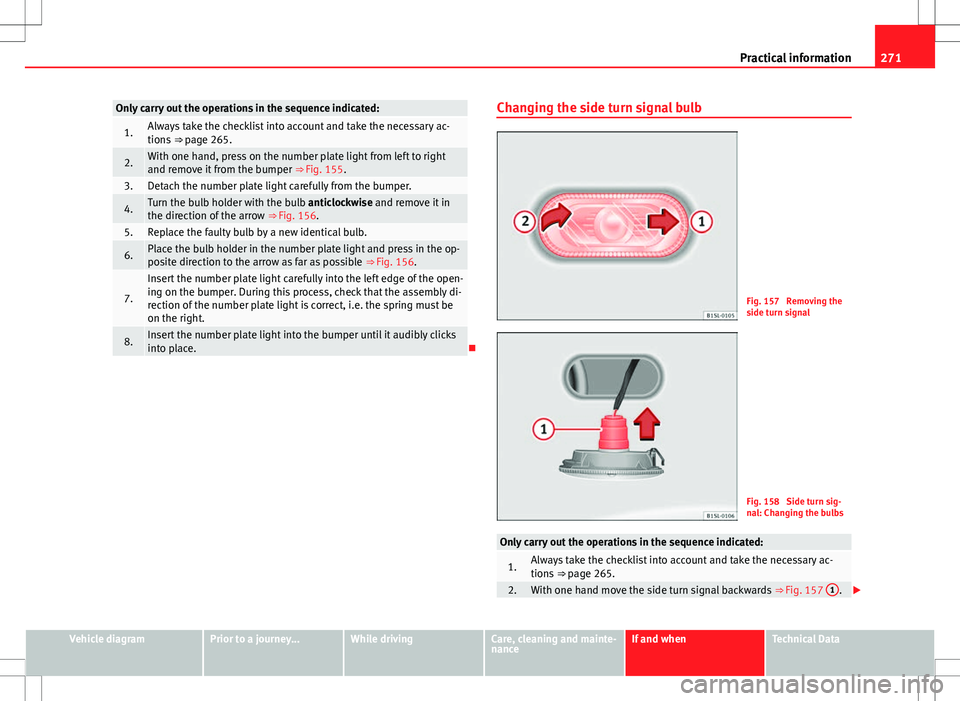
into place.Changing the side turn signal bulb
Fig. 157 Removing the
side turn signal
Fig. 158 Side turn sig-
nal: Changing the bulbs
Only carry out the operations in the sequence indicated:
1.Always take the checklist into account and take the necessary ac-
tions
⇒ page 265.
2.With one hand move the side turn signal backwards ⇒ Fig. 157 1.
Vehicle diagramPrior to a journey...While drivingCare, cleaning and mainte-
nanceIf and whenTechnical Data
Page 277 of 308
275
Practical information
Starting
5. Start the engine of the vehicle with the boosting battery and let it run at idling speed.
6. Start the engine of the vehicle with the flat battery and wait one or two minutes until the engine is “running”.
Removing the jump leads
7. Before you remove the jump leads, switch off the headlights (if they are switched on).
8. When the engine is running, disconnect the leads in reverse or- der to the details given above.
Connect the battery clamps so they have good metal-to-metal contact with
the battery terminals.
If the engine fails to start, switch off the starter after about 10 seconds and
try again after about half a minute.
WARNING
● Please note the safety warnings referring to working in the engine
compartment ⇒ page 182.
● The battery providing assistance must have the same voltage as the
flat battery (12V) and approximately the same capacity (see imprint on
battery). Failure to comply could result in an explosion.
● Never use jump leads when one of the batteries is frozen. Danger of
explosion! Even after the battery has thawed, battery acid could leak and
cause chemical burns. If a battery freezes, it should be replaced.
● Keep sparks, flames and lighted cigarettes away from batteries, dan-
ger of explosion. Failure to comply could result in an explosion.
WARNING (Continued)
● Observe the instructions provided by the manufacturer of the jump
leads.
● Do not connect the negative cable from the other vehicle directly to
the negative terminal of the flat battery. The gas emitted from the battery
could be ignited by sparks. Danger of explosion.
● Do not attach the negative cable from the other vehicle to parts of the
fuel system or to the brake line.
● The non-insulated parts of the battery clamps must not be allowed to
touch. The jump lead attached to the positive battery terminal must not
touch metal parts of the vehicle, this can cause a short circuit.
● Position the leads in such a way that they cannot come into contact
with any moving parts in the engine compartment.
● Do not bend over the batteries. This could result in chemical burns.
Note
The vehicles must not touch each other, otherwise electricity could flow as
soon as the positive terminals are connected.
Vehicle diagramPrior to a journey...While drivingCare, cleaning and mainte-
nanceIf and whenTechnical Data
Page 279 of 308
277
Practical information
Instructions for tow starting
In general, the vehicle should not be started by towing. Jump-starting is
much more preferable ⇒ page 273.
For technical reasons, the following vehicles can not be tow started:
● Vehicles with an automatic gearbox.
● If the vehicle battery is flat, it is possible that the engine control unit
does not operate correctly.
However, if your vehicle must absolutely be tow-started (manual gearbox):
● Engage the 2nd or 3rd gear.
● Keep the clutch pressed down.
● Switch on the ignition and the hazard warning lights.
● Release the clutch when both vehicles are moving.
● As soon as the engine starts, press the clutch and move the gear lever
into neutral. This helps to prevent a collision with the towing vehicle.
CAUTION
When tow-starting, fuel could enter the catalytic converter and damage it.
Notes on towing
Tow rope or tow bar
When towing, the tow bar is the safest and vehicle friendly way. You should
only use a tow rope if you do not have a tow bar.
A tow rope should be slightly elastic to avoid damage to both vehicles. It is
advisable to use a tow rope made of synthetic fibre or similarly elastic mate-
rial. Only secure the tow rope or tow bar to the tow ring or specially designed
fitting.
Towing vehicles with an automatic gearbox
Note the following for a towed vehicle:
●
Make sure the gear selector lever is in the N position.
● Do not drive faster than 50 km/h (30 mph) when towing a vehicle.
● Do not tow further than 50 km (30 miles).
● If a breakdown truck is used, the vehicle must be towed with the front
wheels raised.
Situations in which the vehicle should not be towed
In the following cases, the vehicle should not be towed but transported on a
trailer or special vehicle:
● If the vehicle gearbox does not contain lubricant due to a fault.
● If the battery is flat as the steering cannot be unlocked, as a result, the
electronic steering lock and electronic parking brake cannot be disengaged.
● If the vehicle to be towed has an automatic gearbox and the distance to
be covered is greater than 50 km (30 miles).
Note
The vehicle can only be towed if the steering lock electronic gearbox lock is
deactivated. If the vehicle has no power supply or there is an electric system
fault, the engine must be started using jump leads to deactivate the steer-
ing column electronic gearbox lock.
Vehicle diagramPrior to a journey...While drivingCare, cleaning and mainte-
nanceIf and whenTechnical Data
Page 281 of 308

279
Practical information
If the vehicle is towed, with the hazard warning lights on and the ignition
switched on, the turn signal may be used to indicate changes of direction.
Simply operate the turn signals lever as usual. Meanwhile, the hazard warn-
ing lights will go off. When the turn signal lever is returned to the rest posi-
tion, the hazard warning lights will be turned on automatically.
Notes for the driver of the towed vehicle
● Keep the ignition running to prevent the steering wheel from locking
and also to allow the use of the turn signals, horn, windscreen wipers and
washers.
● As the power assisted steering does not work if the engine is not run-
ning, you will need more strength to steer than normally.
● The brake must be depressed must harder as the brake servo does not
operate. Avoid hitting the towing vehicle.
● Note the instructions and information contained in the instruction man-
ual for the vehicle to be towed.
Notes for the driver of the towing vehicle
● Accelerate gently and carefully. Avoid sudden manoeuvres.
● Brake well in advance than usual and brake gently.
● Note the instructions and information contained in the instruction man-
ual for the vehicle to be towed.
Vehicle diagramPrior to a journey...While drivingCare, cleaning and mainte-
nanceIf and whenTechnical Data
Page 284 of 308

282Description of specifications
● Passengers.
● Total equipment.
● Roof load, included in the carrier.
WARNING
Exceeding the maximum authorised weight and the load on the axles
could cause damage to the vehicle, accidents and serious injuries.
● The real load on the axles should never exceed the maximum permit-
ted.
● The load and its distribution in the vehicle have effects on the vehicle
handling and the braking ability. Always drive at a suitable speed.
CAUTION
Distribute the load as uniformly and as low down on the vehicle as possible.
When transporting heavy objects in the luggage compartment, these
should be placed as far forward as possible or over the rear axle to have as
little influence on handling as possible.
Information on fuel consumption
The consumption and emission values indicated do not refer to one specific
vehicle. They are only to be used to compare the values of the different ve-
hicle versions. The fuel consumption and CO 2 emissions of a vehicle not on-
ly depend on the effective use of fuel. They also depend on your driving
style and other non-technical factors.
Calculation of fuel consumption
Fuel consumption and emission values are determined according to the cur-
rent version of the 715/2007/EC or 80/1268/EEC regulation and are valid
for the vehicle kerb weight. The specifications do not refer to an individualvehicle. To measure the fuel consumption, two measuring cycles are carried
out on a rolling road test bed. The test criteria are as follows:
Urban cycleMeasurement of the urban cycle starts with an engine cold
start. City driving is then simulated at between 0 and 50 km/
h (0 and 31 mph).
Road cycle
In the road cycle simulation, the vehicle undergoes frequent
acceleration and braking in all gears, as in normal everyday
driving. The road speed ranges from 0 to 120 km/h (0 and
75 mph).
CombinedThe average combined consumption is calculated with a
weighting of around 37 % for the urban cycle and 63 % for
the road cycle.
CO
2 emis-
sions of the
combinationThe exhaust gases are collected during both driving cycles
to calculate carbon dioxide emissions (urban and road). The
gas composition is then analysed to evaluate the CO 2 con-
tent and other emissions.
Note
The kerb weight may vary according to the vehicle equipment. This could
raise consumption and the CO 2 emissions slightly.
Note
In practice, consumption values could be different to the values calculated
based on the 715/2007/EC or 80/1268/EEC regulations.
Page 293 of 308
Index
A
AbroadExtended stay abroad with your vehicle . . 234
Sale of vehicle . . . . . . . . . . . . . . . . . . . . . . 234
ABS See "Braking assist systems" . . . . . . . . . . 140
Accessories . . . . . . . . . . . . . . . . . . . . . . . . 222, 223
Additional equipment . . . . . . . . . . . . . . . . . . . 224
Adjust Headlight range . . . . . . . . . . . . . . . . . . . . . . 88
Adjustment Correct sitting position . . . . . . . . . . . . . . . . 50
Front seat . . . . . . . . . . . . . . . . . . . . . . . . . . . 51
rear head restraints . . . . . . . . . . . . . . . . . . . 52
Steering wheel . . . . . . . . . . . . . . . . . . . . . . . 53
Aerial . . . . . . . . . . . . . . . . . . . . . . . . . . . . . . . . . 234
Airbag system . . . . . . . . . . . . . . . . . . . . . . . . . . . 67 Cleaning dash panel . . . . . . . . . . . . . . . . . 208
Control lamp . . . . . . . . . . . . . . . . . . . . . . . . . 69
Deactivating the front passenger airbag . . 73
Deactivating using the key switch . . . . . . . . 73
Description . . . . . . . . . . . . . . . . . . . . . . . . . . 70
Differences between front passenger airbagsystems . . . . . . . . . . . . . . . . . . . . . . . . . . . 69
Faults . . . . . . . . . . . . . . . . . . . . . . . . . . . . . 225
Front airbags . . . . . . . . . . . . . . . . . . . . . . . . 72
Function . . . . . . . . . . . . . . . . . . . . . . . . . . . . 70
Locking the vehicle after airbag deploy- ment . . . . . . . . . . . . . . . . . . . . . . . . . . . . . . 33 Repairs . . . . . . . . . . . . . . . . . . . . . . . . . . . . 225
Side airbags . . . . . . . . . . . . . . . . . . . . . . . . . 75
Use of child seats . . . . . . . . . . . . . . . . . . . . . 73
Vehicle care . . . . . . . . . . . . . . . . . . . . . . . . 208
Air conditioner Air recirculation . . . . . . . . . . . . . . . . . . . . . 169
Air vents . . . . . . . . . . . . . . . . . . . . . . . . . . . 169
Faults . . . . . . . . . . . . . . . . . . . . . . . . . . . . . 168
set . . . . . . . . . . . . . . . . . . . . . . . . . . . . . . . . 167
Things to note . . . . . . . . . . . . . . . . . . . . . . . 168
User instructions . . . . . . . . . . . . . . . . . . . . 167
Air conditioning system . . . . . . . . . . . . . . . . . . 164 Controls . . . . . . . . . . . . . . . . . . . . . . . . . . . . 166
Air recirculation . . . . . . . . . . . . . . . . . . . . . . . . 169 How it works . . . . . . . . . . . . . . . . . . . . . . . . 169
switch off . . . . . . . . . . . . . . . . . . . . . . . . . . 169
temporarily switch off . . . . . . . . . . . . . . . . 169
Air vents . . . . . . . . . . . . . . . . . . . . . . . . . . . . . . 169
Alternator . . . . . . . . . . . . . . . . . . . . . . . . . . . . . 194
Aluminium care . . . . . . . . . . . . . . . . . . . . . . . . 202
Anodized surfaces . . . . . . . . . . . . . . . . . . . . . . 202
Anti-lock brake system (ABS) . . . . . . . . . . . . . 140
Anti-puncture kit . . . . . . . . . . . . . . . . . . . . . . . . 256
Anti-theft locking bolts . . . . . . . . . . . . . . . . . . 250
Anti-theft wheel locking bolts . . . . . . . . . . . . . 251
Antifreeze . . . . . . . . . . . . . . . . . . . . . . . . . . . . . 190
Antitheft bolts . . . . . . . . . . . . . . . . . . . . . . . . . . 247
Ashtray . . . . . . . . . . . . . . . . . . . . . . . . . . . . . . . 115 ASR
see Brake assist systems . . . . . . . . . . . . . . 140
Assistance systems Brake assist system (BAS) . . . . . . . . . . . . . 140
Cruise control system (CCS) . . . . . . . . . . . . 152
Electronic differential lock system (EDL) . 140
electronic stability control (ESC) . . . . . . . . 139
Hill hold . . . . . . . . . . . . . . . . . . . . . . . . . . . 160
Optical parking system (OPS) . . . . . . . . . . 150
Parking aid . . . . . . . . . . . . . . . . . . . . . . . . . 150
Parking distance warning system . . . . . . . 150
Safety Assist (City Safety Assist function) 155
Traction control system (ASR) . . . . . . . . . . 140
Traction Control (TC) . . . . . . . . . . . . . . . . . . 140
Assisted braking systems . . . . . . . . . . . . . . . . 139
Assist systems Anti-lock brake system (ABS) . . . . . . . . . . 140
Audible warnings Control and warning lamps . . . . . . . . . . . . . 15
Lights . . . . . . . . . . . . . . . . . . . . . . . . . . . . . . 86
Seat belt not fastened . . . . . . . . . . . . . . . . . 58
Speed . . . . . . . . . . . . . . . . . . . . . . . . . . . . . . 23
Automatic belt retainer . . . . . . . . . . . . . . . . . . . 65
Automatic car wash . . . . . . . . . . . . . . . . . . . . . 198
Automatic consumer disconnection . . . . . . . . 196
automatic gearbox . . . . . . . . . . . . . . . . . . . . . . 124
Automatic gearbox . . . . . . . . . . . . . . . . . . . . . . 129 driving . . . . . . . . . . . . . . . . . . . . . . . . . . . . . 131
Ignition key lock . . . . . . . . . . . . . . . . . . . . . 121
Kickdown . . . . . . . . . . . . . . . . . . . . . . . . . . 131
291
Index