airbag Seat Mii 2012 User Guide
[x] Cancel search | Manufacturer: SEAT, Model Year: 2012, Model line: Mii, Model: Seat Mii 2012Pages: 308, PDF Size: 4.13 MB
Page 57 of 308
55
Ensuring you are correctly and safely seated
Seat functions Introduction
Additional information and warnings:
● Adjust the seat position ⇒ page 48
● Seat belts ⇒ page 57
● Airbag system ⇒ page 67
● Child seats (accessories) ⇒ page 76
● Exterior mirrors ⇒ page 95
WARNING
Inappropriate use of the seat functions can cause severe injuries.
● Assume the proper sitting position before your trip and remain in it
throughout. This also applies to the other occupants.
● Keep hands, fingers, feet and other limbs away from the seat operat-
ing and adjustment radius.
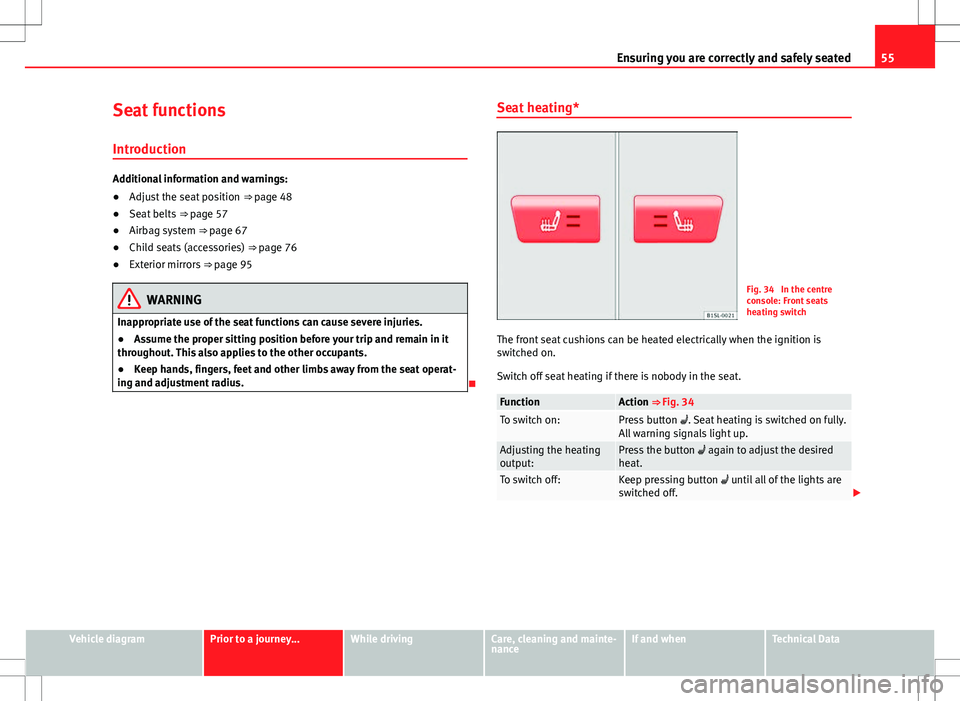
Seat heating*
Fig. 34 In the centre
console: Front seats
heating switch
The front seat cushions can be heated electrically when the ignition is
switched on.
Switch off seat heating if there is nobody in the seat.
FunctionAction ⇒ Fig. 34To switch on:Press button . Seat heating is switched on fully.
All warning signals light up.
Adjusting the heating
output:Press the button again to adjust the desired
heat.
To switch off:Keep pressing button until all of the lights are
switched off.
Vehicle diagramPrior to a journey...While drivingCare, cleaning and mainte-
nanceIf and whenTechnical Data
Page 59 of 308

57
Ensuring you are correctly and safely seated
Seat belts
Introduction
Check the condition of all the seat belts at regular intervals. If you notice
that the belt webbing, fittings, retractor mechanism or buckle of any of the
belts is damaged, the belt must be replaced immediately by a Specialised
workshop ⇒
. The Specialised workshop must use the appropriate spare
parts corresponding to the vehicle, the equipment and the model year. SEAT
recommends visiting a Technical Service.
Additional information and warnings:
● Adjust the seat position ⇒ page 48
● Airbag system ⇒ page 67
● Child seats (accessories) ⇒ page 76
● Accessories, parts replacement, repairs and modifications ⇒ page 222
WARNING
Unbuckled or badly buckled seat belts increase the risk of severe or even
fatal injuries. The seat belt cannot offer its full protection if it is not fas-
tened and used correctly.
● Seats belts are the most effective ways of reducing the risk of sus-
taining severe or fatal injuries In the event of an accident. Correctly fas-
ten seat belts when the vehicle is in motion to protect the driver and all
vehicle occupants.
● Before each trip, every occupant in the vehicle occupants must sit
properly, correctly fasten the seat belt belonging to his or her seat and
keep it fastened throughout the trip. This also applies to other occupants
when driving in town.
WARNING (Continued)
● When travelling, children must be secured in the vehicle with a child
restraint system suitable for their weight and height and with the seat
belts correctly fastened ⇒ page 76.
● Instruct your passengers to fasten their seat belts properly before
driving off.
● Insert the latch plate into the buckle for the appropriate seat and en-
sure it is engaged. Using the latch plate in the buckle of another seat will
not protect you properly and may cause severe injuries.
● Do not allow liquids or foreign bodies to enter the buckle fastenings.
This could damage the buckles and seat belts.
● Never unbuckle your seat belt when the vehicle is moving.
● Never allow more than one passenger to share the same seat belt.
● Never hold children or babies on your lap sharing the same seat belt.
● Loose, bulky clothing (such as a jacket) impairs the proper fit and
function of the seat belt.
WARNING
It is extremely dangerous to drive using damaged seat belts and could re-
sult in serious injury or loss of life.
● Avoid damaging the seat belt by jamming it in the door or the seat
mechanism.
● If the fabric or other parts of the seat belt are damaged, the seat belts
could break in the event of an accident or sudden braking.
● Always have damaged seatbelts replaced immediately by seat belts
approved for the vehicle in question by SEAT. Seat belts which have been
worn in an accident and stretched must be replaced by a Specialised
workshop. Renewal may be necessary even if there is no apparent dam-
age. The belt anchor points should also be checked.
● Never attempt to repair, modify or remove a seat belt yourself. All re-
pairs to seat belts, retractors and buckles must be carried out by a Speci-
alised workshop.
Vehicle diagramPrior to a journey...While drivingCare, cleaning and mainte-
nanceIf and whenTechnical Data
Page 62 of 308

60Ensuring you are correctly and safely seated
At speeds of 30 km/h (18 mph) to 50 km/h (30 mph), the forces acting on
bodies in a collision can easily exceed one tonne (1000 kg or
2.205 pounds). At greater speed these forces are even higher.
This example applies not only to frontal accidents, but to all accidents and
collisions.
Dangers of not using the seat belt
Fig. 39 A driver not
wearing a seat belt is
thrown forward violently
Fig. 40 The unbelted
rear seat passenger is
thrown forward violently,
hitting the driver wearing
a seat belt
Many people believe that the occupants can protect themselves with their
hands in a minor collision. This is false!
Even at low speeds, the forces acting on the body in a collision are so great
that it is not possible to brace oneself with just one's arms and hands. In a
frontal collision, unbelted vehicle occupants are thrown forward and will
make violent contact with the steering wheel, dash panel, windscreen or
whatever else is in the way ⇒ Fig. 39.
The airbag system is not a substitute for seat belts. When triggered, airbags
provide only additional protection. Airbags do not deploy in all types of ac-
cident. All occupants (including the driver) must be wearing seat belts prop-
erly during the trip, even if the vehicle is equipped with airbag systems.
This will reduce the risk of critical or fatal injuries in the event of an accident
– regardless of whether an airbag is fitted for the seat.
The airbag is only deployed once. To achieve the best possible protection,
the seat belt must always be worn properly so that you will be protected in
accidents in which no airbag is deployed. Vehicle occupants not wearing
belts could be thrown from the vehicle and sustain even more severe or fa-
tal injuries.
Page 63 of 308

61
Ensuring you are correctly and safely seated
It is also important for the rear passengers to wear seat belts properly, as
they could otherwise be thrown forward violently in an accident. Rear seat
passengers who do not use seat belts endanger not only themselves but al-
so the driver and other occupants ⇒ Fig. 40.
Seat belt protection
Fig. 41 Drivers with
properly worn seat belts
will not be thrown for-
ward in the event of sud-
den braking
Wearing a correctly fastened seat belt can significantly change the situa-
tion. Properly worn seat belts hold the vehicle occupants in the correct sit-
ting positions and substantially reduce the kinetic energy in the event of an
accident. Seat belts also help to prevent uncontrolled movements that
could lead to severe injuries. In addition, properly worn seat belts reduce
the danger of being thrown from the vehicle ⇒ Fig. 41.
Vehicle occupants wearing their seat belts correctly benefit greatly from the
ability of the belts to absorb kinetic energy. The front crumple zones and
other passive safety features (such as the airbag system) are also designed
to absorb the kinetic energy generated in a collision. Taken together, all
these features reduce the energy released and decrease the risk of injury. Our examples describe frontal collisions. Of course, properly worn seat belts
substantially reduce the risk of injury in all other types of accidents. This is
why it is so important to fasten seat belts before every trip, even when just
driving “around the corner”. Ensure that your passengers wear their seat
belts as well.
Accident statistics have shown properly worn seat belts to be an effective
means of considerably reducing the risk of severe injury and improving the
chances of survival in a serious accident. Furthermore, properly worn seat
belts improve the protection provided by deployed airbags in the event of
an accident. For this reason, wearing a seat belt is required by law in most
countries.
Although your vehicle is equipped with airbags, fasten and wear the seat
belts. The front airbags, for example, are only triggered in some frontal acci-
dents. The front airbags will not be triggered during minor frontal collisions,
minor side collisions, rear collisions, rolls or accidents in which the airbag
trigger threshold value in the control unit is not exceeded.
Therefore, you should always wear your seat belt and ensure that vehicle
occupants have fastened their seat belts properly before you drive off!
Using seat belts
Checklist
Use of the seat belt ⇒
:
¥ Check the condition of all the seat belts at regular intervals.
¥ Keep the seat belts clean.
¥ Keep the seat belt web, the latch plate and the buckle free of foreign
bodies and liquids.
¥ Do not jam or damage the seat belt or the latch plate when closing
the door, for example.
Vehicle diagramPrior to a journey...While drivingCare, cleaning and mainte-
nanceIf and whenTechnical Data
Page 67 of 308

65
Ensuring you are correctly and safely seated
Note
If your physical constitution prevents you from maintaining the correct posi-
tion of the belt webbing, contact a Specialised workshop for help with any
special devices to ensure the optimum protection of the seat belt and air-
bag. SEAT recommends visiting a Technical Service.
Automatic belt retainer, belt tension device, belt tension
limiter
Seat belts are part of the vehicle safety concept ⇒ page 67 and consist of
the following important functions:
Automatic belt retainer
Every seat belt is equipped with an automatic belt retainer on the shoulder
belt. If the belt is pulled slowly or during normal driving, the system allows
for total freedom of movement on the shoulder belt. However, during sud-
den braking, during travel in mountains or bends and during acceleration,
the automatic belt retainer on the seat belt is locked is pulled quickly.
Belt tension devices
The seat belts for the front occupants are equipped with belt tensioners.
Sensors will trigger the belt tension devices during severe head-on, lateral
and rear collisions and retract and tighten the seat belts. If the seat belt is
loose, it is retracted to reduce the forwards movement of occupants or
movement in the direction of the collision. The belt tension device works in
combination with the airbag system. The belt tension device will not be trig-
gered in the event of the vehicle overturning if the side airbags are not de-
ployed.
If the belt tension device is triggered, a fine dust is produced. This is normal
and it is not an indication of fire in the vehicle. Belt tension limiter
The belt tension limiter reduces the force of the seat belt on the body in the
event of an accident.
Note
The relevant safety requirements must be observed when the vehicle or
components of the system are scrapped. These requirements are known to
specialised workshops ⇒ page 65.
Service and disposal of belt tension devices
If you work on the belt tension devices or remove and install other parts of
the vehicle when performing other repair work, the seat belt may be dam-
aged. The consequence may be that, in the event of an accident, the belt
tension devices function incorrectly or not at all.
Observe regulations so that the effectiveness of the belt tension device is
not reduced and that removed parts do not cause any injuries or environ-
mental pollution. These requirements are known to qualified dealerships.
WARNING
Improper handling and home-made repairs of seat belts, automatic belt
retainers and tension devices increase the risk of sustaining severe or fa-
tal injuries. The belt tension device may fail to trigger or may trigger in
the wrong circumstances.
● Never attempt to repair, adjust or remove or install parts of the belt
tension devices or seat belts. Any work must be performed by a special-
ised workshop only ⇒ page 222.
● Do not repair belt tension devices and automatic belt retainers. Re-
place them.
Vehicle diagramPrior to a journey...While drivingCare, cleaning and mainte-
nanceIf and whenTechnical Data
Page 68 of 308

66Ensuring you are correctly and safely seated
For the sake of the environment
Airbag modules and belt tensioner may contain perchlorate. Observe the le-
gal requirements for their disposal.
Page 69 of 308

67
Ensuring you are correctly and safely seated
Airbag system Introduction
Front airbags have been installed for both driver and passenger. The front
airbags can also protect the chest and head of driver and passenger if the
seats, seat belts head restraints and, for the driver, the steering wheel are
correctly adjusted and used. Airbags are considered as additional safety
equipment. An airbag cannot replace the safety belt, which must be worn at
all times, even in front seats where front airbags have been installed.
Additional information and warnings:
● Driving tips ⇒ page 25
● Correct sitting position ⇒ page 48
● Seat belts ⇒ page 57
● Child seats (accessories) ⇒ page 76
● Care and cleaning of the vehicle interior ⇒ page 205
● Accessories, parts replacement, repairs and modifications ⇒ page 222
● Notes for the user ⇒ page 233
WARNING
Never exclusively trust the airbag system as a means of protection.
● Even when triggered, airbag protection is only auxiliary.
● The airbags provide the best protection when the seat belts are prop-
erly fastened, thus reducing the risk of sustaining injuries ⇒ page 57,
Seat belts.
● Before each trip, every occupant must sit properly, correctly fasten
the seat belt belonging to his or her seat and keeping it fastened
throughout the trip. This rule is valid for all occupants.
WARNING
Occupants sitting in the front of the vehicle must never carry any objects
in the deployment space between them and the airbags, as this increa-
ses the risk of sustaining injuries if the airbag is triggered. This modifies
the airbag deployment space or the objects may fly uncontrollably and
hit your body.
● Never carry objects in your hand or on your lap while the vehicle is in
motion.
● Never transport objects on the front passenger seat. In the event of
sudden braking and manoeuvres, the objects may end up in the airbag
deployment space and fly uncontrollably around the interior if the airbag
is activated.
● Occupants of the front and rear seats must never carry any other peo-
ple, pets or objects in the deployment space between them and the air-
bags. Make sure children and other passengers also respect this recom-
mendation.
WARNING
The airbag system provides protection for one accident only. If they have
been deployed, replace them.
● Ensure deployed airbags and the system components involved are im-
mediately replaced with new, SEAT-approved components for the vehicle.
● Have any repairs or modifications carried out at a Specialised work-
shop. Specialised workshops have the necessary tools, diagnostics
equipment, repair information and qualified personnel.
● Never fit recycled or reused airbag components in your vehicle.
● Never modify the airbag system components.
Vehicle diagramPrior to a journey...While drivingCare, cleaning and mainte-
nanceIf and whenTechnical Data
Page 70 of 308

68Ensuring you are correctly and safely seated
WARNING
If the airbags are triggered, a fine dust is produced. This is normal and it
is not an indication of fire in the vehicle.
● This fine dust may irritate the skin and eyes and cause breathing dif-
ficulties, particularly in people suffering from or who have suffered from
asthma or other illnesses of the respiratory tract. To reduce breathing dif-
ficulties, get out of the vehicle and open and doors and windows to
breath in fresh air.
● Should you touch the dust, wash your hands and face using a mild
soap and water before you eat.
● Prevent the dust from affecting the eyes or open wounds.
● Rinse your eyes with water if you have dust in them.
WARNING
Solvents cause the surfaces of the airbag modules to become porous. If
an airbag is accidentally triggered, the detachment of plastic parts could
cause serious injury.
● Never clean the dash panel and the surfaces of the airbag modules
with cleaners containing solvents.
Page 71 of 308

69
Ensuring you are correctly and safely seated
Types of front passenger airbag systems
There are 2 different SEAT front passenger airbag systems:ABCharacteristics of the passenger
front airbag without disabling.Characteristics of the front passen-
ger front airbag that can be disabled
manually ⇒ page 73.
- * Control lamp on the instru-
ment panel.– Control lamp on the instrument
panel.
- Front passenger airbag located in
dash panel.- PASSENGER AIR BAG control
lamp on the dash panel.
- Key switch in the glove compart-
ment on the front passenger side of
the dash panel.
- Front passenger airbag located in
dash panel.
- Description: airbag system- Description: airbag system with
front passenger airbag disabling.
- Description: airbag system without
disabling.* Control lamps
Fig. 46 Control lamp for
disabling the front pas-
senger airbag on the
dash panel
lights
upLocationPossible causeSolution
Instrument
panelFault in airbag system
and seat belt tension-
ers.Have the system checked
immediately by a Special-
ised workshop.
Dash panel.
Fault in the airbag
system.Have the system checked
immediately by a Special-
ised workshop.
Front passenger air-
bag disabled.Check whether the airbag
should remain disabled.
Several warning and control lamps light up for a few seconds when the igni-
tion is switched on while a test of the function is being carried out. They will
switch off after a few seconds.
If the PASSENGER AIR BAG warning lamp does not remain lit or if it is
lit together with the control lamp on the instrument panel and the front
passenger airbag is disabled, there may be a fault in the airbag system
⇒
.
Vehicle diagramPrior to a journey...While drivingCare, cleaning and mainte-
nanceIf and whenTechnical Data
Page 72 of 308

70Ensuring you are correctly and safely seated
WARNING
In the event of a fault in the airbag system, the airbag may not trigger
correctly, may fail to trigger or may even trigger unexpectedly, leading to
severe or fatal injuries.
● Have the airbag system checked immediately by a Specialised work-
shop.
● Never mount a child seat in the front passenger seat or remove the
mounted child seat! The front passenger airbag may deploy during an ac-
cident in spite of the fault.
CAUTION
Always pay attention to any lit lamps and to the corresponding descriptions
and instructions to avoid damage to the vehicle.
Description and function of the airbag
The airbag can protect vehicle occupants in the event of an accidents, cush-
ioning the movement of the occupants in the direction of the collision in
frontal and side accidents.
Deployed airbags fill with a propellant gas. This causes the airbag covers to
break and the airbags to deploy extremely quickly in their entire deploy-
ment space within fractions of a second. When an occupant with the seat
belt properly fastened puts pressure on the inflated airbag, the propellant
gas escapes to absorb the force of the impact and slow the movement. This
reduces the risk of severe or fatal injuries. Airbag deployment does not
mean that other types of injury such as swelling, bruising and skin injuries
can be ruled out. Upon deployment of the airbag, friction can cause the
generation of heat.
Airbags do not protect the arms or the lower part of the body. The most important factors for triggering the airbag are the type of accident,
the angle of impact, the vehicle speed and the characteristics of the object
the vehicle hits. Therefore, airbags are not triggered every time the vehicle
is visibly damaged.
The activation of the airbag system depends on the magnitude of the decel-
eration of the vehicle caused by a collision, which registers through an elec-
tronic control unit. If the deceleration magnitude value is below the refer-
ence value programmed in the control unit, the airbags will not deploy de-
spite serious damage being caused to the vehicle by the accident. Damage
suffered by the vehicle, reparation costs or absence of damage suffered
from the accident are not indications of whether an airbag should have
been deployed. Due to the varying nature of collision situations, it is impos-
sible to define a speed range of the vehicle and reference values. For this
reason, it is not possible to cover all types of collisions and collision angles
resulting in the deployment of the airbag. Factors necessary for the airbag
to be deployed can be, the characteristics of the object (hard or soft)
against which the vehicle collides, the collision angle and the vehicle
speed.
Airbags act in conjunction with three-point seat belts in the event of certain
accidents, when the vehicle deceleration rate is severe enough to trigger
the airbags. Airbags only deploy once and only under certain circumstan-
ces. Seat belts remain present to offer protection in situations where air-
bags are not triggered or where they have already deployed. For example,
when a vehicle hits another after an initial collision or is hit by another vehi-
cle.
The airbag system is an integral part of the vehicle's passive safety system.
The airbag system can only work effectively when the occupants are wear-
ing their seat belts correctly and have adjusted the head restraints properly
⇒ page 48.
Vehicle safety components
The following safety equipment makes up the vehicle safety design to re-
duce the risk of severe and fatal injuries. Depending on the vehicle equip-
ment, some equipment may not be fitted in the vehicle or may not be avail-
able in some markets.