cooling Seat Mii 2012 User Guide
[x] Cancel search | Manufacturer: SEAT, Model Year: 2012, Model line: Mii, Model: Seat Mii 2012Pages: 308, PDF Size: 4.13 MB
Page 192 of 308

190In the engine compartment
WARNING
If the warning lamps are ignored, the vehicle may stall in traffic, or may
cause accidents and severe injuries.
● Always observe any lit warning lamps.
● Never ignore the warning lamps.
● Stop the vehicle safely as soon as possible.
CAUTION
Failure to heed the warning lamps when they appear may result in faults in
the vehicle.
Note
On the display of the Portable Navigation System (supplied by SEAT)
⇒ page 222 an engine coolant temperature gauge can be seen.
Engine coolant specifications
The engine cooling system is supplied from the factory with a specially trea-
ted mixture of water and, at least, 40 % of the additive G 13 (TLVW 774 J).
The engine coolant additive is recognisable by its purple colour. This mix-
ture of water and additive gives the necessary frost protection down to
-25 °C (-13 °F) and protects the light alloy parts of the cooling system
against corrosion. It also prevents scaling and considerably raises the boil-
ing point of the coolant.
To protect the engine cooling system, the percentage of additive must al-
ways be at least 40 %, even in warm climates where anti-freeze protection is
not required.
If greater frost protection is required in very cold climates, the proportion of
additive can be increased. However, the percentage of additive should not exceed 60 %, as this would reduce the frost protection and, in turn, de-
crease the cooling capacity.
When the coolant is topped up, use a mixture of
distilled water and, at
least, 40 % of the G 13 or G 12 plus-plus (TL-VW 774 G) additive (both are
purple) to obtain an optimum anticorrosion protection ⇒
. The mixture of
G 13 with G 12 plus (TL-VW 774 F), G 12 (red) or G 11 (green-blue) engine
coolants will significantly reduce the anticorrosion protection and should,
therefore be avoided ⇒
.
WARNING
If there is not enough anti-freeze in the coolant system, the engine may
fail leading to serious damage.
● Please make sure that the percentage of additive is correct with re-
spect to the lowest expected ambient temperature in the zone in which
the vehicle is to be used.
● When the outside temperature is very low, the coolant could freeze
and the vehicle would be immobilised. In this case, the heating would
not work either and inadequately dressed passengers could die of cold.
CAUTION
The original additives should never be mixed with coolants which are not
approved by SEAT. Otherwise, you run the risk of causing severe damage to
the engine and the engine cooling system.
● If the fluid in the expansion tank is not purple but is, for example,
brown, this indicates that the G 13 additive has been mixed with an inade-
quate coolant. The coolant must be changed as soon as possible if this is
the case! This could result in serious faults and engine damage.
For the sake of the environment
Coolants and additives can contaminate the environment. If any fluids are
spilled, they should be collected and correctly disposed of, with respect to
the environment.
Page 194 of 308

192In the engine compartment
WARNING
Hot vapours and coolant can cause serious burns.
● Never open the coolant expansion tank if steam or coolant is coming
from the engine compartment. Wait until you cannot see or hear any
steam or coolant escaping.
● Always wait until the engine has completely cooled before very care-
fully opening the expansion tank cap. Contact with hot elements of the
engine can cause skin burns.
● Once the engine has cooled, follow the instructions below before
opening the bonnet:
–Engage the handbrake and place the gear selector lever in P or the
gear stick in neutral.
– Remove the key from the ignition.
– Keep children away from the engine compartment and never leave
them unsupervised.
● When the engine is warm or hot, the cooling system is pressurised.
Do not unscrew the cap on the coolant expansion tank when the engine
is hot. Otherwise, coolant may spray out under pressure causing burns
and serious injury.
–Carefully and slowly unscrew the cap anticlockwise, gently press-
ing down on it.
– Always protect your face, hands and arms from hot coolant and
steam using a large, thick cloth.
● When refilling liquids, avoid spilling them on parts of the engine and
the exhaust system. Spilled liquids could cause a fire. Under specific cir-
cumstances, the ethylene glycol can catch fire.CAUTION
● Top up with distilled water only. Any other type of water may lead to con-
siderable rusting in the engine due to its chemical components. This could
consequently damage the engine. If you have not used distilled water but
another type of water to top up the coolant, a Specialised workshop must
immediately replace all of the fluid in the engine cooling system.
● Only top up coolant to the top level of the marked area ⇒ Fig. 113. Oth-
erwise the excess coolant will be forced out of the cooling system when the
engine is hot, causing damage.
● If a lot of liquid coolant has been lost, wait for the engine to cool down
completely before adding coolant. Extensive coolant loss is an indication of
leaks in the engine cooling system. Have the engine cooling system inspec-
ted immediately by a Specialised workshop. Otherwise engine damage may
occur.
● When refilling or changing service liquids, ensure that you put the liq-
uids into the right tank. Making a mistake when refilling could cause seri-
ous malfunctions and damage the engine!
Page 226 of 308

224Vehicle care and maintenance
Fluids and consumables
All vehicle fluids and consumables , such as notched belts, tyres, coolant
fluids, engine oils, spark plugs and batteries are continually being devel-
oped. Therefore all fluids and consumables should be changed at a Special-
ised workshop. Technical Services are permanently informed of any modifi-
cations.
WARNING
The incorrect use or handling of fluids or consumables may result in acci-
dent, serious injury, burns or intoxication.
● Therefore, fluids must always be stored closed in their original con-
tainer.
● Never store fluids in empty food containers or bottles as other people
may accidentally drink the fluid.
● Keep all fluids and consumables out of reach of children.
● Read and observe the information and warnings given on the fluid
containers.
● Only work in the open air or in well-ventilated zones, when using
products which give off harmful vapours.
● Never use fuel, turpentine, engine oil, acetone or any other volatile
liquid in the maintenance of the vehicle. These are toxic and highly flam-
mable. They could lead to fire or explosions!
CAUTION
● Only use appropriate fluids. Never mix the fluids. Using the wrong fluids
could cause serious malfunctions and engine damage!
● Accessories and other components mounted in front of the air inlet re-
duce the cooling effect of the coolant. If the engine is running under great
strain in high outside temperatures, it could overheat.
For the sake of the environment
Leaking fluids could pollute the environment. Collect any spilt fluids in suit-
able containers and dispose of in accordance with legislation and with re-
spect for the environment.
Repairs and technical changes
When performing repairs and technical modifications, SEAT's directives
must be observed! ⇒
Unauthorised modifications to the electronic components or software in the
vehicle may cause malfunctions. Due to the way the electronic components
are linked together in networks, other indirect systems may be affected by
the faults. This may significantly affect the vehicle's performance, increase
component wear and could mean that the vehicle registration documents
are no longer valid.
Your SEAT Official Service cannot be held liable for any damage caused by
technical modifications or repairs performed incorrectly.
The SEAT Official Service does not accept liability for damage resulting from
technical modifications or repairs performed incorrectly; neither is the SEAT
warranty valid in these cases.
SEAT recommends you have any technical modifications or repairs per-
formed at a SEAT Official Service and that you use genuine SEAT spare
parts ®
.
Vehicles with special accessories and equipment
The manufacturers of additional equipment guarantee that the equipment
complies with applicable laws and regulations with respect to the environ-
ment, in particular Directives 2000/53/CE and 2003/11/CE. The first direc-
tive governs the disposal of end-of-life vehicles while the second refers to
the restrictions on the marketing and use of certain dangerous substances
and preparations.
Page 250 of 308
248Practical information
Wheel trims
Introduction
Additional information and warnings:
● Caring for and cleaning the vehicle exterior ⇒ page 197
● Vehicle tools ⇒ page 246
● Change wheel ⇒ page 250
● Tire Mobility Set ⇒ page 256
WARNING
If the wheel trims are not appropriate or not fitted correctly, they could
cause major accidents or damage.
● Incorrectly mounted wheel trims may come off while driving and en-
danger other road users.
● Damaged trims must never be mounted on the wheels.
● Always ensure that the brake ventilation and cooling is not cut off or
blocked. This is also valid if hubcaps are fitted later. If there is not
enough air, you may require significantly longer braking distances.
CAUTION
Remove and remount wheel trims taking care to avoid damage to the vehi-
cle. Hubcaps
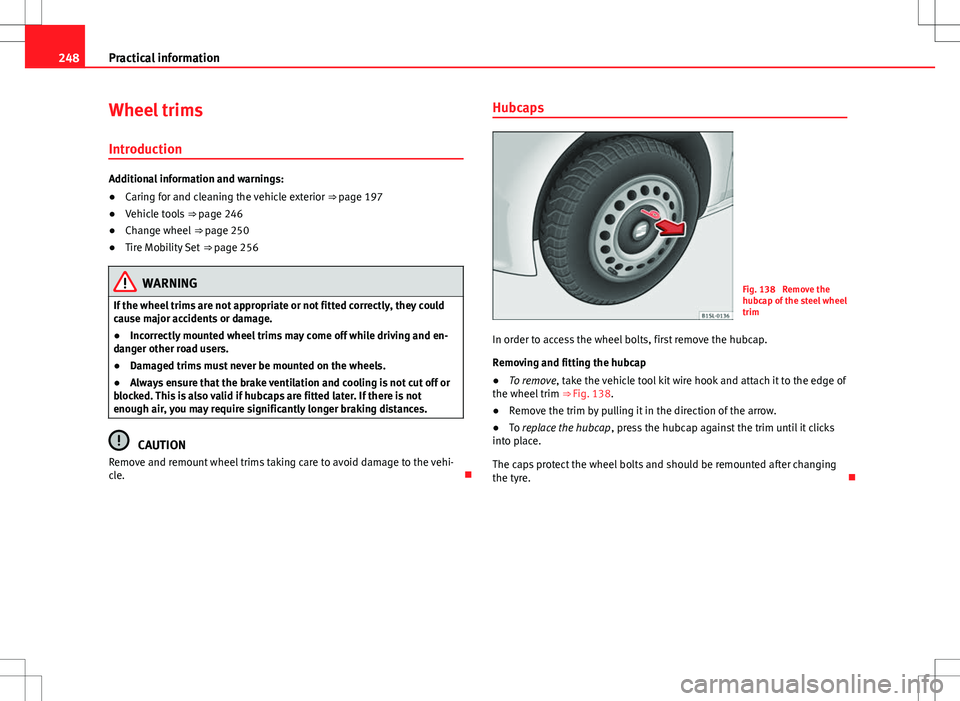
Fig. 138 Remove the
hubcap of the steel wheel
trim
In order to access the wheel bolts, first remove the hubcap.
Removing and fitting the hubcap
● To remove, take the vehicle tool kit wire hook and attach it to the edge of
the wheel trim ⇒ Fig. 138.
● Remove the trim by pulling it in the direction of the arrow.
● To replace the hubcap , press the hubcap against the trim until it clicks
into place.
The caps protect the wheel bolts and should be remounted after changing
the tyre.