change wheel Seat Mii 2012 Owner's Guide
[x] Cancel search | Manufacturer: SEAT, Model Year: 2012, Model line: Mii, Model: Seat Mii 2012Pages: 308, PDF Size: 4.13 MB
Page 253 of 308

251
Practical information
Preparations for changing a wheel
Check list
Before changing a wheel, complete the following operations in the order
given ⇒
:
1. In the event of a flat tyre, park the vehicle a safe distance from traffic and on suitable ground.
2. Apply the handbrake firmly ⇒ page 134.
3. Automatic gearbox: move the selector lever to position P
⇒ page 124.
4. Stop the engine and remove the key from the ignition ⇒ page 119.
5. Manual gearbox: Select a gear ⇒ page 124.
6. Have all vehicle occupants get out of the vehicle and wait in a safe place (for example, behind the safety barrier).
7. Chock the wheel opposite the wheel being changed with a stone or similar object.
8. If the luggage compartment is full: take the baggage out of the vehi- cle.
9. Remove the spare wheel or the temporary spare wheel and the vehi- cle tool kit from the luggage compartment.
10. Remove the wheel trims ⇒ page 248.
WARNING
Failure to follow the checklist prepared for your own safety could lead to
accidents and severe injuries.
● Always complete the operations given in the checklist and observe
the general rules of safety.
Wheel bolts
Fig. 141 Changing the
wheel: Slacken the wheel
bolts
Fig. 142 Changing the
wheel: Tyre valve
1 and
position of anti-theft
wheel locking bolt 2
Only use the tool supplied with the vehicle to loosen the wheel bolts.
Loosen the wheel bolts only about one turn before raising the vehicle with
the jack.
Vehicle diagramPrior to a journey...While drivingCare, cleaning and mainte-
nanceIf and whenTechnical Data
Page 255 of 308
253
Practical information
Raising the vehicle with the jack
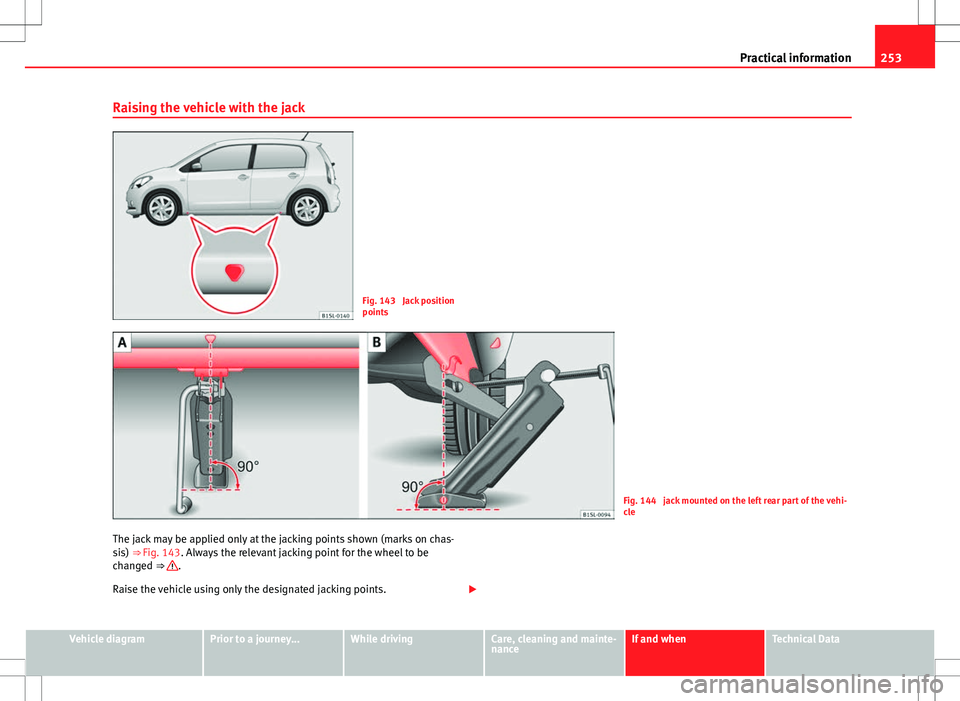
Fig. 143 Jack position
points
Fig. 144 jack mounted on the left rear part of the vehi-
cle
The jack may be applied only at the jacking points shown (marks on chas-
sis) ⇒ Fig. 143. Always the relevant jacking point for the wheel to be
changed ⇒
.
Raise the vehicle using only the designated jacking points.
Vehicle diagramPrior to a journey...While drivingCare, cleaning and mainte-
nanceIf and whenTechnical Data
Page 256 of 308
254Practical information
Check list
For your own safety and that of other passengers, the following points
should be observed in the order given ⇒
:
1. Select a suitable flat and firm surface for raising the vehicle.
2. Switch off the engine, engage a gear (manual gearbox) or place the selector lever in position P ⇒ page 124 and engage the handbrake
⇒ page 134.
3. Block the wheel diagonally opposite the wheel being changed with collapsible wheel chocks or other suitable objects.
4. Loosen the wheel bolts on the wheel to be changed ⇒ page 251.
5. Look below the vehicle for the jacking point ⇒ Fig. 143 closest to the
tyre which has to be changed.
6. Raise the jack with the handle until it can be inserted below the jack- ing point.
7. Ensure that the foot of the jack is firmly on the ground and that it is placed, at a vertical angle, immediately below the lifting point on the
vehicle ⇒ Fig. 144.
8. Straighten the jack and continue raising it using the handle until the claw holds the vertical reinforcement beneath the vehicle ⇒ Fig. 144.
9. Raise the vehicle until the wheel is clear of the ground.
WARNING
If the vehicle is not correctly raised, it could fall off the jack causing seri-
ous injury. Please observe the following rules to minimise the risk of in-
jury:
● You should only use a jack approved by SEAT for your vehicle. Other
jacks, even those approved for other SEAT models, might slip out of
place.
WARNING (Continued)
● The ground should be firm and flat. If the ground is sloped or soft
then the vehicle could slip and fall off the jack. If necessary, support the
jack on a wide solid base.
● If the ground is slippery (for example, on tiles), place a non-slip sur-
face (for example a floor mat) beneath the jack to avoid slipping.
● Only fit the jack at the prescribed jacking points. The claw of the jack
should grip the reinforcement nerve on the underbody ⇒ Fig. 144.
● You should never have any limbs beneath a raised vehicle which is
only supported by a jack.
● If you have to work underneath the vehicle, you must use suitable
stands additionally to support the vehicle, there is a risk of accident!.
● Never raise the vehicle if it is tilting to one side or the engine is run-
ning.
● Never start the engine when the vehicle is raised. The vehicle may
come loose from the jack due to the engine vibrations.
WARNING
Failure to follow the checklist prepared for your own safety could lead to
accidents and severe injuries.
● Always complete the operations given in the checklist and observe
the general rules of safety.
Page 257 of 308

255
Practical information
Changing a wheel
Fig. 145 Changing the
wheel: loosen wheel
bolts with the socket at
the end of the wheel
brace
Removing the wheel
● Please observe the check list ⇒ page 251.
● Loosen the wheel bolts ⇒ page 251.
● Jacking up the vehicle ⇒ page 253.
● Using the hexagonal socket in the wheel brace ⇒ Fig. 145, unscrew the
slackened wheel bolts and place them on a clean surface.
● Take off the wheel.
How to use the spare wheel or temporary spare wheel
Check the direction of rotation of the tyre ⇒ page 218, Tyre code.
● Place the spare wheel or temporary spare wheel into position.
● Replace the wheel bolts and tighten slightly using the hexagonal socket
on the end of the wheel brace.
● To tighten the anti-theft locking wheel bolts use the corresponding
adaptor.
● Lower the vehicle with the jack. ●
Tighten all of the wheel bolts clockwise ⇒
. Tighten the bolts in diago-
nal pairs (not in a circle).
● Put the caps, trim or full hubcap back on ⇒ page 248.
WARNING
If the wheel bolts are not treated suitably or not tightened to the correct
torque then this could lead to loss of vehicle control and to a serious ac-
cident.
● All the wheel bolts and hub threads should be clean and free of oil
and grease. The wheel bolts should be easily tightened to the correct tor-
que.
● The hexagonal socket in the wheel brace should be used for turning
wheel bolts only. Do not use it to loosen or tighten the wheel bolts.
After changing the wheel
● Clean the vehicle tools, if necessary and put them away in the luggage
compartment foam holder ⇒ page 246.
● Store the spare wheel, the temporary spare wheel or the changed wheel
securely in the luggage compartment.
● Have the tightening torque of the wheel bolts checked as soon as possi-
ble with a torque wrench ⇒ page 252.
● Have the flat tyre replaced as quickly as possible.
Vehicle diagramPrior to a journey...While drivingCare, cleaning and mainte-
nanceIf and whenTechnical Data
Page 278 of 308
276Practical information
Towing and tow starting
Introduction
When towing or tow starting, respect the legal requirements.
For technical reasons, it is not possible to tow a vehicle if the battery is flat.
Additional information and warnings:
● Exterior detail ⇒ page 6
● Electronic power control and exhaust gases purification system
⇒ page 236
WARNING
A vehicle with a flat battery should never be towed.
● Never remove the key from the ignition lock. Otherwise, the steering
wheel lock could suddenly lock. Then the vehicle will be uncontrollable.
You may lose control of the vehicle and there is a risk of serious accident.
WARNING
When towing the vehicle, the handling and braking efficiency change
considerably. Please observe the following instructions to minimise the
risk of serious accidents and injury:
● As the driver of the vehicle being towed:
– The brake must be depressed must harder as the brake servo does
not operate. Always remain aware to avoid collision with the towing
vehicle.
– More strength is required at the steering wheel as the power steer-
ing does not operate when the engine is switched off.
● As the driver of the towing vehicle:
– Accelerate gently and carefully.
– Avoid sudden braking and manoeuvres.
– Brake well in advance than usual and brake gently.
CAUTION
● Carefully fit and remove the towing ring and its cover to avoid damage to
the vehicle (for example, paintwork).
● When towing, fuel could enter the catalytic converter and cause dam-
age!
Note
Fitting a towline anchorage to the rear bumper is not possible. The vehicle is
not suitable for towing other vehicles.
Page 281 of 308

279
Practical information
If the vehicle is towed, with the hazard warning lights on and the ignition
switched on, the turn signal may be used to indicate changes of direction.
Simply operate the turn signals lever as usual. Meanwhile, the hazard warn-
ing lights will go off. When the turn signal lever is returned to the rest posi-
tion, the hazard warning lights will be turned on automatically.
Notes for the driver of the towed vehicle
● Keep the ignition running to prevent the steering wheel from locking
and also to allow the use of the turn signals, horn, windscreen wipers and
washers.
● As the power assisted steering does not work if the engine is not run-
ning, you will need more strength to steer than normally.
● The brake must be depressed must harder as the brake servo does not
operate. Avoid hitting the towing vehicle.
● Note the instructions and information contained in the instruction man-
ual for the vehicle to be towed.
Notes for the driver of the towing vehicle
● Accelerate gently and carefully. Avoid sudden manoeuvres.
● Brake well in advance than usual and brake gently.
● Note the instructions and information contained in the instruction man-
ual for the vehicle to be towed.
Vehicle diagramPrior to a journey...While drivingCare, cleaning and mainte-
nanceIf and whenTechnical Data
Page 294 of 308

malfunction . . . . . . . . . . . . . . . . . . . . . . . . 132
starting on a slope . . . . . . . . . . . . . . . . . . . 131
stopping on a slope . . . . . . . . . . . . . . . . . . 131
Axle loads . . . . . . . . . . . . . . . . . . . . . . . . . . . . . 281
B
BAS see Brake assist systems . . . . . . . . . . . . . . 140
Battery Change in the vehicle key . . . . . . . . . . . . . . 31
discharge . . . . . . . . . . . . . . . . . . . . . . . . . . . 33
Discharging . . . . . . . . . . . . . . . . . . . . . . . . 241
See Vehicle battery . . . . . . . . . . . . . . . . . . 193
Battery acid . . . . . . . . . . . . . . . . . . . . . . . . . . . . 195
Before consulting a specialised workshop . . . 238
Belt tension device . . . . . . . . . . . . . . . . . . . . . . . 65 Disposal . . . . . . . . . . . . . . . . . . . . . . . . . . . . 65
Service and disposal . . . . . . . . . . . . . . . . . . 65
Belt tension limiter . . . . . . . . . . . . . . . . . . . . . . . 65
Bench . . . . . . . . . . . . . . . . . . . . . . . . . . . . . . . . 101
Bonnet Closing . . . . . . . . . . . . . . . . . . . . . . . . . . . . 183
Opening . . . . . . . . . . . . . . . . . . . . . . . . . . . 183
Bottle capacity Windscreen washer water bottle . . . . . . . . . 94
Brake . . . . . . . . . . . . . . . . . . . . . . . . . . . . . . . . . 134 Brake servo . . . . . . . . . . . . . . . . . . . . . . . . . 138
Brake assist system (BAS) . . . . . . . . . . . . . . . . 140
Brake fluid . . . . . . . . . . . . . . . . . . . . . . . . . . . . 141 Specification . . . . . . . . . . . . . . . . . . . . . . . . 141 Brakes
Assisted braking systems . . . . . . . . . . . . . 139
Brake fluid . . . . . . . . . . . . . . . . . . . . . . . . . 141
Brake fluid level . . . . . . . . . . . . . . . . . . . . . 142
Brake pads . . . . . . . . . . . . . . . . . . . . . . . . . 137
Changing the brake fluid . . . . . . . . . . . . . . 142
Control lamp . . . . . . . . . . . . . . . . . . . . . . . . 135
Emergency brake indicator in case of sud-den braking . . . . . . . . . . . . . . . . . . . . . . . 241
Handbrake . . . . . . . . . . . . . . . . . . . . . . . . . 136
Running-in brake pads . . . . . . . . . . . . . . . . 137
Warning lamp . . . . . . . . . . . . . . . . . . . . . . . 135
Brake servo . . . . . . . . . . . . . . . . . . . . . . . . 138, 139
Brake system Malfunction . . . . . . . . . . . . . . . . . . . . . . . . 138
Brake systems . . . . . . . . . . . . . . . . . . . . . . . . . 139
Breakdown Securing the vehicle . . . . . . . . . . . . . . . . . 240
Bulb fault See changing bulbs . . . . . . . . . . . . . . . . . . 264
C
Capacities Fuel tank . . . . . . . . . . . . . . . . . . . . . . . . . . . 290
Care See "Care of your vehicle" . . . . . . . . . . . . . 197
Vehicle interior . . . . . . . . . . . . . . . . . . . . . . 205
Care of your vehicle Exterior . . . . . . . . . . . . . . . . . . . . . . . . . . . . 197
Caring for paintwork . . . . . . . . . . . . . . . . . . . . . 202
Carrier system . . . . . . . . . . . . . . . . . . . . . . . . . . 104 Catalytic converter . . . . . . . . . . . . . . . . . . . . . . 237
Control lamp . . . . . . . . . . . . . . . . . . . . . . . . 236
Malfunctions . . . . . . . . . . . . . . . . . . . . . . . . 236
CCS . . . . . . . . . . . . . . . . . . . . . . . . . . . . . . . . . . 152
central locking Deadlock . . . . . . . . . . . . . . . . . . . . . . . . . . . . 37
Central locking . . . . . . . . . . . . . . . . . . . . . . . . . . 33 Central locking button . . . . . . . . . . . . . . . . . 36
locking and unlocking from the exterior . . . 34
locking and unlocking from the inside . . . . 36
Central locking system After airbag deployment . . . . . . . . . . . . . . . 33
Description . . . . . . . . . . . . . . . . . . . . . . . . . . 33
Opening doors individually . . . . . . . . . . . . . 33
Centre console . . . . . . . . . . . . . . . . . . . . . . . 12, 13 Bottom part . . . . . . . . . . . . . . . . . . . . . . . . . . 13
Top part . . . . . . . . . . . . . . . . . . . . . . . . . . . . . 12
Changing Windscreen wiper blades . . . . . . . . . . . . . 201
Changing a wheel . . . . . . . . . . . . . . . . . . . . . . 250 Changing a wheel . . . . . . . . . . . . . . . . . . . 255
Preparations . . . . . . . . . . . . . . . . . . . . . . . . 251
Raising the vehicle . . . . . . . . . . . . . . . . . . . 253
Wheel bolts . . . . . . . . . . . . . . . . . . . . . . . . . 251
Changing bulbs . . . . . . . . . . . . . . . . . . . . . . . . 264 Checklist . . . . . . . . . . . . . . . . . . . . . . . . . . . 265
Front bumper . . . . . . . . . . . . . . . . . . . . . . . 267
Initial operations . . . . . . . . . . . . . . . . . . . . 265
in the headlights . . . . . . . . . . . . . . . . . . . . 266
Number plate light . . . . . . . . . . . . . . . . . . . 270
Rear lights . . . . . . . . . . . . . . . . . . . . . . . . . . 269
Sea changing bulbs . . . . . . . . . . . . . . . . . . 264
292 Index