lights Seat Mii 2012 Owner's Guide
[x] Cancel search | Manufacturer: SEAT, Model Year: 2012, Model line: Mii, Model: Seat Mii 2012Pages: 308, PDF Size: 4.13 MB
Page 93 of 308

91
Lights and visibility
Window wash/wipe system
Introduction
Additional information and warnings:
● Exterior detail ⇒ page 6
● Air recirculation mode ⇒ page 164
● Working in the engine compartment ⇒ page 180
● Caring for and cleaning the vehicle exterior ⇒ page 197
WARNING
Water from the windscreen washer water bottle may freeze on the wind-
screen if it does not contain enough anti-freeze, reducing forward visibili-
ty.
● In winter, ensure the windscreen washer contains enough anti-freeze.
● In cold conditions, you should not use the wash / wipe system unless
you have warmed the windscreen with the ventilation system. The anti-
freeze could freeze on the windscreen and reduce visibility.
WARNING
Worn or dirty wiper blades reduce visibility and increase the risk of acci-
dent and serious injury.
● Always replace damaged or worn blades or blades which do not clean
the windscreen correctly.
CAUTION
In icy conditions, always check that the wiper blades are not frozen to the
glass before using the windscreen wipers for the first time. In cold weather,
it may help to leave the vehicle parked with the windscreen wipers in serv-
ice position ⇒ page 93. Windscreen wiper lever
Fig. 60 Using the wind-
screen wipers
Fig. 61 Using the rear
window wipers
Vehicle diagramPrior to a journey...While drivingCare, cleaning and mainte-
nanceIf and whenTechnical Data
Page 94 of 308

92Lights and visibility
Move the lever to the required position ⇒ :
0Windscreen wiper off.
1Windscreen interval wipe.
2Slow wipe.
3Continuous wipe.
4Brief wipe - short wipe. Hold the lever down for more time to
increase the wipe frequency.
5Automatic wipe for cleaning windscreens with the lever up.
6Interval wipe for rear window. The wiper will clean the win-
dow approximately every 6 seconds.
7Automatic wipe for cleaning rear windows with the lever
pressed.
CAUTION
If the ignition is switched off while the windscreen wipers are on, the wind-
screen wipers carry on wiping at the same level when the ignition is switch-
ed back on. Ice, snow and other obstacles may damage the windscreen wip-
er and the wiper motor.
● If necessary, remove snow and ice from the windscreen wipers before
starting your journey.
● Carefully lift the frozen windscreen wipers from the glass. SEAT recom-
mends a de-icer spray for this operation.
Note
The windscreen wipers will only work when the ignition is switched on.
Note
The interval wipe speed varies according to the vehicle speed. The faster
the vehicle is moving, the more often the windscreen is cleaned.
Note
The rear wiper is automatically switched on when the windscreen wiper is
connected and the vehicle is in reverse gear.
Windscreen wiper functions
Windscreen wiper performance in different situations:If the vehicle is at a stand-
still:The activated position provisionally changes
to the previous position.
For the interval wipe:The intervals between wipes vary according
to the speed of the vehicle. The higher the
vehicle speed the shorter the intervals.
Note
The windscreen wiper will try to wipe away any obstacles that are on the
windscreen. The windscreen wiper will stop moving if the obstacle blocks its
path. Remove the obstacle and switch the windscreen wiper back on again.
Page 95 of 308

93
Lights and visibility
Windscreen wipers service position
Fig. 62 Windscreen wip-
ers in service position
The wiper arms can be raised when the wipers are in service position
⇒ Fig. 62. To place the windscreen wipers in the service position, proceed
as follows:
● The bonnet must be closed
⇒ page 180.
● Switch the ignition on and off.
● Press the windscreen wiper lever downwards briefly
⇒ Fig. 60 4
.
Before driving, always lower the wiper arms. When the ignition is switched
on, the windscreen wiper arms return to their initial position upon activating
the windscreen wiper lever.
Lifting and returning windscreen wiper arms
● Place the windscreen wiper arms in the service position
⇒
.
● Only hold the windscreen wiper arms at the point where the blade is
fixed.
CAUTION
● To prevent damage to the bonnet and the windscreen wiper arms, only
leave them in the service position.
● Before driving, always lower the windscreen wiper arms.
Checking and topping up the windscreen washer bottle
with water
Fig. 63 In the engine
compartment: wind-
screen washer bottle top
Check the water level in the windscreen washer bottle regularly and top up
as required.
● Open the bonnet ⇒ page 180.
● The washer bottle is marked with the symbol on the lid ⇒ Fig. 63.
● Check there is enough water in the bottle.
Vehicle diagramPrior to a journey...While drivingCare, cleaning and mainte-
nanceIf and whenTechnical Data
Page 96 of 308

94Lights and visibility
● To top up, mix water with a window cleaner recommended by SEAT ⇒
.
Please follow the instructions for use found on the packaging.
● In cold weather, a special antifreeze should also be added to prevent
the water from freezing ⇒
.
Bottle capacity
The washer bottle capacity is approximately. 3 litres.
WARNING
Never mix an unsuitable antifreeze or other similar products with the
windscreen washer water. A greasy layer may be formed on the wind-
screen which will impair visibility.
● Use clean water with a window cleaner recommended by SEAT.
● If necessary, add a suitable antifreeze to the water bottle.
CAUTION
● Do not mix cleaning products recommended by SEAT with other prod-
ucts. This could lead to flocculation and may block the windscreen washer
jets.
● When topping up service fluids, make absolutely certain that you fill the
fluids into the correct reservoirs. Using the wrong fluids could cause serious
malfunctions and engine damage!
Page 97 of 308
95
Lights and visibility
Rear vision mirror
Introduction
Additional information and warnings:
● Exterior detail ⇒ page 6
● Braking, stopping and parking ⇒ page 134
Rear vision mirror
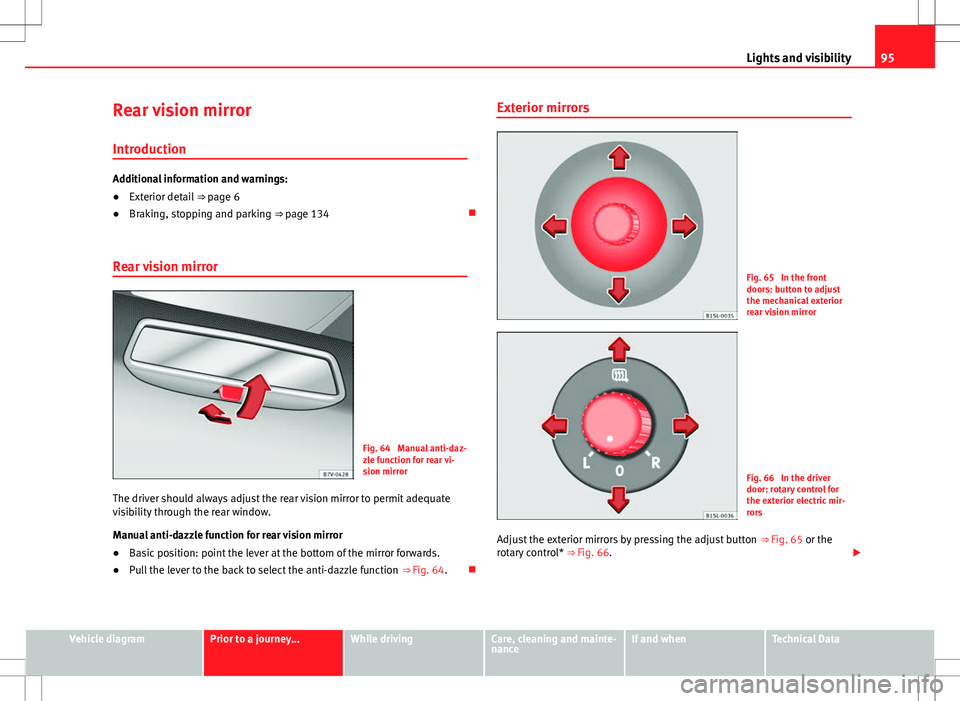
Fig. 64 Manual anti-daz-
zle function for rear vi-
sion mirror
The driver should always adjust the rear vision mirror to permit adequate
visibility through the rear window.
Manual anti-dazzle function for rear vision mirror
● Basic position: point the lever at the bottom of the mirror forwards.
● Pull the lever to the back to select the anti-dazzle function
⇒ Fig. 64. Exterior mirrors
Fig. 65 In the front
doors: button to adjust
the mechanical exterior
rear vision mirror
Fig. 66 In the driver
door: rotary control for
the exterior electric mir-
rors
Adjust the exterior mirrors by pressing the adjust button ⇒ Fig. 65 or the
rotary control* ⇒ Fig. 66.
Vehicle diagramPrior to a journey...While drivingCare, cleaning and mainte-
nanceIf and whenTechnical Data
Page 98 of 308

96Lights and visibility
Turn the rotary control ⇒ Fig. 66 to the required position:
Switch on the exterior mirror heating.
Adjust the left-hand exterior rear vision mirror by turning the
knob forwards, backwards, to the left or to the right.
Zero position. Exterior mirror heating switched off, it is not
possible to adjust the exterior mirrors.
Adjust the right-hand exterior rear vision mirror by turning the
knob forwards, backwards, to the left or to the right.
Folding in the exterior mirrors and returning them to their original position
is possible through a mechanical system. Carefully fold the exterior rear vi-
sion mirror casing towards the side window or pull it away from the window
until it clicks into place.
WARNING
Fold and unfold the exterior rear vision mirror, taking care to avoid inju-
ries.
● Only fold or unfold the exterior rear vision mirror when there is no-
one in the way of the mirror.
● When moving the rear vision mirror, take care not to trap fingers be-
tween the mirror and the mirror bracket.
WARNING
Failure to correctly estimate the distance of the vehicle behind could lead
to serious accident.
● Rear-view convex or aspheric mirrors increase the field of vision, how-
ever objects appear smaller and further away in the mirrors.
● The use of these mirrors to estimate the distance to the next vehicle
when changing lane is imprecise and could result in serious accident.
WARNING (Continued)
● If possible, use the rear vision mirror to estimate distances to vehi-
cles behind you or in other circumstances.
● Make sure that the rear visibility is adequate.
For the sake of the environment
The exterior mirror heating should be switched off when it is no longer nee-
ded. Otherwise, it is an unnecessary fuel consumption.
Note
In the event of faults, the electric exterior mirrors can be adjusted manually
by pressing the edge of the mirror surface.
Page 126 of 308

124Starting, changing gears, parking
Changing gear
Introduction
When reverse gear is engaged and the ignition is switched on the following
takes place:
● Reverse lights light up.
● The rear wiper blade performs one movement when the windscreen wip-
er is activated.
● If necessary, connect the parking distance warning system.
Additional information and warnings:
● Detail of the centre console ⇒ page 12
● Instruments ⇒ page 17
● Braking, stopping and parking ⇒ page 134
● Parking distance warning system ⇒ page 149
● Electronic power control and exhaust gases purification system
⇒ page 236
● Emergency locking and unlocking ⇒ page 243
WARNING
Rapid acceleration can cause loss of traction and skidding, especially on
slippery ground. This could cause loss of control of the vehicle resulting
in an accident and considerable damage.
● Use rapid acceleration only when visibility, weather, road conditions
and traffic permit.
WARNING
Do not allow the brakes to “rub” for a prolonged period of time, or press
the brake pedal frequently or for long periods of time. Continuous brak-
ing heats up the brakes. This could significantly reduce braking power,
increase braking distance or even result in the total failure of the brake
system.
CAUTION
● Never make the brakes “slip” by pressing the pedal gently, if it is not
really necessary to brake. This will increase wear.
● Reduce speed or reduce the gear when faced with steep and long
slopes. This allows you to use the engine braking effect and to reduce the
strain on the brake system. Otherwise, the brakes may overheat and fail.
Only use the brakes to reduce speed or to stop.
Page 134 of 308

132Starting, changing gears, parking
Automatic gearbox malfunction
Back-up programme
When automatic gearbox warning and control lamps light up on the instru-
ment panel, there may be a system malfunction ⇒ page 124. In the event of
some faults the automatic gearbox functions using a backup programme.
When the backup programme is activated, it is possible to drive the vehicle,
however, at low speeds and within a selected range of gears.
With the manual gearbox, in some cases it is not possible to drive with all
the gears.
In all cases the automatic gearbox must be checked at a specialised work-
shop.
Automatic gearbox overheating
The automatic gearbox can overheat with a prolonged start up, or when
stopping and starting continuously. This overheating is displayed with a
warning lamp in the instrument panel. Additionally, an audible warning
can be heard. Stop and let the gearbox cool ⇒
.
The vehicle moves forward or back despite having selected a gear range
When the vehicle does not move in the required direction, the system may
not have the gear range correctly engaged. Press the brake pedal and en-
gage the gear range again. If the vehicle still does not move in the required
direction, there is a system malfunction. Seek specialist assistance and
have the system checked.
CAUTION
● When the gearbox is displayed as overheating for the first time, the vehi-
cle must be parked safely or must be driven at a speed of more than 20 km/
h (12 mph).
● When the warning lamp lights up and the audible warning is sounded,
the vehicle must be parked safely and the engine switched off. Let the gear-
box cool down.
● To prevent damage to the gearbox, driving must only be continued when
the warning lamps are no longer lit up. While the gearbox is overheated,
starting up and driving at walking speed should be avoided.
Recommended gear display
In some vehicles, the recommended gear for reducing fuel consumption is
displayed on the instrument panel display:
DisplayMeaning
Optimum gear.
Recommendation to change up a gear.
Recommendation to change down a gear.
WARNING
The recommended gear display is intended as a guideline only; it should
never replace the driver's attention to driving carefully.
● Responsibility for selecting the correct gear for each situation contin-
ues to lie with the driver, for example when overtaking or climbing a hill.
Page 137 of 308
135
Starting, changing gears, parking
Warning and control lamps
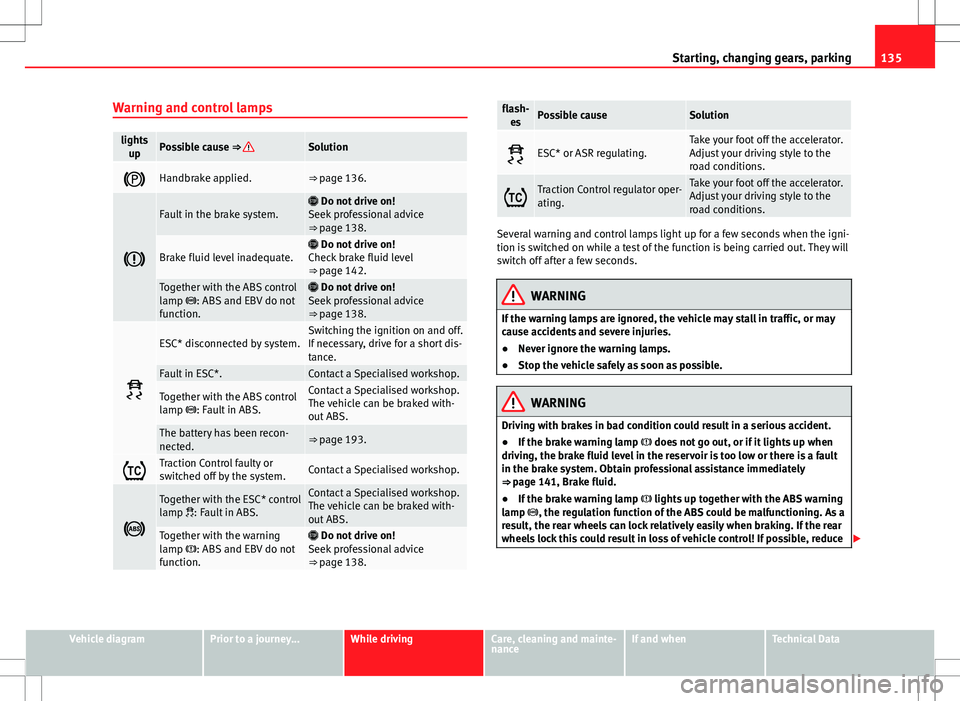
lights upPossible cause ⇒ Solution
Handbrake applied.⇒ page 136.
Fault in the brake system. Do not drive on!
Seek professional advice
⇒ page 138.
Brake fluid level inadequate. Do not drive on!
Check brake fluid level
⇒ page 142.
Together with the ABS control
lamp : ABS and EBV do not
function. Do not drive on!
Seek professional advice
⇒ page 138.
ESC* disconnected by system.Switching the ignition on and off.
If necessary, drive for a short dis-
tance.
Fault in ESC*.Contact a Specialised workshop.
Together with the ABS control
lamp : Fault in ABS.Contact a Specialised workshop.
The vehicle can be braked with-
out ABS.
The battery has been recon-
nected.⇒ page 193.
Traction Control faulty or
switched off by the system.Contact a Specialised workshop.
Together with the ESC* control
lamp : Fault in ABS.Contact a Specialised workshop.
The vehicle can be braked with-
out ABS.
Together with the warning
lamp : ABS and EBV do not
function. Do not drive on!
Seek professional advice
⇒ page 138.
flash- esPossible causeSolution
ESC* or ASR regulating.Take your foot off the accelerator.
Adjust your driving style to the
road conditions.
Traction Control regulator oper-
ating.Take your foot off the accelerator.
Adjust your driving style to the
road conditions.
Several warning and control lamps light up for a few seconds when the igni-
tion is switched on while a test of the function is being carried out. They will
switch off after a few seconds.
WARNING
If the warning lamps are ignored, the vehicle may stall in traffic, or may
cause accidents and severe injuries.
● Never ignore the warning lamps.
● Stop the vehicle safely as soon as possible.
WARNING
Driving with brakes in bad condition could result in a serious accident.
● If the brake warning lamp does not go out, or if it lights up when
driving, the brake fluid level in the reservoir is too low or there is a fault
in the brake system. Obtain professional assistance immediately
⇒ page 141, Brake fluid.
● If the brake warning lamp lights up together with the ABS warning
lamp , the regulation function of the ABS could be malfunctioning. As a
result, the rear wheels can lock relatively easily when braking. If the rear
wheels lock this could result in loss of vehicle control! If possible, reduce
Vehicle diagramPrior to a journey...While drivingCare, cleaning and mainte-
nanceIf and whenTechnical Data
Page 138 of 308

136Starting, changing gears, parking
WARNING (Continued)
your speed and drive carefully to a Specialised workshop close by to
check the brake system. During the following journey, avoid sudden brak-
ing and manoeuvres.
● If the ABS warning lamp does not go out or if it lights while driv-
ing, the ABS is malfunctioning. The vehicle can only be stopped using
normal braking without ABS. The protection provided by the ABS is not
available. Visit a specialised workshop as soon as possible.
CAUTION
Failure to heed the warning lamps when they appear may result in faults in
the vehicle.
Handbrake
Fig. 90 Between the
front seats: Handbrake Using the handbrake
●
Pull firmly in an upwards direction on the handbrake lever while press-
ing the button.
● The handbrake is applied when the control lamp lights up on the in-
strument panel ⇒ page 135 when the ignition is switched on.
Releasing the handbrake
● Pull gently in an upwards direction on the handbrake lever and press the
lock button ⇒ Fig. 90 (arrow).
● Move the handbrake lever downwards keeping the lock button pressed.
WARNING
The incorrect use of the handbrake may result in a serious accident.
● Never use the handbrake to brake the vehicle except in an emergency.
The braking distance is considerably longer, because braking is only ap-
plied to the rear wheels. Always use the foot brake.
● Never drive with the handbrake gently applied. This can overheat the
brake, affecting the brakes system. This also causes premature wear on
the rear brake pads.
● Never accelerate from the engine compartment with the engine run-
ning and a gear engaged. The vehicle could move, even if the handbrake
is applied.
Note
If the vehicle moves at a speed superior to 6 km/h (4 mph) with the hand-
brake applied, an audible warning is sounded.
Parking
When parking your vehicle, all legal requirements should be observed.